THERAPY WORKSHEET
Citation:
Are the results of this single preventive or therapeutic trial valid?
Was the assignment of patients to
treatments randomised?
Was the randomization list concealed?
Were the groups similar at the start of the
trial apart from the experimental therapy?
Was follow-up of patients sufficiently
long and complete?
Were all patients analysed in the groups to
which they were randomised?
Who was kept “blind” to treatment?
Were the groups treated equally, apart
from the experimental treatment?
Are the valid results of this randomised trial important?
What is the magnitude of the treatment
effect?
How precise is the estimate of the
treatment effect?
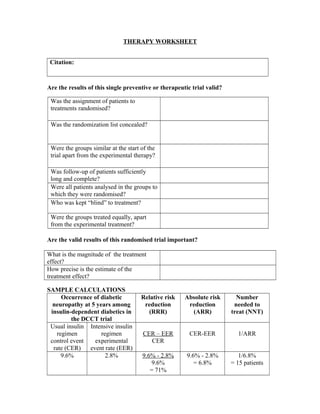
SAMPLE CALCULATIONS
Occurrence of diabetic
neuropathy at 5 years among
insulin-dependent diabetics in
the DCCT trial
Relative risk
reduction
(RRR)
Absolute risk
reduction
(ARR)
Number
needed to
treat (NNT)
Usual insulin
regimen
control event
rate (CER)
Intensive insulin
regimen
experimental
event rate (EER)
CER – EER
CER
CER-EER 1/ARR
9.6% 2.8% 9.6% - 2.8%
9.6%
= 71%
9.6% - 2.8%
= 6.8%
1/6.8%
= 15 patients
95% CI *⇒ 4.4% to 9.2% 11 to 23
* 95% confidence interval (CI) on an NNT = 1/(limits on the CI of its ARR) =
YOUR CALCULATIONS
Relative risk
reduction
(RRR)
Absolute risk
reduction
(ARR)
Number
needed to
treat (NNT)
CER EER CER – EER
CER
CER-EER 1/ARR
95% CI ⇒
Can you apply this valid, important evidence about therapy in caring for your
patient?
Do these results apply to our patient?
Is our patient so different from those in
the study that its results cannot apply?
Is the treatment feasible in our setting?
What are our patient’s potential benefits and harms from the therapy?
Method I: f Risk of the outcome in our patient, relative
to patients in the trial.
Expressed as a decimal: ______
NNT/f = ______ / ______ = ______
(NNT for patients like ours)
Method II: 1/(PEER x RRR) Our patient’s expected event rate if they
received the control treatment (PEER)
= ______
1/(PEERxRRR) = 1/________ = ______
(NNT for patients like ours)
Are our patient’s values and preferences satisfied by the regimen and its
consequences?
Do we and our patient have a clear
assessment of their values and
preferences?
Are they met by this regimen and its
consequences?
%4.2
711
972.0028.0
730
904.096.0
96.1
#
)1(
#
)1(
96.1 ±=




 ×
+




 ×
±=




 −×
+




 −×
±
ofExperPts
EEREER
tsofControlP
CERCER
Additional notes:

Ther worksheet

  • 1.
    THERAPY WORKSHEET Citation: Are theresults of this single preventive or therapeutic trial valid? Was the assignment of patients to treatments randomised? Was the randomization list concealed? Were the groups similar at the start of the trial apart from the experimental therapy? Was follow-up of patients sufficiently long and complete? Were all patients analysed in the groups to which they were randomised? Who was kept “blind” to treatment? Were the groups treated equally, apart from the experimental treatment? Are the valid results of this randomised trial important? What is the magnitude of the treatment effect? How precise is the estimate of the treatment effect? SAMPLE CALCULATIONS Occurrence of diabetic neuropathy at 5 years among insulin-dependent diabetics in the DCCT trial Relative risk reduction (RRR) Absolute risk reduction (ARR) Number needed to treat (NNT) Usual insulin regimen control event rate (CER) Intensive insulin regimen experimental event rate (EER) CER – EER CER CER-EER 1/ARR 9.6% 2.8% 9.6% - 2.8% 9.6% = 71% 9.6% - 2.8% = 6.8% 1/6.8% = 15 patients
  • 2.
    95% CI *⇒4.4% to 9.2% 11 to 23 * 95% confidence interval (CI) on an NNT = 1/(limits on the CI of its ARR) = YOUR CALCULATIONS Relative risk reduction (RRR) Absolute risk reduction (ARR) Number needed to treat (NNT) CER EER CER – EER CER CER-EER 1/ARR 95% CI ⇒ Can you apply this valid, important evidence about therapy in caring for your patient? Do these results apply to our patient? Is our patient so different from those in the study that its results cannot apply? Is the treatment feasible in our setting? What are our patient’s potential benefits and harms from the therapy? Method I: f Risk of the outcome in our patient, relative to patients in the trial. Expressed as a decimal: ______ NNT/f = ______ / ______ = ______ (NNT for patients like ours) Method II: 1/(PEER x RRR) Our patient’s expected event rate if they received the control treatment (PEER) = ______ 1/(PEERxRRR) = 1/________ = ______ (NNT for patients like ours) Are our patient’s values and preferences satisfied by the regimen and its consequences? Do we and our patient have a clear assessment of their values and preferences? Are they met by this regimen and its consequences? %4.2 711 972.0028.0 730 904.096.0 96.1 # )1( # )1( 96.1 ±=      × +      × ±=      −× +      −× ± ofExperPts EEREER tsofControlP CERCER
  • 3.