Introduced by
Dr. Nermin Osman
Assistant Lecturer of Medical Statistics,
MRI, Alexandria University
United Nations System Staff College
Intern-UNITAR
nerminosman@unssc.org
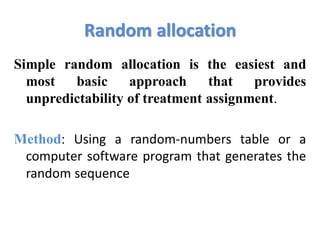
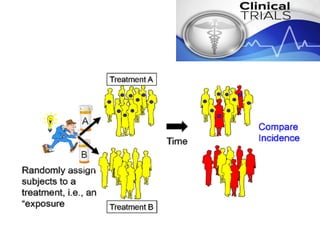
Random allocation
Simple random allocation is the easiest and
most basic approach that provides
unpredictability of treatment assignment.
Method: Using a random-numbers table or a
computer software program that generates the
random sequence
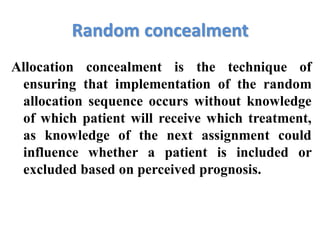
Random concealment
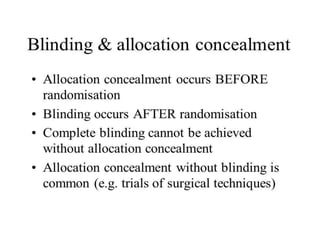
Allocation concealment is the technique of
ensuring that implementation of the random
allocation sequence occurs without knowledge
of which patient will receive which treatment,
as knowledge of the next assignment could
influence whether a patient is included or
excluded based on perceived prognosis.
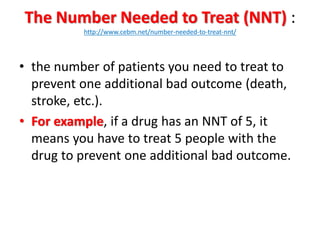
The Number Needed to Treat (NNT) :
http://www.cebm.net/number-needed-to-treat-nnt/
• the number of patients you need to treat to
prevent one additional bad outcome (death,
stroke, etc.).
• For example, if a drug has an NNT of 5, it
means you have to treat 5 people with the
drug to prevent one additional bad outcome.
Calculation
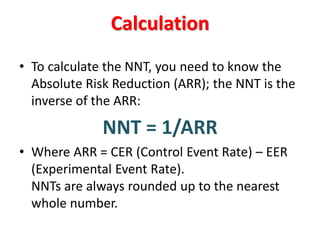
• To calculate the NNT, you need to know the
Absolute Risk Reduction (ARR); the NNT is the
inverse of the ARR:
NNT = 1/ARR
• Where ARR = CER (Control Event Rate) – EER
(Experimental Event Rate).
NNTs are always rounded up to the nearest
whole number.
• E.g.
The results of hypertension randomized control trial into the effect
of intensive hypertensive therapy on the development and
progression of cerebrovascular stroke indicated that
cerebrovascular stroke occurred in 10 % of patients randomized
to placebo and 3.2 % of patients randomized to intensive
hypertensive therapy.
ARR= CER- EER = 10 - 3.2=6.8%
NNT = 1/6.8= 14.7=15
Therefore, we need to treat 15 hypertensive patients with
intensive therapy to prevent 1 patient from developing
cerebrovascular stroke.
Benefits of numbers needed to treat
http://patient.info/doctor/numbers-needed-to-treat
• NNTs can be used either for summarizing the
results of a therapeutic trial or for medical
decision-making about an individual.
• The NNT provides a more clinically useful
measure of the relative benefit of an active
treatment over a control than the use of the
relative risk, the relative risk reduction (RRR) or
the odds ratio (the ratio of the odds of an event
occurring in one group to the odds of it occurring
in another group).
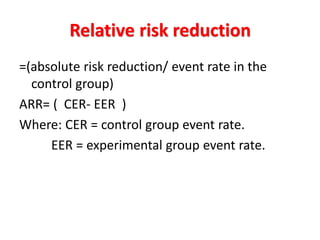
Relative risk reduction
=(absolute risk reduction/ event rate in the
control group)
ARR= ( CER- EER )
Where: CER = control group event rate.
EER = experimental group event rate.
Calculation of odds ratio
Randomized Control
trial
Total
Treatment Control
Developing
the event
Not
Developing
the event
Total
odds ratio (the ratio of the odds of an event occurring in
one group to the odds of it occurring in another group).
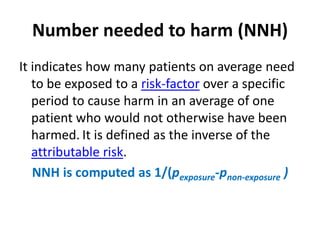
Number needed to harm (NNH)
It indicates how many patients on average need
to be exposed to a risk-factor over a specific
period to cause harm in an average of one
patient who would not otherwise have been
harmed. It is defined as the inverse of the
attributable risk.
NNH is computed as 1/(pexposure-pnon-exposure )
The NNH is an important measure in evidence
based medicine and helps physicians decide
whether it is good to proceed with a particular
treatment which may expose the patient to
harms. While for Clinician the NNT is an
important measure which indicate the severity
of the disease.
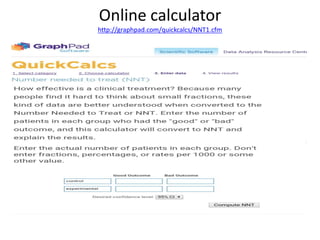
Online calculator
http://graphpad.com/quickcalcs/NNT1.cfm
Clinical trial study design

Clinical trial study design

  • 1.
    Introduced by Dr. NerminOsman Assistant Lecturer of Medical Statistics, MRI, Alexandria University United Nations System Staff College Intern-UNITAR nerminosman@unssc.org
  • 5.
    Random allocation Simple randomallocation is the easiest and most basic approach that provides unpredictability of treatment assignment. Method: Using a random-numbers table or a computer software program that generates the random sequence
  • 7.
    Random concealment Allocation concealmentis the technique of ensuring that implementation of the random allocation sequence occurs without knowledge of which patient will receive which treatment, as knowledge of the next assignment could influence whether a patient is included or excluded based on perceived prognosis.
  • 15.
    The Number Neededto Treat (NNT) : http://www.cebm.net/number-needed-to-treat-nnt/ • the number of patients you need to treat to prevent one additional bad outcome (death, stroke, etc.). • For example, if a drug has an NNT of 5, it means you have to treat 5 people with the drug to prevent one additional bad outcome.
  • 16.
    Calculation • To calculatethe NNT, you need to know the Absolute Risk Reduction (ARR); the NNT is the inverse of the ARR: NNT = 1/ARR • Where ARR = CER (Control Event Rate) – EER (Experimental Event Rate). NNTs are always rounded up to the nearest whole number.
  • 17.
    • E.g. The resultsof hypertension randomized control trial into the effect of intensive hypertensive therapy on the development and progression of cerebrovascular stroke indicated that cerebrovascular stroke occurred in 10 % of patients randomized to placebo and 3.2 % of patients randomized to intensive hypertensive therapy. ARR= CER- EER = 10 - 3.2=6.8% NNT = 1/6.8= 14.7=15 Therefore, we need to treat 15 hypertensive patients with intensive therapy to prevent 1 patient from developing cerebrovascular stroke.
  • 18.
    Benefits of numbersneeded to treat http://patient.info/doctor/numbers-needed-to-treat • NNTs can be used either for summarizing the results of a therapeutic trial or for medical decision-making about an individual. • The NNT provides a more clinically useful measure of the relative benefit of an active treatment over a control than the use of the relative risk, the relative risk reduction (RRR) or the odds ratio (the ratio of the odds of an event occurring in one group to the odds of it occurring in another group).
  • 19.
    Relative risk reduction =(absoluterisk reduction/ event rate in the control group) ARR= ( CER- EER ) Where: CER = control group event rate. EER = experimental group event rate.
  • 20.
    Calculation of oddsratio Randomized Control trial Total Treatment Control Developing the event Not Developing the event Total odds ratio (the ratio of the odds of an event occurring in one group to the odds of it occurring in another group).
  • 22.
    Number needed toharm (NNH) It indicates how many patients on average need to be exposed to a risk-factor over a specific period to cause harm in an average of one patient who would not otherwise have been harmed. It is defined as the inverse of the attributable risk. NNH is computed as 1/(pexposure-pnon-exposure )
  • 23.
    The NNH isan important measure in evidence based medicine and helps physicians decide whether it is good to proceed with a particular treatment which may expose the patient to harms. While for Clinician the NNT is an important measure which indicate the severity of the disease.
  • 24.