T alking about the  P resent
T alking about the  P resent I f your are talking about the present in general you normally use a present simple tense. Y ou use the present simple for talking about the general present including  the present moment. My dad  works  in Saudi Arabia. He  lives  in the Swiss Alps near the Swiss border.
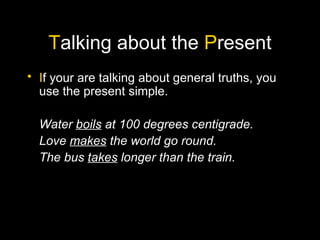
T alking about the  P resent I f your are talking about general truths, you use the present simple. Water  boils  at 100 degrees centigrade. Love  makes  the world go round. The bus  takes  longer than the train.
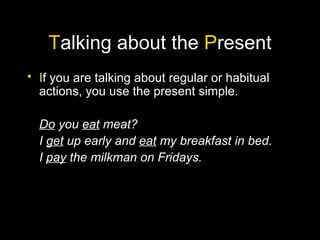
T alking about the  P resent I f you are talking about regular or habitual actions, you use the present simple. Do  you  eat  meat? I  get  up early and  eat  my breakfast in bed. I  pay  the milkman on Fridays.
T alking about the  P resent I f you are talking about something which is regarded as temporary, you use the present continuous. Do you know if she’ s  still  playing  tennis these days? I ’m working  as British Council officer.
T alking about the  P resent I f you are talking about something which is happening now, you normally use the present continuous tense. We ’re having  a meeting. Come and join in. Wait a moment.  I’m listening  to the news.
T alking about the  P resent T here are a number of verbs which are used in the present simple tense even when you are talking about the present moment. These verbs are not normally used in the present continuous or the other continuous tenses.
T alking about the  P resent T hese verbs usually refer to: thinking:   believe, forget, imagine, know, realize, recognize, suppose, think, understand, want, wish liking and disliking:   admire, dislike, hate, like, love, prefer
T alking about the  P resent appearance:   appear, look like, resemble, seem possession:   belong to, contain, have, include, own, possess perception:   hear, see, smell, taste being:   be, consist of, exist
T alking about the  P resent E xamples I  believe  he was not to blame. She  hates  going to parties. Our neighbors  have  two cars.
T alking about the  P resent Note: You normally use verbs of perception with the modal ‘can’, rather than using the present simple tense. I  can   smell  gas.
T alking about the  P resent S ome other common verbs are not normally used in present continuous or the other continuous tenses. concern fit involve mean surprise deserve interest matter satisfy What  do  you  mean ?
T alking about the  P resent WARNING: Some of the verbs listed can be used in continuous tenses in other meanings. For example, ‘have’ referring to possession is not used in continuous tenses. You don’t say ‘I’m having a car.’ But note the following examples. We’ re having  a party tomorrow. She ’s  having  a shower.
Q uestions? For more slide presentations visit:

Talking about the Present

  • 1.
    T alking aboutthe P resent
  • 2.
    T alking aboutthe P resent I f your are talking about the present in general you normally use a present simple tense. Y ou use the present simple for talking about the general present including the present moment. My dad works in Saudi Arabia. He lives in the Swiss Alps near the Swiss border.
  • 3.
    T alking aboutthe P resent I f your are talking about general truths, you use the present simple. Water boils at 100 degrees centigrade. Love makes the world go round. The bus takes longer than the train.
  • 4.
    T alking aboutthe P resent I f you are talking about regular or habitual actions, you use the present simple. Do you eat meat? I get up early and eat my breakfast in bed. I pay the milkman on Fridays.
  • 5.
    T alking aboutthe P resent I f you are talking about something which is regarded as temporary, you use the present continuous. Do you know if she’ s still playing tennis these days? I ’m working as British Council officer.
  • 6.
    T alking aboutthe P resent I f you are talking about something which is happening now, you normally use the present continuous tense. We ’re having a meeting. Come and join in. Wait a moment. I’m listening to the news.
  • 7.
    T alking aboutthe P resent T here are a number of verbs which are used in the present simple tense even when you are talking about the present moment. These verbs are not normally used in the present continuous or the other continuous tenses.
  • 8.
    T alking aboutthe P resent T hese verbs usually refer to: thinking: believe, forget, imagine, know, realize, recognize, suppose, think, understand, want, wish liking and disliking: admire, dislike, hate, like, love, prefer
  • 9.
    T alking aboutthe P resent appearance: appear, look like, resemble, seem possession: belong to, contain, have, include, own, possess perception: hear, see, smell, taste being: be, consist of, exist
  • 10.
    T alking aboutthe P resent E xamples I believe he was not to blame. She hates going to parties. Our neighbors have two cars.
  • 11.
    T alking aboutthe P resent Note: You normally use verbs of perception with the modal ‘can’, rather than using the present simple tense. I can smell gas.
  • 12.
    T alking aboutthe P resent S ome other common verbs are not normally used in present continuous or the other continuous tenses. concern fit involve mean surprise deserve interest matter satisfy What do you mean ?
  • 13.
    T alking aboutthe P resent WARNING: Some of the verbs listed can be used in continuous tenses in other meanings. For example, ‘have’ referring to possession is not used in continuous tenses. You don’t say ‘I’m having a car.’ But note the following examples. We’ re having a party tomorrow. She ’s having a shower.
  • 14.
    Q uestions? Formore slide presentations visit: