WORK-LIFE BALANCE, WORKATTITUDE AND EMPLOYEES’
PERFORMANCE AT KENYA POWER AND LIGHTING COMPANY,
NOREB REGION - KENYA
BY
NOAH KIPRUTO
MBA/5827/21
SUPERVISORS
DR.MOLLY AWINO
DR. MERCY KANAKE
2.
• Background ofthe Study
Employee performance is one of important management topics that
received significant research attention from several scholars and
considered a primary mechanism to enhance organizational success.
Many organizations are exploring various ways of ensuring that their
workforce is performing and continuously monitoring the failures that
could hinder their performance since employee performance is a very
important aspect on overall organizational performance. (Ngozi,
Uzochukwu and Obiageli, 2015).
Work life balance involves the art of balancing work and personal
obligations. It was established because people tend to devote more time to
work than other elements of their lives (Khan& Agha, 2013). Johari et al.,
(2018), confirmed that if a person is not capable to maintain exact balance
and better control then that could cause lack of energy and overburden
workload thus poor performances, that further decreases the quality of life.
3.
This isbecause general quality of employees’ life in its relation to
their working life is of utmost importance in the achievement of
organizational goals (Guest, 2002).
Work attitude on the other hand, is a set of feelings, preferences,
emotions, beliefs, expectations, judgments, appraisals, values,
principles, opinions, and intentions that the workers have toward
different aspects of the work environment that are most important to
achieve the individual and organizational objectives.
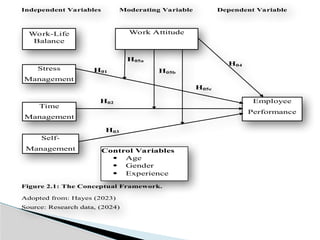
Hence the present study is intended on moderating effect of work
attitude on the relationship between work-life balance and
employees’ performance.
Cont’d..
4.
Statement of theProblem
Employees’ performance is paramount to any company that intends to
spread its wings to greater heights. For instance higher performance leads
to favorable economic growth, large profitability and better social
progress.
At Kplc, great importance is attached to ensuring that employees have
requisite competencies to perform their duties and realize their potential.
However, despite all these strategies, employee performance is still
wanting. Work life balance research has not received a significant attention
and support in Kplc.
Further, little is known about the moderating role of work attitude on the
link between work life balance (stress management, time management, and
self-management) and employee performance.
Therefore, without a comprehensive research, it remains speculative on
how the presence or absence of work attitude affects work life balance and
employees’ performance at Kenya power and Lighting Company.
5.
Research Objectives ofthe Study
The study’s specific objectives include;
1) To determine the effect of stress management on employees’
performance.
2) To explore the effect of time management on employees’
performance.
3) To examine the effect of self-management on employees’
performance.
4) To analyze the effect of work attitude on employees’ performance.
5a) To determine the moderating effect of work attitude on the
relationship between stress management and employees’ performance.
5b) To determine the moderating effect of work attitude on the
relationship between time management and employees’ performance.
5c) To determine the moderating effect of work attitude on the
relationship between self-management and employees’ performance.
6.
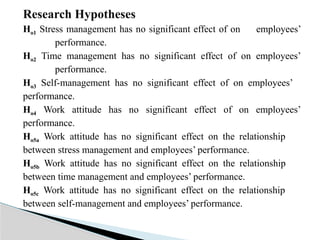
Research Hypotheses
Ho1 Stressmanagement has no significant effect of on employees’
performance.
Ho2 Time management has no significant effect of on employees’
performance.
Ho3 Self-management has no significant effect of on employees’
performance.
Ho4 Work attitude has no significant effect of on employees’
performance.
Ho5a Work attitude has no significant effect on the relationship
between stress management and employees’ performance.
Ho5b Work attitude has no significant effect on the relationship
between time management and employees’ performance.
Ho5c Work attitude has no significant effect on the relationship
between self-management and employees’ performance.
7.
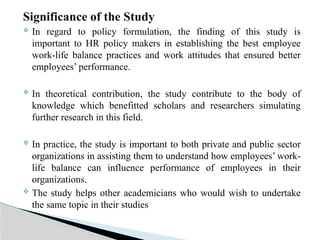
Significance of theStudy
In regard to policy formulation, the finding of this study is
important to HR policy makers in establishing the best employee
work-life balance practices and work attitudes that ensured better
employees’ performance.
In theoretical contribution, the study contribute to the body of
knowledge which benefitted scholars and researchers simulating
further research in this field.
In practice, the study is important to both private and public sector
organizations in assisting them to understand how employees’ work-
life balance can influence performance of employees in their
organizations.
The study helps other academicians who would wish to undertake
the same topic in their studies
8.
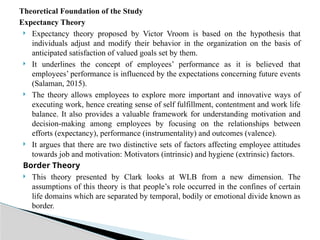
Theoretical Foundation ofthe Study
Expectancy Theory
Expectancy theory proposed by Victor Vroom is based on the hypothesis that
individuals adjust and modify their behavior in the organization on the basis of
anticipated satisfaction of valued goals set by them.
It underlines the concept of employees’ performance as it is believed that
employees’ performance is influenced by the expectations concerning future events
(Salaman, 2015).
The theory allows employees to explore more important and innovative ways of
executing work, hence creating sense of self fulfillment, contentment and work life
balance. It also provides a valuable framework for understanding motivation and
decision-making among employees by focusing on the relationships between
efforts (expectancy), performance (instrumentality) and outcomes (valence).
It argues that there are two distinctive sets of factors affecting employee attitudes
towards job and motivation: Motivators (intrinsic) and hygiene (extrinsic) factors.
Border Theory
This theory presented by Clark looks at WLB from a new dimension. The
assumptions of this theory is that people’s role occurred in the confines of certain
life domains which are separated by temporal, bodily or emotional divide known as
border.
9.
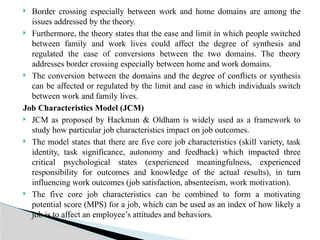
Border crossingespecially between work and home domains are among the
issues addressed by the theory.
Furthermore, the theory states that the ease and limit in which people switched
between family and work lives could affect the degree of synthesis and
regulated the ease of conversions between the two domains. The theory
addresses border crossing especially between home and work domains.
The conversion between the domains and the degree of conflicts or synthesis
can be affected or regulated by the limit and ease in which individuals switch
between work and family lives.
Job Characteristics Model (JCM)
JCM as proposed by Hackman & Oldham is widely used as a framework to
study how particular job characteristics impact on job outcomes.
The model states that there are five core job characteristics (skill variety, task
identity, task significance, autonomy and feedback) which impacted three
critical psychological states (experienced meaningfulness, experienced
responsibility for outcomes and knowledge of the actual results), in turn
influencing work outcomes (job satisfaction, absenteeism, work motivation).
The five core job characteristics can be combined to form a motivating
potential score (MPS) for a job, which can be used as an index of how likely a
job is to affect an employee’s attitudes and behaviors.
10.
Independent Variables ModeratingVariable Dependent Variable
Figure 2.1: The Conceptual Framework.
Adopted from: Hayes (2023)
Source: Research data, (2024)
Employee
Performance
Work Attitude
Stress
Management
Time
Management
Self-
Management Control Variables
Age
Gender
Experience
Work-Life
Balance
H05b
H05a
H01
H02
H03
H05c
H04
11.
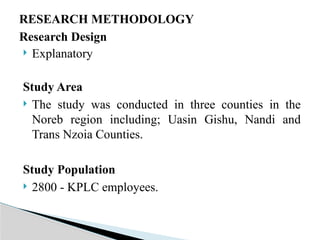
RESEARCH METHODOLOGY
Research Design
Explanatory
Study Area
The study was conducted in three counties in the
Noreb region including; Uasin Gishu, Nandi and
Trans Nzoia Counties.
Study Population
2800 - KPLC employees.
12.
Sample Size/Sample Procedure
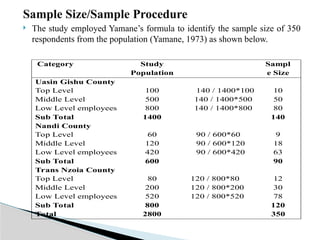
The study employed Yamane’s formula to identify the sample size of 350
respondents from the population (Yamane, 1973) as shown below.
Category Study
Population
Sampl
e Size
Uasin Gishu County
Top Level 100 140 / 1400*100 10
Middle Level 500 140 / 1400*500 50
Low Level employees 800 140 / 1400*800 80
Sub Total 1400 140
Nandi County
Top Level 60 90 / 600*60 9
Middle Level 120 90 / 600*120 18
Low Level employees 420 90 / 600*420 63
Sub Total 600 90
Trans Nzoia County
Top Level 80 120 / 800*80 12
Middle Level 200 120 / 800*200 30
Low Level employees 520 120 / 800*520 78
Sub Total 800 120
Total 2800 350
13.
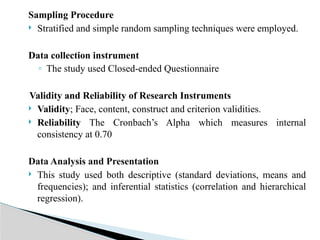
Sampling Procedure
Stratifiedand simple random sampling techniques were employed.
Data collection instrument
◦ The study used Closed-ended Questionnaire
Validity and Reliability of Research Instruments
Validity; Face, content, construct and criterion validities.
Reliability The Cronbach’s Alpha which measures internal
consistency at 0.70
Data Analysis and Presentation
This study used both descriptive (standard deviations, means and
frequencies); and inferential statistics (correlation and hierarchical
regression).
14.
Test of Moderation
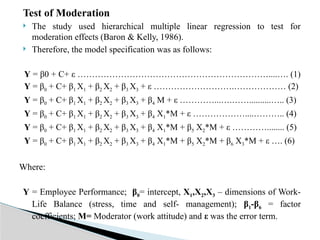
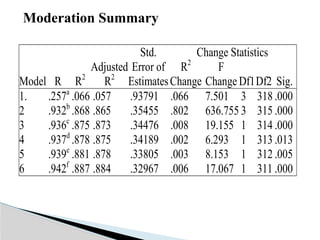
The study used hierarchical multiple linear regression to test for
moderation effects (Baron & Kelly, 1986).
Therefore, the model specification was as follows:
Y = β0 + C+ ε …………………………………………………………....…. (1)
Y = β0 + C+ β1 X1 + β2 X2 + β3 X3 + ε ……………………….……………… (2)
Y = β0 + C+ β1 X1 + β2 X2 + β3 X3 + β4 M + ε …………...….……..........….. (3)
Y = β0 + C+ β1 X1 + β2 X2 + β3 X3 + β4 X1*M + ε ………………....……….. (4)
Y = β0 + C+ β1 X1 + β2 X2 + β3 X3 + β4 X1*M + β5 X2*M + ε …………........ (5)
Y = β0 + C+ β1 X1 + β2 X2 + β3 X3 + β4 X1*M + β5 X2*M + β6 X3*M + ε …. (6)
Where:
Y = Employee Performance; β0= intercept, X1,X2,X3 – dimensions of Work-
Life Balance (stress, time and self- management); β1-β6 = factor
coefficients; M= Moderator (work attitude) and ε was the error term.
15.
DATA ANALYSIS, PRESENTATION,DISCUSSIONS AND
INTERPRETATION
Response Rate
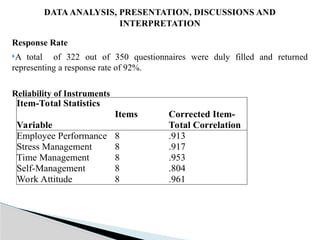
A total of 322 out of 350 questionnaires were duly filled and returned
representing a response rate of 92%.
Reliability of Instruments
Item-Total Statistics
Variable
Items Corrected Item-
Total Correlation
Employee Performance 8 .913
Stress Management 8 .917
Time Management 8 .953
Self-Management 8 .804
Work Attitude 8 .961
16.
Test for Normality
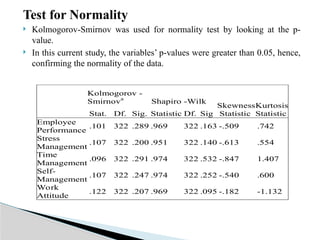
Kolmogorov-Smirnov was used for normality test by looking at the p-
value.
In this current study, the variables’ p-values were greater than 0.05, hence,
confirming the normality of the data.
Kolmogorov -
Smirnova
Shapiro -Wilk
SkewnessKurtosis
Stat. Df. Sig. Statistic Df. Sig Statistic Statistic
Employee
Performance
.101 322 .289 .969 322 .163 -.509 .742
Stress
Management
.107 322 .200 .951 322 .140 -.613 .554
Time
Management
.096 322 .291 .974 322 .532 -.847 1.407
Self-
Management
.107 322 .247 .974 322 .252 -.540 .600
Work
Attitude
.122 322 .207 .969 322 .095 -.182 -1.132
17.
Test for Linearity
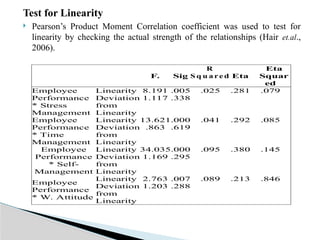
Pearson’s Product Moment Correlation coefficient was used to test for
linearity by checking the actual strength of the relationships (Hair et.al.,
2006).
F. Sig
R
S q u a re d Eta
Eta
Squar
ed
Employee
Performance
* Stress
Management
Linearity 8.191 .005 .025 .281 .079
Deviation
from
Linearity
1.117 .338
Employee
Performance
* Time
Management
Linearity 13.621.000 .041 .292 .085
Deviation
from
Linearity
.863 .619
Employee
Performance
* Self-
Management
Linearity 34.035.000 .095 .380 .145
Deviation
from
Linearity
1.169 .295
Employee
Performance
* W. Attitude
Linearity 2.763 .007 .089 .213 .846
Deviation
from
Linearity
1.203 .288
18.
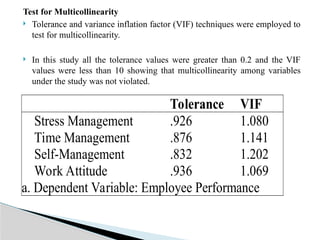
Test for Multicollinearity
Tolerance and variance inflation factor (VIF) techniques were employed to
test for multicollinearity.
In this study all the tolerance values were greater than 0.2 and the VIF
values were less than 10 showing that multicollinearity among variables
under the study was not violated.
Tolerance VIF
Stress Management .926 1.080
Time Management .876 1.141
Self-Management .832 1.202
Work Attitude .936 1.069
a. Dependent Variable: Employee Performance
19.
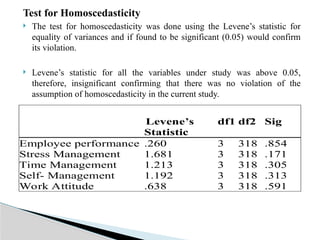
Test for Homoscedasticity
The test for homoscedasticity was done using the Levene’s statistic for
equality of variances and if found to be significant (0.05) would confirm
its violation.
Levene’s statistic for all the variables under study was above 0.05,
therefore, insignificant confirming that there was no violation of the
assumption of homoscedasticity in the current study.
Levene’s
Statistic
df1 df2 Sig
Employee performance .260 3 318 .854
Stress Management 1.681 3 318 .171
Time Management 1.213 3 318 .305
Self- Management 1.192 3 318 .313
Work Attitude .638 3 318 .591
20.
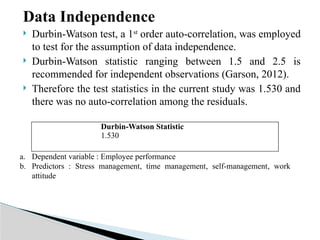
Data Independence
Durbin-Watsontest, a 1st
order auto-correlation, was employed
to test for the assumption of data independence.
Durbin-Watson statistic ranging between 1.5 and 2.5 is
recommended for independent observations (Garson, 2012).
Therefore the test statistics in the current study was 1.530 and
there was no auto-correlation among the residuals.
Durbin-Watson Statistic
1.530
a. Dependent variable : Employee performance
b. Predictors : Stress management, time management, self-management, work
attitude
21.
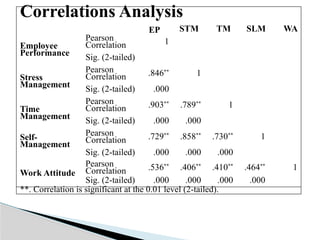
Correlations Analysis
EP STMTM SLM WA
Employee
Performance
Pearson
Correlation 1
Sig. (2-tailed)
Stress
Management
Pearson
Correlation .846**
1
Sig. (2-tailed) .000
Time
Management
Pearson
Correlation .903**
.789**
1
Sig. (2-tailed) .000 .000
Self-
Management
Pearson
Correlation .729**
.858**
.730**
1
Sig. (2-tailed) .000 .000 .000
Work Attitude
Pearson
Correlation .536**
.406**
.410**
.464**
1
Sig. (2-tailed) .000 .000 .000 .000
**. Correlation is significant at the 0.01 level (2-tailed).
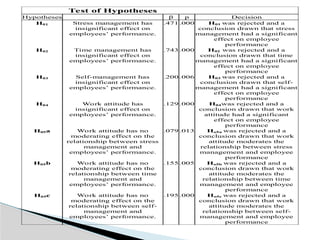
Test of Hypotheses
Hypothesesβ p Decision
H01 Stress management has
insignificant effect on
employees’ performance.
.471 .000 H01 was rejected and a
conclusion drawn that stress
management had a significant
effect on employee
performance
H02 Time management has
insignificant effect on
employees’ performance.
.743 .000 H02 was rejected and a
conclusion drawn that time
management had a significant
effect on employee
performance
H03 Self-management has
insignificant effect on
employees’ performance.
.200 .006 H03 was rejected and a
conclusion drawn that self-
management had a significant
effect on employee
performance
H04 Work attitude has
insignificant effect on
employees’ performance.
.129 .000 H04was rejected and a
conclusion drawn that work
attitude had a significant
effect on employee
performance
H05a Work attitude has no
moderating effect on the
relationship between stress
management and
employees’ performance.
.079 .013 Ho5a was rejected and a
conclusion drawn that work
attitude moderates the
relationship between stress
management and employee
performance
H05b Work attitude has no
moderating effect on the
relationship between time
management and
employees’ performance.
.155 .005 Ho5b was rejected and a
conclusion drawn that work
attitude moderates the
relationship between time
management and employee
performance
H05c Work attitude has no
moderating effect on the
relationship between self-
management and
employees’ performance.
.195 .000 Ho5c was rejected and a
conclusion drawn that work
attitude moderates the
relationship between self-
management and employee
performance
24.
SUMMARIES, CONCLUSIONS ANDRECOMMENDATIONS
Summary
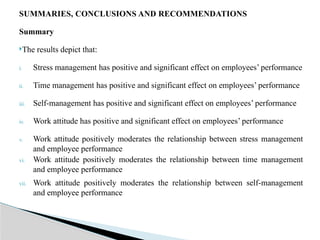
The results depict that:
i. Stress management has positive and significant effect on employees’ performance
ii. Time management has positive and significant effect on employees’ performance
iii. Self-management has positive and significant effect on employees’ performance
iv. Work attitude has positive and significant effect on employees’ performance
v. Work attitude positively moderates the relationship between stress management
and employee performance
vi. Work attitude positively moderates the relationship between time management
and employee performance
vii. Work attitude positively moderates the relationship between self-management
and employee performance
25.
Conclusion
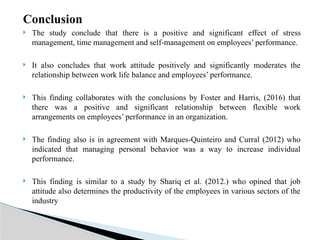
The studyconclude that there is a positive and significant effect of stress
management, time management and self-management on employees’ performance.
It also concludes that work attitude positively and significantly moderates the
relationship between work life balance and employees’ performance.
This finding collaborates with the conclusions by Foster and Harris, (2016) that
there was a positive and significant relationship between flexible work
arrangements on employees’ performance in an organization.
The finding also is in agreement with Marques-Quinteiro and Curral (2012) who
indicated that managing personal behavior was a way to increase individual
performance.
This finding is similar to a study by Shariq et al. (2012.) who opined that job
attitude also determines the productivity of the employees in various sectors of the
industry
26.
The managementof the companies should avail efficient self-
management strategies such as increasing goal alignment
(working towards same goals) to increase employees’ greater
performance and enhance autonomy, time management and
professional abilities.
The management of the companies should also ensure their
employees are sensitized on how to make good use of mind-
body techniques such as yoga and massage to help them in
minimizing the stress levels.
Recommendations
27.
Suggestion for FurtherStudies
i. Future research should address further review of work-life balance
additional variables and other possible moderators or intervening variables
which may broaden the range of influence between these research
practices and employees’ performance.
ii. Moreover, replication of this study should be undertaken in other sectors
so as to further verify the findings of this study.
iii. Future researchers should examine the same constructs as used in this
study using another methodological approach like mixed methods
approach or other analysis approaches.