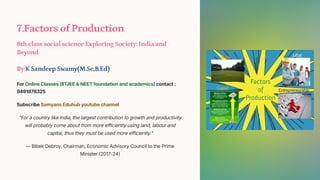
7.Factors of Production
8th class social science Exploring Society: India and
Beyond
By:K Sandeep Swamy(M.Sc,B.Ed)
For Online Classes (IITJEE & NEET foundation and academics) contact :
9491878325
Subscribe Samyans Eduhub youtube channel
"For a country like India, the largest contribution to growth and productivity
will probably come about from more efficiently using land, labour and
capital, thus they must be used more efficiently."
4 Bibek Debroy, Chairman, Economic Advisory Council to the Prime
Minister (2017-24)
The Big Questions
1 What are the factors of production?
2 How are these factors interconnected?
3 What is the role of human capital in production,
and what are its facilitators?
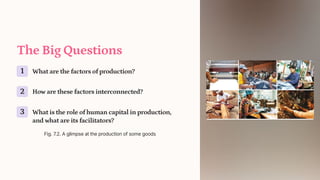
Fig. 7.2. A glimpse at the production of some goods
Introduction to Factors of Production
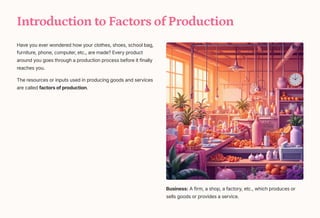
Have you ever wondered how your clothes, shoes, school bag,
furniture, phone, computer, etc., are made? Every product
around you goes through a production process before it finally
reaches you.
The resources or inputs used in producing goods and services
are called factors of production.
Business: A firm, a shop, a factory, etc., which produces or
sells goods or provides a service.
Meet Ratna: A Small Business Owner
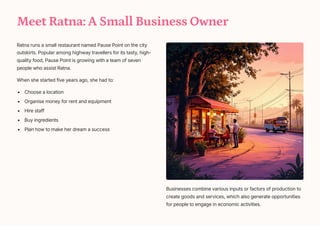
Ratna runs a small restaurant named Pause Point on the city
outskirts. Popular among highway travellers for its tasty, high-
quality food, Pause Point is growing with a team of seven
people who assist Ratna.
When she started five years ago, she had to:
Choose a location
Organise money for rent and equipment
Hire staff
Buy ingredients
Plan how to make her dream a success
Businesses combine various inputs or factors of production to
create goods and services, which also generate opportunities
for people to engage in economic activities.
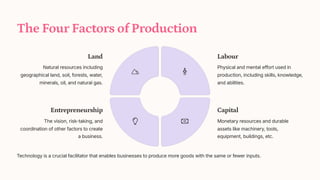
The Four Factors of Production
Technology is a crucial facilitator that enables businesses to produce more goods with the same or fewer inputs.
Land
Natural resources including
geographical land, soil, forests, water,
minerals, oil, and natural gas.
Labour
Physical and mental effort used in
production, including skills, knowledge,
and abilities.
Capital
Monetary resources and durable
assets like machinery, tools,
equipment, buildings, etc.
Entrepreneurship
The vision, risk-taking, and
coordination of other factors to create
a business.
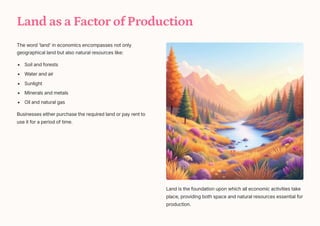
Land as a Factor of Production
The word 'land' in economics encompasses not only
geographical land but also natural resources like:
Soil and forests
Water and air
Sunlight
Minerals and metals
Oil and natural gas
Businesses either purchase the required land or pay rent to
use it for a period of time.
Land is the foundation upon which all economic activities take
place, providing both space and natural resources essential for
production.
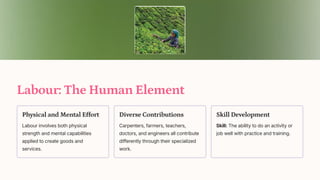
Labour: The Human Element
Physical and Mental Effort
Labour involves both physical
strength and mental capabilities
applied to create goods and
services.
Diverse Contributions
Carpenters, farmers, teachers,
doctors, and engineers all contribute
differently through their specialized
work.
Skill Development
Skill: The ability to do an activity or
job well with practice and training.
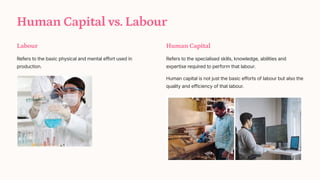
Human Capital vs. Labour
Labour
Refers to the basic physical and mental effort used in
production.
Human Capital
Refers to the specialised skills, knowledge, abilities and
expertise required to perform that labour.
Human capital is not just the basic efforts of labour but also the
quality and efficiency of that labour.
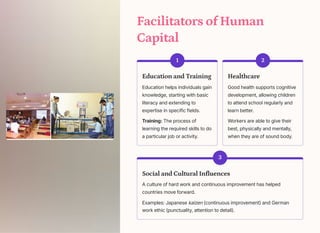
Facilitators of Human
Capital
1
Education and Training
Education helps individuals gain
knowledge, starting with basic
literacy and extending to
expertise in specific fields.
Training: The process of
learning the required skills to do
a particular job or activity.
2
Healthcare
Good health supports cognitive
development, allowing children
to attend school regularly and
learn better.
Workers are able to give their
best, physically and mentally,
when they are of sound body.
3
Social and Cultural Influences
A culture of hard work and continuous improvement has helped
countries move forward.
Examples: Japanese kaizen (continuous improvement) and German
work ethic (punctuality, attention to detail).
Challenges to Human Capital in India
Despite progress in many areas, India faces challenges in
developing human capital:
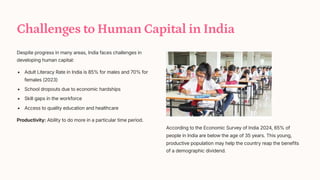
Adult Literacy Rate in India is 85% for males and 70% for
females (2023)
School dropouts due to economic hardships
Skill gaps in the workforce
Access to quality education and healthcare
Productivity: Ability to do more in a particular time period.
According to the Economic Survey of India 2024, 65% of
people in India are below the age of 35 years. This young,
productive population may help the country reap the benefits
of a demographic dividend.
India's Ancient Skill Heritage
For ancient Indians, work was a form of expressing their nature
and striving for perfection, an offering to the deity or the
receiver.
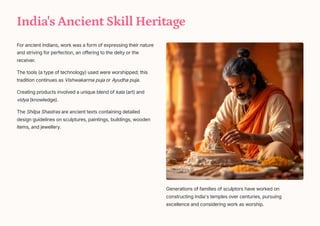
The tools (a type of technology) used were worshipped; this
tradition continues as Vishwakarma puja or Ayudha puja.
Creating products involved a unique blend of kala (art) and
vidya (knowledge).
The Shilpa Shastras are ancient texts containing detailed
design guidelines on sculptures, paintings, buildings, wooden
items, and jewellery.
Generations of families of sculptors have worked on
constructing India's temples over centuries, pursuing
excellence and considering work as worship.
Stitched Shipbuilding: Ancient Indian
Technology
Indians used a unique stitching technique dating back over
2000 years to make ships and boats, which they used to
conduct maritime trade and cultural exchanges across the
Indian Ocean.
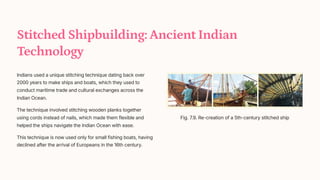
The technique involved stitching wooden planks together
using cords instead of nails, which made them flexible and
helped the ships navigate the Indian Ocean with ease.
This technique is now used only for small fishing boats, having
declined after the arrival of Europeans in the 16th century.
Fig. 7.9. Re-creation of a 5th-century stitched ship
Capital as a Factor of Production
1
Physical Capital
Durable assets like machinery, tools,
equipment, vehicles, vending carts,
computers, shops, factories, office
buildings, etc.
2
Financial Capital
Money required to purchase physical
capital, pay wages, and cover other
expenses.
3
Sources of Capital
Personal savings, family, and
friends
Bank loans (with interest
payments)
Stock market (for large
companies)
Interest: The amount of money paid by the borrower of a loan to the lender for using their money for a specific time.
Dividend: An amount of money paid regularly by a company to its shareholders out of its profits.
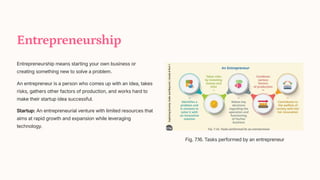
Entrepreneurship
Entrepreneurship means starting your own business or
creating something new to solve a problem.
An entrepreneur is a person who comes up with an idea, takes
risks, gathers other factors of production, and works hard to
make their startup idea successful.
Startup: An entrepreneurial venture with limited resources that
aims at rapid growth and expansion while leveraging
technology.
Fig. 7.16. Tasks performed by an entrepreneur
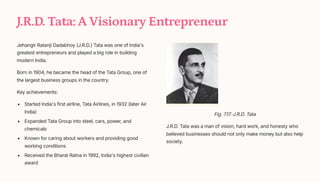
J.R.D. Tata: A Visionary Entrepreneur
Jehangir Ratanji Dadabhoy (J.R.D.) Tata was one of India's
greatest entrepreneurs and played a big role in building
modern India.
Born in 1904, he became the head of the Tata Group, one of
the largest business groups in the country.
Key achievements:
Started India's first airline, Tata Airlines, in 1932 (later Air
India)
Expanded Tata Group into steel, cars, power, and
chemicals
Known for caring about workers and providing good
working conditions
Received the Bharat Ratna in 1992, India's highest civilian
award
Fig. 7.17. J.R.D. Tata
J.R.D. Tata was a man of vision, hard work, and honesty who
believed businesses should not only make money but also help
society.
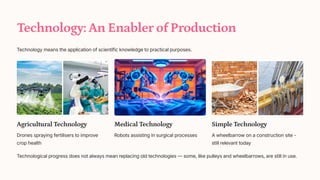
Technology: An Enabler of Production
Technology means the application of scientific knowledge to practical purposes.
Agricultural Technology
Drones spraying fertilisers to improve
crop health
Medical Technology
Robots assisting in surgical processes
Simple Technology
A wheelbarrow on a construction site -
still relevant today
Technological progress does not always mean replacing old technologies 4 some, like pulleys and wheelbarrows, are still in use.
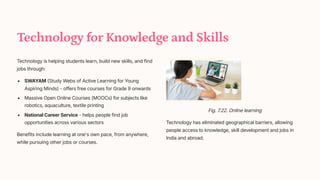
Technology for Knowledge and Skills
Technology is helping students learn, build new skills, and find
jobs through:
SWAYAM (Study Webs of Active Learning for Young
Aspiring Minds) - offers free courses for Grade 9 onwards
Massive Open Online Courses (MOOCs) for subjects like
robotics, aquaculture, textile printing
National Career Service - helps people find job
opportunities across various sectors
Benefits include learning at one's own pace, from anywhere,
while pursuing other jobs or courses.
Fig. 7.22. Online learning
Technology has eliminated geographical barriers, allowing
people access to knowledge, skill development and jobs in
India and abroad.
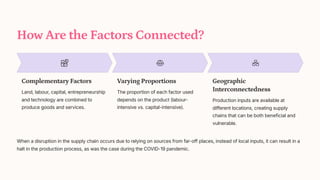
How Are the Factors Connected?
Complementary Factors
Land, labour, capital, entrepreneurship
and technology are combined to
produce goods and services.
Varying Proportions
The proportion of each factor used
depends on the product (labour-
intensive vs. capital-intensive).
Geographic
Interconnectedness
Production inputs are available at
different locations, creating supply
chains that can be both beneficial and
vulnerable.
When a disruption in the supply chain occurs due to relying on sources from far-off places, instead of local inputs, it can result in a
halt in the production process, as was the case during the COVID-19 pandemic.
Mobile Phone Manufacturing: A Case Study
India is the world's second-largest mobile phone manufacturer after China in 2025!
Fig. 7.23. The process of mobile phone assembly
Human effort is involved at every stage of production to design, supervise, and improve products and processes. Together, all
these inputs are essential, working like puzzle pieces to create the goods and services we rely on!
Responsibilities Towards Factors of Production
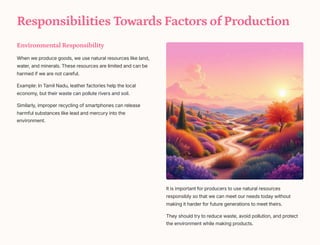
Environmental Responsibility
When we produce goods, we use natural resources like land,
water, and minerals. These resources are limited and can be
harmed if we are not careful.
Example: In Tamil Nadu, leather factories help the local
economy, but their waste can pollute rivers and soil.
Similarly, improper recycling of smartphones can release
harmful substances like lead and mercury into the
environment.
It is important for producers to use natural resources
responsibly so that we can meet our needs today without
making it harder for future generations to meet theirs.
They should try to reduce waste, avoid pollution, and protect
the environment while making products.
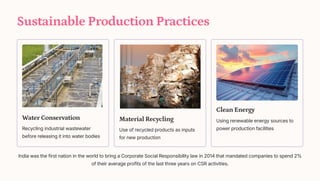
Sustainable Production Practices
Water Conservation
Recycling industrial wastewater
before releasing it into water bodies
Material Recycling
Use of recycled products as inputs
for new production
Clean Energy
Using renewable energy sources to
power production facilities
India was the first nation in the world to bring a Corporate Social Responsibility law in 2014 that mandated companies to spend 2%
of their average profits of the last three years on CSR activities.
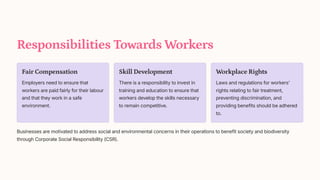
Responsibilities Towards Workers
Fair Compensation
Employers need to ensure that
workers are paid fairly for their labour
and that they work in a safe
environment.
Skill Development
There is a responsibility to invest in
training and education to ensure that
workers develop the skills necessary
to remain competitive.
Workplace Rights
Laws and regulations for workers'
rights relating to fair treatment,
preventing discrimination, and
providing benefits should be adhered
to.
Businesses are motivated to address social and environmental concerns in their operations to benefit society and biodiversity
through Corporate Social Responsibility (CSR).
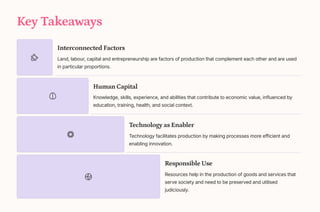
Key Takeaways
Interconnected Factors
Land, labour, capital and entrepreneurship are factors of production that complement each other and are used
in particular proportions.
Human Capital
Knowledge, skills, experience, and abilities that contribute to economic value, influenced by
education, training, health, and social context.
Technology as Enabler
Technology facilitates production by making processes more efficient and
enabling innovation.
Responsible Use
Resources help in the production of goods and services that
serve society and need to be preserved and utilised
judiciously.
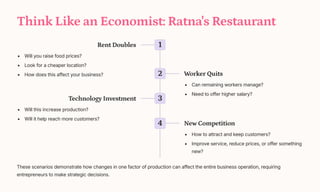
Think Like an Economist: Ratna's Restaurant
1
Rent Doubles
Will you raise food prices?
Look for a cheaper location?
How does this affect your business? 2 Worker Quits
Can remaining workers manage?
Need to offer higher salary?
3
Technology Investment
Will this increase production?
Will it help reach more customers?
4 New Competition
How to attract and keep customers?
Improve service, reduce prices, or offer something
new?
These scenarios demonstrate how changes in one factor of production can affect the entire business operation, requiring
entrepreneurs to make strategic decisions.
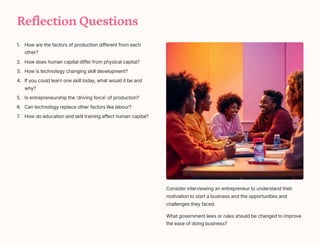
Reflection Questions
How are the factors of production different from each
other?
1.
How does human capital differ from physical capital?
2.
How is technology changing skill development?
3.
If you could learn one skill today, what would it be and
why?
4.
Is entrepreneurship the 'driving force' of production?
5.
Can technology replace other factors like labour?
6.
How do education and skill training affect human capital?
7.
Consider interviewing an entrepreneur to understand their
motivation to start a business and the opportunities and
challenges they faced.
What government laws or rules should be changed to improve
the ease of doing business?