ROYAL UNIVERSITY OF PHNOM
PENH
2015 - 2016
Department: Computer Science
Class: A2
Lecturer: Lim Lyheng
Topic: Lean Software Development
Year 4
Group Members ( 8 ) :
1. San Kimsal
2. Seng Sivehorng
3. Seng Bandith
4. Sary Porsing
5. Sok Chousreang
1
Outline
1. What is Lean
2. History of Lean
3. Lean production
4. 7 principles of Lean
5. 22 tools of Lean
6. Advantages and disadvantages
7. Conclusion
8. References
2
What is Lean
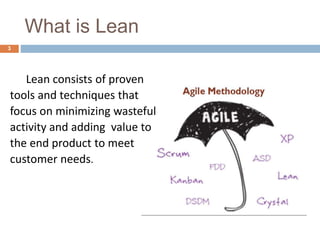
Lean consists of proven
tools and techniques that
focus on minimizing wasteful
activity and adding value to
the end product to meet
customer needs.
3
History
lean was originated in a book by Mary Poppendieck and Tom
Poppendieck in 2003.
Mary Poppendieck
 MS, Mathematics
University of Maryland
 BS, Mathematics
Marquette University
Tom Poppendieck
 PhD, Physics
UW – Madison
 BS, Physics
UW - Madison
4
Lean manufacturing
1. Toyota
2. Ford
3. Textron
4. Illinois Tool Works
5. Intel
6. Caterpillar Inc.
7. Parker Hannifin
8. Kimberley-Clark Corporation
9. Nice
10. John Deere
5
Top 10 Lean manufacturing companies in the world :
7 principles of Lean
 Eliminating Waste
 Amplifying Learning
 Deciding as Late as Possible
 Delivering as Fast as Possible
 Empowering the Team
 Building Integrity In
 Seeing the Whole
6
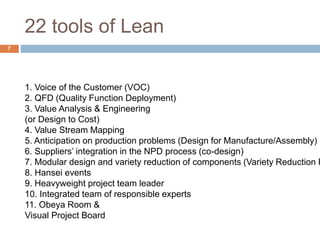
22 tools of Lean
7
1. Voice of the Customer (VOC)
2. QFD (Quality Function Deployment)
3. Value Analysis & Engineering
(or Design to Cost)
4. Value Stream Mapping
5. Anticipation on production problems (Design for Manufacture/Assembly)
6. Suppliers’ integration in the NPD process (co-design)
7. Modular design and variety reduction of components (Variety Reduction P
8. Hansei events
9. Heavyweight project team leader
10. Integrated team of responsible experts
11. Obeya Room &
Visual Project Board
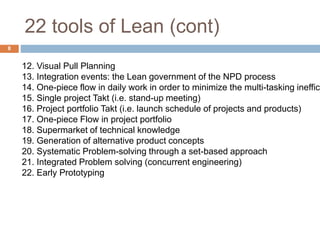
22 tools of Lean (cont)
8
12. Visual Pull Planning
13. Integration events: the Lean government of the NPD process
14. One-piece flow in daily work in order to minimize the multi-tasking ineffici
15. Single project Takt (i.e. stand-up meeting)
16. Project portfolio Takt (i.e. launch schedule of projects and products)
17. One-piece Flow in project portfolio
18. Supermarket of technical knowledge
19. Generation of alternative product concepts
20. Systematic Problem-solving through a set-based approach
21. Integrated Problem solving (concurrent engineering)
22. Early Prototyping
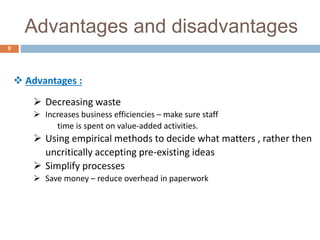
Advantages and disadvantages
9
 Advantages :
 Decreasing waste
 Increases business efficiencies – make sure staff
time is spent on value‐added activities.
 Using empirical methods to decide what matters , rather then
uncritically accepting pre-existing ideas
 Simplify processes
 Save money – reduce overhead in paperwork
Advantages and disadvantages
10
 Disadvantages:
 Strong customer relationships
 Success in the software development depends on how disciplined the
team members are and how advance their technical skills.
 The role of a business analyst is vital to ensure the business
requirements documentation is understood properly. If any organization
don't have a person with the right business analyst then this method
may not be useful for them.
 In this development model great flexibility is given to developer which is
surely great, but too much of it will quickly lead to a development team
who lost focus on its original objectives thus, it heart the flow of entire
project development work.
Conclusion
There are 7 Principles and 22 Tools.
The main goal of Lean Software Development are
 Elimination of waste
 Improve:
 Productivity
 Efficiency
 Bottom line
11
References
•http://www.lean.org/
•https://www.pdx.edu/fadm/sites/www.pdx.edu.fadm/files/02_Introduction%20
to%20Lean%20Principles%20-%20Supergraphic.pdf
•http://www.leaninstitute.in/what-is-lean/history-of-lean
•http://www.infoq.com/interviews/poppendieck-lean-2007
•Etc . . . .
12
Thanks for your time
 Questions?
13

Lean Software Development

  • 1.
    ROYAL UNIVERSITY OFPHNOM PENH 2015 - 2016 Department: Computer Science Class: A2 Lecturer: Lim Lyheng Topic: Lean Software Development Year 4 Group Members ( 8 ) : 1. San Kimsal 2. Seng Sivehorng 3. Seng Bandith 4. Sary Porsing 5. Sok Chousreang 1
  • 2.
    Outline 1. What isLean 2. History of Lean 3. Lean production 4. 7 principles of Lean 5. 22 tools of Lean 6. Advantages and disadvantages 7. Conclusion 8. References 2
  • 3.
    What is Lean Leanconsists of proven tools and techniques that focus on minimizing wasteful activity and adding value to the end product to meet customer needs. 3
  • 4.
    History lean was originatedin a book by Mary Poppendieck and Tom Poppendieck in 2003. Mary Poppendieck  MS, Mathematics University of Maryland  BS, Mathematics Marquette University Tom Poppendieck  PhD, Physics UW – Madison  BS, Physics UW - Madison 4
  • 5.
    Lean manufacturing 1. Toyota 2.Ford 3. Textron 4. Illinois Tool Works 5. Intel 6. Caterpillar Inc. 7. Parker Hannifin 8. Kimberley-Clark Corporation 9. Nice 10. John Deere 5 Top 10 Lean manufacturing companies in the world :
  • 6.
    7 principles ofLean  Eliminating Waste  Amplifying Learning  Deciding as Late as Possible  Delivering as Fast as Possible  Empowering the Team  Building Integrity In  Seeing the Whole 6
  • 7.
    22 tools ofLean 7 1. Voice of the Customer (VOC) 2. QFD (Quality Function Deployment) 3. Value Analysis & Engineering (or Design to Cost) 4. Value Stream Mapping 5. Anticipation on production problems (Design for Manufacture/Assembly) 6. Suppliers’ integration in the NPD process (co-design) 7. Modular design and variety reduction of components (Variety Reduction P 8. Hansei events 9. Heavyweight project team leader 10. Integrated team of responsible experts 11. Obeya Room & Visual Project Board
  • 8.
    22 tools ofLean (cont) 8 12. Visual Pull Planning 13. Integration events: the Lean government of the NPD process 14. One-piece flow in daily work in order to minimize the multi-tasking ineffici 15. Single project Takt (i.e. stand-up meeting) 16. Project portfolio Takt (i.e. launch schedule of projects and products) 17. One-piece Flow in project portfolio 18. Supermarket of technical knowledge 19. Generation of alternative product concepts 20. Systematic Problem-solving through a set-based approach 21. Integrated Problem solving (concurrent engineering) 22. Early Prototyping
  • 9.
    Advantages and disadvantages 9 Advantages :  Decreasing waste  Increases business efficiencies – make sure staff time is spent on value‐added activities.  Using empirical methods to decide what matters , rather then uncritically accepting pre-existing ideas  Simplify processes  Save money – reduce overhead in paperwork
  • 10.
    Advantages and disadvantages 10 Disadvantages:  Strong customer relationships  Success in the software development depends on how disciplined the team members are and how advance their technical skills.  The role of a business analyst is vital to ensure the business requirements documentation is understood properly. If any organization don't have a person with the right business analyst then this method may not be useful for them.  In this development model great flexibility is given to developer which is surely great, but too much of it will quickly lead to a development team who lost focus on its original objectives thus, it heart the flow of entire project development work.
  • 11.
    Conclusion There are 7Principles and 22 Tools. The main goal of Lean Software Development are  Elimination of waste  Improve:  Productivity  Efficiency  Bottom line 11
  • 12.
  • 13.
    Thanks for yourtime  Questions? 13