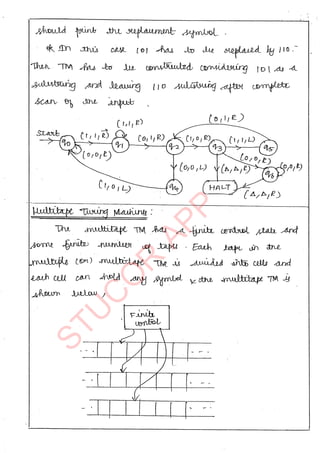
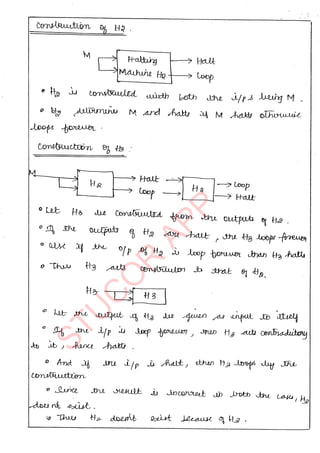
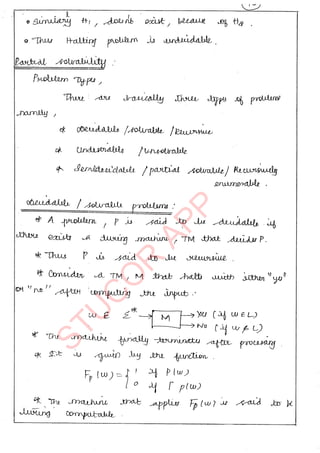
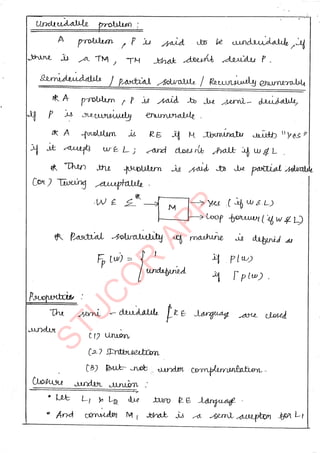
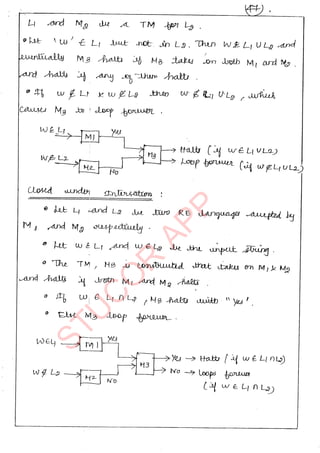
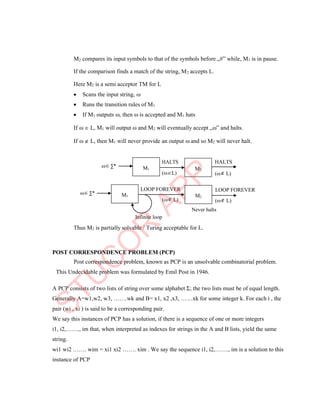
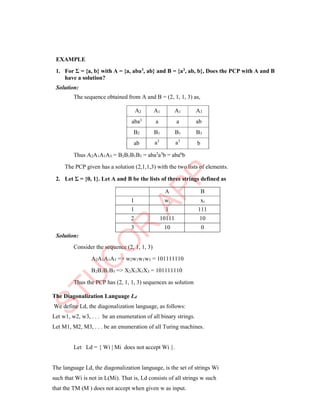
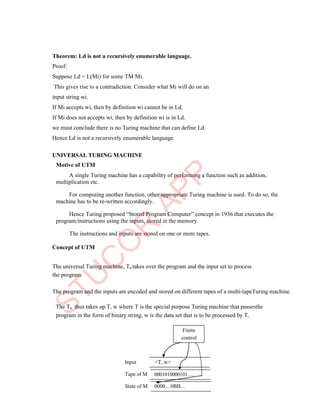
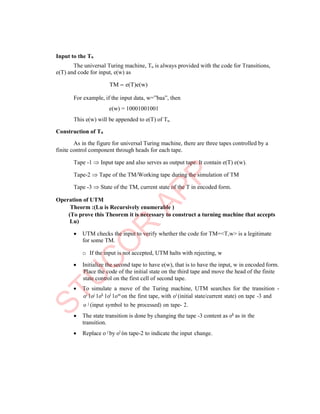
1.1 IntroductIon to AutomAtA theory
Automata theory is the study of abstract machines and the computational problems
can be solved using these machines. Abstract machines are called automata. The name
comes from the Greek word (Αυτόματα).
It means doing something by itself. An automaton can be a finite representation of
a formal language that may be an infinite set. Automata are used as theoretical models for
computing machines, and are used for proofs about computability. The automata theory
is essential for,
+ The study of the limits of computation
+ Designing and checking the behaviour of digital circuits.
+ Pattern searching in Websites
+ Verifying systems of all types that have a finite number of distinct states, such as
communications protocols or protocols for secure exchange information
1.1.1IntroductIon to FormAl lAnguAges
Formal languages are the system used to train the machines in recognizing certain
commands or instructions. These languages are the abstraction of natural languages,
since they are expended by the machines. Formal languages are of five types. They are:
r Regular Languages (RL)
r Context free Languages (CFL)
r Context Sensitive Languages (CSL)
UNIT I
AUTOMATA FUNDAMENTALS
1.2 Theory of Computation
r Recursive Languages
r Recursively Enumerable Languages (RE)
à These languages are recognized by specific automata/machines and grammars.
r Regular grammars (type 3) and finite automata recognize regular
languages.
r Context free grammars (Type 2) and push down automata recognize
context free languages.
r Context sensitive grammars (Type 1) and Linear Bounded Automata
(LBA) recognize context sensitive languages.
r Unrestricted grammars (phrase structure grammar) (Type 0).
r Turing machines recognize recursively enumerable languages.
à Total Turing Machines (TTM) that halt for every input are used to recognize
recursive languages.
1. Formal Language Theory
Formal language theory describes languages as a set of operations over an alphabet.
It is closely linked with automata theory, as automata are used to generate and recognize
formal languages. Automata are used as models for computation; formal languages are
the preferred mode of specification for any problem that must be computed.
2. Computability theory
Computability theory deals primarily with the question of the extent to which a
problem is solvable on a computer. It is closely related to the branch of mathematical
logic called recursion theory.
3. Models of Computation
The computation models that are developed by formal language theory are ,
i) Finite State Automata
ii) Regular expression
1.3
Automata Fundamentals
iii) Push down Automata
iv) Linear bounded automata
v) Turing machine
à The computational models and the languages understandable by these models are
tabulated below.
Table 1.1 The Computational Models
Machines Grammars/ Languages Category
Finite State Automata
(Regular Expression)
Regular Type 3 Simple
Complex
Push Down Automata Context Free Type 2
Linear Bounded Automata Context Sensitive Type 1
Turing Machine Phrase Structure Type 0
Uncomputable
1.1.2 Basic Mathematical Notation and Techniques
1. Alphabet
An alphabet is a finite, nonempty set of symbols.
Example:
i. ∑ ={0,1}
ii. ∑ ={a,b,c}
2. String
A string over an alphabet is a finite sequence of symbols from that alphabet.
1.4 Theory of Computation
Example:
i. 01001 over ∑ ={0,1}
ii. aaabbbbccc over ∑ ={a,b,c}
3. Length of a string
The length of a string is the count of symbols in that string.
Example:
i. |01001| = 5
ii. |aaabbbbccc| =10
iii. |03
15
| = 8
4. Power of an alphabet
The power of an alphabet ∑k, is the set of all strings over ∑ with length k.
Examples:
{ }
{ }
{ }
{ }
0 1 2
2
0
3
*
0,1
00,01, 10, 11
000,001, 010, 011,100,101,110,111
..
, 0,1, 00,01,10,11, 000,001, 010, 011,100,101,110,111
= .......................
=
0
e
+
+
∑ =
∑ =
∑ =
……………
Σ ∪ Σ ∪ Σ
Σ ∪ Σ
∑ = ……………
∑ = { }
1 2 3
,1, 00,01,10,11, 000,001, 010, 011,100,101,110,1
= ............
1
.
1
..........
……
∪
…
Σ ∪ Σ
……
Σ
5. Language (L)
The language of an Automata is a set of strings accepted by the automata.
1.5
Automata Fundamentals
Examples:
i. Set of even length strings over an alphabet {a,b}.
ii. Set of odd length strings over an alphabet {0,1}.
6. Set –former notation of a Language
i. L={w |w consists of an equal number of 0’s and 1’s }
L={ε, 01, 10,0011, 1100, 0101, 1010, 1001, 0110,………}
ii. L= {w |w is a binary integer that is prime }
L={10, 11, 101, 111, …….}
7. Complement of a Language(L )
i. L={w |w contains 101 as substring}
Ḹ ={w |w does not contain 101}
ii. L={w |w contains abb as substring}
L ={w |w does not contain abb}
1.2 IntroductIon to FormAl ProoF
A formal proof or derivation is a finite sequence of sentences called well-formed
formulas in the case of a formal language each of which is an axiom or follows from the
preceding sentences in the sequence by a rule of inference. But in deductive proofs, the
truth of a statement is shown by a detailed sequence of steps and reasons.
Some computer scientists take the extreme view that a formal proof of the
correctness of a program should go hand-in-hand with the writing of the program itself.
We doubt that doing so is productive. Some also say that proof has no place in the
discipline of programming.
+ The slogan “if you are not sure your program is correct, run it and see” is commonly
offered by them.
1.6 Theory of Computation
+ Testing programs is surely essential. However, testing goes only so far, since you
cannot try your program on every input.
+ To make your iteration or recursion correct, you need to set up an inductive
hypothesis, and it is helpful to reason, formally or informally, that the hypothesis
is consistent with the iteration or recursion.
+ This process of understanding the workings of a correct program is essentially the
same as the process of proving theorems by induction.
+ Automata theory covers methodologies of formal proof. It can be of either :
➢ Inductive kind
Recursive proofs of a parameterized statement that use the statement itself with
lower values of the parameter.
➢ Deductive kind
A sequence of justified steps.
1.2.1 Deductive Proofs
à A deductive proof consists of a sequence of statements whose truth leads us
from some initial statement, called the hypothesis or the given statement(s), to a
conclusion statement.
à Each step in the proof must follow, by some accepted logical principle, from either
the given facts, or some of the previous statements in the deductive proof, or a
combination of these.
à Thehypothesismaybetrueorfalse,typicallydependingonvaluesofitsparameters.
Often, the hypothesis consists of several independent statements connected by a
logical AND.
à The theorem that is proved when we go for a hypothesis H to a conclusion C is the
statement “if H then C”. We say that C is deduced from H.
à An example theorem of the form “if H then C” will illustrate these points.
1.7
Automata Fundamentals
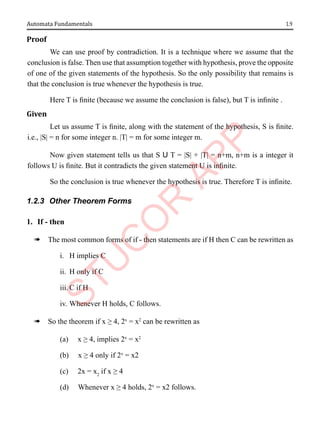
Theorem 1
If x ≥ 4, then 2x
≥ x2
.
Proof
The hypothesis H is “x ≥ 4”. This hypothesis has a parameter, x and thus is neither
true nor false. Rather, its truth depends on the value of x.
H is true for x = 6 and false for x = 2.
à The conclusion C is “2x
≥ x2
”. This statement also uses parameter x and is true for
certain values of x and not others.
Example:
C is false for x = 3, since 23
= 8, which is not as large as 32
= 9. On the other hand,
C is true for x = 4, since 24
= 42
= 16. For x = 5, the statement is also true, since 25
= 32
is
at least as large as 52
= 25.
Perhaps you can see the intuitive argument that tells us the conclusion 2x
= x2
will
be true whenever x ≥ 4. We already saw that it is true for x = 4. As x grows larger than 4,
the left side, 2x
doubles each time x increases by 1.
However, the right side, x2
, grows by the ratio (x+1/x)2
.
If x ≥ 4, then (x + 1)/x cannot be greater than 1.25, and therefore (x+1/x)2
=
(1.25)2 = 1.5625.
Since 1.5625 < 2, each time x increases above 4 the left side 2x
grows more than
the right side x2
.
^ Thus, as long as we start from a value like x = 4 the inequality 2x
≥ x2
is already
satisfied.
Theorem 2
If x is the sum of the squares of four positive integers, then 2x
≥ x2
.
Proof
In deductive proof, we go from a hypothesis H to a conclusion C, i.e., if H then C.
1.8 Theory of Computation
Step 1:
x is the sum of the squares of four integers. Let a, b, c, d be four integers.
x = a2 + b2 + c2 + d2
Step 2:
The integers being squared are at least 1.
a ≥ 1; b ≥ 1; c ≥ 1; d ≥ 1.
Step 3:
Since the integers is at least 1, then its squares is also at least 1.
a2
≥ 1; b2
≥ 1; c2
≥1; d2
≥ 1
Step 4:
From Step 1 and Step 3, we can inter that x is sum of four squares and each
squares is at least 1. x is at least 1+1+1+1 x ≥ 4.
Step 5:
Step 4 is the hypothesis of the previous problem (2x
≥ x2
if x ≥ 4). We can conclude
that,
2x
≥ x2
(or) a2
+ b2
+ c2
+ d2
1.2.2 Reduction to Definitions
If the hypothesis does not use familiar terms like integer, multiplication, addition
etc., then we can convert all terms in the hypothesis to their definitions.
Theorem 3
A set S is finite if there exists an integer n such that S has exactly n elements. |S| = n.
Where,
n - Number of elements in the set S.
S and T - Both subsets of some infinite set U.
T - Complement of S (with respect to U) if S U T = U and S ∩ T = Ф
T - Infinite.
1.9
Automata Fundamentals
Proof
We can use proof by contradiction. It is a technique where we assume that the
conclusion is false. Then use that assumption together with hypothesis, prove the opposite
of one of the given statements of the hypothesis. So the only possibility that remains is
that the conclusion is true whenever the hypothesis is true.
Here T is finite (because we assume the conclusion is false), but T is infinite .
Given
Let us assume T is finite, along with the statement of the hypothesis, S is finite.
i.e., |S| = n for some integer n. |T| = m for some integer m.
Now given statement tells us that S U T = |S| + |T| = n+m, n+m is a integer it
follows U is finite. But it contradicts the given statement U is infinite.
So the conclusion is true whenever the hypothesis is true. Therefore T is infinite.
1.2.3 Other Theorem Forms
1. If - then
à The most common forms of if - then statements are if H then C can be rewritten as
i. H implies C
ii. H only if C
iii. C if H
iv. Whenever H holds, C follows.
à So the theorem if x ≥ 4, 2x
= x2
can be rewritten as
(a) x ≥ 4, implies 2x
= x2
(b) x ≥ 4 only if 2x
= x2
(c) 2x = x2
if x ≥ 4
(d) Whenever x ≥ 4 holds, 2x
= x2 follows.
1.10 Theory of Computation
2. If - and - only - if statements
The statements of the form “A if and only if B” or “Aiff B” has two if - then
statements, is “if A then B” and “if B then A”.
Note:
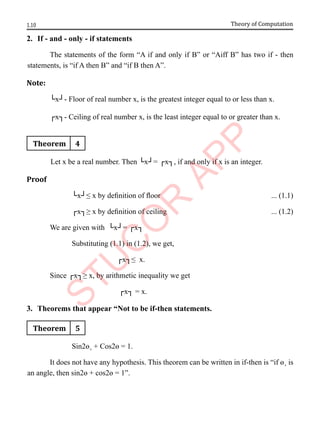
└x┘- Floor of real number x, is the greatest integer equal to or less than x.
┌x┐- Ceiling of real number x, is the least integer equal to or greater than x.
Theorem 4
Let x be a real number. Then └x┘= ┌x┐, if and only if x is an integer.
Proof
└x┘≤ x by definition of floor ... (1.1)
┌x┐≥ x by definition of ceiling ... (1.2)
We are given with └x┘= ┌x┐
Substituting (1.1) in (1.2), we get,
┌x┐≤ x.
Since ┌x┐≥ x, by arithmetic inequality we get
┌x┐ = x.
3. Theorems that appear “Not to be if-then statements.
Theorem 5
Sin2ɵ¸ + Cos2ɵ = 1.
It does not have any hypothesis. This theorem can be written in if-then is “if ɵ¸ is
an angle, then sin2ɵ + cos2ɵ = 1”.
1.11
Automata Fundamentals
1.3 AddItIonAl Forms oF ProoF
The following are the additional forms of proofs.
r Proofs about sets
r Proofs by contradiction
r Proofs by counter example
1.3.1 Proofs About Sets
à Sets contain symbols to form character strings.
à Sets in automata theory are called as languages.
If E and F are two expressions representing sets, the statement E = F means that
two sets represented are same. i.e., every element in the set represented by E is in the set
represented by F and vice versa.
Example:
Union of sets obeys commutative law. Let S and R be sets. Then R U S = S U R. If
E is the expression in R U S and F is the expression S U R, then E = F, an element
x is in E iff x is in F.
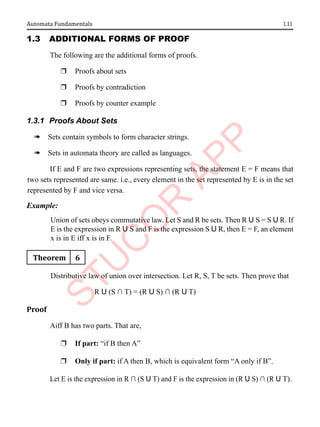
Theorem 6
Distributive law of union over intersection. Let R, S, T be sets. Then prove that
R U (S ∩ T) = (R U S) ∩ (R U T)
Proof
Aiff B has two parts. That are,
r If part: “if B then A”
r Only if part: if A then B, which is equivalent form “A only if B”.
Let E is the expression in R ∩ (S U T) and F is the expression in (R U S) ∩ (R U T).
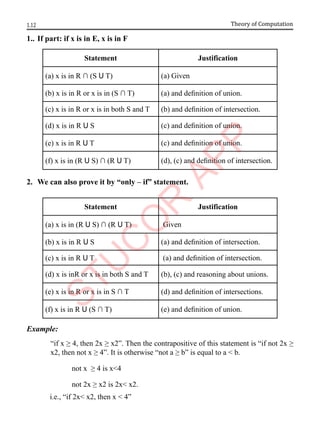
1.12 Theory of Computation
1.. If part: if x is in E, x is in F
Statement Justification
(a) x is in R ∩ (S U T) (a) Given
(b) x is in R or x is in (S ∩ T) (a) and definition of union.
(c) x is in R or x is in both S and T (b) and definition of intersection.
(d) x is in R U S (c) and definition of union.
(e) x is in R U T (c) and definition of union.
(f) x is in (R U S) ∩ (R U T) (d), (c) and definition of intersection.
2. We can also prove it by “only – if” statement.
Statement Justification
(a) x is in (R U S) ∩ (R U T) Given
(b) x is in R U S (a) and definition of intersection.
(c) x is in R U T (a) and definition of intersection.
(d) x is inR or x is in both S and T (b), (c) and reasoning about unions.
(e) x is in R or x is in S ∩ T (d) and definition of intersections.
(f) x is in R U (S ∩ T) (e) and definition of union.
Example:
“if x ≥ 4, then 2x ≥ x2”. Then the contrapositive of this statement is “if not 2x ≥
x2, then not x ≥ 4”. It is otherwise “not a ≥ b” is equal to a < b.
not x ≥ 4 is x<4
not 2x ≥ x2 is 2x< x2.
i.e., “if 2x< x2, then x < 4”
1.13
Automata Fundamentals
1.3.2 Proof by Contradiction
1. It is derived from Latin meaning reduction to the “absurd”.
2. In proof by contradiction, we assume that the theorem is false and then
show that this assumption leads to an obviously false consequence, called
a contradiction.
3. Another way to prove a statement of the form “if H then C” is to prove the
statement “H and not C implies falsehood”.
Step 1:
State by assuming both the hypothesis H and the negation of the conclusion C.
Step 2:
Compute the proof by showing that something known to be false follows logically
from H and C. This form of proof is called proof by contradiction.
Example:
Jack Sees Jill, who has just come in from outdoors. On observing that she is
completely dry, he knows that it is not raining.
Proof
His proof = that it is not raining
Assume the negation of conclusion, ie, it is raining, then Jill would be wet. But
she is not wet, so it must not be raining.
Theorem 7
Let S be a finite subset of some infinite set U. Let T be complement of S with
respect to U. Then T is infinite.
Proof
H = S is finite set of U
U is an infinite set
T is the complement of S with respect to U.
1.14 Theory of Computation
Conclusion C = “T is infinite”
^ We proceed to prove the theorem by proof by contradiction.
^ We assume not C is true. T is finite.
From the assumption S is finite, if T is also finite, then U = S U T is also finite. But
hypothesis says U is infinite. Therefore the logical statement is false.
1.3.3 Proofs by Counter Examples
It is an exception to a proposition general rule. i.e. Specific instance of the falsity
of a universal quantification.
Example:
The statement “all students are lazy”.
Proof
Counter example, a hardworking diligent student counters the statement.
Theorem 8
All primes are odd.
Proof
The integer 2 is prime, but 2 is even.
Theorem 9
There is no pair of integers a and b such that a mod b = b mod a.
Proof
Let us assume a < b.
a mod b = a a = qb + r
a = 0 x b + a. q = quotient r = remainder.
But b mod a < a, is between 0 - 1. Thus when a < b, b mod a < a mod b, so a mod
b = b mod a is impossible. It is same argument for a > b also.
1.15
Automata Fundamentals
Consider a = b. a mod b = b mod a = 0 ( x mod x = 0 ) by counter example, let us
take a = b = 2, a mod b = b mod a = 0 i.e., 2 mod 2 = 2 mod 2 = 0.
1.4 InductIVe ProoFs
1.4.1 Induction on Integers
Proof by Induction is a technique by which the truth of a number of statements
can be inferred from the truth of a few specific instances. Suppose, let P(n) be a statement
about a non-negative integer n. The principle of mathematical induction is that P(n)
follows from:
r P(1)
r P (n-1) implies P(n) for all n ≥ 1.
Condition (a) is called basis and the condition (b) is called inductive step, because
it connects Pn with Pn+1.
1.4.2 Structural Inductions
à In automata theory, there are several recursively defined structures about which we
need to prove statements.
à The examples are trees and expressions.
à Like inductions, all recursive definitions have a basis case, where one or more
elementary structures are defined, and an inductive step, where more complex
structures are defined in terms of previously defined structures.
à Structural induction is a proof method that is used in mathematical logic, computer
science, graph theory, and some other mathematical fields. It is a generalization of
mathematical induction.
à Arecursive definition or inductive definition is one that defines something in terms
of itself (that is, recursively), in a useful way.
Example:
Let us take expressions using the arithmetic operators + and *, with both numbers
and variables allowed as operands.
1.16 Theory of Computation
Basis
Any number or letter (i.e., a variable) is an expression.
Induction
If E and F are expressions, then so are E + F, E*F, and (E).
Example:
Both 2 and x are expressions by the basis. The inductive step tells us x+2, (x + 2)
and 2*(x + 2) are all expressions. Notice how each of these expressions depends on the
previous ones being expressions.
When we have a recursive definition, we can prove theorems about it using the
following proof form, which is called structural induction.
Let S(X) be a statement about the structures X that are defined by some particular
recursive definition.
à As a basis, prove S(X) for the basis structure(s) X.
à For the inductive step, take a. structure X that the recursive definition says is
formed from Y 1,Y2,..., Yk. Assume that the statements S(Y1), S(Y2), ….., S(Yk),
and use these to prove S(X).
Our conclusion is that S(X) is true for all X. The following Theorem gives the
facts and proof for trees and expressions.
Theorem 10
Every tree has one more node than it has edges.
Proof
The formal statement S(T) we need to prove by structural induction is: “if T is a
tree, and T has n nodes and e edges, then n = e + 1”.
Basis
The basis case is when T is a single node. Then n = 1 and e = 0, so the relationship
n = e + 1 holds.
1.17
Automata Fundamentals
Induction
Let T be a tree built by the inductive step of the definition, from root node N and k
smaller trees T1
, T2
,..., Tk
. We may assume that the statements S(Ti ) hold for i = 1, 2,...,
k. That is, let Ti
have ni
nodes and ei
edges; then ni
= ei
+ 1.
The nodes of T are node N and all the nodes of the Ti
’s. There are thus 1 + n1
+ n2
+....+ nk
nodes in T. The edges of T are the k edges we added explicitly in the inductive
definition step, plus the edges of the Ti
’s.
Hence, T has k + el
+ e2
+ …. + ek
edges ... (1.3)
If we substitute ei
+ 1 for ni in the count of the number of nodes of T we find that
T has 1 + [el
+ 1] + [e2
+ 1] + …. + [ek
+ 1] nodes ... (1.4)
Since there are k terms in (1.3), we can regroup (1.4) as
k + 1 + el
+ e2
+ …. + ek ... (1.5)
This expression is exactly 1 more than the expression (1.3) that was given for the
number of edges of T. Thus, T has one more node than it has edges.
Theorem 11
Every expression has an equal number of left and right parentheses.
Proof
Formally, we prove the statement S(G) about any expression G that is defined by
the recursion example described earlier the numbers of left and right parentheses in G are
the same.
Basis
If G is defined by the basis, then G is a number or variable. These expressions
have 0 left parentheses and 0 right parentheses, so the numbers are equal.
Induction
There are three rules whereby expression G may have been constructed according
to the inductive step in the definition:
1.18 Theory of Computation
r G = E + F
r G = E * F
r G = (E)
We may assume that S(E) and S(F) are true; that is, E has the same number of
left and right parentheses, say n of each, and F likewise has the same number of left and
right parentheses, say m of each. Then we can compute the numbers of left and right
parentheses in G for each of the three cases, as follows:
1. If G = E + F
Then G has n + m left parentheses and n + m right parentheses; n of each come
from E and m of each come from F.
2. If G = E * F
The count of parentheses for G is again n + m of each, for the same reason as in
case (i).
3. If G = (E)
Then there are n + l left parentheses in G -- one left parenthesis is explicitly
shown, and the other n are present in E. Likewise, there are n + 1 right parentheses in G;
one is explicit and the other n are in E.
In each of the three cases, we see that the numbers of left and right parentheses in
G are the same. This observation completes the inductive step and completes the proof.
1.4.3 Mutual Inductions
à Sometimes, we cannot prove a single statement by induction, but rather need to
prove a group of statements S1(n), S2(n),...., Sk(n) together by induction on n.
à Automata theory provides many such situations. In the following example we
sample the common situation where we need to explain what an automaton does
by proving a group of statements, one for each state.
à These statements tell under what sequences of inputs the automaton gets into each
of the states.
1.19
Automata Fundamentals
Strictly speaking, proving a group of statements is no different from proving the
conjunction (logical AND) of all the statements. For instance, the group of statements
S1
(n), S2
(n),...., Sk
(n) could be replaced by the single statement
S1
(n) AND S2
(n) AND .... AND Sk
(n)
However, when there are really several independent statements to prove, it is
generally less confusing to keep the statements separate and to prove them all in their
own parts of the basis and inductive steps. This sort of proof is called mutual induction.
We will illustrate the necessary steps for a mutual recursion.
Example:
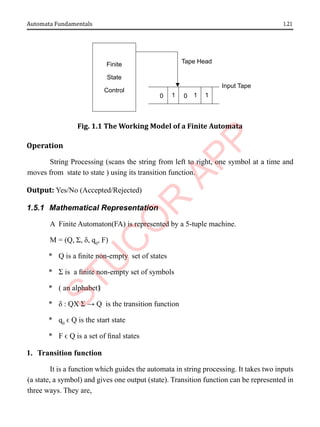
Let us take the on/off switch, which can be represented as an automaton. The
automaton itself is reproduced as given below.
Start off on
Push
Push
Since on pushing the button switches the state between on and off, and the switch
starts out in the off state, we expect that the following statements will together explain
the operation
Push of the switch
1. S1 (n)
The automaton is in state off after n pushes if and only if n is even.
2. S2 (n)
The automaton is in state on after n pushes if and only if n is odd.
We might suppose that S 1 implies S2 and vice-versa, since we know that a number
n cannot be both even and odd. However, what is not always true about an automaton is
that it is in one and only one state. It happens that the automaton is always in exactly one
state, but that fact must be proved as part of the mutual induction.
We give the basis and inductive parts of the proofs of statements S1(n) and S2(n)
below. The proofs depend on several facts about odd and even integers:
1.20 Theory of Computation
* if we add or subtract 1 from an even integer.
* We get an odd integer
* If we add or subtract 1 from an odd integer we get an even integer.
Basis
For the basis, we choose n = 0. Since there are two statements, each of which must
be proved in both directions (because S1 and S 2 are each “if-and-only-if” statements),
there are actually four cases to the basis, and four cases to the induction as well.
i. [S1; If]
Since 0 is in fact even, we must show that after 0 pushes, the automaton is in state
off. Since that is the start state, the automaton is indeed in state off after 0 pushes.
ii. [S1; Only-if ]
The automaton is in state off after 0 pushes, so we must show that 0 is even. But
0 is even by definition of “even”, so there is nothing more to prove.
iii. [S2; If]
The hypothesis of the “if” part of S2 is that 0 is odd. Since this hypothesis H is
false, any statement of the form “if H then C” is true, which has discussed earlier. Thus,
this part of the basis also holds.
iv. [S2; Only-if]
The hypothesis, that the automaton is in state on after 0 pushes, is also false, since
the only way to get to state on is by following an arc labeled Push, which requires that the
button be pushed at least once. Since the hypothesis is false, we can again conclude that
the if-then statement is true.
1.5 FInIte AutomAtA
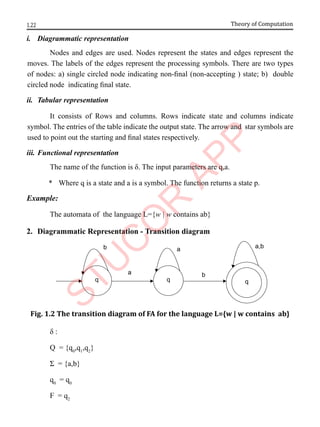
Finite state automaton is an abstract model of a computer. It is represented in the
figure. The components of the automaton are: Input Tape, Finite Control and Tape Head.
Input: String
1.21
Automata Fundamentals
Finite
State
Control
0 1 0 1 1
Input Tape
Tape Head
Fig. 1.1 The Working Model of a Finite Automata
Operation
String Processing (scans the string from left to right, one symbol at a time and
moves from state to state ) using its transition function.
Output: Yes/No (Accepted/Rejected)
1.5.1 Mathematical Representation
A Finite Automaton(FA) is represented by a 5-tuple machine.
M = (Q, Σ, δ, q0
, F)
* Q is a finite non-empty set of states
* Σ is a finite non-empty set of symbols
* ( an alphabet)‫‏‬
* δ : QX Σ → Q is the transition function
* q0
ϵ Q is the start state
* F ϵ Q is a set of final states
1. Transition function
It is a function which guides the automata in string processing. It takes two inputs
(a state, a symbol) and gives one output (state). Transition function can be represented in
three ways. They are,
1.22 Theory of Computation
i. Diagrammatic representation
Nodes and edges are used. Nodes represent the states and edges represent the
moves. The labels of the edges represent the processing symbols. There are two types
of nodes: a) single circled node indicating non-final (non-accepting ) state; b) double
circled node indicating final state.
ii. Tabular representation
It consists of Rows and columns. Rows indicate state and columns indicate
symbol. The entries of the table indicate the output state. The arrow and star symbols are
used to point out the starting and final states respectively.
iii. Functional representation
The name of the function is δ. The input parameters are q,a.
* Where q is a state and a is a symbol. The function returns a state p.
Example:
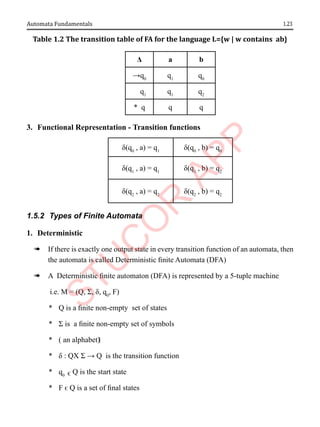
The automata of the language L={w | w contains ab}
2. Diagrammatic Representation - Transition diagram
b
a
a a,b
b
q q q
Fig. 1.2 The transition diagram of FA for the language L={w | w contains ab}
δ :
Q = {q0
,q1
,q2
}
Σ = {a,b}
q0
= q0
F = q2
1.23
Automata Fundamentals
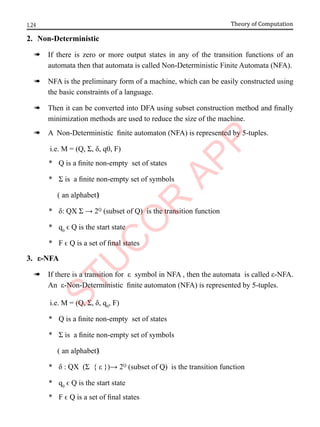
Table 1.2 The transition table of FA for the language L={w | w contains ab}
Δ a b
→q0
q1
q0
q1
q1
q2
* q q q
3. Functional Representation - Transition functions
δ(q0
, a) = q1
δ(q0
, b) = q0
δ(q1
, a) = q1
δ(q1
, b) = q2
δ(q2
, a) = q2
δ(q2
, b) = q2
1.5.2 Types of Finite Automata
1. Deterministic
à If there is exactly one output state in every transition function of an automata, then
the automata is called Deterministic finite Automata (DFA)
à A Deterministic finite automaton (DFA) is represented by a 5-tuple machine
i.e. M = (Q, Σ, δ, q0
, F)
* Q is a finite non-empty set of states
* Σ is a finite non-empty set of symbols
* ( an alphabet)‫‏‬
* δ : QX Σ → Q is the transition function
* q0 ϵ Q is the start state
* F ϵ Q is a set of final states
1.24 Theory of Computation
2. Non-Deterministic
à If there is zero or more output states in any of the transition functions of an
automata then that automata is called Non-Deterministic Finite Automata (NFA).
à NFA is the preliminary form of a machine, which can be easily constructed using
the basic constraints of a language.
à Then it can be converted into DFA using subset construction method and finally
minimization methods are used to reduce the size of the machine.
à A Non-Deterministic finite automaton (NFA) is represented by 5-tuples.
i.e. M = (Q, Σ, δ, q0, F)
* Q is a finite non-empty set of states
* Σ is a finite non-empty set of symbols
( an alphabet)‫‏‬
* δ: QX Σ → 2Q
(subset of Q) is the transition function
* q0
ϵ Q is the start state
* F ϵ Q is a set of final states
3. ε-NFA
à If there is a transition for ε symbol in NFA , then the automata is called ε-NFA.
An ε-Non-Deterministic finite automaton (NFA) is represented by 5-tuples.
i.e. M = (Q, Σ, δ, q0
, F)
* Q is a finite non-empty set of states
* Σ is a finite non-empty set of symbols
( an alphabet)‫‏‬
* δ : QX (Σ { ε })→ 2Q
(subset of Q) is the transition function
* q0
ϵ Q is the start state
* F ϵ Q is a set of final states
1.25
Automata Fundamentals
1.5.3 Language of an Automata
1. L(M)
à The language of machine M
à Set of all strings machine M accepts
2. L(DFA)
0
ˆ
{ ( , ) }
w q w p F
d = ∈
Where,
0
ˆ( , )
q w
d is an extended transition function that takes a state q0
and a string w and
returns a state p which is in F = Regular language.
3. L(NFA)
0
ˆ
{ ( , ) )
w q w F
d j
∩ ≠ - Regular language.
1.6 determInIstIc FInIte AutomAtA(dFA)
Deterministic finite Automata is a definite model of computation where there is
single output for every symbol from every state. The transition table of a DFA will be
complete and unambiguous. There would not be any empty entry and multiple entries.
1.6.1 String Processing
à An automata processes the given string and gives Yes/No as the output.
à During string processing, the symbols in the given string are processed one by one,
from left to right according to the moves defined by the transition functions of the
automata.
à A set of transition function defines an automata.
à During string processing, automata selects the transition function whose input
matches with the current state (state and symbol) and performs a move to output
state.
1.26 Theory of Computation
1.6.2 String Processing in DFA
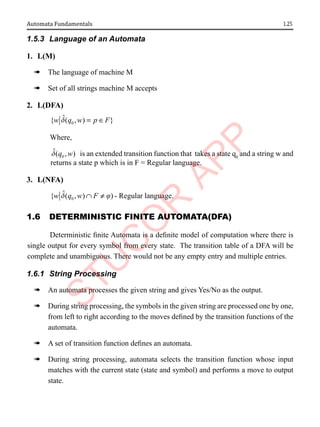
Problem 1.1
Let M = (Q, Σ, δ, q0
, F) where Q={ q0
, q1
,q2
}, Σ,={a,b} F={q2
}
δ a b
→q0
q1
q0
q1
q1
q2
* q2
q2
q2
à Show that the string w= bbabb is accepted by the given FA, M.
0 0
0
1
2
2
ˆ ˆ
( , ) ( , )
ˆ( , )
ˆ( , )
( , )
q bbabb q babb
= q abb
= q bb
q b
q F
d d
d
d
d
=
=
= ∈
à There is a path from starting state to final state.
b b a b b
q0 q0 q1 q2 q F
2
q0
Therefore the given string is accepted.
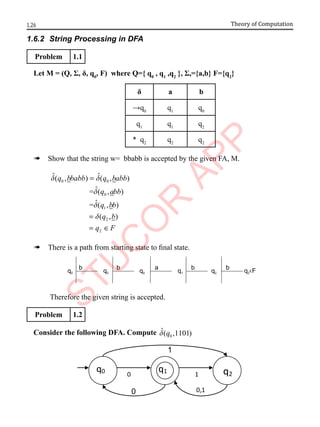
Problem 1.2
Consider the following DFA. Compute 0
ˆ( ,1101)
q
d
q0 q1
0 1 q2
0,1
1
0
1.27
Automata Fundamentals
( ) ( ) ( )
2 2
1 0
0 ,101
ˆ( ,1101) ,01 ,1
q F
q q q q
d = = ∈
=
=
So the string is not accepted.
1.7 non-determInIstIc FInIte AutomAtA(nFA)
NFA is the simple and initial model of computation .Constructing Automata to
recognize a Language includes the following steps:
r Design an NFA
r Convert NFA to DFA
r Minimize the DFA
1.7 .1 Designing NFA for a language
It is very easy to design NFA for a language by considering the common
(compulsory) part of the strings in a given language. There are two types of NFAs.
r NFA without ε-Transitions
r ε-NFA
à Designing NFA without ε-Transitions for a language
Problem 1.3
Design an NFA for the following finite languages over the alphabet {a,b}
a. L={ε}
b. L={a}
c. L={b}
d. L={a,b}
e. L={aa,ab}
f. L={aba,abb,aaa}
1.28 Theory of Computation
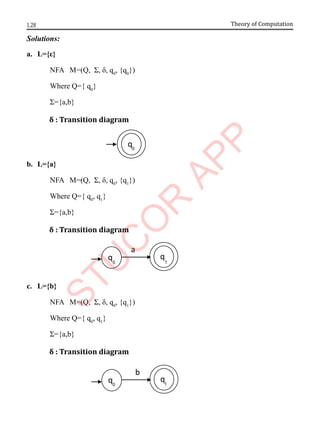
Solutions:
a. L={ε}
NFA M=(Q, Σ, δ, q0
, {q0
})
Where Q={ q0
}
Σ={a,b}
δ : Transition diagram
b. L={a}
NFA M=(Q, Σ, δ, q0
, {q1
})
Where Q={ q0
, q1
}
Σ={a,b}
δ : Transition diagram
c. L={b}
NFA M=(Q, Σ, δ, q0
, {q1
})
Where Q={ q0
, q1
}
Σ={a,b}
δ : Transition diagram
q0
a
q q
0 1
b
q q
0 1
1.29
Automata Fundamentals
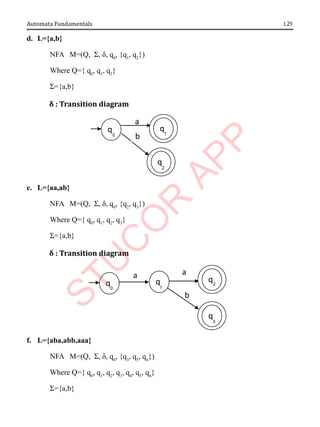
d. L={a,b}
NFA M=(Q, Σ, δ, q0
, {q1
, q2
})
Where Q={ q0
, q1
, q2
}
Σ={a,b}
δ : Transition diagram
e. L={aa,ab}
NFA M=(Q, Σ, δ, q0
, {q2
, q3
})
Where Q={ q0
, q1
, q2
, q3
}
Σ={a,b}
δ : Transition diagram
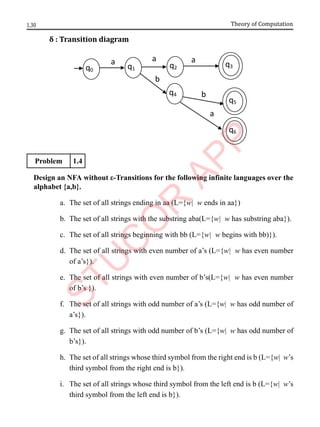
f. L={aba,abb,aaa}
NFA M=(Q, Σ, δ, q0
, {q3
, q5
, q6
})
Where Q={ q0
, q1
, q2
, q3
, q4
, q5
, q6
}
Σ={a,b}
0
a
q q
q
b
0 1
2
b
a
q q
q
q
a
0 1
2
3
1.30 Theory of Computation
δ : Transition diagram
Problem 1.4
Design an NFA without ε-Transitions for the following infinite languages over the
alphabet {a,b}.
a. The set of all strings ending in aa (L={w| w ends in aa})
b. The set of all strings with the substring aba(L={w| w has substring aba}).
c. The set of all strings beginning with bb (L={w| w begins with bb)}).
d. The set of all strings with even number of a’s (L={w| w has even number
of a’s}).
e. The set of all strings with even number of b’s(L={w| w has even number
of b’s }).
f. The set of all strings with odd number of a’s (L={w| w has odd number of
a’s}).
g. The set of all strings with odd number of b’s (L={w| w has odd number of
b’s}).
h. The set of all strings whose third symbol from the right end is b (L={w| w’s
third symbol from the right end is b}).
i. The set of all strings whose third symbol from the left end is b (L={w| w’s
third symbol from the left end is b}).
b
a
b
a
a
q0 q1
q3
q5
q2
q4
q6
a
1.31
Automata Fundamentals
Solutions:
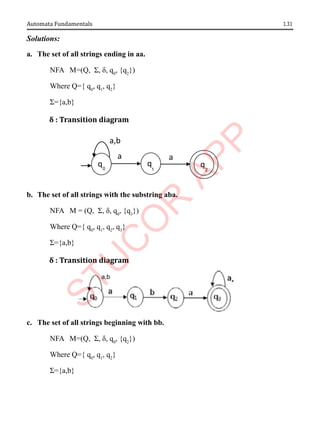
a. The set of all strings ending in aa.
NFA M=(Q, Σ, δ, q0
, {q2
})
Where Q={ q0
, q1
, q2
}
Σ={a,b}
δ : Transition diagram
b. The set of all strings with the substring aba.
NFA M = (Q, Σ, δ, q0
, {q3
})
Where Q={ q0
, q1
, q2
, q3
}
Σ={a,b}
δ : Transition diagram
a,b
c. The set of all strings beginning with bb.
NFA M=(Q, Σ, δ, q0
, {q2
})
Where Q={ q0
, q1
, q2
}
Σ={a,b}
a,b
a
q q
q
a
0 1 2
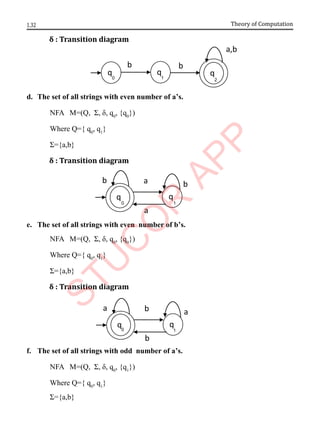
1.32 Theory of Computation
δ : Transition diagram
d. The set of all strings with even number of a’s.
NFA M=(Q, Σ, δ, q0
, {q0
})
Where Q={ q0
, q1
}
Σ={a,b}
δ : Transition diagram
e. The set of all strings with even number of b’s.
NFA M=(Q, Σ, δ, q0
, {q0
})
Where Q={ q0
, q1
}
Σ={a,b}
δ : Transition diagram
f. The set of all strings with odd number of a’s.
NFA M=(Q, Σ, δ, q0
, {q1
})
Where Q={ q0
, q1
}
Σ={a,b}
a,b
b
q q
q
b
0 1 2
b
a
a
q q
b
0 1
a
b
b
q q
a
0 1
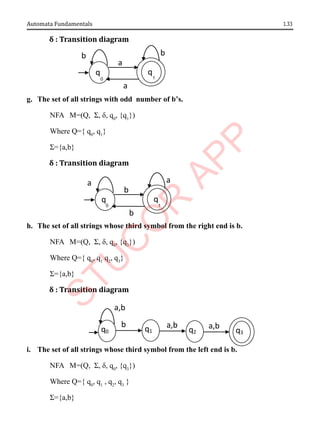
1.33
Automata Fundamentals
δ : Transition diagram
g. The set of all strings with odd number of b’s.
NFA M=(Q, Σ, δ, q0
, {q1
})
Where Q={ q0
, q1
}
Σ={a,b}
δ : Transition diagram
h. The set of all strings whose third symbol from the right end is b.
NFA M=(Q, Σ, δ, q0
, {q3
})
Where Q={ q0
, q1
q2
, q3
}
Σ={a,b}
δ : Transition diagram
i. The set of all strings whose third symbol from the left end is b.
NFA M=(Q, Σ, δ, q0
, {q3
})
Where Q={ q0
, q1
, q2
, q3
}
Σ={a,b}
b
a
a
q q
b
0 1
a
b
b
q q
a
0 1
a,b
q2
a,b
b
q0 q3
q1
a,b
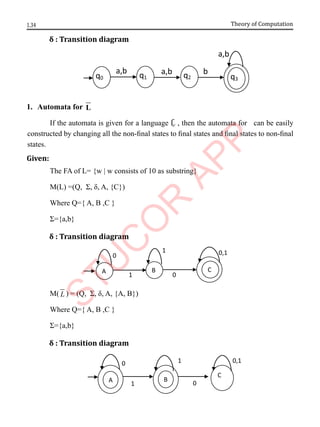
1.34 Theory of Computation
δ : Transition diagram
1. Automata for L
If the automata is given for a language Ḹ , then the automata for can be easily
constructed by changing all the non-final states to final states and final states to non-final
states.
Given:
The FA of L= {w | w consists of 10 as substring}
M(L) =(Q, Σ, δ, A, {C})
Where Q={ A, B ,C }
Σ={a,b}
δ : Transition diagram
M( L ) = (Q, Σ, δ, A, {A, B})
Where Q={ A, B ,C }
Σ={a,b}
δ : Transition diagram
b
q2
a,b
a,b
q0 q3
q1
a,b
0,1
1
C
1 0
B
A
0
0,1
0
1
1
A C
B
A
0
1.35
Automata Fundamentals
2. Automata for 1 2
L L

The intersection of two regular languages can be constructed by taking Cartesian
product of states.
Let, M (L1
) = (Q1
, Σ, δ1
, q1
, F1
)
M (L2
) = (Q2
, Σ, δ2
, q2
, F2
)
Then M ( 1 2
L L
∩ ) = (Q2
X Q2
, Σ, δ, (q1
,q2
), F2
X F2
)
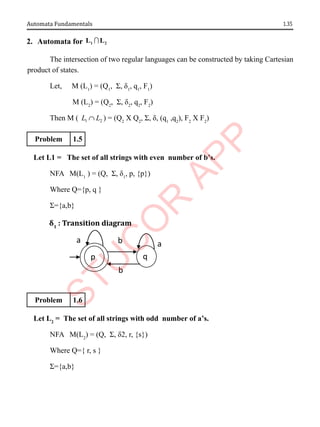
Problem 1.5
Let L1 = The set of all strings with even number of b’s.
NFA M(L1
) = (Q, Σ, δ1
, p, {p})
Where Q={p, q }
Σ={a,b}
δ1
: Transition diagram
Problem 1.6
Let L2
= The set of all strings with odd number of a’s.
NFA M(L2
) = (Q, Σ, δ2, r, {s})
Where Q={ r, s }
Σ={a,b}
a
b
b
p q
a
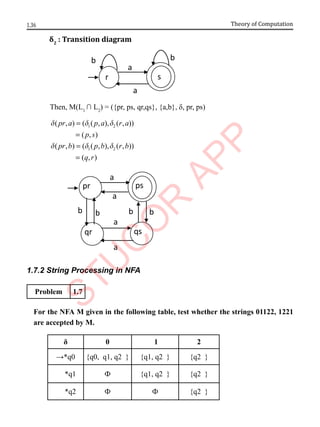
1.36 Theory of Computation
δ2
: Transition diagram
Then, M(L1
∩ L2
) = ({pr, ps, qr,qs}, {a,b}, δ, pr, ps)
1 2
1 2
( , ) ( ( , ), ( , ))
( , )
( , ) ( ( , ), ( , ))
( , )
pr a p a r a
p s
pr b p b r b
q r
d d d
d d d
=
=
=
=
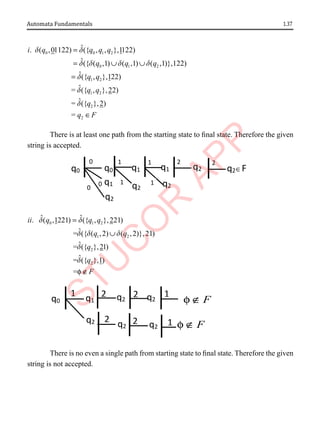
1.7.2 String Processing in NFA
Problem 1.7
For the NFA M given in the following table, test whether the strings 01122, 1221
are accepted by M.
δ 0 1 2
→*q0 {q0, q1, q2 } {q1, q2 } {q2 }
*q1 Ф {q1, q2 } {q2 }
*q2 Ф Ф {q2 }
b
a
a
r s
b
b
a
b
a
a
b
a
b
pr ps
qr qs
1.37
Automata Fundamentals
0 0 1 2
0 1 2
1 2
1 2
2
ˆ
. ( ,01122) ({ , , },1122)
ˆ({ ( ,1) ( ,1) ( ,1)},122)
ˆ({ , },122)
ˆ
= ({ , },22)
ˆ
= ({
i q q q q
q q q
q q
q q
q
d d
d d d d
d
d
d
=
= ∪ ∪
=
2
},2)
= q F
∈
There is at least one path from the starting state to final state. Therefore the given
string is accepted.
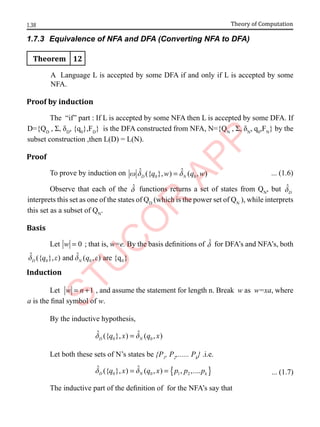
0 1 2
1 2
2
2
ˆ ˆ
. ( ,1221) ({ , },221)
ˆ
= ({ ( ,2) ( ,2)},21)
ˆ
= ({ },21)
ˆ
= ({ },1)
=
ii q q q
q q
q
q
F
d d
d d d
d
d
f
=
∪
∉
There is no even a single path from starting state to final state. Therefore the given
string is not accepted.
1
q2
q1 q2
q2
0
q1 q1
2
q0
0
q0
1 1 2
q2 q2∈F
0 1
q2 q2 q2
q2
q2
q1
2 1
q0
1 2
2 1 F
∉
f
2
F
∉
f
1.38 Theory of Computation
1.7.3 Equivalence of NFA and DFA (Converting NFA to DFA)
Theorem 12
A Language L is accepted by some DFA if and only if L is accepted by some
NFA.
Proof by induction
The “if” part : If L is accepted by some NFA then L is accepted by some DFA. If
D={QD
, Σ, δD
, {q0
},FD
} is the DFA constructed from NFA, N={QN
, Σ, δN
, q0
,FN
} by the
subset construction ,then L(D) = L(N).
Proof
To prove by induction on 0 0
ˆ ˆ
({ }, ) ( , )
D N
q w q w
w d d
= ... (1.6)
Observe that each of the d̂ functions returns a set of states from QN
, but ˆ
D
d
interprets this set as one of the states of QD
(which is the power set of QN
), while interprets
this set as a subset of QN
.
Basis
Let 0
w = ; that is, w=e. By the basis definitions of d̂ for DFA’s and NFA’s, both
0 0 0
ˆ ˆ
({ }, ) and ( , ) are {q }
D N
q q
d e d e
Induction
Let 1
w n
= + , and assume the statement for length n. Break w as w=xa, where
a is the final symbol of w.
By the inductive hypothesis,
0 0
ˆ ˆ
({ }, ) ( , )
D N
q x q x
d d
=
Let both these sets of N’s states be {P1
, P2
,...... Pk
} .i.e.
{ }
0 0 1 2
ˆ ˆ
({ }, ) ( , ) , ,....
D N k
q x q x p p p
d d
= = ... (1.7)
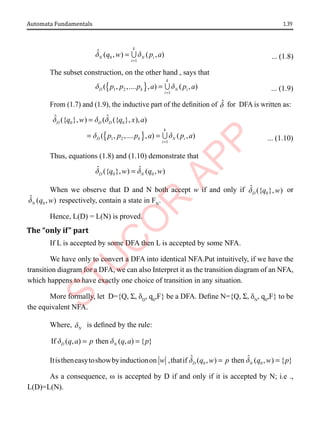
The inductive part of the definition of for the NFA’s say that
1.39
Automata Fundamentals
0
1
ˆ ( , ) ( , )
k
N N i
i
q w p a
d d
=
=  ... (1.8)
The subset construction, on the other hand , says that
{ }
1 2
1
( , ,.... , ) ( , )
k
D k N i
i
p p p a p a
d d
=
=  ... (1.9)
From (1.7) and (1.9), the inductive part of the definition of d̂ for DFA is written as:
{ }
0 0
1 2
1
ˆ ˆ
({ }, ) ( ({ }, ), )
( , ,.... , ) ( , )
D D D
k
D k N i
i
q w q x a
p p p a p a
d d d
d d
=
=
= =  ... (1.10)
Thus, equations (1.8) and (1.10) demonstrate that
0 0
ˆ ˆ
({ }, ) ( , )
D N
q w q w
d d
=
When we observe that D and N both accept w if and only if 0
ˆ ({ }, )
D q w
d or
0
ˆ ( , )
N q w
d respectively, contain a state in FN
.
Hence, L(D) = L(N) is proved.
The “only if” part
If L is accepted by some DFA then L is accepted by some NFA.
We have only to convert a DFA into identical NFA.Put intuitively, if we have the
transition diagram for a DFA, we can also Interpret it as the transition diagram of an NFA,
which happens to have exactly one choice of transition in any situation.
More formally, let D={Q, Σ, δD
, q0
,F} be a DFA. Define N={Q, Σ, δN
, q0
,F} to be
the equivalent NFA.
Where, N
d is defined by the rule:
If ( , ) then ( , ) { }
D N
q a p q a p
d d
= =
Itistheneasytoshowbyinductionon w ,thatif 0 0
ˆ ˆ
( , ) then ( , ) { }
D N
q w p q w p
d d
= =
As a consequence, ω is accepted by D if and only if it is accepted by N; i.e .,
L(D)=L(N).
1.40 Theory of Computation
Subset construction method (with ‘Lazy Evaluation’) is used to convert NFA to
DFA. In this method the transition functions are generated only for reachable states.
Method 1
Steps
1. Include the starting state of NFA (q0) in DFA as starting state of DFA.
2. Find the transition for all the symbols from q0
3. If the output state is new state, include it in DFA and find the transition for
all the symbols from that state.
4. Repeat step3 until there are no more new states.
5. The state which includes final state of NFA is the final state of DFA.
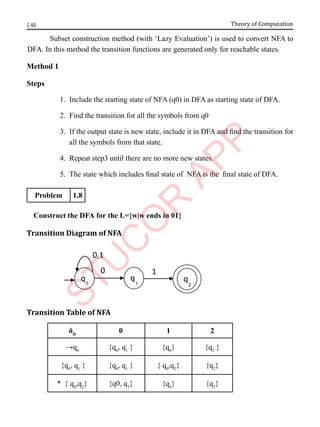
Problem 1.8
Construct the DFA for the L={w|w ends in 01}
Transition Diagram of NFA
Transition Table of NFA
δD
0 1 2
→q0
{q0
, q1
} {q0
} {q2
}
{q0
, q1
} {q0
, q1
} { q0
,q2
} {q2
}
* { q0
,q2
} {q0, q1
} {q0
} {q2
}
0,1
0
q q
q
1
0 1 2
1.41
Automata Fundamentals
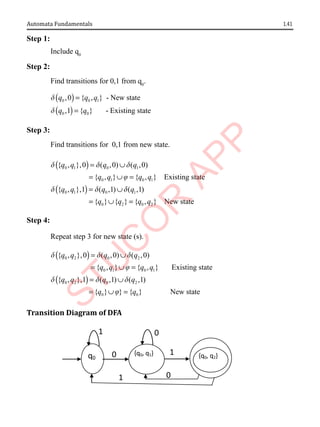
Step 1:
Include q0
Step 2:
Find transitions for 0,1 from q0
.
( )
( )
0 0 1
0 0
,0 { , } - New state
,1 { } - Existing state
q q q
q q
d
d
=
=
Step 3:
Find transitions for 0,1 from new state.
( )
( )
0 1 0 1
0 1 0 1
0 1 0 1
0 2 0 2
{ , },0 ( ,0) ( ,0)
{ , } { , } Existing state
{ , },1 ( ,1) ( ,1)
{ } { } { , } New state
q q q q
q q q q
q q q q
q q q q
d d d
j
d d d
= ∪
= ∪ =
= ∪
= ∪ =
Step 4:
Repeat step 3 for new state (s).
( )
( )
0 2 0 2
0 1 0 1
0 2 0 2
0 0
{ , },0 ( ,0) ( ,0)
{ , } { , } Existing state
{ , },1 ( ,1) ( ,1)
{ } } { } New state
q q q q
q q q q
q q q q
q q
d d d
j
d d d
j
= ∪
= ∪ =
= ∪
= ∪ =
Transition Diagram of DFA
0
1
1 0
0
1
q0
{q0, q1} {q0, q2}
1.42 Theory of Computation
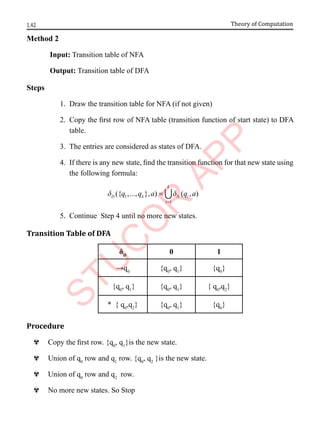
Method 2
Input: Transition table of NFA
Output: Transition table of DFA
Steps
1. Draw the transition table for NFA (if not given)
2. Copy the first row of NFA table (transition function of start state) to DFA
table.
3. The entries are considered as states of DFA.
4. If there is any new state, find the transition function for that new state using
the following formula:
1
1
({ ,..., }, ) ( , )
k
D k N i
i
q q a q a
d d
=
= 
5. Continue Step 4 until no more new states.
Transition Table of DFA
δD
0 1
→q0
{q0
, q1
} {q0
}
{q0
, q1
} {q0
, q1
} { q0
,q2
}
* { q0
,q2
} {q0
, q1
} {q0
}
Procedure
^ Copy the first row. {q0
, q1
}is the new state.
^ Union of q0
row and q1
row. {q0
, q2
}is the new state.
^ Union of q0
row and q2
row.
^ No more new states. So Stop
1.43
Automata Fundamentals
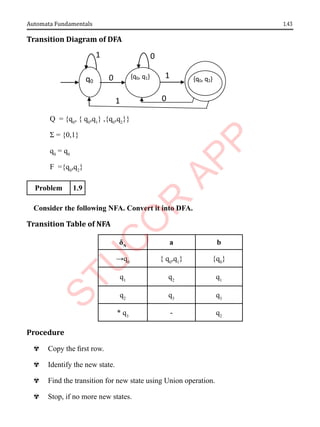
Transition Diagram of DFA
Q = {q0
, { q0
,q1
} ,{q0
,q2
}}
Σ = {0,1}
q0
= q0
F ={q0
,q2
}
Problem 1.9
Consider the following NFA. Convert it into DFA.
Transition Table of NFA
δN
a b
→q0
{ q0
,q1
} {q0
}
q1
q2
q1
q2
q3
q3
* q3
- q2
Procedure
^ Copy the first row.
^ Identify the new state.
^ Find the transition for new state using Union operation.
^ Stop, if no more new states.
0
1
1 0
0
1
q0
{q0, q1} {q0, q2}
1.44 Theory of Computation
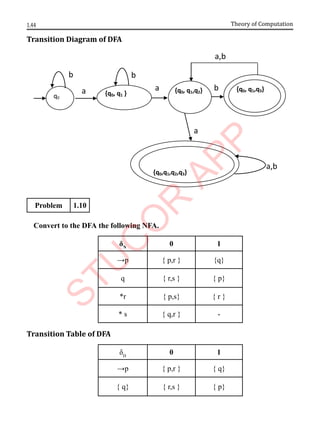
Transition Diagram of DFA
Problem 1.10
Convert to the DFA the following NFA.
δN
0 1
→p { p,r } {q}
q { r,s } { p}
*r { p,s} { r }
* s { q,r } -
Transition Table of DFA
δD
0 1
→p { p,r } { q}
{ q} { r,s } { p}
a
b b
a b
a
a,b
q0
{q0, q1 } {q0, q1,q2} {q0, q1,q3}
{q0,q1,q2,q3}
a,b
1.45
Automata Fundamentals
*{ p,r } { p,r,s } { q,r }
*{ r,s } { p,q,r,s } { r}
*{ p,r,s } { p,q,r,s } { q,r }
*{ r} { p,s} { r }
*{ p,q,r,s } { p,q,r,s } { p,q,r }
*{ p,s} { p,q,r } { q}
*{ p,q,r } { p,r,s } { p,q,r }
*{ q,r } { p,r,s } { p,r }
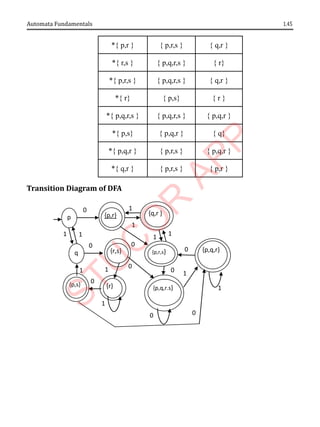
Transition Diagram of DFA
0
0
1
0
1
0
1
1 0
1
0 0
1
1
0
1
1
1
1
0
{r,s}
{r}
p
{q,r }
{p,r}
q {p,r,s}
{p,s}
{p,q,r.s}
{p,q,r}
1.46 Theory of Computation
Problem 1.11
Convert the following NFA to a DFA and informally describe the language it
accepts.
Transition table of given NFA
δN
0 1
→p { p,q } { p}
q { r,s } { t}
r { p,r} { t }
* s - -
*t - -
Transition table of DFA
δD
0 1
→p { p,q } { p}
{ p,q} {p,q, r,s } { p,t}
*{ p,q,r,s } { p,q,r,s } { p,t }
*{p,t} { p,q } { p}
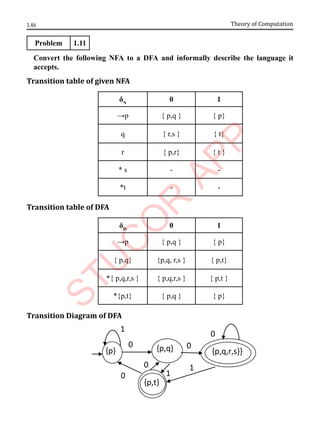
Transition Diagram of DFA
0
0
1
1
0
0
1
{p} {p,q,r,s}}
{p,q}
{p,t}
0
1.47
Automata Fundamentals
Problem 1.12
Convert to a DFA the following NFA.
0 1
→p {q,s} {q}
*q {r} {q,r}
r {s} {p}
*s - {p}
Transition Diagram of DFA
Language of DFA
à The language of a DFA is defined by,
0
ˆ( , )
L(DFA)={w q w is in F}
d
{q,s}
{s}
{r}
[q,
s]
{r,s}
{q,r}
{p,q,r}
{q,r,s}
{p}
1
0
0
1
1
1
1
1 1
0
0
0
0
0
1
1.48 Theory of Computation
à And the language of a NFA is defined by,
0
ˆ
( ) { | ( , ) }
L NFA w q w F
d j
= ∩ ≠
* Where q0
is the start state
* F is the set of final states and
* w is a string.
* L(DFA) and L(NFA) are called Regular Languages.
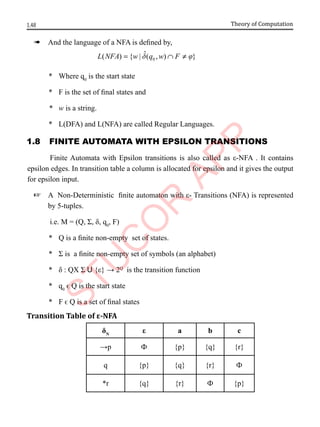
1.8 FInIte AutomAtA wIth ePsIlon trAnsItIons
Finite Automata with Epsilon transitions is also called as ε-NFA . It contains
epsilon edges. In transition table a column is allocated for epsilon and it gives the output
for epsilon input.
+ A Non-Deterministic finite automaton with ε- Transitions (NFA) is represented
by 5-tuples.
i.e. M = (Q, Σ, δ, q0
, F)
* Q is a finite non-empty set of states.
* Σ is a finite non-empty set of symbols (an alphabet)
* δ : QX Σ U {ε} → 2Q
is the transition function
* q0
ϵ Q is the start state
* F ϵ Q is a set of final states
Transition Table of ε-NFA
δN
ε a b c
→p Ф {p} {q} {r}
q {p} {q} {r} Ф
*r {q} {r} Ф {p}
1.49
Automata Fundamentals
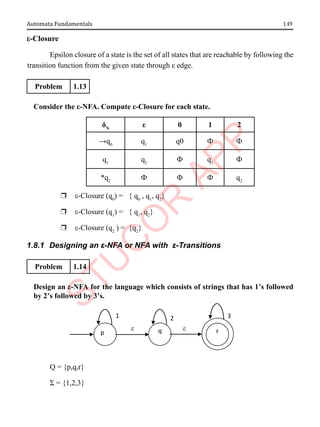
ε-Closure
Epsilon closure of a state is the set of all states that are reachable by following the
transition function from the given state through ε edge.
Problem 1.13
Consider the ε-NFA. Compute ε-Closure for each state.
δN
ε 0 1 2
→q0
q1
q0 Ф Ф
q1
q2
Ф q1
Ф
*q2
Ф Ф Ф q2
r ε-Closure (q0
) = { q0
, q1
, q2
}
r ε-Closure (q1
) = { q1
, q2
}
r ε-Closure (q2
) = {q2
}
1.8.1 Designing an ε-NFA or NFA with ε-Transitions
Problem 1.14
Design an ε-NFA for the language which consists of strings that has 1’s followed
by 2’s followed by 3’s.
Q = {p,q,r}
Σ = {1,2,3}
1 3
2
e
e
p q r
1.50 Theory of Computation
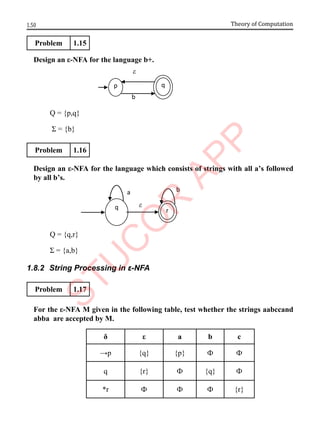
Problem 1.15
Design an ε-NFA for the language b+.
Q = {p,q}
Σ = {b}
Problem 1.16
Design an ε-NFA for the language which consists of strings with all a’s followed
by all b’s.
Q = {q,r}
Σ = {a,b}
1.8.2 String Processing in ε-NFA
Problem 1.17
For the ε-NFA M given in the following table, test whether the strings aabccand
abba are accepted by M.
δ ε a b c
→p {q} {p} Ф Ф
q {r} Ф {q} Ф
*r Ф Ф Ф {r}
b
e
p q
a b
q r
e
1.51
Automata Fundamentals
Step 1:
Compute ε-Closure [states that can be reached by traveling along zero or more ε
arrows] for all states .
r ε-Closure (p) = {p,q,r} ˆ( , )
p
d e
 
 
r ε-Closure (q) = {q,r}
ˆ( , )
q
d e
 
 
r ε-Closure (r ) = {r} ˆ( , )
r
d e
 
 
Step2:
Start with ε-closure (p)= {p,q,r}
Where, p is the starting state of given ε –NFA.
1. (p)= {p,q,r}
ˆ({ , , }, )
ˆ( ( ( , ) ( , ) ( , )), )
ˆ( ( ), )
ˆ({ , , }, )
ˆ
p q r aabcc
closure p a q a r a abcc
closure p abcc
p q r abcc
d
d e d d d
d e
d
= − ∪ ∪
= −
=
= ( ( ( , ) ( , ) ( , )), )
ˆ({ , , }, )
ˆ( ( ( , ) ( , ) ( , )), )
ˆ({ , }, )
closure p a q a r a bcc
p q r bcc
closure p b q b r b cc
q r cc
d e d d d
d
d e d d d
d
− ∪ ∪
=
= − ∪ ∪
=
ˆ( ( ( , ) ( , )), )
ˆ({ , }, )
closure q c r c c
q r c
r F
d e d d
d
= − ∪
=
= ∈
^ Therefore the given string is accepted.
1.52 Theory of Computation
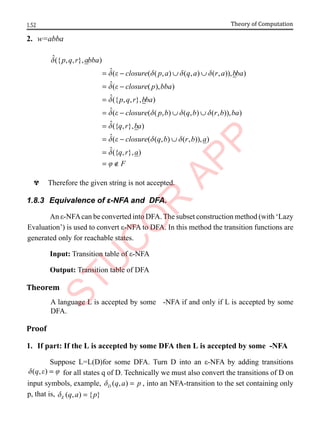
2. w=abba
ˆ({ , , }, )
ˆ( ( ( , ) ( , ) ( , )), )
ˆ( ( ), )
ˆ({ , , }, )
ˆ
p q r abba
closure p a q a r a bba
closure p bba
p q r bba
d
d e d d d
d e
d
d
= − ∪ ∪
= −
=
= ( ( ( , ) ( , ) ( , )), )
ˆ({ , }, )
ˆ( ( ( , ) ( , )), )
ˆ({ , }, )
closure p b q b r b ba
q r ba
closure q b r b a
q r a
F
e d d d
d
d e d d
d
j
− ∪ ∪
=
= − ∪
=
= ∉
^ Therefore the given string is not accepted.
1.8.3 Equivalence of ε-NFA and DFA.
An ε-NFAcan be converted into DFA. The subset construction method (with ‘Lazy
Evaluation’) is used to convert ε-NFA to DFA. In this method the transition functions are
generated only for reachable states.
Input: Transition table of ε-NFA
Output: Transition table of DFA
Theorem
A language L is accepted by some -NFA if and only if L is accepted by some
DFA.
Proof
1. If part: If the L is accepted by some DFA then L is accepted by some -NFA
Suppose L=L(D)for some DFA. Turn D into an ε-NFA by adding transitions
( , )
q
d e j
= for all states q of D. Technically we must also convert the transitions of D on
input symbols, example, ( , )
D q a p
d = , into an NFA-transition to the set containing only
p, that is, ( , ) { }
E q a p
d =
1.53
Automata Fundamentals
Thus, the transitions of E and D are the same , but E explicitly states that there are
no transitions out of any state on ε.
2. Only -If part: If the L is accepted by some -NFA then L is accepted by some
DFA.
Let E = {QE
, Σ, δE
, q0
, FE
} be an ε -NFA. Apply the modified subset construction
to produce the DFA.
D = {QD
, Σ, δD
, qD
, FD
}
^ We need to show that L(D) = L(E), and we do so by showing that the extended
transition functions of E and D are the same.
^ Formally, we show 0
ˆ ˆ
( , ) ( , )
E D D
q w q w
d d
= by induction on the length of ω .
Basics
* If w then w=ε.
* We know 0 0
ˆ ( , ) ( )
E q ECLOSURE q
d e =
* We also know that 0
( )
D
q ECLOSURE q
= , because that is how the start state
of D is defined.
* Finally, for a DFA, we know that ˆ( , )
p p
d e = for any state p, so in particular
0
ˆ ( , ) ( )
D D
q ECLOSURE q
d e = .
* We have thus proved that 0
ˆ ˆ
( , ) ( , )
E D D
q q
d e d e
= .
Induction
* Suppose w=xa.
r Where, a is the final symbol of w and assume that the statement holds
for x.
* That is, 0
ˆ ˆ
( , ) ( , )
E D D
q x q x
d d
= .
* Let both these sets of states be {p1
, p2
,....pk
}. By the definition of d̂ for ε-
NFA’s, we compute 0
ˆ ( , )
E q w
d by,
1.54 Theory of Computation
i. Let {r1
, r2
,....rm
} be 1 ( , )
k
i E i
p a
d
=
 .
ii. Then 0 1
ˆ ( , ) ( )
m
E j j
q w ECLOSURE r
d =
= 
* If we examine the construction of DFA D in the modified subset construction,
we see that δD
({p1
, p2
,....pk
},a) is constructed by the same above two steps (i)
and (ii).
* Thus, ˆ ( , )
D D
q w
d , which is δD
({p1
, p2
,....pk
},a) is the same set as 0
ˆ ( , )
E q w
d .
* We have now proved that 0
ˆ ˆ
( , ) ( , )
E D D
q w q w
d d
= and completed the inductive
part.
Steps to convert ε-NFA to DFA
a. Compute the ε-Closure for each state.
b. Draw the transition table for ε-NFA (if not given)
c. Start state of DFA is ε-Closure(q0
)
• Where q0
is the start state of ε-NFA .
d. Find the transition function for ε-Closure(q0
).
e. The entries are considered as states of DFA.
f. If there is any new state, find the transition function for that new state using
the following formula:
1
1
({ ,..., }, ) ( ( , ))
k
D k N i
i
q q a closure q a
d e d
=
= −

g. Continue the above step ‘f’ until no more new states.
1.8.4 Applications and Limitations of FA
1. Applications of FA
i. Text Search
a. News Analyst - Searches on-line news
1.55
Automata Fundamentals
b. Shopping robot – Searches current prices charged for an item
c. Amazon.com - Search some keywords
d. Lexical analyzer of a compiler - Identifies the token
* Verifying the working of a physical system
* Design and construction of Softwares
ii. Advantages of Finite set of states in Automata
^ Implement a system with a fixed set of resources
^ Implementing a system within a hardware circuit
^ Complementing a system using software with a finite set of codes.
2. Limitations of FA
^ Some languages are not regular – i.e. we cannot construct FA
Example:
* B = {0n
1n
| n ≥ 0} is NOT regular!
* L=wwR
* L=WW
* L=WCWR
* C = { w | w has equal number of 1s and 0s}
1.8.5 Complex Problems
1. Design a NFA that accepts set of all strings that begins with 00 and ends with 11.
Convert it into DFA.
Analysis
^ Here we have two parts:
r Begins with string1
1.56 Theory of Computation
r Ends with string2
^ Let string1 be considered as s1s2 and string 2 be considered as s3s4 where s1,s2,s3
and s4 are substrings.
^ For all s2 and s3, if s2≠s3, we can easily construct the NFA.
^ In this problem there is no such s2 and s3 where s2=s3. Therefore we can construct
the NFA in one step as follows:
^ The DFA of this machine is given below:
δD
0 1
→ {A} {B} -
{B} {C} -
{C} {C} {C,D}
{C,D} {C} {C,D,E}
* {C,D,E} {C} {C,D,E}
Note: It is difficult to draw the NFA for the following languages wheres2=s3.
^ Set of all strings that begins with 01 and ends with 11 [s2=1]
^ Set of all strings that begins with 01 and ends with 10 [s2=1]
^ Set of all strings that begins with 01 and ends with 01 [s2=01]
^ Set of all strings that begins with 10 and ends with 10 [s2=10]
^ Set of all strings that begins with 00 and ends with 00 [s2=00]
^ Set of all strings that begins with 11 and ends with 11 [s2=00]
1
1
0
0
A B C D E
0,1
1.57
Automata Fundamentals
For these kinds of problems we can use the intersection property of regular
languages.
Problem 1.18
Design a DFA that accepts set of all strings that begins with 01 and ends with 11.
à There are three steps, that are given below.
Step 1:
Design a DFA that accepts set of all strings that begins with 01
Step 2:
Design a DFA that accepts set of all strings that ends with 11.
Step 3:
Intersection between two DFAs (Lazy Evaluation-processing only reachable
nodes)
0 1
0,1
A B C
1
1
0,1
D E F
1
0
1
0
0
0
0
{AD} {BD} {CD} {CDE} {CDEF}
1
1.58 Theory of Computation
1.8.6 PROBLEMS
1. Consider the following ε-NFA. Covert it into DFA
Transition Table of ε-NFA
δN
ε a b c
→p Ф {p} {q} {r}
q {p} {q} {r} Ф
*r {q} {r} Ф {p}
Step 1:
Compute ε-Closure [states that can be reached by traveling along zero or more ε
arrows] for all states.
r ε-Closure (p) = {p}
ˆ( , )
p
d e
 
 
r ε-Closure (q) = {p,q}
ˆ( , )
q
d e
 
 
r ε-Closure (r ) = {p,q,r} ˆ( , )
r
d e
 
 
Step 2:
Start with ε-closure (p)= {p}
Where, p is the starting state of given ε –NFA.
Step 3:
Find the transition for{p}
({ }, ) ( ( , ))
( )
{ }
({ }, ) ( ( , ))
( )
D N
D N
p a closure p a
closure p
p New State
p b closure p b
closure q
d e d
e
d e d
e
= −
= −
=
= −
= −
{ , }
({ }, ) ( ( , ))
( )
{ , , }
D N
p q New State
p c closure p c
closure r
p q r
d e d
e
=
= −
= −
=
1.59
Automata Fundamentals
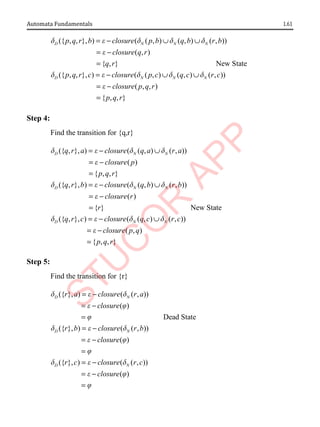
Step 4:
Find the transition for {p,q}
({ , }, ) ( ( , ) ( , ))
( , )
{ , }
({ , }, ) ( ( , ) ( , ))
( , )
{ , , }
({
D N N
D N N
D
p q a closure p a q a
closure p q
p q
p q b closure p b q b
closure q r
p q r
d e d d
e
d e d d
e
d
= − ∪
= −
=
= − ∪
= −
=
, }, ) ( ( , ) ( , ))
( )
{ , , }
N N
p q c closure p c q c
closure r
p q r
e d d
e
= − ∪
= −
=
Step 5:
Find the transition for {p,q,r}
({ , , }, ) ( ( , ) ( , ) ( , ))
( , , )
{ , , }
({ , , }, ) ( ( , ) ( , ) ( , ))
( ,
D N N N
D N N N
p q r a closure p a q a r a
closure p q r
p q r
p q r b closure p b q b r b
closure q
d e d d d
e
d e d d d
e
= − ∪ ∪
= −
=
= − ∪ ∪
= − )
{ , , }
({ , , }, ) ( ( , ) ( , ) ( , ))
( , )
{ , , }
D N N N
r
p q r
p q r c closure p c q c r c
closure p r
p q r
d e d d d
e
=
= − ∪ ∪
= −
=
Step 6:
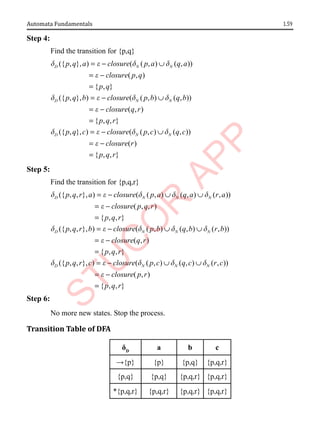
No more new states. Stop the process.
Transition Table of DFA
δD
a b c
→{p} {p} {p,q} {p,q,r}
{p,q} {p,q} {p,q,r} {p,q,r}
*{p,q,r} {p,q,r} {p,q,r} {p,q,r}
1.60 Theory of Computation
Transition Diagram of DFA
2. Consider the following ε-NFA. Covert it into DFA
δ ε a b c
→p {q,r} Ф {q} {r}
q Ф {p} {r} {p,q}
*r Ф Ф Ф Ф
Step 1:
Compute ε-Closure [states that can be reached by traveling along zero or more ε
arrows] for all states .
r ε-Closure (p) = {p,q,r}
ˆ( , )
p
d e
 
 
r ε-Closure (q) = {q}
ˆ( , )
q
d e
 
 
r ε-Closure (r ) = {r}
ˆ( , )
r
d e
 
 
Step 2:
Start with ε-closure (p)= {p,q,r}
Where, p is the starting state of given ε - NFA
Step 3:
Find the transition for {p,q,r}
({ , , }, ) ( ( , ) ( , ) ( , ))
( )
{ , , }
D N N N
p q r a closure p a q a r a
closure p
p q r
d e d d d
e
= − ∪ ∪
= −
=
c
b
a a,b,c
b,c
a
{p} {p,q} {p,q,r}
1.61
Automata Fundamentals
({ , , }, ) ( ( , ) ( , ) ( , ))
( , )
{ , } New State
({ , , }, ) (
D N N N
D
p q r b closure p b q b r b
closure q r
q r
p q r c closure
d e d d d
e
d e
= − ∪ ∪
= −
=
= − ( , ) ( , ) ( , ))
( , , )
{ , , }
N N N
p c q c r c
closure p q r
p q r
d d d
e
∪ ∪
= −
=
Step 4:
Find the transition for {q,r}
({ , }, ) ( ( , ) ( , ))
( )
{ , , }
({ , }, ) ( ( , ) ( , ))
( )
{ }
D N N
D N N
q r a closure q a r a
closure p
p q r
q r b closure q b r b
closure r
r
d e d d
e
d e d d
e
= − ∪
= −
=
= − ∪
= −
= New State
({ , }, ) ( ( , ) ( , ))
( , )
{ , , }
D N N
q r c closure q c r c
closure p q
p q r
d e d d
e
= − ∪
= −
=
Step 5:
Find the transition for {r}
({ }, ) ( ( , ))
( )
Dead State
({ }, ) ( ( , ))
( )
({ }
D N
D N
D
r a closure r a
closure
r b closure r b
closure
r
d e d
e j
j
d e d
e j
j
d
= −
= −
=
= −
= −
=
, ) ( ( , ))
( )
N
c closure r c
closure
e d
e j
j
= −
= −
=
1.62 Theory of Computation
Step 6:
No more new states. Stop the process.
Transition Table of DFA
δD
a b c
→*{p,q,r} {p,q,r} {q,r} {p,q,r}
*{q,r} {p,q,r} {r} {p,q,r}
*{r} Ф Ф Ф
Transition Diagram of DFA
3. Consider the following ε-NFA. Covert a,b,c it into DFA.
Transition Table of ε-NFA
δN
ε 0 1 2
→ q0
q1
q0
Ф Ф
q1
q2
Ф q1
Ф
*q2
Ф Ф Ф q2
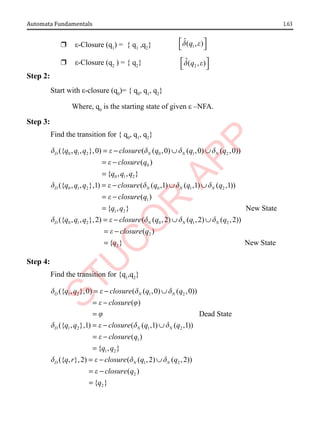
Step 1:
Compute ε-Closure [states that can be reached by traveling along zero or more ε
arrows] for all states .
r ε-Closure (q0
) = { q0
, q1
, q2
} 0
ˆ( , )
q
d e
 
 
b
b
a,c
{q,r} {r}
Ф
{p,q,r}
a,c
1.63
Automata Fundamentals
r ε-Closure (q1
) = { q1
,q2
} 1
ˆ( , )
q
d e
 
 
r ε-Closure (q2
) = { q2
} 2
ˆ( , )
q
d e
 
 
Step 2:
Start with ε-closure (q0
)= { q0
, q1
, q2
}
Where, q0
is the starting state of given ε –NFA.
Step 3:
Find the transition for { q0
, q1
, q2
}
0 1 2 0 1 2
0
0 1 2
0 1 2 0 1 2
({ , , },0) ( ( ,0) ( ,0) ( ,0))
( )
{ , , }
({ , , },1) ( ( ,1) ( ,1) ( ,1))
D N N N
D N N N
q q q closure q q q
closure q
q q q
q q q closure q q q
d e d d d
e
d e d d d
= − ∪ ∪
= −
=
= − ∪ ∪
1
1 2
0 1 2 0 1 2
( )
{ , } New State
({ , , },2) ( ( ,2) ( ,2) ( ,2))
D N N N
closure q
q q
q q q closure q q q
e
d e d d d
= −
=
= − ∪ ∪
2
2
( )
{ } New State
closure q
q
e
= −
=
Step 4:
Find the transition for {q1
,q2
}
1 2 1 2
1 2 1 2
({ , },0) ( ( ,0) ( ,0))
( )
Dead State
({ , },1) ( ( ,1) ( ,1
D N N
D N N
q q closure q q
closure
q q closure q q
d e d d
e j
j
d e d d
= − ∪
= −
=
= − ∪
1
1 2
1 2
2
2
))
( )
{ , }
({ , },2) ( ( ,2) ( ,2))
( )
{ }
D N N
closure q
q q
q r closure q q
closure q
q
e
d e d d
e
= −
=
= − ∪
= −
=
1.64 Theory of Computation
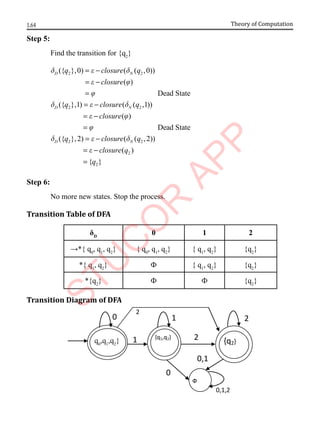
Step 5:
Find the transition for {q2
}
2 2
2 2
({ },0) ( ( ,0))
( )
Dead State
({ },1) ( ( ,1))
( )
D N
D N
q closure q
closure
q closure q
closure
d e d
e j
j
d e d
e j
j
= −
= −
=
= −
= −
=
2 2
2
2
Dead State
({ },2) ( ( ,2))
( )
{ }
D N
q closure q
closure q
q
d e d
e
= −
= −
=
Step 6:
No more new states. Stop the process.
Transition Table of DFA
δD
0 1 2
→*{ q0
, q1
, q2
} { q0
, q1
, q2
} { q1
, q2
} {q2
}
*{ q1
, q2
} Ф { q1
, q2
} {q2
}
*{q2
} Ф Ф {q2
}
Transition Diagram of DFA
Ф
0
1
1
0,1,2
0,1
2
2
{q0,q1,q2}
{q1,q2}
{q2}
0
2
q0
,q1
,q2
}
1.65
Automata Fundamentals
Q = {{q0
, q1
, q2
},{ q1
, q2
},{q2
} }
Σ = {0,1,2}
q0
= {q0
, q1
, q2
}
F = {{q0
, q1
, q2
},{ q1
, q2
},{q2
}}
4. Consider the following ε-NFA. Covert it into DFA
δN
ε a b
→ p {r} {q} {p,r}
q Ф {p} Ф
*r {p,q} {r} {p}
Step 1:
Compute ε-Closure [states that can be reached by traveling along zero or more ε
arrows] for all states.
r ε-Closure (p) = {p,q,r}
ˆ( , )
p
d e
 
 
r ε-Closure (q) = {q}
ˆ( , )
q
d e
 
 
r ε-Closure (r ) = {p,q,r} ˆ( , )
r
d e
 
 
Step 2:
Start with ε-closure (p)= { p, q, r}
Where, p is the starting state of given ε –NFA
Step 3:
Find the transition for { p,q,r}
({ , , }, ) ( ( , ) ( , ) ( , ))
( )
( , , )
{ , , }
D N N N
p q r a closure p a q a r a
closure q p r
closure p q r
p q r
d e d d d
e
e
= − ∪ ∪
= − ∪ ∪
= −
=
1.66 Theory of Computation
({ , , }, ) ( ( , ) ( , ) ( , ))
({{ , } { }})
({ , })
{ , , }
D N N N
p q r b closure p b q b r b
closure p r p
closure p r
p q r
d e d d d
e j
e
= − ∪ ∪
= − ∪ ∪
= −
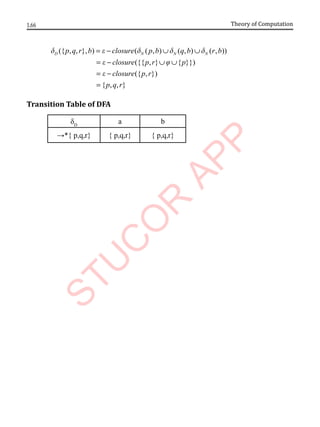
=
Transition Table of DFA
δD
a b
→*{ p,q,r} { p,q,r} { p,q,r}
1.67
Automata Fundamentals
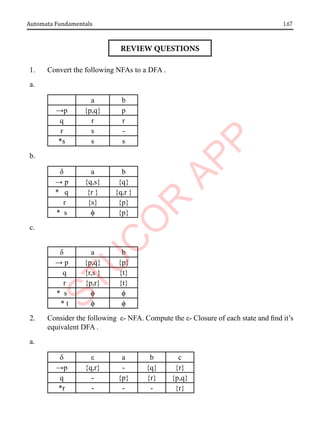
1. Convert the following NFAs to a DFA .
a.
a b
→p {p,q} p
q r r
r s -
*s s s
b.
δ a b
→ p {q,s} {q}
* q {r } {q,r }
r {s} {p}
* s ϕ {p}
c.
δ a b
→ p {p,q} {p}
q {r,s } {t}
r {p,r} {t}
* s ϕ ϕ
* t ϕ ϕ
2. Consider the following ε- NFA. Compute the ε- Closure of each state and find it’s
equivalent DFA .
a.
δ ε a b c
→p {q,r} - {q} {r}
q - {p} {r} {p,q}
*r - - - {r}
REVIEW QUESTIONS
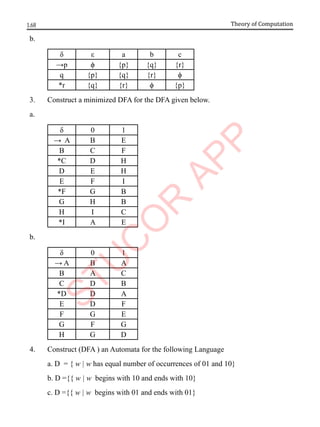
1.68 Theory of Computation
b.
δ ε a b c
→p ϕ {p} {q} {r}
q {p} {q} {r} ϕ
*r {q} {r} ϕ {p}
3. Construct a minimized DFA for the DFA given below.
a.
δ 0 1
→ A B E
B C F
*C D H
D E H
E F I
*F G B
G H B
H I C
*I A E
b.
δ 0 1
→ A B A
B A C
C D B
*D D A
E D F
F G E
G F G
H G D
4. Construct (DFA ) an Automata for the following Language
a. D = { w | w has equal number of occurrences of 01 and 10}
b. D ={{ w | w begins with 10 and ends with 10}
c. D ={{ w | w begins with 01 and ends with 01}
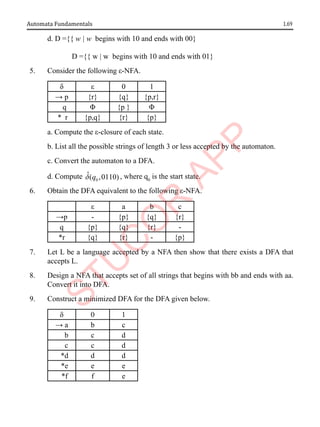
1.69
Automata Fundamentals
d. D ={{ w | w begins with 10 and ends with 00}
D ={{ w | w begins with 10 and ends with 01}
5. Consider the following ε-NFA.
δ ε 0 1
→ p {r} {q} {p,r}
q Φ {p } Φ
* r {p,q} {r} {p}
a. Compute the ε-closure of each state.
b. List all the possible strings of length 3 or less accepted by the automaton.
c. Convert the automaton to a DFA.
d. Compute 0
ˆ( ,0110)
q
d , where q0
is the start state.
6. Obtain the DFA equivalent to the following ε-NFA.
ε a b c
→p - {p} {q} {r}
q {p} {q} {r} -
*r {q} {r} - {p}
7. Let L be a language accepted by a NFA then show that there exists a DFA that
accepts L.
8. Design a NFA that accepts set of all strings that begins with bb and ends with aa.
Convert it into DFA.
9. Construct a minimized DFA for the DFA given below.
δ 0 1
→ a b c
b c d
c c d
*d d d
*e e e
*f f e
1.70 Theory of Computation
10. Design a NFA that accepts empty string or string starts and ends with 0. Convert
it into DFA.
11. Define NFA. Explain its significance. Convert the given NFA to DFA. Prove that
both NFA and DFA accepts the string 0110.
UNIT IV
PROPERTIES OF CONTEXT FREE
LANGUAGES
UNIT V
UNDECIDABILITY
UNIT - 5
UNDECIDABILITY
Non Recursive Enumerable (RE) Language – Undecidable Problem with RE –
Undecidable Problems about TM – Post‘s Correspondence Problem, The Class P
and NP
RECURSIVE AND RECURSIVELY ENUMERABLE LANGUAGES
Recursively Enumerable Language
A language L  * is recursively enumerable if there exist a Turing machine, M that
accepts every string, w Land does not accept strings that are not in L.
If the input string is accepted, M halts with the answer, “YES”.
If the string is not an element of L, then M may not halt and enters into infinite loop.
w є L
w  L
YES
Loops Forever
The language, L is Turing Acceptable.
Recursive Language
A language is said to be recursive if there exists of Turing machine, M that accepts
every string, w L and rejects those strings that are not in L.
If the input is accepted, M halts with the answer,” YES”
w є L
w  L
w L the Turing machine doesn‟t accept the string.
YES
NO
M
M
M1
M2
M3
If w L, then M halts with answer, “NO”. This is also called as Turing Decidable
language.
PROPERTIES OF RECURSIVE AND RE LANGUAGES
1. The union of two recursive language is recursive
2. The language L and its complement L are recursively enumerable, then L is
recursive.
3. The complement of a recursive language is recursive.
4. . The Union of two recursively enumerable languages is recursively enumerable.
5. The intersection of two recursive language is recursive.
6. The intersection of two recursively enumerable language is recursively enumerable
Proofs on the Properties
Property-1
The union of two recursively enumerable languages is recursively enumerable.
Proof:
Let L1 and L2 be two recursively enumerable languages accepted by the Turing
machines M1 and M2.
If a string wL1 then M1 returns “YES”, accepting the input string: Else loops
forever. Similarly if a string w L2 then M2 returns “YES”, else loops forever.
The Turing machine M3 that performs the union of L1 and L2 is given as
RE
YES
YES
RE
YES
RE
Here the output of M1 and M2 are written on the input tape of M3. The turning
machine, M3 returns “YES”, if at least one of the outputs of M1 and M2 is “YES”. The M3
decides on L1UL2 that halts with the answer, “YES” if
forever if both M1 and M2 loop forever.
w L1 or w L2 . Else M3 loops
Hence the union of two recursively enumerable languages is also recursively
enumerable.
wєΣ*
M2
M3
Property – 2
A language is recursive if and only if both it and its complement are recursively
enumerable.
Proof
Let L and L be two recursively enumerable languages accepted by the Turing
machines M1 and M2. If a string, w L, it is accepted by M1 and M1 halts with answer
“YES”. Else M1 enters into infinite loop.
If a string, w L w L, then it is accepted by M2 and M2 halts with answer “YES”.
Otherwise M2 loops forever.
The Turing machine, M3 that simulates M1 and M2 simultaneously is given as
w L1
YES
w L YES
From the above design of TM, if w L, if w L, then M1 accepts w and halts with
“YES”.
If w L, then M2 accepts ww L and halts with “YES”.
Since M1 and M2 are accepting the complements of each other, one of them is
guaranteed to halt for every input, wєΣ*.
Hence M3 is a Turing machine that halts for all strings.
Thus if the language and its complement are recursively enumerable, then they are
recursive.
Property - 3
The complement of a recursive language is recursive.
Proof
Let L be a recursive language accepted by the turning machine, M1.
Let L be a recursive language accepted by the Turing machine M2.
wєΣ*
YES
M1
M2
M1
The construction of M1 and M2 are given as,
w L
L
YES NO
w L NO YES
R R
Let w L, then M1 accepts w and halts with “YES”.
M1 rejects w if w Land halts with “NO”
M2 is activated once M1 halts.
M2 works on L and hence if M1 returns “YES”, M2 halts with “NO”.
If M1 returns “NO”, then M2 halts with “YES”
Thus for all w, where w L or w L , M2 halts with either “YES” or “NO”
Hence the complement of a recursive language is also recursive.
Property – 4
The union of two recursive language is recursive.
Proof:-
Let L1 and L2 be two recursive languages that are accepted by the Turing machines M1
and M2, given by
L(M1) = L1
L(M2) = L2
Let M3 be the Turing machine constructed by the union of M1 and M2. M3 is
constructed as follows.
YE
NO
YES
NO
wєΣ*
M3
YES
NO
M2
M1
3
The Turing machine M3 first simulates M1 with the input string, w.
If w L1 , then M1 accepts and thus M3 also accepts since L(M3) = L(M1) u L(M2).
If M1 rejects string 
w L1 
 , then M3 simulates M2. M3 halts with “YES” if M2
accepts „w‟, else returns “NO”.
Hence M3, M2, M1 halt with either YES or NO on all possible inputs.
Thus the union of two recursive languages is also recursive.
Property – 5
The intersection of two recursive language is recursive.
Proof:-
Let L1 and L2 be two recursive languages accepted by M1 and M2 where
L(M1) = L1
L(M2) = L2
Let M3 be the Turing machine that is constructed by the intersection of M1 and M2, M3
is constructed as follows.
wєΣ*
NO
YES
NO
M LM3   L(M1) L(M2 )
YES
YES
NO
The Turing machine M3 simulates M1 with the input string,w.
If w L1 , then M1 halts along with M3 with answer “NO”, since L(M3)=L(M1) 
L(M2). If then M1 accepts with the answer “YES” and M3 simulates M2.
If M2 accepts the string, then the answer of M2 and M3 are “YES” and halts. Else, M2
and M3 halts with answer “NO”.
M2
M1
YES
M1
M3
YES
M2
Thus, the intersection of two recursive languages is recursive.
Property – 6
Intersection of two recursively enumerable languages is recursively enumerable.
Proof:-
Let L1 and L2 be two recursively enumerable languages accepted by the Turing
machine M1 and M2.
If a string
rejecting w L1 .
w L1 then M1 returns “YES” accepting the input. Else will not halt after
Similarly if a string, w L2 , then M2 returns “YES” else rejects „w‟ and loop forever.
The Turing machine, M3 = M1  M2 is given as
w L1 Rejects & Never Halts
YES
Loop Forever
w L2
Rejects & Never Halts
Here the output of M1 and M2 are written the input tape of M3. The machine, M3
returns “YES” if both the outputs of M1 and M2 is “YES”.
If at least one of M1or M2 is NO it rejects „w‟ and never halts.
Thus M3 decides on L1  L2 that halts if and only if
loops forever along with M1 or M2 or both
w L1 and w L2 . Else M3
Hence the intersection of two recursively enumerable languages is recursively
enumerable.
THE HALTING PROBLEM
 The halting problem is the problem of finding if the program/machine halts or loop
forever.
 The halting problem is un-decidable over Turing machines.
wЄ∑*

Description
 Consider the Turing machine, M and a given string , the problem is to determine
whether M halts by either accepting or rejecting , or run forever.
 Example
while (1)
{
prinf(“Halting problem”);
}
 The above code goes to an infinite loop since the argument of while loop is true
forever.
 Thus it doesn‟t halts.
 Hence Turing problem is the example for undecidability.
 This concept of solving the halting problem being proved as undecidable was done
by Turing in 1936.
 The undecidability can be proved by reduction technique.
Representation of the halting set
The halting set is represented as,
h(M, ) 
1 if M halts on input 
0 otherwise
where,
Theorem
M  Turing machine
  Input string
Proof
Halting problem of Turing machine is unsolvable / undecidable.
The theorem is proved by the method of proof by contradiction.
Let us assume that Turing machine is solvable / decidable.
Construction of H1
M



HALT
LOOP FOREVER
Halting
machine H1
H2
Halting
machine H2
 Consider, a string describing M and input string,  for M.
 Let H1 generates “halt” if H1 determines that the turing machine, M stops after
accepting the input, .
 Otherwise H1 loops forever when, M doesn‟t stops on processing .
Construction of H2
M HALT
LOOP
H2 is constructed with both the inputs being M.
H2 determines M and halts if M halts otherwise loops forever.
Construction of H3
M HALT
LOOP
LOOP
HALT
Let H3 be constructed from the outputs of H2.
If the outputs of H2 are HALT, then H3 loops forever.
Else, if the output of H2 is loop forever, then H3 halts.
Thus H3 acts contractor to that of H2.
H3
 Let the output of H3 be given as input to itself.
 If the input is loop forever, then H3 acts contradictory to it, hence halts.
 And if the input is halt, then H3 loops by the construction.
 Since the result is incorrect in both the cases, H3 doesnot exist.
 Thus H2 doesnot exist because of H3.
 Similarly H1 doesnot exist, because of H2.
Thus halting problem is undecidable.
H3
H3
M
M

p
PARTIAL SOLVABILITY
Problem types
There are basically three types of problems namely
 Decidable / solvable / recursive
 Undecidable / unsolvable
 Semi decidable / partial solvable / recursively enumerable
Decidable / solvable problems
A problem, P is said to be decidable if there exists a turing machine, TM that
decides P.
Thus P is said to be recursive.
Consider a Turing machine, M that halts with either „yes‟ or „no‟ after computing the
input.
 ∑*
YES (if  L)
NO (if  L)
The machine finally terminates after processing
It is given by the function,
F () 
1 if p()
0 if p()
The machine that applies Fp() is said to be turing computable.
Undecidable problem
A problem, P is said to be undecidable if there is a Turing machine, TM that doesn‟t
decides P.
Semi decidable / partial solvable / recursively enumerable
A problem, P is said to be semi decidable, if P is recursively enumerate.
A problem is RE if M terminates with „YES‟ if it accepts   L; and doesn‟t halt if 
 L.
Then the problem is said to be partial solvable / Turing acceptable.
 ∑*
YES (if  L)
LOOP FOREVER (if   L)

p
Partial solvability of a machine is defined as,
F () 
1 if p()
undefined if  p()
Enumerating a language
Consider a k-tape turing machine. Then the machine M enumerates the language L
(such that L  ∑*) if
 The tape head never moves to the left on the first tape.
 No blank symbol (B) on the first tape is erased or modified.
 For all   L, where there exists a transition rule, i on tape 1 with contents
1 # 2 # 3 # ... # n #  # (for n  0)
Where 1, 2 , 3, ....., n ,  are distinct elements on L.
If L is finite, then nothing is printed after the # of the left symbol
That is,
 If L is a finite language then the TM, M either
o Halts normally after all the elements appear on the first tape (elements are
processed)
or
o Continue to process and make moves and state changes without
scanning/printing other string on the first tape.
If the language, L is finite, the Turing machine runs forever.
Theorem
A language L  ∑* is recursively enumerable if and only if L can be enumerated by
some TM.
Proof
k(M1)].
Let M1 be a Turing machine that enumerates L.
And let M2 accepts L. M2 can be constructed as a k-tape Turing machine [k(M2) >
M2 simulates M1 and M1 pauses whenever M2 scans the „#‟ symbol.
M1
LOOP FOREVER
( L)
M2
M2 compares its input symbols to that of the symbols before „#‟ while, M1 is in pause.
If the comparison finds a match of the string, M2 accepts L.
Here M2 is a semi acceptor TM for L
 Scans the input string, 
 Runs the transition rules of M1
 If M1 outputs , then  is accepted and M1 hats
If   L, M1 will output  and M2 will eventually accept „‟ and halts.
If   L, then M1 will never provide an output  and so M2 will never halt.
 ∑*
 ∑*
HALTS
(L)
Infinite loop
HALTS
( L)
LOOP FOREVER
( L)
Never halts
Thus M2 is partially solvable / Turing acceptable for L.
POST CORRESPONDENCE PROBLEM (PCP)
Post correspondence problem, known as PCP is an unsolvable combinatorial problem.
This Undecidable problem was formulated by Emil Post in 1946.
A PCP consists of two lists of string over some alphabet Σ; the two lists must be of equal length.
Generally A=w1,w2, w3, …….wk and B= x1, x2 ,x3, ……xk for some integer k. For each i , the
pair (wi , xi ) is said to be a corresponding pair.
We say this instances of PCP has a solution, if there is a sequence of one or more integers
i1, i2,……., im that, when interpreted as indexes for strings in the A and B lists, yield the same
string.
wi1 wi2 ……. wim = xi1 xi2 ……. xim . We say the sequence i1, i2,……., im is a solution to this
instance of PCP
M2
M1
EXAMPLE
1. For Σ = {a, b} with A = {a, aba3, ab} and B = {a3, ab, b}, Does the PCP with A and B
have a solution?
Solution:
The sequence obtained from A and B = (2, 1, 1, 3) as,
A2 A1 A1 A3
aba3 a a ab
B2 B1 B1 B3
ab a3
a3
b
Thus A2A1A1A3 = B2B1B1B3 = aba3a3b = aba6b
The PCP given has a solution (2,1,1,3) with the two lists of elements.
2. Let Σ = {0, 1}. Let A and B be the lists of three strings defined as
A B
I wi xi
1 1 111
2 10111 10
3 10 0
Solution:
Consider the sequence (2, 1, 1, 3)
A2A1A1A3 => w2w1w1w3 = 101111110
B2B1B1B3 => X2X1X1X3 = 101111110
Thus the PCP has (2, 1, 1, 3) sequences as solution
The Diagonalization Language Ld
We define Ld, the diagonalization language, as follows:
Let w1, w2, w3, . . . be an enumeration of all binary strings.
Let M1, M2, M3, . . . be an enumeration of all Turing machines.
Let Ld = { Wi | Mi does not accept Wi }.
The language Ld, the diagonalization language, is the set of strings Wi
such that Wi is not in L(Mi). That is, Ld consists of all strings w such
that the TM (M ) does not accept when given w as input.
Theorem: Ld is not a recursively enumerable language.
Proof:
Suppose Ld = L(Mi) for some TM Mi.
This gives rise to a contradiction. Consider what Mi will do on an
input string wi.
If Mi accepts wi, then by definition wi cannot be in Ld.
If Mi does not accepts wi, then by definition wi is in Ld.
we must conclude there is no Turing machine that can define Ld.
Hence Ld is not a recursively enumerable language.
UNIVERSAL TURING MACHINE
Motive of UTM
A single Turing machine has a capability of performing a function such as addition,
multiplication etc.
For computing another function, other appropriate Turing machine is used. To do so, the
machine has to be re-written accordingly.
Hence Turing proposed “Stored Program Computer” concept in 1936 that executes the
program/instructions using the inputs, stored in the memory.
The instructions and inputs are stored on one or more tapes.
Concept of UTM
The universal Turing machine, Tu takes over the program and the input set to process
the program.
The program and the inputs are encoded and stored on different tapes of a multi-tapeTuring machine.
The Tu thus takes up T, w where T is the special purpose Turing machine that passesthe
program in the form of binary string, w is the data set that is to be processed by T.
Input
Tape of M
State of M 0000…0BB…
<T, w>
0001010000101….
Finite
control
Input to the Tu
The universal Turing machine, Tu is always provided with the code for Transitions,
e(T) and code for input, e(w) as
TM  e(T)e(w)
For example, if the input data, w=”baa”, then
e(w) = 10001001001
This e(w) will be appended to e(T) of Tu.
Construction of Tu
As in the figure for universal Turing machine, there are three tapes controlled by a
finite control component through heads for each tape.
Tape -1  Input tape and also serves as output tape. It contain e(T) e(w).
Tape-2  Tape of the TM/Working tape during the simulation of TM
Tape -3  State of the TM, current state of the T in encoded form.
Operation of UTM
Theorm :(Lu is Recursively enumerable )
(To prove this Theorem it is necessary to construct a turning machine that accepts
Lu)
 UTM checks the input to verify whether the code for TM=<T,w> is a legitimate
for some TM.
o If the input is not accepted, UTM halts with rejecting, w
 Initialize the second tape to have e(w), that is to have the input, w in encoded form.
Place the code of the initial state on the third tape and move the head of the finite
state control on the first cell of second tape.
 To simulate a move of the Turing machine, UTM searches for the transition -
oi 1oj 1ok 1ol 1om on the first tape, with oi (initial state/current state) on tape -3 and
o j (input symbol to be processed) on tape- 2.
 The state transition is done by changing the tape -3 content as
transition.
 Replace o j by ol on tape-2 to indicate the input change.
ok as in the
d
 Depending on om [m=1 stop, m=2 Left, m=3Right], move the head on
tape-2 to the position of the next 1 to the left/right/stop accordingly
 If TM has no transition, matching the simulated state and tape symbol, then no
transition will be found. This happens when the TM stops also.
 If the TM, T enters halt (accepting state), then UTM accepts the input, w
Thus for every coded pair <T, w>, UTM simulates T on w, if and only if T accepts the
input string, w.
Thus U TM simulates M and accepts W.Thus Lu is recursively enumerable
Definition of Universal Language [Lu]
The universal language, Lu is the set of all binary strings , where  represents the
ordered pair <T, w> where
T Turing machine
w any input string accepted by T
It can also be represented as  = e(T) e(w) .
Theorem
Lu is the recursively enumerable but not recursive .
Proof
From the definition and operations of UTM, we know that Lu is recursively
enumerable.
Lu accepts the string w if it is processed by the TM,T. Else, rejects „w‟ and the
machine doesn‟t halts forever.
To prove that Lu is not recursive, the proof can be done by contradiction. Let Lu is
Turing decidable [recursive], and then by definitionacceptable.
Lu (complement of Lu) is Turing
We can show that Lu is Turing acceptable, that leads to Ld to be Turing acceptable.
But we know that Ld is not Turing acceptable.
Hence Lu is not Turing decidable by proof by contradiction.
Proof on Lu is during acceptable  Ld is Turing acceptable
w
Suppose “A” is the algorithm that recognizes Lu .
Then L is recognizes as follows. Given a string w(0,1)*
determined easily, the
value of I such that w = wi.
Integer value, I in binary is the corresponding code for TM, Ti. Provide <Ti, wi> to the
Accept Accept
w111w
Reject Reject
T for Ld
Copy
Hypothetical
algorithm
T for Lu
algorithm A and accept, w if and only if Ti accepts wi.
So the algorithm accepts w if and only if w = wi which is in L(Ti).
This is the algorithm for Ld. Hence Lu is Recursively Enumerable but not recursive.
TRACTABLE AND INTERACTABLE PROBLEMS
Tractable Problems/Languages
The languages that can be recognized by a Turing machine in finite time and with
reasonable space constraint is said to be tractable.
Example: If the language L1 Time (f), then L is tractable and is less complex in
nature
Example: If L2  Time (f), L2 is complex and cannot be tractable in limited time.
Tractable problems are those that can be solved in polynomial time period.
Intractable Problems
The languages that cannot be recognized by any Turing machine with reasonable space
and time constraint is called intractable problems.
These problems cannot be solved in finite polynomial time. Even problems with
moderate input size cannot achieve feasible solution
P AND NP PROBLEMS
These refer to how long it takes a program to run. Problems in class P can be solved with
algorithms that run in polynomial time.
An algorithm that finds the smallest integer in an array. One way to do this is by iterating over all
the integers of the array and keeping track of the smallest number you've seen up to that
point. Every time you look at an element, you compare it to the current minimum, and if it's
smaller, you update the minimum.
How long does this take? Let's say there are n elements in the array. For every element the
algorithm has to perform a constant number of operations. Therefore we can say that the
algorithm runs in O(n) time, or that the runtime is a linear function of how many elements are in
the array. So this algorithm runs in linear time.
You can also have algorithms that run in quadratic time (O(n^2)), exponential time (O(2^n)), or
even logarithmic time (O(log n)). Binary search (on a balanced tree) runs in logarithmic time
because the height of the binary search tree is a logarithmic function of the number of elements in
the tree.
If the running time is some polynomial function of the size of the input, for instance if the
algorithm runs in linear time or quadratic time or cubic time, then we say the algorithm runs in
polynomial time and the problem it solves is in class P.
NP
There are a lot of programs that don't (necessarily) run in polynomial time on a regular computer,
but do run in polynomial time on a nondeterministic Turing machine. These programs solve
problems in NP, which stands for nondeterministic polynomial time. A nondeterministic Turing
machine can do everything a regular computer can and more. This means all problems in P are also
in NP.
An equivalent way to define NP is by pointing to the problems that can be verified in polynomial
time. This means there is not necessarily a polynomial-time way to find a solution, but once you
have a solution it only takes polynomial time to verify that it is correct.
P = NP, which means any problem that can be verified in polynomial time can also be solved in
polynomial time and vice versa. If they could prove this, it would revolutionize computer science
because people would be able to construct faster algorithms for a lot of important problems.
NP-hard
Solve a problem by reducing it to a different problem. Reduce Problem B to Problem A if, given
a solution to Problem A, It can easily construct a solution to Problem B. (In this case, "easily"
means "in polynomial time.")
If a problem is NP-hard, this means , reduce any problem in NP to that problem. It can solve
that problem, I can easily solve any problem in NP. If we could solve an NP-hard problem in
polynomial time, this would prove P = NP.
NP-complete
A problem is NP-complete if the problem is both
 NP-hard, and
 in NP.
A technical point: O(n) actually means the algorithm runs in asymptotically linear time, which
means the time complexity approaches a line as n gets very large. Also, O(n) is technically an
upper bound, so if the algorithm ran in sublinear time you could still say it's O(n), even if that's
not the best description of it.
** Note that if the input has many different parameters, like n and k, it might be polynomial in n
and exponential in k

theory of computation chapter 2 notes pdf

  • 1.
    1.1 IntroductIon toAutomAtA theory Automata theory is the study of abstract machines and the computational problems can be solved using these machines. Abstract machines are called automata. The name comes from the Greek word (Αυτόματα). It means doing something by itself. An automaton can be a finite representation of a formal language that may be an infinite set. Automata are used as theoretical models for computing machines, and are used for proofs about computability. The automata theory is essential for, + The study of the limits of computation + Designing and checking the behaviour of digital circuits. + Pattern searching in Websites + Verifying systems of all types that have a finite number of distinct states, such as communications protocols or protocols for secure exchange information 1.1.1IntroductIon to FormAl lAnguAges Formal languages are the system used to train the machines in recognizing certain commands or instructions. These languages are the abstraction of natural languages, since they are expended by the machines. Formal languages are of five types. They are: r Regular Languages (RL) r Context free Languages (CFL) r Context Sensitive Languages (CSL) UNIT I AUTOMATA FUNDAMENTALS
  • 2.
    1.2 Theory ofComputation r Recursive Languages r Recursively Enumerable Languages (RE) à These languages are recognized by specific automata/machines and grammars. r Regular grammars (type 3) and finite automata recognize regular languages. r Context free grammars (Type 2) and push down automata recognize context free languages. r Context sensitive grammars (Type 1) and Linear Bounded Automata (LBA) recognize context sensitive languages. r Unrestricted grammars (phrase structure grammar) (Type 0). r Turing machines recognize recursively enumerable languages. à Total Turing Machines (TTM) that halt for every input are used to recognize recursive languages. 1. Formal Language Theory Formal language theory describes languages as a set of operations over an alphabet. It is closely linked with automata theory, as automata are used to generate and recognize formal languages. Automata are used as models for computation; formal languages are the preferred mode of specification for any problem that must be computed. 2. Computability theory Computability theory deals primarily with the question of the extent to which a problem is solvable on a computer. It is closely related to the branch of mathematical logic called recursion theory. 3. Models of Computation The computation models that are developed by formal language theory are , i) Finite State Automata ii) Regular expression
  • 3.
    1.3 Automata Fundamentals iii) Pushdown Automata iv) Linear bounded automata v) Turing machine à The computational models and the languages understandable by these models are tabulated below. Table 1.1 The Computational Models Machines Grammars/ Languages Category Finite State Automata (Regular Expression) Regular Type 3 Simple Complex Push Down Automata Context Free Type 2 Linear Bounded Automata Context Sensitive Type 1 Turing Machine Phrase Structure Type 0 Uncomputable 1.1.2 Basic Mathematical Notation and Techniques 1. Alphabet An alphabet is a finite, nonempty set of symbols. Example: i. ∑ ={0,1} ii. ∑ ={a,b,c} 2. String A string over an alphabet is a finite sequence of symbols from that alphabet.
  • 4.
    1.4 Theory ofComputation Example: i. 01001 over ∑ ={0,1} ii. aaabbbbccc over ∑ ={a,b,c} 3. Length of a string The length of a string is the count of symbols in that string. Example: i. |01001| = 5 ii. |aaabbbbccc| =10 iii. |03 15 | = 8 4. Power of an alphabet The power of an alphabet ∑k, is the set of all strings over ∑ with length k. Examples: { } { } { } { } 0 1 2 2 0 3 * 0,1 00,01, 10, 11 000,001, 010, 011,100,101,110,111 .. , 0,1, 00,01,10,11, 000,001, 010, 011,100,101,110,111 = ....................... = 0 e + + ∑ = ∑ = ∑ = …………… Σ ∪ Σ ∪ Σ Σ ∪ Σ ∑ = …………… ∑ = { } 1 2 3 ,1, 00,01,10,11, 000,001, 010, 011,100,101,110,1 = ............ 1 . 1 .......... …… ∪ … Σ ∪ Σ …… Σ 5. Language (L) The language of an Automata is a set of strings accepted by the automata.
  • 5.
    1.5 Automata Fundamentals Examples: i. Setof even length strings over an alphabet {a,b}. ii. Set of odd length strings over an alphabet {0,1}. 6. Set –former notation of a Language i. L={w |w consists of an equal number of 0’s and 1’s } L={ε, 01, 10,0011, 1100, 0101, 1010, 1001, 0110,………} ii. L= {w |w is a binary integer that is prime } L={10, 11, 101, 111, …….} 7. Complement of a Language(L ) i. L={w |w contains 101 as substring} Ḹ ={w |w does not contain 101} ii. L={w |w contains abb as substring} L ={w |w does not contain abb} 1.2 IntroductIon to FormAl ProoF A formal proof or derivation is a finite sequence of sentences called well-formed formulas in the case of a formal language each of which is an axiom or follows from the preceding sentences in the sequence by a rule of inference. But in deductive proofs, the truth of a statement is shown by a detailed sequence of steps and reasons. Some computer scientists take the extreme view that a formal proof of the correctness of a program should go hand-in-hand with the writing of the program itself. We doubt that doing so is productive. Some also say that proof has no place in the discipline of programming. + The slogan “if you are not sure your program is correct, run it and see” is commonly offered by them.
  • 6.
    1.6 Theory ofComputation + Testing programs is surely essential. However, testing goes only so far, since you cannot try your program on every input. + To make your iteration or recursion correct, you need to set up an inductive hypothesis, and it is helpful to reason, formally or informally, that the hypothesis is consistent with the iteration or recursion. + This process of understanding the workings of a correct program is essentially the same as the process of proving theorems by induction. + Automata theory covers methodologies of formal proof. It can be of either : ➢ Inductive kind Recursive proofs of a parameterized statement that use the statement itself with lower values of the parameter. ➢ Deductive kind A sequence of justified steps. 1.2.1 Deductive Proofs à A deductive proof consists of a sequence of statements whose truth leads us from some initial statement, called the hypothesis or the given statement(s), to a conclusion statement. à Each step in the proof must follow, by some accepted logical principle, from either the given facts, or some of the previous statements in the deductive proof, or a combination of these. à Thehypothesismaybetrueorfalse,typicallydependingonvaluesofitsparameters. Often, the hypothesis consists of several independent statements connected by a logical AND. à The theorem that is proved when we go for a hypothesis H to a conclusion C is the statement “if H then C”. We say that C is deduced from H. à An example theorem of the form “if H then C” will illustrate these points.
  • 7.
    1.7 Automata Fundamentals Theorem 1 Ifx ≥ 4, then 2x ≥ x2 . Proof The hypothesis H is “x ≥ 4”. This hypothesis has a parameter, x and thus is neither true nor false. Rather, its truth depends on the value of x. H is true for x = 6 and false for x = 2. à The conclusion C is “2x ≥ x2 ”. This statement also uses parameter x and is true for certain values of x and not others. Example: C is false for x = 3, since 23 = 8, which is not as large as 32 = 9. On the other hand, C is true for x = 4, since 24 = 42 = 16. For x = 5, the statement is also true, since 25 = 32 is at least as large as 52 = 25. Perhaps you can see the intuitive argument that tells us the conclusion 2x = x2 will be true whenever x ≥ 4. We already saw that it is true for x = 4. As x grows larger than 4, the left side, 2x doubles each time x increases by 1. However, the right side, x2 , grows by the ratio (x+1/x)2 . If x ≥ 4, then (x + 1)/x cannot be greater than 1.25, and therefore (x+1/x)2 = (1.25)2 = 1.5625. Since 1.5625 < 2, each time x increases above 4 the left side 2x grows more than the right side x2 . ^ Thus, as long as we start from a value like x = 4 the inequality 2x ≥ x2 is already satisfied. Theorem 2 If x is the sum of the squares of four positive integers, then 2x ≥ x2 . Proof In deductive proof, we go from a hypothesis H to a conclusion C, i.e., if H then C.
  • 8.
    1.8 Theory ofComputation Step 1: x is the sum of the squares of four integers. Let a, b, c, d be four integers. x = a2 + b2 + c2 + d2 Step 2: The integers being squared are at least 1. a ≥ 1; b ≥ 1; c ≥ 1; d ≥ 1. Step 3: Since the integers is at least 1, then its squares is also at least 1. a2 ≥ 1; b2 ≥ 1; c2 ≥1; d2 ≥ 1 Step 4: From Step 1 and Step 3, we can inter that x is sum of four squares and each squares is at least 1. x is at least 1+1+1+1 x ≥ 4. Step 5: Step 4 is the hypothesis of the previous problem (2x ≥ x2 if x ≥ 4). We can conclude that, 2x ≥ x2 (or) a2 + b2 + c2 + d2 1.2.2 Reduction to Definitions If the hypothesis does not use familiar terms like integer, multiplication, addition etc., then we can convert all terms in the hypothesis to their definitions. Theorem 3 A set S is finite if there exists an integer n such that S has exactly n elements. |S| = n. Where, n - Number of elements in the set S. S and T - Both subsets of some infinite set U. T - Complement of S (with respect to U) if S U T = U and S ∩ T = Ф T - Infinite.
  • 9.
    1.9 Automata Fundamentals Proof We canuse proof by contradiction. It is a technique where we assume that the conclusion is false. Then use that assumption together with hypothesis, prove the opposite of one of the given statements of the hypothesis. So the only possibility that remains is that the conclusion is true whenever the hypothesis is true. Here T is finite (because we assume the conclusion is false), but T is infinite . Given Let us assume T is finite, along with the statement of the hypothesis, S is finite. i.e., |S| = n for some integer n. |T| = m for some integer m. Now given statement tells us that S U T = |S| + |T| = n+m, n+m is a integer it follows U is finite. But it contradicts the given statement U is infinite. So the conclusion is true whenever the hypothesis is true. Therefore T is infinite. 1.2.3 Other Theorem Forms 1. If - then à The most common forms of if - then statements are if H then C can be rewritten as i. H implies C ii. H only if C iii. C if H iv. Whenever H holds, C follows. à So the theorem if x ≥ 4, 2x = x2 can be rewritten as (a) x ≥ 4, implies 2x = x2 (b) x ≥ 4 only if 2x = x2 (c) 2x = x2 if x ≥ 4 (d) Whenever x ≥ 4 holds, 2x = x2 follows.
  • 10.
    1.10 Theory ofComputation 2. If - and - only - if statements The statements of the form “A if and only if B” or “Aiff B” has two if - then statements, is “if A then B” and “if B then A”. Note: └x┘- Floor of real number x, is the greatest integer equal to or less than x. ┌x┐- Ceiling of real number x, is the least integer equal to or greater than x. Theorem 4 Let x be a real number. Then └x┘= ┌x┐, if and only if x is an integer. Proof └x┘≤ x by definition of floor ... (1.1) ┌x┐≥ x by definition of ceiling ... (1.2) We are given with └x┘= ┌x┐ Substituting (1.1) in (1.2), we get, ┌x┐≤ x. Since ┌x┐≥ x, by arithmetic inequality we get ┌x┐ = x. 3. Theorems that appear “Not to be if-then statements. Theorem 5 Sin2ɵ¸ + Cos2ɵ = 1. It does not have any hypothesis. This theorem can be written in if-then is “if ɵ¸ is an angle, then sin2ɵ + cos2ɵ = 1”.
  • 11.
    1.11 Automata Fundamentals 1.3 AddItIonAlForms oF ProoF The following are the additional forms of proofs. r Proofs about sets r Proofs by contradiction r Proofs by counter example 1.3.1 Proofs About Sets à Sets contain symbols to form character strings. à Sets in automata theory are called as languages. If E and F are two expressions representing sets, the statement E = F means that two sets represented are same. i.e., every element in the set represented by E is in the set represented by F and vice versa. Example: Union of sets obeys commutative law. Let S and R be sets. Then R U S = S U R. If E is the expression in R U S and F is the expression S U R, then E = F, an element x is in E iff x is in F. Theorem 6 Distributive law of union over intersection. Let R, S, T be sets. Then prove that R U (S ∩ T) = (R U S) ∩ (R U T) Proof Aiff B has two parts. That are, r If part: “if B then A” r Only if part: if A then B, which is equivalent form “A only if B”. Let E is the expression in R ∩ (S U T) and F is the expression in (R U S) ∩ (R U T).
  • 12.
    1.12 Theory ofComputation 1.. If part: if x is in E, x is in F Statement Justification (a) x is in R ∩ (S U T) (a) Given (b) x is in R or x is in (S ∩ T) (a) and definition of union. (c) x is in R or x is in both S and T (b) and definition of intersection. (d) x is in R U S (c) and definition of union. (e) x is in R U T (c) and definition of union. (f) x is in (R U S) ∩ (R U T) (d), (c) and definition of intersection. 2. We can also prove it by “only – if” statement. Statement Justification (a) x is in (R U S) ∩ (R U T) Given (b) x is in R U S (a) and definition of intersection. (c) x is in R U T (a) and definition of intersection. (d) x is inR or x is in both S and T (b), (c) and reasoning about unions. (e) x is in R or x is in S ∩ T (d) and definition of intersections. (f) x is in R U (S ∩ T) (e) and definition of union. Example: “if x ≥ 4, then 2x ≥ x2”. Then the contrapositive of this statement is “if not 2x ≥ x2, then not x ≥ 4”. It is otherwise “not a ≥ b” is equal to a < b. not x ≥ 4 is x<4 not 2x ≥ x2 is 2x< x2. i.e., “if 2x< x2, then x < 4”
  • 13.
    1.13 Automata Fundamentals 1.3.2 Proofby Contradiction 1. It is derived from Latin meaning reduction to the “absurd”. 2. In proof by contradiction, we assume that the theorem is false and then show that this assumption leads to an obviously false consequence, called a contradiction. 3. Another way to prove a statement of the form “if H then C” is to prove the statement “H and not C implies falsehood”. Step 1: State by assuming both the hypothesis H and the negation of the conclusion C. Step 2: Compute the proof by showing that something known to be false follows logically from H and C. This form of proof is called proof by contradiction. Example: Jack Sees Jill, who has just come in from outdoors. On observing that she is completely dry, he knows that it is not raining. Proof His proof = that it is not raining Assume the negation of conclusion, ie, it is raining, then Jill would be wet. But she is not wet, so it must not be raining. Theorem 7 Let S be a finite subset of some infinite set U. Let T be complement of S with respect to U. Then T is infinite. Proof H = S is finite set of U U is an infinite set T is the complement of S with respect to U.
  • 14.
    1.14 Theory ofComputation Conclusion C = “T is infinite” ^ We proceed to prove the theorem by proof by contradiction. ^ We assume not C is true. T is finite. From the assumption S is finite, if T is also finite, then U = S U T is also finite. But hypothesis says U is infinite. Therefore the logical statement is false. 1.3.3 Proofs by Counter Examples It is an exception to a proposition general rule. i.e. Specific instance of the falsity of a universal quantification. Example: The statement “all students are lazy”. Proof Counter example, a hardworking diligent student counters the statement. Theorem 8 All primes are odd. Proof The integer 2 is prime, but 2 is even. Theorem 9 There is no pair of integers a and b such that a mod b = b mod a. Proof Let us assume a < b. a mod b = a a = qb + r a = 0 x b + a. q = quotient r = remainder. But b mod a < a, is between 0 - 1. Thus when a < b, b mod a < a mod b, so a mod b = b mod a is impossible. It is same argument for a > b also.
  • 15.
    1.15 Automata Fundamentals Consider a= b. a mod b = b mod a = 0 ( x mod x = 0 ) by counter example, let us take a = b = 2, a mod b = b mod a = 0 i.e., 2 mod 2 = 2 mod 2 = 0. 1.4 InductIVe ProoFs 1.4.1 Induction on Integers Proof by Induction is a technique by which the truth of a number of statements can be inferred from the truth of a few specific instances. Suppose, let P(n) be a statement about a non-negative integer n. The principle of mathematical induction is that P(n) follows from: r P(1) r P (n-1) implies P(n) for all n ≥ 1. Condition (a) is called basis and the condition (b) is called inductive step, because it connects Pn with Pn+1. 1.4.2 Structural Inductions à In automata theory, there are several recursively defined structures about which we need to prove statements. à The examples are trees and expressions. à Like inductions, all recursive definitions have a basis case, where one or more elementary structures are defined, and an inductive step, where more complex structures are defined in terms of previously defined structures. à Structural induction is a proof method that is used in mathematical logic, computer science, graph theory, and some other mathematical fields. It is a generalization of mathematical induction. à Arecursive definition or inductive definition is one that defines something in terms of itself (that is, recursively), in a useful way. Example: Let us take expressions using the arithmetic operators + and *, with both numbers and variables allowed as operands.
  • 16.
    1.16 Theory ofComputation Basis Any number or letter (i.e., a variable) is an expression. Induction If E and F are expressions, then so are E + F, E*F, and (E). Example: Both 2 and x are expressions by the basis. The inductive step tells us x+2, (x + 2) and 2*(x + 2) are all expressions. Notice how each of these expressions depends on the previous ones being expressions. When we have a recursive definition, we can prove theorems about it using the following proof form, which is called structural induction. Let S(X) be a statement about the structures X that are defined by some particular recursive definition. à As a basis, prove S(X) for the basis structure(s) X. à For the inductive step, take a. structure X that the recursive definition says is formed from Y 1,Y2,..., Yk. Assume that the statements S(Y1), S(Y2), ….., S(Yk), and use these to prove S(X). Our conclusion is that S(X) is true for all X. The following Theorem gives the facts and proof for trees and expressions. Theorem 10 Every tree has one more node than it has edges. Proof The formal statement S(T) we need to prove by structural induction is: “if T is a tree, and T has n nodes and e edges, then n = e + 1”. Basis The basis case is when T is a single node. Then n = 1 and e = 0, so the relationship n = e + 1 holds.
  • 17.
    1.17 Automata Fundamentals Induction Let Tbe a tree built by the inductive step of the definition, from root node N and k smaller trees T1 , T2 ,..., Tk . We may assume that the statements S(Ti ) hold for i = 1, 2,..., k. That is, let Ti have ni nodes and ei edges; then ni = ei + 1. The nodes of T are node N and all the nodes of the Ti ’s. There are thus 1 + n1 + n2 +....+ nk nodes in T. The edges of T are the k edges we added explicitly in the inductive definition step, plus the edges of the Ti ’s. Hence, T has k + el + e2 + …. + ek edges ... (1.3) If we substitute ei + 1 for ni in the count of the number of nodes of T we find that T has 1 + [el + 1] + [e2 + 1] + …. + [ek + 1] nodes ... (1.4) Since there are k terms in (1.3), we can regroup (1.4) as k + 1 + el + e2 + …. + ek ... (1.5) This expression is exactly 1 more than the expression (1.3) that was given for the number of edges of T. Thus, T has one more node than it has edges. Theorem 11 Every expression has an equal number of left and right parentheses. Proof Formally, we prove the statement S(G) about any expression G that is defined by the recursion example described earlier the numbers of left and right parentheses in G are the same. Basis If G is defined by the basis, then G is a number or variable. These expressions have 0 left parentheses and 0 right parentheses, so the numbers are equal. Induction There are three rules whereby expression G may have been constructed according to the inductive step in the definition:
  • 18.
    1.18 Theory ofComputation r G = E + F r G = E * F r G = (E) We may assume that S(E) and S(F) are true; that is, E has the same number of left and right parentheses, say n of each, and F likewise has the same number of left and right parentheses, say m of each. Then we can compute the numbers of left and right parentheses in G for each of the three cases, as follows: 1. If G = E + F Then G has n + m left parentheses and n + m right parentheses; n of each come from E and m of each come from F. 2. If G = E * F The count of parentheses for G is again n + m of each, for the same reason as in case (i). 3. If G = (E) Then there are n + l left parentheses in G -- one left parenthesis is explicitly shown, and the other n are present in E. Likewise, there are n + 1 right parentheses in G; one is explicit and the other n are in E. In each of the three cases, we see that the numbers of left and right parentheses in G are the same. This observation completes the inductive step and completes the proof. 1.4.3 Mutual Inductions à Sometimes, we cannot prove a single statement by induction, but rather need to prove a group of statements S1(n), S2(n),...., Sk(n) together by induction on n. à Automata theory provides many such situations. In the following example we sample the common situation where we need to explain what an automaton does by proving a group of statements, one for each state. à These statements tell under what sequences of inputs the automaton gets into each of the states.
  • 19.
    1.19 Automata Fundamentals Strictly speaking,proving a group of statements is no different from proving the conjunction (logical AND) of all the statements. For instance, the group of statements S1 (n), S2 (n),...., Sk (n) could be replaced by the single statement S1 (n) AND S2 (n) AND .... AND Sk (n) However, when there are really several independent statements to prove, it is generally less confusing to keep the statements separate and to prove them all in their own parts of the basis and inductive steps. This sort of proof is called mutual induction. We will illustrate the necessary steps for a mutual recursion. Example: Let us take the on/off switch, which can be represented as an automaton. The automaton itself is reproduced as given below. Start off on Push Push Since on pushing the button switches the state between on and off, and the switch starts out in the off state, we expect that the following statements will together explain the operation Push of the switch 1. S1 (n) The automaton is in state off after n pushes if and only if n is even. 2. S2 (n) The automaton is in state on after n pushes if and only if n is odd. We might suppose that S 1 implies S2 and vice-versa, since we know that a number n cannot be both even and odd. However, what is not always true about an automaton is that it is in one and only one state. It happens that the automaton is always in exactly one state, but that fact must be proved as part of the mutual induction. We give the basis and inductive parts of the proofs of statements S1(n) and S2(n) below. The proofs depend on several facts about odd and even integers:
  • 20.
    1.20 Theory ofComputation * if we add or subtract 1 from an even integer. * We get an odd integer * If we add or subtract 1 from an odd integer we get an even integer. Basis For the basis, we choose n = 0. Since there are two statements, each of which must be proved in both directions (because S1 and S 2 are each “if-and-only-if” statements), there are actually four cases to the basis, and four cases to the induction as well. i. [S1; If] Since 0 is in fact even, we must show that after 0 pushes, the automaton is in state off. Since that is the start state, the automaton is indeed in state off after 0 pushes. ii. [S1; Only-if ] The automaton is in state off after 0 pushes, so we must show that 0 is even. But 0 is even by definition of “even”, so there is nothing more to prove. iii. [S2; If] The hypothesis of the “if” part of S2 is that 0 is odd. Since this hypothesis H is false, any statement of the form “if H then C” is true, which has discussed earlier. Thus, this part of the basis also holds. iv. [S2; Only-if] The hypothesis, that the automaton is in state on after 0 pushes, is also false, since the only way to get to state on is by following an arc labeled Push, which requires that the button be pushed at least once. Since the hypothesis is false, we can again conclude that the if-then statement is true. 1.5 FInIte AutomAtA Finite state automaton is an abstract model of a computer. It is represented in the figure. The components of the automaton are: Input Tape, Finite Control and Tape Head. Input: String
  • 21.
    1.21 Automata Fundamentals Finite State Control 0 10 1 1 Input Tape Tape Head Fig. 1.1 The Working Model of a Finite Automata Operation String Processing (scans the string from left to right, one symbol at a time and moves from state to state ) using its transition function. Output: Yes/No (Accepted/Rejected) 1.5.1 Mathematical Representation A Finite Automaton(FA) is represented by a 5-tuple machine. M = (Q, Σ, δ, q0 , F) * Q is a finite non-empty set of states * Σ is a finite non-empty set of symbols * ( an alphabet)‫‏‬ * δ : QX Σ → Q is the transition function * q0 ϵ Q is the start state * F ϵ Q is a set of final states 1. Transition function It is a function which guides the automata in string processing. It takes two inputs (a state, a symbol) and gives one output (state). Transition function can be represented in three ways. They are,
  • 22.
    1.22 Theory ofComputation i. Diagrammatic representation Nodes and edges are used. Nodes represent the states and edges represent the moves. The labels of the edges represent the processing symbols. There are two types of nodes: a) single circled node indicating non-final (non-accepting ) state; b) double circled node indicating final state. ii. Tabular representation It consists of Rows and columns. Rows indicate state and columns indicate symbol. The entries of the table indicate the output state. The arrow and star symbols are used to point out the starting and final states respectively. iii. Functional representation The name of the function is δ. The input parameters are q,a. * Where q is a state and a is a symbol. The function returns a state p. Example: The automata of the language L={w | w contains ab} 2. Diagrammatic Representation - Transition diagram b a a a,b b q q q Fig. 1.2 The transition diagram of FA for the language L={w | w contains ab} δ : Q = {q0 ,q1 ,q2 } Σ = {a,b} q0 = q0 F = q2
  • 23.
    1.23 Automata Fundamentals Table 1.2The transition table of FA for the language L={w | w contains ab} Δ a b →q0 q1 q0 q1 q1 q2 * q q q 3. Functional Representation - Transition functions δ(q0 , a) = q1 δ(q0 , b) = q0 δ(q1 , a) = q1 δ(q1 , b) = q2 δ(q2 , a) = q2 δ(q2 , b) = q2 1.5.2 Types of Finite Automata 1. Deterministic à If there is exactly one output state in every transition function of an automata, then the automata is called Deterministic finite Automata (DFA) à A Deterministic finite automaton (DFA) is represented by a 5-tuple machine i.e. M = (Q, Σ, δ, q0 , F) * Q is a finite non-empty set of states * Σ is a finite non-empty set of symbols * ( an alphabet)‫‏‬ * δ : QX Σ → Q is the transition function * q0 ϵ Q is the start state * F ϵ Q is a set of final states
  • 24.
    1.24 Theory ofComputation 2. Non-Deterministic à If there is zero or more output states in any of the transition functions of an automata then that automata is called Non-Deterministic Finite Automata (NFA). à NFA is the preliminary form of a machine, which can be easily constructed using the basic constraints of a language. à Then it can be converted into DFA using subset construction method and finally minimization methods are used to reduce the size of the machine. à A Non-Deterministic finite automaton (NFA) is represented by 5-tuples. i.e. M = (Q, Σ, δ, q0, F) * Q is a finite non-empty set of states * Σ is a finite non-empty set of symbols ( an alphabet)‫‏‬ * δ: QX Σ → 2Q (subset of Q) is the transition function * q0 ϵ Q is the start state * F ϵ Q is a set of final states 3. ε-NFA à If there is a transition for ε symbol in NFA , then the automata is called ε-NFA. An ε-Non-Deterministic finite automaton (NFA) is represented by 5-tuples. i.e. M = (Q, Σ, δ, q0 , F) * Q is a finite non-empty set of states * Σ is a finite non-empty set of symbols ( an alphabet)‫‏‬ * δ : QX (Σ { ε })→ 2Q (subset of Q) is the transition function * q0 ϵ Q is the start state * F ϵ Q is a set of final states
  • 25.
    1.25 Automata Fundamentals 1.5.3 Languageof an Automata 1. L(M) à The language of machine M à Set of all strings machine M accepts 2. L(DFA) 0 ˆ { ( , ) } w q w p F d = ∈ Where, 0 ˆ( , ) q w d is an extended transition function that takes a state q0 and a string w and returns a state p which is in F = Regular language. 3. L(NFA) 0 ˆ { ( , ) ) w q w F d j ∩ ≠ - Regular language. 1.6 determInIstIc FInIte AutomAtA(dFA) Deterministic finite Automata is a definite model of computation where there is single output for every symbol from every state. The transition table of a DFA will be complete and unambiguous. There would not be any empty entry and multiple entries. 1.6.1 String Processing à An automata processes the given string and gives Yes/No as the output. à During string processing, the symbols in the given string are processed one by one, from left to right according to the moves defined by the transition functions of the automata. à A set of transition function defines an automata. à During string processing, automata selects the transition function whose input matches with the current state (state and symbol) and performs a move to output state.
  • 26.
    1.26 Theory ofComputation 1.6.2 String Processing in DFA Problem 1.1 Let M = (Q, Σ, δ, q0 , F) where Q={ q0 , q1 ,q2 }, Σ,={a,b} F={q2 } δ a b →q0 q1 q0 q1 q1 q2 * q2 q2 q2 à Show that the string w= bbabb is accepted by the given FA, M. 0 0 0 1 2 2 ˆ ˆ ( , ) ( , ) ˆ( , ) ˆ( , ) ( , ) q bbabb q babb = q abb = q bb q b q F d d d d d = = = ∈ à There is a path from starting state to final state. b b a b b q0 q0 q1 q2 q F 2 q0 Therefore the given string is accepted. Problem 1.2 Consider the following DFA. Compute 0 ˆ( ,1101) q d q0 q1 0 1 q2 0,1 1 0
  • 27.
    1.27 Automata Fundamentals ( )( ) ( ) 2 2 1 0 0 ,101 ˆ( ,1101) ,01 ,1 q F q q q q d = = ∈ = = So the string is not accepted. 1.7 non-determInIstIc FInIte AutomAtA(nFA) NFA is the simple and initial model of computation .Constructing Automata to recognize a Language includes the following steps: r Design an NFA r Convert NFA to DFA r Minimize the DFA 1.7 .1 Designing NFA for a language It is very easy to design NFA for a language by considering the common (compulsory) part of the strings in a given language. There are two types of NFAs. r NFA without ε-Transitions r ε-NFA à Designing NFA without ε-Transitions for a language Problem 1.3 Design an NFA for the following finite languages over the alphabet {a,b} a. L={ε} b. L={a} c. L={b} d. L={a,b} e. L={aa,ab} f. L={aba,abb,aaa}
  • 28.
    1.28 Theory ofComputation Solutions: a. L={ε} NFA M=(Q, Σ, δ, q0 , {q0 }) Where Q={ q0 } Σ={a,b} δ : Transition diagram b. L={a} NFA M=(Q, Σ, δ, q0 , {q1 }) Where Q={ q0 , q1 } Σ={a,b} δ : Transition diagram c. L={b} NFA M=(Q, Σ, δ, q0 , {q1 }) Where Q={ q0 , q1 } Σ={a,b} δ : Transition diagram q0 a q q 0 1 b q q 0 1
  • 29.
    1.29 Automata Fundamentals d. L={a,b} NFAM=(Q, Σ, δ, q0 , {q1 , q2 }) Where Q={ q0 , q1 , q2 } Σ={a,b} δ : Transition diagram e. L={aa,ab} NFA M=(Q, Σ, δ, q0 , {q2 , q3 }) Where Q={ q0 , q1 , q2 , q3 } Σ={a,b} δ : Transition diagram f. L={aba,abb,aaa} NFA M=(Q, Σ, δ, q0 , {q3 , q5 , q6 }) Where Q={ q0 , q1 , q2 , q3 , q4 , q5 , q6 } Σ={a,b} 0 a q q q b 0 1 2 b a q q q q a 0 1 2 3
  • 30.
    1.30 Theory ofComputation δ : Transition diagram Problem 1.4 Design an NFA without ε-Transitions for the following infinite languages over the alphabet {a,b}. a. The set of all strings ending in aa (L={w| w ends in aa}) b. The set of all strings with the substring aba(L={w| w has substring aba}). c. The set of all strings beginning with bb (L={w| w begins with bb)}). d. The set of all strings with even number of a’s (L={w| w has even number of a’s}). e. The set of all strings with even number of b’s(L={w| w has even number of b’s }). f. The set of all strings with odd number of a’s (L={w| w has odd number of a’s}). g. The set of all strings with odd number of b’s (L={w| w has odd number of b’s}). h. The set of all strings whose third symbol from the right end is b (L={w| w’s third symbol from the right end is b}). i. The set of all strings whose third symbol from the left end is b (L={w| w’s third symbol from the left end is b}). b a b a a q0 q1 q3 q5 q2 q4 q6 a
  • 31.
    1.31 Automata Fundamentals Solutions: a. Theset of all strings ending in aa. NFA M=(Q, Σ, δ, q0 , {q2 }) Where Q={ q0 , q1 , q2 } Σ={a,b} δ : Transition diagram b. The set of all strings with the substring aba. NFA M = (Q, Σ, δ, q0 , {q3 }) Where Q={ q0 , q1 , q2 , q3 } Σ={a,b} δ : Transition diagram a,b c. The set of all strings beginning with bb. NFA M=(Q, Σ, δ, q0 , {q2 }) Where Q={ q0 , q1 , q2 } Σ={a,b} a,b a q q q a 0 1 2
  • 32.
    1.32 Theory ofComputation δ : Transition diagram d. The set of all strings with even number of a’s. NFA M=(Q, Σ, δ, q0 , {q0 }) Where Q={ q0 , q1 } Σ={a,b} δ : Transition diagram e. The set of all strings with even number of b’s. NFA M=(Q, Σ, δ, q0 , {q0 }) Where Q={ q0 , q1 } Σ={a,b} δ : Transition diagram f. The set of all strings with odd number of a’s. NFA M=(Q, Σ, δ, q0 , {q1 }) Where Q={ q0 , q1 } Σ={a,b} a,b b q q q b 0 1 2 b a a q q b 0 1 a b b q q a 0 1
  • 33.
    1.33 Automata Fundamentals δ :Transition diagram g. The set of all strings with odd number of b’s. NFA M=(Q, Σ, δ, q0 , {q1 }) Where Q={ q0 , q1 } Σ={a,b} δ : Transition diagram h. The set of all strings whose third symbol from the right end is b. NFA M=(Q, Σ, δ, q0 , {q3 }) Where Q={ q0 , q1 q2 , q3 } Σ={a,b} δ : Transition diagram i. The set of all strings whose third symbol from the left end is b. NFA M=(Q, Σ, δ, q0 , {q3 }) Where Q={ q0 , q1 , q2 , q3 } Σ={a,b} b a a q q b 0 1 a b b q q a 0 1 a,b q2 a,b b q0 q3 q1 a,b
  • 34.
    1.34 Theory ofComputation δ : Transition diagram 1. Automata for L If the automata is given for a language Ḹ , then the automata for can be easily constructed by changing all the non-final states to final states and final states to non-final states. Given: The FA of L= {w | w consists of 10 as substring} M(L) =(Q, Σ, δ, A, {C}) Where Q={ A, B ,C } Σ={a,b} δ : Transition diagram M( L ) = (Q, Σ, δ, A, {A, B}) Where Q={ A, B ,C } Σ={a,b} δ : Transition diagram b q2 a,b a,b q0 q3 q1 a,b 0,1 1 C 1 0 B A 0 0,1 0 1 1 A C B A 0
  • 35.
    1.35 Automata Fundamentals 2. Automatafor 1 2 L L  The intersection of two regular languages can be constructed by taking Cartesian product of states. Let, M (L1 ) = (Q1 , Σ, δ1 , q1 , F1 ) M (L2 ) = (Q2 , Σ, δ2 , q2 , F2 ) Then M ( 1 2 L L ∩ ) = (Q2 X Q2 , Σ, δ, (q1 ,q2 ), F2 X F2 ) Problem 1.5 Let L1 = The set of all strings with even number of b’s. NFA M(L1 ) = (Q, Σ, δ1 , p, {p}) Where Q={p, q } Σ={a,b} δ1 : Transition diagram Problem 1.6 Let L2 = The set of all strings with odd number of a’s. NFA M(L2 ) = (Q, Σ, δ2, r, {s}) Where Q={ r, s } Σ={a,b} a b b p q a
  • 36.
    1.36 Theory ofComputation δ2 : Transition diagram Then, M(L1 ∩ L2 ) = ({pr, ps, qr,qs}, {a,b}, δ, pr, ps) 1 2 1 2 ( , ) ( ( , ), ( , )) ( , ) ( , ) ( ( , ), ( , )) ( , ) pr a p a r a p s pr b p b r b q r d d d d d d = = = = 1.7.2 String Processing in NFA Problem 1.7 For the NFA M given in the following table, test whether the strings 01122, 1221 are accepted by M. δ 0 1 2 →*q0 {q0, q1, q2 } {q1, q2 } {q2 } *q1 Ф {q1, q2 } {q2 } *q2 Ф Ф {q2 } b a a r s b b a b a a b a b pr ps qr qs
  • 37.
    1.37 Automata Fundamentals 0 01 2 0 1 2 1 2 1 2 2 ˆ . ( ,01122) ({ , , },1122) ˆ({ ( ,1) ( ,1) ( ,1)},122) ˆ({ , },122) ˆ = ({ , },22) ˆ = ({ i q q q q q q q q q q q q d d d d d d d d d = = ∪ ∪ = 2 },2) = q F ∈ There is at least one path from the starting state to final state. Therefore the given string is accepted. 0 1 2 1 2 2 2 ˆ ˆ . ( ,1221) ({ , },221) ˆ = ({ ( ,2) ( ,2)},21) ˆ = ({ },21) ˆ = ({ },1) = ii q q q q q q q F d d d d d d d f = ∪ ∉ There is no even a single path from starting state to final state. Therefore the given string is not accepted. 1 q2 q1 q2 q2 0 q1 q1 2 q0 0 q0 1 1 2 q2 q2∈F 0 1 q2 q2 q2 q2 q2 q1 2 1 q0 1 2 2 1 F ∉ f 2 F ∉ f
  • 38.
    1.38 Theory ofComputation 1.7.3 Equivalence of NFA and DFA (Converting NFA to DFA) Theorem 12 A Language L is accepted by some DFA if and only if L is accepted by some NFA. Proof by induction The “if” part : If L is accepted by some NFA then L is accepted by some DFA. If D={QD , Σ, δD , {q0 },FD } is the DFA constructed from NFA, N={QN , Σ, δN , q0 ,FN } by the subset construction ,then L(D) = L(N). Proof To prove by induction on 0 0 ˆ ˆ ({ }, ) ( , ) D N q w q w w d d = ... (1.6) Observe that each of the d̂ functions returns a set of states from QN , but ˆ D d interprets this set as one of the states of QD (which is the power set of QN ), while interprets this set as a subset of QN . Basis Let 0 w = ; that is, w=e. By the basis definitions of d̂ for DFA’s and NFA’s, both 0 0 0 ˆ ˆ ({ }, ) and ( , ) are {q } D N q q d e d e Induction Let 1 w n = + , and assume the statement for length n. Break w as w=xa, where a is the final symbol of w. By the inductive hypothesis, 0 0 ˆ ˆ ({ }, ) ( , ) D N q x q x d d = Let both these sets of N’s states be {P1 , P2 ,...... Pk } .i.e. { } 0 0 1 2 ˆ ˆ ({ }, ) ( , ) , ,.... D N k q x q x p p p d d = = ... (1.7) The inductive part of the definition of for the NFA’s say that
  • 39.
    1.39 Automata Fundamentals 0 1 ˆ (, ) ( , ) k N N i i q w p a d d = =  ... (1.8) The subset construction, on the other hand , says that { } 1 2 1 ( , ,.... , ) ( , ) k D k N i i p p p a p a d d = =  ... (1.9) From (1.7) and (1.9), the inductive part of the definition of d̂ for DFA is written as: { } 0 0 1 2 1 ˆ ˆ ({ }, ) ( ({ }, ), ) ( , ,.... , ) ( , ) D D D k D k N i i q w q x a p p p a p a d d d d d = = = =  ... (1.10) Thus, equations (1.8) and (1.10) demonstrate that 0 0 ˆ ˆ ({ }, ) ( , ) D N q w q w d d = When we observe that D and N both accept w if and only if 0 ˆ ({ }, ) D q w d or 0 ˆ ( , ) N q w d respectively, contain a state in FN . Hence, L(D) = L(N) is proved. The “only if” part If L is accepted by some DFA then L is accepted by some NFA. We have only to convert a DFA into identical NFA.Put intuitively, if we have the transition diagram for a DFA, we can also Interpret it as the transition diagram of an NFA, which happens to have exactly one choice of transition in any situation. More formally, let D={Q, Σ, δD , q0 ,F} be a DFA. Define N={Q, Σ, δN , q0 ,F} to be the equivalent NFA. Where, N d is defined by the rule: If ( , ) then ( , ) { } D N q a p q a p d d = = Itistheneasytoshowbyinductionon w ,thatif 0 0 ˆ ˆ ( , ) then ( , ) { } D N q w p q w p d d = = As a consequence, ω is accepted by D if and only if it is accepted by N; i.e ., L(D)=L(N).
  • 40.
    1.40 Theory ofComputation Subset construction method (with ‘Lazy Evaluation’) is used to convert NFA to DFA. In this method the transition functions are generated only for reachable states. Method 1 Steps 1. Include the starting state of NFA (q0) in DFA as starting state of DFA. 2. Find the transition for all the symbols from q0 3. If the output state is new state, include it in DFA and find the transition for all the symbols from that state. 4. Repeat step3 until there are no more new states. 5. The state which includes final state of NFA is the final state of DFA. Problem 1.8 Construct the DFA for the L={w|w ends in 01} Transition Diagram of NFA Transition Table of NFA δD 0 1 2 →q0 {q0 , q1 } {q0 } {q2 } {q0 , q1 } {q0 , q1 } { q0 ,q2 } {q2 } * { q0 ,q2 } {q0, q1 } {q0 } {q2 } 0,1 0 q q q 1 0 1 2
  • 41.
    1.41 Automata Fundamentals Step 1: Includeq0 Step 2: Find transitions for 0,1 from q0 . ( ) ( ) 0 0 1 0 0 ,0 { , } - New state ,1 { } - Existing state q q q q q d d = = Step 3: Find transitions for 0,1 from new state. ( ) ( ) 0 1 0 1 0 1 0 1 0 1 0 1 0 2 0 2 { , },0 ( ,0) ( ,0) { , } { , } Existing state { , },1 ( ,1) ( ,1) { } { } { , } New state q q q q q q q q q q q q q q q q d d d j d d d = ∪ = ∪ = = ∪ = ∪ = Step 4: Repeat step 3 for new state (s). ( ) ( ) 0 2 0 2 0 1 0 1 0 2 0 2 0 0 { , },0 ( ,0) ( ,0) { , } { , } Existing state { , },1 ( ,1) ( ,1) { } } { } New state q q q q q q q q q q q q q q d d d j d d d j = ∪ = ∪ = = ∪ = ∪ = Transition Diagram of DFA 0 1 1 0 0 1 q0 {q0, q1} {q0, q2}
  • 42.
    1.42 Theory ofComputation Method 2 Input: Transition table of NFA Output: Transition table of DFA Steps 1. Draw the transition table for NFA (if not given) 2. Copy the first row of NFA table (transition function of start state) to DFA table. 3. The entries are considered as states of DFA. 4. If there is any new state, find the transition function for that new state using the following formula: 1 1 ({ ,..., }, ) ( , ) k D k N i i q q a q a d d = =  5. Continue Step 4 until no more new states. Transition Table of DFA δD 0 1 →q0 {q0 , q1 } {q0 } {q0 , q1 } {q0 , q1 } { q0 ,q2 } * { q0 ,q2 } {q0 , q1 } {q0 } Procedure ^ Copy the first row. {q0 , q1 }is the new state. ^ Union of q0 row and q1 row. {q0 , q2 }is the new state. ^ Union of q0 row and q2 row. ^ No more new states. So Stop
  • 43.
    1.43 Automata Fundamentals Transition Diagramof DFA Q = {q0 , { q0 ,q1 } ,{q0 ,q2 }} Σ = {0,1} q0 = q0 F ={q0 ,q2 } Problem 1.9 Consider the following NFA. Convert it into DFA. Transition Table of NFA δN a b →q0 { q0 ,q1 } {q0 } q1 q2 q1 q2 q3 q3 * q3 - q2 Procedure ^ Copy the first row. ^ Identify the new state. ^ Find the transition for new state using Union operation. ^ Stop, if no more new states. 0 1 1 0 0 1 q0 {q0, q1} {q0, q2}
  • 44.
    1.44 Theory ofComputation Transition Diagram of DFA Problem 1.10 Convert to the DFA the following NFA. δN 0 1 →p { p,r } {q} q { r,s } { p} *r { p,s} { r } * s { q,r } - Transition Table of DFA δD 0 1 →p { p,r } { q} { q} { r,s } { p} a b b a b a a,b q0 {q0, q1 } {q0, q1,q2} {q0, q1,q3} {q0,q1,q2,q3} a,b
  • 45.
    1.45 Automata Fundamentals *{ p,r} { p,r,s } { q,r } *{ r,s } { p,q,r,s } { r} *{ p,r,s } { p,q,r,s } { q,r } *{ r} { p,s} { r } *{ p,q,r,s } { p,q,r,s } { p,q,r } *{ p,s} { p,q,r } { q} *{ p,q,r } { p,r,s } { p,q,r } *{ q,r } { p,r,s } { p,r } Transition Diagram of DFA 0 0 1 0 1 0 1 1 0 1 0 0 1 1 0 1 1 1 1 0 {r,s} {r} p {q,r } {p,r} q {p,r,s} {p,s} {p,q,r.s} {p,q,r}
  • 46.
    1.46 Theory ofComputation Problem 1.11 Convert the following NFA to a DFA and informally describe the language it accepts. Transition table of given NFA δN 0 1 →p { p,q } { p} q { r,s } { t} r { p,r} { t } * s - - *t - - Transition table of DFA δD 0 1 →p { p,q } { p} { p,q} {p,q, r,s } { p,t} *{ p,q,r,s } { p,q,r,s } { p,t } *{p,t} { p,q } { p} Transition Diagram of DFA 0 0 1 1 0 0 1 {p} {p,q,r,s}} {p,q} {p,t} 0
  • 47.
    1.47 Automata Fundamentals Problem 1.12 Convertto a DFA the following NFA. 0 1 →p {q,s} {q} *q {r} {q,r} r {s} {p} *s - {p} Transition Diagram of DFA Language of DFA à The language of a DFA is defined by, 0 ˆ( , ) L(DFA)={w q w is in F} d {q,s} {s} {r} [q, s] {r,s} {q,r} {p,q,r} {q,r,s} {p} 1 0 0 1 1 1 1 1 1 0 0 0 0 0 1
  • 48.
    1.48 Theory ofComputation à And the language of a NFA is defined by, 0 ˆ ( ) { | ( , ) } L NFA w q w F d j = ∩ ≠ * Where q0 is the start state * F is the set of final states and * w is a string. * L(DFA) and L(NFA) are called Regular Languages. 1.8 FInIte AutomAtA wIth ePsIlon trAnsItIons Finite Automata with Epsilon transitions is also called as ε-NFA . It contains epsilon edges. In transition table a column is allocated for epsilon and it gives the output for epsilon input. + A Non-Deterministic finite automaton with ε- Transitions (NFA) is represented by 5-tuples. i.e. M = (Q, Σ, δ, q0 , F) * Q is a finite non-empty set of states. * Σ is a finite non-empty set of symbols (an alphabet) * δ : QX Σ U {ε} → 2Q is the transition function * q0 ϵ Q is the start state * F ϵ Q is a set of final states Transition Table of ε-NFA δN ε a b c →p Ф {p} {q} {r} q {p} {q} {r} Ф *r {q} {r} Ф {p}
  • 49.
    1.49 Automata Fundamentals ε-Closure Epsilon closureof a state is the set of all states that are reachable by following the transition function from the given state through ε edge. Problem 1.13 Consider the ε-NFA. Compute ε-Closure for each state. δN ε 0 1 2 →q0 q1 q0 Ф Ф q1 q2 Ф q1 Ф *q2 Ф Ф Ф q2 r ε-Closure (q0 ) = { q0 , q1 , q2 } r ε-Closure (q1 ) = { q1 , q2 } r ε-Closure (q2 ) = {q2 } 1.8.1 Designing an ε-NFA or NFA with ε-Transitions Problem 1.14 Design an ε-NFA for the language which consists of strings that has 1’s followed by 2’s followed by 3’s. Q = {p,q,r} Σ = {1,2,3} 1 3 2 e e p q r
  • 50.
    1.50 Theory ofComputation Problem 1.15 Design an ε-NFA for the language b+. Q = {p,q} Σ = {b} Problem 1.16 Design an ε-NFA for the language which consists of strings with all a’s followed by all b’s. Q = {q,r} Σ = {a,b} 1.8.2 String Processing in ε-NFA Problem 1.17 For the ε-NFA M given in the following table, test whether the strings aabccand abba are accepted by M. δ ε a b c →p {q} {p} Ф Ф q {r} Ф {q} Ф *r Ф Ф Ф {r} b e p q a b q r e
  • 51.
    1.51 Automata Fundamentals Step 1: Computeε-Closure [states that can be reached by traveling along zero or more ε arrows] for all states . r ε-Closure (p) = {p,q,r} ˆ( , ) p d e     r ε-Closure (q) = {q,r} ˆ( , ) q d e     r ε-Closure (r ) = {r} ˆ( , ) r d e     Step2: Start with ε-closure (p)= {p,q,r} Where, p is the starting state of given ε –NFA. 1. (p)= {p,q,r} ˆ({ , , }, ) ˆ( ( ( , ) ( , ) ( , )), ) ˆ( ( ), ) ˆ({ , , }, ) ˆ p q r aabcc closure p a q a r a abcc closure p abcc p q r abcc d d e d d d d e d = − ∪ ∪ = − = = ( ( ( , ) ( , ) ( , )), ) ˆ({ , , }, ) ˆ( ( ( , ) ( , ) ( , )), ) ˆ({ , }, ) closure p a q a r a bcc p q r bcc closure p b q b r b cc q r cc d e d d d d d e d d d d − ∪ ∪ = = − ∪ ∪ = ˆ( ( ( , ) ( , )), ) ˆ({ , }, ) closure q c r c c q r c r F d e d d d = − ∪ = = ∈ ^ Therefore the given string is accepted.
  • 52.
    1.52 Theory ofComputation 2. w=abba ˆ({ , , }, ) ˆ( ( ( , ) ( , ) ( , )), ) ˆ( ( ), ) ˆ({ , , }, ) ˆ p q r abba closure p a q a r a bba closure p bba p q r bba d d e d d d d e d d = − ∪ ∪ = − = = ( ( ( , ) ( , ) ( , )), ) ˆ({ , }, ) ˆ( ( ( , ) ( , )), ) ˆ({ , }, ) closure p b q b r b ba q r ba closure q b r b a q r a F e d d d d d e d d d j − ∪ ∪ = = − ∪ = = ∉ ^ Therefore the given string is not accepted. 1.8.3 Equivalence of ε-NFA and DFA. An ε-NFAcan be converted into DFA. The subset construction method (with ‘Lazy Evaluation’) is used to convert ε-NFA to DFA. In this method the transition functions are generated only for reachable states. Input: Transition table of ε-NFA Output: Transition table of DFA Theorem A language L is accepted by some -NFA if and only if L is accepted by some DFA. Proof 1. If part: If the L is accepted by some DFA then L is accepted by some -NFA Suppose L=L(D)for some DFA. Turn D into an ε-NFA by adding transitions ( , ) q d e j = for all states q of D. Technically we must also convert the transitions of D on input symbols, example, ( , ) D q a p d = , into an NFA-transition to the set containing only p, that is, ( , ) { } E q a p d =
  • 53.
    1.53 Automata Fundamentals Thus, thetransitions of E and D are the same , but E explicitly states that there are no transitions out of any state on ε. 2. Only -If part: If the L is accepted by some -NFA then L is accepted by some DFA. Let E = {QE , Σ, δE , q0 , FE } be an ε -NFA. Apply the modified subset construction to produce the DFA. D = {QD , Σ, δD , qD , FD } ^ We need to show that L(D) = L(E), and we do so by showing that the extended transition functions of E and D are the same. ^ Formally, we show 0 ˆ ˆ ( , ) ( , ) E D D q w q w d d = by induction on the length of ω . Basics * If w then w=ε. * We know 0 0 ˆ ( , ) ( ) E q ECLOSURE q d e = * We also know that 0 ( ) D q ECLOSURE q = , because that is how the start state of D is defined. * Finally, for a DFA, we know that ˆ( , ) p p d e = for any state p, so in particular 0 ˆ ( , ) ( ) D D q ECLOSURE q d e = . * We have thus proved that 0 ˆ ˆ ( , ) ( , ) E D D q q d e d e = . Induction * Suppose w=xa. r Where, a is the final symbol of w and assume that the statement holds for x. * That is, 0 ˆ ˆ ( , ) ( , ) E D D q x q x d d = . * Let both these sets of states be {p1 , p2 ,....pk }. By the definition of d̂ for ε- NFA’s, we compute 0 ˆ ( , ) E q w d by,
  • 54.
    1.54 Theory ofComputation i. Let {r1 , r2 ,....rm } be 1 ( , ) k i E i p a d =  . ii. Then 0 1 ˆ ( , ) ( ) m E j j q w ECLOSURE r d = =  * If we examine the construction of DFA D in the modified subset construction, we see that δD ({p1 , p2 ,....pk },a) is constructed by the same above two steps (i) and (ii). * Thus, ˆ ( , ) D D q w d , which is δD ({p1 , p2 ,....pk },a) is the same set as 0 ˆ ( , ) E q w d . * We have now proved that 0 ˆ ˆ ( , ) ( , ) E D D q w q w d d = and completed the inductive part. Steps to convert ε-NFA to DFA a. Compute the ε-Closure for each state. b. Draw the transition table for ε-NFA (if not given) c. Start state of DFA is ε-Closure(q0 ) • Where q0 is the start state of ε-NFA . d. Find the transition function for ε-Closure(q0 ). e. The entries are considered as states of DFA. f. If there is any new state, find the transition function for that new state using the following formula: 1 1 ({ ,..., }, ) ( ( , )) k D k N i i q q a closure q a d e d = = −  g. Continue the above step ‘f’ until no more new states. 1.8.4 Applications and Limitations of FA 1. Applications of FA i. Text Search a. News Analyst - Searches on-line news
  • 55.
    1.55 Automata Fundamentals b. Shoppingrobot – Searches current prices charged for an item c. Amazon.com - Search some keywords d. Lexical analyzer of a compiler - Identifies the token * Verifying the working of a physical system * Design and construction of Softwares ii. Advantages of Finite set of states in Automata ^ Implement a system with a fixed set of resources ^ Implementing a system within a hardware circuit ^ Complementing a system using software with a finite set of codes. 2. Limitations of FA ^ Some languages are not regular – i.e. we cannot construct FA Example: * B = {0n 1n | n ≥ 0} is NOT regular! * L=wwR * L=WW * L=WCWR * C = { w | w has equal number of 1s and 0s} 1.8.5 Complex Problems 1. Design a NFA that accepts set of all strings that begins with 00 and ends with 11. Convert it into DFA. Analysis ^ Here we have two parts: r Begins with string1
  • 56.
    1.56 Theory ofComputation r Ends with string2 ^ Let string1 be considered as s1s2 and string 2 be considered as s3s4 where s1,s2,s3 and s4 are substrings. ^ For all s2 and s3, if s2≠s3, we can easily construct the NFA. ^ In this problem there is no such s2 and s3 where s2=s3. Therefore we can construct the NFA in one step as follows: ^ The DFA of this machine is given below: δD 0 1 → {A} {B} - {B} {C} - {C} {C} {C,D} {C,D} {C} {C,D,E} * {C,D,E} {C} {C,D,E} Note: It is difficult to draw the NFA for the following languages wheres2=s3. ^ Set of all strings that begins with 01 and ends with 11 [s2=1] ^ Set of all strings that begins with 01 and ends with 10 [s2=1] ^ Set of all strings that begins with 01 and ends with 01 [s2=01] ^ Set of all strings that begins with 10 and ends with 10 [s2=10] ^ Set of all strings that begins with 00 and ends with 00 [s2=00] ^ Set of all strings that begins with 11 and ends with 11 [s2=00] 1 1 0 0 A B C D E 0,1
  • 57.
    1.57 Automata Fundamentals For thesekinds of problems we can use the intersection property of regular languages. Problem 1.18 Design a DFA that accepts set of all strings that begins with 01 and ends with 11. à There are three steps, that are given below. Step 1: Design a DFA that accepts set of all strings that begins with 01 Step 2: Design a DFA that accepts set of all strings that ends with 11. Step 3: Intersection between two DFAs (Lazy Evaluation-processing only reachable nodes) 0 1 0,1 A B C 1 1 0,1 D E F 1 0 1 0 0 0 0 {AD} {BD} {CD} {CDE} {CDEF} 1
  • 58.
    1.58 Theory ofComputation 1.8.6 PROBLEMS 1. Consider the following ε-NFA. Covert it into DFA Transition Table of ε-NFA δN ε a b c →p Ф {p} {q} {r} q {p} {q} {r} Ф *r {q} {r} Ф {p} Step 1: Compute ε-Closure [states that can be reached by traveling along zero or more ε arrows] for all states. r ε-Closure (p) = {p} ˆ( , ) p d e     r ε-Closure (q) = {p,q} ˆ( , ) q d e     r ε-Closure (r ) = {p,q,r} ˆ( , ) r d e     Step 2: Start with ε-closure (p)= {p} Where, p is the starting state of given ε –NFA. Step 3: Find the transition for{p} ({ }, ) ( ( , )) ( ) { } ({ }, ) ( ( , )) ( ) D N D N p a closure p a closure p p New State p b closure p b closure q d e d e d e d e = − = − = = − = − { , } ({ }, ) ( ( , )) ( ) { , , } D N p q New State p c closure p c closure r p q r d e d e = = − = − =
  • 59.
    1.59 Automata Fundamentals Step 4: Findthe transition for {p,q} ({ , }, ) ( ( , ) ( , )) ( , ) { , } ({ , }, ) ( ( , ) ( , )) ( , ) { , , } ({ D N N D N N D p q a closure p a q a closure p q p q p q b closure p b q b closure q r p q r d e d d e d e d d e d = − ∪ = − = = − ∪ = − = , }, ) ( ( , ) ( , )) ( ) { , , } N N p q c closure p c q c closure r p q r e d d e = − ∪ = − = Step 5: Find the transition for {p,q,r} ({ , , }, ) ( ( , ) ( , ) ( , )) ( , , ) { , , } ({ , , }, ) ( ( , ) ( , ) ( , )) ( , D N N N D N N N p q r a closure p a q a r a closure p q r p q r p q r b closure p b q b r b closure q d e d d d e d e d d d e = − ∪ ∪ = − = = − ∪ ∪ = − ) { , , } ({ , , }, ) ( ( , ) ( , ) ( , )) ( , ) { , , } D N N N r p q r p q r c closure p c q c r c closure p r p q r d e d d d e = = − ∪ ∪ = − = Step 6: No more new states. Stop the process. Transition Table of DFA δD a b c →{p} {p} {p,q} {p,q,r} {p,q} {p,q} {p,q,r} {p,q,r} *{p,q,r} {p,q,r} {p,q,r} {p,q,r}
  • 60.
    1.60 Theory ofComputation Transition Diagram of DFA 2. Consider the following ε-NFA. Covert it into DFA δ ε a b c →p {q,r} Ф {q} {r} q Ф {p} {r} {p,q} *r Ф Ф Ф Ф Step 1: Compute ε-Closure [states that can be reached by traveling along zero or more ε arrows] for all states . r ε-Closure (p) = {p,q,r} ˆ( , ) p d e     r ε-Closure (q) = {q} ˆ( , ) q d e     r ε-Closure (r ) = {r} ˆ( , ) r d e     Step 2: Start with ε-closure (p)= {p,q,r} Where, p is the starting state of given ε - NFA Step 3: Find the transition for {p,q,r} ({ , , }, ) ( ( , ) ( , ) ( , )) ( ) { , , } D N N N p q r a closure p a q a r a closure p p q r d e d d d e = − ∪ ∪ = − = c b a a,b,c b,c a {p} {p,q} {p,q,r}
  • 61.
    1.61 Automata Fundamentals ({ ,, }, ) ( ( , ) ( , ) ( , )) ( , ) { , } New State ({ , , }, ) ( D N N N D p q r b closure p b q b r b closure q r q r p q r c closure d e d d d e d e = − ∪ ∪ = − = = − ( , ) ( , ) ( , )) ( , , ) { , , } N N N p c q c r c closure p q r p q r d d d e ∪ ∪ = − = Step 4: Find the transition for {q,r} ({ , }, ) ( ( , ) ( , )) ( ) { , , } ({ , }, ) ( ( , ) ( , )) ( ) { } D N N D N N q r a closure q a r a closure p p q r q r b closure q b r b closure r r d e d d e d e d d e = − ∪ = − = = − ∪ = − = New State ({ , }, ) ( ( , ) ( , )) ( , ) { , , } D N N q r c closure q c r c closure p q p q r d e d d e = − ∪ = − = Step 5: Find the transition for {r} ({ }, ) ( ( , )) ( ) Dead State ({ }, ) ( ( , )) ( ) ({ } D N D N D r a closure r a closure r b closure r b closure r d e d e j j d e d e j j d = − = − = = − = − = , ) ( ( , )) ( ) N c closure r c closure e d e j j = − = − =
  • 62.
    1.62 Theory ofComputation Step 6: No more new states. Stop the process. Transition Table of DFA δD a b c →*{p,q,r} {p,q,r} {q,r} {p,q,r} *{q,r} {p,q,r} {r} {p,q,r} *{r} Ф Ф Ф Transition Diagram of DFA 3. Consider the following ε-NFA. Covert a,b,c it into DFA. Transition Table of ε-NFA δN ε 0 1 2 → q0 q1 q0 Ф Ф q1 q2 Ф q1 Ф *q2 Ф Ф Ф q2 Step 1: Compute ε-Closure [states that can be reached by traveling along zero or more ε arrows] for all states . r ε-Closure (q0 ) = { q0 , q1 , q2 } 0 ˆ( , ) q d e     b b a,c {q,r} {r} Ф {p,q,r} a,c
  • 63.
    1.63 Automata Fundamentals r ε-Closure(q1 ) = { q1 ,q2 } 1 ˆ( , ) q d e     r ε-Closure (q2 ) = { q2 } 2 ˆ( , ) q d e     Step 2: Start with ε-closure (q0 )= { q0 , q1 , q2 } Where, q0 is the starting state of given ε –NFA. Step 3: Find the transition for { q0 , q1 , q2 } 0 1 2 0 1 2 0 0 1 2 0 1 2 0 1 2 ({ , , },0) ( ( ,0) ( ,0) ( ,0)) ( ) { , , } ({ , , },1) ( ( ,1) ( ,1) ( ,1)) D N N N D N N N q q q closure q q q closure q q q q q q q closure q q q d e d d d e d e d d d = − ∪ ∪ = − = = − ∪ ∪ 1 1 2 0 1 2 0 1 2 ( ) { , } New State ({ , , },2) ( ( ,2) ( ,2) ( ,2)) D N N N closure q q q q q q closure q q q e d e d d d = − = = − ∪ ∪ 2 2 ( ) { } New State closure q q e = − = Step 4: Find the transition for {q1 ,q2 } 1 2 1 2 1 2 1 2 ({ , },0) ( ( ,0) ( ,0)) ( ) Dead State ({ , },1) ( ( ,1) ( ,1 D N N D N N q q closure q q closure q q closure q q d e d d e j j d e d d = − ∪ = − = = − ∪ 1 1 2 1 2 2 2 )) ( ) { , } ({ , },2) ( ( ,2) ( ,2)) ( ) { } D N N closure q q q q r closure q q closure q q e d e d d e = − = = − ∪ = − =
  • 64.
    1.64 Theory ofComputation Step 5: Find the transition for {q2 } 2 2 2 2 ({ },0) ( ( ,0)) ( ) Dead State ({ },1) ( ( ,1)) ( ) D N D N q closure q closure q closure q closure d e d e j j d e d e j j = − = − = = − = − = 2 2 2 2 Dead State ({ },2) ( ( ,2)) ( ) { } D N q closure q closure q q d e d e = − = − = Step 6: No more new states. Stop the process. Transition Table of DFA δD 0 1 2 →*{ q0 , q1 , q2 } { q0 , q1 , q2 } { q1 , q2 } {q2 } *{ q1 , q2 } Ф { q1 , q2 } {q2 } *{q2 } Ф Ф {q2 } Transition Diagram of DFA Ф 0 1 1 0,1,2 0,1 2 2 {q0,q1,q2} {q1,q2} {q2} 0 2 q0 ,q1 ,q2 }
  • 65.
    1.65 Automata Fundamentals Q ={{q0 , q1 , q2 },{ q1 , q2 },{q2 } } Σ = {0,1,2} q0 = {q0 , q1 , q2 } F = {{q0 , q1 , q2 },{ q1 , q2 },{q2 }} 4. Consider the following ε-NFA. Covert it into DFA δN ε a b → p {r} {q} {p,r} q Ф {p} Ф *r {p,q} {r} {p} Step 1: Compute ε-Closure [states that can be reached by traveling along zero or more ε arrows] for all states. r ε-Closure (p) = {p,q,r} ˆ( , ) p d e     r ε-Closure (q) = {q} ˆ( , ) q d e     r ε-Closure (r ) = {p,q,r} ˆ( , ) r d e     Step 2: Start with ε-closure (p)= { p, q, r} Where, p is the starting state of given ε –NFA Step 3: Find the transition for { p,q,r} ({ , , }, ) ( ( , ) ( , ) ( , )) ( ) ( , , ) { , , } D N N N p q r a closure p a q a r a closure q p r closure p q r p q r d e d d d e e = − ∪ ∪ = − ∪ ∪ = − =
  • 66.
    1.66 Theory ofComputation ({ , , }, ) ( ( , ) ( , ) ( , )) ({{ , } { }}) ({ , }) { , , } D N N N p q r b closure p b q b r b closure p r p closure p r p q r d e d d d e j e = − ∪ ∪ = − ∪ ∪ = − = Transition Table of DFA δD a b →*{ p,q,r} { p,q,r} { p,q,r}
  • 67.
    1.67 Automata Fundamentals 1. Convertthe following NFAs to a DFA . a. a b →p {p,q} p q r r r s - *s s s b. δ a b → p {q,s} {q} * q {r } {q,r } r {s} {p} * s ϕ {p} c. δ a b → p {p,q} {p} q {r,s } {t} r {p,r} {t} * s ϕ ϕ * t ϕ ϕ 2. Consider the following ε- NFA. Compute the ε- Closure of each state and find it’s equivalent DFA . a. δ ε a b c →p {q,r} - {q} {r} q - {p} {r} {p,q} *r - - - {r} REVIEW QUESTIONS
  • 68.
    1.68 Theory ofComputation b. δ ε a b c →p ϕ {p} {q} {r} q {p} {q} {r} ϕ *r {q} {r} ϕ {p} 3. Construct a minimized DFA for the DFA given below. a. δ 0 1 → A B E B C F *C D H D E H E F I *F G B G H B H I C *I A E b. δ 0 1 → A B A B A C C D B *D D A E D F F G E G F G H G D 4. Construct (DFA ) an Automata for the following Language a. D = { w | w has equal number of occurrences of 01 and 10} b. D ={{ w | w begins with 10 and ends with 10} c. D ={{ w | w begins with 01 and ends with 01}
  • 69.
    1.69 Automata Fundamentals d. D={{ w | w begins with 10 and ends with 00} D ={{ w | w begins with 10 and ends with 01} 5. Consider the following ε-NFA. δ ε 0 1 → p {r} {q} {p,r} q Φ {p } Φ * r {p,q} {r} {p} a. Compute the ε-closure of each state. b. List all the possible strings of length 3 or less accepted by the automaton. c. Convert the automaton to a DFA. d. Compute 0 ˆ( ,0110) q d , where q0 is the start state. 6. Obtain the DFA equivalent to the following ε-NFA. ε a b c →p - {p} {q} {r} q {p} {q} {r} - *r {q} {r} - {p} 7. Let L be a language accepted by a NFA then show that there exists a DFA that accepts L. 8. Design a NFA that accepts set of all strings that begins with bb and ends with aa. Convert it into DFA. 9. Construct a minimized DFA for the DFA given below. δ 0 1 → a b c b c d c c d *d d d *e e e *f f e
  • 70.
    1.70 Theory ofComputation 10. Design a NFA that accepts empty string or string starts and ends with 0. Convert it into DFA. 11. Define NFA. Explain its significance. Convert the given NFA to DFA. Prove that both NFA and DFA accepts the string 0110.
  • 196.
    UNIT IV PROPERTIES OFCONTEXT FREE LANGUAGES
  • 266.
  • 291.
    UNIT - 5 UNDECIDABILITY NonRecursive Enumerable (RE) Language – Undecidable Problem with RE – Undecidable Problems about TM – Post‘s Correspondence Problem, The Class P and NP RECURSIVE AND RECURSIVELY ENUMERABLE LANGUAGES Recursively Enumerable Language A language L  * is recursively enumerable if there exist a Turing machine, M that accepts every string, w Land does not accept strings that are not in L. If the input string is accepted, M halts with the answer, “YES”. If the string is not an element of L, then M may not halt and enters into infinite loop. w є L w  L YES Loops Forever The language, L is Turing Acceptable. Recursive Language A language is said to be recursive if there exists of Turing machine, M that accepts every string, w L and rejects those strings that are not in L. If the input is accepted, M halts with the answer,” YES” w є L w  L w L the Turing machine doesn‟t accept the string. YES NO M M
  • 292.
    M1 M2 M3 If w L,then M halts with answer, “NO”. This is also called as Turing Decidable language. PROPERTIES OF RECURSIVE AND RE LANGUAGES 1. The union of two recursive language is recursive 2. The language L and its complement L are recursively enumerable, then L is recursive. 3. The complement of a recursive language is recursive. 4. . The Union of two recursively enumerable languages is recursively enumerable. 5. The intersection of two recursive language is recursive. 6. The intersection of two recursively enumerable language is recursively enumerable Proofs on the Properties Property-1 The union of two recursively enumerable languages is recursively enumerable. Proof: Let L1 and L2 be two recursively enumerable languages accepted by the Turing machines M1 and M2. If a string wL1 then M1 returns “YES”, accepting the input string: Else loops forever. Similarly if a string w L2 then M2 returns “YES”, else loops forever. The Turing machine M3 that performs the union of L1 and L2 is given as RE YES YES RE YES RE Here the output of M1 and M2 are written on the input tape of M3. The turning machine, M3 returns “YES”, if at least one of the outputs of M1 and M2 is “YES”. The M3 decides on L1UL2 that halts with the answer, “YES” if forever if both M1 and M2 loop forever. w L1 or w L2 . Else M3 loops Hence the union of two recursively enumerable languages is also recursively enumerable. wєΣ*
  • 293.
    M2 M3 Property – 2 Alanguage is recursive if and only if both it and its complement are recursively enumerable. Proof Let L and L be two recursively enumerable languages accepted by the Turing machines M1 and M2. If a string, w L, it is accepted by M1 and M1 halts with answer “YES”. Else M1 enters into infinite loop. If a string, w L w L, then it is accepted by M2 and M2 halts with answer “YES”. Otherwise M2 loops forever. The Turing machine, M3 that simulates M1 and M2 simultaneously is given as w L1 YES w L YES From the above design of TM, if w L, if w L, then M1 accepts w and halts with “YES”. If w L, then M2 accepts ww L and halts with “YES”. Since M1 and M2 are accepting the complements of each other, one of them is guaranteed to halt for every input, wєΣ*. Hence M3 is a Turing machine that halts for all strings. Thus if the language and its complement are recursively enumerable, then they are recursive. Property - 3 The complement of a recursive language is recursive. Proof Let L be a recursive language accepted by the turning machine, M1. Let L be a recursive language accepted by the Turing machine M2. wєΣ* YES M1
  • 294.
    M2 M1 The construction ofM1 and M2 are given as, w L L YES NO w L NO YES R R Let w L, then M1 accepts w and halts with “YES”. M1 rejects w if w Land halts with “NO” M2 is activated once M1 halts. M2 works on L and hence if M1 returns “YES”, M2 halts with “NO”. If M1 returns “NO”, then M2 halts with “YES” Thus for all w, where w L or w L , M2 halts with either “YES” or “NO” Hence the complement of a recursive language is also recursive. Property – 4 The union of two recursive language is recursive. Proof:- Let L1 and L2 be two recursive languages that are accepted by the Turing machines M1 and M2, given by L(M1) = L1 L(M2) = L2 Let M3 be the Turing machine constructed by the union of M1 and M2. M3 is constructed as follows. YE NO YES NO wєΣ* M3 YES NO M2 M1
  • 295.
    3 The Turing machineM3 first simulates M1 with the input string, w. If w L1 , then M1 accepts and thus M3 also accepts since L(M3) = L(M1) u L(M2). If M1 rejects string  w L1   , then M3 simulates M2. M3 halts with “YES” if M2 accepts „w‟, else returns “NO”. Hence M3, M2, M1 halt with either YES or NO on all possible inputs. Thus the union of two recursive languages is also recursive. Property – 5 The intersection of two recursive language is recursive. Proof:- Let L1 and L2 be two recursive languages accepted by M1 and M2 where L(M1) = L1 L(M2) = L2 Let M3 be the Turing machine that is constructed by the intersection of M1 and M2, M3 is constructed as follows. wєΣ* NO YES NO M LM3   L(M1) L(M2 ) YES YES NO The Turing machine M3 simulates M1 with the input string,w. If w L1 , then M1 halts along with M3 with answer “NO”, since L(M3)=L(M1)  L(M2). If then M1 accepts with the answer “YES” and M3 simulates M2. If M2 accepts the string, then the answer of M2 and M3 are “YES” and halts. Else, M2 and M3 halts with answer “NO”. M2 M1
  • 296.
    YES M1 M3 YES M2 Thus, the intersectionof two recursive languages is recursive. Property – 6 Intersection of two recursively enumerable languages is recursively enumerable. Proof:- Let L1 and L2 be two recursively enumerable languages accepted by the Turing machine M1 and M2. If a string rejecting w L1 . w L1 then M1 returns “YES” accepting the input. Else will not halt after Similarly if a string, w L2 , then M2 returns “YES” else rejects „w‟ and loop forever. The Turing machine, M3 = M1  M2 is given as w L1 Rejects & Never Halts YES Loop Forever w L2 Rejects & Never Halts Here the output of M1 and M2 are written the input tape of M3. The machine, M3 returns “YES” if both the outputs of M1 and M2 is “YES”. If at least one of M1or M2 is NO it rejects „w‟ and never halts. Thus M3 decides on L1  L2 that halts if and only if loops forever along with M1 or M2 or both w L1 and w L2 . Else M3 Hence the intersection of two recursively enumerable languages is recursively enumerable. THE HALTING PROBLEM  The halting problem is the problem of finding if the program/machine halts or loop forever.  The halting problem is un-decidable over Turing machines. wЄ∑*
  • 297.
     Description  Consider theTuring machine, M and a given string , the problem is to determine whether M halts by either accepting or rejecting , or run forever.  Example while (1) { prinf(“Halting problem”); }  The above code goes to an infinite loop since the argument of while loop is true forever.  Thus it doesn‟t halts.  Hence Turing problem is the example for undecidability.  This concept of solving the halting problem being proved as undecidable was done by Turing in 1936.  The undecidability can be proved by reduction technique. Representation of the halting set The halting set is represented as, h(M, )  1 if M halts on input  0 otherwise where, Theorem M  Turing machine   Input string Proof Halting problem of Turing machine is unsolvable / undecidable. The theorem is proved by the method of proof by contradiction. Let us assume that Turing machine is solvable / decidable. Construction of H1 M    HALT LOOP FOREVER Halting machine H1
  • 298.
    H2 Halting machine H2  Consider,a string describing M and input string,  for M.  Let H1 generates “halt” if H1 determines that the turing machine, M stops after accepting the input, .  Otherwise H1 loops forever when, M doesn‟t stops on processing . Construction of H2 M HALT LOOP H2 is constructed with both the inputs being M. H2 determines M and halts if M halts otherwise loops forever. Construction of H3 M HALT LOOP LOOP HALT Let H3 be constructed from the outputs of H2. If the outputs of H2 are HALT, then H3 loops forever. Else, if the output of H2 is loop forever, then H3 halts. Thus H3 acts contractor to that of H2. H3  Let the output of H3 be given as input to itself.  If the input is loop forever, then H3 acts contradictory to it, hence halts.  And if the input is halt, then H3 loops by the construction.  Since the result is incorrect in both the cases, H3 doesnot exist.  Thus H2 doesnot exist because of H3.  Similarly H1 doesnot exist, because of H2. Thus halting problem is undecidable. H3 H3
  • 299.
    M M  p PARTIAL SOLVABILITY Problem types Thereare basically three types of problems namely  Decidable / solvable / recursive  Undecidable / unsolvable  Semi decidable / partial solvable / recursively enumerable Decidable / solvable problems A problem, P is said to be decidable if there exists a turing machine, TM that decides P. Thus P is said to be recursive. Consider a Turing machine, M that halts with either „yes‟ or „no‟ after computing the input.  ∑* YES (if  L) NO (if  L) The machine finally terminates after processing It is given by the function, F ()  1 if p() 0 if p() The machine that applies Fp() is said to be turing computable. Undecidable problem A problem, P is said to be undecidable if there is a Turing machine, TM that doesn‟t decides P. Semi decidable / partial solvable / recursively enumerable A problem, P is said to be semi decidable, if P is recursively enumerate. A problem is RE if M terminates with „YES‟ if it accepts   L; and doesn‟t halt if   L. Then the problem is said to be partial solvable / Turing acceptable.  ∑* YES (if  L) LOOP FOREVER (if   L)
  • 300.
     p Partial solvability ofa machine is defined as, F ()  1 if p() undefined if  p() Enumerating a language Consider a k-tape turing machine. Then the machine M enumerates the language L (such that L  ∑*) if  The tape head never moves to the left on the first tape.  No blank symbol (B) on the first tape is erased or modified.  For all   L, where there exists a transition rule, i on tape 1 with contents 1 # 2 # 3 # ... # n #  # (for n  0) Where 1, 2 , 3, ....., n ,  are distinct elements on L. If L is finite, then nothing is printed after the # of the left symbol That is,  If L is a finite language then the TM, M either o Halts normally after all the elements appear on the first tape (elements are processed) or o Continue to process and make moves and state changes without scanning/printing other string on the first tape. If the language, L is finite, the Turing machine runs forever. Theorem A language L  ∑* is recursively enumerable if and only if L can be enumerated by some TM. Proof k(M1)]. Let M1 be a Turing machine that enumerates L. And let M2 accepts L. M2 can be constructed as a k-tape Turing machine [k(M2) > M2 simulates M1 and M1 pauses whenever M2 scans the „#‟ symbol.
  • 301.
    M1 LOOP FOREVER ( L) M2 M2compares its input symbols to that of the symbols before „#‟ while, M1 is in pause. If the comparison finds a match of the string, M2 accepts L. Here M2 is a semi acceptor TM for L  Scans the input string,   Runs the transition rules of M1  If M1 outputs , then  is accepted and M1 hats If   L, M1 will output  and M2 will eventually accept „‟ and halts. If   L, then M1 will never provide an output  and so M2 will never halt.  ∑*  ∑* HALTS (L) Infinite loop HALTS ( L) LOOP FOREVER ( L) Never halts Thus M2 is partially solvable / Turing acceptable for L. POST CORRESPONDENCE PROBLEM (PCP) Post correspondence problem, known as PCP is an unsolvable combinatorial problem. This Undecidable problem was formulated by Emil Post in 1946. A PCP consists of two lists of string over some alphabet Σ; the two lists must be of equal length. Generally A=w1,w2, w3, …….wk and B= x1, x2 ,x3, ……xk for some integer k. For each i , the pair (wi , xi ) is said to be a corresponding pair. We say this instances of PCP has a solution, if there is a sequence of one or more integers i1, i2,……., im that, when interpreted as indexes for strings in the A and B lists, yield the same string. wi1 wi2 ……. wim = xi1 xi2 ……. xim . We say the sequence i1, i2,……., im is a solution to this instance of PCP M2 M1
  • 302.
    EXAMPLE 1. For Σ= {a, b} with A = {a, aba3, ab} and B = {a3, ab, b}, Does the PCP with A and B have a solution? Solution: The sequence obtained from A and B = (2, 1, 1, 3) as, A2 A1 A1 A3 aba3 a a ab B2 B1 B1 B3 ab a3 a3 b Thus A2A1A1A3 = B2B1B1B3 = aba3a3b = aba6b The PCP given has a solution (2,1,1,3) with the two lists of elements. 2. Let Σ = {0, 1}. Let A and B be the lists of three strings defined as A B I wi xi 1 1 111 2 10111 10 3 10 0 Solution: Consider the sequence (2, 1, 1, 3) A2A1A1A3 => w2w1w1w3 = 101111110 B2B1B1B3 => X2X1X1X3 = 101111110 Thus the PCP has (2, 1, 1, 3) sequences as solution The Diagonalization Language Ld We define Ld, the diagonalization language, as follows: Let w1, w2, w3, . . . be an enumeration of all binary strings. Let M1, M2, M3, . . . be an enumeration of all Turing machines. Let Ld = { Wi | Mi does not accept Wi }. The language Ld, the diagonalization language, is the set of strings Wi such that Wi is not in L(Mi). That is, Ld consists of all strings w such that the TM (M ) does not accept when given w as input.
  • 303.
    Theorem: Ld isnot a recursively enumerable language. Proof: Suppose Ld = L(Mi) for some TM Mi. This gives rise to a contradiction. Consider what Mi will do on an input string wi. If Mi accepts wi, then by definition wi cannot be in Ld. If Mi does not accepts wi, then by definition wi is in Ld. we must conclude there is no Turing machine that can define Ld. Hence Ld is not a recursively enumerable language. UNIVERSAL TURING MACHINE Motive of UTM A single Turing machine has a capability of performing a function such as addition, multiplication etc. For computing another function, other appropriate Turing machine is used. To do so, the machine has to be re-written accordingly. Hence Turing proposed “Stored Program Computer” concept in 1936 that executes the program/instructions using the inputs, stored in the memory. The instructions and inputs are stored on one or more tapes. Concept of UTM The universal Turing machine, Tu takes over the program and the input set to process the program. The program and the inputs are encoded and stored on different tapes of a multi-tapeTuring machine. The Tu thus takes up T, w where T is the special purpose Turing machine that passesthe program in the form of binary string, w is the data set that is to be processed by T. Input Tape of M State of M 0000…0BB… <T, w> 0001010000101…. Finite control
  • 304.
    Input to theTu The universal Turing machine, Tu is always provided with the code for Transitions, e(T) and code for input, e(w) as TM  e(T)e(w) For example, if the input data, w=”baa”, then e(w) = 10001001001 This e(w) will be appended to e(T) of Tu. Construction of Tu As in the figure for universal Turing machine, there are three tapes controlled by a finite control component through heads for each tape. Tape -1  Input tape and also serves as output tape. It contain e(T) e(w). Tape-2  Tape of the TM/Working tape during the simulation of TM Tape -3  State of the TM, current state of the T in encoded form. Operation of UTM Theorm :(Lu is Recursively enumerable ) (To prove this Theorem it is necessary to construct a turning machine that accepts Lu)  UTM checks the input to verify whether the code for TM=<T,w> is a legitimate for some TM. o If the input is not accepted, UTM halts with rejecting, w  Initialize the second tape to have e(w), that is to have the input, w in encoded form. Place the code of the initial state on the third tape and move the head of the finite state control on the first cell of second tape.  To simulate a move of the Turing machine, UTM searches for the transition - oi 1oj 1ok 1ol 1om on the first tape, with oi (initial state/current state) on tape -3 and o j (input symbol to be processed) on tape- 2.  The state transition is done by changing the tape -3 content as transition.  Replace o j by ol on tape-2 to indicate the input change. ok as in the
  • 305.
    d  Depending onom [m=1 stop, m=2 Left, m=3Right], move the head on tape-2 to the position of the next 1 to the left/right/stop accordingly  If TM has no transition, matching the simulated state and tape symbol, then no transition will be found. This happens when the TM stops also.  If the TM, T enters halt (accepting state), then UTM accepts the input, w Thus for every coded pair <T, w>, UTM simulates T on w, if and only if T accepts the input string, w. Thus U TM simulates M and accepts W.Thus Lu is recursively enumerable Definition of Universal Language [Lu] The universal language, Lu is the set of all binary strings , where  represents the ordered pair <T, w> where T Turing machine w any input string accepted by T It can also be represented as  = e(T) e(w) . Theorem Lu is the recursively enumerable but not recursive . Proof From the definition and operations of UTM, we know that Lu is recursively enumerable. Lu accepts the string w if it is processed by the TM,T. Else, rejects „w‟ and the machine doesn‟t halts forever. To prove that Lu is not recursive, the proof can be done by contradiction. Let Lu is Turing decidable [recursive], and then by definitionacceptable. Lu (complement of Lu) is Turing We can show that Lu is Turing acceptable, that leads to Ld to be Turing acceptable. But we know that Ld is not Turing acceptable. Hence Lu is not Turing decidable by proof by contradiction. Proof on Lu is during acceptable  Ld is Turing acceptable w Suppose “A” is the algorithm that recognizes Lu . Then L is recognizes as follows. Given a string w(0,1)* determined easily, the value of I such that w = wi. Integer value, I in binary is the corresponding code for TM, Ti. Provide <Ti, wi> to the Accept Accept w111w Reject Reject T for Ld Copy Hypothetical algorithm T for Lu
  • 306.
    algorithm A andaccept, w if and only if Ti accepts wi. So the algorithm accepts w if and only if w = wi which is in L(Ti). This is the algorithm for Ld. Hence Lu is Recursively Enumerable but not recursive. TRACTABLE AND INTERACTABLE PROBLEMS Tractable Problems/Languages The languages that can be recognized by a Turing machine in finite time and with reasonable space constraint is said to be tractable. Example: If the language L1 Time (f), then L is tractable and is less complex in nature Example: If L2  Time (f), L2 is complex and cannot be tractable in limited time. Tractable problems are those that can be solved in polynomial time period. Intractable Problems The languages that cannot be recognized by any Turing machine with reasonable space and time constraint is called intractable problems. These problems cannot be solved in finite polynomial time. Even problems with moderate input size cannot achieve feasible solution P AND NP PROBLEMS These refer to how long it takes a program to run. Problems in class P can be solved with algorithms that run in polynomial time. An algorithm that finds the smallest integer in an array. One way to do this is by iterating over all the integers of the array and keeping track of the smallest number you've seen up to that point. Every time you look at an element, you compare it to the current minimum, and if it's smaller, you update the minimum. How long does this take? Let's say there are n elements in the array. For every element the algorithm has to perform a constant number of operations. Therefore we can say that the algorithm runs in O(n) time, or that the runtime is a linear function of how many elements are in the array. So this algorithm runs in linear time. You can also have algorithms that run in quadratic time (O(n^2)), exponential time (O(2^n)), or even logarithmic time (O(log n)). Binary search (on a balanced tree) runs in logarithmic time because the height of the binary search tree is a logarithmic function of the number of elements in the tree.
  • 307.
    If the runningtime is some polynomial function of the size of the input, for instance if the algorithm runs in linear time or quadratic time or cubic time, then we say the algorithm runs in polynomial time and the problem it solves is in class P. NP There are a lot of programs that don't (necessarily) run in polynomial time on a regular computer, but do run in polynomial time on a nondeterministic Turing machine. These programs solve problems in NP, which stands for nondeterministic polynomial time. A nondeterministic Turing machine can do everything a regular computer can and more. This means all problems in P are also in NP. An equivalent way to define NP is by pointing to the problems that can be verified in polynomial time. This means there is not necessarily a polynomial-time way to find a solution, but once you have a solution it only takes polynomial time to verify that it is correct. P = NP, which means any problem that can be verified in polynomial time can also be solved in polynomial time and vice versa. If they could prove this, it would revolutionize computer science because people would be able to construct faster algorithms for a lot of important problems. NP-hard Solve a problem by reducing it to a different problem. Reduce Problem B to Problem A if, given a solution to Problem A, It can easily construct a solution to Problem B. (In this case, "easily" means "in polynomial time.") If a problem is NP-hard, this means , reduce any problem in NP to that problem. It can solve that problem, I can easily solve any problem in NP. If we could solve an NP-hard problem in polynomial time, this would prove P = NP. NP-complete A problem is NP-complete if the problem is both  NP-hard, and  in NP. A technical point: O(n) actually means the algorithm runs in asymptotically linear time, which means the time complexity approaches a line as n gets very large. Also, O(n) is technically an upper bound, so if the algorithm ran in sublinear time you could still say it's O(n), even if that's not the best description of it. ** Note that if the input has many different parameters, like n and k, it might be polynomial in n and exponential in k