A Level Media
G325: Collective Identity
Starter
• What does the following word mean?
Ephebiphobia
Final Exam
How will I be assessed?
• Media Studies Final Exam – 4th June 2013
• Section B
• 60 mins for Section B
• Answer Topic: Media & Collective Identity
• Answer 1 Question from a choice of 2
• You MUST discuss at least 2 Different Media Forms
• You MUST refer to historical, present and future
representations
Marks Awarded
How will I be marked?
• Total of 50 marks
• Marks are given for 3 different areas
1. Explaination/Analysis/Argument (max. 20)
2. Use of Examples (max. 20)
3. Terminology (max. 10)
• Examiners will be looking to see how well you:
– Answer the actual question asked – not just a general response!
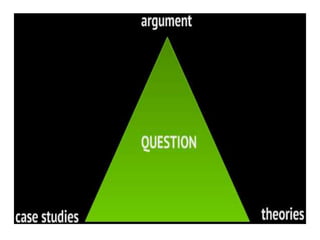
– Create an argument and structure your response using case studies
and theories
– Apply theory you have learnt to the case studies
– Triangulation – how have your brought it all together
What is Identity?
• What do you understand by the term
‘Identity’?
• Spend 2 minutes discussing a definition with
the person sitting next to you
• Now make a 4 and discuss your definitions –
can you create a suitable group definition?
Tackling the Question
Remember the basic rules
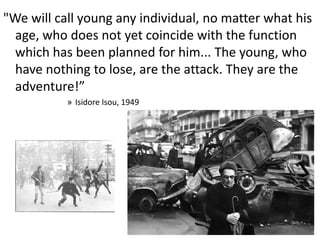
• Always use at least 2 Media examples – 1 historic and 1
current
• Always use at least 2 theorists
• Try to quote them correctly
• All texts should be referenced like this:
• Title (Director Surname, year)
Essay Structure
• Two most important things to remember
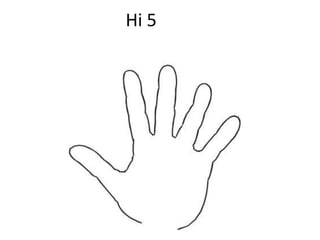
• Hi 5 your Essay!
• Don’t forget to PEE!
Hi 5
PEE
Point
Evidence
Explain
PEE
Point
• Young people today are dangerous to society as they do not respect
society’s rules
Evidence
• Films such as Kidulthood (Huda, 2006) show their teenage cast to all be
drug taking, violent characters with no respect to each other or adults
Explain
• Giroux’s theory states that young people are empty vessels and will
respond to any input to create their identity. By viewing films such as
Kidulthood they are learning behaviours that they consider to be
correct., This is supported by Gerbeners cultivation theory. Gramsci’s
theory of hegemony tells us that those in power dictate the way that
certain ideals are created in society. By showing youth in this way the
dominant social power, wealthy adults, ensure that young people lack
influence in society.
Key Theories & Theorists
• Remember you MUST refer to 2 media
examples and 2 theorists in your answer!
• You can either write about the theorist or use
their quotes to support your point or do both!
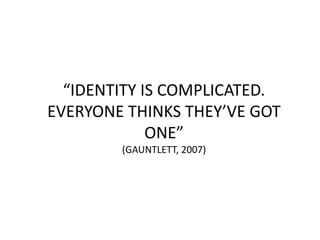
“IDENTITY IS COMPLICATED.
EVERYONE THINKS THEY’VE GOT
ONE”
(GAUNTLETT, 2007)
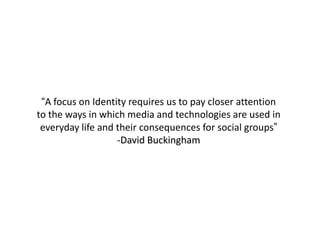
“A focus on Identity requires us to pay closer attention
to the ways in which media and technologies are used in
everyday life and their consequences for social groups”
-David Buckingham
Collective Identity
• ‘A collective identity may have been first constructed by outsiders
who may still enforce it, but depends on some acceptance by
those to whom it is applied. Collective identities are expressed in
cultural materials – names, narratives, symbols, verbal
styles, rituals, clothing.’
Francesca Poletta, James M
Jasper, Collective Identity and Social Movements
• ‘Although there is no consensual definition of collective
identity, discussions of the concept invariably suggest that its
essence resides in a shared sense of ‘one-ness’ or ‘we-ness’
anchored in real or imagined shared attributes and experiences
among those who comprise the collectivity and in relation or
contrast to one or more actual imagined sets of ‘others’.
David
Snow, Collective Identity and Expressive Form
Representation – some definitions
• Representation is the ability of texts to draw upon
features of the world and present them to the
viewer, not simply as reflections, but more so, as
constructions (O‟Shaughnessy & Stadler 2002).
• Hence, the images do not portray reality in an
unbiased way with 100% accuracy, but rather,
present „versions of reality‟ influenced by culture and
people‟s habitual thoughts and actions
(O‟Shaughnessy & Stadler 2002).
David Buckingham
• “our identity is something we uniquely
possess: it is what distinguishes us from other
people. Yet on the other hand, identity also
implies a relationship with a broader collective
or social group of some kind. When we talk
about national identity, cultural identity, or
gender identity, for example, we imply that
our identity is partly a matter of what we
share with other people.” (Buckingham, 2008)
Erik Erikson
• Concept
– Stages of Development
• Explanation
– Humans develop at 8 stages throughout their lives.
– Each of Erikson's stages of psychosocial development
is marked by a conflict for which successful resolution
will result in a favourable outcome, and by an
important event that this conflict resolves itself
around.
Stages of Development
1. Purpose - Initiative vs. Guilt - Preschool / 3–6 years - Does the child have the ability to or do
things on their own, such as dress him or herself? If "guilty" about making his or her own
choices, the child will not function well. Erikson has a positive outlook on this stage, saying that
most guilt is quickly compensated by a sense of accomplishment.
2. Competence - Industry vs. Inferiority - School-age / 6-11. Child comparing self-worth to others
(such as in a classroom environment). Child can recognize major disparities in personal abilities
relative to other children. Erikson places some emphasis on the teacher, who should ensure that
children do not feel inferior.
3. Fidelity - Identity vs. Role Confusion - Adolescent / 12 years till 20. Questioning of self. Who am
I, how do I fit in? Where am I going in life? Erikson believes, that if the parents allow the child to
explore, they will conclude their own identity. However, if the parents continually push him/her
to conform to their views, the teen will face identity confusion.
4. Intimacy vs. isolation - This is the first stage of adult development. This development usually
happens during young adulthood, which is between the ages of 20 to 24. Dating, marriage, family
and friendships are important during the stage in their life. By successfully forming loving
relationships with other people, individuals are able to experience love and intimacy. Those who
fail to form lasting relationships may feel isolated and alone.
Self-Identity and Social Identity
• Self-identity refers to how we define ourselves. Self-identity forms the
basis of our self-esteem. In adolescence, the way we see ourselves
changes in response to peers, family, and school, among other social
environments. Our self-identities shape our perceptions of belonging.

• Social identity is constructed by others, and may differ from self-identity.
Typically, people categorize individuals according to broad, socially-
defined labels. For example, if you have dark skin, you may be labelled
"black" by others even though you may not have adopted that identity for
yourself.
• A positive self-identity is correlated with positive self-esteem [5, 6]. All
identities are not equally valued by society, so some adolescents may
especially need reinforcement to help them construct a positive sense of
self.
Tafjal & Turner
Concept
• Social Identity Theory
Explanation
• In the Social Identity Theory, a person has not one, “personal
self”, but rather several selves that correspond to widening
circles of group membership. Different social contexts may
trigger an individual to think, feel and act on basis of his
personal, family or national “level of self”
• Apart from the “level of self”, an individual has multiple
“social identities”. Social identity is the individual’s self-
concept derived from perceived membership of social groups
How is Youth Identity Constructed?
Shared Experiences:

• Adolescence – physically and emotionally
maturing

• School/ Education

• Finding work - Choosing a career

• Finding love/friendship/acceptance

• Creating an identity that isn’t created by
school/parents/authority

• Experimentation – drugs, culture, crime

• Leaving home

CAN YOU ADD TO THE LIST?
Shared attributes:
• Innocence

• Frustration

• Enthusiasm

• Awkwardness

• Hope

• Anger
Powerlessness

• Stress

CAN YOU ADD TO THE LIST?
Henry Giroux
Concepts
• Youth as empty category
• Explanation
Giroux's theory addresses the media's influence on
youths. He believes that youths act as a sort vessel
open to influences of adult culture and how the
media chooses to represent them, therefore
shaping the youths cultural contexts.
Henry Giroux
Concepts
• Youth as empty category
• Explanation
The media chooses the way they represent race, class, gender,
ethnicity, sexuality, occupation, age and so on, therefore leaving an
influence on the youths that are not necessarily true. The media acts
upon what it's audience wants. When appealing to a adult audience,
the media will reflect fears and anxieties that adults may find
entertaining, therefore giving an unrealistic view on youths.
Giroux suggests that the media influences them in a certain way as
youths are so impressionable, for example, if they are represented as
loud and abusive in films, they will act on this because they are being
told to act in such a way.
Henry Giroux
Concepts
• Youth as empty category
• Quote
“Youth as a complex, shifting, and contradictory category is rarely
narrated in the dominant public sphere through the diverse voices of
the young. Prohibited from speaking as moral and political agents,
youth become an empty category inhabited by the desires, fantasies,
and interests of the adult world. This is not to suggest that youth don't
speak, they are simply restricted from speaking in those spheres where
public conversation shapes social policy and refused the power to make
knowledge consequential with respect to their own individual and
collective needs.” (Giroux, 1998)
Subcultures
“Subcultures try to compensate for the failure
of the larger culture to provide adequate
status, acceptance and identity. In the youth
subculture, youth find their age-related needs
met.”
(Tittley, p.2).
Subcultures
• Thrasher (1927) studied gangs in the jails and on the streets of
Chicago. He found various reasons for young people joining
gangs, including:
1. A sense of family – mostly from broken homes so desired a group
of people to feel part of.
2. Guidance – again, because of lack of family guidance they seek
someone to teach them and to help structure their belief system.
3. Solidarity – giving them the self-esteem and security that they
longed for.
• Gangs were forming in Chicago as a result of urban neglect. These
young people represented the “inner cracks of identity that occur
in the turbulent years of adolescence”.
Subcultures
• Jordaan & Jordaan (1993) gathered information
from lots of other studies of youth subcultures
and found, among other things, the following
special characteristics which the collection of
people share, including:
– An awareness of membership/a sense of
belonging, i.e. shared interests etc.
– A reason for being in the group/an internal
motive, i.e. hippies spreading the message of peace
and love and punks spreading anarchy.
– Pressure to conform, i.e. Jimmy not wanting to talk
to his old friend who is now a rocker.
Subcultures
• A group of people within a larger culture who differentiate themselves from that culture.
• Ken Gelder’s provides 6 key ways to identify a Subculture:
1. often negative relations to work (as 'idle', 'parasitic', at play or at leisure, etc.);
2. negative or ambivalent relation to class (since subcultures are not 'class-conscious' and don't
conform to traditional class definitions);
3. association with territory (the 'street', the 'hood', the club, etc.), rather than property;
4. movement out of the home and into non-domestic forms of belonging (i.e. social groups other
than the family);
5. stylistic ties to excess and exaggeration (with some exceptions);
6. refusal of the banalities of ordinary life and massification
McMillan & Chavis
• Concepts
Sense of Community
• Explaination
McMillan & Chavis (1986) define sense of
community as "a feeling that members have of
belonging, a feeling that members matter to one
another and to the group, and a shared faith that
members' needs will be met through their
commitment to be together."
McMillan & Chavis
• Concepts
Sense of Community
• Explaination
McMillan & Chavis's (1986) theory (and instrument) are the most broadly validated and widely
utilized in this area in the psychological literature. They prefer the abbreviated label "sense of
community", and propose that sense of community is composed of four elements.
Four elements of sense of community
There are four elements of "sense of community" according to the McMillan & Chavis theory:
Membership
Membership includes five attributes:
boundaries
emotional safety
a sense of belonging and identification
personal investment
a common symbol system
McMillan & Chavis
• Concepts
Sense of Community
• Explaination
Influence
Influence works both ways: members need to feel that they have some influence in the group,
and some influence by the group on its members is needed for group cohesion.
Integration and fulfillment of needs
Members feel rewarded in some way for their participation in the community.
Shared emotional connection
The "definitive element for true community" (1986, p. 14), it includes shared history and shared
participation (or at least identification with the history).
Some Dominant Ideologies
• Capitalism. The production of capital and
consumption of surplus value as a life goal.
• Patriotism. To love, support and protect
one‟s country and its people.
• Marriage and family. The “right way” to live
is to marry an opposite-sex partner and
have children.
• Male superiority. Men are more suited to
positions of power, and more suited to
decision-making at work and at home.
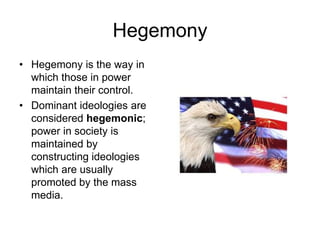
Hegemony
• Hegemony is the way in
which those in power
maintain their control.
• Dominant ideologies are
considered hegemonic;
power in society is
maintained by
constructing ideologies
which are usually
promoted by the mass
media.
Antonio Gramsci
Concepts
• Cultural hegemony
Explanation
• Gramsci developed the idea of "cultural hegemony". As I mentioned
before, this is the idea that one social class within a culture
dominates society, therefore making their views and values
acceptable and "normal" behaviour.
• Gramsci believes hegemony is constantly causing problems within
societies arguing what is actually a "normal" way of life. For
example, this arguing is shown through negative and positive
representation of youths from different classes, most commonly
underclass
Antonio Gramsci
Concepts
• Cultural hegemony
Quote
• So one could say that each one of us changes
himself, modifies himself to the extent that he
changes the complex relations of which he is the
hub... If one's own individuality means to acquire
consciousness of them and to modify one's own
personality means to modify the ensemble of
these relations. (Gramsci)
"We will call young any individual, no matter what his
age, who does not yet coincide with the function
which has been planned for him... The young, who
have nothing to lose, are the attack. They are the
adventure!”
» Isidore Isou, 1949
Stanley Cohen
Concepts
• Moral panic
Explanation
• He argues that occasionally what he calls "folk devils" emerge
within society, reflecting the anxieties and fears of adult culture.
"Moral Panic" emerges when exaggerated media coverage appears
of these "folk devils" leading to politicians and police to act. When
this occurs, the aim is to return the social values of hegemony,
clearly stating what is not a socially acceptable way to behave.
• Cohen's theory suggest that youths have become a cultural "folk
devil" leading media to exaggerate their behaviour.
George Gerbner
• Concepts
Cultivation Theory
• Explanation
Gerbner studies the effect of television on the audience's perception
of crime. His theory suggests that people who watch a large amount of
television have an over exaggerated opinion on crime and how much it
occurs as well as how severe the crimes actually are. He called this
"mean world syndrome". His theory states that because media forms
such as news reports, television programmes and films contain over
exaggerated representations of crimes, mostly negative, people's
perceptions are dramatically influenced. The term used by Gerbner to
describe this is "cultivation theory".
George Gerbner
• Concepts
Cultivation Theory
• Quotes
Fearful people are more dependent, more easily manipulated and
controlled, more susceptible to deceptively simple, strong, tough
measures and hard-line postures... They may accept and even welcome
repression if it promises to relieve their insecurities. (Gerbner)
Who tells the stories of a culture really governs human behavior. It
used to be the parent, the school, the church, the community. Now it’s
a handful of global conglomerates that have nothing to tell, but a great
deal to sell. (Gerbner)
Charles R Acland
Concepts
• Ideology of protection; deviant youth and reproduction of social
order
Explanation
• Acland argues in his theory that the representation of deviant
youths reinforces hegemony, the idea that a culture is ruled by one
social class. Media creates the image of "normal" youth and adults,
then contrasting this with behaviour that contrasts against what we
deem to be socially acceptable. This is what the audience finds
entertaining and interesting, as it is going against these "normal"
views of society. Acland also makes the point that by the media
representing youths in such a way, it allows the state to have more
control over them.
Charles R Acland
Concepts
• Ideology of protection; deviant youth and reproduction of social
order
Explanation
• For example, the mass of media reports about negative youth
behaviour led to the introduction of ASBO's, which then led to even
more media coverage. Acland calls this "ideology of protection"
which is the idea that youths need this constant surveillance and
monitoring in order to "protect" them. Similar to Giroux's theory,
youths are impressionable it is a time in their life when they learn
about roles and values from adult culture. Media coverage of
negative behaviour allows the state to reinforce hegemonic values
and tell youths what is wrong and socially unacceptable.
Charles R Acland
Concepts
• Ideology of protection; deviant youth and
reproduction of social order
Explanation
• For example, the idea in "hoodie horrors" that
youths are like monsters often included in horror
themes leads some youths to relate these
representations to things they fear, such as
demons, which moves them in the opposite
direction of this sort of behaviour.
Henry Jenkins
• Concepts
Participatory Culture
• Explanation
• As technology continues to enable new avenues for communication, collaboration, and circulation of
ideas, it has also given rise to new opportunities for consumers to create their own content. Barriers like
time and money are beginning to become less significant to large groups of consumers.
• For example, the creation of movies once required large amounts of expensive equipment, but now movie
clips can be made with equipment that is affordable to a growing number of people. The ease with which
consumers create new material has also grown. Extensive knowledge of computer programming is no
longer necessary to create content on the internet.
• Media sharing over the Internet acts as a platform to invite users to participate and create communities
that share similar interests through duplicated sources, original content, and repurposed material
Henry Jenkins
• Affiliations — memberships, formal and informal, in online communities
centered around various forms of media, such as Friendster, Facebook,
message boards, metagaming, game clans, or MySpace).
• Expressions — producing new creative forms, such as digital sampling,
skinning and modding, fan videomaking, fan fiction writing, zines, mash-
ups).
• Collaborative Problem-solving — working together in teams, formal and
informal, to complete tasks and develop new knowledge (such as through
Wikipedia, alternative reality gaming, spoiling).
• Circulations — Shaping the flow of media (such as podcasting, blogging)
Galtung & Ruge
Concept
• Information is filtered by those who deem it
worthy
Explanation
• Selective Gatekeeping.
• Galtung and Ruge selective gatekeeping theory
suggests that news from around the world are
evaluated using news values to determine their
newsworthiness.
Hyperdermic Needle Theory
Concept
• Audience is passive. They receive information and react to
it with no influence from other sources.
Explanation
• This approach focuses on content. The audience receives
the information directly. The "Hypodermic Needle Model”
suggests that the media injects its messages straight into
the passive audience. This passive audience is immediately
affected by these messages. The public essentially cannot
escape from the media's influence, and is therefore
considered a "sitting duck”.
Bulmer & Katz
Concept
• Uses and Gratifications. Audience is active. Audience
chooses media for different reasons which effects how
they respond to text
Explanation
• This approach focuses on why people use particular
media rather than on content. In contrast to the
concern of the 'media effects' tradition (Hyperdermic
Needle), it focuses on 'what people do with media',
allowing for a variety of responses and interpretations.
Bulmer & Katz
Information
• finding out about relevant events and conditions in
immediate surroundings, society and the world,
seeking advice on practical matters or opinion and
decision choices, satisfying curiosity and general
interest, learning; self-education, gaining a sense of
security through knowledge
Personal Identity
• finding reinforcement for personal values, finding
models of behavior, identifying with valued other
(in the media), gaining insight into one's self
Bulmer and Katz
Integration and Social Interaction
• gaining insight into circumstances of others; social
empathy, identifying with others and gaining a sense of
belonging, finding a basis for conversation and social
interaction, having a substitute for real-life
companionship, helping to carry out social roles,
enabling one to connect with family, friends and society
Entertainment
• escaping, or being diverted, from problems, relaxing,
getting intrinsic cultural or aesthetic enjoyment, filling
time, emotional release
Stuart Hall
Concept
• Active audiences interpret texts in different ways depending on their
needs
Explanation
• This theory points out that meaning of any text is created by the audience
- not the producer. Meaning is encoded into the text but it is up to the
audience what they take from it depending how they decode the signs
within the text. Encoding-decoding is an active audience theory which
examines the relationships between text and it's audience
• Encoding is a process by which a text is constructed by it's producers
• Decoding is the process by which the audience reads, understands and
interprets text
• Hall states that texts are polysemic, meaning they may be read differently
by different people, depending on their identity, cultural knowledge and
opinions
Stuart Hall
Concept
• Active audiences interpret texts in different ways
depending on their needs
Explanation
• Preffered Reading
• When an audience interprets the message as it was meant
to be understood, they are operating in dominant code.
• The position of professional broadcasters and media
producers is that the messages are already signified within
the hegmonic manner to which they are accustomed.
• The producers and the audience are in harmony
Stuart Hall
Concept
• Active audiences interpret texts in different ways depending on
their needs
Explanation
• Negotiated reading
• Not all audience may underatand what media producers take for
granted. There may be some acknowlwedgment of differences in
understanding.
• Decoding within the negotiated version contains a mixture od
adaptive and oppositional elements: it acknowledges the legitimacy
of the hegemonic definitions to make the grand significations
(abstract) while at the more restricted situational (situated) level it
makes it own ground rules
Stuart Hall
Concept
• Active audiences interpret texts in different ways
depending on their needs
Explanation
• Oppositional Reading
• When media consumers understand the
contextual and literary infections of a text yet
decode the message by a completely
oppositiional means.

Theorists revision 1

  • 1.
    A Level Media G325:Collective Identity
  • 2.
    Starter • What doesthe following word mean? Ephebiphobia
  • 3.
    Final Exam How willI be assessed? • Media Studies Final Exam – 4th June 2013 • Section B • 60 mins for Section B • Answer Topic: Media & Collective Identity • Answer 1 Question from a choice of 2 • You MUST discuss at least 2 Different Media Forms • You MUST refer to historical, present and future representations
  • 4.
    Marks Awarded How willI be marked? • Total of 50 marks • Marks are given for 3 different areas 1. Explaination/Analysis/Argument (max. 20) 2. Use of Examples (max. 20) 3. Terminology (max. 10) • Examiners will be looking to see how well you: – Answer the actual question asked – not just a general response! – Create an argument and structure your response using case studies and theories – Apply theory you have learnt to the case studies – Triangulation – how have your brought it all together
  • 6.
    What is Identity? •What do you understand by the term ‘Identity’? • Spend 2 minutes discussing a definition with the person sitting next to you • Now make a 4 and discuss your definitions – can you create a suitable group definition?
  • 7.
    Tackling the Question Rememberthe basic rules • Always use at least 2 Media examples – 1 historic and 1 current • Always use at least 2 theorists • Try to quote them correctly • All texts should be referenced like this: • Title (Director Surname, year)
  • 8.
    Essay Structure • Twomost important things to remember • Hi 5 your Essay! • Don’t forget to PEE!
  • 9.
  • 10.
  • 11.
    PEE Point • Young peopletoday are dangerous to society as they do not respect society’s rules Evidence • Films such as Kidulthood (Huda, 2006) show their teenage cast to all be drug taking, violent characters with no respect to each other or adults Explain • Giroux’s theory states that young people are empty vessels and will respond to any input to create their identity. By viewing films such as Kidulthood they are learning behaviours that they consider to be correct., This is supported by Gerbeners cultivation theory. Gramsci’s theory of hegemony tells us that those in power dictate the way that certain ideals are created in society. By showing youth in this way the dominant social power, wealthy adults, ensure that young people lack influence in society.
  • 12.
    Key Theories &Theorists • Remember you MUST refer to 2 media examples and 2 theorists in your answer! • You can either write about the theorist or use their quotes to support your point or do both!
  • 13.
    “IDENTITY IS COMPLICATED. EVERYONETHINKS THEY’VE GOT ONE” (GAUNTLETT, 2007)
  • 14.
    “A focus onIdentity requires us to pay closer attention to the ways in which media and technologies are used in everyday life and their consequences for social groups” -David Buckingham
  • 15.
    Collective Identity • ‘Acollective identity may have been first constructed by outsiders who may still enforce it, but depends on some acceptance by those to whom it is applied. Collective identities are expressed in cultural materials – names, narratives, symbols, verbal styles, rituals, clothing.’
Francesca Poletta, James M Jasper, Collective Identity and Social Movements • ‘Although there is no consensual definition of collective identity, discussions of the concept invariably suggest that its essence resides in a shared sense of ‘one-ness’ or ‘we-ness’ anchored in real or imagined shared attributes and experiences among those who comprise the collectivity and in relation or contrast to one or more actual imagined sets of ‘others’.
David Snow, Collective Identity and Expressive Form
  • 16.
    Representation – somedefinitions • Representation is the ability of texts to draw upon features of the world and present them to the viewer, not simply as reflections, but more so, as constructions (O‟Shaughnessy & Stadler 2002). • Hence, the images do not portray reality in an unbiased way with 100% accuracy, but rather, present „versions of reality‟ influenced by culture and people‟s habitual thoughts and actions (O‟Shaughnessy & Stadler 2002).
  • 17.
    David Buckingham • “ouridentity is something we uniquely possess: it is what distinguishes us from other people. Yet on the other hand, identity also implies a relationship with a broader collective or social group of some kind. When we talk about national identity, cultural identity, or gender identity, for example, we imply that our identity is partly a matter of what we share with other people.” (Buckingham, 2008)
  • 18.
    Erik Erikson • Concept –Stages of Development • Explanation – Humans develop at 8 stages throughout their lives. – Each of Erikson's stages of psychosocial development is marked by a conflict for which successful resolution will result in a favourable outcome, and by an important event that this conflict resolves itself around.
  • 19.
    Stages of Development 1.Purpose - Initiative vs. Guilt - Preschool / 3–6 years - Does the child have the ability to or do things on their own, such as dress him or herself? If "guilty" about making his or her own choices, the child will not function well. Erikson has a positive outlook on this stage, saying that most guilt is quickly compensated by a sense of accomplishment. 2. Competence - Industry vs. Inferiority - School-age / 6-11. Child comparing self-worth to others (such as in a classroom environment). Child can recognize major disparities in personal abilities relative to other children. Erikson places some emphasis on the teacher, who should ensure that children do not feel inferior. 3. Fidelity - Identity vs. Role Confusion - Adolescent / 12 years till 20. Questioning of self. Who am I, how do I fit in? Where am I going in life? Erikson believes, that if the parents allow the child to explore, they will conclude their own identity. However, if the parents continually push him/her to conform to their views, the teen will face identity confusion. 4. Intimacy vs. isolation - This is the first stage of adult development. This development usually happens during young adulthood, which is between the ages of 20 to 24. Dating, marriage, family and friendships are important during the stage in their life. By successfully forming loving relationships with other people, individuals are able to experience love and intimacy. Those who fail to form lasting relationships may feel isolated and alone.
  • 20.
    Self-Identity and SocialIdentity • Self-identity refers to how we define ourselves. Self-identity forms the basis of our self-esteem. In adolescence, the way we see ourselves changes in response to peers, family, and school, among other social environments. Our self-identities shape our perceptions of belonging.
 • Social identity is constructed by others, and may differ from self-identity. Typically, people categorize individuals according to broad, socially- defined labels. For example, if you have dark skin, you may be labelled "black" by others even though you may not have adopted that identity for yourself. • A positive self-identity is correlated with positive self-esteem [5, 6]. All identities are not equally valued by society, so some adolescents may especially need reinforcement to help them construct a positive sense of self.
  • 21.
    Tafjal & Turner Concept •Social Identity Theory Explanation • In the Social Identity Theory, a person has not one, “personal self”, but rather several selves that correspond to widening circles of group membership. Different social contexts may trigger an individual to think, feel and act on basis of his personal, family or national “level of self” • Apart from the “level of self”, an individual has multiple “social identities”. Social identity is the individual’s self- concept derived from perceived membership of social groups
  • 22.
    How is YouthIdentity Constructed? Shared Experiences:
 • Adolescence – physically and emotionally maturing
 • School/ Education
 • Finding work - Choosing a career
 • Finding love/friendship/acceptance
 • Creating an identity that isn’t created by school/parents/authority
 • Experimentation – drugs, culture, crime
 • Leaving home
 CAN YOU ADD TO THE LIST? Shared attributes: • Innocence
 • Frustration
 • Enthusiasm
 • Awkwardness
 • Hope
 • Anger
Powerlessness
 • Stress
 CAN YOU ADD TO THE LIST?
  • 23.
    Henry Giroux Concepts • Youthas empty category • Explanation Giroux's theory addresses the media's influence on youths. He believes that youths act as a sort vessel open to influences of adult culture and how the media chooses to represent them, therefore shaping the youths cultural contexts.
  • 24.
    Henry Giroux Concepts • Youthas empty category • Explanation The media chooses the way they represent race, class, gender, ethnicity, sexuality, occupation, age and so on, therefore leaving an influence on the youths that are not necessarily true. The media acts upon what it's audience wants. When appealing to a adult audience, the media will reflect fears and anxieties that adults may find entertaining, therefore giving an unrealistic view on youths. Giroux suggests that the media influences them in a certain way as youths are so impressionable, for example, if they are represented as loud and abusive in films, they will act on this because they are being told to act in such a way.
  • 25.
    Henry Giroux Concepts • Youthas empty category • Quote “Youth as a complex, shifting, and contradictory category is rarely narrated in the dominant public sphere through the diverse voices of the young. Prohibited from speaking as moral and political agents, youth become an empty category inhabited by the desires, fantasies, and interests of the adult world. This is not to suggest that youth don't speak, they are simply restricted from speaking in those spheres where public conversation shapes social policy and refused the power to make knowledge consequential with respect to their own individual and collective needs.” (Giroux, 1998)
  • 26.
    Subcultures “Subcultures try tocompensate for the failure of the larger culture to provide adequate status, acceptance and identity. In the youth subculture, youth find their age-related needs met.” (Tittley, p.2).
  • 27.
    Subcultures • Thrasher (1927)studied gangs in the jails and on the streets of Chicago. He found various reasons for young people joining gangs, including: 1. A sense of family – mostly from broken homes so desired a group of people to feel part of. 2. Guidance – again, because of lack of family guidance they seek someone to teach them and to help structure their belief system. 3. Solidarity – giving them the self-esteem and security that they longed for. • Gangs were forming in Chicago as a result of urban neglect. These young people represented the “inner cracks of identity that occur in the turbulent years of adolescence”.
  • 28.
    Subcultures • Jordaan &Jordaan (1993) gathered information from lots of other studies of youth subcultures and found, among other things, the following special characteristics which the collection of people share, including: – An awareness of membership/a sense of belonging, i.e. shared interests etc. – A reason for being in the group/an internal motive, i.e. hippies spreading the message of peace and love and punks spreading anarchy. – Pressure to conform, i.e. Jimmy not wanting to talk to his old friend who is now a rocker.
  • 29.
    Subcultures • A groupof people within a larger culture who differentiate themselves from that culture. • Ken Gelder’s provides 6 key ways to identify a Subculture: 1. often negative relations to work (as 'idle', 'parasitic', at play or at leisure, etc.); 2. negative or ambivalent relation to class (since subcultures are not 'class-conscious' and don't conform to traditional class definitions); 3. association with territory (the 'street', the 'hood', the club, etc.), rather than property; 4. movement out of the home and into non-domestic forms of belonging (i.e. social groups other than the family); 5. stylistic ties to excess and exaggeration (with some exceptions); 6. refusal of the banalities of ordinary life and massification
  • 30.
    McMillan & Chavis •Concepts Sense of Community • Explaination McMillan & Chavis (1986) define sense of community as "a feeling that members have of belonging, a feeling that members matter to one another and to the group, and a shared faith that members' needs will be met through their commitment to be together."
  • 31.
    McMillan & Chavis •Concepts Sense of Community • Explaination McMillan & Chavis's (1986) theory (and instrument) are the most broadly validated and widely utilized in this area in the psychological literature. They prefer the abbreviated label "sense of community", and propose that sense of community is composed of four elements. Four elements of sense of community There are four elements of "sense of community" according to the McMillan & Chavis theory: Membership Membership includes five attributes: boundaries emotional safety a sense of belonging and identification personal investment a common symbol system
  • 32.
    McMillan & Chavis •Concepts Sense of Community • Explaination Influence Influence works both ways: members need to feel that they have some influence in the group, and some influence by the group on its members is needed for group cohesion. Integration and fulfillment of needs Members feel rewarded in some way for their participation in the community. Shared emotional connection The "definitive element for true community" (1986, p. 14), it includes shared history and shared participation (or at least identification with the history).
  • 33.
    Some Dominant Ideologies •Capitalism. The production of capital and consumption of surplus value as a life goal. • Patriotism. To love, support and protect one‟s country and its people. • Marriage and family. The “right way” to live is to marry an opposite-sex partner and have children. • Male superiority. Men are more suited to positions of power, and more suited to decision-making at work and at home.
  • 34.
    Hegemony • Hegemony isthe way in which those in power maintain their control. • Dominant ideologies are considered hegemonic; power in society is maintained by constructing ideologies which are usually promoted by the mass media.
  • 35.
    Antonio Gramsci Concepts • Culturalhegemony Explanation • Gramsci developed the idea of "cultural hegemony". As I mentioned before, this is the idea that one social class within a culture dominates society, therefore making their views and values acceptable and "normal" behaviour. • Gramsci believes hegemony is constantly causing problems within societies arguing what is actually a "normal" way of life. For example, this arguing is shown through negative and positive representation of youths from different classes, most commonly underclass
  • 36.
    Antonio Gramsci Concepts • Culturalhegemony Quote • So one could say that each one of us changes himself, modifies himself to the extent that he changes the complex relations of which he is the hub... If one's own individuality means to acquire consciousness of them and to modify one's own personality means to modify the ensemble of these relations. (Gramsci)
  • 37.
    "We will callyoung any individual, no matter what his age, who does not yet coincide with the function which has been planned for him... The young, who have nothing to lose, are the attack. They are the adventure!” » Isidore Isou, 1949
  • 38.
    Stanley Cohen Concepts • Moralpanic Explanation • He argues that occasionally what he calls "folk devils" emerge within society, reflecting the anxieties and fears of adult culture. "Moral Panic" emerges when exaggerated media coverage appears of these "folk devils" leading to politicians and police to act. When this occurs, the aim is to return the social values of hegemony, clearly stating what is not a socially acceptable way to behave. • Cohen's theory suggest that youths have become a cultural "folk devil" leading media to exaggerate their behaviour.
  • 39.
    George Gerbner • Concepts CultivationTheory • Explanation Gerbner studies the effect of television on the audience's perception of crime. His theory suggests that people who watch a large amount of television have an over exaggerated opinion on crime and how much it occurs as well as how severe the crimes actually are. He called this "mean world syndrome". His theory states that because media forms such as news reports, television programmes and films contain over exaggerated representations of crimes, mostly negative, people's perceptions are dramatically influenced. The term used by Gerbner to describe this is "cultivation theory".
  • 40.
    George Gerbner • Concepts CultivationTheory • Quotes Fearful people are more dependent, more easily manipulated and controlled, more susceptible to deceptively simple, strong, tough measures and hard-line postures... They may accept and even welcome repression if it promises to relieve their insecurities. (Gerbner) Who tells the stories of a culture really governs human behavior. It used to be the parent, the school, the church, the community. Now it’s a handful of global conglomerates that have nothing to tell, but a great deal to sell. (Gerbner)
  • 41.
    Charles R Acland Concepts •Ideology of protection; deviant youth and reproduction of social order Explanation • Acland argues in his theory that the representation of deviant youths reinforces hegemony, the idea that a culture is ruled by one social class. Media creates the image of "normal" youth and adults, then contrasting this with behaviour that contrasts against what we deem to be socially acceptable. This is what the audience finds entertaining and interesting, as it is going against these "normal" views of society. Acland also makes the point that by the media representing youths in such a way, it allows the state to have more control over them.
  • 42.
    Charles R Acland Concepts •Ideology of protection; deviant youth and reproduction of social order Explanation • For example, the mass of media reports about negative youth behaviour led to the introduction of ASBO's, which then led to even more media coverage. Acland calls this "ideology of protection" which is the idea that youths need this constant surveillance and monitoring in order to "protect" them. Similar to Giroux's theory, youths are impressionable it is a time in their life when they learn about roles and values from adult culture. Media coverage of negative behaviour allows the state to reinforce hegemonic values and tell youths what is wrong and socially unacceptable.
  • 43.
    Charles R Acland Concepts •Ideology of protection; deviant youth and reproduction of social order Explanation • For example, the idea in "hoodie horrors" that youths are like monsters often included in horror themes leads some youths to relate these representations to things they fear, such as demons, which moves them in the opposite direction of this sort of behaviour.
  • 44.
    Henry Jenkins • Concepts ParticipatoryCulture • Explanation • As technology continues to enable new avenues for communication, collaboration, and circulation of ideas, it has also given rise to new opportunities for consumers to create their own content. Barriers like time and money are beginning to become less significant to large groups of consumers. • For example, the creation of movies once required large amounts of expensive equipment, but now movie clips can be made with equipment that is affordable to a growing number of people. The ease with which consumers create new material has also grown. Extensive knowledge of computer programming is no longer necessary to create content on the internet. • Media sharing over the Internet acts as a platform to invite users to participate and create communities that share similar interests through duplicated sources, original content, and repurposed material
  • 45.
    Henry Jenkins • Affiliations— memberships, formal and informal, in online communities centered around various forms of media, such as Friendster, Facebook, message boards, metagaming, game clans, or MySpace). • Expressions — producing new creative forms, such as digital sampling, skinning and modding, fan videomaking, fan fiction writing, zines, mash- ups). • Collaborative Problem-solving — working together in teams, formal and informal, to complete tasks and develop new knowledge (such as through Wikipedia, alternative reality gaming, spoiling). • Circulations — Shaping the flow of media (such as podcasting, blogging)
  • 46.
    Galtung & Ruge Concept •Information is filtered by those who deem it worthy Explanation • Selective Gatekeeping. • Galtung and Ruge selective gatekeeping theory suggests that news from around the world are evaluated using news values to determine their newsworthiness.
  • 47.
    Hyperdermic Needle Theory Concept •Audience is passive. They receive information and react to it with no influence from other sources. Explanation • This approach focuses on content. The audience receives the information directly. The "Hypodermic Needle Model” suggests that the media injects its messages straight into the passive audience. This passive audience is immediately affected by these messages. The public essentially cannot escape from the media's influence, and is therefore considered a "sitting duck”.
  • 48.
    Bulmer & Katz Concept •Uses and Gratifications. Audience is active. Audience chooses media for different reasons which effects how they respond to text Explanation • This approach focuses on why people use particular media rather than on content. In contrast to the concern of the 'media effects' tradition (Hyperdermic Needle), it focuses on 'what people do with media', allowing for a variety of responses and interpretations.
  • 49.
    Bulmer & Katz Information •finding out about relevant events and conditions in immediate surroundings, society and the world, seeking advice on practical matters or opinion and decision choices, satisfying curiosity and general interest, learning; self-education, gaining a sense of security through knowledge Personal Identity • finding reinforcement for personal values, finding models of behavior, identifying with valued other (in the media), gaining insight into one's self
  • 50.
    Bulmer and Katz Integrationand Social Interaction • gaining insight into circumstances of others; social empathy, identifying with others and gaining a sense of belonging, finding a basis for conversation and social interaction, having a substitute for real-life companionship, helping to carry out social roles, enabling one to connect with family, friends and society Entertainment • escaping, or being diverted, from problems, relaxing, getting intrinsic cultural or aesthetic enjoyment, filling time, emotional release
  • 51.
    Stuart Hall Concept • Activeaudiences interpret texts in different ways depending on their needs Explanation • This theory points out that meaning of any text is created by the audience - not the producer. Meaning is encoded into the text but it is up to the audience what they take from it depending how they decode the signs within the text. Encoding-decoding is an active audience theory which examines the relationships between text and it's audience • Encoding is a process by which a text is constructed by it's producers • Decoding is the process by which the audience reads, understands and interprets text • Hall states that texts are polysemic, meaning they may be read differently by different people, depending on their identity, cultural knowledge and opinions
  • 52.
    Stuart Hall Concept • Activeaudiences interpret texts in different ways depending on their needs Explanation • Preffered Reading • When an audience interprets the message as it was meant to be understood, they are operating in dominant code. • The position of professional broadcasters and media producers is that the messages are already signified within the hegmonic manner to which they are accustomed. • The producers and the audience are in harmony
  • 53.
    Stuart Hall Concept • Activeaudiences interpret texts in different ways depending on their needs Explanation • Negotiated reading • Not all audience may underatand what media producers take for granted. There may be some acknowlwedgment of differences in understanding. • Decoding within the negotiated version contains a mixture od adaptive and oppositional elements: it acknowledges the legitimacy of the hegemonic definitions to make the grand significations (abstract) while at the more restricted situational (situated) level it makes it own ground rules
  • 54.
    Stuart Hall Concept • Activeaudiences interpret texts in different ways depending on their needs Explanation • Oppositional Reading • When media consumers understand the contextual and literary infections of a text yet decode the message by a completely oppositiional means.

Editor's Notes

  • #10 IntroductionHistorical ContextCurrent IssuesFuture DebatesConclusion
  • #24 http://amy-mcdermott-a2-g325.blogspot.co.uk/2012/01/research-theory.html
  • #25 http://amy-mcdermott-a2-g325.blogspot.co.uk/2012/01/research-theory.html
  • #26 http://amy-mcdermott-a2-g325.blogspot.co.uk/2012/01/research-theory.html
  • #27 http://www.ymresourcer.com/model/subcult1.htm
  • #45 http://www.youtube.com/watch?v=wtRw-QKb034