G325 – SECTION B
Collective Identity
Identity & Representation of
youth
 Brainstorm as many examples of media that represent youth,
or that you identify with as a young person, from the past five
years (the contemporary)
 Film
 TV
 Music
 Games
 Online (YouTube)
 Magazines
 Radio
 Advertising
 News
Guess the year of these two
quotes:
 “Kids are out of control... They're roaming the
streets. They're out late at night”
 “The children now love luxury; they have bad
manners, contempt for authority; they show
disrespect for elders and love chatter in place
of exercise. Children are now tyrants, not the
servants of their households.”
Guess the year of these two
quotes:
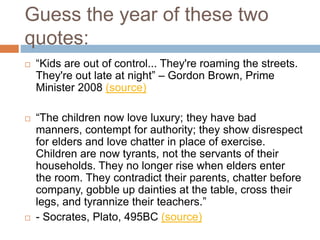
 “Kids are out of control... They're roaming the streets.
They're out late at night” – Gordon Brown, Prime
Minister 2008 (source)
 “The children now love luxury; they have bad
manners, contempt for authority; they show disrespect
for elders and love chatter in place of exercise.
Children are now tyrants, not the servants of their
households. They no longer rise when elders enter
the room. They contradict their parents, chatter before
company, gobble up dainties at the table, cross their
legs, and tyrannize their teachers.”
 - Socrates, Plato, 495BC (source)
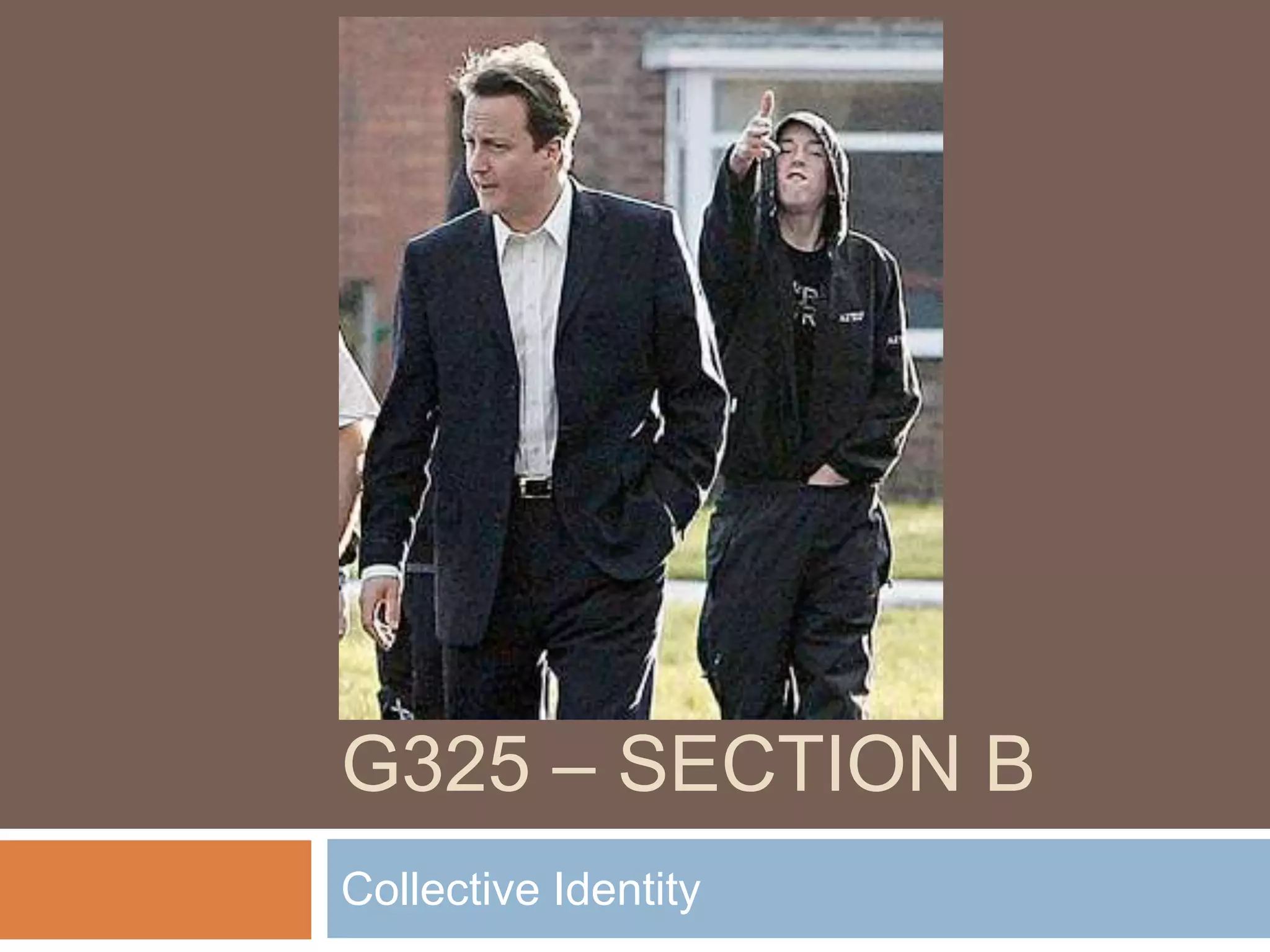
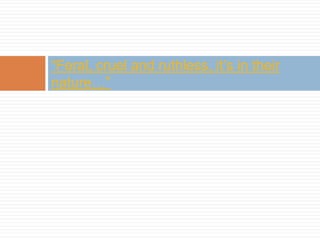
“Feral, cruel and ruthless, it’s in their
nature…”
Five structuring points from the
exam
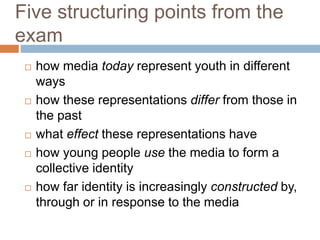
 how media today represent youth in different
ways
 how these representations differ from those in
the past
 what effect these representations have
 how young people use the media to form a
collective identity
 how far identity is increasingly constructed by,
through or in response to the media
Possible questions based on these
structures.
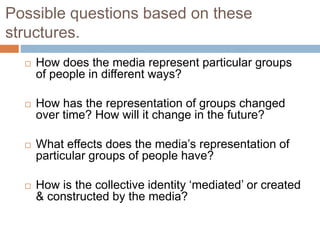
 How does the media represent particular groups
of people in different ways?
 How has the representation of groups changed
over time? How will it change in the future?
 What effects does the media’s representation of
particular groups of people have?
 How is the collective identity ‘mediated’ or created
& constructed by the media?
Collective Identity
 “A collective identity may have been first
constructed by outsiders who may still enforce
it, but depends on some acceptance by those
to whom it is applied” Poletta & Jasper
 Whilst the media may create an identity and
representation of a group, if the group doesn’t
accept this identity it cannot exist.
Collective Identity – David
Gauntlett (2002)
 “It is also the case that the construction of identity has become a
known requirement. Modern Western societies do not leave
individuals in any doubt that they need to make choices of identity
and lifestyle
 It seems clear that the media plays an important role here.
Magazines, bought on one level for a quick fix of glossy
entertainment, promote self-confidence (even if they partly
undermine it, for some readers, at the same time) and provide
information about sex, relationships and lifestyles which can be put
to a variety of uses.
 Television programmes, pop songs, adverts, movies and the
internet all also provide numerous kinds of 'guidance' - not
necessarily in the obvious form of advice-giving, but in the myriad
suggestions of ways of living which they imply. We lap up this
material because the social construction of identity today is the
knowing social construction of identity.”
Historical – Contemporary –
Future
 http://www.mirror.co.uk/news/uk-news/mods-v-
rockers-1964-beach-3437302
 https://www.youtube.com/watch?v=r61ks18Bd
7I
Who are your ‘media’ Role
Models?
 It is for this reason that the 'role model' remains an important
concept, although it should not be taken to mean someone that a
person wants to copy. Instead, role models serve as navigation
points as individuals steer their own personal routes through life.
(Their general direction, we should note, however, is more likely to
be shaped by parents, friends, teachers, colleagues and other
people encountered in everyday life).
 -Gauntlett 2002
 http://www.mirror.co.uk/sport/football/news/jack-wilsheres-smoking-
bad-enough-3869380
 http://www.dailymail.co.uk/debate/article-2018741/Amy-Winehouse-
dead-Genius-life-admire.html
 http://www.telegraph.co.uk/culture/music/11205271/Beyonces-bling-
a-ding-makes-her-a-great-role-model-employment-minister-
says.html
 You got your freshmen, ROTC guys, preps, J.V.
jocks, Asian nerds, Cool Asians, Varsity jocks
Unfriendly black hotties, Girls who eat their
feelings, Girls who don't eat anything, Desperate
wannabes, Burnouts, Sexually active band geeks,
the greatest people you will ever meet and the
worst. Beware the plastics.
 https://www.youtube.com/watch?v=gZ_qXmxdgG
M
 https://www.youtube.com/watch?v=re5veV2F7eY
Who creates this identity?
 A collective identity may have been first
constructed by outsiders who may still
enforce it, but depends on some acceptance
by those to whom it is applied.’
- Poletta & Jasper
 What does this mean?
So who creates your ‘collective’
youth identity?
 Taking this is as start point we can assess the
influence of the media of the two main
participants in the construction of collective
identity:
 a) The outsider: the adult world
 b) The collective: UK youth
The Outsider (The adult world)
 What representations does the adult world
receive & create about youth and young
people?
The Collective
 What representations do young people receive
(& create) about themselves and their own
identity as a collective?
Common factors of
representation
Dave Harrison (http://collectiveidentity.posthaven.com/ ) identifies
some common factors in representation of youth identity:
See which you agree with.
1) Youth are often represented in accordance with popular or
hegemonic notions of adolescence
2) Youth are often ‘demonised’ by the mass media.
3) Youth are represented as being let down by adults
4) Youth are represented as part of a subculture
5) Alienation – youth are represented as being estranged from parts
of society, particularly adult society.
6) Youth are product of the society they were born into, and often
embody the faults and fears of adult society.
7) Representations of UK Youth are often nostalgic and romanticized
Homework
 Moral Panics

Intro to g325 Section B

  • 1.
    G325 – SECTIONB Collective Identity
  • 2.
    Identity & Representationof youth  Brainstorm as many examples of media that represent youth, or that you identify with as a young person, from the past five years (the contemporary)  Film  TV  Music  Games  Online (YouTube)  Magazines  Radio  Advertising  News
  • 3.
    Guess the yearof these two quotes:  “Kids are out of control... They're roaming the streets. They're out late at night”  “The children now love luxury; they have bad manners, contempt for authority; they show disrespect for elders and love chatter in place of exercise. Children are now tyrants, not the servants of their households.”
  • 4.
    Guess the yearof these two quotes:  “Kids are out of control... They're roaming the streets. They're out late at night” – Gordon Brown, Prime Minister 2008 (source)  “The children now love luxury; they have bad manners, contempt for authority; they show disrespect for elders and love chatter in place of exercise. Children are now tyrants, not the servants of their households. They no longer rise when elders enter the room. They contradict their parents, chatter before company, gobble up dainties at the table, cross their legs, and tyrannize their teachers.”  - Socrates, Plato, 495BC (source)
  • 5.
    “Feral, cruel andruthless, it’s in their nature…”
  • 6.
    Five structuring pointsfrom the exam  how media today represent youth in different ways  how these representations differ from those in the past  what effect these representations have  how young people use the media to form a collective identity  how far identity is increasingly constructed by, through or in response to the media
  • 7.
    Possible questions basedon these structures.  How does the media represent particular groups of people in different ways?  How has the representation of groups changed over time? How will it change in the future?  What effects does the media’s representation of particular groups of people have?  How is the collective identity ‘mediated’ or created & constructed by the media?
  • 8.
    Collective Identity  “Acollective identity may have been first constructed by outsiders who may still enforce it, but depends on some acceptance by those to whom it is applied” Poletta & Jasper  Whilst the media may create an identity and representation of a group, if the group doesn’t accept this identity it cannot exist.
  • 9.
    Collective Identity –David Gauntlett (2002)  “It is also the case that the construction of identity has become a known requirement. Modern Western societies do not leave individuals in any doubt that they need to make choices of identity and lifestyle  It seems clear that the media plays an important role here. Magazines, bought on one level for a quick fix of glossy entertainment, promote self-confidence (even if they partly undermine it, for some readers, at the same time) and provide information about sex, relationships and lifestyles which can be put to a variety of uses.  Television programmes, pop songs, adverts, movies and the internet all also provide numerous kinds of 'guidance' - not necessarily in the obvious form of advice-giving, but in the myriad suggestions of ways of living which they imply. We lap up this material because the social construction of identity today is the knowing social construction of identity.”
  • 10.
    Historical – Contemporary– Future  http://www.mirror.co.uk/news/uk-news/mods-v- rockers-1964-beach-3437302  https://www.youtube.com/watch?v=r61ks18Bd 7I
  • 11.
    Who are your‘media’ Role Models?  It is for this reason that the 'role model' remains an important concept, although it should not be taken to mean someone that a person wants to copy. Instead, role models serve as navigation points as individuals steer their own personal routes through life. (Their general direction, we should note, however, is more likely to be shaped by parents, friends, teachers, colleagues and other people encountered in everyday life).  -Gauntlett 2002  http://www.mirror.co.uk/sport/football/news/jack-wilsheres-smoking- bad-enough-3869380  http://www.dailymail.co.uk/debate/article-2018741/Amy-Winehouse- dead-Genius-life-admire.html  http://www.telegraph.co.uk/culture/music/11205271/Beyonces-bling- a-ding-makes-her-a-great-role-model-employment-minister- says.html
  • 12.
     You gotyour freshmen, ROTC guys, preps, J.V. jocks, Asian nerds, Cool Asians, Varsity jocks Unfriendly black hotties, Girls who eat their feelings, Girls who don't eat anything, Desperate wannabes, Burnouts, Sexually active band geeks, the greatest people you will ever meet and the worst. Beware the plastics.  https://www.youtube.com/watch?v=gZ_qXmxdgG M  https://www.youtube.com/watch?v=re5veV2F7eY
  • 13.
    Who creates thisidentity?  A collective identity may have been first constructed by outsiders who may still enforce it, but depends on some acceptance by those to whom it is applied.’ - Poletta & Jasper  What does this mean?
  • 14.
    So who createsyour ‘collective’ youth identity?  Taking this is as start point we can assess the influence of the media of the two main participants in the construction of collective identity:  a) The outsider: the adult world  b) The collective: UK youth
  • 15.
    The Outsider (Theadult world)  What representations does the adult world receive & create about youth and young people?
  • 16.
    The Collective  Whatrepresentations do young people receive (& create) about themselves and their own identity as a collective?
  • 17.
    Common factors of representation DaveHarrison (http://collectiveidentity.posthaven.com/ ) identifies some common factors in representation of youth identity: See which you agree with. 1) Youth are often represented in accordance with popular or hegemonic notions of adolescence 2) Youth are often ‘demonised’ by the mass media. 3) Youth are represented as being let down by adults 4) Youth are represented as part of a subculture 5) Alienation – youth are represented as being estranged from parts of society, particularly adult society. 6) Youth are product of the society they were born into, and often embody the faults and fears of adult society. 7) Representations of UK Youth are often nostalgic and romanticized
  • 19.