Organizing for Literacy
Instruction
OBJECTIVES
By the end of class, you will be able to
answer the questions:
1.Why might teachers organize using
thematic units?
2.What should a literacy teacher consider
when organizing the classroom?
ORGANZING THE DAY
In the last two modules/classes, we have discussed the importance of using
nonfiction in literacy classrooms. In this day, children need exposure and
instruction in how to read all forms of texts: websites, textbooks, tradebooks,
newspapers, poems, magazines, etc.
The big question is how do teachers fit quality instruction in
nonfiction AND fiction into their already packed day?
Alvermann, Swafford and Montero (pg 163) share that, “Probably one of the most
common ways to organize literacy instruction with a content focus is to select a
theme or topic that provides the context and content for literacy instruction. “
These authors continue to share, “You don’t learn to read, you learn to read
something, and you read something because you want to know something…”
In other words, what a third grade teacher is required to teach in science or social
studies, can be carried over into the reading and writing time. If a teacher is
required to teach space in science, the students can read nonfiction tradebooks, the
teacher can guide students in writing a research report over planets, websites can
be explored, etc. This way children are exposed and learning how to read and
write nonfiction throughout the day.
ORGANZING THE DAY
The idea that teachers teach around a topic is often called
thematic teaching.
How can this way of organizing the day be beneficial?
•It can motivate the children to learn because children are naturally curious.
•It provides direction for the teacher. Once a theme or topic is chosen, teachers
can begin to organize their lessons by finding books and other texts for the
students to engage in reading.
•It provides purpose to the students. Children have a reason to read.
•It helps children make connections across the curriculum…what we are learning in
science can be connected to writing and/or reading throughout the day.
•It builds background knowledge (schema). A child may never go to the rainforest
but after reading about it, illustrating it, seeing it on video and writing about it,
knowledge will grow.
ORGANZING THE DAY
Alvermann, Swafford and Montero (pg 164) state, “The
alternative (not teaching thematically) is that students
switch their focus every thirty or forty five minutes: for
example, they read about people who have changed the
world; next they shift to studying the human body; then
they write procedures for making a peanut butter
sandwich; and finally engage in spelling and grammar
exercises about nothing in particular.”
DOES THIS SOUND FAMILIAR TO YOU? This can be
exhausting to the teacher and confusing to the children.
Why not choose a topic (maybe the solar system) and then
read and write books centered around this subject?
ORGANZING THE DAY
How do teachers begin this
process?
I would also advocate adding a 5th
step to this list:
5. Create goals/central questions/key concepts to guide instruction and maintain focus.
Alvermann, Swafford and Montero (pg 165)
Step 1: Familiarize yourself with state and national
standards for which you are accountable.
When looking at 3rd
Grade TEKS, I found four that could be related:
20D Writing/Inquiry/Research: Compile notes into outlines, reports,
summaries, or other written efforts using available technology.
20B Writing/Inquiry/Research: Record his/her own knowledge of a topic in a
variety of ways such as by drawing pictures, making lists and showing
connections among ideas.
9B Science Concepts: Analyze how adaptive characteristics help individuals
within a species to survive and reproduce.
8B Science Concepts: Observe and identify organisms with similar needs that
compete with one another for resources such as oxygen, water, food or
space.
Step 2: Choose a topic or theme. Consider what your
students are interested in, talking about frequently. What do
they know about this topic? Remember you need to be
intrigued too!
As you learned in Module 1, you will be required to gather resources for a
unit this semester. So you will need to engage in these steps. Often this
is a difficult step because you are creating a unit for students that you
may not know their interests. An easy way to choose a topic is to look at
textbooks. If you think third grade would be a grade in your future, then
gather a few third grade science textbooks or social studies textbooks.
What are children asked to read and expand on by these authors? Are
there topics like American symbols, Presidents, landmarks or map? What
about topics such as plants, mammals, insects, weather or the human
body? Each of these can be a theme.
Step 2: Choose a topic or theme. Consider what your
students are interested in, talking about frequently. What do
they know about this topic? Remember you need to be
intrigued too!
Sample Topic:
Rain Forest
Sample Topic:
Rain Forest
Step 3 What print and nonprint materials are available that
will extend students learning?
Now you are ready to think about materials. Print materials can include
tradebooks (fiction and nonfiction), newspapers, websites, magazines,
brochures, postcards, maps and don’t forget to use textbooks too!
Nonprint materials might include videos and DVD’s, guest speakers, and field
trips.
Before planning lessons, it makes sense to gather the materials available to
you first. Begin collecting resources and decide what will or will not be
used.
Step 4: What kinds of assessment will you use to determine
if the students have learned what is necessary from the unit?
We will discuss assessment in a later Module. The point to remember is
that teachers need to keep assessment in mind at the beginning of a unit
of study not just at the end.
Step 5 Create goals/central questions/key concepts to
guide instruction and maintain focus.
Moore and Cunningham (page 40) identify the importance of these central
questions when they state, “ they serve as a stimulus, provoking and
sustaining students’ thinking and learning during day to day activities.
They serve as a connector too, gluing together what students encounter
across several days of instruction.”
Vacca and Vacca (page 244) state they are, “the what of learning-the major
concepts and understandings that students should learn from reading
the unit materials.”
An easy way to create these questions is to begin with wh- words (who, what,
when, where, why and how). These questions will help children to
reflect and extend their thinking and will help the teacher maintain a
focus throughout the unit. Remember in order to encourage higher level
thinking, these questions should be open ended.
Once you have your topic or theme, have gathered
resources and written central questions, you are ready to
begin thinking about planning activities or lessons that
correspond with your central questions. The easiest way I
have found to do this is by creating a brainstorming web
with suggested activities that I can pull from throughout the
learning time of the topic. As this is created, be sure to
consider the resources you have collected and the TEKS for
your grade level. An example of what this might look like
follows. (In red are the central questions)
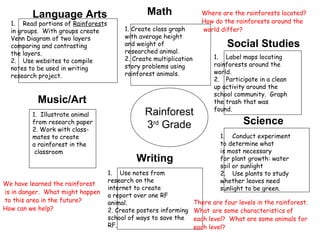
An example of central questions for a third
grade rainforest unit might be:
1.Where are the rainforests located? How do
the rainforests around the world differ?
2.There are four levels in the rainforest. What
are some characteristics of each level? What
are some animals for each level?
3. We have learned the rainforest is in
danger. What might happen to this area in the
future? How can we help?
QUESTIONS???
Once you have your topic or theme, have gathered
resources and written central questions, you are ready to
begin thinking about planning activities or lessons that
correspond with your central questions. The easiest way I
have found to do this is by creating a brainstorming web
with suggested activities that I can pull from throughout the
learning time of the topic. As this is created, be sure to
consider the resources you have collected and the TEKS for
your grade level. An example of what this might look like
follows. (In red are the central questions)
Rainforest
3rd
Grade
1. Read portions of Rainforests
in groups. With groups create
Venn Diagram of two layers
comparing and contrasting
the layers.
2. Use websites to compile
notes to be used in writing
research project.
1. Illustrate animal
from research paper
2. Work with class-
mates to create
a rainforest in the
classroom
1. Create class graph
with average height
and weight of
researched animal.
2. Create multiplication
story problems using
rainforest animals.
1. Label maps locating
rainforests around the
world.
2. Participate in a clean
up activity around the
school community. Graph
the trash that was
found.
1. Use notes from
research on the
internet to create
a report over one RF
animal.
2. Create posters informing
school of ways to save the
RF.
1. Conduct experiment
to determine what
is most necessary
for plant growth: water
soil or sunlight
2. Use plants to study
whether leaves need
sunlight to be green.
Language Arts Math
Social Studies
Science
Writing
Music/Art
We have learned the rainforest
is in danger. What might happen
to this area in the future?
How can we help?
There are four levels in the rainforest.
What are some characteristics of
each level? What are some animals for
each level?
Where are the rainforests located?
How do the rainforests around the
world differ?
Writing Expository in 2nd
grade using a Thematic
Unit over Rainforest
Denise Leech: Interactive Writing in 2nd grade
•Notice how she motivates her students to
with phonics, spelling and grammar while
learning about sloths.
WHAT ABOUT
DEPARTMENTALIZED
TEACHERS?
ORGANZING THE DAY
ORGANIZING THE CLASSROOM
• research has shown how the physical plan of a classroom
impacts the way children interact with each other (pg 159).
• the classroom should be a safe place where students are
free to take risks (pg 159).
• supports all children especially those with limited
experiences with literacy at home (pg 159).
• supports independent thinking because children are often
able to construct their own knowledge (remember what you
have learned about Vygotsky and Constructivism theory) and
have time to work independently.
The chapter compared the literacy classroom to a bookstore.
What kinds of areas do we see in a bookstore?
ORGANZING THE CLASSROOM
Here is an example of a first grade classroom.
You will notice there is a large whole
group area for meeting times. 6th grade
classrooms can and need this too!
There are tables that are used for centers.
There are plenty of shelves for books
that children can access and the desks are
grouped together in the middle of the room.
Whole group area
Student Desks
ORGANIZING THE CLASSROOM
This fourth grade classroom map looks very similar to the first grade map. There is space to work together as a class (large
group area on the floor), space to work with the teacher, space to work at desks independently or with groups and many
books available!
ORGANZING THE CLASSROOM
ORGANIZING THE CLASSROOM
Fountas and Pinnell (pg 51) share this chart for teachers to use to analyze their classroom.
ORGANZING THE CLASSROOM
Summing it up…
Alvermann, Swafford, and Montero (pg 164) conclude well when
they state, “We are not advocating that every literacy
engagement, whether teacher or student initiated, should be
linked to a content topic or theme.” Just because I am
teaching rainforest does not mean every book we read or
word we spell has to deal with the rainforest.
Moore and Cunningham (pg 60) go on to tell us that teachers
incorporate themes in various degrees stating, “Elementary
teachers sometimes offer traditional instruction in spelling
while integrating language arts, social studies, science and
fine arts.” Teaching using themes just makes sense. It helps
the teacher by providing a framework and benefits the child.
OBJECTIVES
By the end of class, you will be able to
answer the questions:
1.Why might teachers organize using
thematic units?
2.What should a literacy teacher consider
when organizing the classroom?
References
Fountas, I. and Pinnell, G (1996) Guided Reading: Good First Teaching for All Children.
Portsmouth, NH: Heinemann.
Alvermann, Donna, Swafford, Jeanne, and Montero, M.Kristina (2004). Content Area
Literacy Instruction for the Elementary Grades. Boston, MA: Pearson.
Moore, David, Moore, Sharon, Cunningham, Sharon, Cunningham, James (2006).
Developing Readers and Writers in the Content Areas K-12. Boston, MA:
Pearson.
Vacca and Vacca ______________________________________________

Thematic units pl

  • 1.
  • 2.
    OBJECTIVES By the endof class, you will be able to answer the questions: 1.Why might teachers organize using thematic units? 2.What should a literacy teacher consider when organizing the classroom?
  • 3.
    ORGANZING THE DAY Inthe last two modules/classes, we have discussed the importance of using nonfiction in literacy classrooms. In this day, children need exposure and instruction in how to read all forms of texts: websites, textbooks, tradebooks, newspapers, poems, magazines, etc. The big question is how do teachers fit quality instruction in nonfiction AND fiction into their already packed day? Alvermann, Swafford and Montero (pg 163) share that, “Probably one of the most common ways to organize literacy instruction with a content focus is to select a theme or topic that provides the context and content for literacy instruction. “ These authors continue to share, “You don’t learn to read, you learn to read something, and you read something because you want to know something…” In other words, what a third grade teacher is required to teach in science or social studies, can be carried over into the reading and writing time. If a teacher is required to teach space in science, the students can read nonfiction tradebooks, the teacher can guide students in writing a research report over planets, websites can be explored, etc. This way children are exposed and learning how to read and write nonfiction throughout the day. ORGANZING THE DAY
  • 4.
    The idea thatteachers teach around a topic is often called thematic teaching. How can this way of organizing the day be beneficial? •It can motivate the children to learn because children are naturally curious. •It provides direction for the teacher. Once a theme or topic is chosen, teachers can begin to organize their lessons by finding books and other texts for the students to engage in reading. •It provides purpose to the students. Children have a reason to read. •It helps children make connections across the curriculum…what we are learning in science can be connected to writing and/or reading throughout the day. •It builds background knowledge (schema). A child may never go to the rainforest but after reading about it, illustrating it, seeing it on video and writing about it, knowledge will grow. ORGANZING THE DAY
  • 5.
    Alvermann, Swafford andMontero (pg 164) state, “The alternative (not teaching thematically) is that students switch their focus every thirty or forty five minutes: for example, they read about people who have changed the world; next they shift to studying the human body; then they write procedures for making a peanut butter sandwich; and finally engage in spelling and grammar exercises about nothing in particular.” DOES THIS SOUND FAMILIAR TO YOU? This can be exhausting to the teacher and confusing to the children. Why not choose a topic (maybe the solar system) and then read and write books centered around this subject? ORGANZING THE DAY
  • 6.
    How do teachersbegin this process? I would also advocate adding a 5th step to this list: 5. Create goals/central questions/key concepts to guide instruction and maintain focus. Alvermann, Swafford and Montero (pg 165)
  • 7.
    Step 1: Familiarizeyourself with state and national standards for which you are accountable. When looking at 3rd Grade TEKS, I found four that could be related: 20D Writing/Inquiry/Research: Compile notes into outlines, reports, summaries, or other written efforts using available technology. 20B Writing/Inquiry/Research: Record his/her own knowledge of a topic in a variety of ways such as by drawing pictures, making lists and showing connections among ideas. 9B Science Concepts: Analyze how adaptive characteristics help individuals within a species to survive and reproduce. 8B Science Concepts: Observe and identify organisms with similar needs that compete with one another for resources such as oxygen, water, food or space.
  • 8.
    Step 2: Choosea topic or theme. Consider what your students are interested in, talking about frequently. What do they know about this topic? Remember you need to be intrigued too! As you learned in Module 1, you will be required to gather resources for a unit this semester. So you will need to engage in these steps. Often this is a difficult step because you are creating a unit for students that you may not know their interests. An easy way to choose a topic is to look at textbooks. If you think third grade would be a grade in your future, then gather a few third grade science textbooks or social studies textbooks. What are children asked to read and expand on by these authors? Are there topics like American symbols, Presidents, landmarks or map? What about topics such as plants, mammals, insects, weather or the human body? Each of these can be a theme.
  • 9.
    Step 2: Choosea topic or theme. Consider what your students are interested in, talking about frequently. What do they know about this topic? Remember you need to be intrigued too! Sample Topic: Rain Forest Sample Topic: Rain Forest
  • 10.
    Step 3 Whatprint and nonprint materials are available that will extend students learning? Now you are ready to think about materials. Print materials can include tradebooks (fiction and nonfiction), newspapers, websites, magazines, brochures, postcards, maps and don’t forget to use textbooks too! Nonprint materials might include videos and DVD’s, guest speakers, and field trips. Before planning lessons, it makes sense to gather the materials available to you first. Begin collecting resources and decide what will or will not be used. Step 4: What kinds of assessment will you use to determine if the students have learned what is necessary from the unit? We will discuss assessment in a later Module. The point to remember is that teachers need to keep assessment in mind at the beginning of a unit of study not just at the end.
  • 11.
    Step 5 Creategoals/central questions/key concepts to guide instruction and maintain focus. Moore and Cunningham (page 40) identify the importance of these central questions when they state, “ they serve as a stimulus, provoking and sustaining students’ thinking and learning during day to day activities. They serve as a connector too, gluing together what students encounter across several days of instruction.” Vacca and Vacca (page 244) state they are, “the what of learning-the major concepts and understandings that students should learn from reading the unit materials.” An easy way to create these questions is to begin with wh- words (who, what, when, where, why and how). These questions will help children to reflect and extend their thinking and will help the teacher maintain a focus throughout the unit. Remember in order to encourage higher level thinking, these questions should be open ended.
  • 12.
    Once you haveyour topic or theme, have gathered resources and written central questions, you are ready to begin thinking about planning activities or lessons that correspond with your central questions. The easiest way I have found to do this is by creating a brainstorming web with suggested activities that I can pull from throughout the learning time of the topic. As this is created, be sure to consider the resources you have collected and the TEKS for your grade level. An example of what this might look like follows. (In red are the central questions)
  • 13.
    An example ofcentral questions for a third grade rainforest unit might be: 1.Where are the rainforests located? How do the rainforests around the world differ? 2.There are four levels in the rainforest. What are some characteristics of each level? What are some animals for each level? 3. We have learned the rainforest is in danger. What might happen to this area in the future? How can we help? QUESTIONS???
  • 14.
    Once you haveyour topic or theme, have gathered resources and written central questions, you are ready to begin thinking about planning activities or lessons that correspond with your central questions. The easiest way I have found to do this is by creating a brainstorming web with suggested activities that I can pull from throughout the learning time of the topic. As this is created, be sure to consider the resources you have collected and the TEKS for your grade level. An example of what this might look like follows. (In red are the central questions)
  • 15.
    Rainforest 3rd Grade 1. Read portionsof Rainforests in groups. With groups create Venn Diagram of two layers comparing and contrasting the layers. 2. Use websites to compile notes to be used in writing research project. 1. Illustrate animal from research paper 2. Work with class- mates to create a rainforest in the classroom 1. Create class graph with average height and weight of researched animal. 2. Create multiplication story problems using rainforest animals. 1. Label maps locating rainforests around the world. 2. Participate in a clean up activity around the school community. Graph the trash that was found. 1. Use notes from research on the internet to create a report over one RF animal. 2. Create posters informing school of ways to save the RF. 1. Conduct experiment to determine what is most necessary for plant growth: water soil or sunlight 2. Use plants to study whether leaves need sunlight to be green. Language Arts Math Social Studies Science Writing Music/Art We have learned the rainforest is in danger. What might happen to this area in the future? How can we help? There are four levels in the rainforest. What are some characteristics of each level? What are some animals for each level? Where are the rainforests located? How do the rainforests around the world differ?
  • 16.
    Writing Expository in2nd grade using a Thematic Unit over Rainforest Denise Leech: Interactive Writing in 2nd grade •Notice how she motivates her students to with phonics, spelling and grammar while learning about sloths.
  • 17.
  • 18.
    ORGANZING THE DAY ORGANIZINGTHE CLASSROOM • research has shown how the physical plan of a classroom impacts the way children interact with each other (pg 159). • the classroom should be a safe place where students are free to take risks (pg 159). • supports all children especially those with limited experiences with literacy at home (pg 159). • supports independent thinking because children are often able to construct their own knowledge (remember what you have learned about Vygotsky and Constructivism theory) and have time to work independently. The chapter compared the literacy classroom to a bookstore. What kinds of areas do we see in a bookstore?
  • 19.
    ORGANZING THE CLASSROOM Hereis an example of a first grade classroom. You will notice there is a large whole group area for meeting times. 6th grade classrooms can and need this too! There are tables that are used for centers. There are plenty of shelves for books that children can access and the desks are grouped together in the middle of the room. Whole group area Student Desks
  • 20.
    ORGANIZING THE CLASSROOM Thisfourth grade classroom map looks very similar to the first grade map. There is space to work together as a class (large group area on the floor), space to work with the teacher, space to work at desks independently or with groups and many books available! ORGANZING THE CLASSROOM
  • 21.
    ORGANIZING THE CLASSROOM Fountasand Pinnell (pg 51) share this chart for teachers to use to analyze their classroom. ORGANZING THE CLASSROOM
  • 22.
    Summing it up… Alvermann,Swafford, and Montero (pg 164) conclude well when they state, “We are not advocating that every literacy engagement, whether teacher or student initiated, should be linked to a content topic or theme.” Just because I am teaching rainforest does not mean every book we read or word we spell has to deal with the rainforest. Moore and Cunningham (pg 60) go on to tell us that teachers incorporate themes in various degrees stating, “Elementary teachers sometimes offer traditional instruction in spelling while integrating language arts, social studies, science and fine arts.” Teaching using themes just makes sense. It helps the teacher by providing a framework and benefits the child.
  • 23.
    OBJECTIVES By the endof class, you will be able to answer the questions: 1.Why might teachers organize using thematic units? 2.What should a literacy teacher consider when organizing the classroom?
  • 24.
    References Fountas, I. andPinnell, G (1996) Guided Reading: Good First Teaching for All Children. Portsmouth, NH: Heinemann. Alvermann, Donna, Swafford, Jeanne, and Montero, M.Kristina (2004). Content Area Literacy Instruction for the Elementary Grades. Boston, MA: Pearson. Moore, David, Moore, Sharon, Cunningham, Sharon, Cunningham, James (2006). Developing Readers and Writers in the Content Areas K-12. Boston, MA: Pearson. Vacca and Vacca ______________________________________________

Editor's Notes

  • #8 As you will notice, these TEKS are rather vague but a teacher could use these four standards to organize a unit based on many topics. For example, one might choose to engage children in a study of the rainforest. No where in the third grade standards will it say to teach rainforest but this topic is very appropriate for what is stated in these third grade requirements.
  • #16 TRY IT (see word document for instructions) share!
  • #19 At your tables, what kinds of things do you want to remember to include into your classroom?