A Model for
Enterprise Capacity
Building and
Development Stages

Tarek Salah Kamel
Capability Development Unit Manager
tsalah@itida.gov.eg
v3.0 , 19th of September 2012
Agenda
 Model Introduction
 Model Objectives
 Model Outline
 Model Details
Model Introduction
The proposed Model for Enterprise Capacity Building and
Development Stages aims to set reference capacity building packages
and support programs to business enterprises that are tightly coupled
to their maturity level.
This should maximize the value proposition of ITIDA capacity building
programs to a beneficiary enterprise and validate the eligibility to
enroll, yielding an optimum ROI for such support programs.
Model Objectives
The Model aims to:
 Identify reference maturity levels for business enterprises.
 Clearly describe the important characteristics of each level, detailing what
capacity building areas are needed to effectively advance the enterprise
into a higher level.
 Assign ITIDA programs for capacity building according to these maturity
levels, so that business enterprises should be eligible for a certain
program if only they are at the correct maturity level.
Model
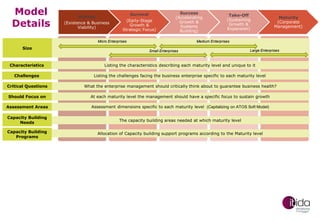
Details

Survival

Startup
(Existence & Business
Viability)

(Early-Stage
Growth &
Strategic Focus)

Success
(Accelerating
Growth &
Systems
Building)

Micro Enterprises

Size

Take-Off
(Sustaining
Growth &
Expansion)

Maturity
(Corporate
Management)

Medium Enterprises
Small Enterprises

Large Enterprises

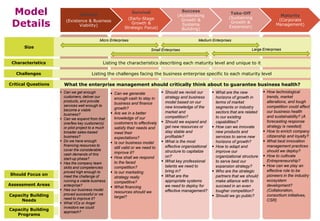
Characteristics

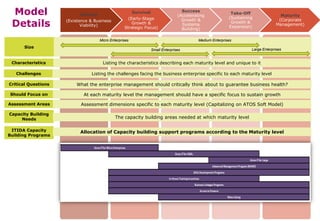
Listing the characteristics describing each maturity level and unique to it

Challenges

Listing the challenges facing the business enterprise specific to each maturity level

Critical Questions

What the enterprise management should critically think about to guarantee business health?

Should Focus on

At each maturity level the management should have a specific focus to sustain growth

Assessment Areas

Assessment dimensions specific to each maturity level (Capitalizing on ATOS Soft Model)

Capacity Building
Needs

The capacity building areas needed at which maturity level

Capacity Building
Programs

Allocation of Capacity building support programs according to the Maturity level
Model
Details

Survival

Startup
(Existence & Business
Viability)

(Early-Stage
Growth &
Strategic Focus)

Success
(Accelerating
Growth &
Systems
Building)

Micro Enterprises

Size

Take-Off
(Sustaining
Growth &
Expansion)

Maturity
(Corporate
Management)

Medium Enterprises
Small Enterprises

Large Enterprises

Characteristics
Challenges

Listing the challenges facing the business enterprise specific to each maturity level

Critical Questions

What the enterprise management should critically ask about to guarantee business health?

Should Focus on

At each maturity level the management should have a specific focus to sustain growth

Assessment Areas

Assessment dimensions specific to each maturity level

Capacity Building
Needs

The capacity building areas needed at which maturity level

Capacity Building
Programs

Allocation of Capacity building support programs according to the Maturity level
Model
Details

Survival

Startup
(Existence & Business
Viability)

(Early-Stage
Growth &
Strategic Focus)

Success
(Accelerating
Growth &
Systems
Building)

Micro Enterprises

Size

Characteristics

Critical Questions
Should Focus on
Assessment Areas
Capacity Building
Needs
Capacity Building
Programs

Maturity
(Corporate
Management)

Medium Enterprises
Small Enterprises

Large Enterprises

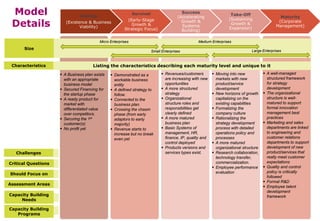
Listing the characteristics describing each maturity level and unique to it
 A well-managed
 Revenues/customers
 Moving into new
structured framework
are increasing with new
markets with new
for strategy
opportunities
product/service
development
 A more structured
development
strategy
 New horizons of growth  The organizational
structure is well Organizational
capitalizing on the
matured to support
structure roles and
existing capabilities
formal innovation
responsibilities get
 Formalizing the
management best
clearly defined
company culture
practices
 A more matured
 Rationalizing the
 Marketing and sales
business plan
strategy development
departments are linked
 Basic Systems of
process with detailed
to engineering and
management, HR,
operations policy and
customer relations
finance, IP, quality and
processes
departments to support
control deployed
 A more matured
development of new
 Products versions and
organizational structure
product/services that
services types exist.
 Research collaboration,
Listing the challenges facing the business enterprise specific to each maturity level
really meet customer
technology transfer,
expectations
commercialization.
What the enterprise management should critically ask about to guarantee business health?
 Employee performance  Quality and control
policy is critically
evaluation
At each maturity level the management should have a specific focus to sustain growth
followed
 Formal R&D
Assessment dimensions specific to each maturity level
 Employee talent
development
framework
The capacity building areas needed at which maturity level

 A Business plan exists
with an appropriate
business model
 Secured Financing for
the startup phase
 A ready product for
market with
differentiated value
over competitors.
 Securing the 1st
customer(s)
 No profit yet

Challenges

Take-Off
(Sustaining
Growth &
Expansion)

 Demonstrated as a
workable business
entity
 A defined strategy to
follow.
 Connected to the
business plan.
 Crossing the chasm
phase (from early
adaptors to early
majority)
 Revenue starts to
increase but no break
even yet

Allocation of Capacity building support programs according to the Maturity level
Model
Details

Survival

Startup
(Existence & Business
Viability)

(Early-Stage
Growth &
Strategic Focus)

Success
(Accelerating
Growth &
Systems
Building)

Micro Enterprises

Size

Take-Off
(Sustaining
Growth &
Expansion)

Maturity
(Corporate
Management)

Medium Enterprises
Large Enterprises

Small Enterprises

Characteristics

Listing the characteristics describing each maturity level and unique to it

Challenges

Listing the challenges facing the business enterprise specific to each maturity level
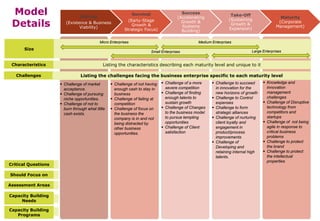
 Challenge of market
acceptance.
 Challenge of pursuing
niche opportunities.
 Challenge of not to
burn through what little
cash exists.

 Challenge of not having
enough cash to stay in
business
 Challenge of failing at
competition
 Challenge of focus on
the business the
company is in and not
being distracted by
other business
opportunities.

 Challenge of a more
severe competition
 Challenge of finding
enough talents to
sustain growth
 Challenge of Changes
to the business model
to pursue tempting
opportunities
 Challenge of Client
satisfaction

 Challenge to succeed
in innovation for the
new horizons of growth
 Challenge to Control
expenses
 Challenge to form
strategic alliances
 Challenge of nurturing
client loyalty and
engagement in
product/process
improvements
 Challenge of
Developing and
retaining internal high
talents.

 Knowledge and
innovation
management
challenges
 Challenge of Disruptive
technology from
competitors and
startups
 Challenge of not being
agile in response to
critical business
problems
 Challenge to protect
the brand
 Challenge to protect
the intellectual
properties

Critical Questions

What the enterprise management should critically ask about to guarantee business health?

Should Focus on

At each maturity level the management should have a specific focus to sustain growth

Assessment Areas

Assessment dimensions specific to each maturity level

Capacity Building
Needs

The capacity building areas needed at which maturity level

Capacity Building
Programs

Allocation of Capacity building support programs according to the Maturity level
Model
Details

Survival

Startup
(Existence & Business
Viability)

(Early-Stage
Growth &
Strategic Focus)

Success
(Accelerating
Growth &
Systems
Building)

Micro Enterprises

Size

Take-Off
(Sustaining
Growth &
Expansion)

Maturity
(Corporate
Management)

Medium Enterprises
Small Enterprises

Large Enterprises

Characteristics

Listing the characteristics describing each maturity level and unique to it

Challenges

Listing the challenges facing the business enterprise specific to each maturity level

Critical Questions

What the enterprise management should critically think about to guarantee business health?

Should Focus on
Assessment Areas
Capacity Building
Needs
Capacity Building
Programs

 How technological
 Can we get enough
 Should we revisit our
 What are the new
 Can we generate
customers, deliver our
trends, market
strategy and business
horizons of growth in
enough cash to stay in
products, and provide
alterations, and tough
model based on our
terms of market
business and finance
services well enough to
competition could affect
new knowledge of the
segments or industry
growth?
become a viable
our business health
market and
sectors that are related
 Are we in a better
business?
and sustainability? (A
competition?
to our existing
knowledge of our
 Can we expand from that
forecasting response
capabilities?
customers to effectively  Should we expand and
one/few key customer(s)
strategy is needed)
get new resources or
 How can we innovate
or pilot project to a much
satisfy their needs and
 How to enrich company
stay stable and
new products and
broader sales-based
meet their
citizenship and loyalty?
business?
profitable?
services to serve new
expectations?
 Do we have enough
 What best innovation
 What is the most
horizons of growth?
 Is our business model
financing resources to
management practices
effective organizational  How to adapt and
still valid or we need to
cover the considerable
should we deploy?
structure to capitalize
improve our
improve it?
cash demands of this
 How to cultivate
on?
organizational structure
 How shall we respond
start-up phase?
Entrepreneurship?
 What key professional
to serve best our
to the faced
 Has the company team
 How can we play an
talents we need to
expansion strategy?
competition?
skills and competencies
effective role to be
bring in?
 Who are the strategic
proved high enough to
 Is our marketing
At each maturity level the management are the have a specific focus we should growth in the industry
should
to sustain pioneers
 What
partners that
meet the challenge of
strategy really
ecosystem
running a viable business
appropriate systems
make alliance with to
competitive?
Assessment dimensions specific to for
each maturity in an even
level
enterprise?
development?
we need to deploy
succeed
 What financing
 Has our business model
(Collaboration,
effective management?
tougher competition?
resources should we
proved successful or we
consortium initiatives,
 Should we go public?
target?
need to improve it?
The capacity building areas needed at which maturity level
CSR)
 What VCs or Angel
investors we could
Allocation of Capacity building support programs according to the Maturity level
approach?
Model
Details

Survival

Startup
(Existence & Business
Viability)

(Early-Stage
Growth &
Strategic Focus)

Success
(Accelerating
Growth &
Systems
Building)

Micro Enterprises

Size

Take-Off
(Sustaining
Growth &
Expansion)

Maturity
(Corporate
Management)

Medium Enterprises
Large Enterprises

Small Enterprises

Characteristics

Listing the characteristics describing each maturity level and unique to it

Challenges

Listing the challenges facing the business enterprise specific to each maturity level

Critical Questions

What the enterprise management should critically think about to guarantee business health?

Should Focus on

At each maturity level the management should have a specific focus to sustain growth
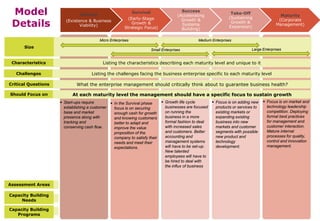
 Start-ups require
 In the Survival phase
establishing a customer
focus is on securing
base and market
enough cash for growth
presence along with
and knowing customers
tracking and
better to adapt and
conserving cash flow.
improve the value
proposition of the
company to satisfy their
needs and meet their
expectations.

 Growth life cycle
businesses are focused
on running the
business in a more
formal fashion to deal
with increased sales
and customers. Better
accounting and
management systems
will have to be set-up.
New talented
employees will have to
be hired to deal with
the influx of business

 Focus is on adding new
products or services to
existing markets or
expanding existing
business into new
markets and customer
segments with possible
new product and
technology
development.

 Focus is on market and
technology leadership
competition. Deploying
formal best practices
for management and
customer interaction.
Mature internal
processes for quality,
control and innovation
management.

Assessment Areas

Assessment dimensions specific to each maturity level

Capacity Building
Needs

The capacity building areas needed at which maturity level

Capacity Building
Programs

Allocation of Capacity building support programs according to the Maturity level
Model
Details

Survival

Startup
(Existence & Business
Viability)

(Early-Stage
Growth &
Strategic Focus)

Success
(Accelerating
Growth &
Systems
Building)

Micro Enterprises

Size

Take-Off
(Sustaining
Growth &
Expansion)

Maturity
(Corporate
Management)

Medium Enterprises
Small Enterprises

Large Enterprises

Characteristics

Listing the characteristics describing each maturity level and unique to it

Challenges

Listing the challenges facing the business enterprise specific to each maturity level

Critical Questions

What the enterprise management should critically think about to guarantee business health?

Should Focus on

At each maturity level the management should have a specific focus to sustain growth

Assessment Areas

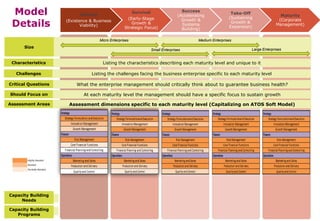
Assessment dimensions specific to each maturity level (Capitalizing on ATOS Soft Model)

Capacity Building
Needs

The capacity building areas needed at which maturity level

Capacity Building
Programs

Allocation of Capacity building support programs according to the Maturity level
Model
Details

Survival

Startup
(Existence & Business
Viability)

(Early-Stage
Growth &
Strategic Focus)

Success
(Accelerating
Growth &
Systems
Building)

Micro Enterprises

Size

Take-Off
(Sustaining
Growth &
Expansion)

Maturity
(Corporate
Management)

Medium Enterprises
Small Enterprises

Large Enterprises

Characteristics

Listing the characteristics describing each maturity level and unique to it

Challenges

Listing the challenges facing the business enterprise specific to each maturity level

Critical Questions

What the enterprise management should critically think about to guarantee business health?

Should Focus on

At each maturity level the management should have a specific focus to sustain growth

Assessment Areas

Assessment dimensions specific to each maturity level (Capitalizing on ATOS Soft Model)

Capacity Building
Needs

The capacity building areas needed at which maturity level

Capacity Building
Programs

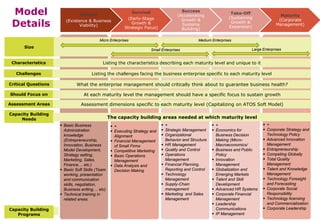
 +
 Strategic Management
 Organizational
Behavior and Structure
 HR Management
 Quality and Control
 Operations
Management
 Financial Planning,
Reporting and Control
 Technology
Management
 Supply-Chain
management
 Marketing and Sales
Management

 +
 Economics for
Business Decision
Making (MicroMacroeconomics/
 Business and Public
Policy
 Innovation
Management
 Globalization and
Emerging Markets
 Talent and Skill
Development
 Advanced HR Systems
 Corporate Financial
Management
 Leadership
Communications
Allocation of Capacity building support programs according to the Maturity
 IP Management

 Basic Business
Administration
knowledge
(Entrepreneurship,
Innovation, Business
Model Development,
Strategy setting,
Marketing, Sales,
Finance, .. etc.)
 Basic Soft Skills (Team
working, presentation
and communication
skills, negotiation,
Business writing, .. etc)
 Technical training in
related areas.

 +
 Executing Strategy and
Alignment
 Financial Management
of Small Firms
 Competitive Marketing
 Basic Operations
Management
 Data Analysis and
Decision Making

 +
 Corporate Strategy and
Technology Policy
 Advanced Innovation
Management
 Entrapreneurship
 Competing Globally
 Total Quality
Management
 Talent and Knowledge
Management
 Technology Foresight
and Forecasting
 Corporate Social
Responsibility
 Technology licensing
and Commercialization
 Corporate Leadership

level
Model
Details

Survival

Startup
(Existence & Business
Viability)

(Early-Stage
Growth &
Strategic Focus)

Success
(Accelerating
Growth &
Systems
Building)

Micro Enterprises

Size

Take-Off
(Sustaining
Growth &
Expansion)

Maturity
(Corporate
Management)

Medium Enterprises
Small Enterprises

Large Enterprises

Characteristics

Listing the characteristics describing each maturity level and unique to it

Challenges

Listing the challenges facing the business enterprise specific to each maturity level

Critical Questions

What the enterprise management should critically think about to guarantee business health?

Should Focus on

At each maturity level the management should have a specific focus to sustain growth

Assessment Areas

Assessment dimensions specific to each maturity level (Capitalizing on ATOS Soft Model)

Capacity Building
Needs

The capacity building areas needed at which maturity level

ITIDA Capacity
Building Programs

Allocation of Capacity building support programs according to the Maturity level
Model
Details
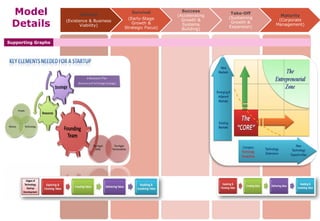
Supporting Graphs

Startup
(Existence & Business
Viability)

Survival
(Early-Stage
Growth &
Strategic Focus)

Success
(Accelerating
Growth &
Systems
Building)

Take-Off
(Sustaining
Growth &
Expansion)

Maturity
(Corporate
Management)
Model
Details
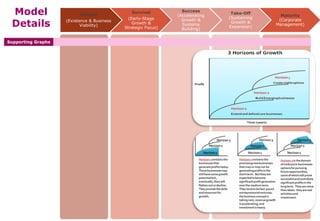
Supporting Graphs

Startup
(Existence & Business
Viability)

Survival
(Early-Stage
Growth &
Strategic Focus)

Success
(Accelerating
Growth &
Systems
Building)

Take-Off
(Sustaining
Growth &
Expansion)

Maturity
(Corporate
Management)
SUPPLEMENT

Relaxed Model Description Figures
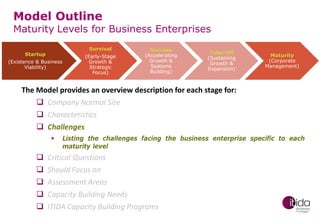
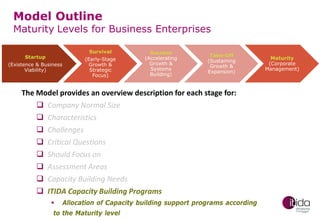
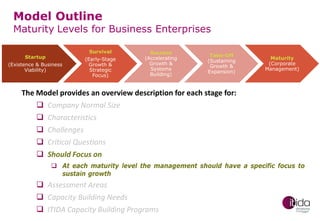
Model Outline

Maturity Levels for Business Enterprises
Startup
(Existence & Business
Viability)

Survival
(Early-Stage
Growth &
Strategic
Focus)

Success
(Accelerating
Growth &
Systems
Building)

Take-Off
(Sustaining
Growth &
Expansion)

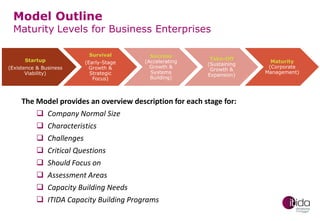
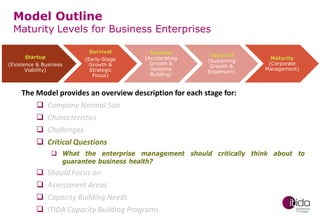
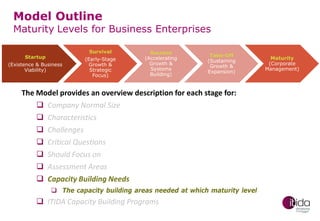
The Model provides an overview description for each stage for:
 Company Normal Size
 Characteristics
 Challenges
 Critical Questions
 Should Focus on
 Assessment Areas
 Capacity Building Needs
 ITIDA Capacity Building Programs

Maturity
(Corporate
Management)
Model Outline

Maturity Levels for Business Enterprises
Startup
(Existence & Business
Viability)

Survival
(Early-Stage
Growth &
Strategic
Focus)

Success
(Accelerating
Growth &
Systems
Building)

Take-Off
(Sustaining
Growth &
Expansion)

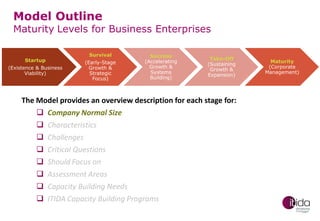
The Model provides an overview description for each stage for:
 Company Normal Size
 Characteristics
 Challenges
 Critical Questions
 Should Focus on
 Assessment Areas
 Capacity Building Needs
 ITIDA Capacity Building Programs

Maturity
(Corporate
Management)
Model
Details

Startup
(Existence & Business
Viability)

Survival
(Early-Stage
Growth &
Strategic Focus)

Success
(Accelerating
Growth &
Systems
Building)

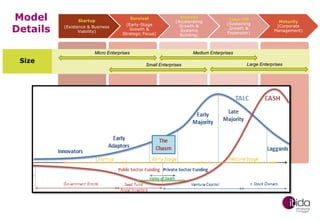
Micro Enterprises

Size

Take-Off
(Sustaining
Growth &
Expansion)

Maturity
(Corporate
Management)

Medium Enterprises
Small Enterprises

Large Enterprises
Model Outline

Maturity Levels for Business Enterprises
Survival

Startup
(Existence & Business
Viability)

(Early-Stage
Growth &
Strategic
Focus)

Success
(Accelerating
Growth &
Systems
Building)

Take-Off
(Sustaining
Growth &
Expansion)

Maturity
(Corporate
Management)

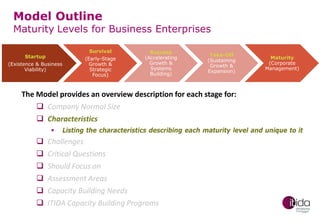
The Model provides an overview description for each stage for:
 Company Normal Size
 Characteristics









Listing the characteristics describing each maturity level and unique to it

Challenges
Critical Questions
Should Focus on
Assessment Areas
Capacity Building Needs
ITIDA Capacity Building Programs
Model
Details

Startup
(Existence & Business
Viability)

Characteristics

Survival
(Early-Stage
Growth &
Strategic Focus)

Success
(Accelerating
Growth &
Systems
Building)

Take-Off
(Sustaining
Growth &
Expansion)

Maturity
(Corporate
Management)

Listing the characteristics describing each maturity level and unique to it

Startup







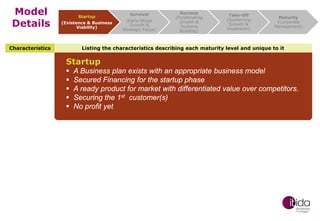
A Business plan exists with an appropriate business model
Secured Financing for the startup phase
A ready product for market with differentiated value over competitors.
Securing the 1st customer(s)
No profit yet
Model
Details

Startup
(Existence & Business
Viability)

Characteristics

Survival
(Early-Stage
Growth &
Strategic Focus)

Success
(Accelerating
Growth & Systems
Building)

Take-Off
(Sustaining
Growth &
Expansion)

Maturity
(Corporate
Management)

Listing the characteristics describing each maturity level and unique to it

Survival







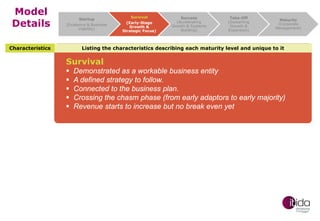
Demonstrated as a workable business entity
A defined strategy to follow.
Connected to the business plan.
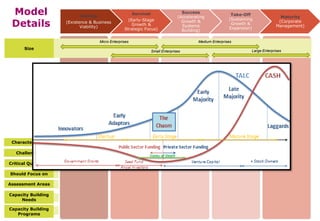
Crossing the chasm phase (from early adaptors to early majority)
Revenue starts to increase but no break even yet
Model
Details

Startup
(Existence & Business
Viability)

Characteristics

Survival
(Early-Stage
Growth &
Strategic Focus)

Success
(Accelerating
Growth &
Systems
Building)

Take-Off
(Sustaining
Growth &
Expansion)

Maturity
(Corporate
Management)

Listing the characteristics describing each maturity level and unique to it

Success







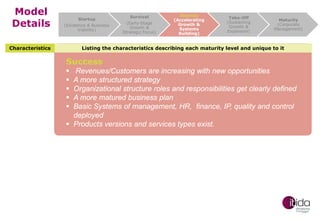
Revenues/Customers are increasing with new opportunities
A more structured strategy
Organizational structure roles and responsibilities get clearly defined
A more matured business plan
Basic Systems of management, HR, finance, IP, quality and control
deployed
 Products versions and services types exist.
Model
Details

Startup
(Existence & Business
Viability)

Characteristics

Survival
(Early-Stage
Growth &
Strategic Focus)

Success
(Accelerating
Growth &
Systems
Building)

Take-Off
(Sustaining
Growth &
Expansion)

Maturity
(Corporate
Management)

Listing the characteristics describing each maturity level and unique to it

Take-Off






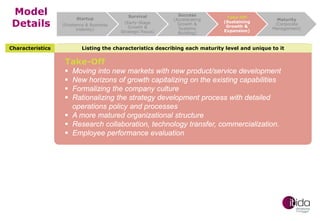
Moving into new markets with new product/service development
New horizons of growth capitalizing on the existing capabilities
Formalizing the company culture
Rationalizing the strategy development process with detailed
operations policy and processes
 A more matured organizational structure
 Research collaboration, technology transfer, commercialization.
 Employee performance evaluation
Model
Details
Characteristics

Startup
(Existence & Business
Viability)

Survival
(Early-Stage
Growth &
Strategic Focus)

Success
(Accelerating
Growth &
Systems
Building)

Take-Off
(Sustaining
Growth &
Expansion)

Maturity
(Corporate
Management)

Listing the characteristics describing each maturity level and unique to it

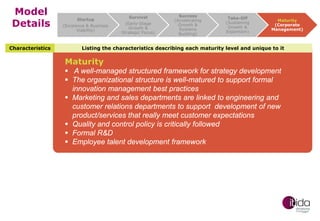
Maturity

 A well-managed structured framework for strategy development
 The organizational structure is well-matured to support formal
innovation management best practices
 Marketing and sales departments are linked to engineering and
customer relations departments to support development of new
product/services that really meet customer expectations
 Quality and control policy is critically followed
 Formal R&D
 Employee talent development framework
Model Outline

Maturity Levels for Business Enterprises
Survival

Startup
(Existence & Business
Viability)

(Early-Stage
Growth &
Strategic
Focus)

Success
(Accelerating
Growth &
Systems
Building)

Take-Off
(Sustaining
Growth &
Expansion)

Maturity
(Corporate
Management)

The Model provides an overview description for each stage for:
 Company Normal Size
 Characteristics
 Challenges








Listing the challenges facing the business enterprise specific to each
maturity level

Critical Questions
Should Focus on
Assessment Areas
Capacity Building Needs
ITIDA Capacity Building Programs
Model
Details
Challenges

Startup
(Existence & Business
Viability)

Survival
(Early-Stage
Growth &
Strategic Focus)

Success
(Accelerating
Growth &
Systems
Building)

Take-Off
(Sustaining
Growth &
Expansion)

Maturity
(Corporate
Management)

Listing the challenges facing the business enterprise specific to each maturity level

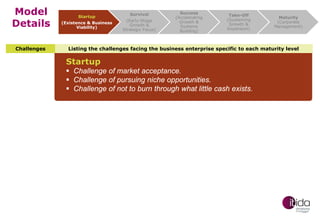
Startup

 Challenge of market acceptance.
 Challenge of pursuing niche opportunities.
 Challenge of not to burn through what little cash exists.
Model
Details
Challenges

Startup
(Existence & Business
Viability)

Survival
(Early-Stage
Growth &
Strategic Focus)

Success
(Accelerating
Growth & Systems
Building)

Take-Off
(Sustaining
Growth &
Expansion)

Maturity
(Corporate
Management)

Listing the challenges facing the business enterprise specific to each maturity level

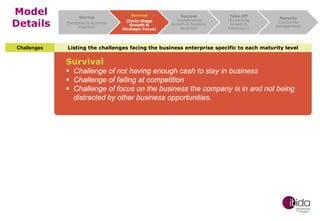
Survival

 Challenge of not having enough cash to stay in business
 Challenge of failing at competition
 Challenge of focus on the business the company is in and not being
distracted by other business opportunities.
Model
Details
Challenges

Startup
(Existence & Business
Viability)

Survival
(Early-Stage
Growth &
Strategic Focus)

Success
(Accelerating
Growth &
Systems
Building)

Take-Off
(Sustaining
Growth &
Expansion)

Maturity
(Corporate
Management)

Listing the challenges facing the business enterprise specific to each maturity level

Success

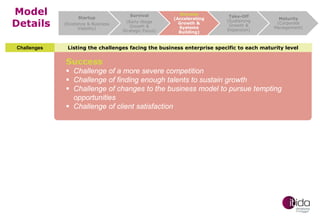
 Challenge of a more severe competition
 Challenge of finding enough talents to sustain growth
 Challenge of changes to the business model to pursue tempting
opportunities
 Challenge of client satisfaction
Model
Details
Challenges

Startup
(Existence & Business
Viability)

Survival
(Early-Stage
Growth &
Strategic Focus)

Success
(Accelerating
Growth &
Systems
Building)

Take-Off
(Sustaining
Growth &
Expansion)

Maturity
(Corporate
Management)

Listing the challenges facing the business enterprise specific to each maturity level

Take-Off






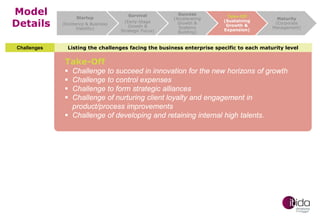
Challenge to succeed in innovation for the new horizons of growth
Challenge to control expenses
Challenge to form strategic alliances
Challenge of nurturing client loyalty and engagement in
product/process improvements
 Challenge of developing and retaining internal high talents.
Model
Details
Challenges

Startup
(Existence & Business
Viability)

Survival
(Early-Stage
Growth &
Strategic Focus)

Success
(Accelerating
Growth &
Systems
Building)

Take-Off
(Sustaining
Growth &
Expansion)

Maturity
(Corporate
Management)

Listing the challenges facing the business enterprise specific to each maturity level

Maturity







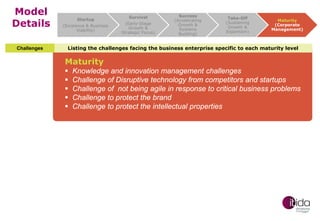
Knowledge and innovation management challenges
Challenge of Disruptive technology from competitors and startups
Challenge of not being agile in response to critical business problems
Challenge to protect the brand
Challenge to protect the intellectual properties
Model Outline

Maturity Levels for Business Enterprises
Survival

Startup
(Existence & Business
Viability)

(Early-Stage
Growth &
Strategic
Focus)

Success
(Accelerating
Growth &
Systems
Building)

Take-Off
(Sustaining
Growth &
Expansion)

Maturity
(Corporate
Management)

The Model provides an overview description for each stage for:
 Company Normal Size
 Characteristics
 Challenges
 Critical Questions
 What the enterprise management should critically think about to
guarantee business health?






Should Focus on
Assessment Areas
Capacity Building Needs
ITIDA Capacity Building Programs
Model
Details
Critical
Questions

Startup
(Existence & Business
Viability)

Survival
(Early-Stage
Growth &
Strategic Focus)

Success
(Accelerating
Growth &
Systems
Building)

Take-Off
(Sustaining
Growth &
Expansion)

Maturity
(Corporate
Management)

What the enterprise management should critically think about to guarantee business health?

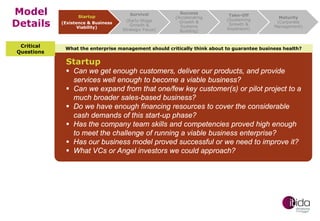
Startup

 Can we get enough customers, deliver our products, and provide
services well enough to become a viable business?
 Can we expand from that one/few key customer(s) or pilot project to a
much broader sales-based business?
 Do we have enough financing resources to cover the considerable
cash demands of this start-up phase?
 Has the company team skills and competencies proved high enough
to meet the challenge of running a viable business enterprise?
 Has our business model proved successful or we need to improve it?
 What VCs or Angel investors we could approach?
Model
Details
Critical
Questions

Startup
(Existence & Business
Viability)

Survival
(Early-Stage
Growth &
Strategic Focus)

Success
(Accelerating
Growth & Systems
Building)

Take-Off
(Sustaining
Growth &
Expansion)

Maturity
(Corporate
Management)

What the enterprise management should critically think about to guarantee business health?

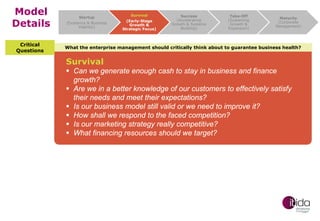
Survival

 Can we generate enough cash to stay in business and finance
growth?
 Are we in a better knowledge of our customers to effectively satisfy
their needs and meet their expectations?
 Is our business model still valid or we need to improve it?
 How shall we respond to the faced competition?
 Is our marketing strategy really competitive?
 What financing resources should we target?
Model
Details
Critical
Questions

Startup
(Existence & Business
Viability)

Survival
(Early-Stage
Growth &
Strategic Focus)

Success
(Accelerating
Growth &
Systems
Building)

Take-Off
(Sustaining
Growth &
Expansion)

Maturity
(Corporate
Management)

What the enterprise management should critically think about to guarantee business health?

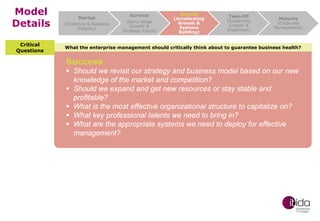
Success

 Should we revisit our strategy and business model based on our new
knowledge of the market and competition?
 Should we expand and get new resources or stay stable and
profitable?
 What is the most effective organizational structure to capitalize on?
 What key professional talents we need to bring in?
 What are the appropriate systems we need to deploy for effective
management?
Model
Details
Critical
Questions

Startup
(Existence & Business
Viability)

Survival
(Early-Stage
Growth &
Strategic Focus)

Success
(Accelerating
Growth &
Systems
Building)

Take-Off
(Sustaining
Growth &
Expansion)

Maturity
(Corporate
Management)

What the enterprise management should critically think about to guarantee business health?

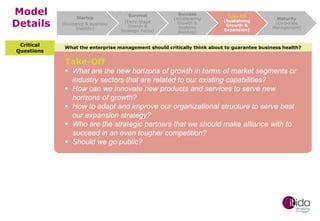
Take-Off

 What are the new horizons of growth in terms of market segments or
industry sectors that are related to our existing capabilities?
 How can we innovate new products and services to serve new
horizons of growth?
 How to adapt and improve our organizational structure to serve best
our expansion strategy?
 Who are the strategic partners that we should make alliance with to
succeed in an even tougher competition?
 Should we go public?
Model
Details
Critical
Questions

Startup
(Existence & Business
Viability)

Survival
(Early-Stage
Growth &
Strategic Focus)

Success
(Accelerating
Growth &
Systems
Building)

Take-Off
(Sustaining
Growth &
Expansion)

Maturity
(Corporate
Management)

What the enterprise management should critically think about to guarantee business health?

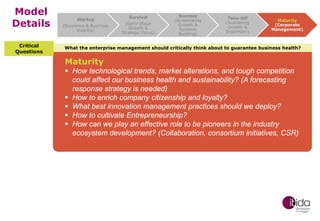
Maturity

 How technological trends, market alterations, and tough competition
could affect our business health and sustainability? (A forecasting
response strategy is needed)
 How to enrich company citizenship and loyalty?
 What best innovation management practices should we deploy?
 How to cultivate Entrepreneurship?
 How can we play an effective role to be pioneers in the industry
ecosystem development? (Collaboration, consortium initiatives, CSR)
Model Outline

Maturity Levels for Business Enterprises
Survival

Startup
(Existence & Business
Viability)

(Early-Stage
Growth &
Strategic
Focus)

Success
(Accelerating
Growth &
Systems
Building)

Take-Off
(Sustaining
Growth &
Expansion)

Maturity
(Corporate
Management)

The Model provides an overview description for each stage for:
 Company Normal Size
 Characteristics
 Challenges
 Critical Questions
 Should Focus on
 At each maturity level the management should have a specific focus to
sustain growth

 Assessment Areas
 Capacity Building Needs
 ITIDA Capacity Building Programs
Model
Details
Should
Focus on

Startup
(Existence & Business
Viability)

Survival
(Early-Stage
Growth &
Strategic Focus)

Success
(Accelerating
Growth &
Systems
Building)

Take-Off
(Sustaining
Growth &
Expansion)

Maturity
(Corporate
Management)

At each maturity level the management should have a specific focus to sustain growth

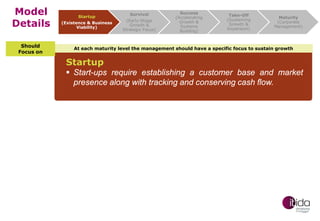
Startup

 Start-ups require establishing a customer base and market
presence along with tracking and conserving cash flow.
Model
Details
Should
Focus on

Startup
(Existence & Business
Viability)

Survival
(Early-Stage
Growth &
Strategic Focus)

Success
(Accelerating
Growth & Systems
Building)

Take-Off
(Sustaining
Growth &
Expansion)

Maturity
(Corporate
Management)

At each maturity level the management should have a specific focus to sustain growth

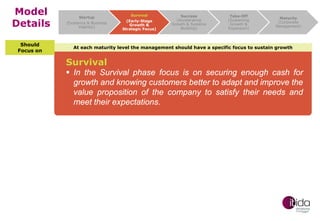
Survival

 In the Survival phase focus is on securing enough cash for
growth and knowing customers better to adapt and improve the
value proposition of the company to satisfy their needs and
meet their expectations.
Model
Details
Should
Focus on

Startup
(Existence & Business
Viability)

Survival
(Early-Stage
Growth &
Strategic Focus)

Success
(Accelerating
Growth &
Systems
Building)

Take-Off
(Sustaining
Growth &
Expansion)

Maturity
(Corporate
Management)

At each maturity level the management should have a specific focus to sustain growth

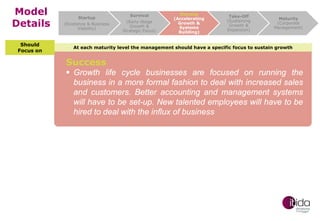
Success

 Growth life cycle businesses are focused on running the
business in a more formal fashion to deal with increased sales
and customers. Better accounting and management systems
will have to be set-up. New talented employees will have to be
hired to deal with the influx of business
Model
Details
Should
Focus on

Startup
(Existence & Business
Viability)

Survival
(Early-Stage
Growth &
Strategic Focus)

Success
(Accelerating
Growth &
Systems
Building)

Take-Off
(Sustaining
Growth &
Expansion)

Maturity
(Corporate
Management)

At each maturity level the management should have a specific focus to sustain growth

Take-Off

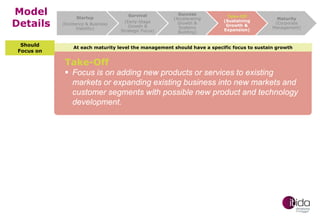
 Focus is on adding new products or services to existing
markets or expanding existing business into new markets and
customer segments with possible new product and technology
development.
Model
Details
Should
Focus on

Startup
(Existence & Business
Viability)

Survival
(Early-Stage
Growth &
Strategic Focus)

Success
(Accelerating
Growth &
Systems
Building)

Take-Off
(Sustaining
Growth &
Expansion)

Maturity
(Corporate
Management)

At each maturity level the management should have a specific focus to sustain growth

Maturity

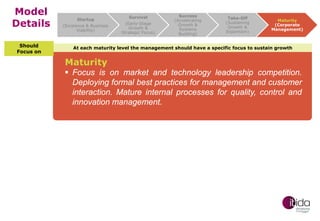
 Focus is on market and technology leadership competition.
Deploying formal best practices for management and customer
interaction. Mature internal processes for quality, control and
innovation management.
Model Outline

Maturity Levels for Business Enterprises
Survival

Startup
(Existence & Business
Viability)

(Early-Stage
Growth &
Strategic
Focus)

Success
(Accelerating
Growth &
Systems
Building)

Take-Off
(Sustaining
Growth &
Expansion)

Maturity
(Corporate
Management)

The Model provides an overview description for each stage for:
 Company Normal Size
 Characteristics
 Challenges
 Critical Questions
 Should Focus on
 Assessment Areas
 Assessment dimensions specific to each maturity level (Capitalizing on
ATOS Soft Model)

 Capacity Building Needs
 ITIDA Capacity Building Programs
Model
Details
Assessment
Areas

Startup
(Existence & Business
Viability)

Survival
(Early-Stage
Growth &
Strategic Focus)

Success
(Accelerating
Growth &
Systems
Building)

Take-Off
(Sustaining
Growth &
Expansion)

Maturity
(Corporate
Management)

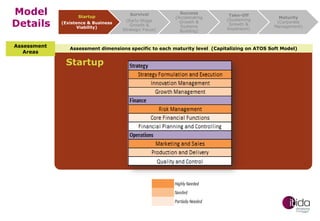
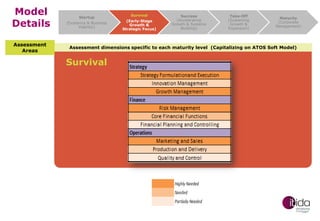
Assessment dimensions specific to each maturity level (Capitalizing on ATOS Soft Model)

Startup
Model
Details
Assessment
Areas

Startup
(Existence & Business
Viability)

Survival
(Early-Stage
Growth &
Strategic Focus)

Success
(Accelerating
Growth & Systems
Building)

Take-Off
(Sustaining
Growth &
Expansion)

Maturity
(Corporate
Management)

Assessment dimensions specific to each maturity level (Capitalizing on ATOS Soft Model)

Survival
Model
Details
Assessment
Areas

Startup
(Existence & Business
Viability)

Survival
(Early-Stage
Growth &
Strategic Focus)

Success
(Accelerating
Growth &
Systems
Building)

Take-Off
(Sustaining
Growth &
Expansion)

Maturity
(Corporate
Management)

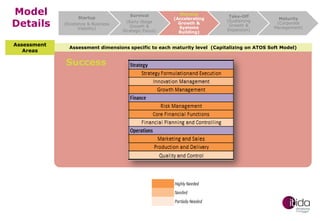
Assessment dimensions specific to each maturity level (Capitalizing on ATOS Soft Model)

Success
Model
Details
Assessment
Areas

Startup
(Existence & Business
Viability)

Survival
(Early-Stage
Growth &
Strategic Focus)

Success
(Accelerating
Growth &
Systems
Building)

Take-Off
(Sustaining
Growth &
Expansion)

Maturity
(Corporate
Management)

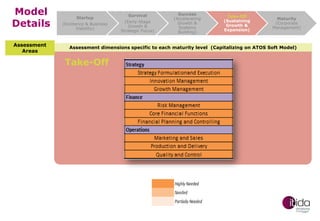
Assessment dimensions specific to each maturity level (Capitalizing on ATOS Soft Model)

Take-Off
Model
Details
Assessment
Areas

Startup
(Existence & Business
Viability)

Survival
(Early-Stage
Growth &
Strategic Focus)

Success
(Accelerating
Growth &
Systems
Building)

Take-Off
(Sustaining
Growth &
Expansion)

Maturity
(Corporate
Management)

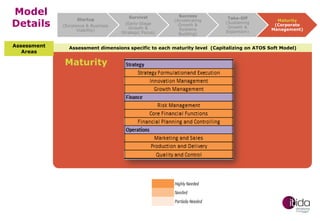
Assessment dimensions specific to each maturity level (Capitalizing on ATOS Soft Model)

Maturity
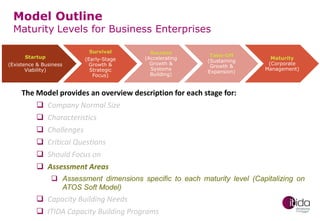
Model Outline

Maturity Levels for Business Enterprises
Survival

Startup
(Existence & Business
Viability)

(Early-Stage
Growth &
Strategic
Focus)

Success
(Accelerating
Growth &
Systems
Building)

Take-Off
(Sustaining
Growth &
Expansion)

The Model provides an overview description for each stage for:
 Company Normal Size
 Characteristics
 Challenges
 Critical Questions
 Should Focus on
 Assessment Areas
 Capacity Building Needs
 The capacity building areas needed at which maturity level

 ITIDA Capacity Building Programs

Maturity
(Corporate
Management)
Model
Details
Capacity
Building Needs

Startup
(Existence & Business
Viability)

Survival
(Early-Stage
Growth &
Strategic Focus)

Success
(Accelerating
Growth &
Systems
Building)

Take-Off
(Sustaining
Growth &
Expansion)

Maturity
(Corporate
Management)

What the enterprise management should critically think about to guarantee business health?

Startup

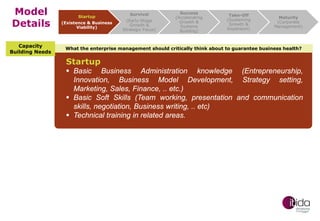
 Basic Business Administration knowledge (Entrepreneurship,
Innovation, Business Model Development, Strategy setting,
Marketing, Sales, Finance, .. etc.)
 Basic Soft Skills (Team working, presentation and communication
skills, negotiation, Business writing, .. etc)
 Technical training in related areas.
Model
Details
Capacity
Building Needs

Startup
(Existence & Business
Viability)

Survival
(Early-Stage
Growth &
Strategic Focus)

Success
(Accelerating
Growth & Systems
Building)

Take-Off
(Sustaining
Growth &
Expansion)

Maturity
(Corporate
Management)

What the enterprise management should critically think about to guarantee business health?

Survival








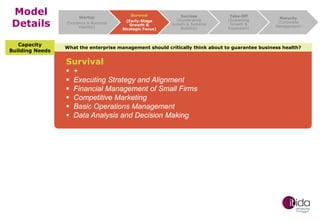
+
Executing Strategy and Alignment
Financial Management of Small Firms
Competitive Marketing
Basic Operations Management
Data Analysis and Decision Making
Model
Details
Capacity
Building Needs

Startup
(Existence & Business
Viability)

Survival
(Early-Stage
Growth &
Strategic Focus)

Success
(Accelerating
Growth &
Systems
Building)

Take-Off
(Sustaining
Growth &
Expansion)

Maturity
(Corporate
Management)

What the enterprise management should critically think about to guarantee business health?

Success












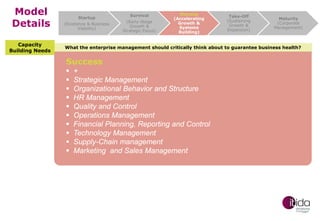
+
Strategic Management
Organizational Behavior and Structure
HR Management
Quality and Control
Operations Management
Financial Planning, Reporting and Control
Technology Management
Supply-Chain management
Marketing and Sales Management
Model
Details
Capacity
Building Needs

Startup
(Existence & Business
Viability)

Survival
(Early-Stage
Growth &
Strategic Focus)

Success
(Accelerating
Growth &
Systems
Building)

Take-Off
(Sustaining
Growth &
Expansion)

Maturity
(Corporate
Management)

What the enterprise management should critically think about to guarantee business health?

Take-Off












+
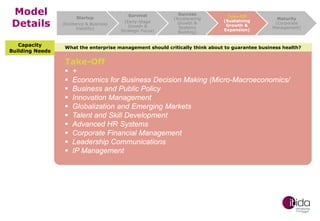
Economics for Business Decision Making (Micro-Macroeconomics/
Business and Public Policy
Innovation Management
Globalization and Emerging Markets
Talent and Skill Development
Advanced HR Systems
Corporate Financial Management
Leadership Communications
IP Management
Model
Details
Capacity
Building Needs

Startup
(Existence & Business
Viability)

Survival
(Early-Stage
Growth &
Strategic Focus)

Success
(Accelerating
Growth &
Systems
Building)

Take-Off
(Sustaining
Growth &
Expansion)

Maturity
(Corporate
Management)

What the enterprise management should critically think about to guarantee business health?

Maturity













+
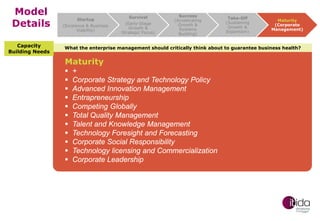
Corporate Strategy and Technology Policy
Advanced Innovation Management
Entrapreneurship
Competing Globally
Total Quality Management
Talent and Knowledge Management
Technology Foresight and Forecasting
Corporate Social Responsibility
Technology licensing and Commercialization
Corporate Leadership
Model Outline

Maturity Levels for Business Enterprises
Survival

Startup
(Existence & Business
Viability)

(Early-Stage
Growth &
Strategic
Focus)

Success
(Accelerating
Growth &
Systems
Building)

Take-Off
(Sustaining
Growth &
Expansion)

The Model provides an overview description for each stage for:
 Company Normal Size
 Characteristics
 Challenges
 Critical Questions
 Should Focus on
 Assessment Areas
 Capacity Building Needs
 ITIDA Capacity Building Programs


Allocation of Capacity building support programs according

to the Maturity level

Maturity
(Corporate
Management)
Model
Details
ITIDA Capacity
Building
Programs

Startup
(Existence & Business
Viability)

Survival
(Early-Stage
Growth &
Strategic Focus)

Success
(Accelerating
Growth &
Systems
Building)

Take-Off
(Sustaining
Growth &
Expansion)

Maturity
(Corporate
Management)

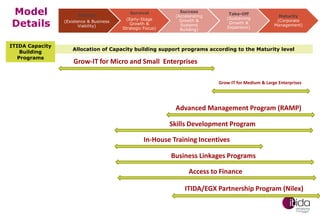
Allocation of Capacity building support programs according to the Maturity level

Grow-IT for Micro and Small Enterprises
Grow-IT for Medium & Large Enterprises

Advanced Management Program (RAMP)
Skills Development Program
In-House Training Incentives
Business Linkages Programs
Access to Finance
ITIDA/EGX Partnership Program (Nilex)
Thank You
Industry Capacity
Building Department
Information Technology Industry
Development Agency (ITIDA)

A propsoed model for enterprise capacity building and development stages

  • 1.
    A Model for EnterpriseCapacity Building and Development Stages Tarek Salah Kamel Capability Development Unit Manager tsalah@itida.gov.eg v3.0 , 19th of September 2012
  • 2.
    Agenda  Model Introduction Model Objectives  Model Outline  Model Details
  • 3.
    Model Introduction The proposedModel for Enterprise Capacity Building and Development Stages aims to set reference capacity building packages and support programs to business enterprises that are tightly coupled to their maturity level. This should maximize the value proposition of ITIDA capacity building programs to a beneficiary enterprise and validate the eligibility to enroll, yielding an optimum ROI for such support programs.
  • 4.
    Model Objectives The Modelaims to:  Identify reference maturity levels for business enterprises.  Clearly describe the important characteristics of each level, detailing what capacity building areas are needed to effectively advance the enterprise into a higher level.  Assign ITIDA programs for capacity building according to these maturity levels, so that business enterprises should be eligible for a certain program if only they are at the correct maturity level.
  • 5.
    Model Details Survival Startup (Existence & Business Viability) (Early-Stage Growth& Strategic Focus) Success (Accelerating Growth & Systems Building) Micro Enterprises Size Take-Off (Sustaining Growth & Expansion) Maturity (Corporate Management) Medium Enterprises Small Enterprises Large Enterprises Characteristics Listing the characteristics describing each maturity level and unique to it Challenges Listing the challenges facing the business enterprise specific to each maturity level Critical Questions What the enterprise management should critically think about to guarantee business health? Should Focus on At each maturity level the management should have a specific focus to sustain growth Assessment Areas Assessment dimensions specific to each maturity level (Capitalizing on ATOS Soft Model) Capacity Building Needs The capacity building areas needed at which maturity level Capacity Building Programs Allocation of Capacity building support programs according to the Maturity level
  • 6.
    Model Details Survival Startup (Existence & Business Viability) (Early-Stage Growth& Strategic Focus) Success (Accelerating Growth & Systems Building) Micro Enterprises Size Take-Off (Sustaining Growth & Expansion) Maturity (Corporate Management) Medium Enterprises Small Enterprises Large Enterprises Characteristics Challenges Listing the challenges facing the business enterprise specific to each maturity level Critical Questions What the enterprise management should critically ask about to guarantee business health? Should Focus on At each maturity level the management should have a specific focus to sustain growth Assessment Areas Assessment dimensions specific to each maturity level Capacity Building Needs The capacity building areas needed at which maturity level Capacity Building Programs Allocation of Capacity building support programs according to the Maturity level
  • 7.
    Model Details Survival Startup (Existence & Business Viability) (Early-Stage Growth& Strategic Focus) Success (Accelerating Growth & Systems Building) Micro Enterprises Size Characteristics Critical Questions Should Focus on Assessment Areas Capacity Building Needs Capacity Building Programs Maturity (Corporate Management) Medium Enterprises Small Enterprises Large Enterprises Listing the characteristics describing each maturity level and unique to it  A well-managed  Revenues/customers  Moving into new structured framework are increasing with new markets with new for strategy opportunities product/service development  A more structured development strategy  New horizons of growth  The organizational structure is well Organizational capitalizing on the matured to support structure roles and existing capabilities formal innovation responsibilities get  Formalizing the management best clearly defined company culture practices  A more matured  Rationalizing the  Marketing and sales business plan strategy development departments are linked  Basic Systems of process with detailed to engineering and management, HR, operations policy and customer relations finance, IP, quality and processes departments to support control deployed  A more matured development of new  Products versions and organizational structure product/services that services types exist.  Research collaboration, Listing the challenges facing the business enterprise specific to each maturity level really meet customer technology transfer, expectations commercialization. What the enterprise management should critically ask about to guarantee business health?  Employee performance  Quality and control policy is critically evaluation At each maturity level the management should have a specific focus to sustain growth followed  Formal R&D Assessment dimensions specific to each maturity level  Employee talent development framework The capacity building areas needed at which maturity level  A Business plan exists with an appropriate business model  Secured Financing for the startup phase  A ready product for market with differentiated value over competitors.  Securing the 1st customer(s)  No profit yet Challenges Take-Off (Sustaining Growth & Expansion)  Demonstrated as a workable business entity  A defined strategy to follow.  Connected to the business plan.  Crossing the chasm phase (from early adaptors to early majority)  Revenue starts to increase but no break even yet Allocation of Capacity building support programs according to the Maturity level
  • 8.
    Model Details Survival Startup (Existence & Business Viability) (Early-Stage Growth& Strategic Focus) Success (Accelerating Growth & Systems Building) Micro Enterprises Size Take-Off (Sustaining Growth & Expansion) Maturity (Corporate Management) Medium Enterprises Large Enterprises Small Enterprises Characteristics Listing the characteristics describing each maturity level and unique to it Challenges Listing the challenges facing the business enterprise specific to each maturity level  Challenge of market acceptance.  Challenge of pursuing niche opportunities.  Challenge of not to burn through what little cash exists.  Challenge of not having enough cash to stay in business  Challenge of failing at competition  Challenge of focus on the business the company is in and not being distracted by other business opportunities.  Challenge of a more severe competition  Challenge of finding enough talents to sustain growth  Challenge of Changes to the business model to pursue tempting opportunities  Challenge of Client satisfaction  Challenge to succeed in innovation for the new horizons of growth  Challenge to Control expenses  Challenge to form strategic alliances  Challenge of nurturing client loyalty and engagement in product/process improvements  Challenge of Developing and retaining internal high talents.  Knowledge and innovation management challenges  Challenge of Disruptive technology from competitors and startups  Challenge of not being agile in response to critical business problems  Challenge to protect the brand  Challenge to protect the intellectual properties Critical Questions What the enterprise management should critically ask about to guarantee business health? Should Focus on At each maturity level the management should have a specific focus to sustain growth Assessment Areas Assessment dimensions specific to each maturity level Capacity Building Needs The capacity building areas needed at which maturity level Capacity Building Programs Allocation of Capacity building support programs according to the Maturity level
  • 9.
    Model Details Survival Startup (Existence & Business Viability) (Early-Stage Growth& Strategic Focus) Success (Accelerating Growth & Systems Building) Micro Enterprises Size Take-Off (Sustaining Growth & Expansion) Maturity (Corporate Management) Medium Enterprises Small Enterprises Large Enterprises Characteristics Listing the characteristics describing each maturity level and unique to it Challenges Listing the challenges facing the business enterprise specific to each maturity level Critical Questions What the enterprise management should critically think about to guarantee business health? Should Focus on Assessment Areas Capacity Building Needs Capacity Building Programs  How technological  Can we get enough  Should we revisit our  What are the new  Can we generate customers, deliver our trends, market strategy and business horizons of growth in enough cash to stay in products, and provide alterations, and tough model based on our terms of market business and finance services well enough to competition could affect new knowledge of the segments or industry growth? become a viable our business health market and sectors that are related  Are we in a better business? and sustainability? (A competition? to our existing knowledge of our  Can we expand from that forecasting response capabilities? customers to effectively  Should we expand and one/few key customer(s) strategy is needed) get new resources or  How can we innovate or pilot project to a much satisfy their needs and  How to enrich company stay stable and new products and broader sales-based meet their citizenship and loyalty? business? profitable? services to serve new expectations?  Do we have enough  What best innovation  What is the most horizons of growth?  Is our business model financing resources to management practices effective organizational  How to adapt and still valid or we need to cover the considerable should we deploy? structure to capitalize improve our improve it? cash demands of this  How to cultivate on? organizational structure  How shall we respond start-up phase? Entrepreneurship?  What key professional to serve best our to the faced  Has the company team  How can we play an talents we need to expansion strategy? competition? skills and competencies effective role to be bring in?  Who are the strategic proved high enough to  Is our marketing At each maturity level the management are the have a specific focus we should growth in the industry should to sustain pioneers  What partners that meet the challenge of strategy really ecosystem running a viable business appropriate systems make alliance with to competitive? Assessment dimensions specific to for each maturity in an even level enterprise? development? we need to deploy succeed  What financing  Has our business model (Collaboration, effective management? tougher competition? resources should we proved successful or we consortium initiatives,  Should we go public? target? need to improve it? The capacity building areas needed at which maturity level CSR)  What VCs or Angel investors we could Allocation of Capacity building support programs according to the Maturity level approach?
  • 10.
    Model Details Survival Startup (Existence & Business Viability) (Early-Stage Growth& Strategic Focus) Success (Accelerating Growth & Systems Building) Micro Enterprises Size Take-Off (Sustaining Growth & Expansion) Maturity (Corporate Management) Medium Enterprises Large Enterprises Small Enterprises Characteristics Listing the characteristics describing each maturity level and unique to it Challenges Listing the challenges facing the business enterprise specific to each maturity level Critical Questions What the enterprise management should critically think about to guarantee business health? Should Focus on At each maturity level the management should have a specific focus to sustain growth  Start-ups require  In the Survival phase establishing a customer focus is on securing base and market enough cash for growth presence along with and knowing customers tracking and better to adapt and conserving cash flow. improve the value proposition of the company to satisfy their needs and meet their expectations.  Growth life cycle businesses are focused on running the business in a more formal fashion to deal with increased sales and customers. Better accounting and management systems will have to be set-up. New talented employees will have to be hired to deal with the influx of business  Focus is on adding new products or services to existing markets or expanding existing business into new markets and customer segments with possible new product and technology development.  Focus is on market and technology leadership competition. Deploying formal best practices for management and customer interaction. Mature internal processes for quality, control and innovation management. Assessment Areas Assessment dimensions specific to each maturity level Capacity Building Needs The capacity building areas needed at which maturity level Capacity Building Programs Allocation of Capacity building support programs according to the Maturity level
  • 11.
    Model Details Survival Startup (Existence & Business Viability) (Early-Stage Growth& Strategic Focus) Success (Accelerating Growth & Systems Building) Micro Enterprises Size Take-Off (Sustaining Growth & Expansion) Maturity (Corporate Management) Medium Enterprises Small Enterprises Large Enterprises Characteristics Listing the characteristics describing each maturity level and unique to it Challenges Listing the challenges facing the business enterprise specific to each maturity level Critical Questions What the enterprise management should critically think about to guarantee business health? Should Focus on At each maturity level the management should have a specific focus to sustain growth Assessment Areas Assessment dimensions specific to each maturity level (Capitalizing on ATOS Soft Model) Capacity Building Needs The capacity building areas needed at which maturity level Capacity Building Programs Allocation of Capacity building support programs according to the Maturity level
  • 12.
    Model Details Survival Startup (Existence & Business Viability) (Early-Stage Growth& Strategic Focus) Success (Accelerating Growth & Systems Building) Micro Enterprises Size Take-Off (Sustaining Growth & Expansion) Maturity (Corporate Management) Medium Enterprises Small Enterprises Large Enterprises Characteristics Listing the characteristics describing each maturity level and unique to it Challenges Listing the challenges facing the business enterprise specific to each maturity level Critical Questions What the enterprise management should critically think about to guarantee business health? Should Focus on At each maturity level the management should have a specific focus to sustain growth Assessment Areas Assessment dimensions specific to each maturity level (Capitalizing on ATOS Soft Model) Capacity Building Needs The capacity building areas needed at which maturity level Capacity Building Programs  +  Strategic Management  Organizational Behavior and Structure  HR Management  Quality and Control  Operations Management  Financial Planning, Reporting and Control  Technology Management  Supply-Chain management  Marketing and Sales Management  +  Economics for Business Decision Making (MicroMacroeconomics/  Business and Public Policy  Innovation Management  Globalization and Emerging Markets  Talent and Skill Development  Advanced HR Systems  Corporate Financial Management  Leadership Communications Allocation of Capacity building support programs according to the Maturity  IP Management  Basic Business Administration knowledge (Entrepreneurship, Innovation, Business Model Development, Strategy setting, Marketing, Sales, Finance, .. etc.)  Basic Soft Skills (Team working, presentation and communication skills, negotiation, Business writing, .. etc)  Technical training in related areas.  +  Executing Strategy and Alignment  Financial Management of Small Firms  Competitive Marketing  Basic Operations Management  Data Analysis and Decision Making  +  Corporate Strategy and Technology Policy  Advanced Innovation Management  Entrapreneurship  Competing Globally  Total Quality Management  Talent and Knowledge Management  Technology Foresight and Forecasting  Corporate Social Responsibility  Technology licensing and Commercialization  Corporate Leadership level
  • 13.
    Model Details Survival Startup (Existence & Business Viability) (Early-Stage Growth& Strategic Focus) Success (Accelerating Growth & Systems Building) Micro Enterprises Size Take-Off (Sustaining Growth & Expansion) Maturity (Corporate Management) Medium Enterprises Small Enterprises Large Enterprises Characteristics Listing the characteristics describing each maturity level and unique to it Challenges Listing the challenges facing the business enterprise specific to each maturity level Critical Questions What the enterprise management should critically think about to guarantee business health? Should Focus on At each maturity level the management should have a specific focus to sustain growth Assessment Areas Assessment dimensions specific to each maturity level (Capitalizing on ATOS Soft Model) Capacity Building Needs The capacity building areas needed at which maturity level ITIDA Capacity Building Programs Allocation of Capacity building support programs according to the Maturity level
  • 14.
    Model Details Supporting Graphs Startup (Existence &Business Viability) Survival (Early-Stage Growth & Strategic Focus) Success (Accelerating Growth & Systems Building) Take-Off (Sustaining Growth & Expansion) Maturity (Corporate Management)
  • 15.
    Model Details Supporting Graphs Startup (Existence &Business Viability) Survival (Early-Stage Growth & Strategic Focus) Success (Accelerating Growth & Systems Building) Take-Off (Sustaining Growth & Expansion) Maturity (Corporate Management)
  • 16.
  • 17.
    Model Outline Maturity Levelsfor Business Enterprises Startup (Existence & Business Viability) Survival (Early-Stage Growth & Strategic Focus) Success (Accelerating Growth & Systems Building) Take-Off (Sustaining Growth & Expansion) The Model provides an overview description for each stage for:  Company Normal Size  Characteristics  Challenges  Critical Questions  Should Focus on  Assessment Areas  Capacity Building Needs  ITIDA Capacity Building Programs Maturity (Corporate Management)
  • 18.
    Model Outline Maturity Levelsfor Business Enterprises Startup (Existence & Business Viability) Survival (Early-Stage Growth & Strategic Focus) Success (Accelerating Growth & Systems Building) Take-Off (Sustaining Growth & Expansion) The Model provides an overview description for each stage for:  Company Normal Size  Characteristics  Challenges  Critical Questions  Should Focus on  Assessment Areas  Capacity Building Needs  ITIDA Capacity Building Programs Maturity (Corporate Management)
  • 19.
    Model Details Startup (Existence & Business Viability) Survival (Early-Stage Growth& Strategic Focus) Success (Accelerating Growth & Systems Building) Micro Enterprises Size Take-Off (Sustaining Growth & Expansion) Maturity (Corporate Management) Medium Enterprises Small Enterprises Large Enterprises
  • 20.
    Model Outline Maturity Levelsfor Business Enterprises Survival Startup (Existence & Business Viability) (Early-Stage Growth & Strategic Focus) Success (Accelerating Growth & Systems Building) Take-Off (Sustaining Growth & Expansion) Maturity (Corporate Management) The Model provides an overview description for each stage for:  Company Normal Size  Characteristics        Listing the characteristics describing each maturity level and unique to it Challenges Critical Questions Should Focus on Assessment Areas Capacity Building Needs ITIDA Capacity Building Programs
  • 21.
    Model Details Startup (Existence & Business Viability) Characteristics Survival (Early-Stage Growth& Strategic Focus) Success (Accelerating Growth & Systems Building) Take-Off (Sustaining Growth & Expansion) Maturity (Corporate Management) Listing the characteristics describing each maturity level and unique to it Startup      A Business plan exists with an appropriate business model Secured Financing for the startup phase A ready product for market with differentiated value over competitors. Securing the 1st customer(s) No profit yet
  • 22.
    Model Details Startup (Existence & Business Viability) Characteristics Survival (Early-Stage Growth& Strategic Focus) Success (Accelerating Growth & Systems Building) Take-Off (Sustaining Growth & Expansion) Maturity (Corporate Management) Listing the characteristics describing each maturity level and unique to it Survival      Demonstrated as a workable business entity A defined strategy to follow. Connected to the business plan. Crossing the chasm phase (from early adaptors to early majority) Revenue starts to increase but no break even yet
  • 23.
    Model Details Startup (Existence & Business Viability) Characteristics Survival (Early-Stage Growth& Strategic Focus) Success (Accelerating Growth & Systems Building) Take-Off (Sustaining Growth & Expansion) Maturity (Corporate Management) Listing the characteristics describing each maturity level and unique to it Success      Revenues/Customers are increasing with new opportunities A more structured strategy Organizational structure roles and responsibilities get clearly defined A more matured business plan Basic Systems of management, HR, finance, IP, quality and control deployed  Products versions and services types exist.
  • 24.
    Model Details Startup (Existence & Business Viability) Characteristics Survival (Early-Stage Growth& Strategic Focus) Success (Accelerating Growth & Systems Building) Take-Off (Sustaining Growth & Expansion) Maturity (Corporate Management) Listing the characteristics describing each maturity level and unique to it Take-Off     Moving into new markets with new product/service development New horizons of growth capitalizing on the existing capabilities Formalizing the company culture Rationalizing the strategy development process with detailed operations policy and processes  A more matured organizational structure  Research collaboration, technology transfer, commercialization.  Employee performance evaluation
  • 25.
    Model Details Characteristics Startup (Existence & Business Viability) Survival (Early-Stage Growth& Strategic Focus) Success (Accelerating Growth & Systems Building) Take-Off (Sustaining Growth & Expansion) Maturity (Corporate Management) Listing the characteristics describing each maturity level and unique to it Maturity  A well-managed structured framework for strategy development  The organizational structure is well-matured to support formal innovation management best practices  Marketing and sales departments are linked to engineering and customer relations departments to support development of new product/services that really meet customer expectations  Quality and control policy is critically followed  Formal R&D  Employee talent development framework
  • 26.
    Model Outline Maturity Levelsfor Business Enterprises Survival Startup (Existence & Business Viability) (Early-Stage Growth & Strategic Focus) Success (Accelerating Growth & Systems Building) Take-Off (Sustaining Growth & Expansion) Maturity (Corporate Management) The Model provides an overview description for each stage for:  Company Normal Size  Characteristics  Challenges       Listing the challenges facing the business enterprise specific to each maturity level Critical Questions Should Focus on Assessment Areas Capacity Building Needs ITIDA Capacity Building Programs
  • 27.
    Model Details Challenges Startup (Existence & Business Viability) Survival (Early-Stage Growth& Strategic Focus) Success (Accelerating Growth & Systems Building) Take-Off (Sustaining Growth & Expansion) Maturity (Corporate Management) Listing the challenges facing the business enterprise specific to each maturity level Startup  Challenge of market acceptance.  Challenge of pursuing niche opportunities.  Challenge of not to burn through what little cash exists.
  • 28.
    Model Details Challenges Startup (Existence & Business Viability) Survival (Early-Stage Growth& Strategic Focus) Success (Accelerating Growth & Systems Building) Take-Off (Sustaining Growth & Expansion) Maturity (Corporate Management) Listing the challenges facing the business enterprise specific to each maturity level Survival  Challenge of not having enough cash to stay in business  Challenge of failing at competition  Challenge of focus on the business the company is in and not being distracted by other business opportunities.
  • 29.
    Model Details Challenges Startup (Existence & Business Viability) Survival (Early-Stage Growth& Strategic Focus) Success (Accelerating Growth & Systems Building) Take-Off (Sustaining Growth & Expansion) Maturity (Corporate Management) Listing the challenges facing the business enterprise specific to each maturity level Success  Challenge of a more severe competition  Challenge of finding enough talents to sustain growth  Challenge of changes to the business model to pursue tempting opportunities  Challenge of client satisfaction
  • 30.
    Model Details Challenges Startup (Existence & Business Viability) Survival (Early-Stage Growth& Strategic Focus) Success (Accelerating Growth & Systems Building) Take-Off (Sustaining Growth & Expansion) Maturity (Corporate Management) Listing the challenges facing the business enterprise specific to each maturity level Take-Off     Challenge to succeed in innovation for the new horizons of growth Challenge to control expenses Challenge to form strategic alliances Challenge of nurturing client loyalty and engagement in product/process improvements  Challenge of developing and retaining internal high talents.
  • 31.
    Model Details Challenges Startup (Existence & Business Viability) Survival (Early-Stage Growth& Strategic Focus) Success (Accelerating Growth & Systems Building) Take-Off (Sustaining Growth & Expansion) Maturity (Corporate Management) Listing the challenges facing the business enterprise specific to each maturity level Maturity      Knowledge and innovation management challenges Challenge of Disruptive technology from competitors and startups Challenge of not being agile in response to critical business problems Challenge to protect the brand Challenge to protect the intellectual properties
  • 32.
    Model Outline Maturity Levelsfor Business Enterprises Survival Startup (Existence & Business Viability) (Early-Stage Growth & Strategic Focus) Success (Accelerating Growth & Systems Building) Take-Off (Sustaining Growth & Expansion) Maturity (Corporate Management) The Model provides an overview description for each stage for:  Company Normal Size  Characteristics  Challenges  Critical Questions  What the enterprise management should critically think about to guarantee business health?     Should Focus on Assessment Areas Capacity Building Needs ITIDA Capacity Building Programs
  • 33.
    Model Details Critical Questions Startup (Existence & Business Viability) Survival (Early-Stage Growth& Strategic Focus) Success (Accelerating Growth & Systems Building) Take-Off (Sustaining Growth & Expansion) Maturity (Corporate Management) What the enterprise management should critically think about to guarantee business health? Startup  Can we get enough customers, deliver our products, and provide services well enough to become a viable business?  Can we expand from that one/few key customer(s) or pilot project to a much broader sales-based business?  Do we have enough financing resources to cover the considerable cash demands of this start-up phase?  Has the company team skills and competencies proved high enough to meet the challenge of running a viable business enterprise?  Has our business model proved successful or we need to improve it?  What VCs or Angel investors we could approach?
  • 34.
    Model Details Critical Questions Startup (Existence & Business Viability) Survival (Early-Stage Growth& Strategic Focus) Success (Accelerating Growth & Systems Building) Take-Off (Sustaining Growth & Expansion) Maturity (Corporate Management) What the enterprise management should critically think about to guarantee business health? Survival  Can we generate enough cash to stay in business and finance growth?  Are we in a better knowledge of our customers to effectively satisfy their needs and meet their expectations?  Is our business model still valid or we need to improve it?  How shall we respond to the faced competition?  Is our marketing strategy really competitive?  What financing resources should we target?
  • 35.
    Model Details Critical Questions Startup (Existence & Business Viability) Survival (Early-Stage Growth& Strategic Focus) Success (Accelerating Growth & Systems Building) Take-Off (Sustaining Growth & Expansion) Maturity (Corporate Management) What the enterprise management should critically think about to guarantee business health? Success  Should we revisit our strategy and business model based on our new knowledge of the market and competition?  Should we expand and get new resources or stay stable and profitable?  What is the most effective organizational structure to capitalize on?  What key professional talents we need to bring in?  What are the appropriate systems we need to deploy for effective management?
  • 36.
    Model Details Critical Questions Startup (Existence & Business Viability) Survival (Early-Stage Growth& Strategic Focus) Success (Accelerating Growth & Systems Building) Take-Off (Sustaining Growth & Expansion) Maturity (Corporate Management) What the enterprise management should critically think about to guarantee business health? Take-Off  What are the new horizons of growth in terms of market segments or industry sectors that are related to our existing capabilities?  How can we innovate new products and services to serve new horizons of growth?  How to adapt and improve our organizational structure to serve best our expansion strategy?  Who are the strategic partners that we should make alliance with to succeed in an even tougher competition?  Should we go public?
  • 37.
    Model Details Critical Questions Startup (Existence & Business Viability) Survival (Early-Stage Growth& Strategic Focus) Success (Accelerating Growth & Systems Building) Take-Off (Sustaining Growth & Expansion) Maturity (Corporate Management) What the enterprise management should critically think about to guarantee business health? Maturity  How technological trends, market alterations, and tough competition could affect our business health and sustainability? (A forecasting response strategy is needed)  How to enrich company citizenship and loyalty?  What best innovation management practices should we deploy?  How to cultivate Entrepreneurship?  How can we play an effective role to be pioneers in the industry ecosystem development? (Collaboration, consortium initiatives, CSR)
  • 38.
    Model Outline Maturity Levelsfor Business Enterprises Survival Startup (Existence & Business Viability) (Early-Stage Growth & Strategic Focus) Success (Accelerating Growth & Systems Building) Take-Off (Sustaining Growth & Expansion) Maturity (Corporate Management) The Model provides an overview description for each stage for:  Company Normal Size  Characteristics  Challenges  Critical Questions  Should Focus on  At each maturity level the management should have a specific focus to sustain growth  Assessment Areas  Capacity Building Needs  ITIDA Capacity Building Programs
  • 39.
    Model Details Should Focus on Startup (Existence &Business Viability) Survival (Early-Stage Growth & Strategic Focus) Success (Accelerating Growth & Systems Building) Take-Off (Sustaining Growth & Expansion) Maturity (Corporate Management) At each maturity level the management should have a specific focus to sustain growth Startup  Start-ups require establishing a customer base and market presence along with tracking and conserving cash flow.
  • 40.
    Model Details Should Focus on Startup (Existence &Business Viability) Survival (Early-Stage Growth & Strategic Focus) Success (Accelerating Growth & Systems Building) Take-Off (Sustaining Growth & Expansion) Maturity (Corporate Management) At each maturity level the management should have a specific focus to sustain growth Survival  In the Survival phase focus is on securing enough cash for growth and knowing customers better to adapt and improve the value proposition of the company to satisfy their needs and meet their expectations.
  • 41.
    Model Details Should Focus on Startup (Existence &Business Viability) Survival (Early-Stage Growth & Strategic Focus) Success (Accelerating Growth & Systems Building) Take-Off (Sustaining Growth & Expansion) Maturity (Corporate Management) At each maturity level the management should have a specific focus to sustain growth Success  Growth life cycle businesses are focused on running the business in a more formal fashion to deal with increased sales and customers. Better accounting and management systems will have to be set-up. New talented employees will have to be hired to deal with the influx of business
  • 42.
    Model Details Should Focus on Startup (Existence &Business Viability) Survival (Early-Stage Growth & Strategic Focus) Success (Accelerating Growth & Systems Building) Take-Off (Sustaining Growth & Expansion) Maturity (Corporate Management) At each maturity level the management should have a specific focus to sustain growth Take-Off  Focus is on adding new products or services to existing markets or expanding existing business into new markets and customer segments with possible new product and technology development.
  • 43.
    Model Details Should Focus on Startup (Existence &Business Viability) Survival (Early-Stage Growth & Strategic Focus) Success (Accelerating Growth & Systems Building) Take-Off (Sustaining Growth & Expansion) Maturity (Corporate Management) At each maturity level the management should have a specific focus to sustain growth Maturity  Focus is on market and technology leadership competition. Deploying formal best practices for management and customer interaction. Mature internal processes for quality, control and innovation management.
  • 44.
    Model Outline Maturity Levelsfor Business Enterprises Survival Startup (Existence & Business Viability) (Early-Stage Growth & Strategic Focus) Success (Accelerating Growth & Systems Building) Take-Off (Sustaining Growth & Expansion) Maturity (Corporate Management) The Model provides an overview description for each stage for:  Company Normal Size  Characteristics  Challenges  Critical Questions  Should Focus on  Assessment Areas  Assessment dimensions specific to each maturity level (Capitalizing on ATOS Soft Model)  Capacity Building Needs  ITIDA Capacity Building Programs
  • 45.
    Model Details Assessment Areas Startup (Existence & Business Viability) Survival (Early-Stage Growth& Strategic Focus) Success (Accelerating Growth & Systems Building) Take-Off (Sustaining Growth & Expansion) Maturity (Corporate Management) Assessment dimensions specific to each maturity level (Capitalizing on ATOS Soft Model) Startup
  • 46.
    Model Details Assessment Areas Startup (Existence & Business Viability) Survival (Early-Stage Growth& Strategic Focus) Success (Accelerating Growth & Systems Building) Take-Off (Sustaining Growth & Expansion) Maturity (Corporate Management) Assessment dimensions specific to each maturity level (Capitalizing on ATOS Soft Model) Survival
  • 47.
    Model Details Assessment Areas Startup (Existence & Business Viability) Survival (Early-Stage Growth& Strategic Focus) Success (Accelerating Growth & Systems Building) Take-Off (Sustaining Growth & Expansion) Maturity (Corporate Management) Assessment dimensions specific to each maturity level (Capitalizing on ATOS Soft Model) Success
  • 48.
    Model Details Assessment Areas Startup (Existence & Business Viability) Survival (Early-Stage Growth& Strategic Focus) Success (Accelerating Growth & Systems Building) Take-Off (Sustaining Growth & Expansion) Maturity (Corporate Management) Assessment dimensions specific to each maturity level (Capitalizing on ATOS Soft Model) Take-Off
  • 49.
    Model Details Assessment Areas Startup (Existence & Business Viability) Survival (Early-Stage Growth& Strategic Focus) Success (Accelerating Growth & Systems Building) Take-Off (Sustaining Growth & Expansion) Maturity (Corporate Management) Assessment dimensions specific to each maturity level (Capitalizing on ATOS Soft Model) Maturity
  • 50.
    Model Outline Maturity Levelsfor Business Enterprises Survival Startup (Existence & Business Viability) (Early-Stage Growth & Strategic Focus) Success (Accelerating Growth & Systems Building) Take-Off (Sustaining Growth & Expansion) The Model provides an overview description for each stage for:  Company Normal Size  Characteristics  Challenges  Critical Questions  Should Focus on  Assessment Areas  Capacity Building Needs  The capacity building areas needed at which maturity level  ITIDA Capacity Building Programs Maturity (Corporate Management)
  • 51.
    Model Details Capacity Building Needs Startup (Existence &Business Viability) Survival (Early-Stage Growth & Strategic Focus) Success (Accelerating Growth & Systems Building) Take-Off (Sustaining Growth & Expansion) Maturity (Corporate Management) What the enterprise management should critically think about to guarantee business health? Startup  Basic Business Administration knowledge (Entrepreneurship, Innovation, Business Model Development, Strategy setting, Marketing, Sales, Finance, .. etc.)  Basic Soft Skills (Team working, presentation and communication skills, negotiation, Business writing, .. etc)  Technical training in related areas.
  • 52.
    Model Details Capacity Building Needs Startup (Existence &Business Viability) Survival (Early-Stage Growth & Strategic Focus) Success (Accelerating Growth & Systems Building) Take-Off (Sustaining Growth & Expansion) Maturity (Corporate Management) What the enterprise management should critically think about to guarantee business health? Survival       + Executing Strategy and Alignment Financial Management of Small Firms Competitive Marketing Basic Operations Management Data Analysis and Decision Making
  • 53.
    Model Details Capacity Building Needs Startup (Existence &Business Viability) Survival (Early-Stage Growth & Strategic Focus) Success (Accelerating Growth & Systems Building) Take-Off (Sustaining Growth & Expansion) Maturity (Corporate Management) What the enterprise management should critically think about to guarantee business health? Success           + Strategic Management Organizational Behavior and Structure HR Management Quality and Control Operations Management Financial Planning, Reporting and Control Technology Management Supply-Chain management Marketing and Sales Management
  • 54.
    Model Details Capacity Building Needs Startup (Existence &Business Viability) Survival (Early-Stage Growth & Strategic Focus) Success (Accelerating Growth & Systems Building) Take-Off (Sustaining Growth & Expansion) Maturity (Corporate Management) What the enterprise management should critically think about to guarantee business health? Take-Off           + Economics for Business Decision Making (Micro-Macroeconomics/ Business and Public Policy Innovation Management Globalization and Emerging Markets Talent and Skill Development Advanced HR Systems Corporate Financial Management Leadership Communications IP Management
  • 55.
    Model Details Capacity Building Needs Startup (Existence &Business Viability) Survival (Early-Stage Growth & Strategic Focus) Success (Accelerating Growth & Systems Building) Take-Off (Sustaining Growth & Expansion) Maturity (Corporate Management) What the enterprise management should critically think about to guarantee business health? Maturity            + Corporate Strategy and Technology Policy Advanced Innovation Management Entrapreneurship Competing Globally Total Quality Management Talent and Knowledge Management Technology Foresight and Forecasting Corporate Social Responsibility Technology licensing and Commercialization Corporate Leadership
  • 56.
    Model Outline Maturity Levelsfor Business Enterprises Survival Startup (Existence & Business Viability) (Early-Stage Growth & Strategic Focus) Success (Accelerating Growth & Systems Building) Take-Off (Sustaining Growth & Expansion) The Model provides an overview description for each stage for:  Company Normal Size  Characteristics  Challenges  Critical Questions  Should Focus on  Assessment Areas  Capacity Building Needs  ITIDA Capacity Building Programs  Allocation of Capacity building support programs according to the Maturity level Maturity (Corporate Management)
  • 57.
    Model Details ITIDA Capacity Building Programs Startup (Existence &Business Viability) Survival (Early-Stage Growth & Strategic Focus) Success (Accelerating Growth & Systems Building) Take-Off (Sustaining Growth & Expansion) Maturity (Corporate Management) Allocation of Capacity building support programs according to the Maturity level Grow-IT for Micro and Small Enterprises Grow-IT for Medium & Large Enterprises Advanced Management Program (RAMP) Skills Development Program In-House Training Incentives Business Linkages Programs Access to Finance ITIDA/EGX Partnership Program (Nilex)
  • 58.
    Thank You Industry Capacity BuildingDepartment Information Technology Industry Development Agency (ITIDA)