| Workforce
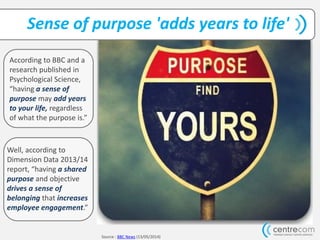
Sense of purpose 'adds years to life'
According to BBC and a
research published in
Psychological Science,
“having a sense of
purpose may add years
to your life, regardless
of what the purpose is.”
Source : BBC News (13/05/2014)
Well, according to
Dimension Data 2013/14
report, “having a shared
purpose and objective
drives a sense of
belonging that increases
employee engagement.”
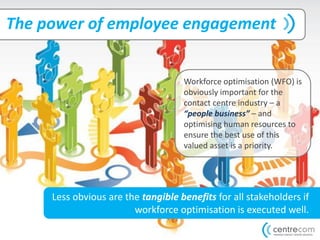
The power of employee engagement
Workforce optimisation (WFO) is
obviously important for the
contact centre industry – a
“people business” – and
optimising human resources to
ensure the best use of this
valued asset is a priority.
Less obvious are the tangible benefits for all stakeholders if
workforce optimisation is executed well.
People are the cost component in contact centres – 69% on average. Agent-
based interactions are becoming increasingly critical and this is leading more
organisations to empower their staff to use their own judgement on
enquiries that have financial consequences.
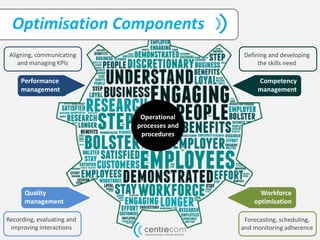
Optimisation Components
TOP 3 areas that will improve
staff satisfaction
Optimisation Components
• Clear company goals and purpose
• Proactive communications
• Relationship with direct manager
Engaged employees are not only less likely to leave, but also deliver a
better customer experience and build a quality platform for services
Aligning, communicating
and managing KPIs
Optimisation Components
Recording, evaluating and
improving interactions
Defining and developing
the skills need
Forecasting, scheduling,
and monitoring adherence
Operational
processes and
procedures
Performance
management
Quality
management
Workforce
optimisation
Competency
management
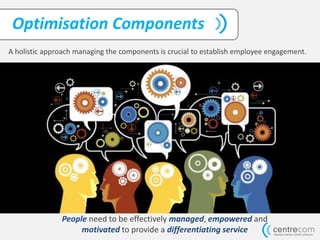
Optimisation Components
A holistic approach managing the components is crucial to establish employee engagement.
People need to be effectively managed, empowered and
motivated to provide a differentiating service
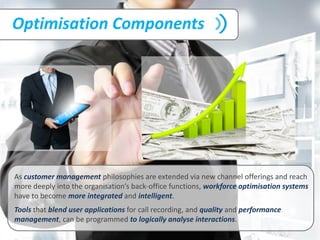
Optimisation Components
As customer management philosophies are extended via new channel offerings and reach
more deeply into the organisation’s back-office functions, workforce optimisation systems
have to become more integrated and intelligent.
Tools that blend user applications for call recording, and quality and performance
management, can be programmed to logically analyse interactions.
Competency Management
While technology advances may help
harmonise operational management
approaches, the task of managing and
motivating people to deliver
consistently, every day, remains the
great challenge.
The competency management
landscape is changing. Traditional
methods are no longer effective and
competency management
approaches need to be modernised
to keep up with the changes.
Competency Management
1- Bridge the skills gap before entering the job market – align with community
investment programmes aimed at youth development
2- Train for the future – a huge benefit of having Generation Y in your workplace is
their propensity for embracing and engaging with technology. With Generation Y
blending home and work life (as opposed to striving for work-life balance), learning can
happen anywhere, anytime.
Initiatives that can help an organisation step up and deliver
more effective competency management:
Competency Management
3- Design your competitive edge – Enabled by technology, learning is moving out of the
classroom and going directly to the learner. Knowledge will be pushed to the desktop where
agents can have direct access to data that’s updated in real time and designed to push
information alerts.
4- Adapt, but maximise skilling – organisations should be able to show the benefit of
each technique and whether a revised approach is enabling faster track towards full
competency – which is currently about 8 weeks. It should also allow for cost comparisons
and information on the level of performance being delivered by trainees.
5- Create a training warranty – a training warranty system that associates training
expenditure with guaranteed improvements in service capability will help transform the
learning function into a value centre, and demonstrate return on investment by linking
training benefits with desired business objectives.
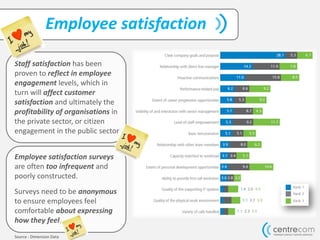
Employee satisfaction
Staff satisfaction has been
proven to reflect in employee
engagement levels, which in
turn will affect customer
satisfaction and ultimately the
profitability of organisations in
the private sector, or citizen
engagement in the public sector
Source : Dimension Data
Employee satisfaction surveys
are often too infrequent and
poorly constructed.
Surveys need to be anonymous
to ensure employees feel
comfortable about expressing
how they feel.
It’s crucial that contact centres continue to respect their entire employee
population’s need to understand the bigger picture and objectives of the enterprise
Call us today
+356 2364 4000
or drop us an e-mail
info.centrecom@centrecom.eu
or visit us
www.centrecom.eu
centrecomnews.com
Need help catching up with
your customers?

Workforce: the power of employees

  • 1.
  • 2.
    Sense of purpose'adds years to life' According to BBC and a research published in Psychological Science, “having a sense of purpose may add years to your life, regardless of what the purpose is.” Source : BBC News (13/05/2014) Well, according to Dimension Data 2013/14 report, “having a shared purpose and objective drives a sense of belonging that increases employee engagement.”
  • 3.
    The power ofemployee engagement Workforce optimisation (WFO) is obviously important for the contact centre industry – a “people business” – and optimising human resources to ensure the best use of this valued asset is a priority. Less obvious are the tangible benefits for all stakeholders if workforce optimisation is executed well.
  • 4.
    People are thecost component in contact centres – 69% on average. Agent- based interactions are becoming increasingly critical and this is leading more organisations to empower their staff to use their own judgement on enquiries that have financial consequences. Optimisation Components
  • 5.
    TOP 3 areasthat will improve staff satisfaction Optimisation Components • Clear company goals and purpose • Proactive communications • Relationship with direct manager Engaged employees are not only less likely to leave, but also deliver a better customer experience and build a quality platform for services
  • 6.
    Aligning, communicating and managingKPIs Optimisation Components Recording, evaluating and improving interactions Defining and developing the skills need Forecasting, scheduling, and monitoring adherence Operational processes and procedures Performance management Quality management Workforce optimisation Competency management
  • 7.
    Optimisation Components A holisticapproach managing the components is crucial to establish employee engagement. People need to be effectively managed, empowered and motivated to provide a differentiating service
  • 8.
    Optimisation Components As customermanagement philosophies are extended via new channel offerings and reach more deeply into the organisation’s back-office functions, workforce optimisation systems have to become more integrated and intelligent. Tools that blend user applications for call recording, and quality and performance management, can be programmed to logically analyse interactions.
  • 9.
    Competency Management While technologyadvances may help harmonise operational management approaches, the task of managing and motivating people to deliver consistently, every day, remains the great challenge. The competency management landscape is changing. Traditional methods are no longer effective and competency management approaches need to be modernised to keep up with the changes.
  • 10.
    Competency Management 1- Bridgethe skills gap before entering the job market – align with community investment programmes aimed at youth development 2- Train for the future – a huge benefit of having Generation Y in your workplace is their propensity for embracing and engaging with technology. With Generation Y blending home and work life (as opposed to striving for work-life balance), learning can happen anywhere, anytime. Initiatives that can help an organisation step up and deliver more effective competency management:
  • 11.
    Competency Management 3- Designyour competitive edge – Enabled by technology, learning is moving out of the classroom and going directly to the learner. Knowledge will be pushed to the desktop where agents can have direct access to data that’s updated in real time and designed to push information alerts. 4- Adapt, but maximise skilling – organisations should be able to show the benefit of each technique and whether a revised approach is enabling faster track towards full competency – which is currently about 8 weeks. It should also allow for cost comparisons and information on the level of performance being delivered by trainees. 5- Create a training warranty – a training warranty system that associates training expenditure with guaranteed improvements in service capability will help transform the learning function into a value centre, and demonstrate return on investment by linking training benefits with desired business objectives.
  • 12.
    Employee satisfaction Staff satisfactionhas been proven to reflect in employee engagement levels, which in turn will affect customer satisfaction and ultimately the profitability of organisations in the private sector, or citizen engagement in the public sector Source : Dimension Data Employee satisfaction surveys are often too infrequent and poorly constructed. Surveys need to be anonymous to ensure employees feel comfortable about expressing how they feel.
  • 13.
    It’s crucial thatcontact centres continue to respect their entire employee population’s need to understand the bigger picture and objectives of the enterprise
  • 14.
    Call us today +3562364 4000 or drop us an e-mail info.centrecom@centrecom.eu or visit us www.centrecom.eu centrecomnews.com Need help catching up with your customers?