ORGANIZATIONAL
BEHAVIOUR
OFFLINE MODE
UNIT-1(6 HOURS)
JAY
KEY LEARNING OUTCOMES -
 Introduction to Organizational Behavior – SCOPE AND IMPORTANCE
 Meaning and Definition of OB
 History of OB and its emergence as a discipline
 Contributions to OB from different disciplines
 Organizational Behaviour Model
 Functions of OB
OB
ORGANISATION BEHAVIOUR
ORGANIZATION
 Organization is a purposeful system with several
subsystems where individual and activities are
organized to achieve certain predetermined goals
through division of labor and coordination of
activities
 Division of Labor?
 Coordination of Activities ? TEAM-TOGETHER
EVERYONE ACHIEVES MORE
ORGANIZATION-FEATURES
 Identifiable Aggregation of Human Beings
 Deliberate and Conscious Creation
 Purposive Creation
 Coordination of Activities
 Structure(Power Centers)
 Rationality-Every organization has some specified norms and standard of
behavior –Every members expected to behave based on this norms or standard
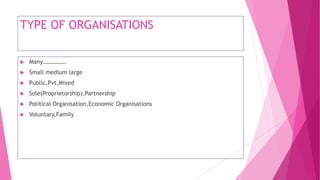
TYPE OF ORGANISATIONS
 Many…………….
 Small medium large
 Public,Pvt,Mixed
 Sole(Proprietorship),Partnership
 Political Organisation,Economic Organisations
 Voluntary,Family
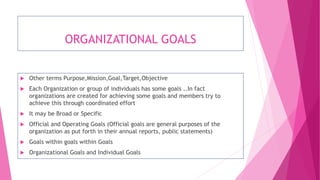
ORGANIZATIONAL GOALS
 Other terms Purpose,Mission,Goal,Target,Objective
 Each Organization or group of individuals has some goals ..In fact
organizations are created for achieving some goals and members try to
achieve this through coordinated effort
 It may be Broad or Specific
 Official and Operating Goals (Official goals are general purposes of the
organization as put forth in their annual reports, public statements)
 Goals within goals within Goals
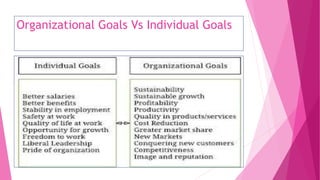
 Organizational Goals and Individual Goals
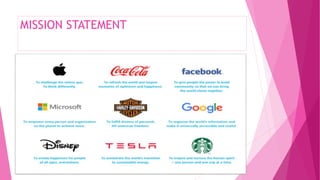
MISSION STATEMENT
Organizational Goals Vs Individual Goals
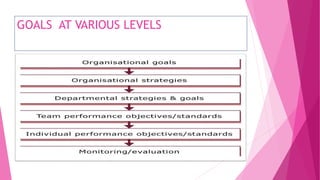
GOALS AT VARIOUS LEVELS
ANSWER THE QUESTIONS
 Define an Organization?
 List out features of Organization
 What are the different types of Goals/Objectives
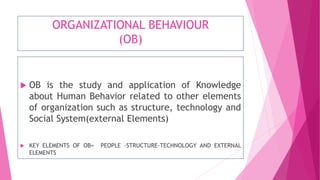
ORGANIZATIONAL BEHAVIOUR
(OB)
 OB is the study and application of Knowledge
about Human Behavior related to other elements
of organization such as structure, technology and
Social System(external Elements)
 KEY ELEMENTS OF OB= PEOPLE –STRUCTURE-TECHNOLOGY AND EXTERNAL
ELEMENTS
WATCH THIS VIDEO
https://youtu.be/biJwCaczx7s
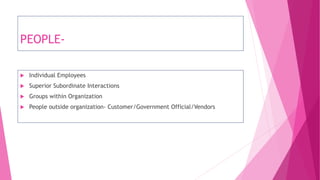
PEOPLE-
 Individual Employees
 Superior Subordinate Interactions
 Groups within Organization
 People outside organization- Customer/Government Official/Vendors
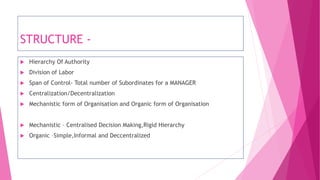
STRUCTURE -
 Hierarchy Of Authority
 Division of Labor
 Span of Control- Total number of Subordinates for a MANAGER
 Centralization/Decentralization
 Mechanistic form of Organisation and Organic form of Organisation
 Mechanistic – Centralised Decision Making,Rigid Hierarchy
 Organic –Simple,Informal and Deccentralized
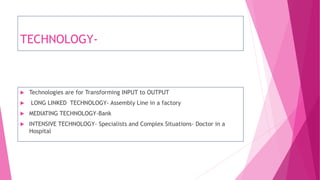
TECHNOLOGY-
 Technologies are for Transforming INPUT to OUTPUT
 LONG LINKED TECHNOLOGY- Assembly Line in a factory
 MEDIATING TECHNOLOGY-Bank
 INTENSIVE TECHNOLOGY- Specialists and Complex Situations- Doctor in a
Hospital
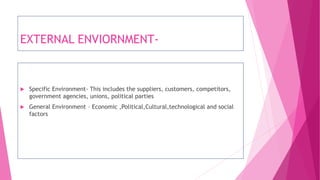
EXTERNAL ENVIORNMENT-
 Specific Environment- This includes the suppliers, customers, competitors,
government agencies, unions, political parties
 General Environment – Economic ,Political,Cultural,technological and social
factors
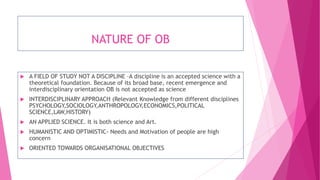
NATURE OF OB
 A FIELD OF STUDY NOT A DISCIPLINE –A discipline is an accepted science with a
theoretical foundation. Because of its broad base, recent emergence and
interdisciplinary orientation OB is not accepted as science
 INTERDISCIPLINARY APPROACH (Relevant Knowledge from different disciplines
PSYCHOLOGY,SOCIOLOGY,ANTHROPOLOGY,ECONOMICS,POLITICAL
SCIENCE,LAW,HISTORY)
 AN APPLIED SCIENCE. It is both science and Art.
 HUMANISTIC AND OPTIMISTIC- Needs and Motivation of people are high
concern
 ORIENTED TOWARDS ORGANISATIONAL OBJECTIVES
CONTRIBUTIONS TO OB FROM VARIOUS
DISCIPLINES
 Psychology
 Sociology
 Anthropology
 Political Science
 Economics
PSYCHOLOGY- How it contributes to OB?
 Greek Word Psyche Meaning Soul or Spirit
 Psychology is the Science of Behavior
 Psychology studies behavior in various Conditions-
normal,abnormal,social,childhood,adolescence,old age
 It also studies Process of Human Behavior SUCH AS
LEARNING,THINKING,MEMORY SENSATION,PERCEPTION etc
SOCIOLOGY-How it contributes to OB
 Study about man’s Social Behavior. The way in which people act towards one
another
 It specifically studies social groups, social behaviour,Society,customs,prestige etc
ANTHROPOLOGY-How it contributes to OB
 Anthropo means MAN and logy means Science
 Anthroplogy Studies civilization, forms of Culture, biological features of
human beings
 It studies the cultural effect on organizational behavior,effects of value
systems,norms,sentiments
Economics & Political Science
 Economics helps in understanding the decision process. Especially methods of
allocating scare resources
 Political Science provides clue to conflicts in organization.Power, authority
structure and overall administrative process
SCOPE OF OBM
 Improves the satisfaction of Employees
 Reduce the chances of conflict
 Facilitates Management
 Helps in Motivation
 Increases organizational efficiency
 Develops Positive attitude
 Helps in Performance Apprisal
ANSWER THE QUESTIONS
 What are the Key Elements of OB?
 List out the various Disciplines contributing to OB
 List out the Scope of OBM in modern Era
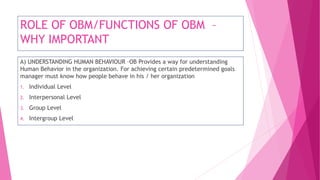
ROLE OF OBM/FUNCTIONS OF OBM –
WHY IMPORTANT
A) UNDERSTANDING HUMAN BEHAVIOUR –OB Provides a way for understanding
Human Behavior in the organization. For achieving certain predetermined goals
manager must know how people behave in his / her organization
1. Individual Level
2. Interpersonal Level
3. Group Level
4. Intergroup Level
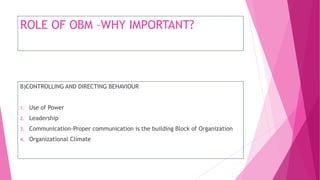
ROLE OF OBM –WHY IMPORTANT?
B)CONTROLLING AND DIRECTING BEHAVIOUR
1. Use of Power
2. Leadership
3. Communication-Proper communication is the building Block of Organization
4. Organizational Climate
ROLE OF OBM –WHY IMPORTANT
C)ORGANISATIONAL ADAPATATION
Organizations have to adapt themselves to the environmental changes by making
suitable internal arrangements
ANSWER THE QUESTIONS
 List out the Roles/Functions OBM
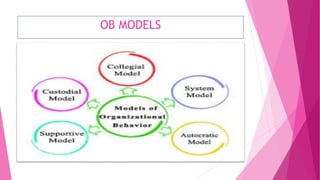
OB MODELS
OB MODELS
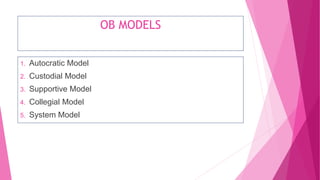
OB MODELS
1. Autocratic Model
2. Custodial Model
3. Supportive Model
4. Collegial Model
5. System Model
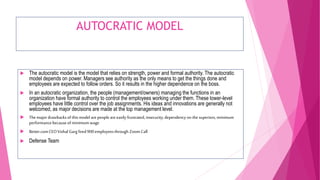
AUTOCRATIC MODEL
 The autocratic model is the model that relies on strength, power and formal authority. The autocratic
model depends on power. Managers see authority as the only means to get the things done and
employees are expected to follow orders. So it results in the higher dependence on the boss.
 In an autocratic organization, the people (management/owners) managing the functions in an
organization have formal authority to control the employees working under them. These lower-level
employees have little control over the job assignments. His ideas and innovations are generally not
welcomed, as major decisions are made at the top management level.
 The major drawbacksof this modelarepeople areeasily frustrated, insecurity,dependency on the superiors,minimum
performancebecauseof minimum wage
 Better.comCEOVishal Garg fired900employeesthrough Zoom Call
 Defense Team
CUSTODIAL MODEL
 Workers being managed under the autocratic model often feel insecure and disappointed. They may also show
aggression towards their boss and their family and neighbors. So progressive managers felt that something must
happen ways to develop better employee relations so that insecurities and frustrations could be removed. The
custodial approach induces employees now to show their dependency and loyalty towards the company and not to
the boss or managers, or supervisors. The employees in this environment are more psychologically contended and
preoccupied with their rewards, but it is not necessary they would be strongly motivated to give the performance.
 To overcome the shortcomings of autocratic model, it came into existence. This model is reward based. More
emphasis is on economic rewards and benefits to motivate employees.
 Thismodel isadaptedby firmshavinghighresourcesasthe namesuggest.It isdependent oneconomicresources.Thisapproachdirectsto
dependonfirmratherthan onmanagerorboss.Theygivepassivecooperationasthey aresatisfiedbutnotstronglyencouraged.
 Eg: In an inspiring incident from Kerela, the managing director (MD) of myG gifted a Mercedes-
Benz car to his employee for his dedication towards the company.
SUPPORTIVE MODEL
 The basic idea behind this theory is that leadership drives people to work not the power of money as in
the custodial model. Through leadership Management provides an environment to help employees
develop and fulfil the interests of the organization, rather than the only things to support employee
benefit payment as per custodial approach.
 Here, it is assumed that workers are self directed and creative. Importance in this model is given to
psychological needs, self esteem, job satisfaction and friendly relations between superior-subordinate.
 This modelis dependenton leadershipstrive.It gives a climate to help employeesgrow and accomplishthe job in the
interestof the organization. Managementjob is to assist the employee’sjob performance.Employeesfeela senseof
participation.
 A software company- Infosys
COLLEGIAL MODEL
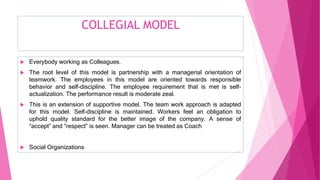
 Everybody working as Colleagues.
 The root level of this model is partnership with a managerial orientation of
teamwork. The employees in this model are oriented towards responsible
behavior and self-discipline. The employee requirement that is met is self-
actualization. The performance result is moderate zeal.
 This is an extension of supportive model. The team work approach is adapted
for this model. Self-discipline is maintained. Workers feel an obligation to
uphold quality standard for the better image of the company. A sense of
“accept” and “respect” is seen. Manager can be treated as Coach
 Social Organizations
SYSTEM MODEL
 The final organizational model is known as the system model. It is the most contemporary
emerging model of the five models discussed in this article. In the system model, the
organization looks at the overall structure and team environment, and assumes that individuals
have different goals, talents, and abilities. The system model aims to try to balance the goals of
the individual with the goals of the organization.
 Individuals obviously want good remuneration, job security, but also want to work in a positive
work environment where the organization adds value to the community and/or its customers. The
model system should be a holistic partnership of managers and employees with a common goal,
and where everyone feels they have a stake in the organization.
COMPARISON OF OB MODELS
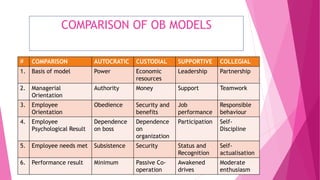
# COMPARISON AUTOCRATIC CUSTODIAL SUPPORTIVE COLLEGIAL
1. Basis of model Power Economic
resources
Leadership Partnership
2. Managerial
Orientation
Authority Money Support Teamwork
3. Employee
Orientation
Obedience Security and
benefits
Job
performance
Responsible
behaviour
4. Employee
Psychological Result
Dependence
on boss
Dependence
on
organization
Participation Self-
Discipline
5. Employee needs met Subsistence Security Status and
Recognition
Self-
actualisation
6. Performance result Minimum Passive Co-
operation
Awakened
drives
Moderate
enthusiasm
ANSWER THE QUESTIONS
 What are the different Organization Models ?
END OF THE SESSION
JAY-BSc, MBA (Madras University) Certified Trainer of Logistics Skill Council of India

OB-UNIT-1.pptx

  • 1.
  • 2.
    KEY LEARNING OUTCOMES-  Introduction to Organizational Behavior – SCOPE AND IMPORTANCE  Meaning and Definition of OB  History of OB and its emergence as a discipline  Contributions to OB from different disciplines  Organizational Behaviour Model  Functions of OB
  • 3.
  • 4.
    ORGANIZATION  Organization isa purposeful system with several subsystems where individual and activities are organized to achieve certain predetermined goals through division of labor and coordination of activities  Division of Labor?  Coordination of Activities ? TEAM-TOGETHER EVERYONE ACHIEVES MORE
  • 5.
    ORGANIZATION-FEATURES  Identifiable Aggregationof Human Beings  Deliberate and Conscious Creation  Purposive Creation  Coordination of Activities  Structure(Power Centers)  Rationality-Every organization has some specified norms and standard of behavior –Every members expected to behave based on this norms or standard
  • 6.
    TYPE OF ORGANISATIONS Many…………….  Small medium large  Public,Pvt,Mixed  Sole(Proprietorship),Partnership  Political Organisation,Economic Organisations  Voluntary,Family
  • 7.
    ORGANIZATIONAL GOALS  Otherterms Purpose,Mission,Goal,Target,Objective  Each Organization or group of individuals has some goals ..In fact organizations are created for achieving some goals and members try to achieve this through coordinated effort  It may be Broad or Specific  Official and Operating Goals (Official goals are general purposes of the organization as put forth in their annual reports, public statements)  Goals within goals within Goals  Organizational Goals and Individual Goals
  • 8.
  • 9.
    Organizational Goals VsIndividual Goals
  • 10.
  • 11.
    ANSWER THE QUESTIONS Define an Organization?  List out features of Organization  What are the different types of Goals/Objectives
  • 12.
    ORGANIZATIONAL BEHAVIOUR (OB)  OBis the study and application of Knowledge about Human Behavior related to other elements of organization such as structure, technology and Social System(external Elements)  KEY ELEMENTS OF OB= PEOPLE –STRUCTURE-TECHNOLOGY AND EXTERNAL ELEMENTS
  • 13.
  • 14.
    PEOPLE-  Individual Employees Superior Subordinate Interactions  Groups within Organization  People outside organization- Customer/Government Official/Vendors
  • 15.
    STRUCTURE -  HierarchyOf Authority  Division of Labor  Span of Control- Total number of Subordinates for a MANAGER  Centralization/Decentralization  Mechanistic form of Organisation and Organic form of Organisation  Mechanistic – Centralised Decision Making,Rigid Hierarchy  Organic –Simple,Informal and Deccentralized
  • 16.
    TECHNOLOGY-  Technologies arefor Transforming INPUT to OUTPUT  LONG LINKED TECHNOLOGY- Assembly Line in a factory  MEDIATING TECHNOLOGY-Bank  INTENSIVE TECHNOLOGY- Specialists and Complex Situations- Doctor in a Hospital
  • 17.
    EXTERNAL ENVIORNMENT-  SpecificEnvironment- This includes the suppliers, customers, competitors, government agencies, unions, political parties  General Environment – Economic ,Political,Cultural,technological and social factors
  • 18.
    NATURE OF OB A FIELD OF STUDY NOT A DISCIPLINE –A discipline is an accepted science with a theoretical foundation. Because of its broad base, recent emergence and interdisciplinary orientation OB is not accepted as science  INTERDISCIPLINARY APPROACH (Relevant Knowledge from different disciplines PSYCHOLOGY,SOCIOLOGY,ANTHROPOLOGY,ECONOMICS,POLITICAL SCIENCE,LAW,HISTORY)  AN APPLIED SCIENCE. It is both science and Art.  HUMANISTIC AND OPTIMISTIC- Needs and Motivation of people are high concern  ORIENTED TOWARDS ORGANISATIONAL OBJECTIVES
  • 19.
    CONTRIBUTIONS TO OBFROM VARIOUS DISCIPLINES  Psychology  Sociology  Anthropology  Political Science  Economics
  • 20.
    PSYCHOLOGY- How itcontributes to OB?  Greek Word Psyche Meaning Soul or Spirit  Psychology is the Science of Behavior  Psychology studies behavior in various Conditions- normal,abnormal,social,childhood,adolescence,old age  It also studies Process of Human Behavior SUCH AS LEARNING,THINKING,MEMORY SENSATION,PERCEPTION etc
  • 21.
    SOCIOLOGY-How it contributesto OB  Study about man’s Social Behavior. The way in which people act towards one another  It specifically studies social groups, social behaviour,Society,customs,prestige etc
  • 22.
    ANTHROPOLOGY-How it contributesto OB  Anthropo means MAN and logy means Science  Anthroplogy Studies civilization, forms of Culture, biological features of human beings  It studies the cultural effect on organizational behavior,effects of value systems,norms,sentiments
  • 23.
    Economics & PoliticalScience  Economics helps in understanding the decision process. Especially methods of allocating scare resources  Political Science provides clue to conflicts in organization.Power, authority structure and overall administrative process
  • 24.
    SCOPE OF OBM Improves the satisfaction of Employees  Reduce the chances of conflict  Facilitates Management  Helps in Motivation  Increases organizational efficiency  Develops Positive attitude  Helps in Performance Apprisal
  • 25.
    ANSWER THE QUESTIONS What are the Key Elements of OB?  List out the various Disciplines contributing to OB  List out the Scope of OBM in modern Era
  • 26.
    ROLE OF OBM/FUNCTIONSOF OBM – WHY IMPORTANT A) UNDERSTANDING HUMAN BEHAVIOUR –OB Provides a way for understanding Human Behavior in the organization. For achieving certain predetermined goals manager must know how people behave in his / her organization 1. Individual Level 2. Interpersonal Level 3. Group Level 4. Intergroup Level
  • 27.
    ROLE OF OBM–WHY IMPORTANT? B)CONTROLLING AND DIRECTING BEHAVIOUR 1. Use of Power 2. Leadership 3. Communication-Proper communication is the building Block of Organization 4. Organizational Climate
  • 28.
    ROLE OF OBM–WHY IMPORTANT C)ORGANISATIONAL ADAPATATION Organizations have to adapt themselves to the environmental changes by making suitable internal arrangements
  • 29.
    ANSWER THE QUESTIONS List out the Roles/Functions OBM
  • 30.
  • 31.
  • 32.
    OB MODELS 1. AutocraticModel 2. Custodial Model 3. Supportive Model 4. Collegial Model 5. System Model
  • 33.
    AUTOCRATIC MODEL  Theautocratic model is the model that relies on strength, power and formal authority. The autocratic model depends on power. Managers see authority as the only means to get the things done and employees are expected to follow orders. So it results in the higher dependence on the boss.  In an autocratic organization, the people (management/owners) managing the functions in an organization have formal authority to control the employees working under them. These lower-level employees have little control over the job assignments. His ideas and innovations are generally not welcomed, as major decisions are made at the top management level.  The major drawbacksof this modelarepeople areeasily frustrated, insecurity,dependency on the superiors,minimum performancebecauseof minimum wage  Better.comCEOVishal Garg fired900employeesthrough Zoom Call  Defense Team
  • 34.
    CUSTODIAL MODEL  Workersbeing managed under the autocratic model often feel insecure and disappointed. They may also show aggression towards their boss and their family and neighbors. So progressive managers felt that something must happen ways to develop better employee relations so that insecurities and frustrations could be removed. The custodial approach induces employees now to show their dependency and loyalty towards the company and not to the boss or managers, or supervisors. The employees in this environment are more psychologically contended and preoccupied with their rewards, but it is not necessary they would be strongly motivated to give the performance.  To overcome the shortcomings of autocratic model, it came into existence. This model is reward based. More emphasis is on economic rewards and benefits to motivate employees.  Thismodel isadaptedby firmshavinghighresourcesasthe namesuggest.It isdependent oneconomicresources.Thisapproachdirectsto dependonfirmratherthan onmanagerorboss.Theygivepassivecooperationasthey aresatisfiedbutnotstronglyencouraged.  Eg: In an inspiring incident from Kerela, the managing director (MD) of myG gifted a Mercedes- Benz car to his employee for his dedication towards the company.
  • 35.
    SUPPORTIVE MODEL  Thebasic idea behind this theory is that leadership drives people to work not the power of money as in the custodial model. Through leadership Management provides an environment to help employees develop and fulfil the interests of the organization, rather than the only things to support employee benefit payment as per custodial approach.  Here, it is assumed that workers are self directed and creative. Importance in this model is given to psychological needs, self esteem, job satisfaction and friendly relations between superior-subordinate.  This modelis dependenton leadershipstrive.It gives a climate to help employeesgrow and accomplishthe job in the interestof the organization. Managementjob is to assist the employee’sjob performance.Employeesfeela senseof participation.  A software company- Infosys
  • 36.
    COLLEGIAL MODEL  Everybodyworking as Colleagues.  The root level of this model is partnership with a managerial orientation of teamwork. The employees in this model are oriented towards responsible behavior and self-discipline. The employee requirement that is met is self- actualization. The performance result is moderate zeal.  This is an extension of supportive model. The team work approach is adapted for this model. Self-discipline is maintained. Workers feel an obligation to uphold quality standard for the better image of the company. A sense of “accept” and “respect” is seen. Manager can be treated as Coach  Social Organizations
  • 37.
    SYSTEM MODEL  Thefinal organizational model is known as the system model. It is the most contemporary emerging model of the five models discussed in this article. In the system model, the organization looks at the overall structure and team environment, and assumes that individuals have different goals, talents, and abilities. The system model aims to try to balance the goals of the individual with the goals of the organization.  Individuals obviously want good remuneration, job security, but also want to work in a positive work environment where the organization adds value to the community and/or its customers. The model system should be a holistic partnership of managers and employees with a common goal, and where everyone feels they have a stake in the organization.
  • 38.
    COMPARISON OF OBMODELS # COMPARISON AUTOCRATIC CUSTODIAL SUPPORTIVE COLLEGIAL 1. Basis of model Power Economic resources Leadership Partnership 2. Managerial Orientation Authority Money Support Teamwork 3. Employee Orientation Obedience Security and benefits Job performance Responsible behaviour 4. Employee Psychological Result Dependence on boss Dependence on organization Participation Self- Discipline 5. Employee needs met Subsistence Security Status and Recognition Self- actualisation 6. Performance result Minimum Passive Co- operation Awakened drives Moderate enthusiasm
  • 39.
    ANSWER THE QUESTIONS What are the different Organization Models ?
  • 40.
    END OF THESESSION JAY-BSc, MBA (Madras University) Certified Trainer of Logistics Skill Council of India