

RAGHVENDRA KUMAR-131206
Navneet VIJAYWARGI-131207
M Abhishek-131245
PRIYANKA KUMARI-131213
 The International Monetary Fund (IMF) is an organization of 187
countries, working to:
 Foster global monetary cooperation
 Facilitate international trade
 Promote high employment and sustainable economic growth
 Reduce poverty around the world.
The work of the IMF is of three main types.
Surveillance involves the monitoring of economic and financial
developments, and the provision of policy advice, aimed especially at crisis-
prevention.
lends to countries with balance of payments difficulties, to provide temporary
financing and to support policies aimed at correcting the underlying
problems; loans to low-income countries are also aimed especially at poverty
reduction.
Third, the IMF provides countries with technical assistance and training in its
areas of expertise.
International Monetary Fund
History
 IMF was conceived in July 1944 at the Bretton Woods
conference
 It came into existence on 29th December 1945.
 Objective - stabilize exchange rates and assist the
reconstruction of the world's international payment
system.
IMF-Basis For Lending
 Nations with severe budget deficits, rampant inflation, strict
price controls, or significantly over-valued or under-valued
currencies run the risk of facing balance of payment crises. Such
member states may request loans
 In return, countries are usually required to launch certain
reforms, which have often been dubbed the "Washington
Consensus".
 These reforms are thought to be beneficial to countries with
fixed exchange rate policies that may engage in fiscal, monetary,
and political practices which may lead to the crisis itself.
 Thus, the structural adjustment programs are at least ostensibly
intended to ensure that the IMF is actually helping to prevent
financial crises rather than merely funding financial
recklessness.
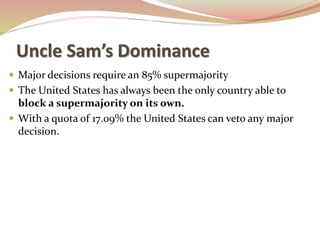
Uncle Sam’s Dominance
 Major decisions require an 85% supermajority
 The United States has always been the only country able to
block a supermajority on its own.
 With a quota of 17.09% the United States can veto any major
decision.
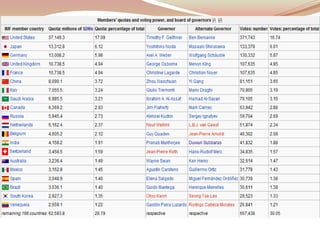
Source : Wikipedia
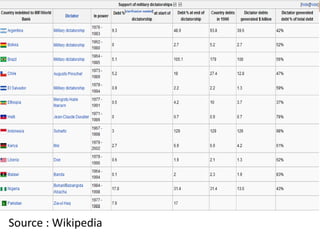
SUPPORT TO DICTATORSHIP
Source : Wikipedia
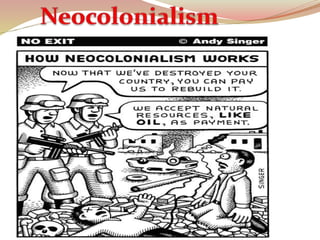
What it means?
 It is defined as the control of a developed country or
International bodies (such as the IMF or World Bank) over
developing countries through economic pressures. A kind
of Modern day Imperialism.
 It is usually practised in the premise of aid to the poorer
crisis ridden countries in the form of money or goods in
return for control over their economic policies and other
domestic affairs which in turn prove advantageous to the
stronger developed countries
For Example……
 1991 to 1993, Kenya had its worst economic performance since
independence :
a) GDP stagnated
b) Inflation increased – 100%
c) Budget deficit reached about 10% of GDP
 The reason for this meltdown was partly due to the Goldenberg crisis
– where millions of shillings were siphoned off the country through
illegal means.
This was again a consequence of Kenya implementing the IMF’s
recommendations and opening up its economy to encourage free
trade.
To renew its economy, it needed funds from the IMF and the World
Bank – but they came at a price. The IMF put conditions on Kenya’s
economy in return for the loan – like the lifting of trade barriers on
End effects
 This led to heavy dumping of the US/EU grain surpluses onto the local
market spearheading local agricultural producers into bankruptcy.
 Apart from Kenya, Zimbabwe and Malawi were also heavily affected as
they were once self-sufficient grain producing countries until 1990
when the IMF ordered dumping of EU/USA grain surpluses,
precipitating local farmers to bankruptcy.
 Tightly regulated and controlled by the international agro-business,
this oversupply ultimately leads to stagnation of both production and
consumption of essential food staples and the impoverishment of
farmers throughout the world.
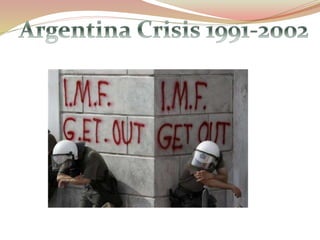
What happened?
1. Argentina was pushed into a devastating economic crisis in December
2001/January 2002, when a partial deposit freeze, a partial default
on public debt, and an abandonment of the fixed exchange rate
led to a major collapse in the output and high levels of unemployment
leading to political and social turmoil.
2. This has raised questions regarding the country’s relationship with the
IMF because they happened while its economic policies were under
the close scrutiny of an IMF-supported program.
3. Furthermore, the IMF had been almost continuously engaged in
Argentina since 1991, when the “Convertibility Plan” fixed the
Argentine peso at parity with the U.S. dollar in a currency board-like
arrangement. While Argentina experienced strong growth and very low
inflation for much of the 1990s.
What the IMF did?
1. IMF backed the “Convertibility Plan” of Argentina by providing
it with various aids It arranged massive amounts of loans --
including $40 billion a year ago -- to support the Argentine
peso.
2. The IMF also provided extensive technical assistance (TA)
during the period, dispatching some 50 missions between 1991
and 2002, mainly in the fiscal, monetary and banking areas.
3. Argentina being a member nation of IMF, had to agree to its
policy of free trade. With peso at par with the dollar, people
could buy virtually everything they could have thought of.
Thus, foreign exchange reserve drastically decreased and
the local companies and factories couldn’t survive the invasion
foreign superior goods. All this led to unemployment in
Argentina.
Culmination
1. It became clear that they could hardly pay back the loans
granted by IMF and under such a chaos, government
changed its policy from fixed exchange rate to floating
exchange rate. The outcome of the change was that the value
of peso deteriorated from 1$=1 peso to 1$=3.18peso.
2. Almost every company in Argentina dealt its transaction in
dollars. With the loans taken in dollars it had to repay them in
dollars.
For Example:
A company having a debt of 1000$ would have had to pay it back
with 1000 peso, but with the new exchange rate it had to pay
almost three times as much.
3. With this bleak scenario, Argentina was declared Bankrupt in
in December 2001.
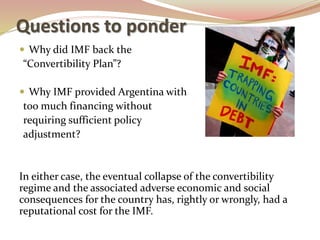
Questions to ponder
 Why did IMF back the
“Convertibility Plan”?
 Why IMF provided Argentina with
too much financing without
requiring sufficient policy
adjustment?
In either case, the eventual collapse of the convertibility
regime and the associated adverse economic and social
consequences for the country has, rightly or wrongly, had a
reputational cost for the IMF.
The World Bank is an international financial institution that
provides financial and technical assistance to developing
countries for development programs
Headquarters:
Washington, DC, and more than 100 country offices
Established:
July 1, 1944, during a conference of 44 countries in Bretton
Woods.
WB mission is to
Reduce poverty in the globe
Improve the living standard
The World Bank (WB)
The World Bank (WB)
 WB focuses on achievement of the Millennium Development
Goals that call for the elimination of poverty and sustained
development.
 Millennium Development Goals based on Five key factors:
 Build capacity
 Infrastructure creation
 Development of Financial Systems
 Combating corruption
 Research, Consultancy and Training.
Objective and Function
 Provide assistance to developing countries
 Promote the economic development of the world's
poorer countries
 Finance the poorest developing countries whose per
capita GNP is less than $865 a year special financial
assistance through the International Development
Association (IDA).
The Bank offers two basic types of loans:
 Investment loans: Support of economic and
social development projects
 Development policy loans: Quick disbursing
finance to support countries
World Bank Group agencies
 the International Bank for Reconstruction and Development
(IBRD), established in 1945, which provides debt financing on the basis
of sovereign guarantees;
 the International Finance Corporation (IFC), established in 1956,
which provides various forms of financing without sovereign guarantees,
primarily to the private sector;
 the International Development Association (IDA), established in
1960, which provides concessional financing (interest-free loans or
grants), usually with sovereign guarantees;
 the International Centre for Settlement of Investment
Disputes (ICSID), established in 1965, which works with governments to
reduce investment risk;
 the Multilateral Investment Guarantee Agency (MIGA), established
in 1988, which provides insurance against certain types of risk, including
political risk, primarily to the private sector.
Areas of operation
 Agriculture and Rural Development
 Conflict and Development
 Development Operations and
Activities
 Economic Policy
 Education
 Energy
 Environment
 Financial Sector
 Gender
 Governance
 Health, Nutrition and Population
 Industry
 International Economics and Trade
 Law and Justice
 Macroeconomic and Economic
Growth
 Mining
 Poverty Reduction
 Private Sector
 Public Sector Governance
 Rural Development
 Social Development
 Social Protection
 Trade
 Transport
 Urban Development
 Water Resources
 Water Supply and Sanitation
 Labor and Social Protections
How is World Bank Run?
 The World Bank is like a cooperative, where its 184 member
countries are shareholders. The shareholders are represented by a
Board of Governors, who are the ultimate policy makers at the
World Bank.
 The governors are member countries' ministers of finance or
ministers of development.
 They meet once a year at the Annual Meetings of the Boards of
Governors of the World Bank Group and the International
Monetary Fund.
 Because the governors only meet annually, they delegate specific
duties to 24 Executive Directors, who work on-site at the bank.
How is World Bank Run?
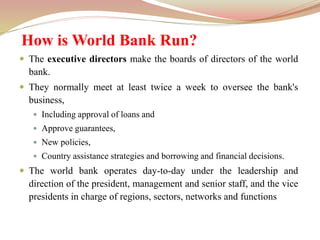
 The five largest shareholders, France, Germany, Japan, the
United Kingdom and the United States appoint an executive
director,
 The other member countries are represented by 19 executive
directors.
 The President is elected by the Board of Governors for a five-
year, renewable term.
How is World Bank Run?
 The executive directors make the boards of directors of the world
bank.
 They normally meet at least twice a week to oversee the bank's
business,
 Including approval of loans and
 Approve guarantees,
 New policies,
 Country assistance strategies and borrowing and financial decisions.
 The world bank operates day-to-day under the leadership and
direction of the president, management and senior staff, and the vice
presidents in charge of regions, sectors, networks and functions
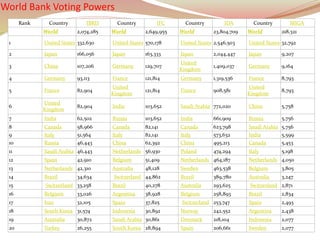
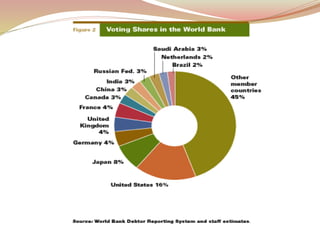
World Bank Voting Powers
Rank Country IBRD Country IFC Country IDA Country MIGA
World 2,074,285 World 2,649,955 World 23,804,709 World 218,321
1 United States 332,630 United States 570,178 United States 2,546,503 United States 32,792
2 Japan 166,056 Japan 163,333 Japan 2,044,447 Japan 9,207
3 China 107,206 Germany 129,707
United
Kingdom
1,409,037 Germany 9,164
4 Germany 93,113 France 121,814 Germany 1,319,536 France 8,793
5 France 82,904
United
Kingdom
121,814 France 908,581
United
Kingdom
8,793
6
United
Kingdom
82,904 India 103,652 Saudi Arabia 772,020 China 5,758
7 India 62,502 Russia 103,652 India 661,909 Russia 5,756
8 Canada 58,966 Canada 82,141 Canada 623,798 Saudi Arabia 5,756
9 Italy 51,564 Italy 82,141 Italy 573,632 India 5,599
10 Russia 46,443 China 62,392 China 495,213 Canada 5,453
11 Saudi Arabia 46,443 Netherlands 56,930 Poland 474,294 Italy 5,198
12 Spain 42,910 Belgium 51,409 Netherlands 464,187 Netherlands 4,050
13 Netherlands 42,310 Australia 48,128 Sweden 463,538 Belgium 3,805
14 Brazil 34,634 Switzerland 44,862 Brazil 389,780 Australia 3,247
15 Switzerland 33,258 Brazil 40,278 Australia 293,625 Switzerland 2,871
16 Belgium 33,026 Argentina 38,928 Belgium 258,893 Brazil 2,834
17 Iran 32,105 Spain 37,825 Switzerland 253,747 Spain 2,493
18 South Korea 31,574 Indonesia 30,892 Norway 242,552 Argentina 2,438
19 Australia 30,872 Saudi Arabia 30,861 Denmark 218,104 Indonesia 2,077
20 Turkey 26,255 South Korea 28,894 Spain 206,661 Sweden 2,077
Source of Funds for World Bank
 IBRD lending to developing countries is primarily financed by
selling AAA-rated bonds in the world's financial markets.
 The greater proportion of its income comes from lending out its own
capital.
 This capital consists of reserves built up over the years and money
paid in from the bank's 184 member country shareholders.
 IBRD’s income also pays for world bank operating expenses and has
contributed to IDA and debt relief.
Source of Funds for World Bank (contd.)
 IDA is the world's largest source of interest-free loans and
grant assistance to the poorest countries.
 This source is replenished every three years by 40 donor
countries.
 Additional funds are regenerated through repayments of
 loan principal on 35-to-40-year,
 no-interest loans, which are then available for re-lending.
 IDA accounts for nearly 40% of our lending
Analytical and Advisory Services
 WB’s roles is to provide analysis, advice and information to
our member countries
 This is done to make sure each country can deliver the
lasting economic and social improvements their people
need.
 This is done:
 through economic research on broad issues such as the
environment, poverty, trade and globalization and
 through country-specific economic and sector work,
 By evaluating a country's economic prospects by examining its
banking systems and financial markets,
 By also examining trade, infrastructure, poverty and social
safety net issues.
32
Capacity Building
 Another core bank function is to increase the
capabilities of:
 It own stuff
 WB partners
 People in developing countries
 This is done to help them to acquire the knowledge and
skills:
 they need to provide technical assistance,
 To improve government performance and delivery of services,
 To sustain poverty reduction programs.
33
Criticism
 It was started to reduce poverty but it support United
States’ business interests.
 It is deeply implicated in contemporary modes of donor
and NGO driven imperialism.
 The President of the Bank is always a citizen of the United
States.
 Lack transparency to external publics.
 It is an instrument for the promotion of U.S. or Western
interests.
 The decision-making structure is undemocratic.
 It has consistently pushed a “neo-liberal” agenda ,
imposing policies on developing countries .
 While the World Bank represents 186 countries, it is run by
a small number of economically powerful countries.
 The World Bank has dual roles that are contradictory: that
of a political organization and that of a practical
organization.
 Some analysis shows that the World Bank has increased
poverty and been detrimental to the environment, public
health and cultural diversity.
 It has been criticized for focusing too much “on issuing
loans rather than on achieving concrete development
results within a finite period of time”.
The World Bank: Still a 20th Century
organization??
 The same outmoded hierarchical bureaucracy that hamstrings big
industrial firms and government departments of the US and Europe is
pervasive.
 The World Bank still operates for the most part with processes and
systems that were designed half a century ago. Each project to be
financed is still reviewed by an incredibly heavy governance structure.
 One of the shocks for each incoming president of the World Bank is
the discovery of its governance structure.
 Given the number of players involved, any significant change often
results in political gridlock.
 The World Bank’s business model is complicated. There are several
different institutions (IBRD, IDA, and IFC).
The confused mission of the World Bank
 The World Bank got off to a confused start when it was created, along
with the International Monetary Fund (IMF), at the Bretton Woods
Conference in 1944.
 As JM Keynes quipped at the time, the Conference had created
something called a bank that was actually a fund, as well as something
called a fund, that was actually a bank.
 It’s an odd combination of a bank, a university and foundation.
 Although it was started for poverty alleviation, it became a lending
machine making poor countries highly indebted.
THANK YOU

Are IMF and World Bank losing relevance

  • 1.
    RAGHVENDRA KUMAR-131206 Navneet VIJAYWARGI-131207 MAbhishek-131245 PRIYANKA KUMARI-131213
  • 2.
     The InternationalMonetary Fund (IMF) is an organization of 187 countries, working to:  Foster global monetary cooperation  Facilitate international trade  Promote high employment and sustainable economic growth  Reduce poverty around the world. The work of the IMF is of three main types. Surveillance involves the monitoring of economic and financial developments, and the provision of policy advice, aimed especially at crisis- prevention. lends to countries with balance of payments difficulties, to provide temporary financing and to support policies aimed at correcting the underlying problems; loans to low-income countries are also aimed especially at poverty reduction. Third, the IMF provides countries with technical assistance and training in its areas of expertise. International Monetary Fund
  • 3.
    History  IMF wasconceived in July 1944 at the Bretton Woods conference  It came into existence on 29th December 1945.  Objective - stabilize exchange rates and assist the reconstruction of the world's international payment system.
  • 4.
    IMF-Basis For Lending Nations with severe budget deficits, rampant inflation, strict price controls, or significantly over-valued or under-valued currencies run the risk of facing balance of payment crises. Such member states may request loans  In return, countries are usually required to launch certain reforms, which have often been dubbed the "Washington Consensus".  These reforms are thought to be beneficial to countries with fixed exchange rate policies that may engage in fiscal, monetary, and political practices which may lead to the crisis itself.  Thus, the structural adjustment programs are at least ostensibly intended to ensure that the IMF is actually helping to prevent financial crises rather than merely funding financial recklessness.
  • 5.
    Uncle Sam’s Dominance Major decisions require an 85% supermajority  The United States has always been the only country able to block a supermajority on its own.  With a quota of 17.09% the United States can veto any major decision.
  • 6.
  • 7.
  • 8.
  • 10.
    What it means? It is defined as the control of a developed country or International bodies (such as the IMF or World Bank) over developing countries through economic pressures. A kind of Modern day Imperialism.  It is usually practised in the premise of aid to the poorer crisis ridden countries in the form of money or goods in return for control over their economic policies and other domestic affairs which in turn prove advantageous to the stronger developed countries
  • 11.
    For Example……  1991to 1993, Kenya had its worst economic performance since independence : a) GDP stagnated b) Inflation increased – 100% c) Budget deficit reached about 10% of GDP  The reason for this meltdown was partly due to the Goldenberg crisis – where millions of shillings were siphoned off the country through illegal means. This was again a consequence of Kenya implementing the IMF’s recommendations and opening up its economy to encourage free trade. To renew its economy, it needed funds from the IMF and the World Bank – but they came at a price. The IMF put conditions on Kenya’s economy in return for the loan – like the lifting of trade barriers on
  • 12.
    End effects  Thisled to heavy dumping of the US/EU grain surpluses onto the local market spearheading local agricultural producers into bankruptcy.  Apart from Kenya, Zimbabwe and Malawi were also heavily affected as they were once self-sufficient grain producing countries until 1990 when the IMF ordered dumping of EU/USA grain surpluses, precipitating local farmers to bankruptcy.  Tightly regulated and controlled by the international agro-business, this oversupply ultimately leads to stagnation of both production and consumption of essential food staples and the impoverishment of farmers throughout the world.
  • 14.
    What happened? 1. Argentinawas pushed into a devastating economic crisis in December 2001/January 2002, when a partial deposit freeze, a partial default on public debt, and an abandonment of the fixed exchange rate led to a major collapse in the output and high levels of unemployment leading to political and social turmoil. 2. This has raised questions regarding the country’s relationship with the IMF because they happened while its economic policies were under the close scrutiny of an IMF-supported program. 3. Furthermore, the IMF had been almost continuously engaged in Argentina since 1991, when the “Convertibility Plan” fixed the Argentine peso at parity with the U.S. dollar in a currency board-like arrangement. While Argentina experienced strong growth and very low inflation for much of the 1990s.
  • 15.
    What the IMFdid? 1. IMF backed the “Convertibility Plan” of Argentina by providing it with various aids It arranged massive amounts of loans -- including $40 billion a year ago -- to support the Argentine peso. 2. The IMF also provided extensive technical assistance (TA) during the period, dispatching some 50 missions between 1991 and 2002, mainly in the fiscal, monetary and banking areas. 3. Argentina being a member nation of IMF, had to agree to its policy of free trade. With peso at par with the dollar, people could buy virtually everything they could have thought of. Thus, foreign exchange reserve drastically decreased and the local companies and factories couldn’t survive the invasion foreign superior goods. All this led to unemployment in Argentina.
  • 16.
    Culmination 1. It becameclear that they could hardly pay back the loans granted by IMF and under such a chaos, government changed its policy from fixed exchange rate to floating exchange rate. The outcome of the change was that the value of peso deteriorated from 1$=1 peso to 1$=3.18peso. 2. Almost every company in Argentina dealt its transaction in dollars. With the loans taken in dollars it had to repay them in dollars. For Example: A company having a debt of 1000$ would have had to pay it back with 1000 peso, but with the new exchange rate it had to pay almost three times as much. 3. With this bleak scenario, Argentina was declared Bankrupt in in December 2001.
  • 18.
    Questions to ponder Why did IMF back the “Convertibility Plan”?  Why IMF provided Argentina with too much financing without requiring sufficient policy adjustment? In either case, the eventual collapse of the convertibility regime and the associated adverse economic and social consequences for the country has, rightly or wrongly, had a reputational cost for the IMF.
  • 19.
    The World Bankis an international financial institution that provides financial and technical assistance to developing countries for development programs Headquarters: Washington, DC, and more than 100 country offices Established: July 1, 1944, during a conference of 44 countries in Bretton Woods. WB mission is to Reduce poverty in the globe Improve the living standard The World Bank (WB)
  • 20.
    The World Bank(WB)  WB focuses on achievement of the Millennium Development Goals that call for the elimination of poverty and sustained development.  Millennium Development Goals based on Five key factors:  Build capacity  Infrastructure creation  Development of Financial Systems  Combating corruption  Research, Consultancy and Training.
  • 21.
    Objective and Function Provide assistance to developing countries  Promote the economic development of the world's poorer countries  Finance the poorest developing countries whose per capita GNP is less than $865 a year special financial assistance through the International Development Association (IDA).
  • 22.
    The Bank offerstwo basic types of loans:  Investment loans: Support of economic and social development projects  Development policy loans: Quick disbursing finance to support countries
  • 23.
    World Bank Groupagencies  the International Bank for Reconstruction and Development (IBRD), established in 1945, which provides debt financing on the basis of sovereign guarantees;  the International Finance Corporation (IFC), established in 1956, which provides various forms of financing without sovereign guarantees, primarily to the private sector;  the International Development Association (IDA), established in 1960, which provides concessional financing (interest-free loans or grants), usually with sovereign guarantees;  the International Centre for Settlement of Investment Disputes (ICSID), established in 1965, which works with governments to reduce investment risk;  the Multilateral Investment Guarantee Agency (MIGA), established in 1988, which provides insurance against certain types of risk, including political risk, primarily to the private sector.
  • 24.
    Areas of operation Agriculture and Rural Development  Conflict and Development  Development Operations and Activities  Economic Policy  Education  Energy  Environment  Financial Sector  Gender  Governance  Health, Nutrition and Population  Industry  International Economics and Trade  Law and Justice  Macroeconomic and Economic Growth  Mining  Poverty Reduction  Private Sector  Public Sector Governance  Rural Development  Social Development  Social Protection  Trade  Transport  Urban Development  Water Resources  Water Supply and Sanitation  Labor and Social Protections
  • 25.
    How is WorldBank Run?  The World Bank is like a cooperative, where its 184 member countries are shareholders. The shareholders are represented by a Board of Governors, who are the ultimate policy makers at the World Bank.  The governors are member countries' ministers of finance or ministers of development.  They meet once a year at the Annual Meetings of the Boards of Governors of the World Bank Group and the International Monetary Fund.  Because the governors only meet annually, they delegate specific duties to 24 Executive Directors, who work on-site at the bank.
  • 26.
    How is WorldBank Run?  The five largest shareholders, France, Germany, Japan, the United Kingdom and the United States appoint an executive director,  The other member countries are represented by 19 executive directors.  The President is elected by the Board of Governors for a five- year, renewable term.
  • 27.
    How is WorldBank Run?  The executive directors make the boards of directors of the world bank.  They normally meet at least twice a week to oversee the bank's business,  Including approval of loans and  Approve guarantees,  New policies,  Country assistance strategies and borrowing and financial decisions.  The world bank operates day-to-day under the leadership and direction of the president, management and senior staff, and the vice presidents in charge of regions, sectors, networks and functions
  • 28.
    World Bank VotingPowers Rank Country IBRD Country IFC Country IDA Country MIGA World 2,074,285 World 2,649,955 World 23,804,709 World 218,321 1 United States 332,630 United States 570,178 United States 2,546,503 United States 32,792 2 Japan 166,056 Japan 163,333 Japan 2,044,447 Japan 9,207 3 China 107,206 Germany 129,707 United Kingdom 1,409,037 Germany 9,164 4 Germany 93,113 France 121,814 Germany 1,319,536 France 8,793 5 France 82,904 United Kingdom 121,814 France 908,581 United Kingdom 8,793 6 United Kingdom 82,904 India 103,652 Saudi Arabia 772,020 China 5,758 7 India 62,502 Russia 103,652 India 661,909 Russia 5,756 8 Canada 58,966 Canada 82,141 Canada 623,798 Saudi Arabia 5,756 9 Italy 51,564 Italy 82,141 Italy 573,632 India 5,599 10 Russia 46,443 China 62,392 China 495,213 Canada 5,453 11 Saudi Arabia 46,443 Netherlands 56,930 Poland 474,294 Italy 5,198 12 Spain 42,910 Belgium 51,409 Netherlands 464,187 Netherlands 4,050 13 Netherlands 42,310 Australia 48,128 Sweden 463,538 Belgium 3,805 14 Brazil 34,634 Switzerland 44,862 Brazil 389,780 Australia 3,247 15 Switzerland 33,258 Brazil 40,278 Australia 293,625 Switzerland 2,871 16 Belgium 33,026 Argentina 38,928 Belgium 258,893 Brazil 2,834 17 Iran 32,105 Spain 37,825 Switzerland 253,747 Spain 2,493 18 South Korea 31,574 Indonesia 30,892 Norway 242,552 Argentina 2,438 19 Australia 30,872 Saudi Arabia 30,861 Denmark 218,104 Indonesia 2,077 20 Turkey 26,255 South Korea 28,894 Spain 206,661 Sweden 2,077
  • 30.
    Source of Fundsfor World Bank  IBRD lending to developing countries is primarily financed by selling AAA-rated bonds in the world's financial markets.  The greater proportion of its income comes from lending out its own capital.  This capital consists of reserves built up over the years and money paid in from the bank's 184 member country shareholders.  IBRD’s income also pays for world bank operating expenses and has contributed to IDA and debt relief.
  • 31.
    Source of Fundsfor World Bank (contd.)  IDA is the world's largest source of interest-free loans and grant assistance to the poorest countries.  This source is replenished every three years by 40 donor countries.  Additional funds are regenerated through repayments of  loan principal on 35-to-40-year,  no-interest loans, which are then available for re-lending.  IDA accounts for nearly 40% of our lending
  • 32.
    Analytical and AdvisoryServices  WB’s roles is to provide analysis, advice and information to our member countries  This is done to make sure each country can deliver the lasting economic and social improvements their people need.  This is done:  through economic research on broad issues such as the environment, poverty, trade and globalization and  through country-specific economic and sector work,  By evaluating a country's economic prospects by examining its banking systems and financial markets,  By also examining trade, infrastructure, poverty and social safety net issues. 32
  • 33.
    Capacity Building  Anothercore bank function is to increase the capabilities of:  It own stuff  WB partners  People in developing countries  This is done to help them to acquire the knowledge and skills:  they need to provide technical assistance,  To improve government performance and delivery of services,  To sustain poverty reduction programs. 33
  • 34.
    Criticism  It wasstarted to reduce poverty but it support United States’ business interests.  It is deeply implicated in contemporary modes of donor and NGO driven imperialism.  The President of the Bank is always a citizen of the United States.  Lack transparency to external publics.  It is an instrument for the promotion of U.S. or Western interests.  The decision-making structure is undemocratic.  It has consistently pushed a “neo-liberal” agenda , imposing policies on developing countries .
  • 35.
     While theWorld Bank represents 186 countries, it is run by a small number of economically powerful countries.  The World Bank has dual roles that are contradictory: that of a political organization and that of a practical organization.  Some analysis shows that the World Bank has increased poverty and been detrimental to the environment, public health and cultural diversity.  It has been criticized for focusing too much “on issuing loans rather than on achieving concrete development results within a finite period of time”.
  • 36.
    The World Bank:Still a 20th Century organization??  The same outmoded hierarchical bureaucracy that hamstrings big industrial firms and government departments of the US and Europe is pervasive.  The World Bank still operates for the most part with processes and systems that were designed half a century ago. Each project to be financed is still reviewed by an incredibly heavy governance structure.  One of the shocks for each incoming president of the World Bank is the discovery of its governance structure.  Given the number of players involved, any significant change often results in political gridlock.  The World Bank’s business model is complicated. There are several different institutions (IBRD, IDA, and IFC).
  • 37.
    The confused missionof the World Bank  The World Bank got off to a confused start when it was created, along with the International Monetary Fund (IMF), at the Bretton Woods Conference in 1944.  As JM Keynes quipped at the time, the Conference had created something called a bank that was actually a fund, as well as something called a fund, that was actually a bank.  It’s an odd combination of a bank, a university and foundation.  Although it was started for poverty alleviation, it became a lending machine making poor countries highly indebted.
  • 38.

Editor's Notes

  • #9 The IMF did not hesitate to support dictatorships when they (and other major capitalist powers) found it opportune.