

Credit and Development
• A contractual agreement
  in which a borrower
  receives something of
  value now and agrees to
  repay the lender at some
  date in the
  future, generally with
  interest. The term also
  refers to the borrowing
  capacity of an individual or
  company.
CREDIT AND DEVELOPMENT
• Inadequate funds have prevented many
  poor countries from accelerating the pace
  of their economic development. Taxes and
  other sources of government incomes are
  not enough to finance all their basic
  programs of development.
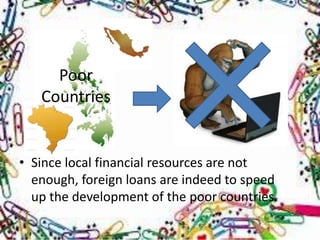
Poor
   Countries


• Since local financial resources are not
  enough, foreign loans are indeed to speed
  up the development of the poor countries.
FOREIGN LOANS, NOT FOREIGN
            INVESMENTS
• For an undeveloped country, more money
  means more investments and production.
  And these speed up economic activities.
  However, if such capital belongs to the
  foreigners, naturally the profits go to them.
• Society may appear affluent and
  progressive, but this is not real in the sense
  that wealth and income belong to the
  foreigners.
THE ROLE OF WORLD BANK
      • The leading nations of the
        world met at Bretton
        Woods, New Hampshire in
        1944 to organize the
        International Bank for
        Reconstruction and
        Development (known as
        World Bank).
MAIN OBJECTIVE OF WORLD BANK
             To extend long-term
             loans for reconstruction
             and development,
             especially to the less
             developed countries
             that cannot secure
             private loans at
             reasonably low interest.
Some features of the World Bank are:

 1. Its loans are limited to agricultural
    productions.
 2. Many of the Bank’s loans are channeled
    into development project such as multi-
    purpose dams, irrigation projects, health
    and sanitation programs, and
    transportation and communication
    facilities.
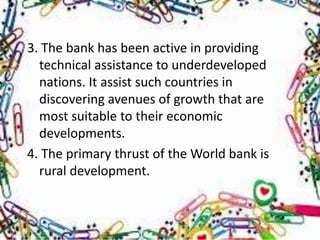
3. The bank has been active in providing
  technical assistance to underdeveloped
  nations. It assist such countries in
  discovering avenues of growth that are
  most suitable to their economic
  developments.
4. The primary thrust of the World bank is
  rural development.
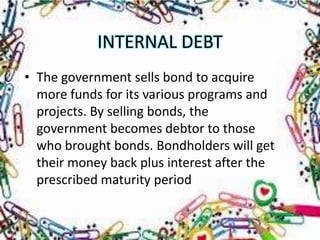
INTERNAL DEBT
• The government sells bond to acquire
  more funds for its various programs and
  projects. By selling bonds, the
  government becomes debtor to those
  who brought bonds. Bondholders will get
  their money back plus interest after the
  prescribed maturity period
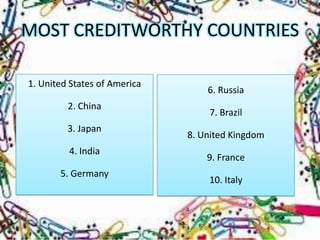
MOST CREDITWORTHY COUNTRIES

1. United States of America
                                  6. Russia
         2. China
                                  7. Brazil
         3. Japan
                              8. United Kingdom
         4. India
                                  9. France
       5. Germany
                                  10. Italy
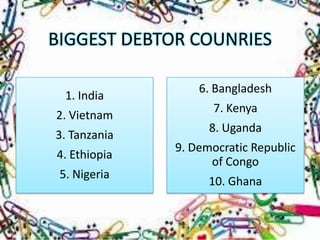
BIGGEST DEBTOR COUNRIES

                  6. Bangladesh
  1. India
                    7. Kenya
2. Vietnam
                    8. Uganda
3. Tanzania
              9. Democratic Republic
4. Ethiopia
                    of Congo
 5. Nigeria
                    10. Ghana
NEGATIVE SIDE OF PUBLIC DEBT
1. It leads to wasteful government
   spending.
2. It creates inflation.
3. It burdens future generation.
4. It dampens production of goods and
   services.
5. It reduces future consumption and
   saving.
Credit and development

Credit and development

  • 1.
  • 2.
    • A contractualagreement in which a borrower receives something of value now and agrees to repay the lender at some date in the future, generally with interest. The term also refers to the borrowing capacity of an individual or company.
  • 3.
    CREDIT AND DEVELOPMENT •Inadequate funds have prevented many poor countries from accelerating the pace of their economic development. Taxes and other sources of government incomes are not enough to finance all their basic programs of development.
  • 4.
    Poor Countries • Since local financial resources are not enough, foreign loans are indeed to speed up the development of the poor countries.
  • 5.
    FOREIGN LOANS, NOTFOREIGN INVESMENTS • For an undeveloped country, more money means more investments and production. And these speed up economic activities. However, if such capital belongs to the foreigners, naturally the profits go to them. • Society may appear affluent and progressive, but this is not real in the sense that wealth and income belong to the foreigners.
  • 6.
    THE ROLE OFWORLD BANK • The leading nations of the world met at Bretton Woods, New Hampshire in 1944 to organize the International Bank for Reconstruction and Development (known as World Bank).
  • 7.
    MAIN OBJECTIVE OFWORLD BANK To extend long-term loans for reconstruction and development, especially to the less developed countries that cannot secure private loans at reasonably low interest.
  • 8.
    Some features ofthe World Bank are: 1. Its loans are limited to agricultural productions. 2. Many of the Bank’s loans are channeled into development project such as multi- purpose dams, irrigation projects, health and sanitation programs, and transportation and communication facilities.
  • 9.
    3. The bankhas been active in providing technical assistance to underdeveloped nations. It assist such countries in discovering avenues of growth that are most suitable to their economic developments. 4. The primary thrust of the World bank is rural development.
  • 10.
    INTERNAL DEBT • Thegovernment sells bond to acquire more funds for its various programs and projects. By selling bonds, the government becomes debtor to those who brought bonds. Bondholders will get their money back plus interest after the prescribed maturity period
  • 11.
    MOST CREDITWORTHY COUNTRIES 1.United States of America 6. Russia 2. China 7. Brazil 3. Japan 8. United Kingdom 4. India 9. France 5. Germany 10. Italy
  • 12.
    BIGGEST DEBTOR COUNRIES 6. Bangladesh 1. India 7. Kenya 2. Vietnam 8. Uganda 3. Tanzania 9. Democratic Republic 4. Ethiopia of Congo 5. Nigeria 10. Ghana
  • 13.
    NEGATIVE SIDE OFPUBLIC DEBT 1. It leads to wasteful government spending. 2. It creates inflation. 3. It burdens future generation. 4. It dampens production of goods and services. 5. It reduces future consumption and saving.