





The Work Book 
Everything you need to know about 
work basics and civility
Written by Marianne Jacobbi 
Illustrations by Nishan Akgulian 
© 2001, 2010 Ceridian Corporation. All rights reserved.
The pages that follow describe the written and unwritten 
rules of the workplace. Included are practical and tactical 
tips to help you navigate the world of work. You’ll 
find advice on improving your “people skills”—from 
communicating with co-workers to resolving problems 
to being a team player. You’ll find tips on using e-mail 
and telephone etiquette and working in a 24/7 world. 
You’ll find suggestions on how to take care of yourself and 
reduce stress in your work life. You’ll even find basic rules of 
common courtesy.
2 
We begin with a dozen questions to help you assess how much—or how little—you 
know about the rules of the workplace. See how you do with the following questions. 
Questions 
1. True or False. In a crowded elevator, women should always exit first. 
2. True or False. It’s a good idea to use ALL CAPS in e-mail correspondence 
because it really gets across your message. 
3. True or False. It’s OK to lose your temper at work so long as you apologize 
afterwards. 
4. True or False. If you are going to be more than 10 minutes late, you should call 
to say you are running late. 
5. Yes or No.Your teenager is raising money for the homeless. Is it OK to ask people 
at work if they would like to contribute to the cause? 
6. Yes or No. If someone mispronounces your name, should you correct the person? 
7. Yes or No. It’s a good idea to arrive 15 minutes early for an appointment with 
a customer. 
8. Important e-mail should always be answered within: 
a. 2 hours 
b. 24 hours 
c. one week 
9. You have forgotten the name of the person you are introducing. You should: 
a. Not introduce the person. 
b. Admit it and say, “Please forgive me. I know we’ve met, but I’ve forgotten 
your name.” 
c. Excuse yourself and leave the room for a moment so you don’t embarrass yourself.
3 
10. You’re dining out with co-workers and are afraid you have something stuck in 
your teeth. You should: 
a. Ask for a toothpick. 
b. Try to get the food out with your finger or your tongue. 
c. Excuse yourself and go to the restroom. 
11. Everyone at work is “chipping in” for a wedding gift for a co-worker, but the 
contribution is more than you feel you can afford. You should: 
a. Give nothing. 
b. Say to co-workers, “Here is the contribution I am able to make. I wish 
I could give more, but at this time I just can’t.” 
c. Tell people you’re willing to chip in but then “forget” to bring in 
your contribution. 
12. The best way to politely end a phone call is to say: 
a. “Is there anything else we need to discuss before we hang up?” 
b. “I have another call coming in.” 
c. “I’ll let you go now.”
4 
Answers 
1. False. Whoever is closest to the door exits first. 
2. False. All capital letters sound like you’re shouting and should be avoided. 
3. False. Outbursts of temper are never appropriate at work. If you feel you are going 
to lose your temper, excuse yourself, and suggest that you meet again later to talk. 
Then cool off and compose yourself. Be sure to follow up with the person. 
4. True. 
5. Yes. It’s fine during a break or at lunch to ask co-workers you know whether 
they’d like to contribute to your teenager’s cause. But it would be inappropriate 
to post a company-wide message or send out a company-wide e-mail soliciting 
donations, no matter how worthy the cause. 
6. Yes. Politely correct the person without embarrassing him or her. You might say, 
“Actually, my first name is pronounced ‘Lane-a.’” 
7. No. Fifteen minutes early is too early to announce your arrival. It’s best to arrive 
on time or no more than a few minutes before your appointment. 
8. b. Keep in mind that your company may also have its own guidelines about 
responding to important messages. 
9. b. 
10. c. 
11. b. 
12. a. 
Answers to these and other etiquette questions may be found in New Rules @ Work: 
79 Etiquette Tips, Tools, and Techniques to Get Ahead and Stay Ahead by Barbara Pachter and 
Ellen Schneid Coleman (Prentice Hall Press, 2006) and Emily Post’s The Etiquette 
Advantage in Business: Personal Skills for Professional Success, Second Edition, by 
Peggy Post and Peter Post (William Morrow, 2005).
5 
Anger 
Apologize 
Breaks 
Cell phones 
Coaching and feedback 
Communication 
Company property 
Cube etiquette 
Dining 
Diversity 
Dress 
A toD
6 
anger 
We all lose our tempers occasionally and have feelings of anger at work. Here are 
some suggestions to try the next time you feel upset or are about to lose your temper: 
• Ask for a break if you need one. Then go off alone for a brief period. Take a walk 
to the restroom or the break room or water cooler. Sometimes a quick walk out-side 
may be all you need to calm down and feel less irritable. 
• Silently count to 10. 
• Use deep-breathing or muscle-relaxation exercises. 
• Vent your frustrations to a trusted friend. 
• If you find yourself writing an angry response to an e-mail message, stop yourself. 
Don’t send it. Give yourself time to think of a more thoughtful response, even if 
you need to wait until the next day to send it. 
• If your anger persists, talk with your human resources (HR) representative or 
contact your employee assistance program (EAP) if your organization has one. 
apologize 
If you say something you later wish you hadn’t, follow up with a personal response 
and an apology. Maybe you lashed out in anger at a co-worker, overreacted at 
a meeting, or criticized someone harshly. An apology is in order. It’s best to offer it in 
private, and in person. “I apologize for what I said yesterday.” 
breaks 
Use your time off each day to relax and recharge. 
• Take “stretch breaks” or “mini breaks.” Your stretch break doesn’t have to last more 
than a minute. Stand up, move around, and stretch in your work area. Or do 
something else for a minute. Get a drink of water, or take a walk down the hall. 
• Avoid junk food and too much caffeine (including coffee, tea, and caffeinated 
soft drinks). 
• Try to eat lunch away from your desk or work area. 
• Use your break time to do something nice for yourself—take a walk, talk with a 
friend, or read a book or listen to music. 
Adults spend about 75 percent of the time they 
are awake doing work-related activities—getting 
ready for work, traveling to work, working, con-templating 
work, and decompressing after work. 
Fish! A Remarkable Way to Boost Morale and 
Improve Results by Stephen C. Lundin, John 
Christensen, and Harry Paul
7 
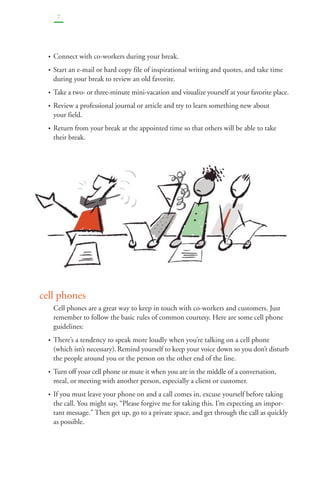
• Connect with co-workers during your break. 
• Start an e-mail or hard copy file of inspirational writing and quotes, and take time 
during your break to review an old favorite. 
• Take a two- or three-minute mini-vacation and visualize yourself at your favorite place. 
• Review a professional journal or article and try to learn something new about 
your field. 
• Return from your break at the appointed time so that others will be able to take 
their break. 
cell phones 
Cell phones are a great way to keep in touch with co-workers and customers. Just 
remember to follow the basic rules of common courtesy. Here are some cell phone 
guidelines: 
• There’s a tendency to speak more loudly when you’re talking on a cell phone 
(which isn’t necessary).Remind yourself to keep your voice down so you don’t disturb 
the people around you or the person on the other end of the line. 
• Turn off your cell phone or mute it when you are in the middle of a conversation, 
meal, or meeting with another person, especially a client or customer. 
• If you must leave your phone on and a call comes in, excuse yourself before taking 
the call. You might say, “Please forgive me for taking this. I’m expecting an impor-tant 
message.” Then get up, go to a private space, and get through the call as quickly 
as possible.
8 
• Avoid holding meetings or work-related conversations while you are driving unless 
absolutely necessary. Safety should always be your first priority. Always use a hands-free 
device when talking on the phone while driving. (In many states, that's the 
law.) Be aware that people on the other end of the line may have trouble hearing 
you as you move in and out of traffic. It’s safer and more productive for everyone if 
you pull over, have your conversation, hang up, and drive on. 
• Conversations on cell phones are not confidential. (Signals get transmitted over 
radio towers and can be accessed by others.) If the party you are speaking to starts to 
discuss sensitive information, remind the person that the line is not confidential. 
Ask if he would like you to call him back on a land line. 
coaching and feedback 
Coaching and feedback are intended to help you do a better job and improve work 
performance. Here are some tips: 
• Always try to give coaching and important feedback in person. Arrange a time to 
talk in private. Don’t give important feedback in passing, in the hallway, or in the 
company lunchroom or break room. 
• Never criticize a co-worker or employee in front of other people. 
• Give timely feedback. Don’t wait until two months after the job is finished to 
suggest improvements. 
• Say what the problem is and be as specific as you can be. Instead of using vague 
statements like, “This report is awful,” point out exactly what’s wrong with the 
report. “Page three could use more statistics.” 
• Focus on the work and not on personalities. Instead of saying, “You always miss 
deadlines,” you might say, “This project is two weeks behind schedule.” This keeps 
the conversation focused on actions and behavior, things the person can change, 
rather than character flaws. 
• Offer solutions and suggestions for fixing what’s wrong. “We need to get this 
project back on track. May I make some suggestions?” Or, “The report might be 
stronger if you included more…” 
• Remember to point out the positive things. 
Fifty-nine percent of Americans would rather visit 
the dentist than sit next to someone speaking on 
a cell phone, according to a survey cited in Electric 
Perspectives magazine.
9 
• If you are on the receiving end of coaching, try to use it to your advantage. Coaching 
can provide you with valuable information about how to do a better job and improve 
your work performance. Be open to hearing what your manager or co-worker is 
telling you. Ask questions if you don’t understand. 
communication 
Good communication will help you build rewarding relationships and be more 
successful at work. (See also “cell phones,” “speakerphone and teleconference calls,” 
and “telephone tips.”) Here are some general communication tips: 
• Be a good listener. Show that you are interested in what the other person has to say. 
Lean forward in your chair. Nod your head from time to time. Say “I understand.” 
• Concentrate on what is being said. Don’t let yourself be distracted by what’s going on 
around you. Don’t take calls, check e-mail or messages, or sort the papers on your desk. 
• Don’t interrupt. Wait for a pause before you speak. 
• Remember the importance of eye contact. In most cultures, you show you are inter-ested 
in what the other person has to say by making eye contact. 
• Pay attention to your body language—posture, gestures, and facial expressions. 
Different cultures interpret gestures and facial expressions differently. To avoid 
sending a negative message, try not to slouch, fidget, tap your feet, crowd the other 
person, or play with your hair, clothes, or jewelry. 
• Summarize and repeat back what the other person has said to be sure there is no 
misunderstanding or miscommunication. “Let’s make sure I understand,” you 
might say to your manager when discussing a schedule change. “You would like me 
to begin the new schedule next month?” 
• Try to keep an open mind when discussing a problem. The mindset “I’m right, 
you’re wrong” prevents people from listening well. Refrain from judging until 
you’ve heard all that the person has to say. It helps to summarize the other person’s 
comments: “So, if I understand you, you’re saying that…” 
• Ask others what they think—for their point of view—before making a decision or 
taking action. When people participate in decisions that affect them, they tend to 
support those actions more fully. 
• If a co-worker needs to speak with you at a time when you can’t give him your full 
attention, be honest and let him know. Then schedule a time to meet when it will 
be convenient for both of you. 
• Have important conversations face-to-face if possible, rather than using e-mail or 
the phone. 
• If you aren’t sure how to discuss a sensitive subject like a misunderstanding with a 
co-worker, bring up your concern with your manager, your HR representative, or 
contact your EAP or the program that provided this publication.
10 
company property 
It’s against the law to steal or take supplies or equipment from your employer. 
That includes taking home office supplies, padding your expense account, or making 
personal long-distance phone calls on the company’s nickel. Stealing could also 
result in serious disciplinary action. 
cube etiquette 
Working in close quarters next to others requires give-and-take on everyone’s part 
and respecting one another’s boundaries. What if your cubicle neighbor talks 
loudly on the phone or plays music that keeps you from concentrating? Here are 
some tips: 
• As a general rule of thumb, try not to sneak up behind someone in a cube. 
Announce yourself at their doorway or lightly knock on the wall. 
• Never read someone’s computer screen or comment on cube conversations you’ve 
overheard. 
• Don’t congregate outside someone’s cube to hold impromptu meetings. Go to a 
conference room or break room. 
• Ask permission of your cubicle neighbors before using a speakerphone. Better yet, 
go to a conference room or quiet room to take speakerphone calls. 
• Keep your cubicle space tidy and clean. 
• Avoid eating foods with strong odors in your cube. Take your meal to the lunch 
room or break room. 
• To resolve a problem with a noisy cube neighbor, politely approach the person and 
say, “Could we talk for a moment? I wanted to ask if you could take conference calls 
in a private area. When I’m working on a deadline, it makes it hard for me to con-centrate. 
I’d do the same for you, of course.” 
• If repeated attempts at negotiating with your cube neighbor are unsuccessful, ask 
your manager or HR representative for help. 
Experts have found that people respond to body 
language 55 percent of the time, tone of voice 38 
percent of the time, and a person’s actual words 
only 7 percent of the time, according to HR Focus.
11 
dinin g 
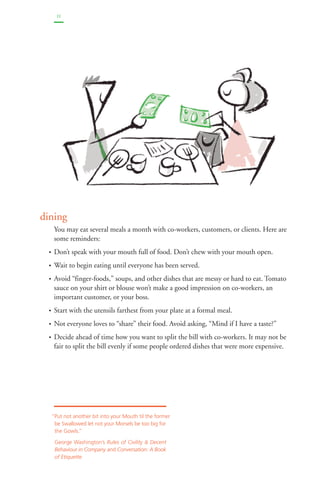
You may eat several meals a month with co-workers, customers, or clients. Here are 
some reminders: 
• Don’t speak with your mouth full of food. Don’t chew with your mouth open. 
• Wait to begin eating until everyone has been served. 
• Avoid “finger-foods,” soups, and other dishes that are messy or hard to eat. Tomato 
sauce on your shirt or blouse won’t make a good impression on co-workers, an 
important customer, or your boss. 
• Start with the utensils farthest from your plate at a formal meal. 
• Not everyone loves to “share” their food. Avoid asking, “Mind if I have a taste?” 
• Decide ahead of time how you want to split the bill with co-workers. It may not be 
fair to split the bill evenly if some people ordered dishes that were more expensive. 
“Put not another bit into your Mouth til the former 
be Swallowed let not your Morsels be too big for 
the Gowls.” 
George Washington’s Rules of Civility & Decent 
Behaviour in Company and Conversation: A Book 
of Etiquette
12 
diversity 
The work force is more diverse than ever before, and today’s employees are a diverse 
mix of ages, races, religions, backgrounds, work styles, physical abilities, levels of 
education, and ways of seeing the world. Most of us don’t think of ourselves as being 
racist, sexist, homophobic, ageist, or biased or prejudiced toward others. However, 
research shows that employees from racial, ethnic, and other minority groups con-tinue 
to face negative stereotypes and bias in the workplace. Here are four important 
tips: 
• Never make insensitive comments about others, such as jokes based on race, age, 
religion, gender, or sexual orientation. Never mimic someone’s accent. Don’t make 
assumptions about someone’s background or origins. 
• Avoid generalities and stereotypes in your interactions with co-workers and don’t 
judge or pigeonhole people from other backgrounds or generations. Remember that 
there are 65-year-olds who are technology whizzes and 25-year-olds who have a lot 
to teach older colleagues. 
• Make an effort to work inclusively and collaboratively. For example, when you 
schedule meetings, take into account people’s personal lives and their different 
needs. Early morning meetings may be a hardship for those with small children or a 
dependent relative at home. Late-in-the-day meetings can be hard for those who 
may be attending evening classes. 
• Avoid political discussions at work. Not everyone shares your political views and 
beliefs. 
dress 
The way you dress for work sets a tone and sends a message. Most companies have a 
dress code, and you can find out what it is where you work by asking your manager 
or by referring to your employee handbook or intranet site if your company has one. 
If your company has no written dress code, look around at what others are wearing 
and dress accordingly. Here are some guidelines: 
• If your company has a casual, “business casual,” or relaxed dress code, find out what 
that means. In some workplaces, it may mean that men do not have to wear a tie or 
that women may wear pants instead of skirts; at other companies, it may mean you’re 
free to wear jeans. The definition varies a great deal from company to company. 
• A relaxed or casual dress code doesn’t mean you can relax all your standards. At most 
companies, the following are examples of clothes that are not considered appropriate 
for work: torn blue jeans, T-shirts with slogans, low-cut tops, miniskirts, and any 
clothes that are too short, tight, or revealing.
13 
• Use perfume, cologne, and after-shave sparingly out of respect for others. Just 
because you love the scent you wear doesn’t mean everyone else does. People may 
have allergic reactions or be bothered by the smell. 
• Follow good bathing habits and have your clothes cleaned regularly. 
“Unlike the United States, most countries do not 
define casual as jeans and sneakers or 
sportswear. Shorts and jeans, for men and 
women, are considered inappropriate attire 
for social functions in many parts of the 
world. Instead, you will find that business 
attire is usually appropriate for an event 
specified as casual.” 
Protocol for the Modern Diplomat 
U.S. Department of State
14 
Elevator rules 
E-mail 
Employee assistance program 
Ergonomics 
“Excuse me” 
Food and drink 
Gifts 
“Good morning” 
Gossip 
E to G
15 
elevator rules 
Here are five elevator rules to remember: 
• Wait for everyone in the elevator to exit before entering. 
• If you are hosting visitors, clients, or customers, hold the elevator door and allow 
your guest to enter first. 
• Never discuss personal or private topics unless you’re the only two people on 
the elevator. 
• Hold the “door open” button for others entering the elevator. 
• The people nearest the elevator door should exit first (unless there are elderly or 
disabled people, who should always be allowed to go first). 
e-mail 
Your company probably has a policy about the proper use of e-mail and you should 
be familiar with the policy. Here are some e-mail do’s and don’ts: 
Do: 
• Do find out what your company’s e-mail guidelines are. There may be rules about 
sending jokes, personal e-mail, large attachments, or company-wide messages. 
• Do begin your e-mail correspondence with a salutation. For example, you might 
write, “Dear Nancy,” or “Nancy,” or “Hi Nancy.” (Salutations aren’t necessary when 
writing group e-mails or e-mails to co-workers with whom you correspond several 
times a day or week.) 
• Do give your e-mail a clear, concise, and informative subject heading. 
• Do use proper spelling, grammar, and punctuation. Your e-mail program probably 
has a spell-check tool that will catch misspellings before you send a message. Reread 
your message before sending it to check spelling, content, and tone. Check to be 
sure it is professional and cordial. 
• Do set your e-mail default to a readable font size. For example, 10 pt. Arial is 
considered a readable font size. 
• Do respond to messages promptly so you don’t forget to reply. For important 
messages, respond within 24 hours. 
• Do keep your e-mail messages brief and to the point. 
• Do exercise caution when corresponding by e-mail. Your correspondence can be 
forwarded, copied, or kept by others. 
• Do delete unimportant e-mail immediately and remember to empty your deleted 
items folder.
16 
• Do use e-mail to give praise, especially if you are a manager. 
• Do keep attachments to a minimum. Large attachments can sometimes be difficult 
for the recipient to open. If you must send a lengthy document, it’s best to send it 
in a compressed or zip file. If your e-mail includes an attachment, check before 
sending to make sure you’ve included it. 
• Do use discretion before forwarding e-mail messages. You may want to ask the 
sender’s permission before doing so. 
• Do be thoughtful about whom you copy on your e-mails. Think about whether 
everyone needs to see your e-mail. It’s always a good idea to copy your manager 
when you’re complimenting or praising a co-worker about a job well done. 
Don’t: 
• Don’t circulate group jokes or chain letters. 
• Don’t send vulgar jokes, sexually explicit photographs, or anything that someone 
else could find offensive. 
• Don’t send personal or confidential e-mail at work. E-mail is often saved on your 
company’s network or server, and even when you delete a message, it can still be 
retrieved on the hard drive by software or online services. Also, your company may 
have the right to monitor messages you send and receive. 
• Don’t use e-mail for sensitive business matters that would best be handled in a 
face-to-face meeting. For example, don’t use e-mail to ask for a raise, reprimand a 
co-worker or employee, or give notice that you are leaving your job. Handle the 
matter in person or in a letter. 
• Don’t use cute “emoticons” such as (: in business correspondence. 
• Avoid using all capital letters. As explained in the quiz at the beginning of this 
booklet, ALL CAPS sound like you’re shouting. They’re also harder to read. 
“Don’t send anything by e-mail that you wouldn’t 
want to see posted on the office bulletin board.” 
The Complete Idiot’s Guide to Business Etiquette 
by Mary Mitchell with John Corr 
To avoid three of the most common grammar 
mistakes people make, remember these rules: 
• Use an apostrophe in the word “it’s” only when 
writing “it is.” Otherwise, the word is spelled “its.” 
• “I” is always the subject of the sentence. “Me” 
is the object. For example, you would say “Sean 
and I sent the report.” “They sent the report to 
Sean and me.” 
• The word “effect” is used primarily as a noun. 
“The speech had a big effect on me.” The word 
“affect” is used primarily as a verb. “The speech 
really affected me.”
17 
• Don’t make solicitations by group e-mail, for example, for such things as Girl Scout 
cookies or a charity fundraiser. 
• Don’t send condolence notes by e-mail. Write a handwritten note. 
employee assistance program 
An EAP is a service provided by many companies and organizations. The purpose 
of an EAP is to provide help and assistance to employees by professionally trained 
consultants, over the phone, online, or in person. Consultants provide assistance 
with family problems, addiction and recovery, financial and legal issues, stress, 
depression, relationship issues and other problems affecting your work or personal 
life. You can find out if your company has an EAP by asking your manager or your 
HR representative. 
ergonomics 
Ergonomics is the applied science of designing equipment to reduce workplace ill-nesses, 
injuries, and discomfort. Ergonomics can include everything from sitting 
properly at your desk to protecting your back from injury if your job requires you 
to do a lot of lifting. Physical stresses—like awkward posture, poor lighting, and 
repetitive motion—can lead to illnesses and injuries such as eyestrain, back pain, 
and carpal tunnel syndrome, the nerve disorder that can be caused by the repetitive 
motions of using a keyboard. An ergonomics specialist can help you make sure that 
whatever equipment or machines you use are safe and suited to your needs. Many 
companies have an ergonomics specialist on staff or are able to refer you to one to 
help prevent problems. You can also talk with your health care provider. Here are 
some general tips on office ergonomics: 
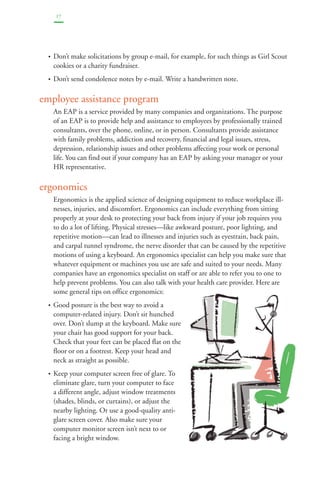
• Good posture is the best way to avoid a 
computer-related injury. Don’t sit hunched 
over. Don’t slump at the keyboard. Make sure 
your chair has good support for your back. 
Check that your feet can be placed flat on the 
floor or on a footrest. Keep your head and 
neck as straight as possible. 
• Keep your computer screen free of glare. To 
eliminate glare, turn your computer to face 
a different angle, adjust window treatments 
(shades, blinds, or curtains), or adjust the 
nearby lighting. Or use a good-quality anti-glare 
screen cover. Also make sure your 
computer monitor screen isn’t next to or 
facing a bright window.
18 
• Use a wrist pad at your computer keyboard to reduce the risk of injury. 
• Make sure you have enough light. A dimly lit environment can be a strain on your 
eyes and make you feel sleepy. 
• Consider using accessories like a cordless mouse or an ergonomic keyboard if you 
are experiencing problems or to help reduce the risk of injury. 
• Make sure that the telephone is close to you if you use it frequently. Consider getting 
a headset if you work long hours on the phone to avoid neck or shoulder strain. 
• Take frequent “eye breaks.” Every 15 minutes or so, look away from the computer 
screen for a minute or two to a distant scene that’s at least 20 feet away. This will 
help relax your eye muscles. 
• Remember to take stretch breaks throughout the day to avoid muscle soreness and 
repetitive motion injury. 
“excuse me” 
These are commonsense reminders, but worth repeating, whether you’re just 
starting out at your first job or you’re a seasoned employee: 
• If you approach your co-worker or boss and she is on the phone, excuse yourself 
and return later. Don’t just stand there and wait for the person to hang up. 
• Watch for signals that someone is busy and don’t interrupt if he or she seems 
absorbed in work. Is the person concentrating at the computer? Is the person 
engrossed in conversation with a customer? 
• If you do interrupt someone, remember to say “excuse me.” 
food and drink 
A nutritious diet will help you stay more focused at work and help you feel healthier 
in general. 
• Keep a water bottle at your desk or work area and remember to drink water through-out 
the day. This is especially important if you work at night, since dehydration can 
make you feel more fatigued. 
QUESTION 
I work with someone who interrupts constantly— 
at meetings, during casual conversations, even 
when I’m on the phone with customers. How do 
I politely tell this person to stop interrupting? 
ANSWER 
Explain to your co-worker that it is difficult for you 
to do your work, such as assisting customers, 
when he interrupts you. (Your co-worker may not 
even realize that he is doing this.) Then suggest to 
your co-worker that if he has a request and you 
are busy or on the phone, he could leave you a 
note or a voice mail and you will get back to him 
as quickly as possible.
19 
• Limit how much caffeine and alcohol you drink. 
• If you bring in “treats” like fruit or baked goods to share with others, remember to 
share with everyone in your group. Otherwise, pass around the treats quietly. 
• Stick to what some experts call the “80/20” rule in your eating. If 80 percent of what 
you eat is healthy—with a nutritious, low-fat mix of vegetables, fruit, and grains— 
then you can allow yourself to eat what you want for the remaining 20 percent. 
• If you use the vending machines at work, try to choose healthy snacks like pretzels, 
yogurt, low-fat cookies, and trail mix. 
gifts 
Exchanging gifts with co-workers to mark a 
birthday, wedding, shower, or other celebration 
is always fun. But how big a present should 
you give? What if you can’t afford to give? 
Is it necessary to give a gift every year to 
your boss? Here are some guidelines: 
• If you ask co-workers to share in the cost 
of a gift, suggest an amount that is 
affordable to everyone—$3 to $5 might 
be all that most people can afford. At 
large companies, this takes the burden off 
everyone, especially when there might be 
several celebrations a month. 
• You might want to “consolidate” birthday celebrations or agree to celebrate birthdays 
with a group lunch or cake so that gift giving doesn’t put too big a strain on people’s 
budgets. A card is always a nice gesture. 
• Food, gift certificates, and books are always “safe” gifts to give co-workers. 
• In general, employees don’t give holiday presents to managers (although it’s fine if 
you choose to do so). You might consider pooling with co-workers to buy a group 
gift for your manager. 
Ear to Shoulder Chair Stretch 
Sit on your chair with your spine erect and both 
feet flat on the floor. Inhale deeply. As you exhale, 
slowly roll your left ear towards your left shoulder. 
Inhale and exhale slowly again, rolling your chin 
back to your chest. Inhale and exhale slowly again 
and roll your right ear to your right shoulder. 
Inhale deeply and exhale slowly, rolling your chin 
back to your chest. Do four or more sets of these.
20 
• When celebrating a birthday, remember that it’s impolite to ask, “How old are you?” 
• Ask your manager or HR representative what the guidelines are at your company 
about giving and receiving gifts from clients and customers. Some clients, for 
example, may not be allowed to accept gifts. Many companies have policies about 
receiving gifts from clients as well. 
• Remember to send a thank-you note when someone gives you a gift. 
“good morning” 
Remember to greet the people you see in the morning when you arrive at work— 
administrative assistants, co-workers, managers, and the receptionist at the front 
desk. A friendly “good morning” makes everyone’s day more pleasant. 
gossip 
Workplace gossip lowers productivity and morale. Here are some ways to steer clear 
of the gossip mill: 
• Ask yourself if something is true before you pass the information along to others. 
Did it come from a reliable source? If not, check your information with the person 
at the heart of the matter or someone you know who has access to the right infor-mation. 
If you hear a rumor about the company, go to your manager or someone 
reliable to confirm what’s true and what isn’t. 
• Before spreading a rumor further, ask yourself, “Is there a reason to pass on this 
news?” 
• Notice how others’ comments affect you, and limit your contact with people who 
make you feel weary or negative about work. 
QUESTION 
I am thinking of dating a co-worker, but don’t 
know if there are rules about this at my workplace. 
What should I do? 
ANSWER 
It is inappropriate for a manager and a subordinate 
to be in a romantic or sexual relationship. This 
could hinder their ability to work together as well 
as cause a perception of favoritism. As for dating 
other co-workers, good judgment is necessary. 
For example, if you ask a co-worker out, and he 
or she does not appear interested, back off and do 
not pursue the person. Your company may have 
a specific policy on dating co-workers. Ask your 
manager or check with your HR department 
about this.
21 
Handshakes 
Harassment 
Human resources 
Inappropriate questions 
Internet use 
Introductions 
Jokes 
Kitchen courtesies 
Language 
Meetings 
Monday morning tips 
Money 
HtoM
22 
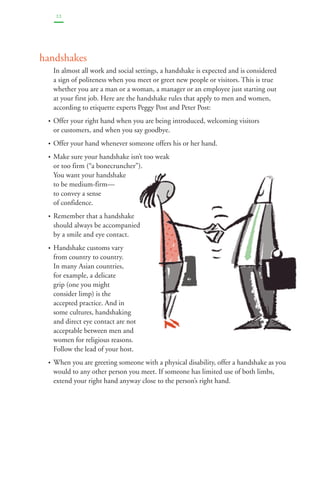
handshakes 
In almost all work and social settings, a handshake is expected and is considered 
a sign of politeness when you meet or greet new people or visitors. This is true 
whether you are a man or a woman, a manager or an employee just starting out 
at your first job. Here are the handshake rules that apply to men and women, 
according to etiquette experts Peggy Post and Peter Post: 
• Offer your right hand when you are being introduced, welcoming visitors 
or customers, and when you say goodbye. 
• Offer your hand whenever someone offers his or her hand. 
• Make sure your handshake isn’t too weak 
or too firm (“a bonecruncher”). 
You want your handshake 
to be medium-firm— 
to convey a sense 
of confidence. 
• Remember that a handshake 
should always be accompanied 
by a smile and eye contact. 
• Handshake customs vary 
from country to country. 
In many Asian countries, 
for example, a delicate 
grip (one you might 
consider limp) is the 
accepted practice. And in 
some cultures, handshaking 
and direct eye contact are not 
acceptable between men and 
women for religious reasons. 
Follow the lead of your host. 
• When you are greeting someone with a physical disability, offer a handshake as you 
would to any other person you meet. If someone has limited use of both limbs, 
extend your right hand anyway close to the person’s right hand.
23 
harassment 
Behavior or comments that annoy, disturb, frighten, or irritate another person may 
be construed as harassment. Threats, demeaning remarks, humiliation in front of 
others or privately, intimidation, persistent teasing, sexist remarks, sending and 
receiving voice-mail or e-mail messages with information of a sexual nature, sexually 
explicit jokes and pictures, and unwelcome sexual advances or romantic advances 
are all forms of harassment. It’s important to report the problem if you feel that 
someone at work is harassing you. If you aren’t sure how to report harassment, talk 
with your manager, EAP, or HR representative about what to do. If a co-worker 
uses inappropriate language at work or language that makes you uncomfortable, 
talk with your manager, EAP, or HR representative about what to do. 
human resources 
This is the department at your company that handles personnel issues, questions 
about payroll, benefits, and work-related issues, and questions you may not be able to 
share with your manager. Issues and complaints received by your HR representative 
are handled in a confidential manner. Your EAP or the program that provided this 
publication is another helpful resource if you have work-related questions or concerns. 
inappropriate questions 
A question you might think of as “friendly” could be thought of as insulting or too 
personal by a co-worker. Here are some questions that are inappropriate to ask a 
co-worker, unless the two of you are very good friends: 
• Why aren’t you married? 
• Why don’t you have children? 
• How much do you make? 
• What is your job level? 
• What kind of surgery are you having? 
• What’s that pill you’re taking? 
• How much did you pay for that jacket? 
• How old are you? 
• How much weight have you lost? 
• Why did you get a divorce? 
• How big is your mortgage?
24 
internet use 
Your company may have a policy about use of the Internet at work and you should 
be familiar with the policy. Here are some general guidelines: 
• Limit personal use of the Internet at work. 
• Respect copyright laws. Don’t download, distribute, or reproduce any information 
or materials protected by copyright without the permission of the copyright owner. 
• Be aware that your company may have the right to monitor your use of the Internet. 
• Never transmit, download, or distribute material that is threatening, abusive, or 
obscene. At some companies, this may be grounds for termination. 
introductions 
The most important rule to remember about introductions is don’t forget to make 
them. How many times have you been in a situation where someone forgot to 
introduce you, and you then felt embarrassed and uncomfortable? Should you 
introduce yourself ? Here are some guidelines: 
• It’s generally considered good manners to stand up if seated when you are being 
introduced to someone. 
• Make eye contact, smile, and shake hands (see “handshakes”). 
• If you are introducing someone, always provide the person’s name and title. “This is 
Ron Smith, sales manager for the eastern region.” 
• The client is always the most important person in the room and should be introduced 
first. “Sue, I’d like you to meet Ron Smith, sales manager for the eastern region. Sue 
Warner is our client from Nebraska.” 
• If someone forgets to introduce you, introduce yourself. “Hello. I’m Ron Smith. 
I don’t believe we’ve met.” 
jokes 
A good joke can make your day, and a sense of humor can turn even the most 
tedious tasks to fun. But jokes that are in poor taste or that could offend others are 
off-limits at work. Here are some guidelines: 
• Never tell off-color, vulgar, or sexual jokes. 
• Never tell racial, ethnic, or religious jokes. 
• Practical jokes are out of place.
25 
• Don’t send sexually explicit jokes or photographs by e-mail to people at work. 
What if the recipient opened the e-mail and an embarrassing picture appeared on 
the screen just when a co-worker stopped by? 
• Be careful about trying to be humorous in an e-mail message. The recipient won’t 
be able to “read” your tone or your body language and may misinterpret your 
humorous comment as serious. 
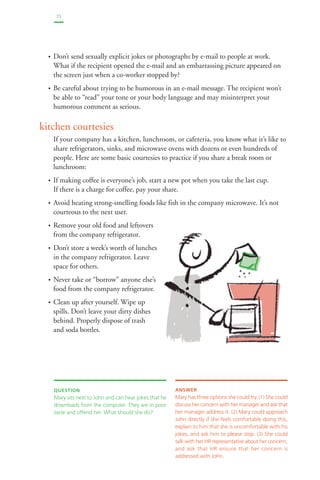
kitchen courtesies 
If your company has a kitchen, lunchroom, or cafeteria, you know what it’s like to 
share refrigerators, sinks, and microwave ovens with dozens or even hundreds of 
people. Here are some basic courtesies to practice if you share a break room or 
lunchroom: 
• If making coffee is everyone’s job, start a new pot when you take the last cup. 
If there is a charge for coffee, pay your share. 
• Avoid heating strong-smelling foods like fish in the company microwave. It’s not 
courteous to the next user. 
• Remove your old food and leftovers 
from the company refrigerator. 
• Don’t store a week’s worth of lunches 
in the company refrigerator. Leave 
space for others. 
• Never take or “borrow” anyone else’s 
food from the company refrigerator. 
• Clean up after yourself. Wipe up 
spills. Don’t leave your dirty dishes 
behind. Properly dispose of trash 
and soda bottles. 
QUESTION 
Mary sits next to John and can hear jokes that he 
downloads from the computer. They are in poor 
taste and offend her. What should she do? 
ANSWER 
Mary has three options she could try. (1) She could 
discuss her concern with her manager and ask that 
her manager address it. (2) Mary could approach 
John directly if she feels comfortable doing this, 
explain to him that she is uncomfortable with his 
jokes, and ask him to please stop. (3) She could 
talk with her HR representative about her concern, 
and ask that HR ensure that her concern is 
addressed with John.
26 
language 
A few simple reminders: 
• Use polite and appropriate language in all your communications both inside and 
outside the company. 
• Speak the primary language of your workplace. Speaking a foreign language in 
front of co-workers who do not understand it can make people feel excluded 
and uncomfortable. 
• It’s normal to feel frustrated at work from time to time. But that doesn’t give you 
permission to use offensive or disrespectful language. Cursing and swearing are 
never appropriate at work. Swearing makes others uncomfortable. The next time 
you’re frustrated, try taking the advice of James V. O’Connor, author of Cuss Control: 
The Complete Book on How to Curb Your Cursing. Instead of using a four-letter word, 
try saying “baloney,” “hokum,” or “hogwash”—words that won’t offend anybody. 
meetings 
One whole year of the average person’s life is spent in meetings, according to the 
Complete Business Etiquette Handbook. (And much more if you are a manager.) 
Meetings that drag on for hours, or where little gets accomplished, can be frustrating 
for everyone. Here are some tips: 
• When scheduling a meeting, ask yourself, “Is a meeting necessary?” The purpose of 
a meeting is to share information quickly and efficiently and to invite discussion. 
Maybe you could accomplish what needs to get done with a phone call or an e-mail 
message instead of a meeting. For example, if all you need to do is distribute infor-mation 
but you don’t need people’s feedback, you might be able to do that with a 
simple memo. 
• When requesting a meeting, give as much advance notice as possible. State the time 
and place of the meeting and its purpose. Give any necessary background information. 
• Schedule meetings in core hours—not too early or late, so that others can meet 
personal responsibilities. 
• Prepare an agenda that clearly outlines what topics will be covered at the meeting. 
Try to send the agenda out a day in advance. Send out background materials ahead 
of time, too. 
• Be prepared for the meeting, whether you are chairing it or you are a participant. 
Know what you’re expected to contribute. If you’re unsure why you were invited to 
the meeting, check with the organizer.
27 
• If you can’t attend a meeting, let the person who called the meeting know as soon as 
possible. 
• Start meetings on time. If you’re attending a meeting, be sure to arrive on time. If 
you are late, apologize and give the reason if you can do so without being disruptive. 
• Schedule breaks during long meetings. 
• Keep your eye on the time if you are chairing the meeting, and stick to the agenda. 
• Discourage interruptions. 
• Present information clearly and concisely. 
• If interest appears to be lagging, change the format by asking questions. 
• In a decision-making meeting, encourage everyone to offer opinions and suggestions. 
• At the end of the meeting, review key points made at the meeting and what steps 
need to be taken next. Make sure follow-up items are delegated before you adjourn. 
• Thank everyone for coming. 
• Send follow-up notes or minutes from the meeting, if appropriate. 
monday morning tips 
Here are some ways to get a good start on your workweek. (If you work nights or 
don’t start your workweek on Monday morning, these tips apply to whenever you 
start your workweek.) 
• Make a list on Friday afternoon of what needs to be accomplished Monday. That 
will make it easier to get started on Monday morning. 
• Spend the first 15 or 20 minutes on Monday morning reviewing the upcoming 
week—setting goals and establishing priorities for each day. Include what you’d like 
to accomplish in your personal life. 
• Try not to schedule a meeting for first thing Monday morning, before you have had 
a chance to settle in and set your priorities for the week. 
QUESTION 
What if you work near someone who uses language 
that offends you? What should you do? 
ANSWER 
If you need help resolving an issue that directly 
concerns you, the best resource in most situa-tions 
is your manager. If this approach doesn’t 
work or does not seem appropriate, contact your 
HR representative. It’s important that you ask for 
help when you need it.
28 
• Check in with your manager and other members of your team or department to see 
what issues or projects they foresee coming up during the week. 
• Ask others about their weekend—how it went, what they did. Share your experiences. 
• Buy yourself or someone else flowers for their desk. 
money 
It’s best not to talk about money at work—how much you earn, how much your 
merit increase or bonus was, or whether you met your sales quota. 
According to a survey by Accountemps in Menlo 
Park, California, employees are the most produc-tive 
on Tuesdays and the least productive on 
Fridays.
29 
Name tags 
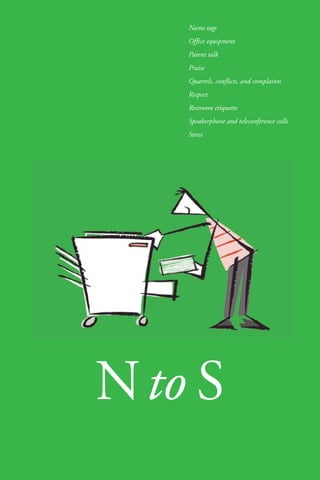
Office equipment 
Parent talk 
Praise 
Quarrels, conflicts, and complaints 
Respect 
Restroom etiquette 
Speakerphone and teleconference calls 
Stress 
Nto S
30 
name tags 
Some companies require employees to wear identification badges at all times. Find 
out from your HR representative or supervisor if you are required to do so. The 
proper place to wear a stick-on name tag, the kind you get at a meeting or confer-ence, 
for example, is up high near your right shoulder. 
office equipment 
On a busy day, there’s nothing more annoying than finding the office printer out of 
paper or the photocopier jammed or out of order. 
• If you share a printer with others, refill it with paper when it’s empty. 
• Always reset machines to the original settings after using them. For example, if you 
used the photocopier and you set the machine for legal-sized paper or three-hole-punch 
paper, return it to the standard-sized paper setting when you’re finished. 
• If a co-worker has left a confidential document at the fax machine, photocopier, or 
printer, exercise politeness and restraint. Don’t read it. Return it to the person or 
put it in an envelope and leave it in the person’s mailbox with a note: “You left this 
at the fax machine. I didn’t read it.” 
• If a machine isn’t working, report the problem to the appropriate person or 
department. 
• Don’t use office equipment for personal matters. 
parent talk 
You love your children and they’re probably the cutest and most special people in 
the world. But that doesn’t mean it’s polite to talk about them excessively at work. 
Be sensitive to the fact that some of your co-workers don’t have children or just 
don’t want to talk about their children. 
QUESTION 
Should you bring your child to work?
31 
praise 
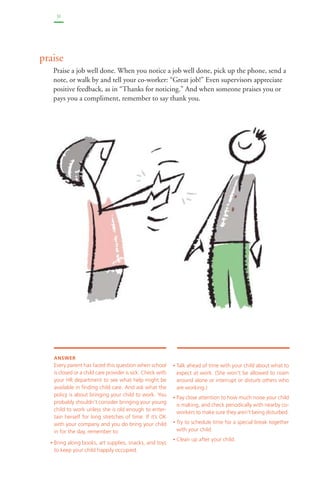
Praise a job well done. When you notice a job well done, pick up the phone, send a 
note, or walk by and tell your co-worker: “Great job!” Even supervisors appreciate 
positive feedback, as in “Thanks for noticing.” And when someone praises you or 
pays you a compliment, remember to say thank you. 
• Talk ahead of time with your child about what to 
expect at work. (She won’t be allowed to roam 
around alone or interrupt or disturb others who 
are working.) 
• Pay close attention to how much noise your child 
is making, and check periodically with nearby co-workers 
to make sure they aren’t being disturbed. 
• Try to schedule time for a special break together 
with your child. 
• Clean up after your child. 
ANSWER 
Every parent has faced this question when school 
is closed or a child care provider is sick. Check with 
your HR department to see what help might be 
available in finding child care. And ask what the 
policy is about bringing your child to work. You 
probably shouldn’t consider bringing your young 
child to work unless she is old enough to enter-tain 
herself for long stretches of time. If it’s OK 
with your company and you do bring your child 
in for the day, remember to: 
• Bring along books, art supplies, snacks, and toys 
to keep your child happily occupied.
32 
quarrels, conflicts, and complaints 
When you work closely with people, even with people you like very much, you’re 
bound to disagree with one another or have occasional conflicts. Many times stress 
is the cause of differences. Most differences between co-workers resolve themselves. 
Here are some ways to resolve problems in a professional way and to avoid hurt 
feelings: 
• Identify what’s bothering you. Writing it down may help you clarify the problem. 
• Don’t let problems and conflicts linger. The sooner you work to resolve a conflict, 
the better. 
• Use direct channels of communication. If you have a complaint about a co-worker, 
talk to your co-worker first, not to your manager. Don’t talk to others behind your 
co-worker’s back. 
• Set up a time to talk about the problem with your co-worker. This should be a 
planned meeting, not a quick talk in the hallway. You might say, “I’d like to talk 
about an issue. Could we arrange a time to get together?” 
• Plan ahead and write down what you are going to say. You want the conversation 
to stay controlled and focused. 
• Make it clear from the start that your goal is to build a strong working relationship. 
You could begin by saying, “I’m glad we’re talking, because I want to try to solve 
this problem that’s been interfering with our work.” 
• Make an effort to stay calm and not to sound argumentative or combative during 
the discussion. 
• Offer solutions and suggestions for fixing what’s wrong. 
• If the problem persists, find someone to help you. It may be your manager or 
someone from your company’s HR department. 
• If a problem is bigger than you can handle yourself, one trusted co-worker or super-visor 
who is familiar with the situation might be able to give you valuable feedback. 
You could also find out how your company’s HR department or EAP might help. 
• If you have a complaint about the company, seek to resolve it through the company’s 
internal resources—e.g., your manager, the HR department, or the next-higher 
level of management.
33 
respect 
When you respect the people with whom you work, relationships at work are more 
pleasant and satisfying. 
• Don’t make racial, ethnic, or sexist remarks, jokes, or generalities. Don’t make 
remarks or jokes about sexual orientation. 
• Avoid stereotypes. 
• Remember that people of different religions and cultures celebrate different 
holidays. Be knowledgeable about those dates and don’t schedule meetings or 
parties at those times. 
• Be respectful of people’s values and beliefs, dietary restrictions, and preferences. 
Don’t assume, for example, that everyone will want to participate in a “Secret Santa” 
swap or attend a work party at a bar. When in doubt, ask the person what his or 
her preferences are. “We’d like to hold a celebration for our department. What shall 
we order to eat?” 
• Be respectful of age differences. Don’t make assumptions about age. Treat 
everyone equitably. 
• Don’t assume that a younger colleague or administrative assistant in another area 
is available to do your work. 
• Respect the rights of others not to join in a work celebration, contribute to a gift, 
or donate to a fundraiser or cause. 
• Be respectful of differences in financial resources. Instead of making a regular habit 
of going out to lunch together, which might be a financial strain for some people, 
try having lunch together in a way that allows people the option of bringing food 
from home. Avoid talking about clothes or other purchases in ways that might 
make others feel inadequate or uncomfortable. 
restroom etiquette 
You know the rules: 
• Help keep the bathroom clean. 
• Put paper towels in the trash. 
• Report any shortage of supplies to the appropriate person at your company. 
• Watch what you say. You never know who’s in the room or might come in 
the room. 
• Make sure the toilet flushes completely. 
• Practice good hygiene. Remember to wash your hands.
34 
speakerphone and teleconference calls 
Speakerphone calls and teleconference calls—with several people in different locations 
talking on the telephone—are becoming more and more common as the work world 
becomes more global. Here are some tips: 
• Try to avoid using a speakerphone if you work in a cubicle or other open workspace 
because co-workers could be distracted by your conversations. 
• Arrange telephone equipment before the call begins. Moving the speakerphone or 
microphone during the phone call may make noise and interrupt the conversation. 
Place the phone centrally so that everyone in the room can hear, and as close to the 
people speaking as possible. 
• Shut your door if you have one when using a speakerphone. 
• When using a speakerphone, always begin by telling people on the line that you are 
on a speakerphone. Also, be sure to let them know who else is in the room. 
• Speak slightly louder than usual. 
• Begin a teleconference call with introductions. 
• Consider using the mute button if you are not expecting to say anything for an 
extended period. Just remember to turn it off when you want to speak. 
• If there are several people on the call, identify yourself before you speak. “This is 
Suzanne. I agree that…” 
• Wait for a pause before speaking so that you don’t talk over someone else. 
• Remember that normal sounds are amplified on speakerphone and teleconference 
calls. Pay attention to how loudly you are breathing. 
• Before asking a question, you might ask the facilitator or moderator, “Are you taking 
questions now?” 
• Never put the phone on hold when you are on a teleconference. If you do, others 
on the call may be drowned out by the “hold music.” 
• If you are the facilitator or moderator, check with each person or site on the line 
to be sure everyone has had a chance to say what they wanted to say before ending 
the call. 
• If you will be leaving before the teleconference call has ended, and if it is appropri-ate 
and won’t interrupt the flow of the meeting, let others know that you have to go, 
and say goodbye. 
Embarrassing telephone moment 
Sarah was on a teleconference call with clients and 
co-workers when her second phone line rang. 
Forgetting to press the mute button on her tele-conference 
call, she answered the ringing phone. 
It was her mother. “Mom, I can’t talk to you right 
now. Not now!” she shouted to her mother and to 
everyone else listening in at the teleconference.
35 
stress 
Some degree of positive stress can actually be good for you—it stimulates you to 
peak performance for an important task and is also linked with feelings of joy and 
exhilaration. But stress is not healthy when it is experienced day in and day out. 
It’s important to be aware of the symptoms of stress and to consult your doctor right 
away and make changes in your life if you are feeling any of these symptoms: 
• difficulty sleeping 
• headaches 
• neck or back pain 
• muscle tension 
• chest pains 
• heart palpitations or shortness of breath 
• stomach pain or upset stomach 
• sweaty hands or feet 
• irritability or anger 
• depression 
• fatigue, inactivity, or lack of energy 
• increase in use of prescription drugs or alcohol 
If you are experiencing any of these symptoms, you should start to pay close atten-tion 
to your stress. You may be living with a level of stress that could put your 
health, work, or family life at risk. Along with eating healthy meals, getting enough 
sleep, and making time for exercise, here are some steps you can take to begin to 
reduce the stress in your life: 
• Try stress reduction techniques such as deep breathing or meditation. 
• Try to build a pause into your day—whether it’s a quiet break at work, meals with 
friends or family, or a walk before or after work. 
• Give yourself permission to take care of your own needs. 
• Take advantage of the programs and benefits your company offers to assist you in 
balancing the demands of your work and your personal life. 
• Save voice messages that make you smile from people you care about and play them 
back when you need a boost.
36 
Teams and being a team player 
Telephone tips 
Thank-you notes 
Tidy and neat 
Time 
Unwritten rules 
Vacations 
Voice mail 
Workspace etiquette 
X-rated material 
Yelling 
Zero tolerance 
Tto Z
37 
teams and being a team player 
Teamwork can be both exciting and challenging. Here are some ways to be a good 
team player: 
• Be open to other people’s ideas and suggestions. 
• Take an interest in the people around you and listen to what they have to say. 
• Try to be flexible. 
• Ask how you can help. 
• Make sure everyone has a chance to express his or her ideas. 
• Share the credit with others for a job well done. 
• If your team makes decisions by consensus and you disagree with the decision, state 
your concerns, then support the decision. 
telephone tips 
Whether you spend minutes or hours on the phone each day at work, you’ll do 
better if you follow these guidelines: 
Do: 
• Do answer the phone with a courteous hello and an appropriate greeting. 
• Do try to return telephone calls within 24 hours, if not sooner. 
• Do identify yourself when you place a call. Don’t expect the person on the other 
end of the line to recognize your voice. “Hello Kate, this is Mark Jones.” 
• Do ask, “Is this a good time to talk?” before launching into a conversation with the 
person you’re calling. Or you might begin the call by saying, “I hope I’m not inter-rupting.” 
If the person sounds busy, let him or her know how long your question or 
request will take. “I have a question. This shouldn’t take more than five minutes.” 
• Do limit the number of personal calls you make. (If you need to make a personal 
call and you need privacy, ask your manager ahead of time if there is a private space 
where you could make a call—perhaps in a conference room or an unused office. 
Or step outside and use your cell phone.) 
• Do maintain professional telephone etiquette when working and taking calls from 
home. That means screening out the sounds of noisy children, the tea kettle 
whistling, or your dog barking in the background when you’re on a work call. 
• Do check messages before you leave for an appointment or a lunch date. It could be 
the person you’re expecting to meet saying they have to cancel.
38 
Don’t: 
• Don’t give out the phone number of a co-worker 
to someone you don’t know—take a message. 
(Many companies prohibit giving out 
employees’ home phone numbers or addresses 
to anyone for any reason.) 
• Don’t eat while you are on the phone. 
• Don’t do other things while you are on an 
important call. You want to be fully 
prepared and focused. 
• Don’t keep someone on hold for 
more than a minute. It’s better 
to call them back. 
thank-you notes 
Thank-you notes matter as much in your work life as they do in your personal life. 
Here are some reminders: 
• Send a thank-you note when someone other than a close friend takes you to lunch 
or dinner or invites you to their home for dinner. 
• Send a thank-you note when someone goes above and beyond the call of duty and does 
a special favor for you, or goes out of their way to help you with a project or job. 
• In general, thank-you notes should be handwritten. 
• Try to send thank-you notes right away—preferably within 24 hours after the event. 
The average person spends a year of his life look-ing 
for lost objects, according to a survey in 
American Demographics magazine.
39 
tidy and neat 
We all have different standards of neatness and ways of organizing our workspace. 
While you may be relaxed about neatness at home, it’s important to follow the guide-lines 
set by your company about neatness at work. Here are some tips: 
• Straighten up your workspace before a client visit. Keep any area that customers will 
see as orderly as possible. (That includes your car if you are on the road and will be 
hosting customers in your car.) 
• Leave all common areas as tidy and neat as you found them—that includes the 
kitchen or dining area, break room, meeting rooms, and restrooms. 
• Always throw food stuff away—including empty bottles, wrappers, food containers, 
and cans. 
• Keep at least one area of your workspace neat so that you are able to find important 
papers and invoices right away. 
• Set aside a time each week or month to straighten up your workspace. File or throw 
away papers. Sharpen pencils. Empty your recycling bin if you use one. 
QUESTION 
I work next to someone whose work area is a real 
mess and it drives me crazy. What should I do? 
ANSWER 
First, you need to ask yourself if your co-worker’s 
messy work area affects your ability to get your job 
done. If it does not, then there really isn’t much 
that you can do, except explain to the person that 
it may create an image problem if a customer or 
client sees it. If your co-worker’s messy work area 
does affect your ability to get your job done, 
explain to your co-worker the negative effect it is 
having on your job, and ask if she could please 
clean up her work area. If nothing gets better, then 
talk to your manager about the problem.
40 
time 
Being on time is a basic courtesy and a sign of respect. 
• Arrive at meetings on time. 
• Return from your break on time. 
• Call to let people know if you are going to be late. 
• Respond promptly to phone messages and e-mail messages. 
unwritten rules 
Every workplace has rules of conduct and behavior that aren’t written down but that 
are important to know and follow. It can sometimes be difficult to know what the 
unwritten rules are. You might ask your manager or a knowledgeable co-worker you 
trust, “What are some of the unwritten rules around here that I should be aware of ?” 
Here are some common ones to keep in mind: 
• Don’t drink excessively at any company function. 
• Don’t flirt or make any sexual advances to anyone at work. 
• Don’t talk about your personal problems to co-workers unless you are close friends 
outside of work. 
• Keep your religious views private. 
• Attend to details of personal hygiene, such as flossing your teeth or clipping your 
fingernails, in the privacy of the restroom. 
• Always try to cover your mouth and nose with a tissue or your hand when sneezing 
or coughing. (And remember to wash your hands.) 
• Follow the “chain of command.” If you have a problem or concern, start with 
your manager. If you don’t get satisfaction, go to HR and politely find out who else 
you can speak with in the organization. Or, contact the program that provided this 
publication. 
QUESTION 
Are there unwritten rules I should be aware of 
about “after-hours behavior”—the way I behave 
after work? 
ANSWER 
People may let down their guard when socializing 
with co-workers outside of work, especially if 
alcohol is involved. It’s important to remember 
that any time and anywhere you are interacting 
with a co-worker—even a co-worker who is a 
friend—you also have a business relationship.
41 
vacations 
Take your vacation time. You need it! Time off helps you reduce stress, improve 
your mood, and return to work refreshed. Leave your computer and job worries 
behind so you can concentrate on friends, family, and yourself. Before leaving for 
vacation, remember to: 
• Hand off any pending work or projects to a co-worker or assistant. 
• Let clients and customers know you will be away. 
• Turn on your out-of-office e-mail message, so that clients and co-workers know 
how long you will be away, and indicate whom to contact in your absence. Let peo-ple 
know if you will be checking your messages while you are away. 
• Change your outgoing telephone voice-mail message to reflect your absence, and 
tell callers when you’ll return. 
When you return from vacation, remember to: 
• Turn off your out-of-office e-mail message and change your telephone voice-mail 
message to let people know you’re back at work. 
• Be sensitive to those around you when talking about your time away. Co-workers 
who did not get to go to the warm beaches of Florida may not want to hear for 
hours on end about what a wonderful time you had.
42 
voice mail 
Here are some voice-mail reminders: 
• Indicate on your voice-mail message if you are out of the office, when you will be 
back, and whom to contact if the caller needs help right away. 
• Make sure that your voice-mail message is current. 
• Be concise when leaving messages on someone’s machine or voice mail. Often, a 
voice-mail system will limit the length of incoming messages to one or two minutes. 
Know what you’re going to say before you place the call. And say your name and 
number slowly. 
• When leaving a voice-mail message for someone who doesn’t know you, repeat your 
name and number at the end of the message to make it easier for the person to write 
down your contact information. 
• Don’t listen to your voice-mail messages on speakerphone if other people can 
overhear. 
workspace etiquette 
Whatever your workspace looks like—whether it’s a cubicle, office, or a space you 
share with dozens of other employees—there are common courtesies that will help 
everyone co-exist happily: 
• Don’t invade other people’s workspaces. Don’t read the papers on someone’s desk, 
or ask, “Hey, what’s that on your computer screen?” Never sit in someone’s space to 
do paperwork or use the phone without the person’s permission. 
• In your own workspace, try not to talk too loudly when you are on the phone. 
It makes it hard for the people around you to concentrate on their work. 
• If you are going to use your speakerphone, go to a private area or shut your door if 
you have one, so the noise won’t distract others. 
• When you are in open spaces, remember that others can hear what you are saying. 
Don’t talk about others. Try not to eavesdrop when in cubicles or other open spaces. 
• Don’t “borrow” items from other people’s workspaces. 
• Be sensitive to the fact that strong-smelling foods can affect the people around you. 
If the person who sits next to you is a vegetarian, you might want to take your 
steak-and-cheese sub to another area. 
• Use good taste and common sense when decorating your workspace. Avoid hanging 
pictures, slogans, or posters that could offend others on your bulletin board, walls, 
or locker.
43 
• Use earphones if you listen to a radio, audio files, or music in your workspace. 
• Don’t hold loud or boisterous conversations near other people’s workspaces. Find a 
place to talk where you won’t disturb others. 
x-rated material 
X-rated photographs, letters, posters, pictures, e-mail, magazines, and language are 
off-limits at work. 
yelling 
It’s never OK to yell at or insult the people with whom you work. If you do raise 
your voice or yell at someone, always apologize. 
zero tolerance 
Your company probably has a “zero-tolerance” violence prevention policy, and you 
should be familiar with it. A zero-tolerance policy means that you can be disciplined 
or terminated for any of the following: injuring another person physically, engaging 
in behavior that creates fear of injury in another person or that causes another per-son 
extreme emotional distress, possessing or using a weapon on company premises, 
damaging company property intentionally, or committing acts of harassment.
If you have other work tips or ideas you’d like us to 
consider for our next edition, send us an e-mail at 
publications@ceridian.com. 
The pages that follow describe the written and unwritten rules of 
the workplace. Included are practical and tactical tips to help you 
navigate the world of work. You’ll find advice on improving your 
“people skills”—from communicating with 
co-workers to resolving problems to being a team player. You’ll find 
tips on using e-mail, fax machines, and the telephone. You’ll find 
suggestions on how to take care of yourself and reduce stress in 
your work life. You’ll even find basic rules of 
etiquette and common courtesy.
61121-1010

The work book

  • 1.
    The Work Book Everything you need to know about work basics and civility
  • 2.
    Written by MarianneJacobbi Illustrations by Nishan Akgulian © 2001, 2010 Ceridian Corporation. All rights reserved.
  • 3.
    The pages thatfollow describe the written and unwritten rules of the workplace. Included are practical and tactical tips to help you navigate the world of work. You’ll find advice on improving your “people skills”—from communicating with co-workers to resolving problems to being a team player. You’ll find tips on using e-mail and telephone etiquette and working in a 24/7 world. You’ll find suggestions on how to take care of yourself and reduce stress in your work life. You’ll even find basic rules of common courtesy.
  • 4.
    2 We beginwith a dozen questions to help you assess how much—or how little—you know about the rules of the workplace. See how you do with the following questions. Questions 1. True or False. In a crowded elevator, women should always exit first. 2. True or False. It’s a good idea to use ALL CAPS in e-mail correspondence because it really gets across your message. 3. True or False. It’s OK to lose your temper at work so long as you apologize afterwards. 4. True or False. If you are going to be more than 10 minutes late, you should call to say you are running late. 5. Yes or No.Your teenager is raising money for the homeless. Is it OK to ask people at work if they would like to contribute to the cause? 6. Yes or No. If someone mispronounces your name, should you correct the person? 7. Yes or No. It’s a good idea to arrive 15 minutes early for an appointment with a customer. 8. Important e-mail should always be answered within: a. 2 hours b. 24 hours c. one week 9. You have forgotten the name of the person you are introducing. You should: a. Not introduce the person. b. Admit it and say, “Please forgive me. I know we’ve met, but I’ve forgotten your name.” c. Excuse yourself and leave the room for a moment so you don’t embarrass yourself.
  • 5.
    3 10. You’redining out with co-workers and are afraid you have something stuck in your teeth. You should: a. Ask for a toothpick. b. Try to get the food out with your finger or your tongue. c. Excuse yourself and go to the restroom. 11. Everyone at work is “chipping in” for a wedding gift for a co-worker, but the contribution is more than you feel you can afford. You should: a. Give nothing. b. Say to co-workers, “Here is the contribution I am able to make. I wish I could give more, but at this time I just can’t.” c. Tell people you’re willing to chip in but then “forget” to bring in your contribution. 12. The best way to politely end a phone call is to say: a. “Is there anything else we need to discuss before we hang up?” b. “I have another call coming in.” c. “I’ll let you go now.”
  • 6.
    4 Answers 1.False. Whoever is closest to the door exits first. 2. False. All capital letters sound like you’re shouting and should be avoided. 3. False. Outbursts of temper are never appropriate at work. If you feel you are going to lose your temper, excuse yourself, and suggest that you meet again later to talk. Then cool off and compose yourself. Be sure to follow up with the person. 4. True. 5. Yes. It’s fine during a break or at lunch to ask co-workers you know whether they’d like to contribute to your teenager’s cause. But it would be inappropriate to post a company-wide message or send out a company-wide e-mail soliciting donations, no matter how worthy the cause. 6. Yes. Politely correct the person without embarrassing him or her. You might say, “Actually, my first name is pronounced ‘Lane-a.’” 7. No. Fifteen minutes early is too early to announce your arrival. It’s best to arrive on time or no more than a few minutes before your appointment. 8. b. Keep in mind that your company may also have its own guidelines about responding to important messages. 9. b. 10. c. 11. b. 12. a. Answers to these and other etiquette questions may be found in New Rules @ Work: 79 Etiquette Tips, Tools, and Techniques to Get Ahead and Stay Ahead by Barbara Pachter and Ellen Schneid Coleman (Prentice Hall Press, 2006) and Emily Post’s The Etiquette Advantage in Business: Personal Skills for Professional Success, Second Edition, by Peggy Post and Peter Post (William Morrow, 2005).
  • 7.
    5 Anger Apologize Breaks Cell phones Coaching and feedback Communication Company property Cube etiquette Dining Diversity Dress A toD
  • 8.
    6 anger Weall lose our tempers occasionally and have feelings of anger at work. Here are some suggestions to try the next time you feel upset or are about to lose your temper: • Ask for a break if you need one. Then go off alone for a brief period. Take a walk to the restroom or the break room or water cooler. Sometimes a quick walk out-side may be all you need to calm down and feel less irritable. • Silently count to 10. • Use deep-breathing or muscle-relaxation exercises. • Vent your frustrations to a trusted friend. • If you find yourself writing an angry response to an e-mail message, stop yourself. Don’t send it. Give yourself time to think of a more thoughtful response, even if you need to wait until the next day to send it. • If your anger persists, talk with your human resources (HR) representative or contact your employee assistance program (EAP) if your organization has one. apologize If you say something you later wish you hadn’t, follow up with a personal response and an apology. Maybe you lashed out in anger at a co-worker, overreacted at a meeting, or criticized someone harshly. An apology is in order. It’s best to offer it in private, and in person. “I apologize for what I said yesterday.” breaks Use your time off each day to relax and recharge. • Take “stretch breaks” or “mini breaks.” Your stretch break doesn’t have to last more than a minute. Stand up, move around, and stretch in your work area. Or do something else for a minute. Get a drink of water, or take a walk down the hall. • Avoid junk food and too much caffeine (including coffee, tea, and caffeinated soft drinks). • Try to eat lunch away from your desk or work area. • Use your break time to do something nice for yourself—take a walk, talk with a friend, or read a book or listen to music. Adults spend about 75 percent of the time they are awake doing work-related activities—getting ready for work, traveling to work, working, con-templating work, and decompressing after work. Fish! A Remarkable Way to Boost Morale and Improve Results by Stephen C. Lundin, John Christensen, and Harry Paul
  • 9.
    7 • Connectwith co-workers during your break. • Start an e-mail or hard copy file of inspirational writing and quotes, and take time during your break to review an old favorite. • Take a two- or three-minute mini-vacation and visualize yourself at your favorite place. • Review a professional journal or article and try to learn something new about your field. • Return from your break at the appointed time so that others will be able to take their break. cell phones Cell phones are a great way to keep in touch with co-workers and customers. Just remember to follow the basic rules of common courtesy. Here are some cell phone guidelines: • There’s a tendency to speak more loudly when you’re talking on a cell phone (which isn’t necessary).Remind yourself to keep your voice down so you don’t disturb the people around you or the person on the other end of the line. • Turn off your cell phone or mute it when you are in the middle of a conversation, meal, or meeting with another person, especially a client or customer. • If you must leave your phone on and a call comes in, excuse yourself before taking the call. You might say, “Please forgive me for taking this. I’m expecting an impor-tant message.” Then get up, go to a private space, and get through the call as quickly as possible.
  • 10.
    8 • Avoidholding meetings or work-related conversations while you are driving unless absolutely necessary. Safety should always be your first priority. Always use a hands-free device when talking on the phone while driving. (In many states, that's the law.) Be aware that people on the other end of the line may have trouble hearing you as you move in and out of traffic. It’s safer and more productive for everyone if you pull over, have your conversation, hang up, and drive on. • Conversations on cell phones are not confidential. (Signals get transmitted over radio towers and can be accessed by others.) If the party you are speaking to starts to discuss sensitive information, remind the person that the line is not confidential. Ask if he would like you to call him back on a land line. coaching and feedback Coaching and feedback are intended to help you do a better job and improve work performance. Here are some tips: • Always try to give coaching and important feedback in person. Arrange a time to talk in private. Don’t give important feedback in passing, in the hallway, or in the company lunchroom or break room. • Never criticize a co-worker or employee in front of other people. • Give timely feedback. Don’t wait until two months after the job is finished to suggest improvements. • Say what the problem is and be as specific as you can be. Instead of using vague statements like, “This report is awful,” point out exactly what’s wrong with the report. “Page three could use more statistics.” • Focus on the work and not on personalities. Instead of saying, “You always miss deadlines,” you might say, “This project is two weeks behind schedule.” This keeps the conversation focused on actions and behavior, things the person can change, rather than character flaws. • Offer solutions and suggestions for fixing what’s wrong. “We need to get this project back on track. May I make some suggestions?” Or, “The report might be stronger if you included more…” • Remember to point out the positive things. Fifty-nine percent of Americans would rather visit the dentist than sit next to someone speaking on a cell phone, according to a survey cited in Electric Perspectives magazine.
  • 11.
    9 • Ifyou are on the receiving end of coaching, try to use it to your advantage. Coaching can provide you with valuable information about how to do a better job and improve your work performance. Be open to hearing what your manager or co-worker is telling you. Ask questions if you don’t understand. communication Good communication will help you build rewarding relationships and be more successful at work. (See also “cell phones,” “speakerphone and teleconference calls,” and “telephone tips.”) Here are some general communication tips: • Be a good listener. Show that you are interested in what the other person has to say. Lean forward in your chair. Nod your head from time to time. Say “I understand.” • Concentrate on what is being said. Don’t let yourself be distracted by what’s going on around you. Don’t take calls, check e-mail or messages, or sort the papers on your desk. • Don’t interrupt. Wait for a pause before you speak. • Remember the importance of eye contact. In most cultures, you show you are inter-ested in what the other person has to say by making eye contact. • Pay attention to your body language—posture, gestures, and facial expressions. Different cultures interpret gestures and facial expressions differently. To avoid sending a negative message, try not to slouch, fidget, tap your feet, crowd the other person, or play with your hair, clothes, or jewelry. • Summarize and repeat back what the other person has said to be sure there is no misunderstanding or miscommunication. “Let’s make sure I understand,” you might say to your manager when discussing a schedule change. “You would like me to begin the new schedule next month?” • Try to keep an open mind when discussing a problem. The mindset “I’m right, you’re wrong” prevents people from listening well. Refrain from judging until you’ve heard all that the person has to say. It helps to summarize the other person’s comments: “So, if I understand you, you’re saying that…” • Ask others what they think—for their point of view—before making a decision or taking action. When people participate in decisions that affect them, they tend to support those actions more fully. • If a co-worker needs to speak with you at a time when you can’t give him your full attention, be honest and let him know. Then schedule a time to meet when it will be convenient for both of you. • Have important conversations face-to-face if possible, rather than using e-mail or the phone. • If you aren’t sure how to discuss a sensitive subject like a misunderstanding with a co-worker, bring up your concern with your manager, your HR representative, or contact your EAP or the program that provided this publication.
  • 12.
    10 company property It’s against the law to steal or take supplies or equipment from your employer. That includes taking home office supplies, padding your expense account, or making personal long-distance phone calls on the company’s nickel. Stealing could also result in serious disciplinary action. cube etiquette Working in close quarters next to others requires give-and-take on everyone’s part and respecting one another’s boundaries. What if your cubicle neighbor talks loudly on the phone or plays music that keeps you from concentrating? Here are some tips: • As a general rule of thumb, try not to sneak up behind someone in a cube. Announce yourself at their doorway or lightly knock on the wall. • Never read someone’s computer screen or comment on cube conversations you’ve overheard. • Don’t congregate outside someone’s cube to hold impromptu meetings. Go to a conference room or break room. • Ask permission of your cubicle neighbors before using a speakerphone. Better yet, go to a conference room or quiet room to take speakerphone calls. • Keep your cubicle space tidy and clean. • Avoid eating foods with strong odors in your cube. Take your meal to the lunch room or break room. • To resolve a problem with a noisy cube neighbor, politely approach the person and say, “Could we talk for a moment? I wanted to ask if you could take conference calls in a private area. When I’m working on a deadline, it makes it hard for me to con-centrate. I’d do the same for you, of course.” • If repeated attempts at negotiating with your cube neighbor are unsuccessful, ask your manager or HR representative for help. Experts have found that people respond to body language 55 percent of the time, tone of voice 38 percent of the time, and a person’s actual words only 7 percent of the time, according to HR Focus.
  • 13.
    11 dinin g You may eat several meals a month with co-workers, customers, or clients. Here are some reminders: • Don’t speak with your mouth full of food. Don’t chew with your mouth open. • Wait to begin eating until everyone has been served. • Avoid “finger-foods,” soups, and other dishes that are messy or hard to eat. Tomato sauce on your shirt or blouse won’t make a good impression on co-workers, an important customer, or your boss. • Start with the utensils farthest from your plate at a formal meal. • Not everyone loves to “share” their food. Avoid asking, “Mind if I have a taste?” • Decide ahead of time how you want to split the bill with co-workers. It may not be fair to split the bill evenly if some people ordered dishes that were more expensive. “Put not another bit into your Mouth til the former be Swallowed let not your Morsels be too big for the Gowls.” George Washington’s Rules of Civility & Decent Behaviour in Company and Conversation: A Book of Etiquette
  • 14.
    12 diversity Thework force is more diverse than ever before, and today’s employees are a diverse mix of ages, races, religions, backgrounds, work styles, physical abilities, levels of education, and ways of seeing the world. Most of us don’t think of ourselves as being racist, sexist, homophobic, ageist, or biased or prejudiced toward others. However, research shows that employees from racial, ethnic, and other minority groups con-tinue to face negative stereotypes and bias in the workplace. Here are four important tips: • Never make insensitive comments about others, such as jokes based on race, age, religion, gender, or sexual orientation. Never mimic someone’s accent. Don’t make assumptions about someone’s background or origins. • Avoid generalities and stereotypes in your interactions with co-workers and don’t judge or pigeonhole people from other backgrounds or generations. Remember that there are 65-year-olds who are technology whizzes and 25-year-olds who have a lot to teach older colleagues. • Make an effort to work inclusively and collaboratively. For example, when you schedule meetings, take into account people’s personal lives and their different needs. Early morning meetings may be a hardship for those with small children or a dependent relative at home. Late-in-the-day meetings can be hard for those who may be attending evening classes. • Avoid political discussions at work. Not everyone shares your political views and beliefs. dress The way you dress for work sets a tone and sends a message. Most companies have a dress code, and you can find out what it is where you work by asking your manager or by referring to your employee handbook or intranet site if your company has one. If your company has no written dress code, look around at what others are wearing and dress accordingly. Here are some guidelines: • If your company has a casual, “business casual,” or relaxed dress code, find out what that means. In some workplaces, it may mean that men do not have to wear a tie or that women may wear pants instead of skirts; at other companies, it may mean you’re free to wear jeans. The definition varies a great deal from company to company. • A relaxed or casual dress code doesn’t mean you can relax all your standards. At most companies, the following are examples of clothes that are not considered appropriate for work: torn blue jeans, T-shirts with slogans, low-cut tops, miniskirts, and any clothes that are too short, tight, or revealing.
  • 15.
    13 • Useperfume, cologne, and after-shave sparingly out of respect for others. Just because you love the scent you wear doesn’t mean everyone else does. People may have allergic reactions or be bothered by the smell. • Follow good bathing habits and have your clothes cleaned regularly. “Unlike the United States, most countries do not define casual as jeans and sneakers or sportswear. Shorts and jeans, for men and women, are considered inappropriate attire for social functions in many parts of the world. Instead, you will find that business attire is usually appropriate for an event specified as casual.” Protocol for the Modern Diplomat U.S. Department of State
  • 16.
    14 Elevator rules E-mail Employee assistance program Ergonomics “Excuse me” Food and drink Gifts “Good morning” Gossip E to G
  • 17.
    15 elevator rules Here are five elevator rules to remember: • Wait for everyone in the elevator to exit before entering. • If you are hosting visitors, clients, or customers, hold the elevator door and allow your guest to enter first. • Never discuss personal or private topics unless you’re the only two people on the elevator. • Hold the “door open” button for others entering the elevator. • The people nearest the elevator door should exit first (unless there are elderly or disabled people, who should always be allowed to go first). e-mail Your company probably has a policy about the proper use of e-mail and you should be familiar with the policy. Here are some e-mail do’s and don’ts: Do: • Do find out what your company’s e-mail guidelines are. There may be rules about sending jokes, personal e-mail, large attachments, or company-wide messages. • Do begin your e-mail correspondence with a salutation. For example, you might write, “Dear Nancy,” or “Nancy,” or “Hi Nancy.” (Salutations aren’t necessary when writing group e-mails or e-mails to co-workers with whom you correspond several times a day or week.) • Do give your e-mail a clear, concise, and informative subject heading. • Do use proper spelling, grammar, and punctuation. Your e-mail program probably has a spell-check tool that will catch misspellings before you send a message. Reread your message before sending it to check spelling, content, and tone. Check to be sure it is professional and cordial. • Do set your e-mail default to a readable font size. For example, 10 pt. Arial is considered a readable font size. • Do respond to messages promptly so you don’t forget to reply. For important messages, respond within 24 hours. • Do keep your e-mail messages brief and to the point. • Do exercise caution when corresponding by e-mail. Your correspondence can be forwarded, copied, or kept by others. • Do delete unimportant e-mail immediately and remember to empty your deleted items folder.
  • 18.
    16 • Douse e-mail to give praise, especially if you are a manager. • Do keep attachments to a minimum. Large attachments can sometimes be difficult for the recipient to open. If you must send a lengthy document, it’s best to send it in a compressed or zip file. If your e-mail includes an attachment, check before sending to make sure you’ve included it. • Do use discretion before forwarding e-mail messages. You may want to ask the sender’s permission before doing so. • Do be thoughtful about whom you copy on your e-mails. Think about whether everyone needs to see your e-mail. It’s always a good idea to copy your manager when you’re complimenting or praising a co-worker about a job well done. Don’t: • Don’t circulate group jokes or chain letters. • Don’t send vulgar jokes, sexually explicit photographs, or anything that someone else could find offensive. • Don’t send personal or confidential e-mail at work. E-mail is often saved on your company’s network or server, and even when you delete a message, it can still be retrieved on the hard drive by software or online services. Also, your company may have the right to monitor messages you send and receive. • Don’t use e-mail for sensitive business matters that would best be handled in a face-to-face meeting. For example, don’t use e-mail to ask for a raise, reprimand a co-worker or employee, or give notice that you are leaving your job. Handle the matter in person or in a letter. • Don’t use cute “emoticons” such as (: in business correspondence. • Avoid using all capital letters. As explained in the quiz at the beginning of this booklet, ALL CAPS sound like you’re shouting. They’re also harder to read. “Don’t send anything by e-mail that you wouldn’t want to see posted on the office bulletin board.” The Complete Idiot’s Guide to Business Etiquette by Mary Mitchell with John Corr To avoid three of the most common grammar mistakes people make, remember these rules: • Use an apostrophe in the word “it’s” only when writing “it is.” Otherwise, the word is spelled “its.” • “I” is always the subject of the sentence. “Me” is the object. For example, you would say “Sean and I sent the report.” “They sent the report to Sean and me.” • The word “effect” is used primarily as a noun. “The speech had a big effect on me.” The word “affect” is used primarily as a verb. “The speech really affected me.”
  • 19.
    17 • Don’tmake solicitations by group e-mail, for example, for such things as Girl Scout cookies or a charity fundraiser. • Don’t send condolence notes by e-mail. Write a handwritten note. employee assistance program An EAP is a service provided by many companies and organizations. The purpose of an EAP is to provide help and assistance to employees by professionally trained consultants, over the phone, online, or in person. Consultants provide assistance with family problems, addiction and recovery, financial and legal issues, stress, depression, relationship issues and other problems affecting your work or personal life. You can find out if your company has an EAP by asking your manager or your HR representative. ergonomics Ergonomics is the applied science of designing equipment to reduce workplace ill-nesses, injuries, and discomfort. Ergonomics can include everything from sitting properly at your desk to protecting your back from injury if your job requires you to do a lot of lifting. Physical stresses—like awkward posture, poor lighting, and repetitive motion—can lead to illnesses and injuries such as eyestrain, back pain, and carpal tunnel syndrome, the nerve disorder that can be caused by the repetitive motions of using a keyboard. An ergonomics specialist can help you make sure that whatever equipment or machines you use are safe and suited to your needs. Many companies have an ergonomics specialist on staff or are able to refer you to one to help prevent problems. You can also talk with your health care provider. Here are some general tips on office ergonomics: • Good posture is the best way to avoid a computer-related injury. Don’t sit hunched over. Don’t slump at the keyboard. Make sure your chair has good support for your back. Check that your feet can be placed flat on the floor or on a footrest. Keep your head and neck as straight as possible. • Keep your computer screen free of glare. To eliminate glare, turn your computer to face a different angle, adjust window treatments (shades, blinds, or curtains), or adjust the nearby lighting. Or use a good-quality anti-glare screen cover. Also make sure your computer monitor screen isn’t next to or facing a bright window.
  • 20.
    18 • Usea wrist pad at your computer keyboard to reduce the risk of injury. • Make sure you have enough light. A dimly lit environment can be a strain on your eyes and make you feel sleepy. • Consider using accessories like a cordless mouse or an ergonomic keyboard if you are experiencing problems or to help reduce the risk of injury. • Make sure that the telephone is close to you if you use it frequently. Consider getting a headset if you work long hours on the phone to avoid neck or shoulder strain. • Take frequent “eye breaks.” Every 15 minutes or so, look away from the computer screen for a minute or two to a distant scene that’s at least 20 feet away. This will help relax your eye muscles. • Remember to take stretch breaks throughout the day to avoid muscle soreness and repetitive motion injury. “excuse me” These are commonsense reminders, but worth repeating, whether you’re just starting out at your first job or you’re a seasoned employee: • If you approach your co-worker or boss and she is on the phone, excuse yourself and return later. Don’t just stand there and wait for the person to hang up. • Watch for signals that someone is busy and don’t interrupt if he or she seems absorbed in work. Is the person concentrating at the computer? Is the person engrossed in conversation with a customer? • If you do interrupt someone, remember to say “excuse me.” food and drink A nutritious diet will help you stay more focused at work and help you feel healthier in general. • Keep a water bottle at your desk or work area and remember to drink water through-out the day. This is especially important if you work at night, since dehydration can make you feel more fatigued. QUESTION I work with someone who interrupts constantly— at meetings, during casual conversations, even when I’m on the phone with customers. How do I politely tell this person to stop interrupting? ANSWER Explain to your co-worker that it is difficult for you to do your work, such as assisting customers, when he interrupts you. (Your co-worker may not even realize that he is doing this.) Then suggest to your co-worker that if he has a request and you are busy or on the phone, he could leave you a note or a voice mail and you will get back to him as quickly as possible.
  • 21.
    19 • Limithow much caffeine and alcohol you drink. • If you bring in “treats” like fruit or baked goods to share with others, remember to share with everyone in your group. Otherwise, pass around the treats quietly. • Stick to what some experts call the “80/20” rule in your eating. If 80 percent of what you eat is healthy—with a nutritious, low-fat mix of vegetables, fruit, and grains— then you can allow yourself to eat what you want for the remaining 20 percent. • If you use the vending machines at work, try to choose healthy snacks like pretzels, yogurt, low-fat cookies, and trail mix. gifts Exchanging gifts with co-workers to mark a birthday, wedding, shower, or other celebration is always fun. But how big a present should you give? What if you can’t afford to give? Is it necessary to give a gift every year to your boss? Here are some guidelines: • If you ask co-workers to share in the cost of a gift, suggest an amount that is affordable to everyone—$3 to $5 might be all that most people can afford. At large companies, this takes the burden off everyone, especially when there might be several celebrations a month. • You might want to “consolidate” birthday celebrations or agree to celebrate birthdays with a group lunch or cake so that gift giving doesn’t put too big a strain on people’s budgets. A card is always a nice gesture. • Food, gift certificates, and books are always “safe” gifts to give co-workers. • In general, employees don’t give holiday presents to managers (although it’s fine if you choose to do so). You might consider pooling with co-workers to buy a group gift for your manager. Ear to Shoulder Chair Stretch Sit on your chair with your spine erect and both feet flat on the floor. Inhale deeply. As you exhale, slowly roll your left ear towards your left shoulder. Inhale and exhale slowly again, rolling your chin back to your chest. Inhale and exhale slowly again and roll your right ear to your right shoulder. Inhale deeply and exhale slowly, rolling your chin back to your chest. Do four or more sets of these.
  • 22.
    20 • Whencelebrating a birthday, remember that it’s impolite to ask, “How old are you?” • Ask your manager or HR representative what the guidelines are at your company about giving and receiving gifts from clients and customers. Some clients, for example, may not be allowed to accept gifts. Many companies have policies about receiving gifts from clients as well. • Remember to send a thank-you note when someone gives you a gift. “good morning” Remember to greet the people you see in the morning when you arrive at work— administrative assistants, co-workers, managers, and the receptionist at the front desk. A friendly “good morning” makes everyone’s day more pleasant. gossip Workplace gossip lowers productivity and morale. Here are some ways to steer clear of the gossip mill: • Ask yourself if something is true before you pass the information along to others. Did it come from a reliable source? If not, check your information with the person at the heart of the matter or someone you know who has access to the right infor-mation. If you hear a rumor about the company, go to your manager or someone reliable to confirm what’s true and what isn’t. • Before spreading a rumor further, ask yourself, “Is there a reason to pass on this news?” • Notice how others’ comments affect you, and limit your contact with people who make you feel weary or negative about work. QUESTION I am thinking of dating a co-worker, but don’t know if there are rules about this at my workplace. What should I do? ANSWER It is inappropriate for a manager and a subordinate to be in a romantic or sexual relationship. This could hinder their ability to work together as well as cause a perception of favoritism. As for dating other co-workers, good judgment is necessary. For example, if you ask a co-worker out, and he or she does not appear interested, back off and do not pursue the person. Your company may have a specific policy on dating co-workers. Ask your manager or check with your HR department about this.
  • 23.
    21 Handshakes Harassment Human resources Inappropriate questions Internet use Introductions Jokes Kitchen courtesies Language Meetings Monday morning tips Money HtoM
  • 24.
    22 handshakes Inalmost all work and social settings, a handshake is expected and is considered a sign of politeness when you meet or greet new people or visitors. This is true whether you are a man or a woman, a manager or an employee just starting out at your first job. Here are the handshake rules that apply to men and women, according to etiquette experts Peggy Post and Peter Post: • Offer your right hand when you are being introduced, welcoming visitors or customers, and when you say goodbye. • Offer your hand whenever someone offers his or her hand. • Make sure your handshake isn’t too weak or too firm (“a bonecruncher”). You want your handshake to be medium-firm— to convey a sense of confidence. • Remember that a handshake should always be accompanied by a smile and eye contact. • Handshake customs vary from country to country. In many Asian countries, for example, a delicate grip (one you might consider limp) is the accepted practice. And in some cultures, handshaking and direct eye contact are not acceptable between men and women for religious reasons. Follow the lead of your host. • When you are greeting someone with a physical disability, offer a handshake as you would to any other person you meet. If someone has limited use of both limbs, extend your right hand anyway close to the person’s right hand.
  • 25.
    23 harassment Behavioror comments that annoy, disturb, frighten, or irritate another person may be construed as harassment. Threats, demeaning remarks, humiliation in front of others or privately, intimidation, persistent teasing, sexist remarks, sending and receiving voice-mail or e-mail messages with information of a sexual nature, sexually explicit jokes and pictures, and unwelcome sexual advances or romantic advances are all forms of harassment. It’s important to report the problem if you feel that someone at work is harassing you. If you aren’t sure how to report harassment, talk with your manager, EAP, or HR representative about what to do. If a co-worker uses inappropriate language at work or language that makes you uncomfortable, talk with your manager, EAP, or HR representative about what to do. human resources This is the department at your company that handles personnel issues, questions about payroll, benefits, and work-related issues, and questions you may not be able to share with your manager. Issues and complaints received by your HR representative are handled in a confidential manner. Your EAP or the program that provided this publication is another helpful resource if you have work-related questions or concerns. inappropriate questions A question you might think of as “friendly” could be thought of as insulting or too personal by a co-worker. Here are some questions that are inappropriate to ask a co-worker, unless the two of you are very good friends: • Why aren’t you married? • Why don’t you have children? • How much do you make? • What is your job level? • What kind of surgery are you having? • What’s that pill you’re taking? • How much did you pay for that jacket? • How old are you? • How much weight have you lost? • Why did you get a divorce? • How big is your mortgage?
  • 26.
    24 internet use Your company may have a policy about use of the Internet at work and you should be familiar with the policy. Here are some general guidelines: • Limit personal use of the Internet at work. • Respect copyright laws. Don’t download, distribute, or reproduce any information or materials protected by copyright without the permission of the copyright owner. • Be aware that your company may have the right to monitor your use of the Internet. • Never transmit, download, or distribute material that is threatening, abusive, or obscene. At some companies, this may be grounds for termination. introductions The most important rule to remember about introductions is don’t forget to make them. How many times have you been in a situation where someone forgot to introduce you, and you then felt embarrassed and uncomfortable? Should you introduce yourself ? Here are some guidelines: • It’s generally considered good manners to stand up if seated when you are being introduced to someone. • Make eye contact, smile, and shake hands (see “handshakes”). • If you are introducing someone, always provide the person’s name and title. “This is Ron Smith, sales manager for the eastern region.” • The client is always the most important person in the room and should be introduced first. “Sue, I’d like you to meet Ron Smith, sales manager for the eastern region. Sue Warner is our client from Nebraska.” • If someone forgets to introduce you, introduce yourself. “Hello. I’m Ron Smith. I don’t believe we’ve met.” jokes A good joke can make your day, and a sense of humor can turn even the most tedious tasks to fun. But jokes that are in poor taste or that could offend others are off-limits at work. Here are some guidelines: • Never tell off-color, vulgar, or sexual jokes. • Never tell racial, ethnic, or religious jokes. • Practical jokes are out of place.
  • 27.
    25 • Don’tsend sexually explicit jokes or photographs by e-mail to people at work. What if the recipient opened the e-mail and an embarrassing picture appeared on the screen just when a co-worker stopped by? • Be careful about trying to be humorous in an e-mail message. The recipient won’t be able to “read” your tone or your body language and may misinterpret your humorous comment as serious. kitchen courtesies If your company has a kitchen, lunchroom, or cafeteria, you know what it’s like to share refrigerators, sinks, and microwave ovens with dozens or even hundreds of people. Here are some basic courtesies to practice if you share a break room or lunchroom: • If making coffee is everyone’s job, start a new pot when you take the last cup. If there is a charge for coffee, pay your share. • Avoid heating strong-smelling foods like fish in the company microwave. It’s not courteous to the next user. • Remove your old food and leftovers from the company refrigerator. • Don’t store a week’s worth of lunches in the company refrigerator. Leave space for others. • Never take or “borrow” anyone else’s food from the company refrigerator. • Clean up after yourself. Wipe up spills. Don’t leave your dirty dishes behind. Properly dispose of trash and soda bottles. QUESTION Mary sits next to John and can hear jokes that he downloads from the computer. They are in poor taste and offend her. What should she do? ANSWER Mary has three options she could try. (1) She could discuss her concern with her manager and ask that her manager address it. (2) Mary could approach John directly if she feels comfortable doing this, explain to him that she is uncomfortable with his jokes, and ask him to please stop. (3) She could talk with her HR representative about her concern, and ask that HR ensure that her concern is addressed with John.
  • 28.
    26 language Afew simple reminders: • Use polite and appropriate language in all your communications both inside and outside the company. • Speak the primary language of your workplace. Speaking a foreign language in front of co-workers who do not understand it can make people feel excluded and uncomfortable. • It’s normal to feel frustrated at work from time to time. But that doesn’t give you permission to use offensive or disrespectful language. Cursing and swearing are never appropriate at work. Swearing makes others uncomfortable. The next time you’re frustrated, try taking the advice of James V. O’Connor, author of Cuss Control: The Complete Book on How to Curb Your Cursing. Instead of using a four-letter word, try saying “baloney,” “hokum,” or “hogwash”—words that won’t offend anybody. meetings One whole year of the average person’s life is spent in meetings, according to the Complete Business Etiquette Handbook. (And much more if you are a manager.) Meetings that drag on for hours, or where little gets accomplished, can be frustrating for everyone. Here are some tips: • When scheduling a meeting, ask yourself, “Is a meeting necessary?” The purpose of a meeting is to share information quickly and efficiently and to invite discussion. Maybe you could accomplish what needs to get done with a phone call or an e-mail message instead of a meeting. For example, if all you need to do is distribute infor-mation but you don’t need people’s feedback, you might be able to do that with a simple memo. • When requesting a meeting, give as much advance notice as possible. State the time and place of the meeting and its purpose. Give any necessary background information. • Schedule meetings in core hours—not too early or late, so that others can meet personal responsibilities. • Prepare an agenda that clearly outlines what topics will be covered at the meeting. Try to send the agenda out a day in advance. Send out background materials ahead of time, too. • Be prepared for the meeting, whether you are chairing it or you are a participant. Know what you’re expected to contribute. If you’re unsure why you were invited to the meeting, check with the organizer.
  • 29.
    27 • Ifyou can’t attend a meeting, let the person who called the meeting know as soon as possible. • Start meetings on time. If you’re attending a meeting, be sure to arrive on time. If you are late, apologize and give the reason if you can do so without being disruptive. • Schedule breaks during long meetings. • Keep your eye on the time if you are chairing the meeting, and stick to the agenda. • Discourage interruptions. • Present information clearly and concisely. • If interest appears to be lagging, change the format by asking questions. • In a decision-making meeting, encourage everyone to offer opinions and suggestions. • At the end of the meeting, review key points made at the meeting and what steps need to be taken next. Make sure follow-up items are delegated before you adjourn. • Thank everyone for coming. • Send follow-up notes or minutes from the meeting, if appropriate. monday morning tips Here are some ways to get a good start on your workweek. (If you work nights or don’t start your workweek on Monday morning, these tips apply to whenever you start your workweek.) • Make a list on Friday afternoon of what needs to be accomplished Monday. That will make it easier to get started on Monday morning. • Spend the first 15 or 20 minutes on Monday morning reviewing the upcoming week—setting goals and establishing priorities for each day. Include what you’d like to accomplish in your personal life. • Try not to schedule a meeting for first thing Monday morning, before you have had a chance to settle in and set your priorities for the week. QUESTION What if you work near someone who uses language that offends you? What should you do? ANSWER If you need help resolving an issue that directly concerns you, the best resource in most situa-tions is your manager. If this approach doesn’t work or does not seem appropriate, contact your HR representative. It’s important that you ask for help when you need it.
  • 30.
    28 • Checkin with your manager and other members of your team or department to see what issues or projects they foresee coming up during the week. • Ask others about their weekend—how it went, what they did. Share your experiences. • Buy yourself or someone else flowers for their desk. money It’s best not to talk about money at work—how much you earn, how much your merit increase or bonus was, or whether you met your sales quota. According to a survey by Accountemps in Menlo Park, California, employees are the most produc-tive on Tuesdays and the least productive on Fridays.
  • 31.
    29 Name tags Office equipment Parent talk Praise Quarrels, conflicts, and complaints Respect Restroom etiquette Speakerphone and teleconference calls Stress Nto S
  • 32.
    30 name tags Some companies require employees to wear identification badges at all times. Find out from your HR representative or supervisor if you are required to do so. The proper place to wear a stick-on name tag, the kind you get at a meeting or confer-ence, for example, is up high near your right shoulder. office equipment On a busy day, there’s nothing more annoying than finding the office printer out of paper or the photocopier jammed or out of order. • If you share a printer with others, refill it with paper when it’s empty. • Always reset machines to the original settings after using them. For example, if you used the photocopier and you set the machine for legal-sized paper or three-hole-punch paper, return it to the standard-sized paper setting when you’re finished. • If a co-worker has left a confidential document at the fax machine, photocopier, or printer, exercise politeness and restraint. Don’t read it. Return it to the person or put it in an envelope and leave it in the person’s mailbox with a note: “You left this at the fax machine. I didn’t read it.” • If a machine isn’t working, report the problem to the appropriate person or department. • Don’t use office equipment for personal matters. parent talk You love your children and they’re probably the cutest and most special people in the world. But that doesn’t mean it’s polite to talk about them excessively at work. Be sensitive to the fact that some of your co-workers don’t have children or just don’t want to talk about their children. QUESTION Should you bring your child to work?
  • 33.
    31 praise Praisea job well done. When you notice a job well done, pick up the phone, send a note, or walk by and tell your co-worker: “Great job!” Even supervisors appreciate positive feedback, as in “Thanks for noticing.” And when someone praises you or pays you a compliment, remember to say thank you. • Talk ahead of time with your child about what to expect at work. (She won’t be allowed to roam around alone or interrupt or disturb others who are working.) • Pay close attention to how much noise your child is making, and check periodically with nearby co-workers to make sure they aren’t being disturbed. • Try to schedule time for a special break together with your child. • Clean up after your child. ANSWER Every parent has faced this question when school is closed or a child care provider is sick. Check with your HR department to see what help might be available in finding child care. And ask what the policy is about bringing your child to work. You probably shouldn’t consider bringing your young child to work unless she is old enough to enter-tain herself for long stretches of time. If it’s OK with your company and you do bring your child in for the day, remember to: • Bring along books, art supplies, snacks, and toys to keep your child happily occupied.
  • 34.
    32 quarrels, conflicts,and complaints When you work closely with people, even with people you like very much, you’re bound to disagree with one another or have occasional conflicts. Many times stress is the cause of differences. Most differences between co-workers resolve themselves. Here are some ways to resolve problems in a professional way and to avoid hurt feelings: • Identify what’s bothering you. Writing it down may help you clarify the problem. • Don’t let problems and conflicts linger. The sooner you work to resolve a conflict, the better. • Use direct channels of communication. If you have a complaint about a co-worker, talk to your co-worker first, not to your manager. Don’t talk to others behind your co-worker’s back. • Set up a time to talk about the problem with your co-worker. This should be a planned meeting, not a quick talk in the hallway. You might say, “I’d like to talk about an issue. Could we arrange a time to get together?” • Plan ahead and write down what you are going to say. You want the conversation to stay controlled and focused. • Make it clear from the start that your goal is to build a strong working relationship. You could begin by saying, “I’m glad we’re talking, because I want to try to solve this problem that’s been interfering with our work.” • Make an effort to stay calm and not to sound argumentative or combative during the discussion. • Offer solutions and suggestions for fixing what’s wrong. • If the problem persists, find someone to help you. It may be your manager or someone from your company’s HR department. • If a problem is bigger than you can handle yourself, one trusted co-worker or super-visor who is familiar with the situation might be able to give you valuable feedback. You could also find out how your company’s HR department or EAP might help. • If you have a complaint about the company, seek to resolve it through the company’s internal resources—e.g., your manager, the HR department, or the next-higher level of management.
  • 35.
    33 respect Whenyou respect the people with whom you work, relationships at work are more pleasant and satisfying. • Don’t make racial, ethnic, or sexist remarks, jokes, or generalities. Don’t make remarks or jokes about sexual orientation. • Avoid stereotypes. • Remember that people of different religions and cultures celebrate different holidays. Be knowledgeable about those dates and don’t schedule meetings or parties at those times. • Be respectful of people’s values and beliefs, dietary restrictions, and preferences. Don’t assume, for example, that everyone will want to participate in a “Secret Santa” swap or attend a work party at a bar. When in doubt, ask the person what his or her preferences are. “We’d like to hold a celebration for our department. What shall we order to eat?” • Be respectful of age differences. Don’t make assumptions about age. Treat everyone equitably. • Don’t assume that a younger colleague or administrative assistant in another area is available to do your work. • Respect the rights of others not to join in a work celebration, contribute to a gift, or donate to a fundraiser or cause. • Be respectful of differences in financial resources. Instead of making a regular habit of going out to lunch together, which might be a financial strain for some people, try having lunch together in a way that allows people the option of bringing food from home. Avoid talking about clothes or other purchases in ways that might make others feel inadequate or uncomfortable. restroom etiquette You know the rules: • Help keep the bathroom clean. • Put paper towels in the trash. • Report any shortage of supplies to the appropriate person at your company. • Watch what you say. You never know who’s in the room or might come in the room. • Make sure the toilet flushes completely. • Practice good hygiene. Remember to wash your hands.
  • 36.
    34 speakerphone andteleconference calls Speakerphone calls and teleconference calls—with several people in different locations talking on the telephone—are becoming more and more common as the work world becomes more global. Here are some tips: • Try to avoid using a speakerphone if you work in a cubicle or other open workspace because co-workers could be distracted by your conversations. • Arrange telephone equipment before the call begins. Moving the speakerphone or microphone during the phone call may make noise and interrupt the conversation. Place the phone centrally so that everyone in the room can hear, and as close to the people speaking as possible. • Shut your door if you have one when using a speakerphone. • When using a speakerphone, always begin by telling people on the line that you are on a speakerphone. Also, be sure to let them know who else is in the room. • Speak slightly louder than usual. • Begin a teleconference call with introductions. • Consider using the mute button if you are not expecting to say anything for an extended period. Just remember to turn it off when you want to speak. • If there are several people on the call, identify yourself before you speak. “This is Suzanne. I agree that…” • Wait for a pause before speaking so that you don’t talk over someone else. • Remember that normal sounds are amplified on speakerphone and teleconference calls. Pay attention to how loudly you are breathing. • Before asking a question, you might ask the facilitator or moderator, “Are you taking questions now?” • Never put the phone on hold when you are on a teleconference. If you do, others on the call may be drowned out by the “hold music.” • If you are the facilitator or moderator, check with each person or site on the line to be sure everyone has had a chance to say what they wanted to say before ending the call. • If you will be leaving before the teleconference call has ended, and if it is appropri-ate and won’t interrupt the flow of the meeting, let others know that you have to go, and say goodbye. Embarrassing telephone moment Sarah was on a teleconference call with clients and co-workers when her second phone line rang. Forgetting to press the mute button on her tele-conference call, she answered the ringing phone. It was her mother. “Mom, I can’t talk to you right now. Not now!” she shouted to her mother and to everyone else listening in at the teleconference.
  • 37.
    35 stress Somedegree of positive stress can actually be good for you—it stimulates you to peak performance for an important task and is also linked with feelings of joy and exhilaration. But stress is not healthy when it is experienced day in and day out. It’s important to be aware of the symptoms of stress and to consult your doctor right away and make changes in your life if you are feeling any of these symptoms: • difficulty sleeping • headaches • neck or back pain • muscle tension • chest pains • heart palpitations or shortness of breath • stomach pain or upset stomach • sweaty hands or feet • irritability or anger • depression • fatigue, inactivity, or lack of energy • increase in use of prescription drugs or alcohol If you are experiencing any of these symptoms, you should start to pay close atten-tion to your stress. You may be living with a level of stress that could put your health, work, or family life at risk. Along with eating healthy meals, getting enough sleep, and making time for exercise, here are some steps you can take to begin to reduce the stress in your life: • Try stress reduction techniques such as deep breathing or meditation. • Try to build a pause into your day—whether it’s a quiet break at work, meals with friends or family, or a walk before or after work. • Give yourself permission to take care of your own needs. • Take advantage of the programs and benefits your company offers to assist you in balancing the demands of your work and your personal life. • Save voice messages that make you smile from people you care about and play them back when you need a boost.
  • 38.
    36 Teams andbeing a team player Telephone tips Thank-you notes Tidy and neat Time Unwritten rules Vacations Voice mail Workspace etiquette X-rated material Yelling Zero tolerance Tto Z
  • 39.
    37 teams andbeing a team player Teamwork can be both exciting and challenging. Here are some ways to be a good team player: • Be open to other people’s ideas and suggestions. • Take an interest in the people around you and listen to what they have to say. • Try to be flexible. • Ask how you can help. • Make sure everyone has a chance to express his or her ideas. • Share the credit with others for a job well done. • If your team makes decisions by consensus and you disagree with the decision, state your concerns, then support the decision. telephone tips Whether you spend minutes or hours on the phone each day at work, you’ll do better if you follow these guidelines: Do: • Do answer the phone with a courteous hello and an appropriate greeting. • Do try to return telephone calls within 24 hours, if not sooner. • Do identify yourself when you place a call. Don’t expect the person on the other end of the line to recognize your voice. “Hello Kate, this is Mark Jones.” • Do ask, “Is this a good time to talk?” before launching into a conversation with the person you’re calling. Or you might begin the call by saying, “I hope I’m not inter-rupting.” If the person sounds busy, let him or her know how long your question or request will take. “I have a question. This shouldn’t take more than five minutes.” • Do limit the number of personal calls you make. (If you need to make a personal call and you need privacy, ask your manager ahead of time if there is a private space where you could make a call—perhaps in a conference room or an unused office. Or step outside and use your cell phone.) • Do maintain professional telephone etiquette when working and taking calls from home. That means screening out the sounds of noisy children, the tea kettle whistling, or your dog barking in the background when you’re on a work call. • Do check messages before you leave for an appointment or a lunch date. It could be the person you’re expecting to meet saying they have to cancel.
  • 40.
    38 Don’t: •Don’t give out the phone number of a co-worker to someone you don’t know—take a message. (Many companies prohibit giving out employees’ home phone numbers or addresses to anyone for any reason.) • Don’t eat while you are on the phone. • Don’t do other things while you are on an important call. You want to be fully prepared and focused. • Don’t keep someone on hold for more than a minute. It’s better to call them back. thank-you notes Thank-you notes matter as much in your work life as they do in your personal life. Here are some reminders: • Send a thank-you note when someone other than a close friend takes you to lunch or dinner or invites you to their home for dinner. • Send a thank-you note when someone goes above and beyond the call of duty and does a special favor for you, or goes out of their way to help you with a project or job. • In general, thank-you notes should be handwritten. • Try to send thank-you notes right away—preferably within 24 hours after the event. The average person spends a year of his life look-ing for lost objects, according to a survey in American Demographics magazine.
  • 41.
    39 tidy andneat We all have different standards of neatness and ways of organizing our workspace. While you may be relaxed about neatness at home, it’s important to follow the guide-lines set by your company about neatness at work. Here are some tips: • Straighten up your workspace before a client visit. Keep any area that customers will see as orderly as possible. (That includes your car if you are on the road and will be hosting customers in your car.) • Leave all common areas as tidy and neat as you found them—that includes the kitchen or dining area, break room, meeting rooms, and restrooms. • Always throw food stuff away—including empty bottles, wrappers, food containers, and cans. • Keep at least one area of your workspace neat so that you are able to find important papers and invoices right away. • Set aside a time each week or month to straighten up your workspace. File or throw away papers. Sharpen pencils. Empty your recycling bin if you use one. QUESTION I work next to someone whose work area is a real mess and it drives me crazy. What should I do? ANSWER First, you need to ask yourself if your co-worker’s messy work area affects your ability to get your job done. If it does not, then there really isn’t much that you can do, except explain to the person that it may create an image problem if a customer or client sees it. If your co-worker’s messy work area does affect your ability to get your job done, explain to your co-worker the negative effect it is having on your job, and ask if she could please clean up her work area. If nothing gets better, then talk to your manager about the problem.
  • 42.
    40 time Beingon time is a basic courtesy and a sign of respect. • Arrive at meetings on time. • Return from your break on time. • Call to let people know if you are going to be late. • Respond promptly to phone messages and e-mail messages. unwritten rules Every workplace has rules of conduct and behavior that aren’t written down but that are important to know and follow. It can sometimes be difficult to know what the unwritten rules are. You might ask your manager or a knowledgeable co-worker you trust, “What are some of the unwritten rules around here that I should be aware of ?” Here are some common ones to keep in mind: • Don’t drink excessively at any company function. • Don’t flirt or make any sexual advances to anyone at work. • Don’t talk about your personal problems to co-workers unless you are close friends outside of work. • Keep your religious views private. • Attend to details of personal hygiene, such as flossing your teeth or clipping your fingernails, in the privacy of the restroom. • Always try to cover your mouth and nose with a tissue or your hand when sneezing or coughing. (And remember to wash your hands.) • Follow the “chain of command.” If you have a problem or concern, start with your manager. If you don’t get satisfaction, go to HR and politely find out who else you can speak with in the organization. Or, contact the program that provided this publication. QUESTION Are there unwritten rules I should be aware of about “after-hours behavior”—the way I behave after work? ANSWER People may let down their guard when socializing with co-workers outside of work, especially if alcohol is involved. It’s important to remember that any time and anywhere you are interacting with a co-worker—even a co-worker who is a friend—you also have a business relationship.
  • 43.
    41 vacations Takeyour vacation time. You need it! Time off helps you reduce stress, improve your mood, and return to work refreshed. Leave your computer and job worries behind so you can concentrate on friends, family, and yourself. Before leaving for vacation, remember to: • Hand off any pending work or projects to a co-worker or assistant. • Let clients and customers know you will be away. • Turn on your out-of-office e-mail message, so that clients and co-workers know how long you will be away, and indicate whom to contact in your absence. Let peo-ple know if you will be checking your messages while you are away. • Change your outgoing telephone voice-mail message to reflect your absence, and tell callers when you’ll return. When you return from vacation, remember to: • Turn off your out-of-office e-mail message and change your telephone voice-mail message to let people know you’re back at work. • Be sensitive to those around you when talking about your time away. Co-workers who did not get to go to the warm beaches of Florida may not want to hear for hours on end about what a wonderful time you had.
  • 44.
    42 voice mail Here are some voice-mail reminders: • Indicate on your voice-mail message if you are out of the office, when you will be back, and whom to contact if the caller needs help right away. • Make sure that your voice-mail message is current. • Be concise when leaving messages on someone’s machine or voice mail. Often, a voice-mail system will limit the length of incoming messages to one or two minutes. Know what you’re going to say before you place the call. And say your name and number slowly. • When leaving a voice-mail message for someone who doesn’t know you, repeat your name and number at the end of the message to make it easier for the person to write down your contact information. • Don’t listen to your voice-mail messages on speakerphone if other people can overhear. workspace etiquette Whatever your workspace looks like—whether it’s a cubicle, office, or a space you share with dozens of other employees—there are common courtesies that will help everyone co-exist happily: • Don’t invade other people’s workspaces. Don’t read the papers on someone’s desk, or ask, “Hey, what’s that on your computer screen?” Never sit in someone’s space to do paperwork or use the phone without the person’s permission. • In your own workspace, try not to talk too loudly when you are on the phone. It makes it hard for the people around you to concentrate on their work. • If you are going to use your speakerphone, go to a private area or shut your door if you have one, so the noise won’t distract others. • When you are in open spaces, remember that others can hear what you are saying. Don’t talk about others. Try not to eavesdrop when in cubicles or other open spaces. • Don’t “borrow” items from other people’s workspaces. • Be sensitive to the fact that strong-smelling foods can affect the people around you. If the person who sits next to you is a vegetarian, you might want to take your steak-and-cheese sub to another area. • Use good taste and common sense when decorating your workspace. Avoid hanging pictures, slogans, or posters that could offend others on your bulletin board, walls, or locker.
  • 45.
    43 • Useearphones if you listen to a radio, audio files, or music in your workspace. • Don’t hold loud or boisterous conversations near other people’s workspaces. Find a place to talk where you won’t disturb others. x-rated material X-rated photographs, letters, posters, pictures, e-mail, magazines, and language are off-limits at work. yelling It’s never OK to yell at or insult the people with whom you work. If you do raise your voice or yell at someone, always apologize. zero tolerance Your company probably has a “zero-tolerance” violence prevention policy, and you should be familiar with it. A zero-tolerance policy means that you can be disciplined or terminated for any of the following: injuring another person physically, engaging in behavior that creates fear of injury in another person or that causes another per-son extreme emotional distress, possessing or using a weapon on company premises, damaging company property intentionally, or committing acts of harassment.
  • 46.
    If you haveother work tips or ideas you’d like us to consider for our next edition, send us an e-mail at publications@ceridian.com. The pages that follow describe the written and unwritten rules of the workplace. Included are practical and tactical tips to help you navigate the world of work. You’ll find advice on improving your “people skills”—from communicating with co-workers to resolving problems to being a team player. You’ll find tips on using e-mail, fax machines, and the telephone. You’ll find suggestions on how to take care of yourself and reduce stress in your work life. You’ll even find basic rules of etiquette and common courtesy.
  • 47.