CMH 204 
CLASS QUIZ AND 
ANSWERS 
Lecturers: Dr. Henry Sawyerr/Ms. Olulegan
If you have to introduce two people and you can’t 
remember one person’s name, you recover by saying 
a. “Do you know one another?” 
b. “I can’t remember your name. Will you introduce 
yourself?” 
c. Nothing and hope they will introduce themselves. 
d. “It’s been one of those days. Please tell me your 
name again.” 
e. Nothing and doing nothing. After all, you don’t 
want to embarrass yourself or others.
If you have to introduce two people and you can’t 
remember one person’s name, you recover by saying 
a. “Do you know one another?” 
b. “I can’t remember your name. Will you introduce 
yourself?” 
c. Nothing and hope they will introduce themselves. 
d. “It’s been one of those days. Please tell me your 
name again.” 
e. Nothing and doing nothing. After all, you don’t 
want to embarrass yourself or others.
You enter a coworker’s office or cubicle to chat 
and she’s on the phone, so you: 
a. Leave a note saying you need to speak with her 
and try to get her at another time 
b. Stand in the doorway and wait for her to get 
off – it’ll save you the time of having to come 
back later when she’ll probably just be on 
another call 
c. Insist that she speak with you immediately – 
it’s important and you don’t have time to wait 
around
You enter a coworker’s office or cubicle to chat 
and she’s on the phone, so you: 
a. Leave a note saying you need to speak with 
her and try to get her at another time 
b. Stand in the doorway and wait for her to get 
off – it’ll save you the time of having to come 
back later when she’ll probably just be on 
another call 
c. Insist that she speak with you immediately – 
it’s important and you don’t have time to wait 
around
You’re at a dinner and champagne is served with 
the dessert. You simply can’t drink champagne 
yet know the host will be offering a toast. Do you: 
a. Tell the waiter, “No champagne” 
b. Turn over your glass 
c. Ask the waiter to pour water into your 
champagne glass instead 
d. Say nothing and allow the champagne to be 
poured
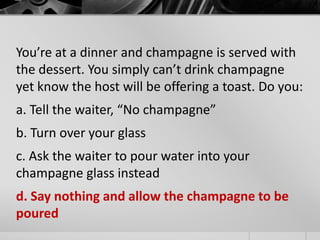
You’re at a dinner and champagne is served with 
the dessert. You simply can’t drink champagne 
yet know the host will be offering a toast. Do you: 
a. Tell the waiter, “No champagne” 
b. Turn over your glass 
c. Ask the waiter to pour water into your 
champagne glass instead 
d. Say nothing and allow the champagne to be 
poured
You’re invited to a reception and the 
invitation states: “7:00 to 9:00 PM.” You 
should arrive: 
a. at 7:00 PM 
b. anytime between 7:00 PM and 9:00 PM 
c. between 7:00 PM and 7:30 PM 
d. go early and leave early
You’re invited to a reception and the 
invitation states: “7:00 to 9:00 PM.” You 
should arrive: 
a. at 7:00 PM 
b. anytime between 7:00 PM and 9:00 PM 
c. between 7:00 PM and 7:30 PM 
d. go early and leave early 
[It’s terribly impolite to arrive early]
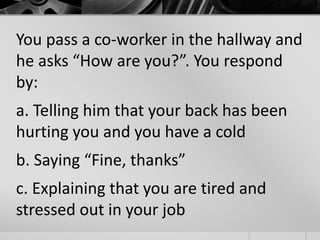
You pass a co-worker in the hallway and 
he asks “How are you?”. You respond 
by: 
a. Telling him that your back has been 
hurting you and you have a cold 
b. Saying “Fine, thanks” 
c. Explaining that you are tired and 
stressed out in your job
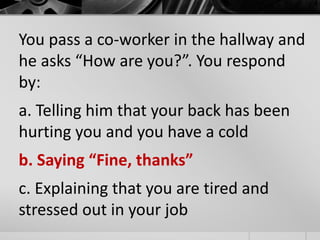
You pass a co-worker in the hallway and 
he asks “How are you?”. You respond 
by: 
a. Telling him that your back has been 
hurting you and you have a cold 
b. Saying “Fine, thanks” 
c. Explaining that you are tired and 
stressed out in your job
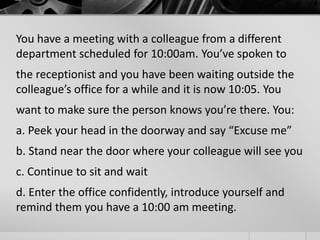
You have a meeting with a colleague from a different 
department scheduled for 10:00am. You’ve spoken to 
the receptionist and you have been waiting outside the 
colleague’s office for a while and it is now 10:05. You 
want to make sure the person knows you’re there. You: 
a. Peek your head in the doorway and say “Excuse me” 
b. Stand near the door where your colleague will see you 
c. Continue to sit and wait 
d. Enter the office confidently, introduce yourself and 
remind them you have a 10:00 am meeting.
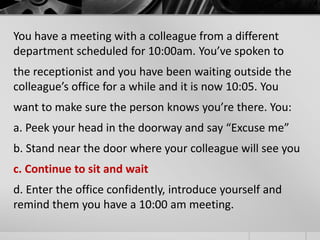
You have a meeting with a colleague from a different 
department scheduled for 10:00am. You’ve spoken to 
the receptionist and you have been waiting outside the 
colleague’s office for a while and it is now 10:05. You 
want to make sure the person knows you’re there. You: 
a. Peek your head in the doorway and say “Excuse me” 
b. Stand near the door where your colleague will see you 
c. Continue to sit and wait 
d. Enter the office confidently, introduce yourself and 
remind them you have a 10:00 am meeting.
A co-worker shares office gossip/rumors 
with you. You: 
a. Thank him for telling you and pass the 
stories on 
b. Check out the facts with other 
employees 
c. Politely listen and keep the information 
to yourself
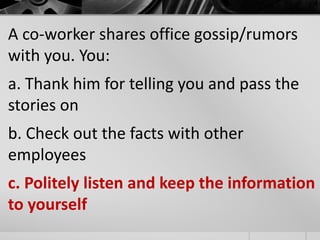
A co-worker shares office gossip/rumors 
with you. You: 
a. Thank him for telling you and pass the 
stories on 
b. Check out the facts with other 
employees 
c. Politely listen and keep the information 
to yourself
When someone new 
enters a room, would 
you stand?
When someone new enters a room, you 
should rise if introductions are to be made. 
Should you be seated with others and it 
would be awkward for everyone to stand, 
you should remain seated. Many experts 
suggest men should always rise when a 
woman or special guest enters the room or 
return to a table at a meal. When arriving 
at a table for a meal, generally you should 
stand until all who will be seated at the 
table have arrived or until the host sits.
You should answer the 
phone after how many 
rings?
You should answer a 
telephone within four 
rings.
When the National 
Anthem is being played, 
where should you be 
facing?
When the national anthem 
is played, you should always 
stand and face the flag. 
Should no flag be present, 
you should stand and face 
the music.
How should you 
greet someone 
with a disability?
You should greet 
someone with a 
disability as you would 
anyone else.
When you receive an 
invitation that requests 
an RSVP, what does that 
mean?
An invitation that requests an RSVP is 
asking for you to indicate whether or 
not you are able to accept the 
invitation. You should always respond 
within two weeks of receiving the 
invitation or as quickly as possible. An 
invitation marked “regrets only” needs 
no response if you will be able to 
attend.
COMMUNICATIONS 
IN THE WORK PLACE
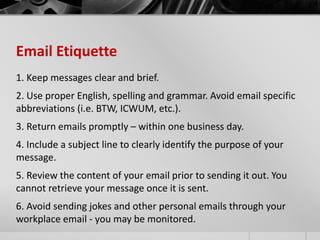
Email Etiquette 
1. Keep messages clear and brief. 
2. Use proper English, spelling and grammar. Avoid email specific 
abbreviations (i.e. BTW, ICWUM, etc.). 
3. Return emails promptly – within one business day. 
4. Include a subject line to clearly identify the purpose of your 
message. 
5. Review the content of your email prior to sending it out. You 
cannot retrieve your message once it is sent. 
6. Avoid sending jokes and other personal emails through your 
workplace email - you may be monitored.
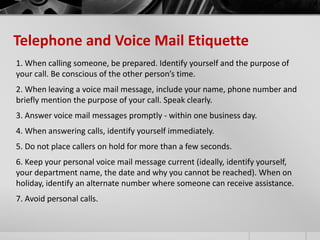
Telephone and Voice Mail Etiquette 
1. When calling someone, be prepared. Identify yourself and the purpose of 
your call. Be conscious of the other person’s time. 
2. When leaving a voice mail message, include your name, phone number and 
briefly mention the purpose of your call. Speak clearly. 
3. Answer voice mail messages promptly - within one business day. 
4. When answering calls, identify yourself immediately. 
5. Do not place callers on hold for more than a few seconds. 
6. Keep your personal voice mail message current (ideally, identify yourself, 
your department name, the date and why you cannot be reached). When on 
holiday, identify an alternate number where someone can receive assistance. 
7. Avoid personal calls.
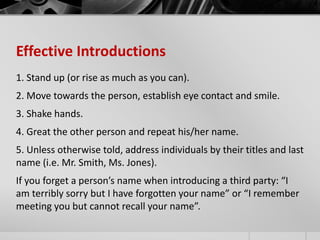
Effective Introductions 
1. Stand up (or rise as much as you can). 
2. Move towards the person, establish eye contact and smile. 
3. Shake hands. 
4. Great the other person and repeat his/her name. 
5. Unless otherwise told, address individuals by their titles and last 
name (i.e. Mr. Smith, Ms. Jones). 
If you forget a person’s name when introducing a third party: “I 
am terribly sorry but I have forgotten your name” or “I remember 
meeting you but cannot recall your name”.
Verbal Communication 
Every encounter offers a chance to impress the other person. Keep in mind 
that: 
• Someone who talks too much may be seen as nervous or insensitive 
• Someone who ignores others could be considered snobbish 
• Someone who only discusses work may come across as limited 
Make sure you find a professional balance during your interactions with 
colleagues and clients. 
Safe topics for small talk include weather, traffic, sports, non-controversial 
current events (i.e. the Oscars), travel. 
Avoid slang and foul language. Be careful with humour and sarcasm. Do not 
express your opinions on politics, religion, culture, and ethnicity. 
When addressing superiors, colleagues or clients, follow the norms of the 
workplace (first name only or title and last name, i.e. Mr. Smith).
Non-verbal Communication 
Body language communicates more than what you say. 
Gestures, facial expressions, posture and physical 
contact are also powerful forms of communication. 
Maintain eye contact and avoid distracting mannerisms 
such as: 
Scratching or picking at yourself, tugging or playing with 
hair, combing hair in public, drumming fingers, picking or 
biting 
fingernails, tapping feet, applying makeup or nail polish 
in public, picking teeth, fidgeting, yawning, clicking pens, 
chewing gum.
Privacy and Feelings 
Do not start or encourage office 
gossip. Spreading rumours about 
co-workers can be harmful. 
When a colleague confides in 
you, show respect by keeping 
the conversation private.
Work Space/Shared Areas 
Respect other people’s space and 
property. Always ask permission to 
enter an office, borrow, move, or use 
equipment/items/snacks. Return 
borrowed items promptly and in good 
condition. When using someone else’s 
space, clean up after yourself when 
leaving.
Time 
Your punctuality and/or ability to meet 
timelines affect everyone in your 
workplace. Arrive on time or early for 
work and meetings. Respect all 
timelines for work assignments – your 
tardiness or request for extensions 
could impact other people’s work.
CREDITS 
 Centennial College Co-operative Education 
And Employment Resources 
 www.jrl-engineering.com 
 www. etiquetteexpert.com 
 www.emilypost.com; and 
 www.gradview.com

CMH 204 Practicum Class Quiz

  • 1.
    CMH 204 CLASSQUIZ AND ANSWERS Lecturers: Dr. Henry Sawyerr/Ms. Olulegan
  • 2.
    If you haveto introduce two people and you can’t remember one person’s name, you recover by saying a. “Do you know one another?” b. “I can’t remember your name. Will you introduce yourself?” c. Nothing and hope they will introduce themselves. d. “It’s been one of those days. Please tell me your name again.” e. Nothing and doing nothing. After all, you don’t want to embarrass yourself or others.
  • 3.
    If you haveto introduce two people and you can’t remember one person’s name, you recover by saying a. “Do you know one another?” b. “I can’t remember your name. Will you introduce yourself?” c. Nothing and hope they will introduce themselves. d. “It’s been one of those days. Please tell me your name again.” e. Nothing and doing nothing. After all, you don’t want to embarrass yourself or others.
  • 4.
    You enter acoworker’s office or cubicle to chat and she’s on the phone, so you: a. Leave a note saying you need to speak with her and try to get her at another time b. Stand in the doorway and wait for her to get off – it’ll save you the time of having to come back later when she’ll probably just be on another call c. Insist that she speak with you immediately – it’s important and you don’t have time to wait around
  • 5.
    You enter acoworker’s office or cubicle to chat and she’s on the phone, so you: a. Leave a note saying you need to speak with her and try to get her at another time b. Stand in the doorway and wait for her to get off – it’ll save you the time of having to come back later when she’ll probably just be on another call c. Insist that she speak with you immediately – it’s important and you don’t have time to wait around
  • 6.
    You’re at adinner and champagne is served with the dessert. You simply can’t drink champagne yet know the host will be offering a toast. Do you: a. Tell the waiter, “No champagne” b. Turn over your glass c. Ask the waiter to pour water into your champagne glass instead d. Say nothing and allow the champagne to be poured
  • 7.
    You’re at adinner and champagne is served with the dessert. You simply can’t drink champagne yet know the host will be offering a toast. Do you: a. Tell the waiter, “No champagne” b. Turn over your glass c. Ask the waiter to pour water into your champagne glass instead d. Say nothing and allow the champagne to be poured
  • 8.
    You’re invited toa reception and the invitation states: “7:00 to 9:00 PM.” You should arrive: a. at 7:00 PM b. anytime between 7:00 PM and 9:00 PM c. between 7:00 PM and 7:30 PM d. go early and leave early
  • 9.
    You’re invited toa reception and the invitation states: “7:00 to 9:00 PM.” You should arrive: a. at 7:00 PM b. anytime between 7:00 PM and 9:00 PM c. between 7:00 PM and 7:30 PM d. go early and leave early [It’s terribly impolite to arrive early]
  • 10.
    You pass aco-worker in the hallway and he asks “How are you?”. You respond by: a. Telling him that your back has been hurting you and you have a cold b. Saying “Fine, thanks” c. Explaining that you are tired and stressed out in your job
  • 11.
    You pass aco-worker in the hallway and he asks “How are you?”. You respond by: a. Telling him that your back has been hurting you and you have a cold b. Saying “Fine, thanks” c. Explaining that you are tired and stressed out in your job
  • 12.
    You have ameeting with a colleague from a different department scheduled for 10:00am. You’ve spoken to the receptionist and you have been waiting outside the colleague’s office for a while and it is now 10:05. You want to make sure the person knows you’re there. You: a. Peek your head in the doorway and say “Excuse me” b. Stand near the door where your colleague will see you c. Continue to sit and wait d. Enter the office confidently, introduce yourself and remind them you have a 10:00 am meeting.
  • 13.
    You have ameeting with a colleague from a different department scheduled for 10:00am. You’ve spoken to the receptionist and you have been waiting outside the colleague’s office for a while and it is now 10:05. You want to make sure the person knows you’re there. You: a. Peek your head in the doorway and say “Excuse me” b. Stand near the door where your colleague will see you c. Continue to sit and wait d. Enter the office confidently, introduce yourself and remind them you have a 10:00 am meeting.
  • 14.
    A co-worker sharesoffice gossip/rumors with you. You: a. Thank him for telling you and pass the stories on b. Check out the facts with other employees c. Politely listen and keep the information to yourself
  • 15.
    A co-worker sharesoffice gossip/rumors with you. You: a. Thank him for telling you and pass the stories on b. Check out the facts with other employees c. Politely listen and keep the information to yourself
  • 16.
    When someone new enters a room, would you stand?
  • 17.
    When someone newenters a room, you should rise if introductions are to be made. Should you be seated with others and it would be awkward for everyone to stand, you should remain seated. Many experts suggest men should always rise when a woman or special guest enters the room or return to a table at a meal. When arriving at a table for a meal, generally you should stand until all who will be seated at the table have arrived or until the host sits.
  • 18.
    You should answerthe phone after how many rings?
  • 19.
    You should answera telephone within four rings.
  • 20.
    When the National Anthem is being played, where should you be facing?
  • 21.
    When the nationalanthem is played, you should always stand and face the flag. Should no flag be present, you should stand and face the music.
  • 22.
    How should you greet someone with a disability?
  • 23.
    You should greet someone with a disability as you would anyone else.
  • 24.
    When you receivean invitation that requests an RSVP, what does that mean?
  • 25.
    An invitation thatrequests an RSVP is asking for you to indicate whether or not you are able to accept the invitation. You should always respond within two weeks of receiving the invitation or as quickly as possible. An invitation marked “regrets only” needs no response if you will be able to attend.
  • 26.
  • 27.
    Email Etiquette 1.Keep messages clear and brief. 2. Use proper English, spelling and grammar. Avoid email specific abbreviations (i.e. BTW, ICWUM, etc.). 3. Return emails promptly – within one business day. 4. Include a subject line to clearly identify the purpose of your message. 5. Review the content of your email prior to sending it out. You cannot retrieve your message once it is sent. 6. Avoid sending jokes and other personal emails through your workplace email - you may be monitored.
  • 28.
    Telephone and VoiceMail Etiquette 1. When calling someone, be prepared. Identify yourself and the purpose of your call. Be conscious of the other person’s time. 2. When leaving a voice mail message, include your name, phone number and briefly mention the purpose of your call. Speak clearly. 3. Answer voice mail messages promptly - within one business day. 4. When answering calls, identify yourself immediately. 5. Do not place callers on hold for more than a few seconds. 6. Keep your personal voice mail message current (ideally, identify yourself, your department name, the date and why you cannot be reached). When on holiday, identify an alternate number where someone can receive assistance. 7. Avoid personal calls.
  • 29.
    Effective Introductions 1.Stand up (or rise as much as you can). 2. Move towards the person, establish eye contact and smile. 3. Shake hands. 4. Great the other person and repeat his/her name. 5. Unless otherwise told, address individuals by their titles and last name (i.e. Mr. Smith, Ms. Jones). If you forget a person’s name when introducing a third party: “I am terribly sorry but I have forgotten your name” or “I remember meeting you but cannot recall your name”.
  • 30.
    Verbal Communication Everyencounter offers a chance to impress the other person. Keep in mind that: • Someone who talks too much may be seen as nervous or insensitive • Someone who ignores others could be considered snobbish • Someone who only discusses work may come across as limited Make sure you find a professional balance during your interactions with colleagues and clients. Safe topics for small talk include weather, traffic, sports, non-controversial current events (i.e. the Oscars), travel. Avoid slang and foul language. Be careful with humour and sarcasm. Do not express your opinions on politics, religion, culture, and ethnicity. When addressing superiors, colleagues or clients, follow the norms of the workplace (first name only or title and last name, i.e. Mr. Smith).
  • 31.
    Non-verbal Communication Bodylanguage communicates more than what you say. Gestures, facial expressions, posture and physical contact are also powerful forms of communication. Maintain eye contact and avoid distracting mannerisms such as: Scratching or picking at yourself, tugging or playing with hair, combing hair in public, drumming fingers, picking or biting fingernails, tapping feet, applying makeup or nail polish in public, picking teeth, fidgeting, yawning, clicking pens, chewing gum.
  • 32.
    Privacy and Feelings Do not start or encourage office gossip. Spreading rumours about co-workers can be harmful. When a colleague confides in you, show respect by keeping the conversation private.
  • 33.
    Work Space/Shared Areas Respect other people’s space and property. Always ask permission to enter an office, borrow, move, or use equipment/items/snacks. Return borrowed items promptly and in good condition. When using someone else’s space, clean up after yourself when leaving.
  • 34.
    Time Your punctualityand/or ability to meet timelines affect everyone in your workplace. Arrive on time or early for work and meetings. Respect all timelines for work assignments – your tardiness or request for extensions could impact other people’s work.
  • 35.
    CREDITS  CentennialCollege Co-operative Education And Employment Resources  www.jrl-engineering.com  www. etiquetteexpert.com  www.emilypost.com; and  www.gradview.com