Enterprise 2.0
Knowledge Management
A Revolution of Knowledge in Three Parts.
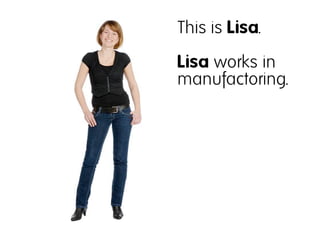
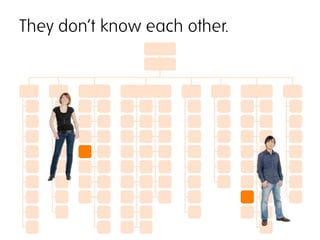
This is Lisa.
Lisa works in
manufactoring.
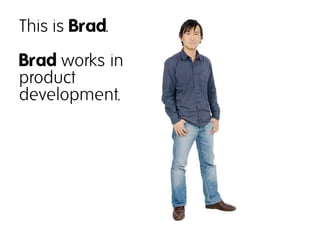
This is Brad.
Brad works in
product
development.
Both work for a large supplier of the
automotive industry.
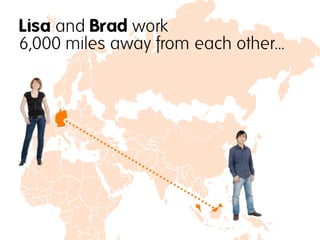
Lisa and Brad work
6,000 miles away from each other…
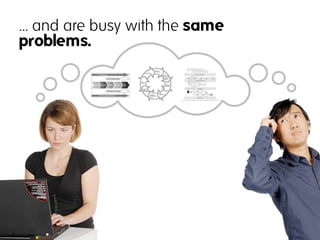
… and are busy with the same
problems.
They don‘t know each other.
But they should.
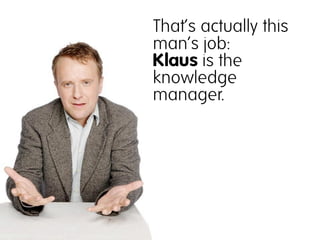
That‘s actually this
man‘s job:
Klaus is the
knowledge
manager.
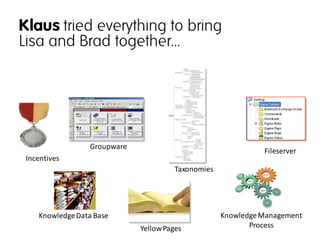
Klaus tried everything to bring
Lisa and Brad together…


                 Groupware
                                                               Fileserver
 Incentives
                                       Taxonomies


    Knowledge Data Base                             Knowledge Management 
                             Yellow Pages                  Process
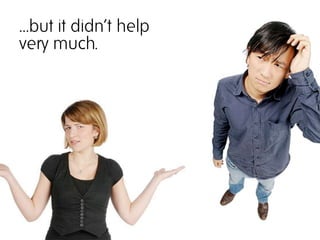
…but it didn‘t help
very much.
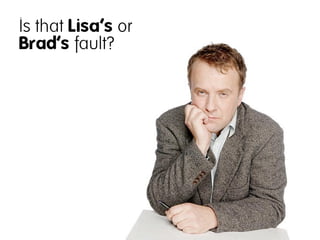
Is that Lisa‘s or
Brad‘s fault?
No.
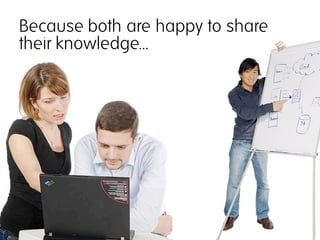
Because both are happy to share
their knowledge...
We all like to share
  knowledge…
…if we get the right
     audience.
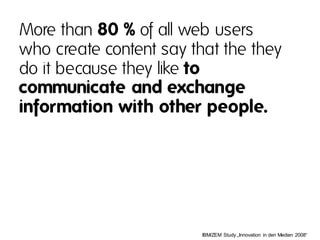
More than 80 % of all web users
who create content say that the they
do it because they like to
communicate and exchange
information with other people.


                         IBM/ZEM  Study „Innovation  in den Medien  2008“
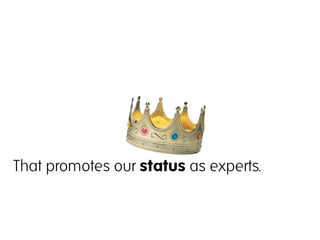
Positive feedback from others is
important.
That promotes our status as experts.
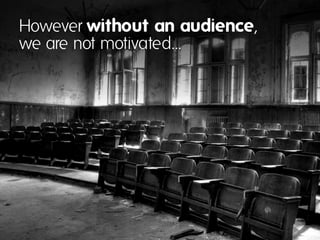
However without an audience,
we are not motivated…
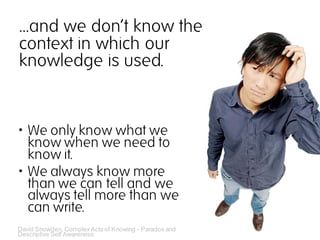
…and we don‘t know the
context in which our
knowledge is used.


 We only know what we
  know when we need to
  know it.
 We always know more
  than we can tell and we
  always tell more than we
  can write.
David Snowden, Complex Acts of Knowing - Paradox and
Descriptive Self Awareness
The old knowledge management
didn‘t care.
1. Write your knowledge into a database.
2. Find an adequate level of detail.
3. Maybe somebody will use your knowledge
   some day. And… maybe not.
4. Don‘t spend too much of your time on this!
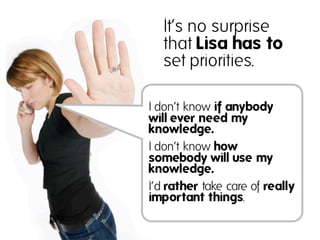
It‘s no surprise
   that Lisa has to
   set priorities.

I don‘t know if anybody
will ever need my
knowledge.
I don‘t know how
somebody will use my
knowledge.
I‘d rather take care of really
important things.
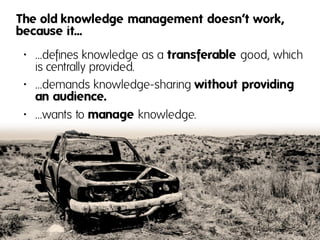
The old knowledge management doesn‘t work,
because it...
• …defines knowledge as a transferable good, which
  is centrally provided.
• …demands knowledge-sharing without providing
  an audience.
• …wants to manage knowledge.
„You can't manage
   knowledge.
   Knowledge is
   between two ears,
   and only between
   two ears.“
   Peter Drucker


Nach: Wilson, T.D. (2002) "The nonsense of 'knowledge management'" Information Research, 8(1), paper no. 144 [Available at
http://InformationR.net/ir/8-1/paper144.html] Bild: http://www.cgu.edu/images/Drucker/Peter_Drucker/images/PeterDrucker016_jpg.jpg
Where do we
go from here?
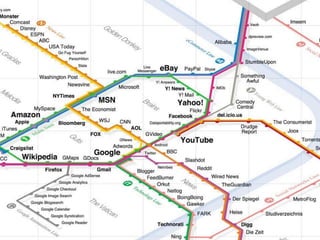
The web enters the
business…
Klaus loves the Wikipedia!
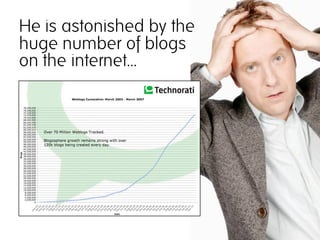
He is astonished by the
huge number of blogs
on the internet…
... and he jumps at his chance.
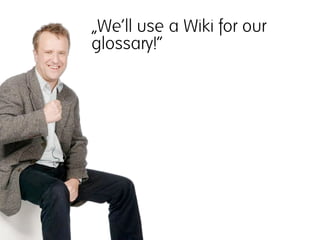
„We‘ll use a Wiki for our
glossary!“
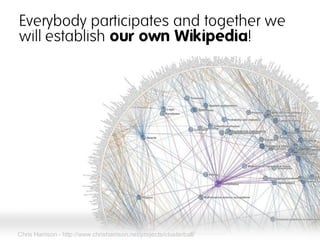
Everybody participates and together we
will establish our own Wikipedia!


Chris Harrison - http://www.chrisharrison.net/projects/clusterball/
Social Software…

... makes knowledge
     management
      successful!
WRONG!
Social Software is
 (unfortunately)
   just a tool...
Sure it is easier, more intuitive,
and looks better – but it won‘t
guarantee an audience either.
Social Software in your business…
1. Write your knowledge into a database, into
   the wiki, a blog, [or other Social Software
   tool]….
2. Find an adequate level of detail.
3. Maybe somebody will use your knowledge
   some day. And… maybe not.
4. Don‘t spend too much of your time on this!
„But it works on the
web…“
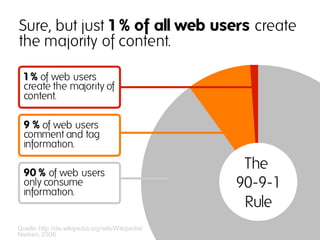
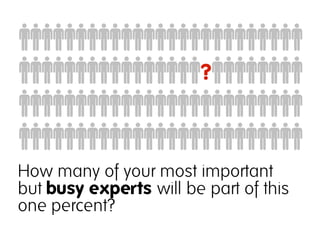
Sure, but just 1 % of all web users create
the majority of content.

  1 % of web users
  create the majority of
  content.

  9 % of web users
  comment and tag
  information.

  90 % of web users
                                                   The
  only consume
  information.
                                                  90-9-1
                                                   Rule
Quelle: http://de.wikipedia.org/wiki/Wikipedia/
Nielsen, 2006
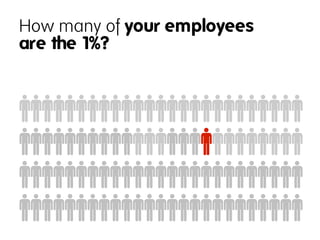
How many of your employees
are the 1%?
?


How many of your most important
but busy experts will be part of this
one percent?
Sorry, Klaus…
… but that is not
knowledge
management!
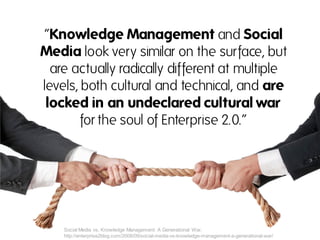
“Knowledge Management and Social
Media look very similar on the surface, but
  are actually radically different at multiple
levels, both cultural and technical, and are
 locked in an undeclared cultural war
        for the soul of Enterprise 2.0.“


    Social Media vs. Knowledge Management: A Generational War.
    http://enterprise2blog.com/2008/09/social-media-vs-knowledge-management-a-generational-war/
1. Sharing knowledge is always
   voluntary, no one can ever be
   forced.
2. We share knowledge when we
   have the right audience, that
   motivates us and creates the right
   context.
3. Social Software alone is not the
   solution to the old problems of
   knowledge management.
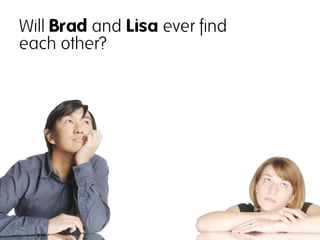
Will Brad and Lisa ever find
each other?
http://www.besser20.de/english
Frank Wolf, Christoph Rauhut, Simone Happ,
Christopher Buschow, Katja Dräger, Christin Büttner
Thanks to: Anne Glas, Holger Günzler, Dada Lin, Jana Frommhold, Ricarda Köckler
f.wolf@t-systems.com
            simone.happ@t-systems.com
http://www.t-systems-mms.com/mms/en
        http://www.besser20.de/english

The Wikipedia Myth - Enterprise 2.0 Knowledge Management

  • 1.
    Enterprise 2.0 Knowledge Management ARevolution of Knowledge in Three Parts.
  • 2.
    This is Lisa. Lisaworks in manufactoring.
  • 3.
    This is Brad. Bradworks in product development.
  • 4.
    Both work fora large supplier of the automotive industry.
  • 5.
    Lisa and Bradwork 6,000 miles away from each other…
  • 6.
    … and arebusy with the same problems.
  • 7.
    They don‘t knoweach other.
  • 8.
  • 9.
    That‘s actually this man‘sjob: Klaus is the knowledge manager.
  • 10.
    Klaus tried everythingto bring Lisa and Brad together… Groupware Fileserver Incentives Taxonomies Knowledge Data Base Knowledge Management  Yellow Pages Process
  • 11.
    …but it didn‘thelp very much.
  • 12.
    Is that Lisa‘sor Brad‘s fault?
  • 13.
  • 14.
    Because both arehappy to share their knowledge...
  • 15.
    We all liketo share knowledge…
  • 16.
    …if we getthe right audience.
  • 17.
    More than 80% of all web users who create content say that the they do it because they like to communicate and exchange information with other people. IBM/ZEM  Study „Innovation  in den Medien  2008“
  • 18.
    Positive feedback fromothers is important.
  • 19.
    That promotes ourstatus as experts.
  • 20.
    However without anaudience, we are not motivated…
  • 21.
    …and we don‘tknow the context in which our knowledge is used.  We only know what we know when we need to know it.  We always know more than we can tell and we always tell more than we can write. David Snowden, Complex Acts of Knowing - Paradox and Descriptive Self Awareness
  • 22.
    The old knowledgemanagement didn‘t care. 1. Write your knowledge into a database. 2. Find an adequate level of detail. 3. Maybe somebody will use your knowledge some day. And… maybe not. 4. Don‘t spend too much of your time on this!
  • 23.
    It‘s no surprise that Lisa has to set priorities. I don‘t know if anybody will ever need my knowledge. I don‘t know how somebody will use my knowledge. I‘d rather take care of really important things.
  • 24.
    The old knowledgemanagement doesn‘t work, because it... • …defines knowledge as a transferable good, which is centrally provided. • …demands knowledge-sharing without providing an audience. • …wants to manage knowledge.
  • 25.
    „You can't manage knowledge. Knowledge is between two ears, and only between two ears.“ Peter Drucker Nach: Wilson, T.D. (2002) "The nonsense of 'knowledge management'" Information Research, 8(1), paper no. 144 [Available at http://InformationR.net/ir/8-1/paper144.html] Bild: http://www.cgu.edu/images/Drucker/Peter_Drucker/images/PeterDrucker016_jpg.jpg
  • 27.
    Where do we gofrom here?
  • 29.
    The web entersthe business…
  • 30.
    Klaus loves theWikipedia!
  • 31.
    He is astonishedby the huge number of blogs on the internet…
  • 32.
    ... and hejumps at his chance.
  • 33.
    „We‘ll use aWiki for our glossary!“
  • 34.
    Everybody participates andtogether we will establish our own Wikipedia! Chris Harrison - http://www.chrisharrison.net/projects/clusterball/
  • 35.
    Social Software… ... makesknowledge management successful!
  • 36.
  • 37.
    Social Software is (unfortunately) just a tool...
  • 38.
    Sure it iseasier, more intuitive, and looks better – but it won‘t guarantee an audience either.
  • 39.
    Social Software inyour business… 1. Write your knowledge into a database, into the wiki, a blog, [or other Social Software tool]…. 2. Find an adequate level of detail. 3. Maybe somebody will use your knowledge some day. And… maybe not. 4. Don‘t spend too much of your time on this!
  • 40.
    „But it workson the web…“
  • 41.
    Sure, but just1 % of all web users create the majority of content. 1 % of web users create the majority of content. 9 % of web users comment and tag information. 90 % of web users The only consume information. 90-9-1 Rule Quelle: http://de.wikipedia.org/wiki/Wikipedia/ Nielsen, 2006
  • 42.
    How many ofyour employees are the 1%?
  • 43.
    ? How many ofyour most important but busy experts will be part of this one percent?
  • 44.
  • 45.
    … but thatis not knowledge management!
  • 46.
    “Knowledge Management andSocial Media look very similar on the surface, but are actually radically different at multiple levels, both cultural and technical, and are locked in an undeclared cultural war for the soul of Enterprise 2.0.“ Social Media vs. Knowledge Management: A Generational War. http://enterprise2blog.com/2008/09/social-media-vs-knowledge-management-a-generational-war/
  • 47.
    1. Sharing knowledgeis always voluntary, no one can ever be forced. 2. We share knowledge when we have the right audience, that motivates us and creates the right context. 3. Social Software alone is not the solution to the old problems of knowledge management.
  • 48.
    Will Brad andLisa ever find each other?
  • 49.
  • 50.
    Frank Wolf, ChristophRauhut, Simone Happ, Christopher Buschow, Katja Dräger, Christin Büttner Thanks to: Anne Glas, Holger Günzler, Dada Lin, Jana Frommhold, Ricarda Köckler
  • 51.
    f.wolf@t-systems.com simone.happ@t-systems.com http://www.t-systems-mms.com/mms/en http://www.besser20.de/english