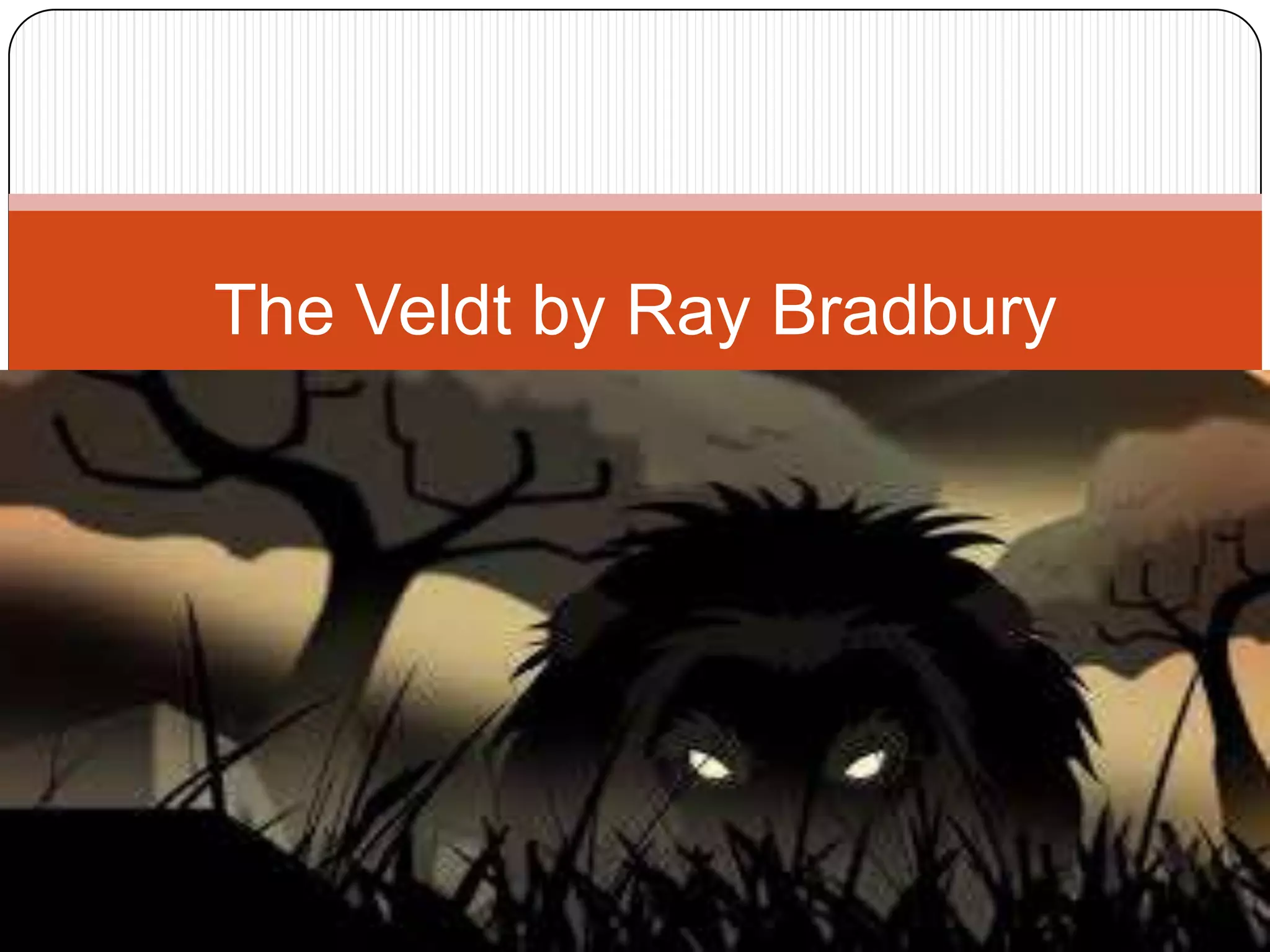
The Veldt by Ray Bradbury
Background
 This is written during the 1950’s and

during a time of racial segregation
in the United States.
 Technology was quickly developing
and televisions were becoming
common place for children to be
entertained by.
What is a Veldt?
Veldt (also spelled veld ) is a
term used to refer to certain wide
open rural spaces of Southern
Africa.
Before you read- Agree or
Disagree
___ Parents should control all of their
children’s choices.
___ Technology is a threat to humanity.
___Freedom over structure is better for
children.
___ Technology makes people lazy or
disconnected.
___Children are naturally more savage than
adults.
Review of Pertinent Literary
Elements
Setting- the where + the when + the
scene.
Characterization- a description of the
qualities or peculiarities or significant
details of a character creating their
identity.
Conflict-the tension between what the
main character or protagonist wants
and what is in his or her way.
Theme-a recurring idea throughout a
work
Setting in The Veldt
Basic Time and Place= Futuristic suburban home
in the US. This is called the Happy Life Home.
Secondary Setting= The children in the story are
able to use a high tech nursery to create natural
settings to play in. The children repeatedly play in
an African savage land.
Characters
Main Characters
 George Hadley- Typical father “knows best” He is
very straight forward and seems to want the best for
his children, but fails to connect at all with them
emotionally or personally.
 Lydia Hadley- A stereotypical suburban housewife
who seems to have concern for the children, but
fails to set boundaries or structures.
 The Children- Peter and Wendy Hadley. Smart and
cagey kids who want the freedom to create and play
in their own world and have become dissatisfied
with the quiet yet paralyzing nature of the Home
they live in.
 David McClean- Obvious “Clean” reference here is
a psychologist hired to fix the kids or the nursery or
both,
Conflicts
 The major conflict in the story is between the

parents and the children. The parent’s nature is
to protect the children while the children are
trying to seek adventure and power through their
use of the nursery.
 Another conflict in the story is the usefulness of
humans in advanced technological world. Often
the parents feel they have little or no purpose
since the children are taken care of by the house.
 There is also the conflict of man vs. machine
throughout the story as the parents are
eventually threatened by the Nursery.
Themes
 Comfort of Technology vs. Man’s Purpose-

The Veldt presents technology as something that
makes life so easy that the humans become soft
and spineless.
 Fear of the Savage- The use of Africa and the
parent’s fear has some racial implications as the
story is written during a time of Jim Crow laws
and segregation. The story explores the
established white-European cultures fear of
African cultures and the projection of savagery
even though slavery which was savage in nature
(initiated by white Europeans) created a
comfortable life for many white Americans.
Symbols and Figurative
Language
 The nursery in "The Veldt" isn't just an awesome

virtual reality room where parents can park their
kids. If it were, everyone would want one in our
house. But the nursery in "The Veldt" is basically
the scariest room that has ever existed. It also
becomes a symbol of the passive nature of
television.
 Lions-They represent the nature of power and
hunger in the story. Bradbury’s descriptions of the
lions seem to parallel the children at times, and
the children begin to hunger a passive prey. The
parents have become that passive prey.
Key Questions for consideration
 What is the most genuine fear in the story? Is it of the

technology, the children, or of the savage image of
Africa? Choose one and use evidence from the story
to support your answer.
 The story is both predictive of the future and

descriptive of the role of television and technology in
the lives of children. Do you think this story is more
predictive or descriptive? Give examples to support
your position.
 What mistakes have George and Lydia made in
raising their children? Use evidence from the story to
support your position.

The Veldt - by Ray Bradbury

  • 1.
    The Veldt byRay Bradbury
  • 2.
    Background  This iswritten during the 1950’s and during a time of racial segregation in the United States.  Technology was quickly developing and televisions were becoming common place for children to be entertained by.
  • 3.
    What is aVeldt? Veldt (also spelled veld ) is a term used to refer to certain wide open rural spaces of Southern Africa.
  • 4.
    Before you read-Agree or Disagree ___ Parents should control all of their children’s choices. ___ Technology is a threat to humanity. ___Freedom over structure is better for children. ___ Technology makes people lazy or disconnected. ___Children are naturally more savage than adults.
  • 5.
    Review of PertinentLiterary Elements Setting- the where + the when + the scene. Characterization- a description of the qualities or peculiarities or significant details of a character creating their identity. Conflict-the tension between what the main character or protagonist wants and what is in his or her way. Theme-a recurring idea throughout a work
  • 6.
    Setting in TheVeldt Basic Time and Place= Futuristic suburban home in the US. This is called the Happy Life Home. Secondary Setting= The children in the story are able to use a high tech nursery to create natural settings to play in. The children repeatedly play in an African savage land.
  • 7.
    Characters Main Characters  GeorgeHadley- Typical father “knows best” He is very straight forward and seems to want the best for his children, but fails to connect at all with them emotionally or personally.  Lydia Hadley- A stereotypical suburban housewife who seems to have concern for the children, but fails to set boundaries or structures.  The Children- Peter and Wendy Hadley. Smart and cagey kids who want the freedom to create and play in their own world and have become dissatisfied with the quiet yet paralyzing nature of the Home they live in.  David McClean- Obvious “Clean” reference here is a psychologist hired to fix the kids or the nursery or both,
  • 8.
    Conflicts  The majorconflict in the story is between the parents and the children. The parent’s nature is to protect the children while the children are trying to seek adventure and power through their use of the nursery.  Another conflict in the story is the usefulness of humans in advanced technological world. Often the parents feel they have little or no purpose since the children are taken care of by the house.  There is also the conflict of man vs. machine throughout the story as the parents are eventually threatened by the Nursery.
  • 9.
    Themes  Comfort ofTechnology vs. Man’s Purpose- The Veldt presents technology as something that makes life so easy that the humans become soft and spineless.  Fear of the Savage- The use of Africa and the parent’s fear has some racial implications as the story is written during a time of Jim Crow laws and segregation. The story explores the established white-European cultures fear of African cultures and the projection of savagery even though slavery which was savage in nature (initiated by white Europeans) created a comfortable life for many white Americans.
  • 10.
    Symbols and Figurative Language The nursery in "The Veldt" isn't just an awesome virtual reality room where parents can park their kids. If it were, everyone would want one in our house. But the nursery in "The Veldt" is basically the scariest room that has ever existed. It also becomes a symbol of the passive nature of television.  Lions-They represent the nature of power and hunger in the story. Bradbury’s descriptions of the lions seem to parallel the children at times, and the children begin to hunger a passive prey. The parents have become that passive prey.
  • 11.
    Key Questions forconsideration  What is the most genuine fear in the story? Is it of the technology, the children, or of the savage image of Africa? Choose one and use evidence from the story to support your answer.  The story is both predictive of the future and descriptive of the role of television and technology in the lives of children. Do you think this story is more predictive or descriptive? Give examples to support your position.  What mistakes have George and Lydia made in raising their children? Use evidence from the story to support your position.