The temperature at
which book paper
catches fire and burns
An Introductory
Powerpoint:
Fahrenheit 451
by Ray Bradbury
Fahrenheit 451
• 1947 – began as “Bright
Phoenix” which contained
seed for…
• 1951 – “The Firemen,” a short
story published in Galaxy
magazine and expanded…
• 1953 – Fahrenheit 451, a novel
written at a time when the
world was threatened by
nuclear war, new technologies
were emerging, and the world
was getting smaller due to
technology.
Concepts Related to Fahrenheit 451:
• Social criticism: mode of criticism that addresses malicious
conditions in a society considered to be flawed and aims at
practical solutions.
Fahrenheit 451 warns against the dangers of suppressing
thoughts and ideas through censorship
• Science fiction: a form of fantasy in which scientific facts,
assumptions, or hypotheses form the basis of adventures in
the future, on other planets, in other dimensions in time, or
under new variants of scientific law
Fahrenheit 451 conveys a message that oppressive
government, left unchecked, can do irreparable damage to
society by limiting the creativity and freedom of its people.
Additional Concepts
• Totalitarian society – a society centrally controlled by an
autocratic leader with strict control of all aspects of life and
subordination of the individual to the state
• Dystopian society – an imagined place or state in which
everything is unpleasant or bad
*Propaganda is used to control citizens.
*Information, independent thought, & freedom are
restricted.
*A figurehead or concept is worshipped by citizens.
*Citizens feel trapped & struggle to escape.
*The natural world is banished & distrusted.
*Citizens are dehumanized.
*The society is an illusion of a perfect utopian world.
Historical Context
What Was Happening in the World in the
1950s?
• World War II had ended only a few years earlier.
• Nuclear warfare loomed.
• More jobs led to Americans having more
discretionary income which led to increased passivity
and conformity and the adage of: “Follow orders, and
you will succeed.”
• Era of McCarthyism brought new vigor to Truman’s
hunt for Communist infiltrators.
• Technology/electronics expansion included the use of
televised surveillance footage for many purposes and
the condensation of information into sound bites.
• Illiteracy was growing.
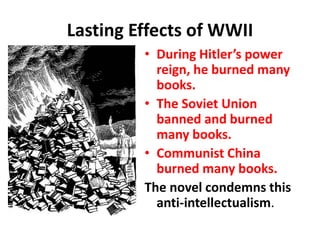
Lasting Effects of WWII
• During Hitler’s power
reign, he burned many
books.
• The Soviet Union
banned and burned
many books.
• Communist China
burned many books.
The novel condemns this
anti-intellectualism.
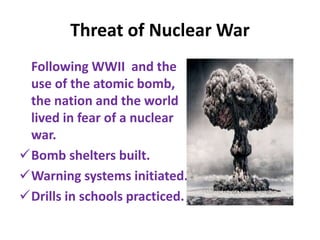
Threat of Nuclear War
Following WWII and the
use of the atomic bomb,
the nation and the world
lived in fear of a nuclear
war.
Bomb shelters built.
Warning systems initiated.
Drills in schools practiced.
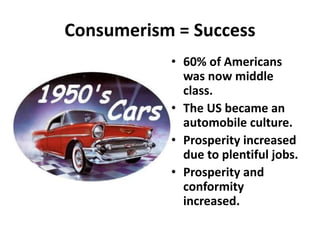
Consumerism = Success
• 60% of Americans
was now middle
class.
• The US became an
automobile culture.
• Prosperity increased
due to plentiful jobs.
• Prosperity and
conformity
increased.
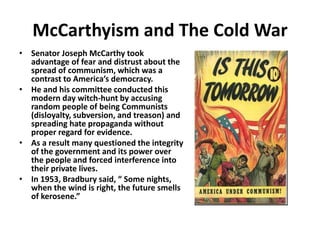
McCarthyism and The Cold War
• Senator Joseph McCarthy took
advantage of fear and distrust about the
spread of communism, which was a
contrast to America’s democracy.
• He and his committee conducted this
modern day witch-hunt by accusing
random people of being Communists
(disloyalty, subversion, and treason) and
spreading hate propaganda without
proper regard for evidence.
• As a result many questioned the integrity
of the government and its power over
the people and forced interference into
their private lives.
• In 1953, Bradbury said, “ Some nights,
when the wind is right, the future smells
of kerosene.”
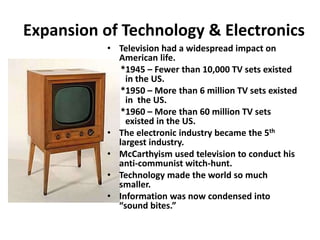
Expansion of Technology & Electronics
• Television had a widespread impact on
American life.
*1945 – Fewer than 10,000 TV sets existed
in the US.
*1950 – More than 6 million TV sets existed
in the US.
*1960 – More than 60 million TV sets
existed in the US.
• The electronic industry became the 5th
largest industry.
• McCarthyism used television to conduct his
anti-communist witch-hunt.
• Technology made the world so much
smaller.
• Information was now condensed into
“sound bites.”
PREVENT
Bradbury
claimed he
was trying
to prevent
the future,
not
predict it.
PREDICT
However, he did anticipate the future:
• Seashell radios
• Parlor walls
• Interactive TV
• Population explosion
• Rise in violence
• Growing illiteracy
• Condensation of information
• Dehumanization & impersonalization of life
• Elimination of books
• Loss of meaningful interaction with others
• Surveillance by police and government
• Reliance on technology to mediate all social
experiences
TWO CENTRAL THEMES
CENSORSHIP
• The suppression of speech or
deletion of communicative
material which may be
considered objectionable,
harmful, sensitive, or
inconvenient by a controlling
group.
• In the novel, it is ironic that
censorship begins with the
people not the government.
• Ironically, Bradbury discovered
that editors had censored
language in 75 sections without
his knowledge and consent.
IGNORANCE VS KNOWLEDGE
• Without the ability to
think, people can not make
wise decisions.
• Is ignorance bliss, or do
knowledge and learning
provide true happiness?
• In Fahrenheit 451 firemen
promote ignorance by
destroying books – and
with them – knowledge.
ADDITIONAL THEMES
• Individual self-expression is important.
• Censorship deprives self-expression.
• Violence is self-destructive.
• Mindless pleasure-seeking & materialism makes
for an empty life.
• Humanity has the ability to be reborn or revived.
• In the wrong hands, modern technology can be dangerous.
• Commercialism can erode or overpower spiritual values.
• People lose their humanity if they are not able to
communicate and interact with each other on a personal
level.
• Humanity should preserve and value the culture of the past.
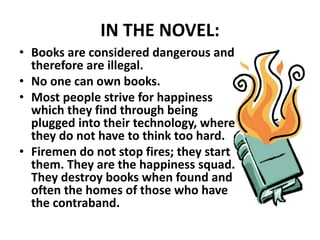
IN THE NOVEL:
• Books are considered dangerous and
therefore are illegal.
• No one can own books.
• Most people strive for happiness
which they find through being
plugged into their technology, where
they do not have to think too hard.
• Firemen do not stop fires; they start
them. They are the happiness squad.
They destroy books when found and
often the homes of those who have
the contraband.
SETTING IN THE NOVEL
• TIME: Future – Bradbury identifies the time period as
1999; Granger, a character from Part III mentions the
atomic bomb’s destruction 50 years ago; other
scholars identify time as 24th century
• PLACE: America; Montag’s cold & violent city; the
firehouse, Montag’s home (mausoleum-like), Faber’s
home, simple forest
• ATMOSPHERE: A repressive government censors all
literature, citizens lives are filled with trivial
distractions, people desire happiness in any way they
can obtain it, technology rules, war is imminent, and
people do not think for themselves.
INTERNAL CONFLICTS IN THE NOVEL
Man vs himself
1. Montag and his struggle
to overcome his violent
past and going against the
tenets of his profession
2. Faber overcoming his fears
and helping Montag
EXTERNAL CONFLICTS IN THE NOVEL
Man vs society
Montag vs society
Clarisse McClellan vs society
Professor Faber vs society
Man vs man
Montag vs Beatty
Montag vs Midlred
SYMBOLS IN THE NOVEL
• Phoenix
• The Hearth and the Salamander
• The Sieve and the Sand
• Mechanical hound
• Old woman
• Mirrors
• Birds
• Captain Beatty
• Mildred
• Montag
• Books
CHARACTERS IN THE NOVEL
• Guy Montag
• Mildred Montag
• Captain Beatty
• Professor Faber
• Clarisse McClellan
• Granger
• Mrs. Phelps
• Mrs. Bowles
• Old Woman
• Mechanical Hound
• Stoneman and Black
• Book People
POINT OF VIEW
Third Person
Limited Omniscient -
Montag’s thoughts and
feelings

4.fahrenheit451 an introductory powerpoint 2015

  • 1.
    The temperature at whichbook paper catches fire and burns An Introductory Powerpoint: Fahrenheit 451 by Ray Bradbury
  • 2.
    Fahrenheit 451 • 1947– began as “Bright Phoenix” which contained seed for… • 1951 – “The Firemen,” a short story published in Galaxy magazine and expanded… • 1953 – Fahrenheit 451, a novel written at a time when the world was threatened by nuclear war, new technologies were emerging, and the world was getting smaller due to technology.
  • 3.
    Concepts Related toFahrenheit 451: • Social criticism: mode of criticism that addresses malicious conditions in a society considered to be flawed and aims at practical solutions. Fahrenheit 451 warns against the dangers of suppressing thoughts and ideas through censorship • Science fiction: a form of fantasy in which scientific facts, assumptions, or hypotheses form the basis of adventures in the future, on other planets, in other dimensions in time, or under new variants of scientific law Fahrenheit 451 conveys a message that oppressive government, left unchecked, can do irreparable damage to society by limiting the creativity and freedom of its people.
  • 4.
    Additional Concepts • Totalitariansociety – a society centrally controlled by an autocratic leader with strict control of all aspects of life and subordination of the individual to the state • Dystopian society – an imagined place or state in which everything is unpleasant or bad *Propaganda is used to control citizens. *Information, independent thought, & freedom are restricted. *A figurehead or concept is worshipped by citizens. *Citizens feel trapped & struggle to escape. *The natural world is banished & distrusted. *Citizens are dehumanized. *The society is an illusion of a perfect utopian world.
  • 5.
    Historical Context What WasHappening in the World in the 1950s? • World War II had ended only a few years earlier. • Nuclear warfare loomed. • More jobs led to Americans having more discretionary income which led to increased passivity and conformity and the adage of: “Follow orders, and you will succeed.” • Era of McCarthyism brought new vigor to Truman’s hunt for Communist infiltrators. • Technology/electronics expansion included the use of televised surveillance footage for many purposes and the condensation of information into sound bites. • Illiteracy was growing.
  • 6.
    Lasting Effects ofWWII • During Hitler’s power reign, he burned many books. • The Soviet Union banned and burned many books. • Communist China burned many books. The novel condemns this anti-intellectualism.
  • 7.
    Threat of NuclearWar Following WWII and the use of the atomic bomb, the nation and the world lived in fear of a nuclear war. Bomb shelters built. Warning systems initiated. Drills in schools practiced.
  • 8.
    Consumerism = Success •60% of Americans was now middle class. • The US became an automobile culture. • Prosperity increased due to plentiful jobs. • Prosperity and conformity increased.
  • 9.
    McCarthyism and TheCold War • Senator Joseph McCarthy took advantage of fear and distrust about the spread of communism, which was a contrast to America’s democracy. • He and his committee conducted this modern day witch-hunt by accusing random people of being Communists (disloyalty, subversion, and treason) and spreading hate propaganda without proper regard for evidence. • As a result many questioned the integrity of the government and its power over the people and forced interference into their private lives. • In 1953, Bradbury said, “ Some nights, when the wind is right, the future smells of kerosene.”
  • 10.
    Expansion of Technology& Electronics • Television had a widespread impact on American life. *1945 – Fewer than 10,000 TV sets existed in the US. *1950 – More than 6 million TV sets existed in the US. *1960 – More than 60 million TV sets existed in the US. • The electronic industry became the 5th largest industry. • McCarthyism used television to conduct his anti-communist witch-hunt. • Technology made the world so much smaller. • Information was now condensed into “sound bites.”
  • 11.
    PREVENT Bradbury claimed he was trying toprevent the future, not predict it. PREDICT However, he did anticipate the future: • Seashell radios • Parlor walls • Interactive TV • Population explosion • Rise in violence • Growing illiteracy • Condensation of information • Dehumanization & impersonalization of life • Elimination of books • Loss of meaningful interaction with others • Surveillance by police and government • Reliance on technology to mediate all social experiences
  • 12.
    TWO CENTRAL THEMES CENSORSHIP •The suppression of speech or deletion of communicative material which may be considered objectionable, harmful, sensitive, or inconvenient by a controlling group. • In the novel, it is ironic that censorship begins with the people not the government. • Ironically, Bradbury discovered that editors had censored language in 75 sections without his knowledge and consent. IGNORANCE VS KNOWLEDGE • Without the ability to think, people can not make wise decisions. • Is ignorance bliss, or do knowledge and learning provide true happiness? • In Fahrenheit 451 firemen promote ignorance by destroying books – and with them – knowledge.
  • 13.
    ADDITIONAL THEMES • Individualself-expression is important. • Censorship deprives self-expression. • Violence is self-destructive. • Mindless pleasure-seeking & materialism makes for an empty life. • Humanity has the ability to be reborn or revived. • In the wrong hands, modern technology can be dangerous. • Commercialism can erode or overpower spiritual values. • People lose their humanity if they are not able to communicate and interact with each other on a personal level. • Humanity should preserve and value the culture of the past.
  • 14.
    IN THE NOVEL: •Books are considered dangerous and therefore are illegal. • No one can own books. • Most people strive for happiness which they find through being plugged into their technology, where they do not have to think too hard. • Firemen do not stop fires; they start them. They are the happiness squad. They destroy books when found and often the homes of those who have the contraband.
  • 15.
    SETTING IN THENOVEL • TIME: Future – Bradbury identifies the time period as 1999; Granger, a character from Part III mentions the atomic bomb’s destruction 50 years ago; other scholars identify time as 24th century • PLACE: America; Montag’s cold & violent city; the firehouse, Montag’s home (mausoleum-like), Faber’s home, simple forest • ATMOSPHERE: A repressive government censors all literature, citizens lives are filled with trivial distractions, people desire happiness in any way they can obtain it, technology rules, war is imminent, and people do not think for themselves.
  • 16.
    INTERNAL CONFLICTS INTHE NOVEL Man vs himself 1. Montag and his struggle to overcome his violent past and going against the tenets of his profession 2. Faber overcoming his fears and helping Montag
  • 17.
    EXTERNAL CONFLICTS INTHE NOVEL Man vs society Montag vs society Clarisse McClellan vs society Professor Faber vs society Man vs man Montag vs Beatty Montag vs Midlred
  • 18.
    SYMBOLS IN THENOVEL • Phoenix • The Hearth and the Salamander • The Sieve and the Sand • Mechanical hound • Old woman • Mirrors • Birds • Captain Beatty • Mildred • Montag • Books
  • 19.
    CHARACTERS IN THENOVEL • Guy Montag • Mildred Montag • Captain Beatty • Professor Faber • Clarisse McClellan • Granger • Mrs. Phelps • Mrs. Bowles • Old Woman • Mechanical Hound • Stoneman and Black • Book People
  • 20.
    POINT OF VIEW ThirdPerson Limited Omniscient - Montag’s thoughts and feelings