The Value of
Infrastructure Asset
Management
Christopher W. Toms, P.E.
Senior Client Manager
What is Infrastructure Asset
Management?
• Definition*:
Ongoing process of maintaining, upgrading, and
operating physical assets cost-effectively, based on
a continuous physical inventory and condition
assessment
* from Michigan publication
What is Infrastructure Asset
Management?
• Definition:
Ongoing process of maintaining, upgrading, and
operating physical assets cost-effectively, based on a
continuous physical inventory and condition assessment
• Example assets
• Roads
• Bridges
• Culverts/Storm Sewers
• Curbs/Sidewalks
• Stormwater Management Basins
• Signs
What is Infrastructure Asset
Management?
• Definition:
Ongoing process of maintaining, upgrading, and
operating physical assets cost-effectively, based on a
continuous physical inventory and condition assessment
• A gap typically exists in a community because:
• Operations and maintenance costs increase at a rate
faster than inflation because assets are getting older
• Rates provide funds that are sufficient to sustain
current operation and maintenance, but insufficient to
pay for upgrades or capital replacements
What is Infrastructure Asset
Management?
• Township has:
• 15 roads
• 24’ wide
• 1 mile long
• It costs:
• $15.00/square yard to refurbish roadway
• Each road has:
• 15 year design life
• New road adopted each year for the last 15
years
What is Infrastructure Asset
Management?
• Township needs to budget $211,200 per
year, per mile
• Compare that to current Liquid Fuels and
Turnback allocation per mile
What is Infrastructure Asset
Management?
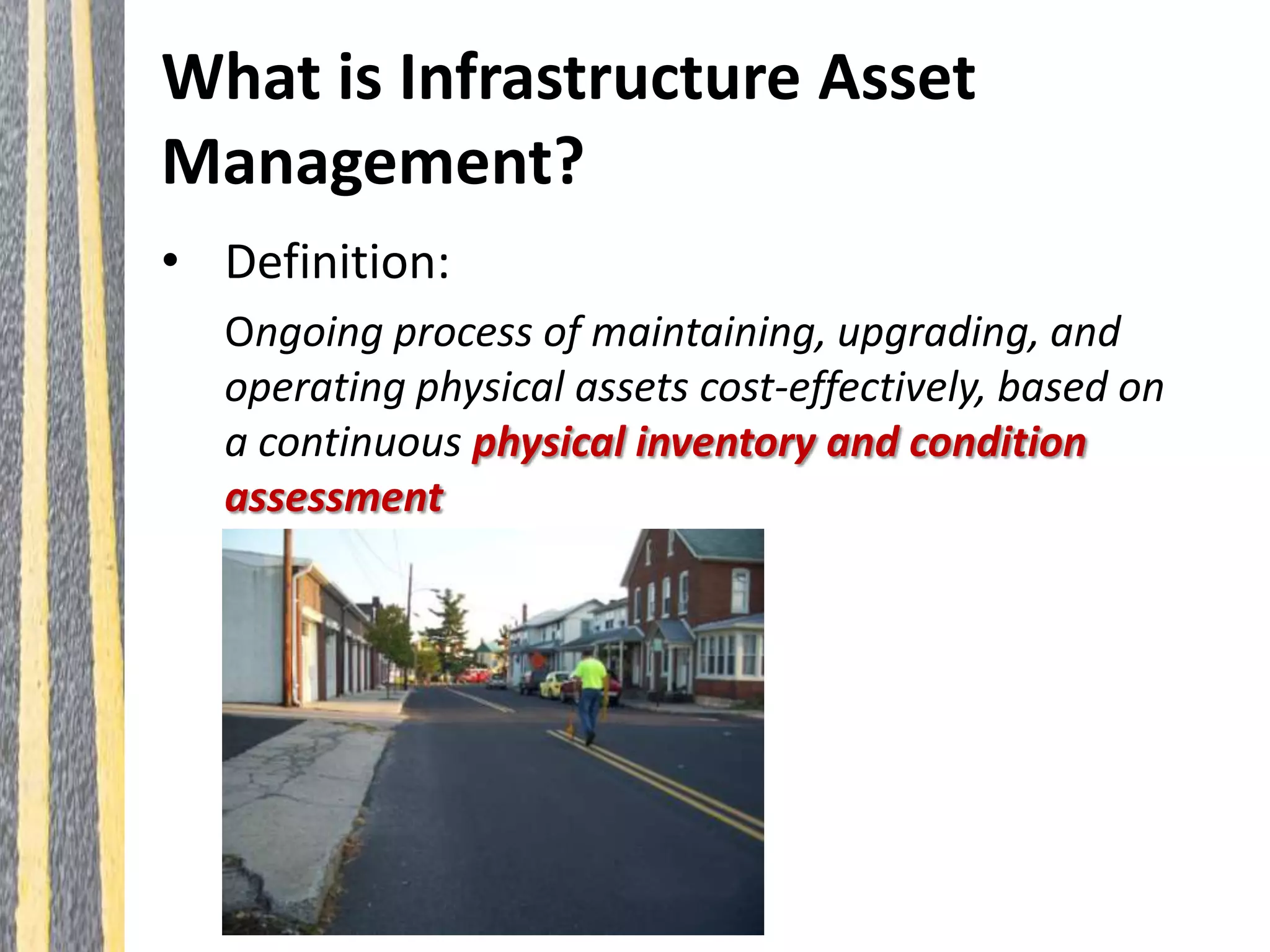
• Definition:
Ongoing process of maintaining, upgrading, and
operating physical assets cost-effectively, based on
a continuous physical inventory and condition
assessment
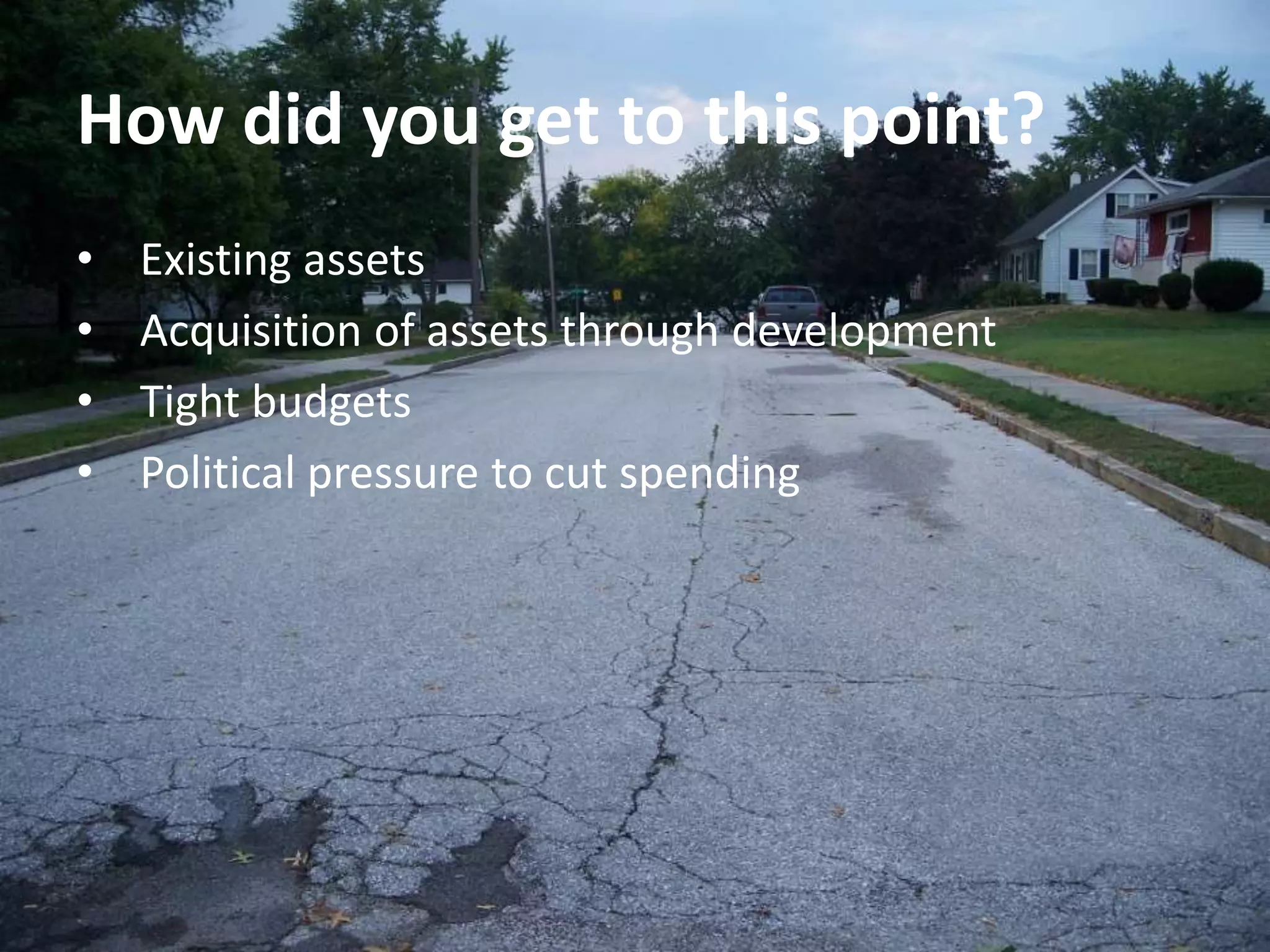
How did you get to this point?
• Existing assets
• Acquisition of assets through development
• Tight budgets
• Political pressure to cut spending
Why develop asset management
plans?
• Township elected officials and staff are at the
front lines of fixing the Commonwealth’s
crumbling infrastructure
• ASCE’s Failure to Act report:
• “deteriorating infrastructure, long known to be a
public safety issue, has a cascading impact on the
nation’s economy, negatively affecting business
productivity, gross domestic
product, employment, personal income, and
international competitiveness.”
Why develop asset management
plans?
• The timing of, and allocation from, grant
programs may not be sufficient to address future
needs
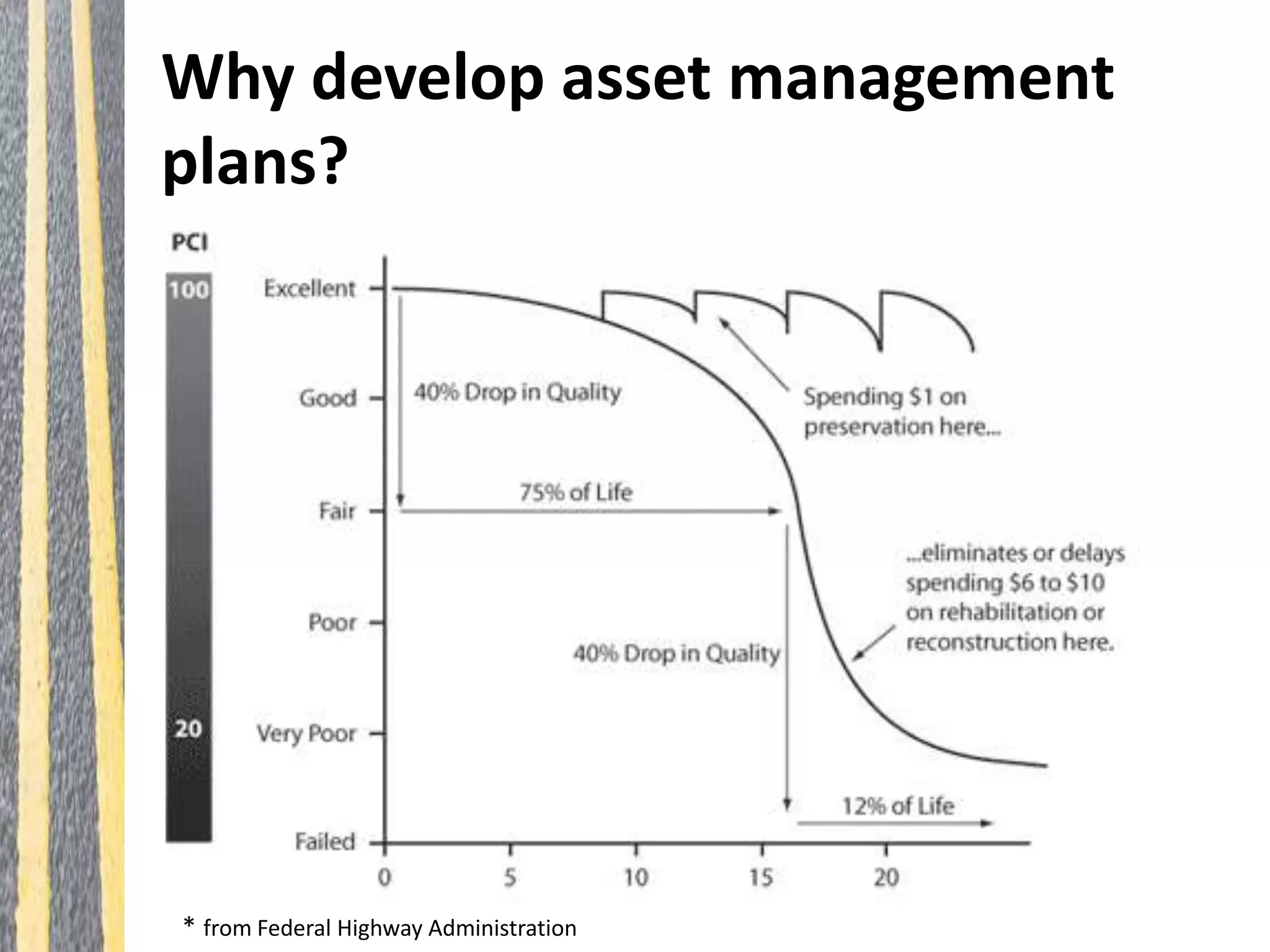
• Therefore, it is necessary to find ways to save
money while still maintaining infrastructure
assets at a desired level of service (quality and
safety)
Why develop asset management
plans?
* from Federal Highway Administration
Why develop asset management
plans?
How to Create an Asset
Management Plan
• Buy-in: working plan vs. paper weight
• Definition:
Ongoing process of maintaining, upgrading, and
operating physical assets cost-effectively, based
on a continuous physical inventory and
condition assessment
How to Create an Asset
Management Plan
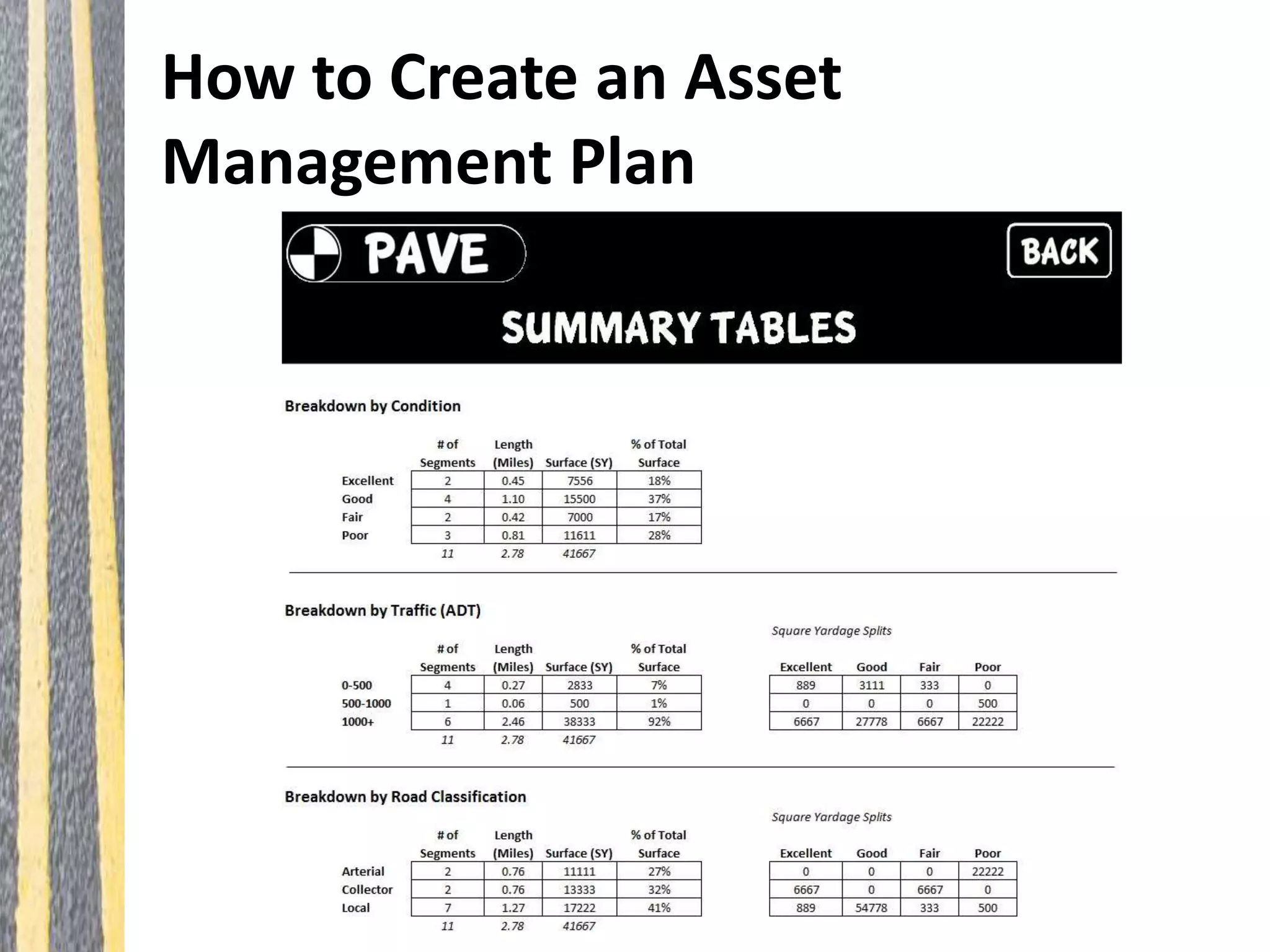
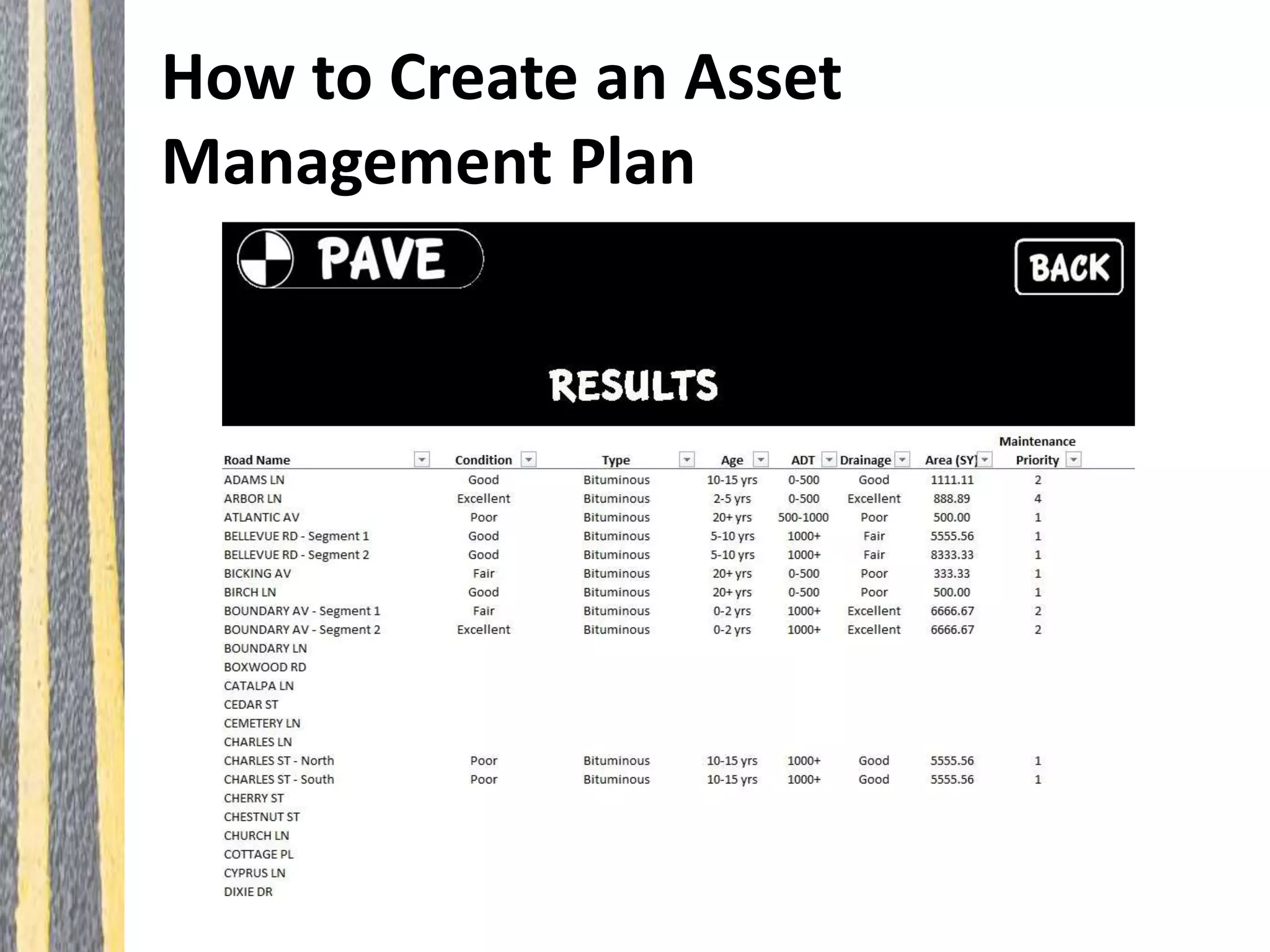
• Steps
• Inventory
• Assess condition (rating)
• Determine needs (cost estimates) “unrestricted” plan
• Assess finances
• Develop multi-year “budgeted” plan
How to Create an Asset
Management Plan
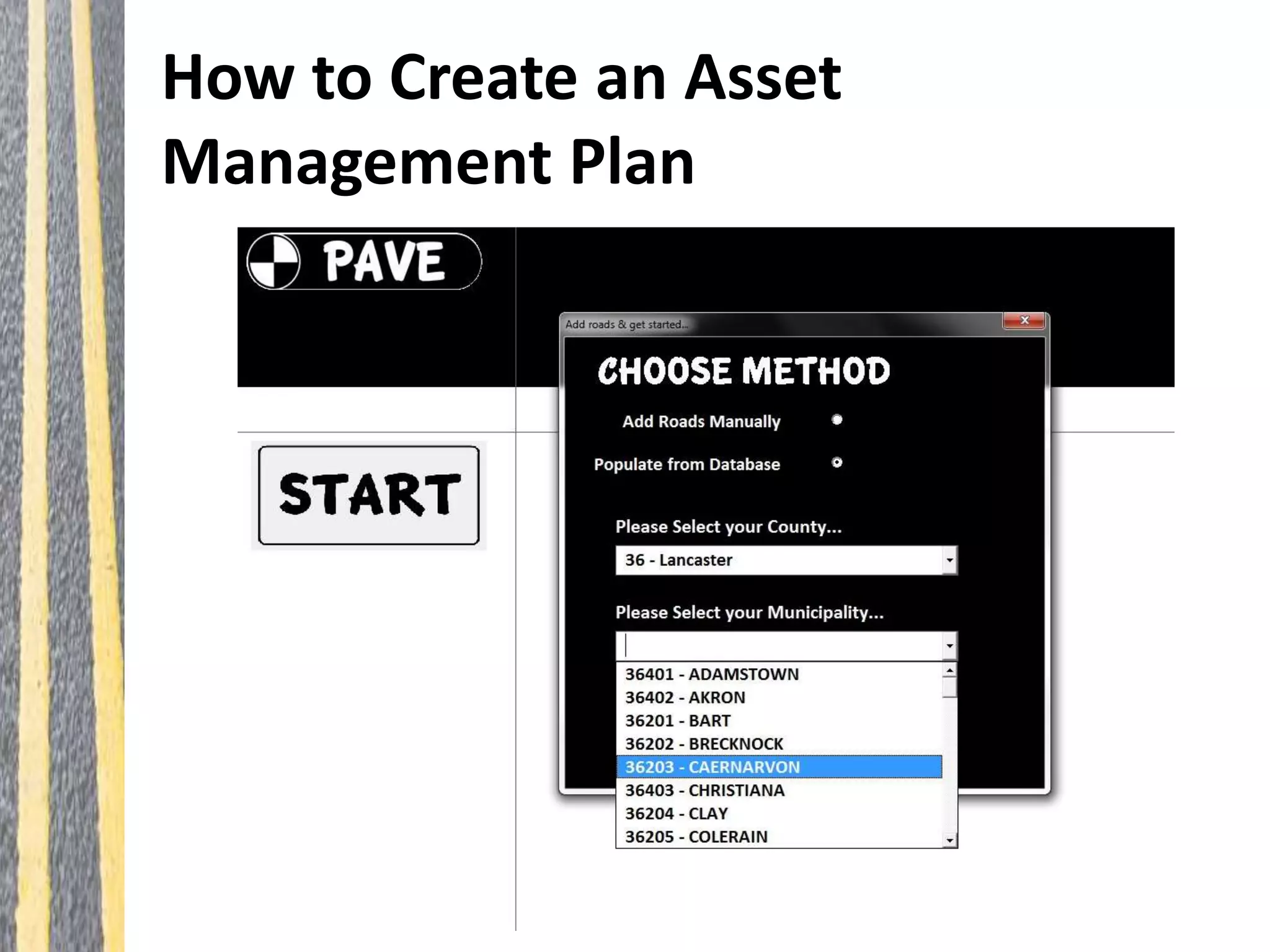
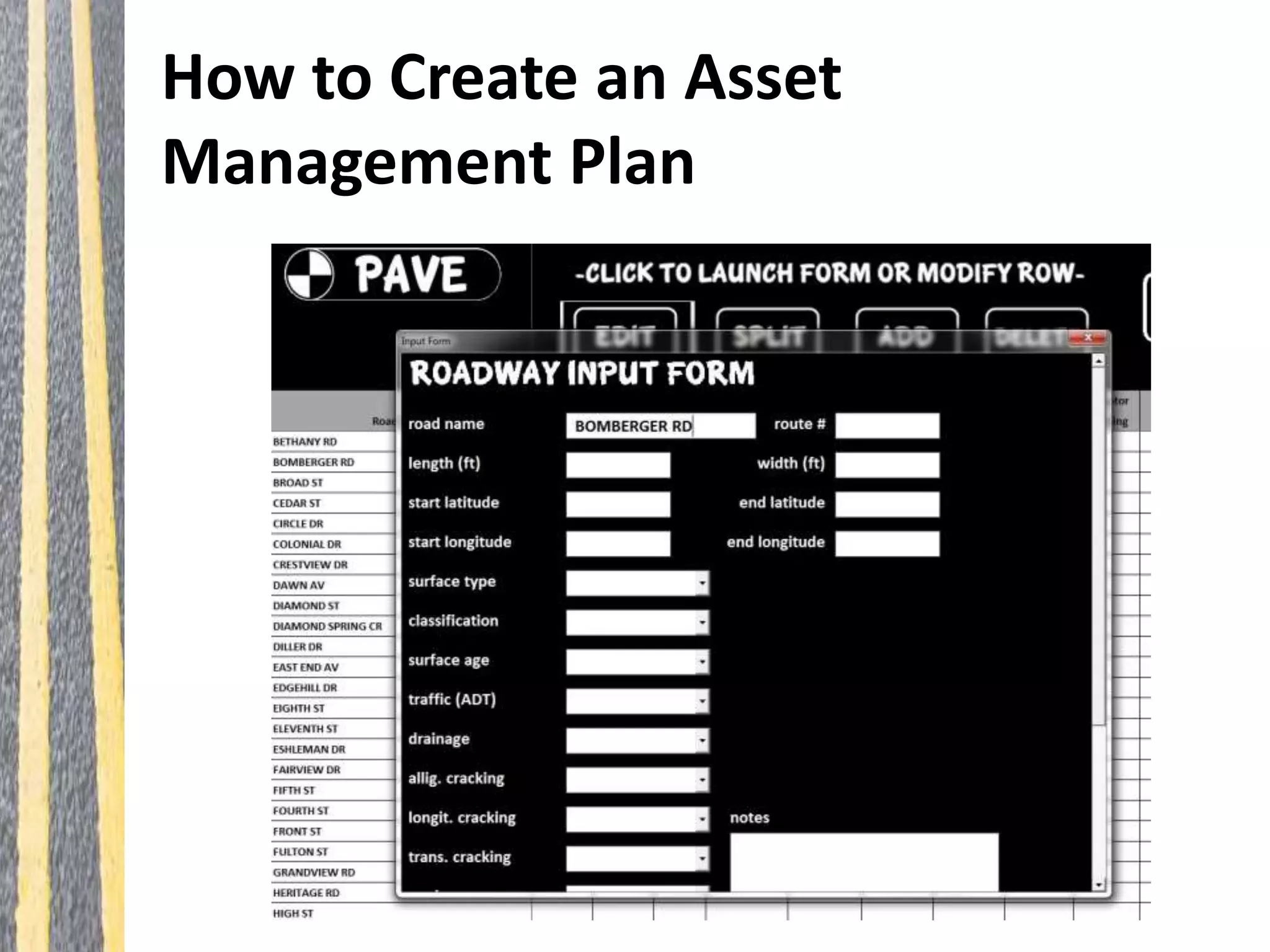
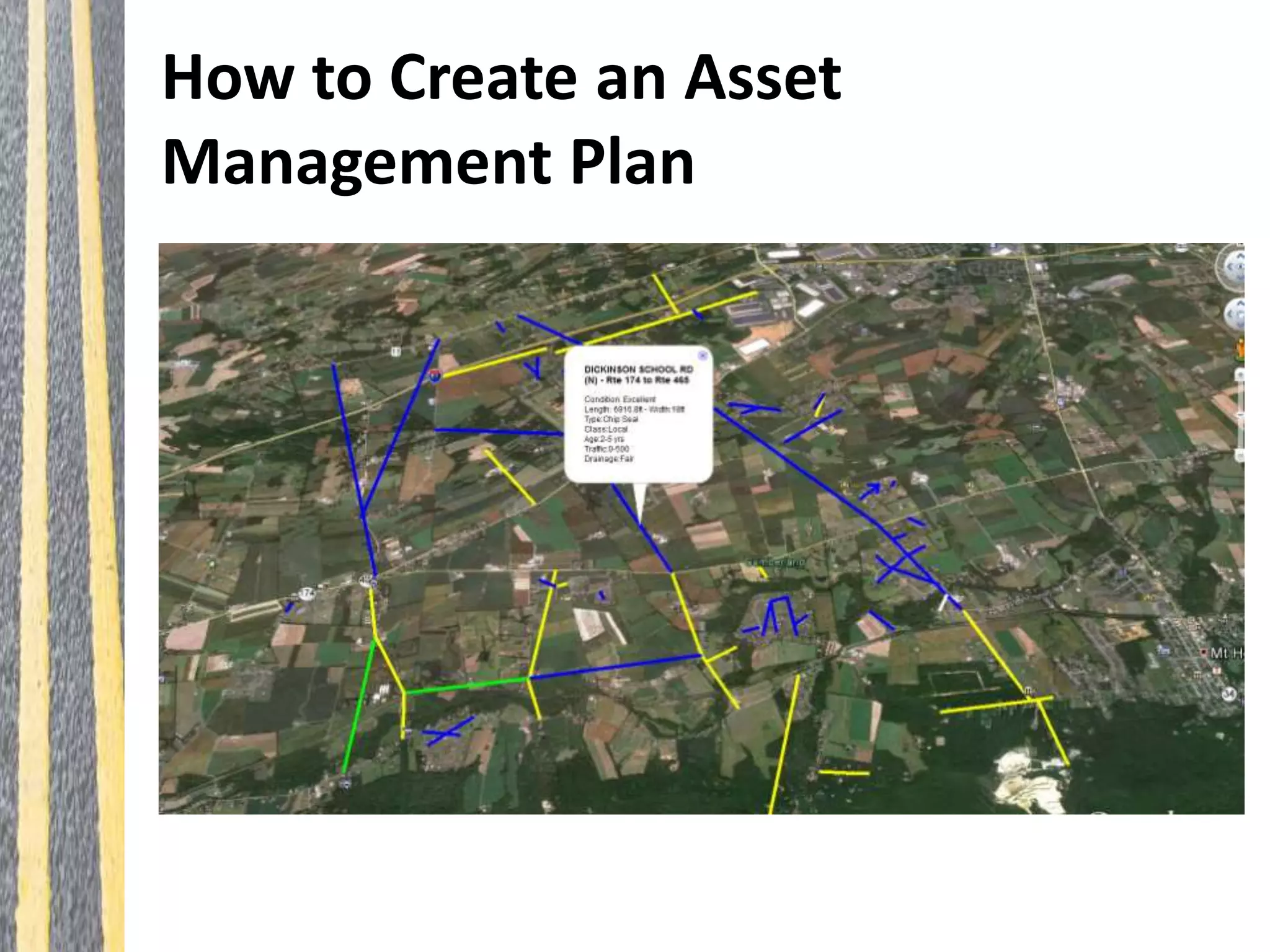
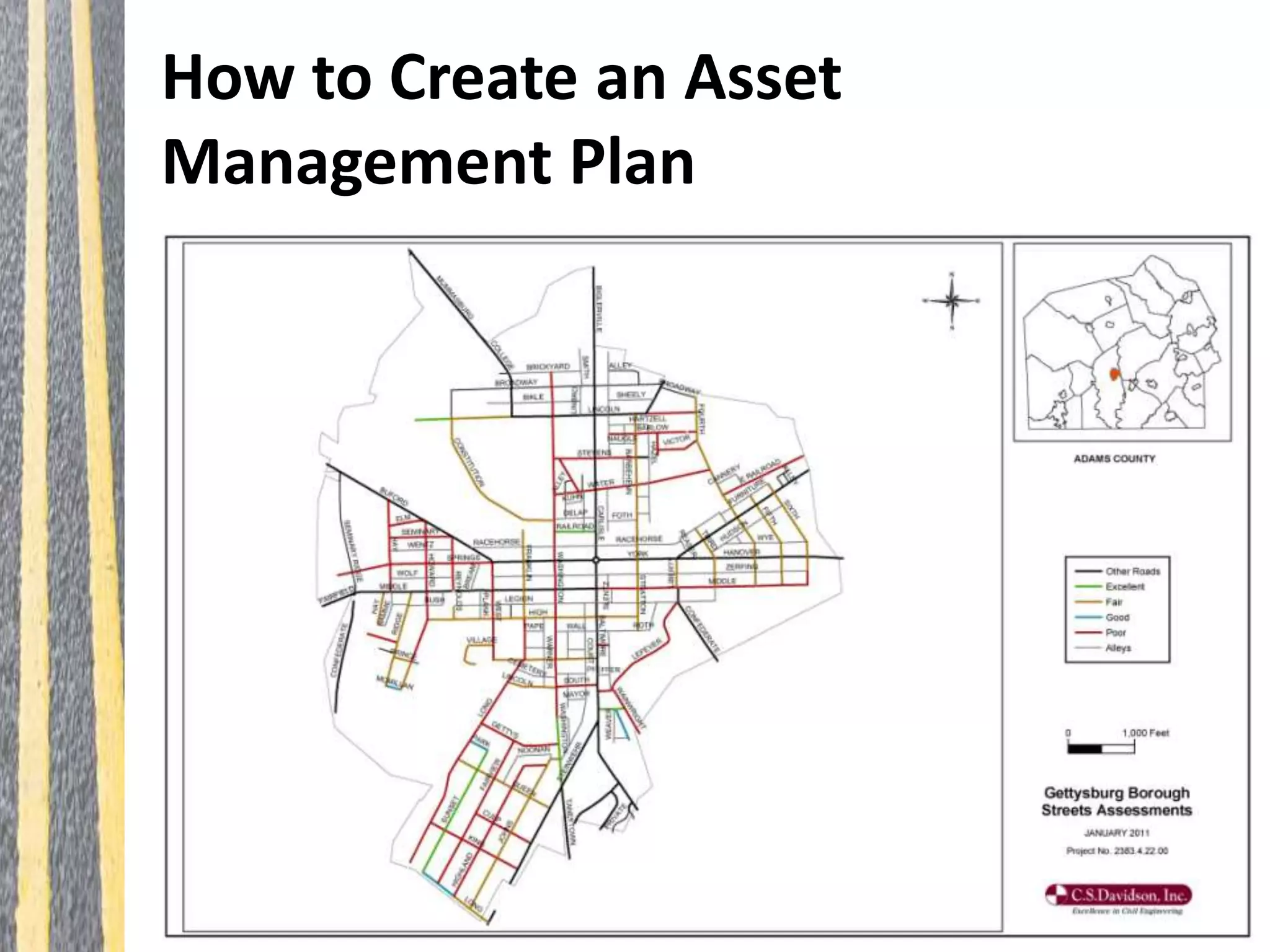
• Inventory
• Existing maps
• Existing lists/reports
• As-builts
• Drive to and measure
• GIS
How to Create an Asset
Management Plan
How to Create an Asset
Management Plan
How to Create an Asset
Management Plan
• Assess condition (rating)
• Multiple methods are published and available
• Subjective method
– Cheap
– Need to use same set of eyes
– Limited data analysis over time
How to Create an Asset
Management Plan
• Objective method
• More time/expense
• Multiple staff/consultants could come to same results
• Data analysis over time could lead to a better
understand of deterioration rates
How to Create an Asset
Management Plan
How to Create an Asset
Management Plan
How to Create an Asset
Management Plan
How to Create an Asset
Management Plan
How to Create an Asset
Management Plan
How to Create an Asset
Management Plan
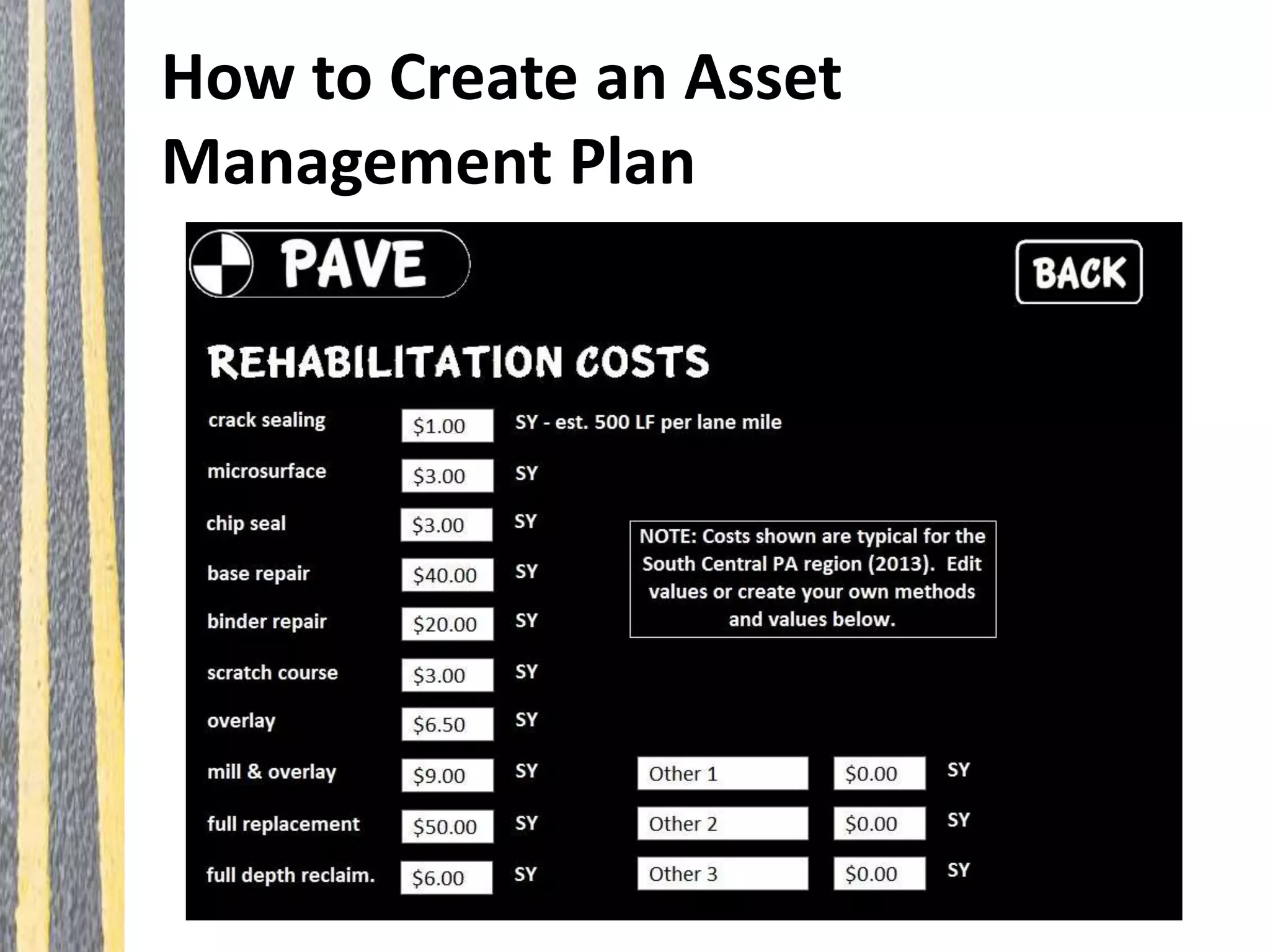
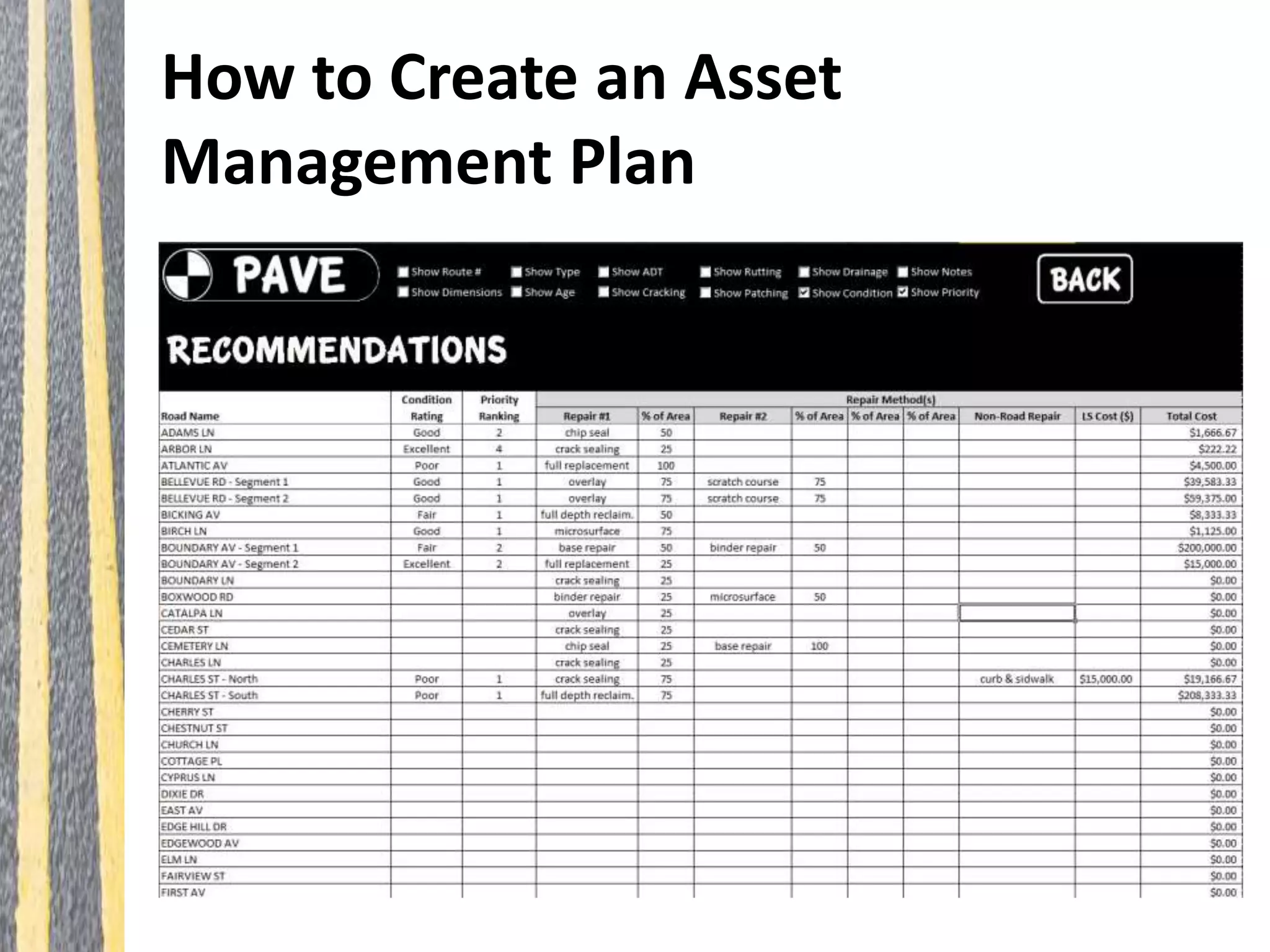
• Determine needs (cost estimates) “unrestricted”
plan
• Use judgment to develop prescriptions to bring asset up
to desired level of service
• Prepare cost estimates for each prescription with
appropriate contingencies
How to Create an Asset
Management Plan
How to Create an Asset
Management Plan
How to Create an Asset
Management Plan
• Assess finances
• Existing budgets
• Funding opportunities
How to Create an Asset
Management Plan
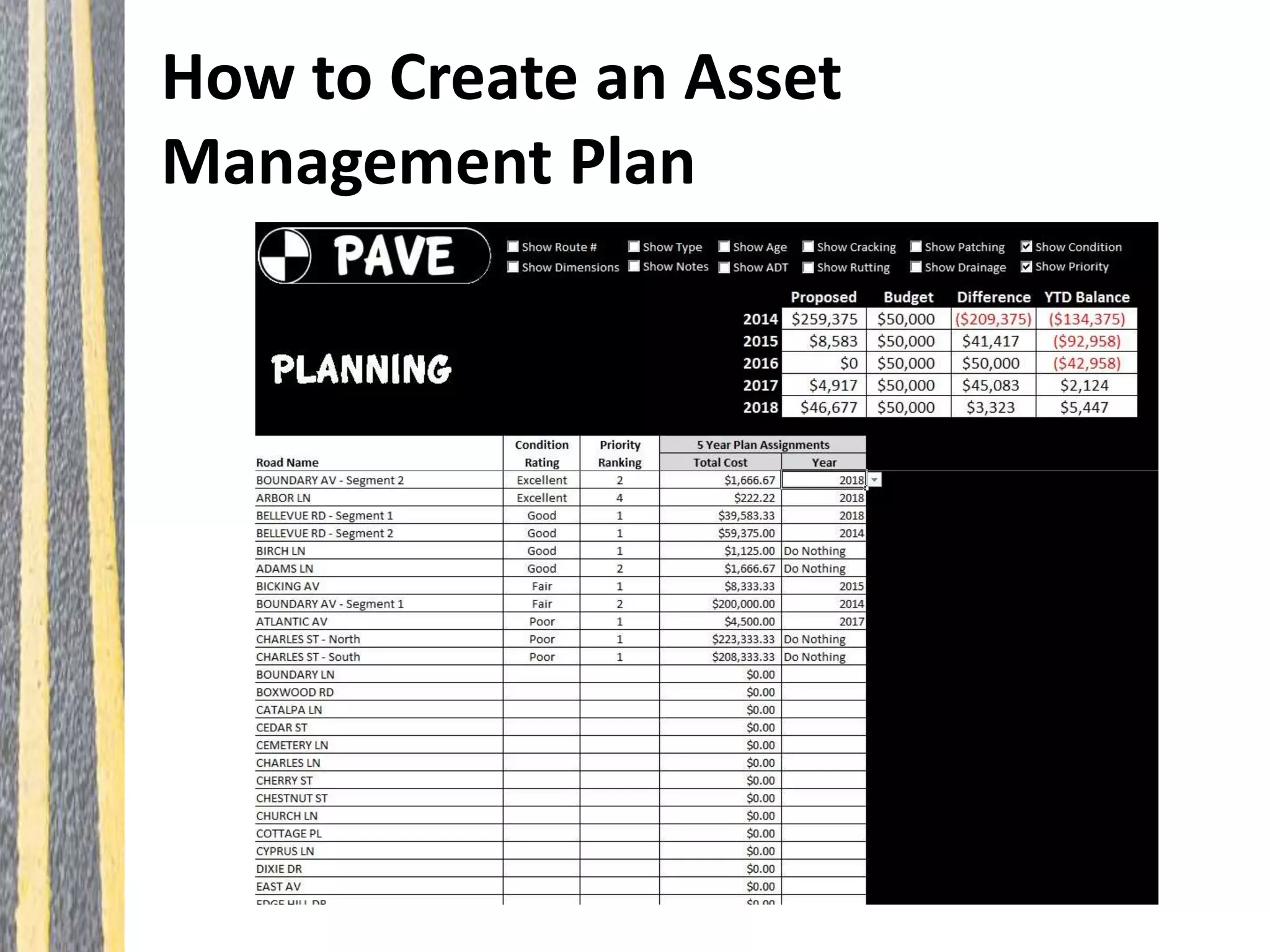
• Develop multi-year “budgeted” plan
• Develop priority ranking metrics
(traffic, age, drainage, hazards, resident input)
• Coordination of condition
assessment, prescriptions and cost
estimates, priorities, and finances
• Living document
• Implement and track progress and costs
• Change plan as necessary (a changed plan is better than no plan)
• Explain deviations to those who will follow you
• Repeat
How to Create an Asset
Management Plan
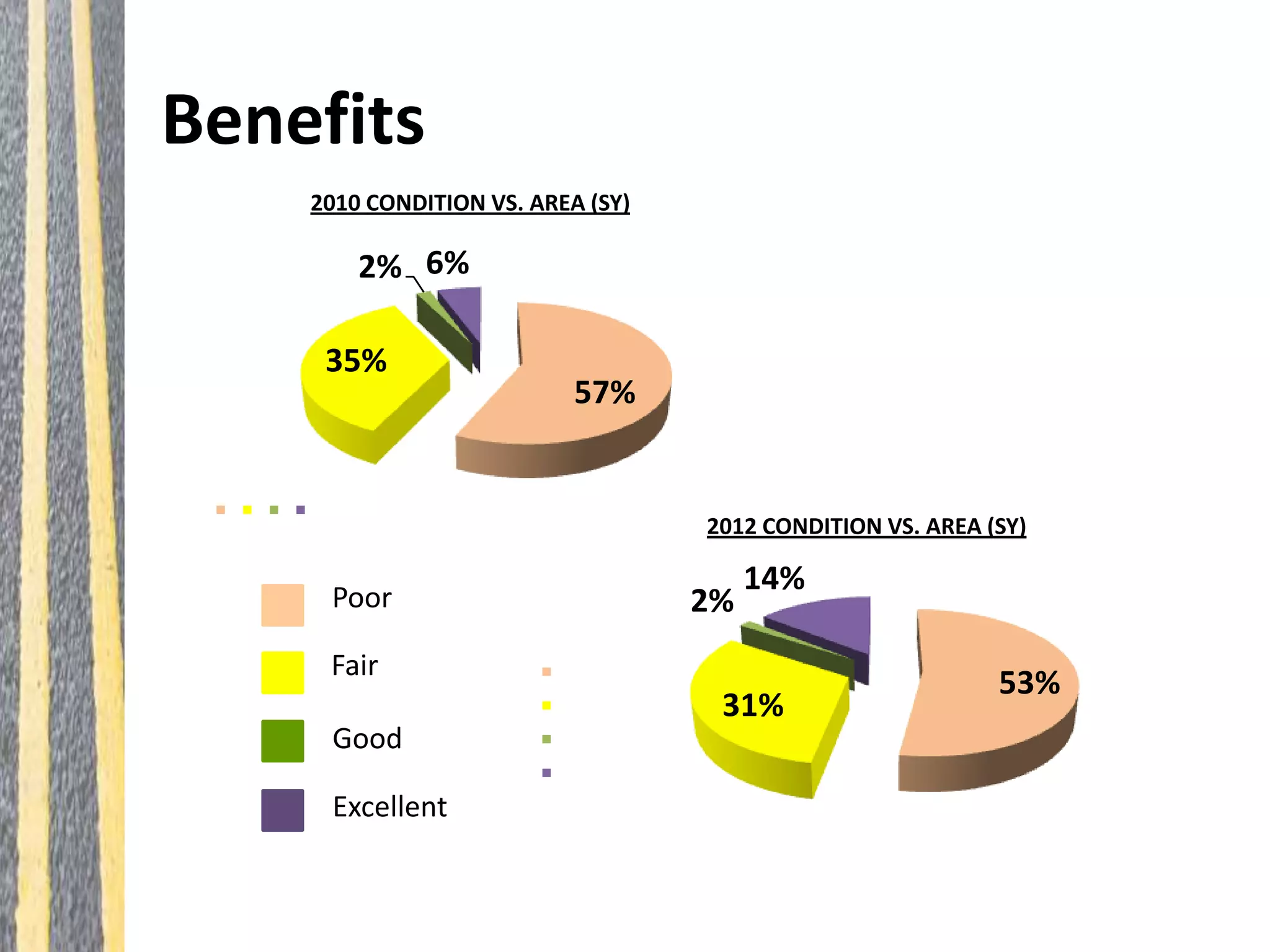
Benefits
• Budget planning easier
• Look at the plan
• Spend or set aside
• Coordination of utilities
• Example: Street cut ordinances with sliding scale
degradation fee
• Fee waived if utilities make repairs prior to road repair
• Note: A five-year plan may have to updated at year 3 or
4 so utilities can begin to plan for activities in years 6
and 7
Benefits
• Communication with residents
• Demonstrate scope of work planned and how funds will
be allocated
• Answer “When will my street be paved/bridge be
repaired/stormwater basin be fixed?”
• Show Progress
• Commitment to stick to plan
• Reassess to show improved condition ratings
Benefits
57%
35%
2% 6%
2010 CONDITION VS. AREA (SY)
Poor
Fair
Good
Excellent
53%
31%
2%
14%
2012 CONDITION VS. AREA (SY)
QUESTIONS?
Christopher W. Toms, P.E.
Senior Client Manager
(717) 846-4805
cwt@csdavidson.com

The Value of Infrastructure Asset Management

  • 1.
    The Value of InfrastructureAsset Management Christopher W. Toms, P.E. Senior Client Manager
  • 2.
    What is InfrastructureAsset Management? • Definition*: Ongoing process of maintaining, upgrading, and operating physical assets cost-effectively, based on a continuous physical inventory and condition assessment * from Michigan publication
  • 3.
    What is InfrastructureAsset Management? • Definition: Ongoing process of maintaining, upgrading, and operating physical assets cost-effectively, based on a continuous physical inventory and condition assessment • Example assets • Roads • Bridges • Culverts/Storm Sewers • Curbs/Sidewalks • Stormwater Management Basins • Signs
  • 4.
    What is InfrastructureAsset Management? • Definition: Ongoing process of maintaining, upgrading, and operating physical assets cost-effectively, based on a continuous physical inventory and condition assessment • A gap typically exists in a community because: • Operations and maintenance costs increase at a rate faster than inflation because assets are getting older • Rates provide funds that are sufficient to sustain current operation and maintenance, but insufficient to pay for upgrades or capital replacements
  • 5.
    What is InfrastructureAsset Management? • Township has: • 15 roads • 24’ wide • 1 mile long • It costs: • $15.00/square yard to refurbish roadway • Each road has: • 15 year design life • New road adopted each year for the last 15 years
  • 6.
    What is InfrastructureAsset Management? • Township needs to budget $211,200 per year, per mile • Compare that to current Liquid Fuels and Turnback allocation per mile
  • 7.
    What is InfrastructureAsset Management? • Definition: Ongoing process of maintaining, upgrading, and operating physical assets cost-effectively, based on a continuous physical inventory and condition assessment
  • 8.
    How did youget to this point? • Existing assets • Acquisition of assets through development • Tight budgets • Political pressure to cut spending
  • 9.
    Why develop assetmanagement plans? • Township elected officials and staff are at the front lines of fixing the Commonwealth’s crumbling infrastructure • ASCE’s Failure to Act report: • “deteriorating infrastructure, long known to be a public safety issue, has a cascading impact on the nation’s economy, negatively affecting business productivity, gross domestic product, employment, personal income, and international competitiveness.”
  • 10.
    Why develop assetmanagement plans? • The timing of, and allocation from, grant programs may not be sufficient to address future needs • Therefore, it is necessary to find ways to save money while still maintaining infrastructure assets at a desired level of service (quality and safety)
  • 11.
    Why develop assetmanagement plans? * from Federal Highway Administration
  • 12.
    Why develop assetmanagement plans?
  • 13.
    How to Createan Asset Management Plan • Buy-in: working plan vs. paper weight • Definition: Ongoing process of maintaining, upgrading, and operating physical assets cost-effectively, based on a continuous physical inventory and condition assessment
  • 14.
    How to Createan Asset Management Plan • Steps • Inventory • Assess condition (rating) • Determine needs (cost estimates) “unrestricted” plan • Assess finances • Develop multi-year “budgeted” plan
  • 15.
    How to Createan Asset Management Plan • Inventory • Existing maps • Existing lists/reports • As-builts • Drive to and measure • GIS
  • 16.
    How to Createan Asset Management Plan
  • 17.
    How to Createan Asset Management Plan
  • 18.
    How to Createan Asset Management Plan • Assess condition (rating) • Multiple methods are published and available • Subjective method – Cheap – Need to use same set of eyes – Limited data analysis over time
  • 19.
    How to Createan Asset Management Plan • Objective method • More time/expense • Multiple staff/consultants could come to same results • Data analysis over time could lead to a better understand of deterioration rates
  • 20.
    How to Createan Asset Management Plan
  • 21.
    How to Createan Asset Management Plan
  • 22.
    How to Createan Asset Management Plan
  • 23.
    How to Createan Asset Management Plan
  • 24.
    How to Createan Asset Management Plan
  • 25.
    How to Createan Asset Management Plan • Determine needs (cost estimates) “unrestricted” plan • Use judgment to develop prescriptions to bring asset up to desired level of service • Prepare cost estimates for each prescription with appropriate contingencies
  • 26.
    How to Createan Asset Management Plan
  • 27.
    How to Createan Asset Management Plan
  • 28.
    How to Createan Asset Management Plan • Assess finances • Existing budgets • Funding opportunities
  • 29.
    How to Createan Asset Management Plan • Develop multi-year “budgeted” plan • Develop priority ranking metrics (traffic, age, drainage, hazards, resident input) • Coordination of condition assessment, prescriptions and cost estimates, priorities, and finances • Living document • Implement and track progress and costs • Change plan as necessary (a changed plan is better than no plan) • Explain deviations to those who will follow you • Repeat
  • 30.
    How to Createan Asset Management Plan
  • 31.
    Benefits • Budget planningeasier • Look at the plan • Spend or set aside • Coordination of utilities • Example: Street cut ordinances with sliding scale degradation fee • Fee waived if utilities make repairs prior to road repair • Note: A five-year plan may have to updated at year 3 or 4 so utilities can begin to plan for activities in years 6 and 7
  • 32.
    Benefits • Communication withresidents • Demonstrate scope of work planned and how funds will be allocated • Answer “When will my street be paved/bridge be repaired/stormwater basin be fixed?” • Show Progress • Commitment to stick to plan • Reassess to show improved condition ratings
  • 33.
    Benefits 57% 35% 2% 6% 2010 CONDITIONVS. AREA (SY) Poor Fair Good Excellent 53% 31% 2% 14% 2012 CONDITION VS. AREA (SY)
  • 35.
    QUESTIONS? Christopher W. Toms,P.E. Senior Client Manager (717) 846-4805 cwt@csdavidson.com