The INTENT project : INtegrating
 TElecollaborative NeTworks into
Foreign Language Higher Education
         3 Paper Symposium
PART II
EVIDENCING AND ASSESSING ONLINE
  INTERCULTURAL COMPETENCES:
      THE INTENT PORTFOLIO

          DR. MELINDA DOOLY
    (U. AUTÒNOMA DE BARCELONA)
          DR. TIMOTHY LEWIS
               (OPEN U.)
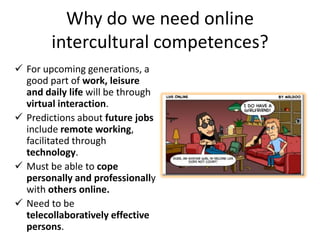
Why do we need online
        intercultural competences?
 For upcoming generations, a
  good part of work, leisure
  and daily life will be through
  virtual interaction.
 Predictions about future jobs
  include remote working,
  facilitated through
  technology.
 Must be able to cope
  personally and professionally
  with others online.
 Need to be
  telecollaboratively effective
  persons.
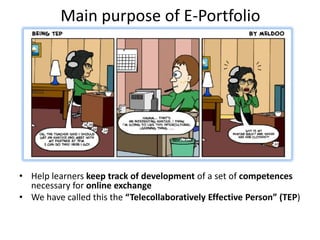
Main purpose of E-Portfolio


• Help learners keep track of development of a set of competences
  necessary for online exchange
• We have called this the “Telecollaboratively Effective Person” (TEP)
The 3 components

  Brief descriptions
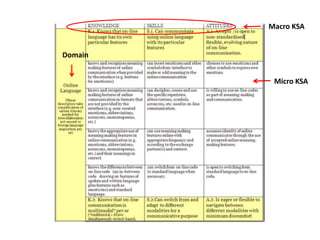
Descriptors
• Divided into 4 main domains:
  –   Online Language Competences
  –   Social Competences
  –   Technical Competences
  –   Intercultural Competences.
• These domains are divided into 3 ‘macro’ KSAs
  (Knowledge, Skills, and Attitudes)
  – KSAs into ‘micro’ KSAs to facilitate pinpointing specific
    actions for development and assessment of the
    competences.
Descriptors   Macro KSA


Domain


                        Micro KSA
Personal Reflection Diary
• Suggestions on how to document the
  development of TEP competences.
• Suggestions on how to link reflections to TEP
  descriptors & evidence of learning
• Suggestions on different modes (text, audio,
  video, still images)
• ‘Openers’: reflection questions to get started
Reflection Questions
•   –What? Briefly describe the event/s from an online exchange as objectively as
    possible.
     – What happened?
     – Who was involved?
       What did you observe?
     – Etc.
•   –So What? Analyze the experience, objectively (e.g. with the TEP guidelines) and
    subjectively (what you felt, did).
     – Did something surprise you or feel unexpected?
     – What was your perspective as the event was happening (What ‘lens’ were you ‘viewing’
       from?)
     – Was there something you particularly liked/disliked? Why?
     – Were there any particular challenges or difficulties?
     – Etc.
•   –Now What? Did you learn anything from it? Where can you go from here?
     –   Did you learn a new skill or clarify an interest?
     –   How can you keep and apply this learning in the future?
     –   What more would you like to learn related to this type of exchange?
     –   How can you learn more?
     –   What information/advice would you like to share with your peers?
     –   If you could do the exchange again, what would you do differently?
     –   Etc.
Evidence of Learning
• Suggestions on how to link evidence to theory and
  practice.
• Suggestions on linking all of the above to reflection
  (through personal diary)
• Suggestions for modes of documentation
   –Text chat extracts
   –Voice chat recordings
   –Voice chat transcriptions
   –Blog or forum entries
   –Screen captures such as recording of screen movements
    (while text chatting, while meeting in synchronous video
    conferencing sessions, Virtual Worlds, etc.)
   –…
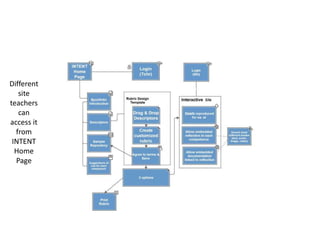
Outline of Platform

   Brief description
Different
   site
teachers
   can
access it
  from
 INTENT
  Home
  Page
Optional Uses of Portfolio

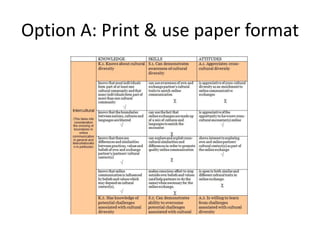
Self-design of rubric (print & use)
 Interactive mélange of selected
           competences
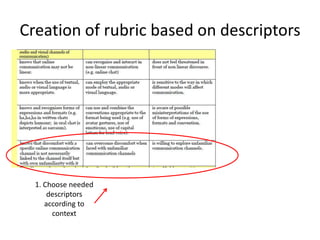
Creation of rubric based on descriptors


  1. Choose needed
      descriptors
     according to
       context
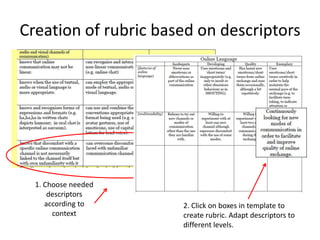
Creation of rubric based on descriptors


  1. Choose needed
      descriptors
     according to     2. Click on boxes in template to
       context        create rubric. Adapt descriptors to
                      different levels.
Option A: Print & use paper format
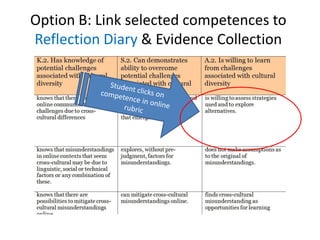
Option B: Link selected competences to
Reflection Diary & Evidence Collection
Option B: Link selected competences to
  Reflection Diary & Evidence Collection


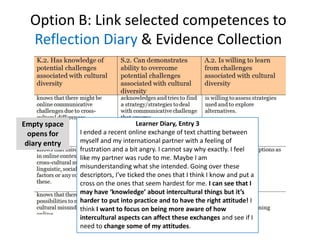
Empty space                         Learner Diary, Entry 3
  opens for    I ended a recent online exchange of text chatting between
 diary entry   myself and my international partner with a feeling of
               frustration and a bit angry. I cannot say why exactly. I feel
               like my partner was rude to me. Maybe I am
               misunderstanding what she intended. Going over these
               descriptors, I’ve ticked the ones that I think I know and put a
               cross on the ones that seem hardest for me. I can see that I
               may have ‘knowledge’ about intercultural things but it’s
               harder to put into practice and to have the right attitude! I
               think I want to focus on being more aware of how
               intercultural aspects can affect these exchanges and see if I
               need to change some of my attitudes.
Option B: Link selected competences to
Reflection Diary & Evidence Collection
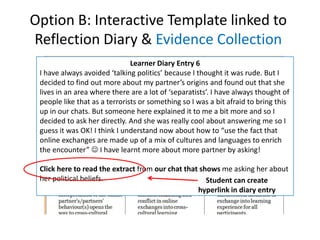
Option B: Interactive Template linked to
Reflection Diary & Evidence Collection
                               Learner Diary Entry 6
 I have always avoided ‘talking politics’ because I thought it was rude. But I
 decided to find out more about my partner’s origins and found out that she
 lives in an area where there are a lot of ‘separatists’. I have always thought of
 people like that as a terrorists or something so I was a bit afraid to bring this
 up in our chats. But someone here explained it to me a bit more and so I
 decided to ask her directly. And she was really cool about answering me so I
 guess it was OK! I think I understand now about how to “use the fact that
 online exchanges are made up of a mix of cultures and languages to enrich
 the encounter”  I have learnt more about more partner by asking!

 Click here to read the extract from our chat that shows me asking her about
 her political beliefs.                              Student can create
                                                  hyperlink in diary entry
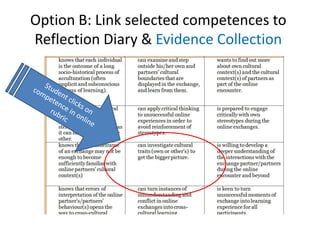
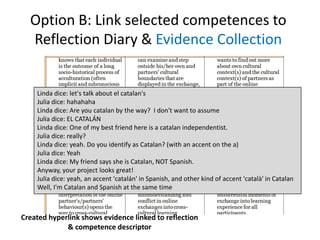
Option B: Link selected competences to
  Reflection Diary & Evidence Collection


    Linda dice: let's talk about el catalan's
    Julia dice: hahahaha
    Linda dice: Are you catalan by the way? I don't want to assume
    Julia dice: EL CATALÁN
    Linda dice: One of my best friend here is a catalan independentist.
    Julia dice: really?
    Linda dice: yeah. Do you identify as Catalan? (with an accent on the a)
    Julia dice: Yeah
    Linda dice: My friend says she is Catalan, NOT Spanish.
    Anyway, your project looks great!
    Julia dice: yeah, an accent 'catalán' in Spanish, and other kind of accent 'català' in Catalan
    Well, I'm Catalan and Spanish at the same time


Created hyperlink shows evidence linked to reflection
             & competence descriptor
Open Floor

   We’d like your feedback on the
Eportfolio descriptors for the Social &
       Intercultural Aspects …

INTENT Presentation IALIC 2012

  • 1.
    The INTENT project: INtegrating TElecollaborative NeTworks into Foreign Language Higher Education 3 Paper Symposium
  • 2.
    PART II EVIDENCING ANDASSESSING ONLINE INTERCULTURAL COMPETENCES: THE INTENT PORTFOLIO DR. MELINDA DOOLY (U. AUTÒNOMA DE BARCELONA) DR. TIMOTHY LEWIS (OPEN U.)
  • 3.
    Why do weneed online intercultural competences?  For upcoming generations, a good part of work, leisure and daily life will be through virtual interaction.  Predictions about future jobs include remote working, facilitated through technology.  Must be able to cope personally and professionally with others online.  Need to be telecollaboratively effective persons.
  • 4.
    Main purpose ofE-Portfolio • Help learners keep track of development of a set of competences necessary for online exchange • We have called this the “Telecollaboratively Effective Person” (TEP)
  • 5.
    The 3 components Brief descriptions
  • 6.
    Descriptors • Divided into4 main domains: – Online Language Competences – Social Competences – Technical Competences – Intercultural Competences. • These domains are divided into 3 ‘macro’ KSAs (Knowledge, Skills, and Attitudes) – KSAs into ‘micro’ KSAs to facilitate pinpointing specific actions for development and assessment of the competences.
  • 7.
    Descriptors Macro KSA Domain Micro KSA
  • 8.
    Personal Reflection Diary •Suggestions on how to document the development of TEP competences. • Suggestions on how to link reflections to TEP descriptors & evidence of learning • Suggestions on different modes (text, audio, video, still images) • ‘Openers’: reflection questions to get started
  • 9.
    Reflection Questions • –What? Briefly describe the event/s from an online exchange as objectively as possible. – What happened? – Who was involved? What did you observe? – Etc. • –So What? Analyze the experience, objectively (e.g. with the TEP guidelines) and subjectively (what you felt, did). – Did something surprise you or feel unexpected? – What was your perspective as the event was happening (What ‘lens’ were you ‘viewing’ from?) – Was there something you particularly liked/disliked? Why? – Were there any particular challenges or difficulties? – Etc. • –Now What? Did you learn anything from it? Where can you go from here? – Did you learn a new skill or clarify an interest? – How can you keep and apply this learning in the future? – What more would you like to learn related to this type of exchange? – How can you learn more? – What information/advice would you like to share with your peers? – If you could do the exchange again, what would you do differently? – Etc.
  • 10.
    Evidence of Learning •Suggestions on how to link evidence to theory and practice. • Suggestions on linking all of the above to reflection (through personal diary) • Suggestions for modes of documentation –Text chat extracts –Voice chat recordings –Voice chat transcriptions –Blog or forum entries –Screen captures such as recording of screen movements (while text chatting, while meeting in synchronous video conferencing sessions, Virtual Worlds, etc.) –…
  • 11.
    Outline of Platform Brief description
  • 12.
    Different site teachers can access it from INTENT Home Page
  • 13.
    Optional Uses ofPortfolio Self-design of rubric (print & use) Interactive mélange of selected competences
  • 14.
    Creation of rubricbased on descriptors 1. Choose needed descriptors according to context
  • 15.
    Creation of rubricbased on descriptors 1. Choose needed descriptors according to 2. Click on boxes in template to context create rubric. Adapt descriptors to different levels.
  • 16.
    Option A: Print& use paper format
  • 17.
    Option B: Linkselected competences to Reflection Diary & Evidence Collection
  • 18.
    Option B: Linkselected competences to Reflection Diary & Evidence Collection Empty space Learner Diary, Entry 3 opens for I ended a recent online exchange of text chatting between diary entry myself and my international partner with a feeling of frustration and a bit angry. I cannot say why exactly. I feel like my partner was rude to me. Maybe I am misunderstanding what she intended. Going over these descriptors, I’ve ticked the ones that I think I know and put a cross on the ones that seem hardest for me. I can see that I may have ‘knowledge’ about intercultural things but it’s harder to put into practice and to have the right attitude! I think I want to focus on being more aware of how intercultural aspects can affect these exchanges and see if I need to change some of my attitudes.
  • 19.
    Option B: Linkselected competences to Reflection Diary & Evidence Collection
  • 20.
    Option B: InteractiveTemplate linked to Reflection Diary & Evidence Collection Learner Diary Entry 6 I have always avoided ‘talking politics’ because I thought it was rude. But I decided to find out more about my partner’s origins and found out that she lives in an area where there are a lot of ‘separatists’. I have always thought of people like that as a terrorists or something so I was a bit afraid to bring this up in our chats. But someone here explained it to me a bit more and so I decided to ask her directly. And she was really cool about answering me so I guess it was OK! I think I understand now about how to “use the fact that online exchanges are made up of a mix of cultures and languages to enrich the encounter”  I have learnt more about more partner by asking! Click here to read the extract from our chat that shows me asking her about her political beliefs. Student can create hyperlink in diary entry
  • 21.
    Option B: Linkselected competences to Reflection Diary & Evidence Collection Linda dice: let's talk about el catalan's Julia dice: hahahaha Linda dice: Are you catalan by the way? I don't want to assume Julia dice: EL CATALÁN Linda dice: One of my best friend here is a catalan independentist. Julia dice: really? Linda dice: yeah. Do you identify as Catalan? (with an accent on the a) Julia dice: Yeah Linda dice: My friend says she is Catalan, NOT Spanish. Anyway, your project looks great! Julia dice: yeah, an accent 'catalán' in Spanish, and other kind of accent 'català' in Catalan Well, I'm Catalan and Spanish at the same time Created hyperlink shows evidence linked to reflection & competence descriptor
  • 22.
    Open Floor We’d like your feedback on the Eportfolio descriptors for the Social & Intercultural Aspects …