Work andWealth
Introduction
 Information technology and automation affecting
workplace
 Increases in productivity
 Globalization of job market
 Organization of companies
 Telework
 Workplace monitoring
 Impacts of information technology on society
 Digital divide
 Winner-take-all effects
Automation
andJob
Destruction
 Between 1979 and 2011…
 U.S. population increased 39%
 Manufacturing employment dropped 40%, from 19.4
million jobs to 11.7 million jobs
 Lost white-collar jobs
 Secretarial and clerical positions
 Accountants and bookkeepers
 Middle managers
 Juliet Schor:Work week got longer between 1979
and 1990
 PRECURSOR TOTHE DIGITASL DIVIDE
 Ques- can anyone think of a situation where a
comuter system has taken a job????? Sftware…
customer service calls???? Emails vs. snail mail
Automation
andJob
Creation
 Automation lowers prices
 That increases demand for the product
 It also increases real incomes, increasing demand for
other products
 Increased demand  more jobs
 Number of manufacturing jobs worldwide is increasing
 Martin Carnoy: Workers today work less than workers
100 years ago
Effects of
Increase in
Productivity
 We have used higher productivity to achieve a higher
material standard of living
 This is in contrast to medieval or ancient times (before
modern capitalism)
 In medieval or ancient times
 Low caloric intake meant pace of work was slow
 Work was seasonal and
intermittent
 Laborers resisted working if
they had enough money
(i.e., they weren’t consumers)
 When wages rose, laborers
worked less
Rise of the
Robots?
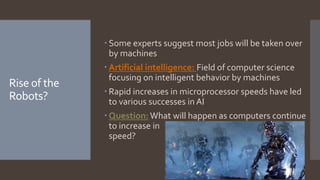
 Some experts suggest most jobs will be taken over
by machines
 Artificial intelligence: Field of computer science
focusing on intelligent behavior by machines
 Rapid increases in microprocessor speeds have led
to various successes in AI
 Question: What will happen as computers continue
to increase in
speed?
Notable
Achievements
inAI
Moral
Questions
Related to
Robotics
 Question: Is it wrong to create machines capable
of making human labor obsolete?
 Question: Would intelligent robots demoralize
humanity?
 Question: Is it wrong to work on an intelligent
machine if it can’t be guaranteed the machine will
be benevolent toward humans?
 Question: What if a malevolent human puts
intelligent machines to an evil use?
 Question: How would creative
computers change our ideas about
intellectual property?
Organizational
Changes
 Information technology integration into firms
 Automating back office functions (e.g., payroll)
 Improving manufacturing
 Improving communication among business units
 Results
 Flattened organizational structures
 Eliminating transactional middlemen (supply-chain
automation)
Telework
Advantages
 Increases productivity
 Reduces absenteeism
 Improves morale
 Helps recruitment and
retention of top employees
 Saves overhead
 Improves company resilience
 Helps environment
 Saves employees money
Disadvantages
 Threatens managers’ control
and authority
 Makes face-to-face meetings
impossible
 Sensitive information less
secure
 Team meetings more difficult
 Teleworkers less visible
 Teleworkers “out of the loop”
 Isolation of teleworkers
 Teleworkers work longer hours
for same pay
Employees work away from traditional place of work
Examples
Home office
Commuting to a telecenter
Salespersons with no office
About 20% of Americans do some telework
Temporary
Work
 Companies less committed to employees
 Lay-offs not taboo as they once were
 Companies hiring more temporary employees
 Saves money on benefits
 Makes it easier to downsize
 Long-term employment for one firm less common
 Average time spent at a company is 5 years.
 Temporary ContractWork allows for:
 Skilled worker
 A Change
Globalization
Arguments For
 Increases competition
 People in poorer countries
deserve jobs, too
 It is a tried-and-true route for
a poor country to become
prosperous
 Global jobs reduce unrest and
increase stability
Arguments Against
 Makes the United States
subordinate to theWorld
Trade Organization
 Forces American workers to
compete with foreigners who
do not get decent wages and
benefits
 Accelerates exodus of
manufacturing and white-
collar jobs from United States
 Hurts workers in foreign
countries
Globalization: Process of creating a worldwide
network of businesses and markets
Globalization causes a greater mobility of
goods, services, and capital around the world
Globalization made possible through rapidly
decreasing cost of information technology
The Digital
Divide
 Digital divide: Some people have access to modern
information technology while others do not
 Underlying assumption: people with access to
telephones, computers, Internet have opportunities
denied to those without access
 Concept of digital divide became popular with
emergence ofWorldWide Web
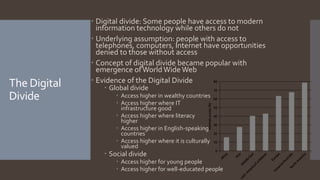
 Evidence of the Digital Divide
 Global divide
 Access higher in wealthy countries
 Access higher where IT
infrastructure good
 Access higher where literacy
higher
 Access higher in English-speaking
countries
 Access higher where it is culturally
valued
 Social divide
 Access higher for young people
 Access higher for well-educated people
Critiques of the
Digital Divide
 DD talk suggests the difference between “haves”
and “have nots” is simply about access
 DD talk puts everyone in two categories, but
reality is a continuum
 DD implies lack of access leads to less advantaged
social position, but maybe it is the other way
around
 Internet is not the pinnacle of information
technology
MassiveOpen
OnlineCourses
Net Neutrality
TheWinner-
Take-All
Phenomenon
 Winner-take-all: a few top performers have disproportionate
share of wealth
 Question: Does aWinner-take-all phenomenon benefit or hinder
society?
 Question: How can we reduce theWinner-Take-All Phenomenon?
 Causes
 IT and efficient transportation systems
 Network economies
 Dominance of English language
 Changing business norms

Work and Wealth

  • 1.
  • 2.
    Introduction  Information technologyand automation affecting workplace  Increases in productivity  Globalization of job market  Organization of companies  Telework  Workplace monitoring  Impacts of information technology on society  Digital divide  Winner-take-all effects
  • 3.
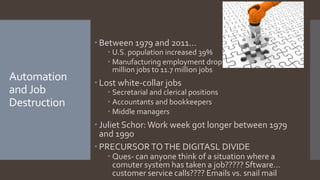
    Automation andJob Destruction  Between 1979and 2011…  U.S. population increased 39%  Manufacturing employment dropped 40%, from 19.4 million jobs to 11.7 million jobs  Lost white-collar jobs  Secretarial and clerical positions  Accountants and bookkeepers  Middle managers  Juliet Schor:Work week got longer between 1979 and 1990  PRECURSOR TOTHE DIGITASL DIVIDE  Ques- can anyone think of a situation where a comuter system has taken a job????? Sftware… customer service calls???? Emails vs. snail mail
  • 4.
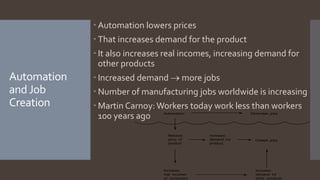
    Automation andJob Creation  Automation lowersprices  That increases demand for the product  It also increases real incomes, increasing demand for other products  Increased demand  more jobs  Number of manufacturing jobs worldwide is increasing  Martin Carnoy: Workers today work less than workers 100 years ago
  • 5.
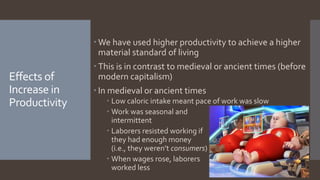
    Effects of Increase in Productivity We have used higher productivity to achieve a higher material standard of living  This is in contrast to medieval or ancient times (before modern capitalism)  In medieval or ancient times  Low caloric intake meant pace of work was slow  Work was seasonal and intermittent  Laborers resisted working if they had enough money (i.e., they weren’t consumers)  When wages rose, laborers worked less
  • 6.
    Rise of the Robots? Some experts suggest most jobs will be taken over by machines  Artificial intelligence: Field of computer science focusing on intelligent behavior by machines  Rapid increases in microprocessor speeds have led to various successes in AI  Question: What will happen as computers continue to increase in speed?
  • 7.
  • 8.
    Moral Questions Related to Robotics  Question:Is it wrong to create machines capable of making human labor obsolete?  Question: Would intelligent robots demoralize humanity?  Question: Is it wrong to work on an intelligent machine if it can’t be guaranteed the machine will be benevolent toward humans?  Question: What if a malevolent human puts intelligent machines to an evil use?  Question: How would creative computers change our ideas about intellectual property?
  • 9.
    Organizational Changes  Information technologyintegration into firms  Automating back office functions (e.g., payroll)  Improving manufacturing  Improving communication among business units  Results  Flattened organizational structures  Eliminating transactional middlemen (supply-chain automation)
  • 10.
    Telework Advantages  Increases productivity Reduces absenteeism  Improves morale  Helps recruitment and retention of top employees  Saves overhead  Improves company resilience  Helps environment  Saves employees money Disadvantages  Threatens managers’ control and authority  Makes face-to-face meetings impossible  Sensitive information less secure  Team meetings more difficult  Teleworkers less visible  Teleworkers “out of the loop”  Isolation of teleworkers  Teleworkers work longer hours for same pay Employees work away from traditional place of work Examples Home office Commuting to a telecenter Salespersons with no office About 20% of Americans do some telework
  • 11.
    Temporary Work  Companies lesscommitted to employees  Lay-offs not taboo as they once were  Companies hiring more temporary employees  Saves money on benefits  Makes it easier to downsize  Long-term employment for one firm less common  Average time spent at a company is 5 years.  Temporary ContractWork allows for:  Skilled worker  A Change
  • 12.
    Globalization Arguments For  Increasescompetition  People in poorer countries deserve jobs, too  It is a tried-and-true route for a poor country to become prosperous  Global jobs reduce unrest and increase stability Arguments Against  Makes the United States subordinate to theWorld Trade Organization  Forces American workers to compete with foreigners who do not get decent wages and benefits  Accelerates exodus of manufacturing and white- collar jobs from United States  Hurts workers in foreign countries Globalization: Process of creating a worldwide network of businesses and markets Globalization causes a greater mobility of goods, services, and capital around the world Globalization made possible through rapidly decreasing cost of information technology
  • 13.
    The Digital Divide  Digitaldivide: Some people have access to modern information technology while others do not  Underlying assumption: people with access to telephones, computers, Internet have opportunities denied to those without access  Concept of digital divide became popular with emergence ofWorldWide Web  Evidence of the Digital Divide  Global divide  Access higher in wealthy countries  Access higher where IT infrastructure good  Access higher where literacy higher  Access higher in English-speaking countries  Access higher where it is culturally valued  Social divide  Access higher for young people  Access higher for well-educated people
  • 14.
    Critiques of the DigitalDivide  DD talk suggests the difference between “haves” and “have nots” is simply about access  DD talk puts everyone in two categories, but reality is a continuum  DD implies lack of access leads to less advantaged social position, but maybe it is the other way around  Internet is not the pinnacle of information technology
  • 15.
  • 16.
  • 17.
    TheWinner- Take-All Phenomenon  Winner-take-all: afew top performers have disproportionate share of wealth  Question: Does aWinner-take-all phenomenon benefit or hinder society?  Question: How can we reduce theWinner-Take-All Phenomenon?  Causes  IT and efficient transportation systems  Network economies  Dominance of English language  Changing business norms

Editor's Notes

  • #4 General Motors Exited Bankruptcy in 2009 with 30% Fewer Employees
  • #9 Asimov’s Laws A robot may not injure a human being or, through inaction, allow a human being to come to harm. A robot must obey the orders given it by human beings except where such orders would conflict with the First Law. A robot must protect its own existence as long as such protection does not conflict with the First or Second Laws.[
  • #16 Rate of tuition increases at US universities has exceeded inflation for several decades Financing college education increasingly difficult for poorer families Free massive open online courses (MOOCs) promoted as a way to make higher education more affordable Study by Community College Research Center Students less likely to complete and do well in MOOCs than traditional courses MOOCs widen achievement gap between white and black students and between those with higher GPAs and those with lower GPAs Usually have to pay for the credits
  • #17 Signed petition a few years ago about passing legislation for net neutrality Tiered service: Charging more for high-priority routing of Internet packets Supporters of tiered service say it is needed to support Voice-over-IP and other services Opponents to tiered service (e.g., Google, Yahoo!) say it would hurt small start-up companies and lower innovation Others think companies controlling Internet might favor some content over other content Net neutrality legislation would require all Internet packets be treated the same Opponents of proposed legislation say consumers should be able to pay more to get higher quality service
  • #18 Benefits consumers but not businesses which in turn has a negative impact on the economoy Limit number of hours that stores remain open 24 Hour Stores Businesses form cooperative agreements to reduce positional arms races Example: salary caps on pro sports teams More progressive tax structures Campaign finance reform