PARTNERSHIP FOR SUSTAINABLE COMMUNITIES


 Grant Background
 The Tomorrow Plan
 The Tomorrow Team
 Planning Tools
 Project Status
GRANT BACKGROUND
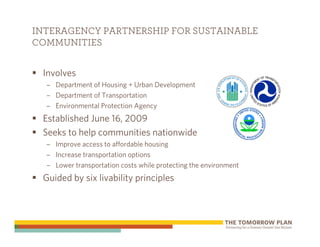
INTERAGENCY PARTNERSHIP FOR SUSTAINABLE
COMMUNITIES


 Involves
  – Department of Housing + Urban Development
  – Department of Transportation
  – Environmental Protection Agency
 Established June 16, 2009
 Seeks to help communities nationwide
  – Improve access to affordable housing
  – Increase transportation options
  – Lower transportation costs while protecting the environment
 Guided by six livability principles
LIVABILITY PRINCIPLES


  Provide more transportation choices
  Promote equitable, affordable housing
  Enhance economic competitiveness
  Support existing communities
  Coordinate and leverage federal policies and investment
  Value communities and neighborhoods
SUSTAINABLE COMMUNITIES REGIONAL PLANNING
GRANT PROGRAM


 Offered by the Partnership
 Provides support to regions seeking to improve regional
 planning efforts and long-term sustainability
 Also seeks to address several interdependent challenges
  –   Economic competitiveness and revitalization
  –   Social equity, inclusion, and access to opportunity
  –   Energy use and climate change
  –   Public health and environmental impact
THE GRANT


 Awarded $2 million
 Leveraging nearly $1.1 million in local funds
 One of 45 recipients in an extremely competitive program
  – Over 1,300 interests of expression submitted
 Only grant recipient in Iowa
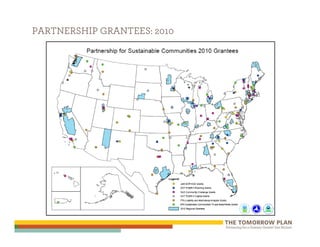
PARTNERSHIP GRANTEES: 2010


                  (INSERT GRAPHIC)
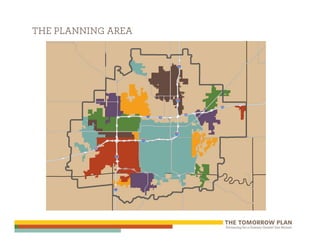
THE PLANNING AREA


                    (INSERT GRAPHIC)
THE PLANNING AREA


 Located in the heart of Iowa
 Most populous area in the state
 Approximately 480,000 residents
 Lies at the crossroads of Intestates 35 + 80
 17 communities + portions of 4 counties
 542 square miles
 Urban + rural areas
THE TOMORROW PLAN
THE TOMORROW PLAN


 Essentially starting with a blank slate
 The Tomorrow Plan will:
  – Provide a comprehensive framework for future development
  – Allow the MPO and other entities to work collaboratively to engage the
    public to establish the region’s vision for the next forty years
  – Ensure that all components align
THE TOMORROW PLAN


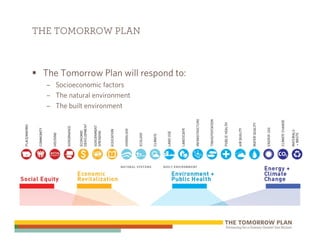
 The Tomorrow Plan will respond to:
  – Socioeconomic factors
  – The natural environment
  – The built environment
THE TOMORROW PLAN


 Five phase process over 20 months
  –   Project initiation
  –   Regional assessment
  –   Regional vision for sustainability
  –   Regional sustainability framework
  –   Sustainability report and implementation
OUTCOMES OF THE TOMORROW PLAN


 Aligned plans in the region
 Increased participation + decision-making
 Reduced socioeconomic disparities
 Decreased vehicle miles traveled
 Decreased housing + transportation costs
 Infill + compact development
 Improved access
 Improved public health
 Decreased hazardous environmental threats
 Enhanced regional competitiveness
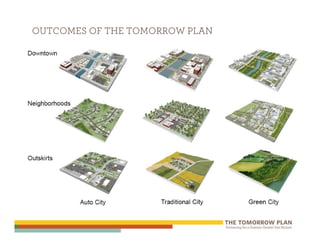
OUTCOMES OF THE TOMORROW PLAN


                (INSERT GRAPHIC)
WHY NOW?


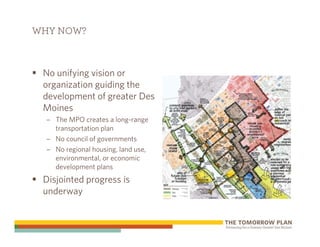
 No unifying vision or
 organization guiding the
 development of greater Des
 Moines
  – The MPO creates a long-range
    transportation plan
  – No council of governments
  – No regional housing, land use,
    environmental, or economic
    development plans
 Disjointed progress is
 underway
WHY NOW?


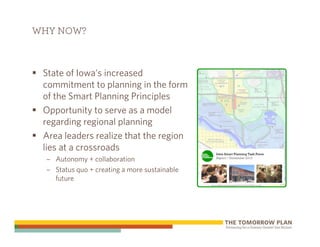
 State of Iowa’s increased
 commitment to planning in the form
 of the Smart Planning Principles
 Opportunity to serve as a model
 regarding regional planning
 Area leaders realize that the region
 lies at a crossroads
  – Autonomy + collaboration
  – Status quo + creating a more sustainable
    future
WHY NOW?


 Over 95% of all area trips utilize automobiles
 Major flooding events are occurring more often
 Current population is expected to grow by 40% by 2035
 Approximately ½ of area residents spend more than 45% of
 their income on housing + transportation costs
 Central Iowa is home to the 2nd most polluted river in the
 country
 Poverty + low educational attainment are concentrated in
 the central city
WHY NOW?


 Maintain the region’s position on various ‘best of’ lists in
 order to attract future investments
 Connect other efforts already underway
  – DART Forward 2035
  – Capital Crossroads
  – STAR Community Index
THE TOMORROW TEAM
THE TOMORROW TEAM


 Governmental, regional planning agencies, nonprofits, and
 public + private sector partners
 Intentionally included numerous interests from the beginning
  – Local elected officials + city managers
  – Local planners
  – Business interests
 One of the required program outcomes is “increased
 participation and decision-making” in developing and
 implementing a long-range vision for the region by
 populations traditionally marginalized in the public planning
 process”
THE TOMORROW TEAM


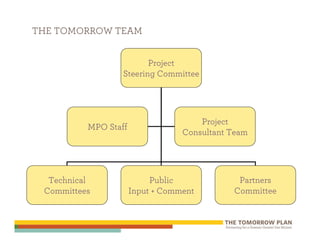
                         Project
                  Steering Committee


                                      Project
          MPO Staff (INSERT GRAPHIC)
                                  Consultant Team


  Technical             Public                Partners
 Committees        Input + Comment           Committee
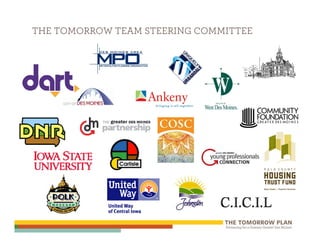
THE TOMORROW TEAM STEERING COMMITTEE
THE TOMORROW TEAM PARTNERS COMMITTEE


 Seeks to be inclusive of all interests – public + private
 Over 300 representatives from regional groups invited to
 participate
 Represent the elements that The Tomorrow Plan will address
  – Socioeconomic factors
  – The natural environment
  – The built environment
 First meeting held September 14th
PLANNING TOOLS
THE PROCESS OF THE TOMORROW PLAN


 Project initiation (July – September 2011)
 Regional assessment (July – December 2011)
 Regional vision for sustainability (December 2011 – July
 2012)
 Regional sustainability framework (June – November 2012)
 Sustainability report + implementation (September 2012 –
 February 2013)
PHASE 1: PROJECT INITATION


  Public participation process design
  – Surveys
  – Stakeholder interviews + focus groups
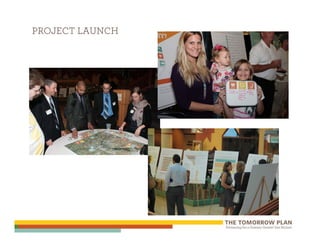
  Project launch
  – Educate, engage, collect feedback
  SWOT analysis
  – What are regional values + aspirations for future?
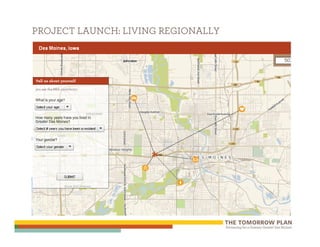
PROJECT LAUNCH
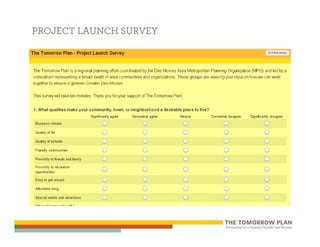
PROJECT LAUNCH SURVEY


                (INSERT GRAPHIC)
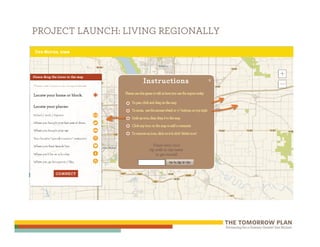
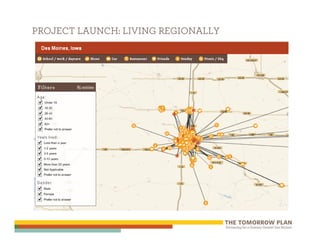
PROJECT LAUNCH: LIVING REGIONALLY


                 (INSERT GRAPHIC)
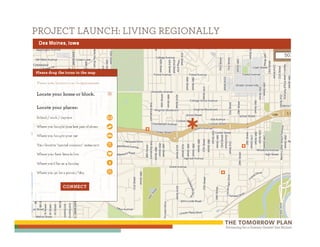
PROJECT LAUNCH: LIVING REGIONALLY
PHASE 2: REGIONAL ASSESSMENT


 Data array
 Sustainability scan
  – Evaluation of existing plans + policies
  – Development code review
  – What does ‘sustainability’ mean for greater Des Moines?
 Regional baseline measures
 State of the region report
  – What are regional development trends, opportunities, and challenges?
  – How sustainable is the region already?
  – What model sustainable development practices could be included in future
    land use plans and code updates in the region?
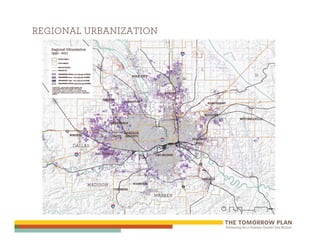
REGIONAL URBANIZATION
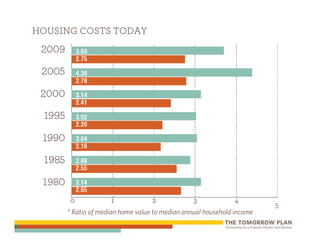
HOUSING COSTS TODAY


     * Ratio of median home value to median annual household income
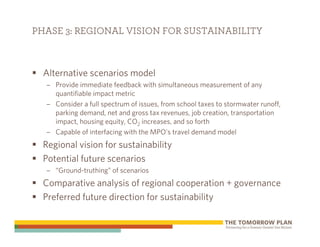
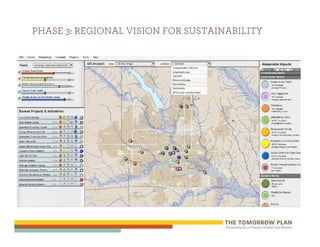
PHASE 3: REGIONAL VISION FOR SUSTAINABILITY


  Alternative scenarios model
  – Provide immediate feedback with simultaneous measurement of any
    quantifiable impact metric
  – Consider a full spectrum of issues, from school taxes to stormwater runoff,
    parking demand, net and gross tax revenues, job creation, transportation
    impact, housing equity, CO2 increases, and so forth
  – Capable of interfacing with the MPO’s travel demand model
  Regional vision for sustainability
  Potential future scenarios
  – “Ground-truthing” of scenarios
  Comparative analysis of regional cooperation + governance
  Preferred future direction for sustainability
PHASE 3: REGIONAL VISION FOR SUSTAINABILITY


                  (INSERT GRAPHIC)
PHASE 4: REGIONAL SUSTAINABILITY FRAMEWORK


 Development of plan components
  – Socioeconomic factors
  – Natural environment
  – Built environment
 Sustainability framework
  – Existing conditions + trends summary
  – Needs analysis
  – Goals + strategies for each of the plan components
PHASE 5: SUSTAINABILITY REPORT +
IMPLEMENTATION


  Sustainability action plan
  –   Action agenda with timeframes + responsibilities
  –   Database of indicators + tools for access by local government
  –   Potential sources of funding + other implementation resources
  –   Management structure to build capacity for implementation
  –   Program to monitor implementation progress
  Implementation priorities
  The Tomorrow Plan report + brochure summary
HUD ON PUBLIC ENGAGEMENT


“…if Job 1 of these grants is helping facilitate more sustainable,
  comprehensive planning for communities and regions, then
  creating opportunities for meaningful, robust
  participation by everyone who will be affected by this
  process is Job 1A. This will be a difficult hill to climb for many
  grantees, precisely because if it were easy and/or routine to
  do, underrepresented groups would already by part of the
  process…”
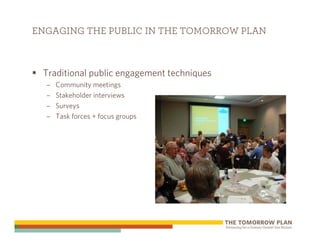
ENGAGING THE PUBLIC IN THE TOMORROW PLAN


 Traditional public engagement techniques
  –   Community meetings
  –   Stakeholder interviews
  –   Surveys
  –   Task forces + focus groups
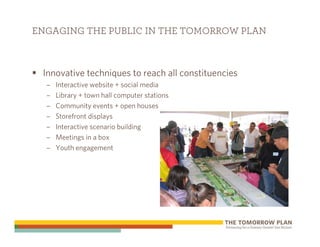
ENGAGING THE PUBLIC IN THE TOMORROW PLAN


 Innovative techniques to reach all constituencies
  –   Interactive website + social media
  –   Library + town hall computer stations
  –   Community events + open houses
  –   Storefront displays
  –   Interactive scenario building
  –   Meetings in a box
  –   Youth engagement
ENGAGING THE PUBLIC IN THE TOMORROW PLAN


 Speaker series to educate the public
  –   Importance of regional planning
  –   Sustainable planning
  –   Case studies in scenarios
  –   Visioning
  –   Implementation
 Outreach series events to correspond to speaker series
 events
PROJECT STATUS
WHERE IS THE PROJECT TODAY?


 Synthesizing public input from project launch event
  – Online survey
  – Living regionally activity
 Preparing for first public outreach series to determine what
 are viewed as key resources, opportunities, and challenges
  –   October 24: Lakeside Center, Ankeny
  –   October 25: Des Moines Central Library
  –   October 25: Raccoon River Park Nature Lodge, West Des Moines
  –   October 26: Windsor Heights Community Center
  –   October 27: Doanes Park Youth Center, Pleasant Hill
 Analyzing data to understand the existing conditions in the
 region
Facebook + Twitter
 Phone: 515.334.0075
bwilcoxon@dmampo.org
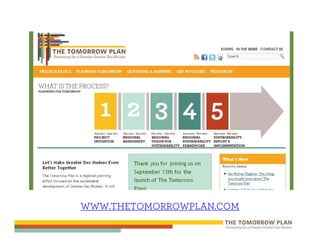
WWW.THETOMORROWPLAN.COM
The Tomorrow Plan

The Tomorrow Plan

  • 2.
    PARTNERSHIP FOR SUSTAINABLECOMMUNITIES Grant Background The Tomorrow Plan The Tomorrow Team Planning Tools Project Status
  • 3.
  • 4.
    INTERAGENCY PARTNERSHIP FORSUSTAINABLE COMMUNITIES Involves – Department of Housing + Urban Development – Department of Transportation – Environmental Protection Agency Established June 16, 2009 Seeks to help communities nationwide – Improve access to affordable housing – Increase transportation options – Lower transportation costs while protecting the environment Guided by six livability principles
  • 5.
    LIVABILITY PRINCIPLES Provide more transportation choices Promote equitable, affordable housing Enhance economic competitiveness Support existing communities Coordinate and leverage federal policies and investment Value communities and neighborhoods
  • 6.
    SUSTAINABLE COMMUNITIES REGIONALPLANNING GRANT PROGRAM Offered by the Partnership Provides support to regions seeking to improve regional planning efforts and long-term sustainability Also seeks to address several interdependent challenges – Economic competitiveness and revitalization – Social equity, inclusion, and access to opportunity – Energy use and climate change – Public health and environmental impact
  • 7.
    THE GRANT Awarded$2 million Leveraging nearly $1.1 million in local funds One of 45 recipients in an extremely competitive program – Over 1,300 interests of expression submitted Only grant recipient in Iowa
  • 8.
    PARTNERSHIP GRANTEES: 2010 (INSERT GRAPHIC)
  • 9.
    THE PLANNING AREA (INSERT GRAPHIC)
  • 10.
    THE PLANNING AREA Located in the heart of Iowa Most populous area in the state Approximately 480,000 residents Lies at the crossroads of Intestates 35 + 80 17 communities + portions of 4 counties 542 square miles Urban + rural areas
  • 11.
  • 12.
    THE TOMORROW PLAN Essentially starting with a blank slate The Tomorrow Plan will: – Provide a comprehensive framework for future development – Allow the MPO and other entities to work collaboratively to engage the public to establish the region’s vision for the next forty years – Ensure that all components align
  • 13.
    THE TOMORROW PLAN The Tomorrow Plan will respond to: – Socioeconomic factors – The natural environment – The built environment
  • 14.
    THE TOMORROW PLAN Five phase process over 20 months – Project initiation – Regional assessment – Regional vision for sustainability – Regional sustainability framework – Sustainability report and implementation
  • 15.
    OUTCOMES OF THETOMORROW PLAN Aligned plans in the region Increased participation + decision-making Reduced socioeconomic disparities Decreased vehicle miles traveled Decreased housing + transportation costs Infill + compact development Improved access Improved public health Decreased hazardous environmental threats Enhanced regional competitiveness
  • 16.
    OUTCOMES OF THETOMORROW PLAN (INSERT GRAPHIC)
  • 17.
    WHY NOW? Nounifying vision or organization guiding the development of greater Des Moines – The MPO creates a long-range transportation plan – No council of governments – No regional housing, land use, environmental, or economic development plans Disjointed progress is underway
  • 18.
    WHY NOW? Stateof Iowa’s increased commitment to planning in the form of the Smart Planning Principles Opportunity to serve as a model regarding regional planning Area leaders realize that the region lies at a crossroads – Autonomy + collaboration – Status quo + creating a more sustainable future
  • 19.
    WHY NOW? Over95% of all area trips utilize automobiles Major flooding events are occurring more often Current population is expected to grow by 40% by 2035 Approximately ½ of area residents spend more than 45% of their income on housing + transportation costs Central Iowa is home to the 2nd most polluted river in the country Poverty + low educational attainment are concentrated in the central city
  • 20.
    WHY NOW? Maintainthe region’s position on various ‘best of’ lists in order to attract future investments Connect other efforts already underway – DART Forward 2035 – Capital Crossroads – STAR Community Index
  • 21.
  • 22.
    THE TOMORROW TEAM Governmental, regional planning agencies, nonprofits, and public + private sector partners Intentionally included numerous interests from the beginning – Local elected officials + city managers – Local planners – Business interests One of the required program outcomes is “increased participation and decision-making” in developing and implementing a long-range vision for the region by populations traditionally marginalized in the public planning process”
  • 23.
    THE TOMORROW TEAM Project Steering Committee Project MPO Staff (INSERT GRAPHIC) Consultant Team Technical Public Partners Committees Input + Comment Committee
  • 24.
    THE TOMORROW TEAMSTEERING COMMITTEE
  • 25.
    THE TOMORROW TEAMPARTNERS COMMITTEE Seeks to be inclusive of all interests – public + private Over 300 representatives from regional groups invited to participate Represent the elements that The Tomorrow Plan will address – Socioeconomic factors – The natural environment – The built environment First meeting held September 14th
  • 26.
  • 27.
    THE PROCESS OFTHE TOMORROW PLAN Project initiation (July – September 2011) Regional assessment (July – December 2011) Regional vision for sustainability (December 2011 – July 2012) Regional sustainability framework (June – November 2012) Sustainability report + implementation (September 2012 – February 2013)
  • 28.
    PHASE 1: PROJECTINITATION Public participation process design – Surveys – Stakeholder interviews + focus groups Project launch – Educate, engage, collect feedback SWOT analysis – What are regional values + aspirations for future?
  • 29.
  • 30.
    PROJECT LAUNCH SURVEY (INSERT GRAPHIC)
  • 31.
    PROJECT LAUNCH: LIVINGREGIONALLY (INSERT GRAPHIC)
  • 32.
  • 33.
  • 34.
  • 35.
    PHASE 2: REGIONALASSESSMENT Data array Sustainability scan – Evaluation of existing plans + policies – Development code review – What does ‘sustainability’ mean for greater Des Moines? Regional baseline measures State of the region report – What are regional development trends, opportunities, and challenges? – How sustainable is the region already? – What model sustainable development practices could be included in future land use plans and code updates in the region?
  • 36.
  • 37.
    HOUSING COSTS TODAY * Ratio of median home value to median annual household income
  • 38.
    PHASE 3: REGIONALVISION FOR SUSTAINABILITY Alternative scenarios model – Provide immediate feedback with simultaneous measurement of any quantifiable impact metric – Consider a full spectrum of issues, from school taxes to stormwater runoff, parking demand, net and gross tax revenues, job creation, transportation impact, housing equity, CO2 increases, and so forth – Capable of interfacing with the MPO’s travel demand model Regional vision for sustainability Potential future scenarios – “Ground-truthing” of scenarios Comparative analysis of regional cooperation + governance Preferred future direction for sustainability
  • 39.
    PHASE 3: REGIONALVISION FOR SUSTAINABILITY (INSERT GRAPHIC)
  • 40.
    PHASE 4: REGIONALSUSTAINABILITY FRAMEWORK Development of plan components – Socioeconomic factors – Natural environment – Built environment Sustainability framework – Existing conditions + trends summary – Needs analysis – Goals + strategies for each of the plan components
  • 41.
    PHASE 5: SUSTAINABILITYREPORT + IMPLEMENTATION Sustainability action plan – Action agenda with timeframes + responsibilities – Database of indicators + tools for access by local government – Potential sources of funding + other implementation resources – Management structure to build capacity for implementation – Program to monitor implementation progress Implementation priorities The Tomorrow Plan report + brochure summary
  • 42.
    HUD ON PUBLICENGAGEMENT “…if Job 1 of these grants is helping facilitate more sustainable, comprehensive planning for communities and regions, then creating opportunities for meaningful, robust participation by everyone who will be affected by this process is Job 1A. This will be a difficult hill to climb for many grantees, precisely because if it were easy and/or routine to do, underrepresented groups would already by part of the process…”
  • 43.
    ENGAGING THE PUBLICIN THE TOMORROW PLAN Traditional public engagement techniques – Community meetings – Stakeholder interviews – Surveys – Task forces + focus groups
  • 44.
    ENGAGING THE PUBLICIN THE TOMORROW PLAN Innovative techniques to reach all constituencies – Interactive website + social media – Library + town hall computer stations – Community events + open houses – Storefront displays – Interactive scenario building – Meetings in a box – Youth engagement
  • 45.
    ENGAGING THE PUBLICIN THE TOMORROW PLAN Speaker series to educate the public – Importance of regional planning – Sustainable planning – Case studies in scenarios – Visioning – Implementation Outreach series events to correspond to speaker series events
  • 46.
  • 47.
    WHERE IS THEPROJECT TODAY? Synthesizing public input from project launch event – Online survey – Living regionally activity Preparing for first public outreach series to determine what are viewed as key resources, opportunities, and challenges – October 24: Lakeside Center, Ankeny – October 25: Des Moines Central Library – October 25: Raccoon River Park Nature Lodge, West Des Moines – October 26: Windsor Heights Community Center – October 27: Doanes Park Youth Center, Pleasant Hill Analyzing data to understand the existing conditions in the region
  • 48.
    Facebook + Twitter Phone: 515.334.0075 bwilcoxon@dmampo.org
  • 49.