GRAIN VALLEY, MO
LAND-USE PLAN
2015
April 27th, 2015
City of Grain Valley, MO, Deptartment of Administration & Finance
711 Main Street
Grain Valley, MO 64029
Dear Review Committee:
The MAPS Inc. team is elated to submit our qualifications for Land-Use Planning and Implementation
strategies with the City of Grain Valley, Missouri. Future land-use planning has the capability to create
positive outcomes and sustain those outcomes for the City of Grain Valley in the near and far future. If
executed appropiately, it can rejuvenate the community to establish a framework of the correct balance of
land-uses that are feasible in terms of economic growth, environmental preservation, and social equity.
The result of “good” land-use planning really is manifested through hard work, dedication and pride. We
take pride in our work and services, we also take initiative to reach the community in the most efficient and
effective way possible through our proven community engagement techniques. Afterall, public particpation is
paramount to a success project that reflects the community’s vision.This vision will exemplify the importance
of healhty community action, the value of safety and quality of life.This vision is the guide for this Plan to
enhance the quality of the communty as a place to live, work and play.The core goal of successful land-use
planning is to have a safe, attractive and sustainalbe community that is meaninful over the long-term for
citizens, neighbors and travelers.
If selected, we will be happy to offer our very own team of experts that has experiences in land planning, site
planning, architecture, urban design, landscape architecture and sustainable solutions.We feel this experience
and professional excellence can produce exceptional planning, architecture, and sustainable solutions to the
municipality of Grain Valley and through the implementation of this Plan the City of Grain Valley can
become leaders in sustainable land-use planning for the county, metropolitan area, and the state of Missouri.
We thank you in advance for your time and consideration. If you have any questions as you review our
proposal, please do not hesitate to contact me at 573.587.33767 or treymaevers@gmail.com.
Sincerely,
2
TABLE OF CONTENTS
	 COVER LETTER 		
	
	 BASIC QUALIFICATIONS					
		
		MISSION STATEMENT
		PHILOSOPHY
		LEGAL BASIS
	 BASIC QUALIFICATIONS
	 PLAN EVALUATION
	 APPROACH TO PROJECT
		MANAGMENT/ORGANIZATION
		
		GOALS
		COMMITTE ENGAGEMENT
		POPULATION PROJECTIONS
		 REGIONAL STATUS AND ECONOMICS
	 APPROVAL
	INNOVATION	
	 WORK PRODUCT SAMPLES
	
	 UPDATE SUMMARY
	
	APPENDIX
3
4
4
4
4
5
6
8
8
9
10
12
13
15
16
19
25
26
COVER LETTER
Trey Maevers
CEO and Founder, MAPS, Inc.
5620 W 133rd Ter. | Overland Park, KS 66209
P: 573.587.3376 | E: treymaevers@gmail.com
3
Trey Maevers
4 5
MAPS approach and expertise has led to successful implementation of many land-use and urban design
projects. Our goal is provide the most efficient and effective method for you, the City of Grain Valley, to
reach your desired outcome. In order to achieve that goal, MAPS, Inc. has established definitions that are
pertinent to our success in assisting and providing solutions for communities like Grain Valley.
COMPREHENSIVE PLAN
How does a Comprehensive Plan work? As annotated in the Legal Basis section, Comprehensive Planning
acts as guide, therefore as a guide it would entail some structure.This contributes to the Rational Planing
Theory.This Theory insists that planners, or anybody devleoping a plan, need a systems or framework base
their decisions after the process is complete. Comprehensive Planning is a process that typically has a
general framework that guides communities to:
•	 Identify and diagnose issues;
•	 Explore techniques and alternatives;
•	 Collect data and information;
•	 Outline a vision and define goals;
•	 Create policies;
•	 Implement strategies,
•	 Evaluate and monitor progress;
•	 Establish possible future procedures.
HOW DO YOU USE THE PLAN?
In the last decade the Comprehensive Plan has become more than a plan. It has developed into a tool for
planners, city officials, and citizens to focus on local and/or regional initiatives.The evolved Comprehensive
Plan includes policy recommendations, detailed guidelines and timelines, and best practices. Simply, the
Comprehensive Plan requires the community to answer three simply, yet ardous questions:
•	 What course is the City on?
•	 What future does the City want?
•	 How do we make that future a reality?
BASIC QUALIFICATIONS | MAPS, Inc.
MISSION STATEMENT
We are Architects and Planners FOR sustainable
communities;
We create positive outcomes by INVESTING the
time to improve quality of life;
We are more than designing spaces, we design
COMMUNITIES.
PHILOSOPHY OF PLANNING
“Urban Planning” goes by many names, including
town planning, land-use planning, transporation
planning, rural planning, city planning, community
planning, and regional planning. With all of these
terms, planning still can be narrowed down to
one (1) sole purpose: Improve the welfare of the
people and their communities by creating places
that are equitable, healthy, efficient, convenient, and
attractive for both present and future generations.
Urban planning contributes to the guidance and
ensurance of orderly development of within and
outside of urban areas.
Due to the relationship of the built environment,
urban planners work professionals in the
enginnering and architecture fields. With these
relationships, planners can achieve strategic, policy
and sustainable goals. Good urban planning
provides city leaders, businesses, developers, and
citizens with an opportunity to be involved in
the improvements and enhancements of their
communities. Fundamentally, good planning and
good city administration are interchangeable.
BASIC QUALIFICATIONS | MAPS, Inc.
LEGAL BASIS
American history has demonstrated the importance
of the local government’s ability to provide a secure
and safe place to live. At the turn of the Twentieth
Century, land use zoning came to the U.S. Supreme
Court in Hadacheck v. Sebastian (1906), and
many interpreted the findings of the case to have
granted implicit approval of land use zoning. After
the case American cities began to see the need
for the planning process to convserve the local
government’s responsbility of health and welfare for
the community. In 1926, the U.S. Supreme Court
upheld the constitutionality of comprehensive
zoning in Village of Euclid v. Amber Realty Co. This
case ushered in another foundation of planning as
the Federal Government, through the Department
of Commerce, wrote a legal provision for States to
provide local governments with the framework to
engange in planning.1
This provision was called the Standard State Zoning
Enabling Act (SZEA, 1926), which created the
“Comprehensive Plan” or “Master Plan”. However, a
comprehensive plan is not usually legally binding,
city ordinances must be amended in order to
legally implement the provision required to use the
comprehensive plan. Learning from history, most
states adopted this provision, and the states that
did not still gives incentives to local governments
that establish a plan to guide development.
Municipalities in Missouri are considered to be
governmental subdivisions of the State and, as such,
are empowered to adopt planning and zoning for
the general purposes of enhancing the health, safety,
and welfare of their residents. This authority is
outlined in Chapter 89 of the Revised Statutes of the
State of Missouri.
MAPS, Inc. is a land planning, urban design and strategic services firm. We provide these services to a wide
variety of governmnet agencies, property owners and developers. We have evolved a proprietary approach
and unique culture that has quickly earned us the reputation for solving complex problems on many levels of
society.
SUSTAINABILITY
Sustainability is not a new notion. It actually has traces back to the Classical Greek era. In fact, the Athenian
Oath for citizens includes this statement, “...to transmit this city not ony, not less, but greater & more
beautiful than it wa transmitted to us.” 2
This demonstrates the importance of doing whatever is necessary
to provide a better world for the future generations.This is a strong message in times of uncertainty of the
repercussions of our harm to the natural environment.
6 7
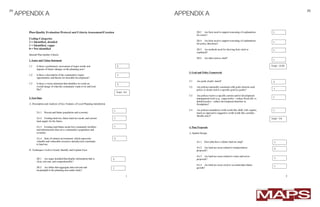
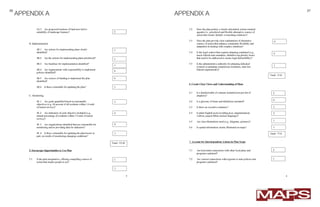
In order to evaluate the quality of Grain Valley’s current Land-Use, Policy, and Implementation Chapters
in the 2010 Comprehensive Plan, everyone reading or referring to the it must understand the mechanics of
what makes a good plan. This is done by identifying specific components of the plan, using mutliple criteria
for evalutation, and assessing the plan in context of all criteria.
PLAN EVALUATION
One the most-widely used evaluation systems
among planners, is the Plan-Quality Evaluation
Protocol from the Urban Land Use Planning (Berke
et al, 2006)3
. This evaluation categorizes each
section of a plan and establishes a coding and point
system of zero (0) which means the plan does not
identify that criteria, one (1) means that the criteria
is identified and vague, and two (2) shows that the
plan has identified the criteria in detail. There are
eight (8) categories of of criterion:
1.	 Issues and Vision Statement
2.	 Fact Base
3.	 Goal and Policy Framework
4.	 Plan Proposals
5.	 Encourage Opportunites to Use Plan
6.	 Create Clear Views and Understanding
7.	 Account for Interdependent Actions
8.	 Participation of Actors
This system allows the reviewer to cover all of the
bases of “good plans”. For MAPS, Inc. full review
of the Grain Valley’s 2010 Land-Use, Policy, and
Implementation Chapters please see Appendix A.
The Plan-Quality Evaluation Protocol system is is
based off evaluating the full comprehensive plan,
so the partial review of the Land-Use, Policy and
Implementation Chapters will, by default, produce a
low score.This is why it is important to use multiple
systems.
The other evaluation systems that MAPS, Inc.
uses is the Sustainability criteria developed by
Philip Berke and Maria Conroy in their study
and evaluation of multiple Comprehensive Plans.4
Which looks at the plan based off the following
criteria:
•	 Harmony with nature
•	 Livable built environments
•	 Place-based economy
•	 Equity
•	 Environmental repurcussions (Polluter’s Pay)
Responsible regionalism
MAPS, Inc. has additional criteria for evaluation.
This has been developed through multiple
Comprehensive Plan projects. This evaluation
criteria is separating into five (5) sections:
1.	 Inspirational
2.	 Synthesis
3.	 Attractiveness
4.	 Performance
5.	 Resourcefulness
Negative
•	 The Plans lacked the essential details on the private orginazations and government departments that
would contribute to successful implementation.
•	 Also, the policies and actions lacked the direction of the organizations that are in charge of monitoring
and evaluating this plan and the plans’ actions.
•	 The other big negative factor was the lack of clarity of what federal, state and city policies, laws and
programs that can contribute to the plan.
•	 Also, there is no mention of development and growth in terms of sustainability or other terms that relate
the future land-uses to local ecology, economy, and equity.
•	
•	 The design in some parts becomes a littel text-heavy and irrational.The use of more tables, graphs and
graphics can increase awareness and attention with the reader.
•	
•	 There is no Glossary of Terms. Some of the lingo and jargon can get confusing for some people.
Positive
•	 The most positive criterion that was met was the Plans’ description of the exisitng conditions.The Plans
demonstrated the community’s exisiting conditions through multiple perspecitves, specifically, the plan
shows the environmental constraints for the exisiting and future land-use proposals.
•	 Another positive point was that the public participated in the process through meetings and surveys, this
is very crucial to a plan’s effectiveness.
•	 Lastly, there were the right amount of general goals and they were clearly stated.
PLAN EVALUATION
After putting Grain Valley’s current Land-Use, Policy, and Implementation Chapters in the 2010
Comprehensive Plan through all three (3) evaluation systems, MAPS, Inc. has determined the final grade of
a “C”. A short synopsis of the positive and negative reasons for this grade is explained below.
8 9
Goal 1: The City of Grain Valley will develop a culture that attracts new development to bolster the local
economy, therefore relieving the tax burden on all property owners.
	 Objective 1.1: Seek to develop a diverse range of land uses to include, but not limited to, retail, office, 	
	 regional/community commercial, business park and light-industrial.
		 Policy 1.1.1: Create the framework and guidelines for which new developments that meet the 	
		 established standards could qualify to receive a credit or relief from impact fees.
	 Objective 1.2: Promote development by updating the development codes that reflect the current best 	
	 practices for buildings and developments.
		
		 Policy 1.2.1: Implement Form-Based Codes as a part of the City’s development ordinances 	
		and codes.
Goal 2: The City will establish an approach that sustains the vision of each resident and the area they live,
work, and play.
	
	 Objective 2.1: The Vision set forth in this Plan should be expounded upon to include specific areas 	
	 that require more attention and detail.
		 Policy 2.1.1: Create and implement Concept Plans for those targeted areas.
	 Objective 2.2: The City will continue the efforts to review, discuss and advance the plans set forth in 	
	 this Comprehensive Plan.
		 Policy 2.2.1: Compose a seperate Committee that is soley concerned that the community 		
		 accepts, complies, applies, and adapts to changes in the Comprehensive Plan.
Goal 3: The City will be an exemplification on how to entice sustainable development.
	
	 Objective 3.1: Necessitate that all new development preserves the ecological system at the lot, 		
	 neighborhood, city, county and regional level.
		 Policy 3.1.1: Assure that all new development is is meeting all environmental regulations (i.e. 	
		 EPA, FEMA, MO. Dept. of Health, MO. Dept. of Natural Resources)
	 Objective 3.2: Foster a built environment that is equitable and strengthens the local economy.
		 Policy 3.2.1: Alter and/or streamline regulations to facilitate mix-use developments that 		
		 support and assimilate into the overall community setting.
			
After establishing a thorough review and evaluation of these Plans. MAPS, Inc. has used our creative and
analytical expertise to form three (3) goal statements for the Futre Land-Use Plan of Grain Valley, MO. Also,
MAPS, Inc. has conceived of two (2) objectives and two (2) policy statements to accompany each goal.
GOALS
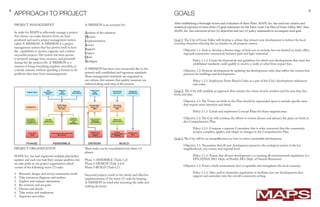
PROJECT ORGANIZATION
MAPS, Inc. has had organized multiple plan/policy
updates and each one had their unique qualities, but
we take pride in our project organization which
consist of the following seven (7) tasks:
1.	 Research, design, and survey community needs
2.	 Take inventory, diagnose and analyze
3.	 Explore and evaluate alternatives
4.	 Re-envision and set goals
5.	 Discuss and decide
6.	 Take action and implement
7.	 Supervise and refine
PROJECT MANAGEMENT
In order for MAPS to effectively manage a project
that clients can make decision from, we have
produced and used a project management system
called A-MISSION. A-MISSION is a project
management system that has proven itself to have
the capabilities to receive, organize and conduct
successful projects.This system has been proven
to properly manage time, resouces, and personell
during the the projects life. A-MISSION is a
mission to bring everything togehter smoothly, in
a timely manner, without spending a fortune to fix
problems that arise from mismanagement.
APPROACH TO PROJECT
A-MISSION is an acronym for:
Analysis of the situation
Mission
Implementation
Service
Support
Inspect
Omit
Neoligize
A-MISSION has been very resourceful due to the
system’s well-established and rigourous standards.
These management standards are engrained in
our culture, this ensures that quality measures are
enforced along each step of the process.
These tasks can be consolidated into three (3)
phases:
Phase 1-ASSEMBLE (Tasks 1,2)
Phase 2-DESIGN (Task 3,4,5)
Phase 3-BUILD (Task 6,7)
Successul projects result in the timely and effective
implementation of the seven (7) tasks by keeping
A-MISSION in mind why executing the tasks and
making decisions.
10 11
With the combination of online surveys, there will
be three (3) public meetings. After reviewing the
school schedule and normal business hours in the
City, MAPS Inc. determined that these meetings
will be situated at a favorably time for most,Tuesday
evenings. We will suggest that the CPAC assist
in promoting the meetings well beforehand.
Each meeting will have a specific agenda and
organization. Below are the general outlines of each
meeting’s agenda.
December 1st
, 2015 Public Meeting #1:
•	 Introduction to the process
•	 Existing Views and Opinions of the City
•	 Input for vision, growth and the future
January 12th
, 2016 Public Meeting #2:
•	 Explore alternatives and best practices
•	 Feedback on the alternatives
•	 Obtain consensus on one alternative
March 8th
, 2016 Public Meeting #3:
•	 Favor on preferred plans from meeting #2
•	 Evaluate Policies and Strategies
•	 Make final public recommendations
COMMUNITY ENGAGEMENT
Source: http://www.biweekly.pl/article/2912-designing-objects-designing-cities.html
The planning process is meant to reflect the vision
and wishes of the community. In order to get
this effect, it is paramount to consult with the
most people in the community as effectively and
efficiently as possible.
The main goal of citizen participation is to gain
support, build trust and, ultimately, build a better
program/plan for the community. MAPS Inc. will
work to reach a broad range of participants to create
a general consensus about the Plan update. During
this process, MAPS Inc. will engage and interact
with the Comprehensive Plan Advisory Committee
(CPAC), businesses, civic leaders, school district,
various neigborhoods and the general public.
There are many ways to induce participation
and get input from the community.The most
familiar approaches are surveys, public hearings,
neighborhood meetings, workshops, charrettes, and
focus groups. After review the previous community
engagement techniques that occured in 2009,
MAPS Inc. has determined to use the techniques
that are appropiate for the four steps of planning
(i.e. Prepare, Plan, Implement, Review) and the
development of values, goals, and objective.5
These
techniques are the use of an Advisory Committee,
Attitude Surveys, Group Dynamics,Task Forces,
Charrettes and Public Information programs.
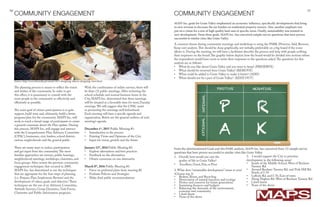
From the aforementioned Goals and this PARK analysis, MAPS Inc. has conceived three (3) sample survey
questions that have proven successful in similar cities like Grain Valley.
A common theme during community meetings and workshops is using the PARK (Preserve, Add, Remove,
Keep out) analysis.This should be done graphically, not verbally, preferrably on a big board if the room
allows it. During the meeting, we will have a facilitator describe the process and help with people scribing
their responses on the board.The graphic below depicts how the board would be divided into sections where
the respondents would have room to write their responses to the questions asked.The questions for this
analysis are as follows:
•	 What do you like about Grain Valley and you want to keep? (PRESERVE)
•	 What should be removed from Grain Valley? (REMOVE)
•	 What could be added to Grain Valley to make it better? (ADD)
•	 What should not be a part of Grain Valley? (KEEP OUT)
MAPS Inc. goals for Grain Valley emphasized an economic influence, specifically developments that bring
in new revenue to decrease the tax burden on residential property owners. Also, another emphasis was
put on a vision for a mix of high quality land uses at specific areas. Finally, sustainability was insisted in
new development. From these goals, MAPS Inc. has conceived sample survey questions that have proven
successful in similar cities like Grain Valley.
COMMUNITY ENGAGEMENT
P
A
R
K
POSITIVE NEGATIVE
INTERNALEXTERNAL
2. What does “sustainable development” mean to you?
(Choose top 3)
•	 Reduse, Reuse, and Recycling
•	 Preservation of natural resources and ecology
•	 Protect and conserve for future generations
•	 Sustaining finances and budgets
•	 Balancing the demands of the environment,
economy and community
•	 I don’t know
•	 None of the above
1.	 Overall, how would you rate the
quality of life in Grain Valley?
•	 Excellent, Good, Fair, or Poor
3. I would support the City to prioritze
development in the following areas?
•	 South of the Middle School, West of Buckner
Tarsney Rd.
•	 Around Buckner Tarsney Rd. and Pink Hill Rd.
North of I-70
•	 Lefholz Rd. and I-70, East of town
•	 Along Negben Rd. West of Buckner Tarsney Rd.
•	 I don’t know
•	 None of the above
12 13
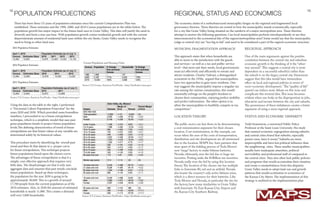
Source: U.S. Census, American FactFinder: <http://factfinder.census.gov>
There has been three (3) years of population estimates since the current Comprehensive Plan was
established. These estimates and the 1990, 2000, and 2010 Census populations are in the tables below. The
population growth has major impact to the future land-uses in Grain Valley. This data will justify the need to
diversify and form a mix-use base. With population growth comes residential growth and with the current
disportationate amount of residential land-uses within the city limits, Grain Valley needs to recognize the
need to bring in other land uses.
POPULATION PROJECTIONS
Using the data in the table to the right, I performed
a “Decennial Cohort Population Projection” for the
years 2020 and 2030. Which provided some boundless
numbers, I proceeded to us a linear extrapolation
technique, which is a simplistic model that uses past
gross population trends to project future population
levels.The defining characteristics of trend of linear
extrapolation are that future values of any variable are
determined solely by its historical values.
This procedure starts by identifying the overall past
trend and then fit that datum to a proper curve
for linear extrapolation. This technique projects
future populations based upon the chosen curve.
The advantages of linear extrapolation is that it a
simple, cost-effective approach that requires very
little data. The disadvantages are that it only uses
aggregate data and assumes that past trends conclude
future populations. Based up these techniques,
the population for the year 2030 is going to be
approximately 30,849. This is a growth of around
17,700 people from the current population as of the
2010 estimates. Also, in 2030 the amount of estimated
households is nearly 11,000. This creates a demand
well over 5,000 households.
Census Population and Housing Units:
REGIONAL APPROACH
One of the main arguments against the positive
correlation between the central city and suburban
economic growth is the thinking of it the “other-
way-around”.This suggests a central city is more
dependent on a successful suburb(s) rather than
the suburb is on the larger, central city. Swanstrom
suggest that this idea would have tremendous
effect on local and regional policies in terms of
socio-economic development.7
The “quality of life”
quarrel can induce more debate on this issue and
complicate this reversal idea.This issue becomes
evident when one looks at the disproportion in jobs,
education and income between the city and suburbs.
The prominence of these imbalances creates a better
argument of using a more regional approach.
STATUS AND ECONOMIC DISPARITY
Todd Swanstorm, a renowned Public Policy
Professor at the Saint Louis University. His study
that examed economic segregration among suburbs
and central cities found that suburbs, especially
poorer ones, have it worse.8
Suburbs are more
imperceptible and have less political influence than
the neighboring cities. These smaller municipalities
usually have inadequate amenities, political
survivability and professional staff of compared to
the central cities. They also often lack public policies
and programs that would accomodate their situation
and create a counterbalance from this disparity.
Grain Valley needs to adopt land-use and growth
patterns that would acclimatize to economics of
the Kansas City Metro. The implementation of this
strategy is outlined in the implementation plan
MUNICIPAL FRAGMENTATION APPROACH
This approach states that when households are
able to move to the jurisdiction with the goods
and services—as well as a tax and public-service
level—that most suit their needs, local governments
must act effectively and efficiently to retrain and
attract residents. Charles Tiebout, a distinguished
economist in the 1950s, argued that municipalities
have two approaches to gain more residents. One
way suggests the municipality impose a singular tax
rate among the various communities, this would
essentially infringe on the people’s freedom to
choose their communities, enjoying perfect mobility
and perfect information. The other option is to
allow the municipalities to healthily compete in tax
competition.6
LOCATION THEORY
The public sector can lure firms in by demonstrating
a cost-minimization argument for their chosen
location. Cost minimization, in this example, can
occur when the sum of the costs of transportation,
distribution and site development are all minimized
due to the location. MAPS Inc. have partners that
were apart of the bidding process of Tesla Motors’
new “mega” factory to make lithium batteries.
Nevada, ultimately, won the bid due to huge tax
incentive. Putting aside the $1Billion tax incentive,
Nevada really won the bid by using this location
theory.The location of the chosen site has multiple
links to Interstate 80, rail and an airfield. Nevada
also boasts the country’s only active lithium mine,
which is a direct resource for their batteries. Like
Tesla Motors and Nevada, in particular the site for
the factory, have many similarities to Grain Valley
with Interstate 70, East Kansas City Airport and
the Kansas City Southern Railway.
The economic status of a surburban/rural municaplity hinges on the regional and fragmented local
governance theories. These theories are rooted in how the municipality stands economically, especially
for a city like Grain Valley being situated on the outskirts of a major metropolitan area. These theories
attempt to answer the following questions. Can local municipalities perform interdependently or are they
interconnected to the economical fate of the region/metropolitan area? Some would say that the municipality
(edge or central city) are “too big to fail” and need to be considered a part of the region’s economic structure.
REGIONAL STATUS AND ECONOMICS
Source: U.S. Census, American FactFinder: <http://factfinder.census.gov>
14 15
Apartments and other higher-density residential
develoments have the broadest tax base and the
revenue is equally distributed among different uses.
Even though it has a shortfall in financing, it has
the most healthy tax structure.
In this review we would suggest the municipality
accept both the retail and higher-density
development proposals.The revenue collected from
the retail can be used to cover the cost-benefit
gap in apartment, and then the city can still reach
a useful level of revenue.The concerns of general
community welfare as well as project revenue are the
main factors for these type of situations.
Recalling the importance of location for future sites,
this recommendation will create “locational inertia”.
This can be an enormous influence on the efforts of
planners and economic development practitioners.
This way of thinking brings a competiveness edge
for local municipalities in attracting new firms to
conduct business.
LIMITATIONS
One large consideration that is not accounted for in
this analysis is the availabiltiy of current occupancy
rates on a local level.These calculations are based
on the assumption that every unit will be occupied
though this is very unlikely.This could have a
significant impact on potential municipal revenue,
thus changing the projected net benefit figures.
Additionally, another limitiation is the
interpretation of the market analysis for the retail
location.The trade area capture needs to be assessed
and the other retail locations in the area need to
be identified because the retail gravitation may not
depict a sound market for a new store.
RETAIL REVENUE ANALYSIS
In reviewing and comparing revenue streams of
potential retail and residential developments, the
following considerations are crucial for making the
right decisions for local government.
•	 No matter commercial or residential land use
type, own source revenue is the most important
revenue source
•	 “Big-box retail” has the highest return on
expenditure rate for local government
•	 Multi-family, apartment developments make it
unfeasible for the local government to recoup
the losses on expenditures for the project.
•	 Moderate income residential subdivision has the
highest positive cash flow for local government,
but requiring a large sum of capital expenditure
•	 The vast majority of revenue for retailers comes
from franchise fees.
In a pure economic sense, “big-box” retail is the
most desirable option because of its high return on
investment. But, as local planners, we have concerns
about the development of the community at large.
Residential land use requires more expenditure from
local budget, but it can bring the highest population
increment. Population growth can stimulate
community development in the long-term. If local
government accepted the big-box retail center
proposal, indeed it can generate a short-term
profit for local government. But without enough
population to consume the goods and services, the
retail business cannot last long, especially, when
there is a leakage of retail businesses.
Consider land use for subdivision, residential
subdivision can yield the highest franchise fee
for the city, but it composes a large percentage of
revenue source. Basically, the City is earning money
from building infrastructure and providing natural
resources. It is an easy way to collect money but it is
not sustainable in the long-term.
After reviewing the theories of regional and local economies as it pertians to Grain Valley, MAPS Inc. has
provided a more in-depth analysis of an economic indicator that could demonstrate the opportunities and
threats to Grain Valley’s economic status.
REGIONAL STATUS AND ECONOMICS
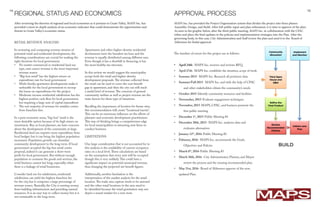
The timeline of events for this project are as follows:
•	 April 24th- MAPS Inc. recieves and reviews RFQ
•	 April 27th- MAPS Inc. establishs the situation, scope of work
•	 Summer 2015- MAPS Inc. Research all pertinent data
•	 Summer/Fall 2015- MAPS Inc. and with the help of CPAC 	
	 and other stakeholders obtain the community’s needs
•	 October 2015-Identify community resources and facilities
•	 Novemeber, 2015-Evaluate engagement techniques
•	 November, 2015-MAPS, CPAC, and business promote the 	
	 first public meeting
•	 December 1st
, 2015-Public Meeting #1
•	 December 20th, 2015- MAPS Inc. analyzes data and 		
	 evaluates alternatives
•	 January 12th
, 2016-Public Meeting #2
•	 Feburary, 2016- MAPS Inc. recommends the Goals, 		
	 Objectives and Policies
•	 March 8th
, 2016-Public Meeting #3
•	 March 30th, 2016- City Administrator, Planner, and Mayor 	
	 review the process and the ensuing recommended plan.
•	 May 31st, 2016- Board of Aldermen approve of the new,
updated Plan.
MAPS Inc. has provided the Project Organization system that divides the project into three phases:
Assemble, Design, and Build. After full-public input and plan refinement, it is time to approve of the plan.
As seen in the graphic below, after the third public meeting, MAPS Inc. in collobaration with the CPAC
refine and place the final updates to the policies and implementation strategies into the Plan. After the
governing body, in this case, City Administration and Staff review the plan and send it to the Board of
Aldermen for findal approval.
APPROVAL PROCESS
16 17
LEED (Leadership in Energy and Environmental Design) is the premier rating system for green buildings. It
was developed by the U.S. Green Building Council (USGBC) in the 1990’s. Since then LEED has experienced
exponential growth. The certification system has broadened to include a portfolio of nine rating systems that
target specific buildings and developments, the rating systems are as follows:
•	 Building Design and Construction (BD+C)
•	 Interior Design and Construction (ID+C)
•	 Building Operations and Maintenance (O+M)
•	 Neigbhorhood Development (ND)
•	 Homes
Sustainable Communities is a core concept that will be engrained in this update. The USGBC developed
LEED-­ND (Neighborhood Development) specifically for that. LEED-ND goes beyond the individual
building and concentrates on the building(s) context in the world. Most of the LEED-ND criterion
encourage quality design and high-performance of sustainable communities. Since LEED is the standard
for the “sustainable design” industry, this process is easily attainable, can work through bureaucratic
sophistications. With the right approach and if it is included in the visioning process Grain Valley can
become the first township to become LEED-ND certified, across the whole town. Now that is exciting!
LAND-USE INNOVATION
Communities across the country are adopting Form-Based Codes to assist with the effort to enhance the
look, feel and function of the built environment. A Form-Based Code allows property owners, businesses,
and developers to have more flexibilty when it comes to land-uses on the property.The only “takeaway”
is that the relaxed land-use requirements come at the cost of strict urban design guidelines that include
a myriad of architecture and planning tactics like setbacks, landscaping, ornamitation, and other design
elements.The overall intent of Form-Based Codes is to encourage quality development that both looks great
but functions well in the context of the neighborhood. Grain Valley can adopt Form-Base Codes in the
Zoning Ordinances or through the Building Codes.
LAND-USE INNOVATION
http://leed.usgbc.org/images/neighborhood-development_cover.jpg
18 19
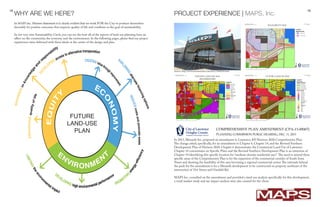
In MAPS Inc. Mission Statement it is clearly evident that we work FOR the City to position themselves
favorably for positive outcomes that improve quality of life and contibute to the goal of sustainability.
In our very own Sustainability Circle, you can see the how all of the aspects of land-use planning have an
affect on the community, the economy and the environment. In the following pages, please find our project
experiences were delivered with these ideals at the center of the design and plan.
WHY ARE WE HERE?
In 2013, Menards Inc. proposed an amendment to Lawrence, KS’ Horizon 2020 Comprehensive Plan.
The change asked, specifically, for an amendment to Chapter 6, Chapter 14, and the Revised Southern
Development Plan of Horizon 2020. Chapter 6 demonstrates the Commercial Land Use of Lawrence.
Chapter 14 concentrates on Specific Plans and the Revised Southern Development Plan is an extension of
Chapter 14 identifying this specific location for “medium-density residential uses”.The need to amend these
specific areas of the Comprehensive Plan is for the expansion of the commercial corridor of South Iowa
Street and showing the feasibility of this area becoming a regional commercial center.The rationale behind
the push for the amendment is for a Menards development to be constructed on property northeast of the
intersection of 31st Street and Ousdahl Rd.
MAPS Inc. consulted on the amendment and provided a land-use analysis specifically for this development,
a retail market study and tax impact analysis were also created for the client.
PROJECT EXPERIENCE | MAPS, Inc.
FUTURE
LAND-USE
PLAN
Source: http://www.semissourian.com/story/1846950.html
20 21
SPENCER AMPHITHEATER AND PATIO | UNIVERSITY OF KANSAS
PROJECT EXPERIENCE | MAPS, Inc.
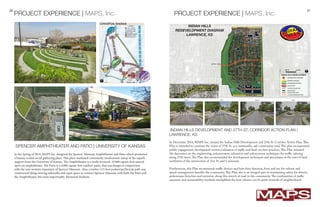
In the Spring of 2014, MAPS Inc. designed the Spencer Musuem Amphitheater and Patio which promoted
a human-scaled social gathering place. This place marketed community involvement ontop of the superb
support from the University of Kansas. The Amphitheater is a multi-terraced, 10,000 square foot natural
open-air amphitheater. The Patio is a 4,000 square foot outdoor patio, that was design in conjunction
with the new western expansion of Spencer Museum. Also, a twelve (12) foot pedestrian/bicycle path was
constructed along existing sidewalks and open space to connect Spencer Museum with both the Patio and
the Amphitheater, but most importantly, Memorial Stadium.
In December 2014, MAPS Inc. created the Indian Hills Development and 27th St. Corridor Action Plan.This
Plan is intended to continue the vision of 27th St. as a sustainable, safe community road.This plan incorporated
public engagement, development review, evaluation of traffic and land-use best practices.This Plan initiated
the discussion on the engineering, enhancement, education and enforcement techniques for traffic calming
along 27th street.The Plan also recommended the development techniques and procedures at the tract of land
northwest of the intersection of 31st St. and Louisiania.
Furthermore, this Plan recommends traffic devices and how their function, form and use for volume and
speed-management benefits the community.This Plan also is an integral part in maintaining safety for drivers,
pedestrians, bicyclists and motorists along this stretch of road in this community.The combination of traffic
measures and sustainability methods exemplified the how citizens can be great stewards of neighborhood.
PROJECT EXPERIENCE | MAPS, Inc.
INDIAN HILLS DEVELOPMENT AND 27TH ST. CORRIDOR ACTION PLAN |
LAWRENCE, KS
22 23
URBAN CONCEPTUAL MASSING | KANSAS CITY, MO
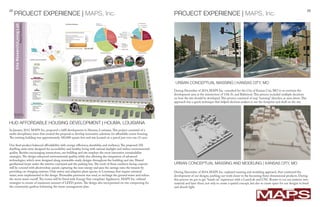
During December of 2014, MAPS Inc. consulted for the City of Kansas City, MO to re-envision the
development area at the intersection of 13th St. and Baltimore.This process included multiple decisions
on how the site should be developed.This process consisted of may “massing” sketches, as seen above.This
approach was a quick technique that helped decision makers to see the footprint and shell on the site.
PROJECT EXPERIENCE | MAPS, Inc.
URBAN CONCEPTUAL MASSING AND MODELING | KANSAS CITY, MO
During December of 2014, MAPS Inc. explored massing and modeling approach. that continued the
development of our designs, pushing our work closer to the becoming three-dimensional products. During
this process we got to get “hands on” experience with a LaserLab and CNC Router to cut our patterns into
material and layer them, not only to create a spatial concept, but also to create space for our designs to bend
and absorb light.
In January 2015, MAPS Inc. proposed a infill development in Houma, Louisiana.This project consisted of a
multi-disciplinary team that created the proposal to develop innovative solutions for affordable senior housing.
The exisitng building was approximately 100,000 square feet and was located on a parcel just over one (1) acre.
Our final product balanced affordability with energy-efficiency, durability, and resiliency.The proposed 250
dwelling units were designed for accessibility and healthy living with natural daylight and indoor environmental
quality. Besides encouraging interactions, our building and site employs the most innovative sustainability
strategies.The design enhanced environmental quality, while also allowing the integration of advanced
technologies, which were designed along renewable-ready designs throughout the building and site. Shared
geothermal loops under the interior courtyard and the parking lots.The roofs of these southern facing carports
will be covered with photovoltaic panels capturing the suns energy and pass the savings onto the tenants by
providing car charging stations. Only native and adaptive plant species to Louisiana, that require minimal
water, were implemented in the design. Permeable pavement was used, to recharge the ground water and reduce
the storm water runoff.The rooms will be fitted with Energy Star compliant Appliances. MAPS Inc. utilized
strategies to ensure of maximum amount of LEED points.The design also incorporated on-site composting for
the community gardens bolstering the waste-management plan.
PROJECT EXPERIENCE | MAPS, Inc.
HUD AFFORDABLE HOUSING DEVELOPMENT | HOUMA, LOUISIANA
24 25
APPENDIX A APPENDIX A
26 27
APPENDIX A APPENDIX A
2928
APPENDIX A ENDNOTES
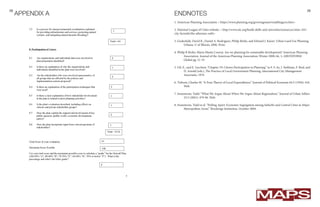
1. American Planning Association < https://www.planning.org/growingsmart/enablingacts.htm>
2. National League of Cities website: < http://www.nlc.org/build-skills-and-networks/resources/cities-101/
city-factoids/the-athenian-oath>
3. Godschalk, David R., Daniel A. Rodríguez, Philip Berke, and Edward J. Kaiser. Urban Land Use Planning. 	
	 Urbana: U of Illinois, 2006. Print.
4. Philip R Berke; Maria Manta Conroy. Are we planning for sustainable development? American Planning 	
	 Association. Journal of the American Planning Association; Winter 2000; 66, 1; ABI/INFORM 		
	 Global pg. 21-33
5. Gil, E., and E. Lucchesi: “Chapter 19: Citizen Participation in Planning,” in F. S. So, I. Stollman, F. Beal, and	
	 D. Arnold (eds.), The Practice of Local Government Planning, International City Management 		
	 Associatio, 1979.
6. Tiebout, Charles M. “A Pure Theory of Local Expenditures.” Journal of Political Economy 64.5 (1956): 416. 	
	Web.
7. Swanstrom, Todd. “What We Argue About When We Argue About Regionalism.” Journal of Urban Affairs 	
	 23.5 (2001): 479-96. Web.
8. Swanstrom, Todd et al. “Pulling Apart: Economic Segregation among Suburbs and Central Cities in Major 	
	 Metropolitan Areas.” Brookings Institution. October 2004.

Trey Maevers-RFQ-Comprehensive Exam

  • 1.
  • 2.
    April 27th, 2015 Cityof Grain Valley, MO, Deptartment of Administration & Finance 711 Main Street Grain Valley, MO 64029 Dear Review Committee: The MAPS Inc. team is elated to submit our qualifications for Land-Use Planning and Implementation strategies with the City of Grain Valley, Missouri. Future land-use planning has the capability to create positive outcomes and sustain those outcomes for the City of Grain Valley in the near and far future. If executed appropiately, it can rejuvenate the community to establish a framework of the correct balance of land-uses that are feasible in terms of economic growth, environmental preservation, and social equity. The result of “good” land-use planning really is manifested through hard work, dedication and pride. We take pride in our work and services, we also take initiative to reach the community in the most efficient and effective way possible through our proven community engagement techniques. Afterall, public particpation is paramount to a success project that reflects the community’s vision.This vision will exemplify the importance of healhty community action, the value of safety and quality of life.This vision is the guide for this Plan to enhance the quality of the communty as a place to live, work and play.The core goal of successful land-use planning is to have a safe, attractive and sustainalbe community that is meaninful over the long-term for citizens, neighbors and travelers. If selected, we will be happy to offer our very own team of experts that has experiences in land planning, site planning, architecture, urban design, landscape architecture and sustainable solutions.We feel this experience and professional excellence can produce exceptional planning, architecture, and sustainable solutions to the municipality of Grain Valley and through the implementation of this Plan the City of Grain Valley can become leaders in sustainable land-use planning for the county, metropolitan area, and the state of Missouri. We thank you in advance for your time and consideration. If you have any questions as you review our proposal, please do not hesitate to contact me at 573.587.33767 or treymaevers@gmail.com. Sincerely, 2 TABLE OF CONTENTS COVER LETTER BASIC QUALIFICATIONS MISSION STATEMENT PHILOSOPHY LEGAL BASIS BASIC QUALIFICATIONS PLAN EVALUATION APPROACH TO PROJECT MANAGMENT/ORGANIZATION GOALS COMMITTE ENGAGEMENT POPULATION PROJECTIONS REGIONAL STATUS AND ECONOMICS APPROVAL INNOVATION WORK PRODUCT SAMPLES UPDATE SUMMARY APPENDIX 3 4 4 4 4 5 6 8 8 9 10 12 13 15 16 19 25 26 COVER LETTER Trey Maevers CEO and Founder, MAPS, Inc. 5620 W 133rd Ter. | Overland Park, KS 66209 P: 573.587.3376 | E: treymaevers@gmail.com 3 Trey Maevers
  • 3.
    4 5 MAPS approachand expertise has led to successful implementation of many land-use and urban design projects. Our goal is provide the most efficient and effective method for you, the City of Grain Valley, to reach your desired outcome. In order to achieve that goal, MAPS, Inc. has established definitions that are pertinent to our success in assisting and providing solutions for communities like Grain Valley. COMPREHENSIVE PLAN How does a Comprehensive Plan work? As annotated in the Legal Basis section, Comprehensive Planning acts as guide, therefore as a guide it would entail some structure.This contributes to the Rational Planing Theory.This Theory insists that planners, or anybody devleoping a plan, need a systems or framework base their decisions after the process is complete. Comprehensive Planning is a process that typically has a general framework that guides communities to: • Identify and diagnose issues; • Explore techniques and alternatives; • Collect data and information; • Outline a vision and define goals; • Create policies; • Implement strategies, • Evaluate and monitor progress; • Establish possible future procedures. HOW DO YOU USE THE PLAN? In the last decade the Comprehensive Plan has become more than a plan. It has developed into a tool for planners, city officials, and citizens to focus on local and/or regional initiatives.The evolved Comprehensive Plan includes policy recommendations, detailed guidelines and timelines, and best practices. Simply, the Comprehensive Plan requires the community to answer three simply, yet ardous questions: • What course is the City on? • What future does the City want? • How do we make that future a reality? BASIC QUALIFICATIONS | MAPS, Inc. MISSION STATEMENT We are Architects and Planners FOR sustainable communities; We create positive outcomes by INVESTING the time to improve quality of life; We are more than designing spaces, we design COMMUNITIES. PHILOSOPHY OF PLANNING “Urban Planning” goes by many names, including town planning, land-use planning, transporation planning, rural planning, city planning, community planning, and regional planning. With all of these terms, planning still can be narrowed down to one (1) sole purpose: Improve the welfare of the people and their communities by creating places that are equitable, healthy, efficient, convenient, and attractive for both present and future generations. Urban planning contributes to the guidance and ensurance of orderly development of within and outside of urban areas. Due to the relationship of the built environment, urban planners work professionals in the enginnering and architecture fields. With these relationships, planners can achieve strategic, policy and sustainable goals. Good urban planning provides city leaders, businesses, developers, and citizens with an opportunity to be involved in the improvements and enhancements of their communities. Fundamentally, good planning and good city administration are interchangeable. BASIC QUALIFICATIONS | MAPS, Inc. LEGAL BASIS American history has demonstrated the importance of the local government’s ability to provide a secure and safe place to live. At the turn of the Twentieth Century, land use zoning came to the U.S. Supreme Court in Hadacheck v. Sebastian (1906), and many interpreted the findings of the case to have granted implicit approval of land use zoning. After the case American cities began to see the need for the planning process to convserve the local government’s responsbility of health and welfare for the community. In 1926, the U.S. Supreme Court upheld the constitutionality of comprehensive zoning in Village of Euclid v. Amber Realty Co. This case ushered in another foundation of planning as the Federal Government, through the Department of Commerce, wrote a legal provision for States to provide local governments with the framework to engange in planning.1 This provision was called the Standard State Zoning Enabling Act (SZEA, 1926), which created the “Comprehensive Plan” or “Master Plan”. However, a comprehensive plan is not usually legally binding, city ordinances must be amended in order to legally implement the provision required to use the comprehensive plan. Learning from history, most states adopted this provision, and the states that did not still gives incentives to local governments that establish a plan to guide development. Municipalities in Missouri are considered to be governmental subdivisions of the State and, as such, are empowered to adopt planning and zoning for the general purposes of enhancing the health, safety, and welfare of their residents. This authority is outlined in Chapter 89 of the Revised Statutes of the State of Missouri. MAPS, Inc. is a land planning, urban design and strategic services firm. We provide these services to a wide variety of governmnet agencies, property owners and developers. We have evolved a proprietary approach and unique culture that has quickly earned us the reputation for solving complex problems on many levels of society. SUSTAINABILITY Sustainability is not a new notion. It actually has traces back to the Classical Greek era. In fact, the Athenian Oath for citizens includes this statement, “...to transmit this city not ony, not less, but greater & more beautiful than it wa transmitted to us.” 2 This demonstrates the importance of doing whatever is necessary to provide a better world for the future generations.This is a strong message in times of uncertainty of the repercussions of our harm to the natural environment.
  • 4.
    6 7 In orderto evaluate the quality of Grain Valley’s current Land-Use, Policy, and Implementation Chapters in the 2010 Comprehensive Plan, everyone reading or referring to the it must understand the mechanics of what makes a good plan. This is done by identifying specific components of the plan, using mutliple criteria for evalutation, and assessing the plan in context of all criteria. PLAN EVALUATION One the most-widely used evaluation systems among planners, is the Plan-Quality Evaluation Protocol from the Urban Land Use Planning (Berke et al, 2006)3 . This evaluation categorizes each section of a plan and establishes a coding and point system of zero (0) which means the plan does not identify that criteria, one (1) means that the criteria is identified and vague, and two (2) shows that the plan has identified the criteria in detail. There are eight (8) categories of of criterion: 1. Issues and Vision Statement 2. Fact Base 3. Goal and Policy Framework 4. Plan Proposals 5. Encourage Opportunites to Use Plan 6. Create Clear Views and Understanding 7. Account for Interdependent Actions 8. Participation of Actors This system allows the reviewer to cover all of the bases of “good plans”. For MAPS, Inc. full review of the Grain Valley’s 2010 Land-Use, Policy, and Implementation Chapters please see Appendix A. The Plan-Quality Evaluation Protocol system is is based off evaluating the full comprehensive plan, so the partial review of the Land-Use, Policy and Implementation Chapters will, by default, produce a low score.This is why it is important to use multiple systems. The other evaluation systems that MAPS, Inc. uses is the Sustainability criteria developed by Philip Berke and Maria Conroy in their study and evaluation of multiple Comprehensive Plans.4 Which looks at the plan based off the following criteria: • Harmony with nature • Livable built environments • Place-based economy • Equity • Environmental repurcussions (Polluter’s Pay) Responsible regionalism MAPS, Inc. has additional criteria for evaluation. This has been developed through multiple Comprehensive Plan projects. This evaluation criteria is separating into five (5) sections: 1. Inspirational 2. Synthesis 3. Attractiveness 4. Performance 5. Resourcefulness Negative • The Plans lacked the essential details on the private orginazations and government departments that would contribute to successful implementation. • Also, the policies and actions lacked the direction of the organizations that are in charge of monitoring and evaluating this plan and the plans’ actions. • The other big negative factor was the lack of clarity of what federal, state and city policies, laws and programs that can contribute to the plan. • Also, there is no mention of development and growth in terms of sustainability or other terms that relate the future land-uses to local ecology, economy, and equity. • • The design in some parts becomes a littel text-heavy and irrational.The use of more tables, graphs and graphics can increase awareness and attention with the reader. • • There is no Glossary of Terms. Some of the lingo and jargon can get confusing for some people. Positive • The most positive criterion that was met was the Plans’ description of the exisitng conditions.The Plans demonstrated the community’s exisiting conditions through multiple perspecitves, specifically, the plan shows the environmental constraints for the exisiting and future land-use proposals. • Another positive point was that the public participated in the process through meetings and surveys, this is very crucial to a plan’s effectiveness. • Lastly, there were the right amount of general goals and they were clearly stated. PLAN EVALUATION After putting Grain Valley’s current Land-Use, Policy, and Implementation Chapters in the 2010 Comprehensive Plan through all three (3) evaluation systems, MAPS, Inc. has determined the final grade of a “C”. A short synopsis of the positive and negative reasons for this grade is explained below.
  • 5.
    8 9 Goal 1:The City of Grain Valley will develop a culture that attracts new development to bolster the local economy, therefore relieving the tax burden on all property owners. Objective 1.1: Seek to develop a diverse range of land uses to include, but not limited to, retail, office, regional/community commercial, business park and light-industrial. Policy 1.1.1: Create the framework and guidelines for which new developments that meet the established standards could qualify to receive a credit or relief from impact fees. Objective 1.2: Promote development by updating the development codes that reflect the current best practices for buildings and developments. Policy 1.2.1: Implement Form-Based Codes as a part of the City’s development ordinances and codes. Goal 2: The City will establish an approach that sustains the vision of each resident and the area they live, work, and play. Objective 2.1: The Vision set forth in this Plan should be expounded upon to include specific areas that require more attention and detail. Policy 2.1.1: Create and implement Concept Plans for those targeted areas. Objective 2.2: The City will continue the efforts to review, discuss and advance the plans set forth in this Comprehensive Plan. Policy 2.2.1: Compose a seperate Committee that is soley concerned that the community accepts, complies, applies, and adapts to changes in the Comprehensive Plan. Goal 3: The City will be an exemplification on how to entice sustainable development. Objective 3.1: Necessitate that all new development preserves the ecological system at the lot, neighborhood, city, county and regional level. Policy 3.1.1: Assure that all new development is is meeting all environmental regulations (i.e. EPA, FEMA, MO. Dept. of Health, MO. Dept. of Natural Resources) Objective 3.2: Foster a built environment that is equitable and strengthens the local economy. Policy 3.2.1: Alter and/or streamline regulations to facilitate mix-use developments that support and assimilate into the overall community setting. After establishing a thorough review and evaluation of these Plans. MAPS, Inc. has used our creative and analytical expertise to form three (3) goal statements for the Futre Land-Use Plan of Grain Valley, MO. Also, MAPS, Inc. has conceived of two (2) objectives and two (2) policy statements to accompany each goal. GOALS PROJECT ORGANIZATION MAPS, Inc. has had organized multiple plan/policy updates and each one had their unique qualities, but we take pride in our project organization which consist of the following seven (7) tasks: 1. Research, design, and survey community needs 2. Take inventory, diagnose and analyze 3. Explore and evaluate alternatives 4. Re-envision and set goals 5. Discuss and decide 6. Take action and implement 7. Supervise and refine PROJECT MANAGEMENT In order for MAPS to effectively manage a project that clients can make decision from, we have produced and used a project management system called A-MISSION. A-MISSION is a project management system that has proven itself to have the capabilities to receive, organize and conduct successful projects.This system has been proven to properly manage time, resouces, and personell during the the projects life. A-MISSION is a mission to bring everything togehter smoothly, in a timely manner, without spending a fortune to fix problems that arise from mismanagement. APPROACH TO PROJECT A-MISSION is an acronym for: Analysis of the situation Mission Implementation Service Support Inspect Omit Neoligize A-MISSION has been very resourceful due to the system’s well-established and rigourous standards. These management standards are engrained in our culture, this ensures that quality measures are enforced along each step of the process. These tasks can be consolidated into three (3) phases: Phase 1-ASSEMBLE (Tasks 1,2) Phase 2-DESIGN (Task 3,4,5) Phase 3-BUILD (Task 6,7) Successul projects result in the timely and effective implementation of the seven (7) tasks by keeping A-MISSION in mind why executing the tasks and making decisions.
  • 6.
    10 11 With thecombination of online surveys, there will be three (3) public meetings. After reviewing the school schedule and normal business hours in the City, MAPS Inc. determined that these meetings will be situated at a favorably time for most,Tuesday evenings. We will suggest that the CPAC assist in promoting the meetings well beforehand. Each meeting will have a specific agenda and organization. Below are the general outlines of each meeting’s agenda. December 1st , 2015 Public Meeting #1: • Introduction to the process • Existing Views and Opinions of the City • Input for vision, growth and the future January 12th , 2016 Public Meeting #2: • Explore alternatives and best practices • Feedback on the alternatives • Obtain consensus on one alternative March 8th , 2016 Public Meeting #3: • Favor on preferred plans from meeting #2 • Evaluate Policies and Strategies • Make final public recommendations COMMUNITY ENGAGEMENT Source: http://www.biweekly.pl/article/2912-designing-objects-designing-cities.html The planning process is meant to reflect the vision and wishes of the community. In order to get this effect, it is paramount to consult with the most people in the community as effectively and efficiently as possible. The main goal of citizen participation is to gain support, build trust and, ultimately, build a better program/plan for the community. MAPS Inc. will work to reach a broad range of participants to create a general consensus about the Plan update. During this process, MAPS Inc. will engage and interact with the Comprehensive Plan Advisory Committee (CPAC), businesses, civic leaders, school district, various neigborhoods and the general public. There are many ways to induce participation and get input from the community.The most familiar approaches are surveys, public hearings, neighborhood meetings, workshops, charrettes, and focus groups. After review the previous community engagement techniques that occured in 2009, MAPS Inc. has determined to use the techniques that are appropiate for the four steps of planning (i.e. Prepare, Plan, Implement, Review) and the development of values, goals, and objective.5 These techniques are the use of an Advisory Committee, Attitude Surveys, Group Dynamics,Task Forces, Charrettes and Public Information programs. From the aforementioned Goals and this PARK analysis, MAPS Inc. has conceived three (3) sample survey questions that have proven successful in similar cities like Grain Valley. A common theme during community meetings and workshops is using the PARK (Preserve, Add, Remove, Keep out) analysis.This should be done graphically, not verbally, preferrably on a big board if the room allows it. During the meeting, we will have a facilitator describe the process and help with people scribing their responses on the board.The graphic below depicts how the board would be divided into sections where the respondents would have room to write their responses to the questions asked.The questions for this analysis are as follows: • What do you like about Grain Valley and you want to keep? (PRESERVE) • What should be removed from Grain Valley? (REMOVE) • What could be added to Grain Valley to make it better? (ADD) • What should not be a part of Grain Valley? (KEEP OUT) MAPS Inc. goals for Grain Valley emphasized an economic influence, specifically developments that bring in new revenue to decrease the tax burden on residential property owners. Also, another emphasis was put on a vision for a mix of high quality land uses at specific areas. Finally, sustainability was insisted in new development. From these goals, MAPS Inc. has conceived sample survey questions that have proven successful in similar cities like Grain Valley. COMMUNITY ENGAGEMENT P A R K POSITIVE NEGATIVE INTERNALEXTERNAL 2. What does “sustainable development” mean to you? (Choose top 3) • Reduse, Reuse, and Recycling • Preservation of natural resources and ecology • Protect and conserve for future generations • Sustaining finances and budgets • Balancing the demands of the environment, economy and community • I don’t know • None of the above 1. Overall, how would you rate the quality of life in Grain Valley? • Excellent, Good, Fair, or Poor 3. I would support the City to prioritze development in the following areas? • South of the Middle School, West of Buckner Tarsney Rd. • Around Buckner Tarsney Rd. and Pink Hill Rd. North of I-70 • Lefholz Rd. and I-70, East of town • Along Negben Rd. West of Buckner Tarsney Rd. • I don’t know • None of the above
  • 7.
    12 13 Source: U.S.Census, American FactFinder: <http://factfinder.census.gov> There has been three (3) years of population estimates since the current Comprehensive Plan was established. These estimates and the 1990, 2000, and 2010 Census populations are in the tables below. The population growth has major impact to the future land-uses in Grain Valley. This data will justify the need to diversify and form a mix-use base. With population growth comes residential growth and with the current disportationate amount of residential land-uses within the city limits, Grain Valley needs to recognize the need to bring in other land uses. POPULATION PROJECTIONS Using the data in the table to the right, I performed a “Decennial Cohort Population Projection” for the years 2020 and 2030. Which provided some boundless numbers, I proceeded to us a linear extrapolation technique, which is a simplistic model that uses past gross population trends to project future population levels.The defining characteristics of trend of linear extrapolation are that future values of any variable are determined solely by its historical values. This procedure starts by identifying the overall past trend and then fit that datum to a proper curve for linear extrapolation. This technique projects future populations based upon the chosen curve. The advantages of linear extrapolation is that it a simple, cost-effective approach that requires very little data. The disadvantages are that it only uses aggregate data and assumes that past trends conclude future populations. Based up these techniques, the population for the year 2030 is going to be approximately 30,849. This is a growth of around 17,700 people from the current population as of the 2010 estimates. Also, in 2030 the amount of estimated households is nearly 11,000. This creates a demand well over 5,000 households. Census Population and Housing Units: REGIONAL APPROACH One of the main arguments against the positive correlation between the central city and suburban economic growth is the thinking of it the “other- way-around”.This suggests a central city is more dependent on a successful suburb(s) rather than the suburb is on the larger, central city. Swanstrom suggest that this idea would have tremendous effect on local and regional policies in terms of socio-economic development.7 The “quality of life” quarrel can induce more debate on this issue and complicate this reversal idea.This issue becomes evident when one looks at the disproportion in jobs, education and income between the city and suburbs. The prominence of these imbalances creates a better argument of using a more regional approach. STATUS AND ECONOMIC DISPARITY Todd Swanstorm, a renowned Public Policy Professor at the Saint Louis University. His study that examed economic segregration among suburbs and central cities found that suburbs, especially poorer ones, have it worse.8 Suburbs are more imperceptible and have less political influence than the neighboring cities. These smaller municipalities usually have inadequate amenities, political survivability and professional staff of compared to the central cities. They also often lack public policies and programs that would accomodate their situation and create a counterbalance from this disparity. Grain Valley needs to adopt land-use and growth patterns that would acclimatize to economics of the Kansas City Metro. The implementation of this strategy is outlined in the implementation plan MUNICIPAL FRAGMENTATION APPROACH This approach states that when households are able to move to the jurisdiction with the goods and services—as well as a tax and public-service level—that most suit their needs, local governments must act effectively and efficiently to retrain and attract residents. Charles Tiebout, a distinguished economist in the 1950s, argued that municipalities have two approaches to gain more residents. One way suggests the municipality impose a singular tax rate among the various communities, this would essentially infringe on the people’s freedom to choose their communities, enjoying perfect mobility and perfect information. The other option is to allow the municipalities to healthily compete in tax competition.6 LOCATION THEORY The public sector can lure firms in by demonstrating a cost-minimization argument for their chosen location. Cost minimization, in this example, can occur when the sum of the costs of transportation, distribution and site development are all minimized due to the location. MAPS Inc. have partners that were apart of the bidding process of Tesla Motors’ new “mega” factory to make lithium batteries. Nevada, ultimately, won the bid due to huge tax incentive. Putting aside the $1Billion tax incentive, Nevada really won the bid by using this location theory.The location of the chosen site has multiple links to Interstate 80, rail and an airfield. Nevada also boasts the country’s only active lithium mine, which is a direct resource for their batteries. Like Tesla Motors and Nevada, in particular the site for the factory, have many similarities to Grain Valley with Interstate 70, East Kansas City Airport and the Kansas City Southern Railway. The economic status of a surburban/rural municaplity hinges on the regional and fragmented local governance theories. These theories are rooted in how the municipality stands economically, especially for a city like Grain Valley being situated on the outskirts of a major metropolitan area. These theories attempt to answer the following questions. Can local municipalities perform interdependently or are they interconnected to the economical fate of the region/metropolitan area? Some would say that the municipality (edge or central city) are “too big to fail” and need to be considered a part of the region’s economic structure. REGIONAL STATUS AND ECONOMICS Source: U.S. Census, American FactFinder: <http://factfinder.census.gov> Source: U.S. Census, American FactFinder: <http://factfinder.census.gov>
  • 8.
    14 15 Apartments andother higher-density residential develoments have the broadest tax base and the revenue is equally distributed among different uses. Even though it has a shortfall in financing, it has the most healthy tax structure. In this review we would suggest the municipality accept both the retail and higher-density development proposals.The revenue collected from the retail can be used to cover the cost-benefit gap in apartment, and then the city can still reach a useful level of revenue.The concerns of general community welfare as well as project revenue are the main factors for these type of situations. Recalling the importance of location for future sites, this recommendation will create “locational inertia”. This can be an enormous influence on the efforts of planners and economic development practitioners. This way of thinking brings a competiveness edge for local municipalities in attracting new firms to conduct business. LIMITATIONS One large consideration that is not accounted for in this analysis is the availabiltiy of current occupancy rates on a local level.These calculations are based on the assumption that every unit will be occupied though this is very unlikely.This could have a significant impact on potential municipal revenue, thus changing the projected net benefit figures. Additionally, another limitiation is the interpretation of the market analysis for the retail location.The trade area capture needs to be assessed and the other retail locations in the area need to be identified because the retail gravitation may not depict a sound market for a new store. RETAIL REVENUE ANALYSIS In reviewing and comparing revenue streams of potential retail and residential developments, the following considerations are crucial for making the right decisions for local government. • No matter commercial or residential land use type, own source revenue is the most important revenue source • “Big-box retail” has the highest return on expenditure rate for local government • Multi-family, apartment developments make it unfeasible for the local government to recoup the losses on expenditures for the project. • Moderate income residential subdivision has the highest positive cash flow for local government, but requiring a large sum of capital expenditure • The vast majority of revenue for retailers comes from franchise fees. In a pure economic sense, “big-box” retail is the most desirable option because of its high return on investment. But, as local planners, we have concerns about the development of the community at large. Residential land use requires more expenditure from local budget, but it can bring the highest population increment. Population growth can stimulate community development in the long-term. If local government accepted the big-box retail center proposal, indeed it can generate a short-term profit for local government. But without enough population to consume the goods and services, the retail business cannot last long, especially, when there is a leakage of retail businesses. Consider land use for subdivision, residential subdivision can yield the highest franchise fee for the city, but it composes a large percentage of revenue source. Basically, the City is earning money from building infrastructure and providing natural resources. It is an easy way to collect money but it is not sustainable in the long-term. After reviewing the theories of regional and local economies as it pertians to Grain Valley, MAPS Inc. has provided a more in-depth analysis of an economic indicator that could demonstrate the opportunities and threats to Grain Valley’s economic status. REGIONAL STATUS AND ECONOMICS The timeline of events for this project are as follows: • April 24th- MAPS Inc. recieves and reviews RFQ • April 27th- MAPS Inc. establishs the situation, scope of work • Summer 2015- MAPS Inc. Research all pertinent data • Summer/Fall 2015- MAPS Inc. and with the help of CPAC and other stakeholders obtain the community’s needs • October 2015-Identify community resources and facilities • Novemeber, 2015-Evaluate engagement techniques • November, 2015-MAPS, CPAC, and business promote the first public meeting • December 1st , 2015-Public Meeting #1 • December 20th, 2015- MAPS Inc. analyzes data and evaluates alternatives • January 12th , 2016-Public Meeting #2 • Feburary, 2016- MAPS Inc. recommends the Goals, Objectives and Policies • March 8th , 2016-Public Meeting #3 • March 30th, 2016- City Administrator, Planner, and Mayor review the process and the ensuing recommended plan. • May 31st, 2016- Board of Aldermen approve of the new, updated Plan. MAPS Inc. has provided the Project Organization system that divides the project into three phases: Assemble, Design, and Build. After full-public input and plan refinement, it is time to approve of the plan. As seen in the graphic below, after the third public meeting, MAPS Inc. in collobaration with the CPAC refine and place the final updates to the policies and implementation strategies into the Plan. After the governing body, in this case, City Administration and Staff review the plan and send it to the Board of Aldermen for findal approval. APPROVAL PROCESS
  • 9.
    16 17 LEED (Leadershipin Energy and Environmental Design) is the premier rating system for green buildings. It was developed by the U.S. Green Building Council (USGBC) in the 1990’s. Since then LEED has experienced exponential growth. The certification system has broadened to include a portfolio of nine rating systems that target specific buildings and developments, the rating systems are as follows: • Building Design and Construction (BD+C) • Interior Design and Construction (ID+C) • Building Operations and Maintenance (O+M) • Neigbhorhood Development (ND) • Homes Sustainable Communities is a core concept that will be engrained in this update. The USGBC developed LEED-­ND (Neighborhood Development) specifically for that. LEED-ND goes beyond the individual building and concentrates on the building(s) context in the world. Most of the LEED-ND criterion encourage quality design and high-performance of sustainable communities. Since LEED is the standard for the “sustainable design” industry, this process is easily attainable, can work through bureaucratic sophistications. With the right approach and if it is included in the visioning process Grain Valley can become the first township to become LEED-ND certified, across the whole town. Now that is exciting! LAND-USE INNOVATION Communities across the country are adopting Form-Based Codes to assist with the effort to enhance the look, feel and function of the built environment. A Form-Based Code allows property owners, businesses, and developers to have more flexibilty when it comes to land-uses on the property.The only “takeaway” is that the relaxed land-use requirements come at the cost of strict urban design guidelines that include a myriad of architecture and planning tactics like setbacks, landscaping, ornamitation, and other design elements.The overall intent of Form-Based Codes is to encourage quality development that both looks great but functions well in the context of the neighborhood. Grain Valley can adopt Form-Base Codes in the Zoning Ordinances or through the Building Codes. LAND-USE INNOVATION http://leed.usgbc.org/images/neighborhood-development_cover.jpg
  • 10.
    18 19 In MAPSInc. Mission Statement it is clearly evident that we work FOR the City to position themselves favorably for positive outcomes that improve quality of life and contibute to the goal of sustainability. In our very own Sustainability Circle, you can see the how all of the aspects of land-use planning have an affect on the community, the economy and the environment. In the following pages, please find our project experiences were delivered with these ideals at the center of the design and plan. WHY ARE WE HERE? In 2013, Menards Inc. proposed an amendment to Lawrence, KS’ Horizon 2020 Comprehensive Plan. The change asked, specifically, for an amendment to Chapter 6, Chapter 14, and the Revised Southern Development Plan of Horizon 2020. Chapter 6 demonstrates the Commercial Land Use of Lawrence. Chapter 14 concentrates on Specific Plans and the Revised Southern Development Plan is an extension of Chapter 14 identifying this specific location for “medium-density residential uses”.The need to amend these specific areas of the Comprehensive Plan is for the expansion of the commercial corridor of South Iowa Street and showing the feasibility of this area becoming a regional commercial center.The rationale behind the push for the amendment is for a Menards development to be constructed on property northeast of the intersection of 31st Street and Ousdahl Rd. MAPS Inc. consulted on the amendment and provided a land-use analysis specifically for this development, a retail market study and tax impact analysis were also created for the client. PROJECT EXPERIENCE | MAPS, Inc. FUTURE LAND-USE PLAN Source: http://www.semissourian.com/story/1846950.html
  • 11.
    20 21 SPENCER AMPHITHEATERAND PATIO | UNIVERSITY OF KANSAS PROJECT EXPERIENCE | MAPS, Inc. In the Spring of 2014, MAPS Inc. designed the Spencer Musuem Amphitheater and Patio which promoted a human-scaled social gathering place. This place marketed community involvement ontop of the superb support from the University of Kansas. The Amphitheater is a multi-terraced, 10,000 square foot natural open-air amphitheater. The Patio is a 4,000 square foot outdoor patio, that was design in conjunction with the new western expansion of Spencer Museum. Also, a twelve (12) foot pedestrian/bicycle path was constructed along existing sidewalks and open space to connect Spencer Museum with both the Patio and the Amphitheater, but most importantly, Memorial Stadium. In December 2014, MAPS Inc. created the Indian Hills Development and 27th St. Corridor Action Plan.This Plan is intended to continue the vision of 27th St. as a sustainable, safe community road.This plan incorporated public engagement, development review, evaluation of traffic and land-use best practices.This Plan initiated the discussion on the engineering, enhancement, education and enforcement techniques for traffic calming along 27th street.The Plan also recommended the development techniques and procedures at the tract of land northwest of the intersection of 31st St. and Louisiania. Furthermore, this Plan recommends traffic devices and how their function, form and use for volume and speed-management benefits the community.This Plan also is an integral part in maintaining safety for drivers, pedestrians, bicyclists and motorists along this stretch of road in this community.The combination of traffic measures and sustainability methods exemplified the how citizens can be great stewards of neighborhood. PROJECT EXPERIENCE | MAPS, Inc. INDIAN HILLS DEVELOPMENT AND 27TH ST. CORRIDOR ACTION PLAN | LAWRENCE, KS
  • 12.
    22 23 URBAN CONCEPTUALMASSING | KANSAS CITY, MO During December of 2014, MAPS Inc. consulted for the City of Kansas City, MO to re-envision the development area at the intersection of 13th St. and Baltimore.This process included multiple decisions on how the site should be developed.This process consisted of may “massing” sketches, as seen above.This approach was a quick technique that helped decision makers to see the footprint and shell on the site. PROJECT EXPERIENCE | MAPS, Inc. URBAN CONCEPTUAL MASSING AND MODELING | KANSAS CITY, MO During December of 2014, MAPS Inc. explored massing and modeling approach. that continued the development of our designs, pushing our work closer to the becoming three-dimensional products. During this process we got to get “hands on” experience with a LaserLab and CNC Router to cut our patterns into material and layer them, not only to create a spatial concept, but also to create space for our designs to bend and absorb light. In January 2015, MAPS Inc. proposed a infill development in Houma, Louisiana.This project consisted of a multi-disciplinary team that created the proposal to develop innovative solutions for affordable senior housing. The exisitng building was approximately 100,000 square feet and was located on a parcel just over one (1) acre. Our final product balanced affordability with energy-efficiency, durability, and resiliency.The proposed 250 dwelling units were designed for accessibility and healthy living with natural daylight and indoor environmental quality. Besides encouraging interactions, our building and site employs the most innovative sustainability strategies.The design enhanced environmental quality, while also allowing the integration of advanced technologies, which were designed along renewable-ready designs throughout the building and site. Shared geothermal loops under the interior courtyard and the parking lots.The roofs of these southern facing carports will be covered with photovoltaic panels capturing the suns energy and pass the savings onto the tenants by providing car charging stations. Only native and adaptive plant species to Louisiana, that require minimal water, were implemented in the design. Permeable pavement was used, to recharge the ground water and reduce the storm water runoff.The rooms will be fitted with Energy Star compliant Appliances. MAPS Inc. utilized strategies to ensure of maximum amount of LEED points.The design also incorporated on-site composting for the community gardens bolstering the waste-management plan. PROJECT EXPERIENCE | MAPS, Inc. HUD AFFORDABLE HOUSING DEVELOPMENT | HOUMA, LOUISIANA
  • 13.
    24 25 APPENDIX AAPPENDIX A
  • 14.
    26 27 APPENDIX AAPPENDIX A
  • 15.
    2928 APPENDIX A ENDNOTES 1.American Planning Association < https://www.planning.org/growingsmart/enablingacts.htm> 2. National League of Cities website: < http://www.nlc.org/build-skills-and-networks/resources/cities-101/ city-factoids/the-athenian-oath> 3. Godschalk, David R., Daniel A. Rodríguez, Philip Berke, and Edward J. Kaiser. Urban Land Use Planning. Urbana: U of Illinois, 2006. Print. 4. Philip R Berke; Maria Manta Conroy. Are we planning for sustainable development? American Planning Association. Journal of the American Planning Association; Winter 2000; 66, 1; ABI/INFORM Global pg. 21-33 5. Gil, E., and E. Lucchesi: “Chapter 19: Citizen Participation in Planning,” in F. S. So, I. Stollman, F. Beal, and D. Arnold (eds.), The Practice of Local Government Planning, International City Management Associatio, 1979. 6. Tiebout, Charles M. “A Pure Theory of Local Expenditures.” Journal of Political Economy 64.5 (1956): 416. Web. 7. Swanstrom, Todd. “What We Argue About When We Argue About Regionalism.” Journal of Urban Affairs 23.5 (2001): 479-96. Web. 8. Swanstrom, Todd et al. “Pulling Apart: Economic Segregation among Suburbs and Central Cities in Major Metropolitan Areas.” Brookings Institution. October 2004.