1
Introduction
Personal statements are
an integral part of the university
admissions process in the UK.
However, there is strong evidence
suggesting this process advantages
some types of applicant over
others.1
The persistent ‘Access Gap’
in UK Higher Education, in which
applicants from state schools with
the same grades as their privately-
educated peers are said to be one
third less likely to gain an offer
from a leading university, may be
related to personal statements.2
An applicant’s school type is a key
predictor of the quality of their
personal statement; those from
more advantaged educational
backgrounds are more likely
to receive better support and
guidance.3
What is a personal statement?
A-level attainment is the most
important factor in securing
offers from selective universities.
However, as part of the application
process, the University and Colleges
Admissions Service (UCAS) allows
each applicant 4,000 characters to
write a personal statement. UCAS
provides the following guidance to
students when writing their personal
statements:
Course tutors read personal
statements to compare different
applicants – so this is where you
should describe your ambitions,
skills and experience that will
make you suitable for the course.4
When candidates apply for a course
with similar grades, or when a
candidate’s overall suitability for a
course is being considered, personal
statements can be an important
factor in an admissions tutor’s
decision.
There is little research into what
happens to personal statements
once they are received by admissions
offices. Evidence from university
websites suggests that this may vary
by the course applied to, even within
the same university.
Does using the personal statement
lead to unfair outcomes?
The Sutton Trust has published
research showing that clear writing
errors are three times more
common in the personal statements
of applicants from sixth form
colleges and comprehensive schools
than in statements of applicants
from independent schools.5
All
of the statements analysed were
written by young people who would
go on to receive identical A-level
results. The differences in the
written quality of the statements
were therefore more likely to be
the result of inferior support and
guidance than academic ability.
Can this unfairness be addressed?
In 2013, the HE Access Network
(HEAN) piloted a programme for The
Sutton Trust aimed specifically at
young people from less advantaged
backgrounds. The Academic
Apprenticeship took a new approach
to the personal statement which
sought to provide students with a
set of structured activities enabling
them to analyse wider reading and
academic activities related to their
course. Instead of listing wider
reading texts or simply naming other
enrichment activities, Academic
Apprentices were encouraged to
scrutinise academic materials and
course-related activities in greater
depth. Through a set of subject-
specific pathways, the Academic
Apprenticeship advised students
to create personal statements
that focused on showcasing their
academic suitability for a course,
particularly by offering detailed
analysis of a topic that went
beyond the A-level syllabus. In
the case of vocational subjects
such as medicine, applicants were
encouraged to scrutinise a work
experience placement in depth.
The evaluation of the Academic
Apprenticeship project provides
encouraging evidence that, with the
right support, the playing field can,
to some extent, be levelled. All of the
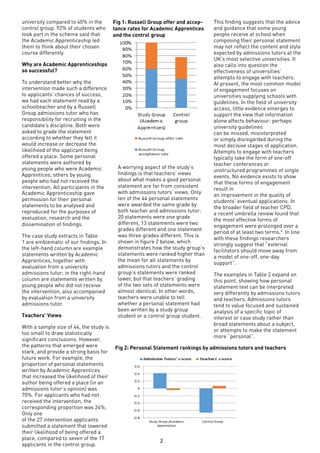
students (100%) in the study group
received at least one offer from a
Russell Group University, compared
to 73% of students in a control group
(even though the control group
students attended schools with
higher progression rates to HE). 60%
of students in the study group went
on be accepted by a Russell Group
Recommendations
1.	 Universities should be more transparent about how specific subject depart-
ments use and evaluate personal statements. This information should be shared
widely, and effectively, with applicants, schools and teachers.
2.	 Sections of detailed analysis and reflection in personal statements are highly
valued by academics. Schools should support applicants in providing opportuni-
ties to undertake and reflect upon academic enrichment activities.
3.	 Schools and colleges need to improve the quality of staff training to ensure
that key messages are consistent and based on up to date guidelines.
4.	 Both universities and UCAS should consider whether the format of the per-
sonal statement could be improved to ensure it is a useful and fair indicator of an
applicant's potential.
Making a Statement
by Dr Steve Jones (University of Manchester) and the HE Access Network
Edition 10: January 2016
2
university compared to 40% in the
control group. 92% of students who
took part in the scheme said that
the Academic Apprenticeship led
them to think about their chosen
course differently.
Why are Academic Apprenticeships
so successful?
To understand better why the
intervention made such a difference
to applicants’ chances of success,
we had each statement read by a
schoolteacher and by a Russell
Group admissions tutor who has
responsibility for recruiting in the
candidate’s discipline. Both were
asked to grade the statement
according to whether they felt it
would increase or decrease the
likelihood of the applicant being
offered a place. Some personal
statements were authored by
young people who were Academic
Apprentices; others by young
people who had not received the
intervention. All participants in the
Academic Apprenticeship gave
permission for their personal
statements to be analysed and
reproduced for the purposes of
evaluation, research and the
dissemination of findings.
The case study extracts in Table
1 are emblematic of our findings. In
the left-hand column are example
statements written by Academic
Apprentices, together with
evaluation from a university
admissions tutor; in the right-hand
column are statements written by
young people who did not receive
the intervention, also accompanied
by evaluation from a university
admissions tutor.
Teachers’ Views
With a sample size of 44, the study is
too small to draw statistically
significant conclusions. However,
the patterns that emerged were
stark, and provide a strong basis for
future work. For example, the
proportion of personal statements
written by Academic Apprentices
that increased the likelihood of their
author being offered a place (in an
admissions tutor’s opinion) was
70%. For applicants who had not
received the intervention, the
corresponding proportion was 24%.
Only one
of the 27 intervention applicants
submitted a statement that lowered
their likelihood of being offered a
place, compared to seven of the 17
applicants in the control group.
A worrying aspect of the study’s
findings is that teachers’ views
about what makes a good personal
statement are far from consistent
with admissions tutors’ views. Only
ten of the 44 personal statements
were awarded the same grade by
both teacher and admissions tutor:
20 statements were one grade
different, 13 statements were two
grades different and one statement
was three grades different. This is
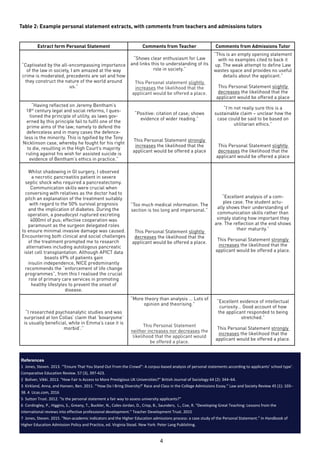
shown in figure 2 below, which
demonstrates how the study group’s
statements were ranked higher than
the mean for all statements by
admissions tutors and the control
group’s statements were ranked
lower, but that teachers’ grading
of the two sets of statements were
almost identical. In other words,
teachers were unable to tell
whether a personal statement had
been written by a study group
student or a control group student.
This finding suggests that the advice
and guidance that some young
people receive at school when
composing their personal statement
may not reflect the content and style
expected by admissions tutors at the
UK’s most selective universities. It
also calls into question the
effectiveness of universities’
attempts to engage with teachers.
At present, the most common model
of engagement focuses on
universities supplying schools with
guidelines. In the field of university
access, little evidence emerges to
support the view that information
alone affects behaviour: perhaps
university guidelines
can be missed, misinterpreted
or simply disregarded during the
most decisive stages of application.
Attempts to engage with teachers
typically take the form of one-off
teacher conferences or
unstructured programmes of single
events. No evidence exists to show
that these forms of engagement
result in
an improvement in the quality of
students’ eventual applications. In
the broader field of teacher CPD,
a recent umbrella review found that
the most effective forms of
engagement were prolonged over a
period of at least two terms.6
In line
with these findings researchers
strongly suggest that “external
facilitators should move away from
a model of one-off, one-day
support”.
The examples in Table 2 expand on
this point, showing how personal
statement text can be interpreted
very differently by admissions tutors
and teachers. Admissions tutors
tend to value focused and sustained
analysis of a specific topic of
interest or case study rather than
broad statements about a subject,
or attempts to make the statement
more “personal”.
Fig 2: Personal Statement rankings by admissions tutors and teachers
Fig 1: Russell Group offer and accep-
tance rates for Academic Apprentices
and the control group
3
Half a million personal statements
are written every year by university
applicants, a process occupying
significant time and resources. The
justification usually offered is that
selective universities need to assess
applicants ‘holistically’ rather than
rely on grades alone. But much of
the evidence available suggests that
the personal statement is a counter-
indicator, enhancing the applications
of those candidates who already
benefit from advantages of school
type.
Few other nations expect their
young people to ‘sell’ themselves
to universities in this way.7
Interventions such as the Academic
Apprenticeship suggest that it is
possible to level the playing field
for personal statements but that
applicants need to be given a
structured programme of advice that
emphasises academic suitability.
However, our evaluation not only
confirms that state-educated
students are unlikely to understand
what elite universities want from
them, it also suggests that that
the teachers they turn to for
advice might be similarly unclear.
The evaluation raises important
questions about the effectiveness
of university efforts to engage with
teachers, and schools efforts to
support their students through the
applications process.
Table 1: Example personal statement extracts from Academic Apprentices and the control group
Personal Statement Text from Academic Apprentices Personal Statement Text from control group students
“I especially enjoy reading War poetry as it offers subjec-
tive and emotive responses that are rarely found in histori-
cal accounts. To pursue this interest I studied the pastoral
idyll outside of the curriculum and explored the impact
which the First World War had on ideas of rural land,
particularly in Hardy’s poem ‘In time of the “Breaking of
Nations”’ (1915) and Edward Thomas’s ‘As the Team’s Head
Brass’ (1916). … I feel that the interlinking of the war and
the land makes the war seem “nearer” in Thomas’ poem,
whereas in Hardy’s work the presence of war is distanced
through the use of everyday imagery such as the “maid and
her wight”.
Admissions Tutor Comment: “Good evidence of wider read-
ing and critical ability.”
“I am particularly interested in Victorian literature because
the social constraints and etiquette of the time are vividly
portrayed, yet the novels of this period remain timeless.”
Admissions Tutor Comment: “This is bland: there is a much
stronger way to put this tension.”
“Choosing to study such a diverse and intellectually
stimulating course has come by careful consideration and
exploration of what a career in medicine entails. Having
shadowed an obstetrician in two different environments,
one at Homerton hospital in East London and the other
whilst volunteering in Albania, I was able to compare how
medicine is practised in another society, particularly within
the field of obstetric and neonatal care. It was fascinating
to learn about the physiological changes the female body
undergoes both during pregnancy and labour. I observed a
mixture of normal births, forceps deliveries and caesareans
which highlighted the importance of careful monitoring and
the need to respond quickly to signs of maternal or foetal
distress. Watching a baby open its eyes for the first time in
a country with exceedingly poor healthcare standards and
poverty however, made me appreciate the NHS in the UK.”
Admissions Tutor Comment: “Very good opening paragraph
- illustrates experience of candidate and the motivation to
study medicine – shows a good understanding of what is
involved.”
“To find out more about the complexity of the brain, I read “So
you want to be a brain surgeon” by Stephan Sanders. This has
given me a great deal of insight into neurosurgery.”
Admissions Tutor Comment: “While this illustrates that the
candidate is reading around the subject, some further signifi-
cance [should] be given.”
“I was introduced to immigration law and the R (Quila) v
SSHD case. I was drawn to the conflict between paragraph
277 of the Immigration Rules, which increased the age of
foreign spouses able to obtain a UK visa, and Article 8 of the
ECHR, which guarantees respect for private and family life.
My interest in this legal dilemma stems from whether the
law’s aim, to deter forced marriages and therefore protect
these human rights, is more important than the human
rights of the majority that are consequently affected.”
Admissions Tutor Comment: “This is excellent. Unlike some
of the other statements, this applicant does a very good job
explaining the law clearly, and ALSO evaluating it.”
“I want to pursue higher education not only to enhance my
self-learning and independent study skills and be qualified but
also to develop who I am. Independence is an important part
of my identity as it determines who I become
Admissions Tutor Comment: “This reads a little like the
applicant is just trying to fill space and leaves the selector
slightly underwhelmed at the end of the personal statement.”
4
References
1 Jones, Steven. 2013. ‘“Ensure That You Stand Out From the Crowd”: A corpus-based analysis of personal statements according to applicants’ school type’.
Comparative Education Review. 57 (3), 397-423.
2 Boliver, Vikki. 2013. “How Fair Is Access to More Prestigious UK Universities?” British Journal of Sociology 64 (2): 344–64.
3 Kirkland, Anna, and Hansen, Ben. 2011. “‘How Do I Bring Diversity?’ Race and Class in the College Admissions Essay.” Law and Society Review 45 (1): 103–
38. 4 Ucas.com, 2016
5 Sutton Trust. 2012. “Is the personal statement a fair way to assess university applicants?”
6 Cordingley, P., Higgins, S., Greany, T., Buckler, N., Coles-Jordan, D., Crisp, B., Saunders, L., Coe, R. “Developing Great Teaching: Lessons from the
international reviews into effective professional development.” Teacher Development Trust. 2015
7 Jones, Steven. 2015. “Non-academic indicators and the Higher Education admissions process: a case study of the Personal Statement.” In Handbook of
Higher Education Admission Policy and Practice, ed. Virginia Stead. New York: Peter Lang Publishing.
Extract form Personal Statement Comments from Teacher Comments from Admissions Tutor
“Captivated by the all-encompassing importance
of the law in society, I am amazed at the way
crime is moderated, precedents are set and how
they construct the nature of the world around
us.”
“Shows clear enthusiasm for Law
and links this to understanding of its
role in society.”
This Personal statement slightly
increases the likelihood that the
applicant would be offered a place.
“This is an empty opening statement
with no examples cited to back it
up. The weak attempt to define Law
wastes space and provides no useful
details about the applicant.”
This Personal Statement slightly
decreases the likelihood that the
applicant would be offered a place
“Having reflected on Jeremy Bentham’s
18th
 century legal and social reforms, I ques-
tioned the principle of utility, as laws gov-
erned by this principle fail to fulfil one of the
prime aims of the law; namely to defend the
defenceless and in many cases the defence-
less is the minority. This is typified by the Tony
Nicklinson case, whereby he fought for his right
to die, resulting in the High Court’s majority
ruling against his wish for assisted suicide is
evidence of Bentham’s ethics in practice.”
“Positive: citation of case; shows
evidence of wider reading.”
This Personal Statement strongly
increases the likelihood that the
applicant would be offered a place
“I’m not really sure this is a
sustainable claim – unclear how the
case could be said to be based on
utilitarian ethics.”
This Personal Statement slightly
decreases the likelihood that the
applicant would be offered a place
Whilst shadowing in GI surgery, I observed
a necrotic pancreatitis patient in severe
septic shock who required a pancreatectomy.
Communication skills were crucial when
conversing with relatives as the doctor had to
pitch an explanation of the treatment suitably
with regard to the 50% survival prognosis
and the implication of diabetes. During the
operation, a pseudocyst ruptured excreting
4000ml of pus; effective cooperation was
paramount as the surgeon delegated roles
to ensure minimal invasive damage was caused.
Encountering both clinical and social challenges
of the treatment prompted me to research
alternatives including autologous pancreatic
islet cell transplantation. Although APICT data
boasts 69% of patients gain
insulin independence, NICE predominantly
recommends the “enforcement of life change
programmes”, from this I realised the crucial
role of primary care services in promoting
healthy lifestyles to prevent the onset of
disease.
“Too much medical information. The
section is too long and impersonal.”
This Personal Statement slightly
decreases the likelihood that the
applicant would be offered a place.
“Excellent analysis of a com-
plex case. The student actu-
ally shows their understanding of
communication skills rather than
simply stating how important they
are. The reflection at the end shows
their maturity.”
This Personal Statement strongly
increases the likelihood that the
applicant would be offered a place.
“I researched psychoanalytic studies and was
surprised at Ion Collas’ claim that ‘bovarysme’
is usually beneficial, while in Emma’s case it is
morbid’.”
“More theory than analysis … Lots of
opinion and theorising.”
This Personal Statement
neither increases nor decreases the
likelihood that the applicant would
be offered a place.
“Excellent evidence of intellectual
curiosity… Good account of how
the applicant responded to being
stretched.”
This Personal Statement strongly
increases the likelihood that the
applicant would be offered a place.
Table 2: Example personal statement extracts, with comments from teachers and admissions tutors

The Sutton Trust's Making a Statement Research - Jan 2016

  • 1.
    1 Introduction Personal statements are anintegral part of the university admissions process in the UK. However, there is strong evidence suggesting this process advantages some types of applicant over others.1 The persistent ‘Access Gap’ in UK Higher Education, in which applicants from state schools with the same grades as their privately- educated peers are said to be one third less likely to gain an offer from a leading university, may be related to personal statements.2 An applicant’s school type is a key predictor of the quality of their personal statement; those from more advantaged educational backgrounds are more likely to receive better support and guidance.3 What is a personal statement? A-level attainment is the most important factor in securing offers from selective universities. However, as part of the application process, the University and Colleges Admissions Service (UCAS) allows each applicant 4,000 characters to write a personal statement. UCAS provides the following guidance to students when writing their personal statements: Course tutors read personal statements to compare different applicants – so this is where you should describe your ambitions, skills and experience that will make you suitable for the course.4 When candidates apply for a course with similar grades, or when a candidate’s overall suitability for a course is being considered, personal statements can be an important factor in an admissions tutor’s decision. There is little research into what happens to personal statements once they are received by admissions offices. Evidence from university websites suggests that this may vary by the course applied to, even within the same university. Does using the personal statement lead to unfair outcomes? The Sutton Trust has published research showing that clear writing errors are three times more common in the personal statements of applicants from sixth form colleges and comprehensive schools than in statements of applicants from independent schools.5 All of the statements analysed were written by young people who would go on to receive identical A-level results. The differences in the written quality of the statements were therefore more likely to be the result of inferior support and guidance than academic ability. Can this unfairness be addressed? In 2013, the HE Access Network (HEAN) piloted a programme for The Sutton Trust aimed specifically at young people from less advantaged backgrounds. The Academic Apprenticeship took a new approach to the personal statement which sought to provide students with a set of structured activities enabling them to analyse wider reading and academic activities related to their course. Instead of listing wider reading texts or simply naming other enrichment activities, Academic Apprentices were encouraged to scrutinise academic materials and course-related activities in greater depth. Through a set of subject- specific pathways, the Academic Apprenticeship advised students to create personal statements that focused on showcasing their academic suitability for a course, particularly by offering detailed analysis of a topic that went beyond the A-level syllabus. In the case of vocational subjects such as medicine, applicants were encouraged to scrutinise a work experience placement in depth. The evaluation of the Academic Apprenticeship project provides encouraging evidence that, with the right support, the playing field can, to some extent, be levelled. All of the students (100%) in the study group received at least one offer from a Russell Group University, compared to 73% of students in a control group (even though the control group students attended schools with higher progression rates to HE). 60% of students in the study group went on be accepted by a Russell Group Recommendations 1. Universities should be more transparent about how specific subject depart- ments use and evaluate personal statements. This information should be shared widely, and effectively, with applicants, schools and teachers. 2. Sections of detailed analysis and reflection in personal statements are highly valued by academics. Schools should support applicants in providing opportuni- ties to undertake and reflect upon academic enrichment activities. 3. Schools and colleges need to improve the quality of staff training to ensure that key messages are consistent and based on up to date guidelines. 4. Both universities and UCAS should consider whether the format of the per- sonal statement could be improved to ensure it is a useful and fair indicator of an applicant's potential. Making a Statement by Dr Steve Jones (University of Manchester) and the HE Access Network Edition 10: January 2016
  • 2.
    2 university compared to40% in the control group. 92% of students who took part in the scheme said that the Academic Apprenticeship led them to think about their chosen course differently. Why are Academic Apprenticeships so successful? To understand better why the intervention made such a difference to applicants’ chances of success, we had each statement read by a schoolteacher and by a Russell Group admissions tutor who has responsibility for recruiting in the candidate’s discipline. Both were asked to grade the statement according to whether they felt it would increase or decrease the likelihood of the applicant being offered a place. Some personal statements were authored by young people who were Academic Apprentices; others by young people who had not received the intervention. All participants in the Academic Apprenticeship gave permission for their personal statements to be analysed and reproduced for the purposes of evaluation, research and the dissemination of findings. The case study extracts in Table 1 are emblematic of our findings. In the left-hand column are example statements written by Academic Apprentices, together with evaluation from a university admissions tutor; in the right-hand column are statements written by young people who did not receive the intervention, also accompanied by evaluation from a university admissions tutor. Teachers’ Views With a sample size of 44, the study is too small to draw statistically significant conclusions. However, the patterns that emerged were stark, and provide a strong basis for future work. For example, the proportion of personal statements written by Academic Apprentices that increased the likelihood of their author being offered a place (in an admissions tutor’s opinion) was 70%. For applicants who had not received the intervention, the corresponding proportion was 24%. Only one of the 27 intervention applicants submitted a statement that lowered their likelihood of being offered a place, compared to seven of the 17 applicants in the control group. A worrying aspect of the study’s findings is that teachers’ views about what makes a good personal statement are far from consistent with admissions tutors’ views. Only ten of the 44 personal statements were awarded the same grade by both teacher and admissions tutor: 20 statements were one grade different, 13 statements were two grades different and one statement was three grades different. This is shown in figure 2 below, which demonstrates how the study group’s statements were ranked higher than the mean for all statements by admissions tutors and the control group’s statements were ranked lower, but that teachers’ grading of the two sets of statements were almost identical. In other words, teachers were unable to tell whether a personal statement had been written by a study group student or a control group student. This finding suggests that the advice and guidance that some young people receive at school when composing their personal statement may not reflect the content and style expected by admissions tutors at the UK’s most selective universities. It also calls into question the effectiveness of universities’ attempts to engage with teachers. At present, the most common model of engagement focuses on universities supplying schools with guidelines. In the field of university access, little evidence emerges to support the view that information alone affects behaviour: perhaps university guidelines can be missed, misinterpreted or simply disregarded during the most decisive stages of application. Attempts to engage with teachers typically take the form of one-off teacher conferences or unstructured programmes of single events. No evidence exists to show that these forms of engagement result in an improvement in the quality of students’ eventual applications. In the broader field of teacher CPD, a recent umbrella review found that the most effective forms of engagement were prolonged over a period of at least two terms.6 In line with these findings researchers strongly suggest that “external facilitators should move away from a model of one-off, one-day support”. The examples in Table 2 expand on this point, showing how personal statement text can be interpreted very differently by admissions tutors and teachers. Admissions tutors tend to value focused and sustained analysis of a specific topic of interest or case study rather than broad statements about a subject, or attempts to make the statement more “personal”. Fig 2: Personal Statement rankings by admissions tutors and teachers Fig 1: Russell Group offer and accep- tance rates for Academic Apprentices and the control group
  • 3.
    3 Half a millionpersonal statements are written every year by university applicants, a process occupying significant time and resources. The justification usually offered is that selective universities need to assess applicants ‘holistically’ rather than rely on grades alone. But much of the evidence available suggests that the personal statement is a counter- indicator, enhancing the applications of those candidates who already benefit from advantages of school type. Few other nations expect their young people to ‘sell’ themselves to universities in this way.7 Interventions such as the Academic Apprenticeship suggest that it is possible to level the playing field for personal statements but that applicants need to be given a structured programme of advice that emphasises academic suitability. However, our evaluation not only confirms that state-educated students are unlikely to understand what elite universities want from them, it also suggests that that the teachers they turn to for advice might be similarly unclear. The evaluation raises important questions about the effectiveness of university efforts to engage with teachers, and schools efforts to support their students through the applications process. Table 1: Example personal statement extracts from Academic Apprentices and the control group Personal Statement Text from Academic Apprentices Personal Statement Text from control group students “I especially enjoy reading War poetry as it offers subjec- tive and emotive responses that are rarely found in histori- cal accounts. To pursue this interest I studied the pastoral idyll outside of the curriculum and explored the impact which the First World War had on ideas of rural land, particularly in Hardy’s poem ‘In time of the “Breaking of Nations”’ (1915) and Edward Thomas’s ‘As the Team’s Head Brass’ (1916). … I feel that the interlinking of the war and the land makes the war seem “nearer” in Thomas’ poem, whereas in Hardy’s work the presence of war is distanced through the use of everyday imagery such as the “maid and her wight”. Admissions Tutor Comment: “Good evidence of wider read- ing and critical ability.” “I am particularly interested in Victorian literature because the social constraints and etiquette of the time are vividly portrayed, yet the novels of this period remain timeless.” Admissions Tutor Comment: “This is bland: there is a much stronger way to put this tension.” “Choosing to study such a diverse and intellectually stimulating course has come by careful consideration and exploration of what a career in medicine entails. Having shadowed an obstetrician in two different environments, one at Homerton hospital in East London and the other whilst volunteering in Albania, I was able to compare how medicine is practised in another society, particularly within the field of obstetric and neonatal care. It was fascinating to learn about the physiological changes the female body undergoes both during pregnancy and labour. I observed a mixture of normal births, forceps deliveries and caesareans which highlighted the importance of careful monitoring and the need to respond quickly to signs of maternal or foetal distress. Watching a baby open its eyes for the first time in a country with exceedingly poor healthcare standards and poverty however, made me appreciate the NHS in the UK.” Admissions Tutor Comment: “Very good opening paragraph - illustrates experience of candidate and the motivation to study medicine – shows a good understanding of what is involved.” “To find out more about the complexity of the brain, I read “So you want to be a brain surgeon” by Stephan Sanders. This has given me a great deal of insight into neurosurgery.” Admissions Tutor Comment: “While this illustrates that the candidate is reading around the subject, some further signifi- cance [should] be given.” “I was introduced to immigration law and the R (Quila) v SSHD case. I was drawn to the conflict between paragraph 277 of the Immigration Rules, which increased the age of foreign spouses able to obtain a UK visa, and Article 8 of the ECHR, which guarantees respect for private and family life. My interest in this legal dilemma stems from whether the law’s aim, to deter forced marriages and therefore protect these human rights, is more important than the human rights of the majority that are consequently affected.” Admissions Tutor Comment: “This is excellent. Unlike some of the other statements, this applicant does a very good job explaining the law clearly, and ALSO evaluating it.” “I want to pursue higher education not only to enhance my self-learning and independent study skills and be qualified but also to develop who I am. Independence is an important part of my identity as it determines who I become Admissions Tutor Comment: “This reads a little like the applicant is just trying to fill space and leaves the selector slightly underwhelmed at the end of the personal statement.”
  • 4.
    4 References 1 Jones, Steven.2013. ‘“Ensure That You Stand Out From the Crowd”: A corpus-based analysis of personal statements according to applicants’ school type’. Comparative Education Review. 57 (3), 397-423. 2 Boliver, Vikki. 2013. “How Fair Is Access to More Prestigious UK Universities?” British Journal of Sociology 64 (2): 344–64. 3 Kirkland, Anna, and Hansen, Ben. 2011. “‘How Do I Bring Diversity?’ Race and Class in the College Admissions Essay.” Law and Society Review 45 (1): 103– 38. 4 Ucas.com, 2016 5 Sutton Trust. 2012. “Is the personal statement a fair way to assess university applicants?” 6 Cordingley, P., Higgins, S., Greany, T., Buckler, N., Coles-Jordan, D., Crisp, B., Saunders, L., Coe, R. “Developing Great Teaching: Lessons from the international reviews into effective professional development.” Teacher Development Trust. 2015 7 Jones, Steven. 2015. “Non-academic indicators and the Higher Education admissions process: a case study of the Personal Statement.” In Handbook of Higher Education Admission Policy and Practice, ed. Virginia Stead. New York: Peter Lang Publishing. Extract form Personal Statement Comments from Teacher Comments from Admissions Tutor “Captivated by the all-encompassing importance of the law in society, I am amazed at the way crime is moderated, precedents are set and how they construct the nature of the world around us.” “Shows clear enthusiasm for Law and links this to understanding of its role in society.” This Personal statement slightly increases the likelihood that the applicant would be offered a place. “This is an empty opening statement with no examples cited to back it up. The weak attempt to define Law wastes space and provides no useful details about the applicant.” This Personal Statement slightly decreases the likelihood that the applicant would be offered a place “Having reflected on Jeremy Bentham’s 18th  century legal and social reforms, I ques- tioned the principle of utility, as laws gov- erned by this principle fail to fulfil one of the prime aims of the law; namely to defend the defenceless and in many cases the defence- less is the minority. This is typified by the Tony Nicklinson case, whereby he fought for his right to die, resulting in the High Court’s majority ruling against his wish for assisted suicide is evidence of Bentham’s ethics in practice.” “Positive: citation of case; shows evidence of wider reading.” This Personal Statement strongly increases the likelihood that the applicant would be offered a place “I’m not really sure this is a sustainable claim – unclear how the case could be said to be based on utilitarian ethics.” This Personal Statement slightly decreases the likelihood that the applicant would be offered a place Whilst shadowing in GI surgery, I observed a necrotic pancreatitis patient in severe septic shock who required a pancreatectomy. Communication skills were crucial when conversing with relatives as the doctor had to pitch an explanation of the treatment suitably with regard to the 50% survival prognosis and the implication of diabetes. During the operation, a pseudocyst ruptured excreting 4000ml of pus; effective cooperation was paramount as the surgeon delegated roles to ensure minimal invasive damage was caused. Encountering both clinical and social challenges of the treatment prompted me to research alternatives including autologous pancreatic islet cell transplantation. Although APICT data boasts 69% of patients gain insulin independence, NICE predominantly recommends the “enforcement of life change programmes”, from this I realised the crucial role of primary care services in promoting healthy lifestyles to prevent the onset of disease. “Too much medical information. The section is too long and impersonal.” This Personal Statement slightly decreases the likelihood that the applicant would be offered a place. “Excellent analysis of a com- plex case. The student actu- ally shows their understanding of communication skills rather than simply stating how important they are. The reflection at the end shows their maturity.” This Personal Statement strongly increases the likelihood that the applicant would be offered a place. “I researched psychoanalytic studies and was surprised at Ion Collas’ claim that ‘bovarysme’ is usually beneficial, while in Emma’s case it is morbid’.” “More theory than analysis … Lots of opinion and theorising.” This Personal Statement neither increases nor decreases the likelihood that the applicant would be offered a place. “Excellent evidence of intellectual curiosity… Good account of how the applicant responded to being stretched.” This Personal Statement strongly increases the likelihood that the applicant would be offered a place. Table 2: Example personal statement extracts, with comments from teachers and admissions tutors