7
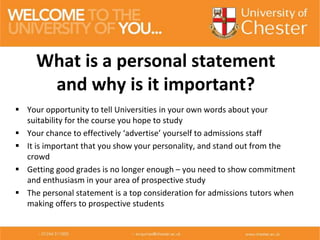
 Your opportunity to tell Universities in your own words about your
suitability for the course you hope to study
 Your chance to effectively ‘advertise’ yourself to admissions staff
 It is important that you show your personality, and stand out from the
crowd
 Getting good grades is no longer enough – you need to show commitment
and enthusiasm in your area of prospective study
 The personal statement is a top consideration for admissions tutors when
making offers to prospective students
What is a personal statement
and why is it important?
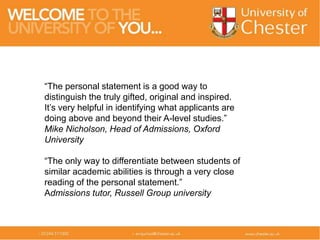
“The personal statement is a good way to
distinguish the truly gifted, original and inspired.
It’s very helpful in identifying what applicants are
doing above and beyond their A-level studies.”
Mike Nicholson, Head of Admissions, Oxford
University
“The only way to differentiate between students of
similar academic abilities is through a very close
reading of the personal statement.”
Admissions tutor, Russell Group university
 The personal statement needs to include a clear and thorough
explanation of why you want to study your chosen course
 It must be well written with no spelling or grammatical errors
 If you are applying for a course which involves an interview
(Teaching, Nursing, Art & Design etc) the personal statement will be
used as a basis for discussion, so you must be confident to answer
questions on what you have written
Key considerations
• Reasons why you are applying for your chosen course:
• Why the subject interests you
• Evidence that you understand what is required
• Why you want to go to university generally
• Why you are a suitable candidate for the course:
• The skills and experience you have which will help you succeed
• How your current and previous studies relate to the course
• Activities that you have taken part in which demonstrates
commitment to the course
What needs to be included?
• Information about your hobbies and interests:
• Any awards achieved
• Musical achievements
• Sporting achievements
• Positions of responsibility
• Think about how your hobbies, interested and social activities
demonstrate skills and abilities
What needs to be included?
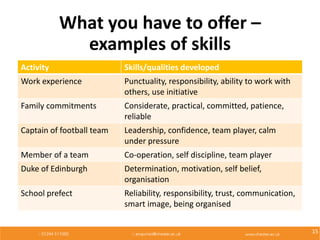
What you have to offer –
examples of skills
Activity Skills/qualities developed
Work experience Punctuality, responsibility, ability to work with
others, use initiative
Family commitments Considerate, practical, committed, patience,
reliable
Captain of football team Leadership, confidence, team player, calm
under pressure
Member of a team Co-operation, self discipline, team player
Duke of Edinburgh Determination, motivation, self belief,
organisation
School prefect Reliability, responsibility, trust, communication,
smart image, being organised
15
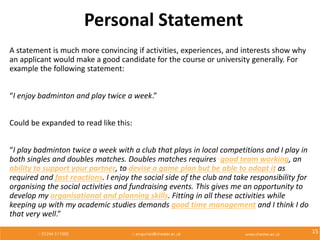
Personal Statement
A statement is much more convincing if activities, experiences, and interests show why
an applicant would make a good candidate for the course or university generally. For
example the following statement:
“I enjoy badminton and play twice a week.”
Could be expanded to read like this:
“I play badminton twice a week with a club that plays in local competitions and I play in
both singles and doubles matches. Doubles matches requires good team working, an
ability to support your partner, to devise a game plan but be able to adapt it as
required and fast reactions. I enjoy the social side of the club and take responsibility for
organising the social activities and fundraising events. This gives me an opportunity to
develop my organisational and planning skills. Fitting in all these activities while
keeping up with my academic studies demands good time management and I think I do
that very well.”
15
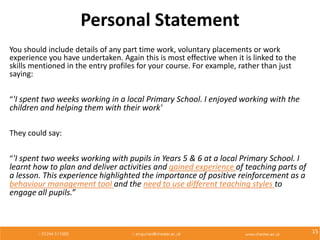
Personal Statement
You should include details of any part time work, voluntary placements or work
experience you have undertaken. Again this is most effective when it is linked to the
skills mentioned in the entry profiles for your course. For example, rather than just
saying:
“'I spent two weeks working in a local Primary School. I enjoyed working with the
children and helping them with their work'
They could say:
“'I spent two weeks working with pupils in Years 5 & 6 at a local Primary School. I
learnt how to plan and deliver activities and gained experience of teaching parts of
a lesson. This experience highlighted the importance of positive reinforcement as a
behaviour management tool and the need to use different teaching styles to
engage all pupils.”
15
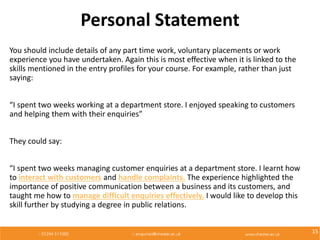
Personal Statement
You should include details of any part time work, voluntary placements or work
experience you have undertaken. Again this is most effective when it is linked to the
skills mentioned in the entry profiles for your course. For example, rather than just
saying:
“I spent two weeks working at a department store. I enjoyed speaking to customers
and helping them with their enquiries”
They could say:
“I spent two weeks managing customer enquiries at a department store. I learnt how
to interact with customers and handle complaints. The experience highlighted the
importance of positive communication between a business and its customers, and
taught me how to manage difficult enquiries effectively. I would like to develop this
skill further by studying a degree in public relations.
15
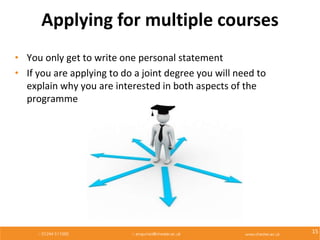
Applying for multiple courses
15
• You only get to write one personal statement
• If you are applying to do a joint degree you will need to
explain why you are interested in both aspects of the
programme
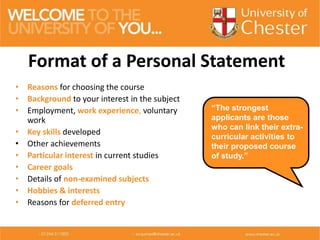
Format of a Personal Statement
• Reasons for choosing the course
• Background to your interest in the subject
• Employment, work experience, voluntary
work
• Key skills developed
• Other achievements
• Particular interest in current studies
• Career goals
• Details of non-examined subjects
• Hobbies & interests
• Reasons for deferred entry
“The strongest
applicants are those
who can link their extra-
curricular activities to
their proposed course
of study.”
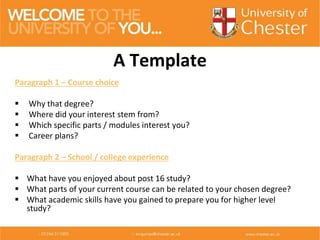
Paragraph 1 – Course choice
 Why that degree?
 Where did your interest stem from?
 Which specific parts / modules interest you?
 Career plans?
Paragraph 2 – School / college experience
 What have you enjoyed about post 16 study?
 What parts of your current course can be related to your chosen degree?
 What academic skills have you gained to prepare you for higher level
study?
A Template
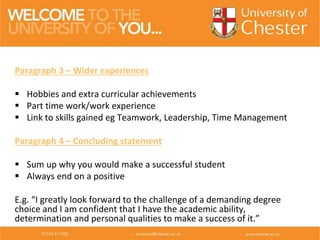
Paragraph 3 – Wider experiences
 Hobbies and extra curricular achievements
 Part time work/work experience
 Link to skills gained eg Teamwork, Leadership, Time Management
Paragraph 4 – Concluding statement
 Sum up why you would make a successful student
 Always end on a positive
E.g. “I greatly look forward to the challenge of a demanding degree
choice and I am confident that I have the academic ability,
determination and personal qualities to make a success of it.”
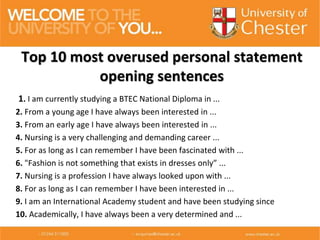
1. I am currently studying a BTEC National Diploma in ...
2. From a young age I have always been interested in ...
3. From an early age I have always been interested in ...
4. Nursing is a very challenging and demanding career ...
5. For as long as I can remember I have been fascinated with ...
6. "Fashion is not something that exists in dresses only” ...
7. Nursing is a profession I have always looked upon with ...
8. For as long as I can remember I have been interested in ...
9. I am an International Academy student and have been studying since
10. Academically, I have always been a very determined and ...
Top 10 most overused personal statement
opening sentences
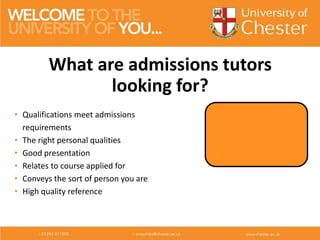
What are admissions tutors
looking for?
Research the
course - identify
the requirements
and state how you
fulfil them
• Qualifications meet admissions
requirements
• The right personal qualities
• Good presentation
• Relates to course applied for
• Conveys the sort of person you are
• High quality reference
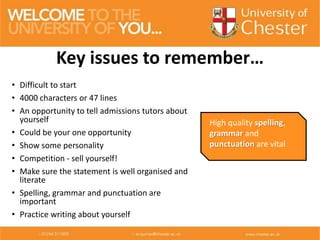
Key issues to remember…
• Difficult to start
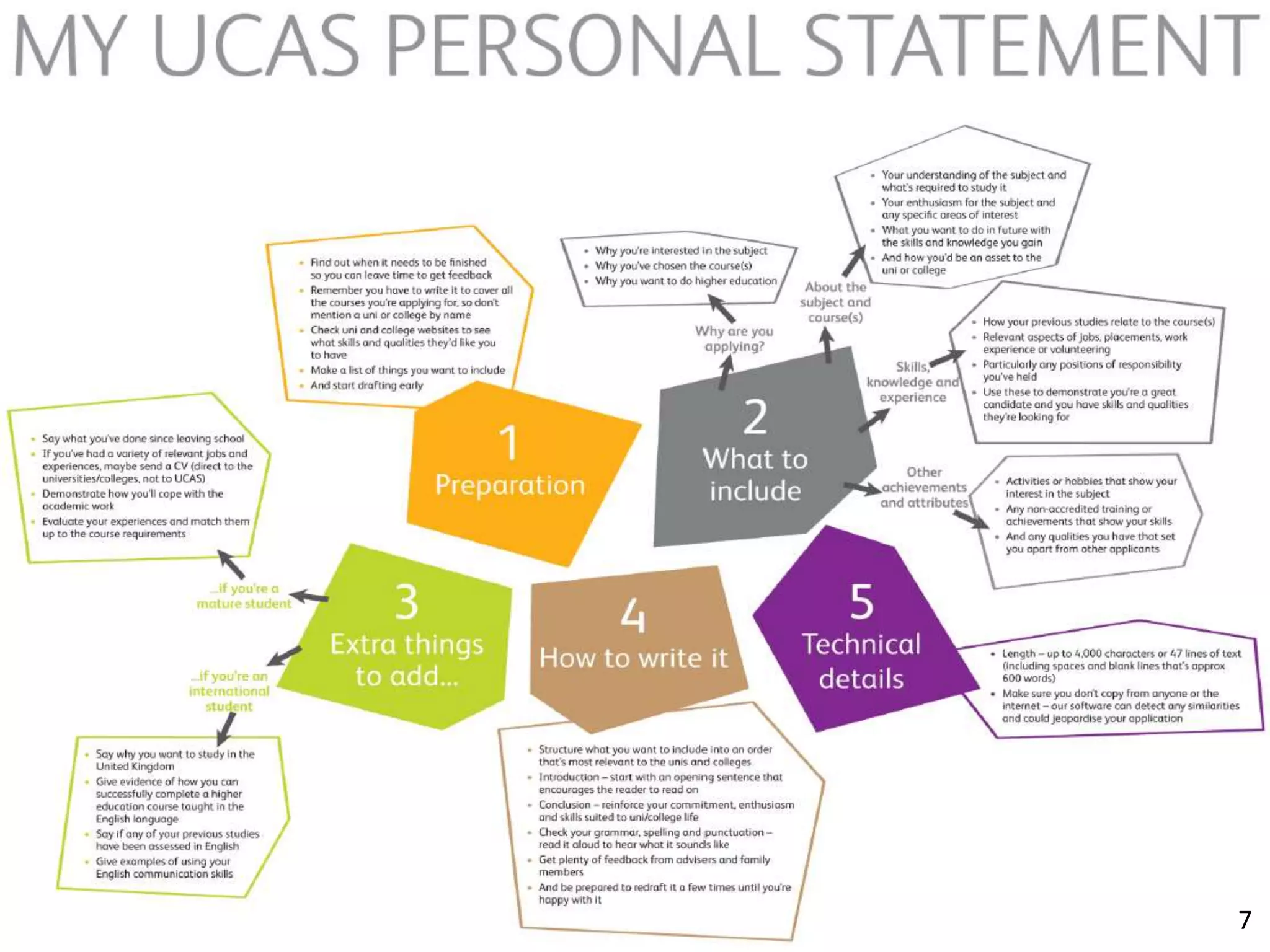
• 4000 characters or 47 lines
• An opportunity to tell admissions tutors about
yourself
• Could be your one opportunity
• Show some personality
• Competition - sell yourself!
• Make sure the statement is well organised and
literate
• Spelling, grammar and punctuation are
important
• Practice writing about yourself
High quality spelling,
grammar and
punctuation are vital
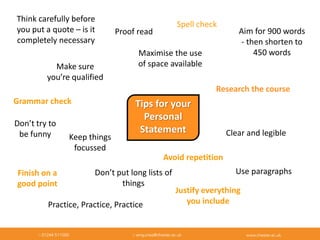
Proof read
Spell check
Grammar check
Maximise the use
of space available
Clear and legible
Use paragraphs
Avoid repetition
Research the course
Practice, Practice, Practice
Justify everything
you include
Keep things
focussed
Don’t try to
be funny
Make sure
you’re qualified
Aim for 900 words
- then shorten to
450 words
Finish on a
good point
Don’t put long lists of
things
Think carefully before
you put a quote – is it
completely necessary
Tips for your
Personal
Statement

UCAS timeline Personal Statement ppt

  • 1.
  • 2.
     Your opportunityto tell Universities in your own words about your suitability for the course you hope to study  Your chance to effectively ‘advertise’ yourself to admissions staff  It is important that you show your personality, and stand out from the crowd  Getting good grades is no longer enough – you need to show commitment and enthusiasm in your area of prospective study  The personal statement is a top consideration for admissions tutors when making offers to prospective students What is a personal statement and why is it important?
  • 3.
    “The personal statementis a good way to distinguish the truly gifted, original and inspired. It’s very helpful in identifying what applicants are doing above and beyond their A-level studies.” Mike Nicholson, Head of Admissions, Oxford University “The only way to differentiate between students of similar academic abilities is through a very close reading of the personal statement.” Admissions tutor, Russell Group university
  • 4.
     The personalstatement needs to include a clear and thorough explanation of why you want to study your chosen course  It must be well written with no spelling or grammatical errors  If you are applying for a course which involves an interview (Teaching, Nursing, Art & Design etc) the personal statement will be used as a basis for discussion, so you must be confident to answer questions on what you have written Key considerations
  • 5.
    • Reasons whyyou are applying for your chosen course: • Why the subject interests you • Evidence that you understand what is required • Why you want to go to university generally • Why you are a suitable candidate for the course: • The skills and experience you have which will help you succeed • How your current and previous studies relate to the course • Activities that you have taken part in which demonstrates commitment to the course What needs to be included?
  • 6.
    • Information aboutyour hobbies and interests: • Any awards achieved • Musical achievements • Sporting achievements • Positions of responsibility • Think about how your hobbies, interested and social activities demonstrate skills and abilities What needs to be included?
  • 7.
    What you haveto offer – examples of skills Activity Skills/qualities developed Work experience Punctuality, responsibility, ability to work with others, use initiative Family commitments Considerate, practical, committed, patience, reliable Captain of football team Leadership, confidence, team player, calm under pressure Member of a team Co-operation, self discipline, team player Duke of Edinburgh Determination, motivation, self belief, organisation School prefect Reliability, responsibility, trust, communication, smart image, being organised 15
  • 8.
    Personal Statement A statementis much more convincing if activities, experiences, and interests show why an applicant would make a good candidate for the course or university generally. For example the following statement: “I enjoy badminton and play twice a week.” Could be expanded to read like this: “I play badminton twice a week with a club that plays in local competitions and I play in both singles and doubles matches. Doubles matches requires good team working, an ability to support your partner, to devise a game plan but be able to adapt it as required and fast reactions. I enjoy the social side of the club and take responsibility for organising the social activities and fundraising events. This gives me an opportunity to develop my organisational and planning skills. Fitting in all these activities while keeping up with my academic studies demands good time management and I think I do that very well.” 15
  • 9.
    Personal Statement You shouldinclude details of any part time work, voluntary placements or work experience you have undertaken. Again this is most effective when it is linked to the skills mentioned in the entry profiles for your course. For example, rather than just saying: “'I spent two weeks working in a local Primary School. I enjoyed working with the children and helping them with their work' They could say: “'I spent two weeks working with pupils in Years 5 & 6 at a local Primary School. I learnt how to plan and deliver activities and gained experience of teaching parts of a lesson. This experience highlighted the importance of positive reinforcement as a behaviour management tool and the need to use different teaching styles to engage all pupils.” 15
  • 10.
    Personal Statement You shouldinclude details of any part time work, voluntary placements or work experience you have undertaken. Again this is most effective when it is linked to the skills mentioned in the entry profiles for your course. For example, rather than just saying: “I spent two weeks working at a department store. I enjoyed speaking to customers and helping them with their enquiries” They could say: “I spent two weeks managing customer enquiries at a department store. I learnt how to interact with customers and handle complaints. The experience highlighted the importance of positive communication between a business and its customers, and taught me how to manage difficult enquiries effectively. I would like to develop this skill further by studying a degree in public relations. 15
  • 11.
    Applying for multiplecourses 15 • You only get to write one personal statement • If you are applying to do a joint degree you will need to explain why you are interested in both aspects of the programme
  • 12.
    Format of aPersonal Statement • Reasons for choosing the course • Background to your interest in the subject • Employment, work experience, voluntary work • Key skills developed • Other achievements • Particular interest in current studies • Career goals • Details of non-examined subjects • Hobbies & interests • Reasons for deferred entry “The strongest applicants are those who can link their extra- curricular activities to their proposed course of study.”
  • 13.
    Paragraph 1 –Course choice  Why that degree?  Where did your interest stem from?  Which specific parts / modules interest you?  Career plans? Paragraph 2 – School / college experience  What have you enjoyed about post 16 study?  What parts of your current course can be related to your chosen degree?  What academic skills have you gained to prepare you for higher level study? A Template
  • 14.
    Paragraph 3 –Wider experiences  Hobbies and extra curricular achievements  Part time work/work experience  Link to skills gained eg Teamwork, Leadership, Time Management Paragraph 4 – Concluding statement  Sum up why you would make a successful student  Always end on a positive E.g. “I greatly look forward to the challenge of a demanding degree choice and I am confident that I have the academic ability, determination and personal qualities to make a success of it.”
  • 15.
    1. I amcurrently studying a BTEC National Diploma in ... 2. From a young age I have always been interested in ... 3. From an early age I have always been interested in ... 4. Nursing is a very challenging and demanding career ... 5. For as long as I can remember I have been fascinated with ... 6. "Fashion is not something that exists in dresses only” ... 7. Nursing is a profession I have always looked upon with ... 8. For as long as I can remember I have been interested in ... 9. I am an International Academy student and have been studying since 10. Academically, I have always been a very determined and ... Top 10 most overused personal statement opening sentences
  • 16.
    What are admissionstutors looking for? Research the course - identify the requirements and state how you fulfil them • Qualifications meet admissions requirements • The right personal qualities • Good presentation • Relates to course applied for • Conveys the sort of person you are • High quality reference
  • 17.
    Key issues toremember… • Difficult to start • 4000 characters or 47 lines • An opportunity to tell admissions tutors about yourself • Could be your one opportunity • Show some personality • Competition - sell yourself! • Make sure the statement is well organised and literate • Spelling, grammar and punctuation are important • Practice writing about yourself High quality spelling, grammar and punctuation are vital
  • 18.
    Proof read Spell check Grammarcheck Maximise the use of space available Clear and legible Use paragraphs Avoid repetition Research the course Practice, Practice, Practice Justify everything you include Keep things focussed Don’t try to be funny Make sure you’re qualified Aim for 900 words - then shorten to 450 words Finish on a good point Don’t put long lists of things Think carefully before you put a quote – is it completely necessary Tips for your Personal Statement