Working	
  Paper	


                            The	
  Sustainable	
  Community	
  Development	
  Code:	
  	
  
         Regulating	
  a	
  Sustainable	
  Urban	
  Land-­use	
  Patterns	
  for	
  a	
  Post-­Carbon	
  World	
  
                                             James	
  van	
  Hemert	


Introduction	
  

            Local	
  government	
  land-­‐use	
  codes	
  must	
  be	
  reformed	
  if	
  they	
  are	
  to	
  play	
  an	
  important	
  

societal	
  role	
  in	
  achieving	
  a	
  sustainable	
  and	
  livable	
  post	
  carbon	
  future.	
  The	
  United	
  States	
  of	
  

America’s	
  100	
  largest	
  metropolitan	
  regions	
  include	
  9,000	
  cities,	
  towns,	
  and	
  counties.i	
  They	
  

are	
  failing	
  to	
  sufficiently	
  change	
  their	
  codes	
  to	
  advance	
  the	
  emerging	
  paradigm	
  of	
  

sustainability.ii	
  Worse,	
  their	
  codes	
  represent	
  a	
  significant	
  barrier	
  to	
  achieving	
  sustainability	


                                                                         T
goals.	
  This	
  chapter	
  describes	
  a	
  comprehensive	
  framework	
  for	
  land-­‐use	
  code	
  reform,	
  an	
  

initiative	
  of	
  the	
  Rocky	
  Mountain	
  Land	
  Use	
  Institute	
  of	
  the	
  University	
  of	
  Denver.	
  The	
  
                                             AF
Sustainable	
  Commuity	
  Development	
  Code	
  is	
  discussed,	
  featuring	
  the	
  code’s	
  rationale,	
  

approach,	
  and	
  structure,	
  as	
  well	
  as	
  an	
  explanation	
  of	
  one	
  of	
  the	
  code’s	
  chapters.	
  

            Our	
  land-­‐use	
  patterns	
  and	
  transportation	
  networks	
  have	
  substantially	
  contributed	
  
                R

to	
  the	
  bloated	
  size	
  of	
  our	
  ecological	
  footprint,iii	
  which	
  weighs	
  in	
  at	
  over	
  four	
  times	
  the	
  

global	
  average,	
  which	
  is	
  itself	
  already	
  1.3	
  times	
  the	
  planet’s	
  carrying	
  capacity.iv	
  The	
  low	
  
               D


density	
  and	
  limited-­‐use	
  character	
  of	
  our	
  settlements	
  is	
  coupled	
  with	
  an	
  almost	
  exclusively	
  

automobile-­‐focused	
  transportation	
  system,	
  and,	
  together,	
  they	
  conspire	
  to	
  trap	
  us	
  in	
  a	
  

wasteful	
  mobility	
  patterns	
  in	
  which	
  each	
  household	
  depends	
  almost	
  exclusively	
  on	
  a	
  

privately	
  owned	
  vehicle.	
  Our	
  built	
  environment	
  represents	
  68	
  percent	
  of	
  our	
  total	
  energy	
  

use,	
  of	
  which	
  buildings	
  represent	
  39	
  percent	
  and	
  transportation	
  represents	
  29	
  percent.v	
  

We	
  use	
  fossil	
  fuels	
  to	
  generate	
  85	
  percent	
  of	
  our	
  energy.	


          In	
  the	
  United	
  States,	
  the	
  rate	
  of	
  urban	
  land	
  consumption	
  over	
  the	
  past	
  several	
  

generations	
  has	
  exceeded	
  the	
  rate	
  of	
  population	
  growth	
  by	
  several	
  times.vi	
  This	
  increases	


Working	
  Paper	


the	
  rapidly	
  growing	
  financial	
  burden	
  of	
  maintaining	
  an	
  automobile-­‐centered	
  

infrastructurevii	
  and	
  increases	
  our	
  dependency	
  on	
  fossil	
  fuels	
  with	
  all	
  the	
  attendant	
  

environmental	
  costs,	
  including	
  carbon	
  greenhouse	
  gas	
  emissions.	
  The	
  Association	
  for	
  the	
  

Study	
  of	
  Peak	
  Oil	
  and	
  Gas	
  (ASPO)	
  projects	
  global	
  “peak	
  oil”viii	
  to	
  occur	
  in	
  2010.ix	
  If	
  true,	
  our	
  

entire	
  human	
  settlement	
  infrastructure	
  and	
  its	
  economic	
  basis	
  are	
  in	
  grave	
  danger	
  of	
  

imminent	
  collapse.x	


          Global	
  warming	
  induced	
  climate	
  change	
  is	
  already	
  threatening	
  the	
  viability	
  of	
  

coastline	
  settlements,	
  increasing	
  drought	
  in	
  the	
  Rocky	
  Mountain	
  West,	
  increasing	
  the	
  

potential	
  for	
  disease,	
  increasing	
  flooding,	
  and	
  threatening	
  the	
  viability	
  of	
  agricultural	


                                                                           T
production.xi	
  Biologists	
  predict	
  that	
  the	
  current	
  alarming	
  rate	
  of	
  species	
  extinction	
  will	
  
                                              AF
accelerate	
  further	
  under	
  the	
  combined	
  effects	
  of	
  climate	
  change,	
  declining	
  habitat	
  due	
  to	
  

deforestation,	
  agriculture,	
  and	
  urbanization.xii	


          Our	
  current	
  and	
  future	
  land-­‐use	
  patterns	
  are	
  substantially	
  locked	
  in	
  place	
  by	
  local	
  
                R
growth-­‐management	
  policies	
  and	
  development	
  codes	
  which,	
  despite	
  using	
  “smart	
  growth”	
  

labels,	
  severely	
  limit	
  land-­‐use	
  choices	
  and	
  density,	
  creating	
  in	
  effect,	
  legally	
  mandated	
  low-­‐
               D

density	
  sprawl.	
  xiii	


          Breaking	
  free	
  from	
  this	
  balkanized	
  local	
  land-­‐use	
  code	
  regulatory	
  trap	
  will	
  be	
  

excruciatingly	
  difficult	
  for	
  psychological,	
  social,	
  political,	
  and	
  financial	
  reasons.	
  

Exacerbating	
  the	
  challenge	
  is	
  the	
  fact	
  that	
  our	
  attention	
  is	
  distracted	
  by	
  narrowly	
  conceived	
  

technical	
  fixes	
  for	
  addressing	
  climate	
  change	
  and	
  “peak	
  oil.”	
  These	
  fixes	
  include,	
  for	
  

example,	
  plug-­‐in-­‐hybrid	
  cars,	
  that	
  will	
  still	
  require	
  fossil-­‐fuel	
  based	
  electricity.xiv	
  Most	
  

biofuels	
  have	
  yet	
  to	
  achieve	
  a	
  net	
  positive	
  return	
  on	
  energy	
  inputs	
  and	
  represent	
  direct	
  

competition	
  with	
  global	
  food	
  supplies.xv	
  Deceptively	
  named	
  “clean	
  coal,”	
  requiring	
  carbon	


Working	
  Paper	


sequestration,	
  remains	
  uneconomical	
  and	
  faces	
  enormous	
  technological	
  challenges.xvi	
  A	
  

hydrogen	
  economy	
  may	
  be	
  a	
  very	
  long	
  ways	
  off.xvii	
  “Green”	
  buildings	
  are	
  not	
  necessarily	
  

energy	
  and	
  carbon	
  efficient.xviii	
  These	
  fixes	
  fail	
  to	
  address	
  the	
  fundamental	
  problem	
  of	
  

unsustainable	
  land-­‐use	
  patterns,	
  inflexible	
  land-­‐use	
  regulatory	
  regimes	
  and	
  an	
  exceedingly	
  

burdensome	
  and	
  dysfunctional	
  automobile-­‐focused	
  roadway	
  network.	
  Additionally,	
  local	
  

politics,	
  often	
  excessively	
  influenced	
  by	
  NIMBYs—“not	
  in	
  my	
  back	
  yard”	
  activists),	
  whose	
  

ranks	
  include	
  “no	
  growth”	
  environmentalists—exacerbates	
  the	
  difficulties	
  already	
  inherent	
  

in	
  meeting	
  the	
  challenge	
  of	
  a	
  more	
  sustainable	
  future.xix	


          The	
  critical	
  and	
  necessary	
  starting	
  point	
  to	
  break	
  free	
  of	
  this	
  regulatory	
  leg-­‐hold	
  is	


                                                                         T
comprehensive	
  reform	
  of	
  land-­‐use	
  codes	
  focused	
  on	
  the	
  environmental,	
  the	
  economic	
  and	
  
                                             AF
the	
  social	
  equity	
  elements	
  of	
  sustainability	
  as	
  the	
  central	
  paradigm.	


Land-­use	
  code	
  family	
  tree	
  
                R
            Understanding	
  the	
  nature	
  of	
  our	
  current	
  land-­‐use	
  code	
  types,	
  their	
  history,	
  and	
  their	
  

strengths	
  and	
  shortcomings	
  is	
  a	
  necessary	
  first	
  step.	
  We	
  will	
  be	
  building	
  upon	
  and	
  
               D

reforming	
  these	
  edifices:	
  they	
  are	
  not	
  about	
  to	
  be	
  disassembled.	
  There	
  are	
  basically	
  four	
  

typological	
  strains	
  of	
  land-­‐use	
  codes	
  in	
  operation:	
  Euclidian,	
  Planned	
  Development,	
  

Performance,	
  and	
  Form	
  Based	
  (as	
  well	
  hybrid	
  codes	
  that	
  combine	
  some	
  aspects	
  of	
  each);	
  

each	
  of	
  the	
  four	
  primary	
  types	
  are	
  explained	
  below	
  in	
  more	
  detail.	
  Most	
  communities	
  have	
  

evolved	
  over	
  the	
  years	
  a	
  hybridized	
  form	
  of	
  zoning	
  that	
  incorporates	
  elements	
  to	
  varying	
  

degrees	
  of	
  these	
  four	
  types.	
  An	
  emerging	
  fifth	
  type	
  of	
  code	
  is	
  the	
  sustainable	
  code.	


1.	
  Euclidian	


Working	
  Paper	


In	
  1926	
  the	
  U.S.	
  Supreme	
  Court	
  in	
  “Village	
  of	
  Euclid	
  vs.	
  Ambler	
  Realty	
  Companyxx”	
  upheld	
  

the	
  validity	
  of	
  an	
  ordinance	
  to	
  separate	
  land	
  uses	
  into	
  zone	
  districts,	
  specifying	
  permitted	
  

and	
  excluded	
  uses,	
  prescribing	
  minimum	
  lot,	
  area,	
  and	
  bulk	
  requirement	
  for	
  all	
  permitted	
  

uses.	
  Land	
  uses	
  are	
  separated	
  and	
  sorted	
  into	
  groups	
  based	
  upon	
  their	
  perceived	
  

compatibility	
  in	
  order	
  to	
  promote	
  public	
  “health,	
  safety,	
  and	
  welfare.”	
  Euclidian	
  zoning,	
  also	
  

referred	
  to	
  as	
  “conventional	
  zoning,”	
  remains	
  the	
  default	
  base	
  code	
  in	
  most	
  cities,	
  towns,	
  

and	
  counties.	
  	
  Euclidian	
  codes	
  have	
  not	
  been	
  shown	
  to	
  be	
  particularly	
  effective,	
  however,	
  in	
  

dealing	
  with	
  myriad	
  environmental	
  issues	
  such	
  as	
  floodplain	
  management	
  and	
  habitat	
  

protection.	
  Their	
  focus	
  on	
  density	
  maximums	
  and	
  the	
  separation	
  of	
  uses	
  have	
  the	


                                                                    T
particularly	
  pernicious	
  effect	
  of	
  enabling	
  NIMBY	
  groups	
  to	
  prevent	
  sustainable	
  compact	
  
                                          AF
and	
  mixed-­‐use	
  urban	
  development.	


2.	
  Planned	
  Unit	
  Development	
  (PUD)	
  	
  
                R
Planned	
  Unit	
  Development	
  is	
  a	
  means	
  of	
  land	
  regulation	
  typically	
  associated	
  with	
  large-­‐-­‐

scale,	
  unified	
  land	
  development.	
  Generally	
  it	
  promotes	
  a	
  mixture	
  of	
  land	
  uses	
  and	
  dwelling	
  
               D

types,	
  increased	
  administrative	
  discretion	
  of	
  local	
  professional	
  planning	
  staff,	
  and	
  the	
  

enhancement	
  of	
  the	
  bargaining	
  process	
  between	
  the	
  developer	
  and	
  government	
  

municipalities.	
  This	
  strengthens	
  the	
  municipality’s	
  site	
  plan	
  review	
  and	
  control	
  over	
  

development.	
  PUDs	
  exhibit	
  a	
  much	
  greater	
  degree	
  of	
  flexibility	
  granted	
  relative	
  to	
  the	
  more	
  

rigid	
  Euclidian	
  zoning	
  scheme.	
  Although	
  PUDs	
  can	
  address	
  sustainability	
  issues,	
  their	
  

highly	
  negotiated	
  and	
  custom-­‐designed	
  character	
  means	
  that	
  critical	
  sustainability	
  matters	
  

are	
  often	
  inadequate	
  or	
  left	
  unaddressed.	


Working	
  Paper	


3.	
  Performance	
  Systems	


Developed	
  in	
  the	
  1970s	
  in	
  response	
  to	
  the	
  overly	
  rigid	
  and	
  often	
  environmentally	
  

damaging	
  Euclidian	
  zoning	
  system,	
  performance-­‐based	
  zoning	
  takes	
  as	
  its	
  starting	
  point	
  an	
  

environmental	
  carrying	
  capacity	
  model	
  whereby	
  the	
  type	
  and	
  level	
  of	
  development	
  must	
  fit	
  

the	
  unique	
  characteristics	
  of	
  the	
  individual	
  property.	
  Lane	
  Kendig’s	
  extensive	
  work	
  on	
  this	
  

system	
  has	
  made	
  his	
  name	
  virtually	
  synonymous	
  with	
  it.xxi	
  Essentially,	
  the	
  code	
  allows	
  

almost	
  anything	
  to	
  be	
  built	
  anywhere,	
  provided	
  appropriate	
  mitigation	
  measures	
  are	
  taken	
  

into	
  consideration.	
  The	
  approach	
  placed	
  an	
  emphasis	
  on	
  environmental	
  protection	
  hitherto	
  

not	
  present	
  in	
  any	
  Euclidian	
  scheme.	


                                                                      T
	
  
                                            AF
4.	
  Form-­Based	
  

Form-­‐based	
  development	
  codes,	
  popularly	
  represented	
  by	
  the	
  SmartCode,xxii	
  focus	
  heavily	
  

on	
  the	
  public	
  realm	
  and	
  the	
  type	
  of	
  urban	
  form	
  necessary	
  to	
  create	
  welcoming	
  public	
  
                R
spaces	
  and	
  walkable	
  neighborhoods.	
  It	
  is	
  based	
  on	
  an	
  urban-­‐to-­‐rural	
  transect	
  urban	
  

planning	
  which	
  defines	
  a	
  series	
  of	
  zones	
  that	
  transition	
  from	
  sparse	
  rural	
  lands	
  to	
  the	
  
               D

dense	
  urban	
  core.	
  The	
  transect	
  is	
  an	
  important	
  part	
  of	
  the	
  New	
  Urbanist	
  and	
  Smart	
  Growth	
  

movements.	
  The	
  code	
  is	
  highly	
  prescriptive	
  regarding	
  urban	
  form	
  and	
  has	
  limited	
  explicit	
  

focus	
  on	
  environmental	
  and	
  natural	
  resources.	
  To	
  the	
  extent	
  that	
  many	
  New	
  Urbanist	
  

developments	
  rely	
  heavily	
  on	
  automobile	
  transport	
  and	
  serve	
  the	
  detached	
  single-­‐family	
  

housing	
  market,	
  they	
  often	
  fall	
  short	
  of	
  being	
  truly	
  sustainable.	
  Furthermore,	
  form-­‐based	
  

codes	
  and	
  the	
  SmartCode	
  in	
  particular	
  are	
  incomplete	
  and	
  no	
  community	
  can	
  adopt	
  them	
  

as	
  a	
  stand-­‐alone	
  regulatory	
  ordinance.	


Working	
  Paper	


The	
  Sustainable	
  Community	
  Development	
  Code	
  

            The	
  Sustainable	
  Community	
  Development	
  Code	
  is	
  a	
  holistic	
  framework	
  for	
  local	
  

government	
  regulation	
  of	
  land	
  use	
  and	
  the	
  environment.	
  Its	
  core	
  distinguishing	
  feature	
  is	
  

the	
  promotion,	
  enhancement,	
  and	
  enforcement	
  of	
  environmental,	
  social,	
  and	
  economic	
  

sustainability.	
  The	
  meta-­‐goal	
  of	
  the	
  code	
  is	
  to	
  reform	
  land-­‐use	
  codes	
  in	
  such	
  a	
  way	
  that	
  

human	
  settlements	
  move	
  toward	
  smaller	
  ecological	
  footprints.	
  This	
  can	
  be	
  measured,	
  for	
  

example,	
  in	
  movement	
  toward	
  zero	
  carbon	
  emissions,	
  zero	
  waste,	
  zero	
  fossil	
  fuel	
  

consumption,	
  improved	
  prosperity,	
  and	
  greater	
  social	
  cohesion.	


          When	
  we	
  began	
  shaping	
  the	
  sustainable	
  community	
  development	
  code,	
  we	
  were	


                                                                         T
influenced	
  by	
  the	
  work	
  of	
  Peter	
  Brandon	
  (University	
  of	
  Salford,	
  UK)	
  and	
  Patrizia	
  Lombardi	
  
                                             AF
(University	
  of	
  Turin,	
  Italy)	
  as	
  expressed	
  in	
  “Evaluating	
  Sustainable	
  Development	
  in	
  the	
  

Built	
  Environment.”xxiii	
  Their	
  work	
  is	
  heavily	
  influenced	
  by	
  the	
  Dutch	
  philosopher	
  Herman	
  

Dooyeweerd,	
  whose	
  once	
  obscure	
  writings	
  have	
  gained	
  currency	
  recently	
  in	
  legal	
  and	
  
                R
planning	
  literature.	
  	
  Dooyeweerd	
  developed	
  the	
  concept	
  of	
  modalities,	
  an	
  integrated	
  and	
  

holistic	
  philosophy	
  that	
  can	
  be	
  used	
  to	
  explain	
  the	
  interdependence	
  between	
  aspects	
  of	
  the	
  
               D

urban	
  environment.	
  This	
  concept	
  can	
  also	
  be	
  linked	
  to	
  the	
  wider	
  sustainable	
  development	
  

agenda.	
  The	
  holism	
  of	
  modalities	
  allows	
  an	
  integrated	
  view	
  of	
  the	
  issue	
  and	
  assists	
  in	
  

explaining	
  what	
  is	
  meant	
  by,	
  and	
  what	
  contributes	
  to,	
  sustainable	
  development.xxiv	


          This	
  overview	
  covers	
  the	
  code’s	
  distinct	
  characteristics,	
  describes	
  the	
  intellectual	
  

genesis	
  of	
  its	
  topical	
  substance,	
  lists	
  the	
  topics	
  organized	
  by	
  major	
  themes	
  and	
  explains	
  one	
  

of	
  the	
  code	
  chapters	
  to	
  describe	
  the	
  code’s	
  operational	
  features.	


          The	
  code’s	
  distinct	
  characteristics	
  include	
  the	
  following:	
  

       1. A	
  high	
  degree	
  of	
  comprehensiveness;	


Working	
  Paper	


       2. The	
  integration	
  of	
  natural	
  and	
  man-­‐made	
  systems;	
  

       3. A	
  progressive	
  nature,	
  drawing	
  upon	
  useful	
  features	
  of	
  other	
  code	
  frameworks	
  

            already	
  proven	
  and	
  in	
  use:	
  

       4. It	
  is	
  based	
  on	
  sustainable	
  comprehensive	
  policy	
  plans	
  and	
  long-­‐term	
  civic	
  

            engagement;	
  and	


       5. It	
  is	
  tailored	
  to	
  local	
  and	
  regional	
  climate,	
  ecology,	
  and	
  culture.	
  

Innovative	
  operational	
  features	
  include	
  a	
  user-­‐friendly	
  web-­‐based	
  framework,	
  the	
  use	
  of	
  

hyperlinks	
  to	
  references	
  and	
  government	
  web	
  sites,	
  commentary,	
  and	
  sustainability	
  

measurements.	
  A	
  key	
  organizational	
  feature	
  is	
  the	
  division	
  of	
  topics	
  into	
  three	
  categories:	


                                                                        T
overcoming	
  obstacles,	
  applying	
  incentives	
  and	
  enacting	
  regulations.	
  	
  
                                             AF


Major	
  topics	
  of	
  the	
  code	
  are	
  organized	
  according	
  to	
  the	
  following:	
  

1. ENVIRONMENTAL	
  HEALTH	
  AND	
  NATURAL	
  RESOURCES	
  
                R
       1.1.       Climate	
  change	
  

       1.2.       Low	
  impact	
  development	
  and	
  green	
  infrastructure	
  	
  
               D

       1.3.       Natural	
   resource	
   conservation—including	
   wildlife	
   habitat	
   and	
   sensitive	
   lands	
  

              protection	


       1.4.       Water	
  conservation	
  

       1.5.       Solid	
  waste	
  and	
  recycling	
  

2. NATURAL	
  HAZARDS	


       2.1.       Floodplain	
  management	


       2.2.       Wildfires	
  in	
  the	
  wildland-­‐urban	
  interface	


       2.3.       Coastal	
  hazards	


Working	
  Paper	


       2.4.       Steep	
  slopes	
  

3. LAND	
  USE	
  AND	
  COMMUNITY	
  CHARACTER	
  

       3.1.       Character	
  and	
  aesthetics	
  

            3.1.1. Visual	
  elements	
  

       3.2.       Urban	
  form	
  and	
  density	
  

       3.3.       Historic	
  preservation	
  

4. MOBILITY	
  &	
  TRANSPORTATION	
  

       4.1.       Mobility	
  systems	


            4.1.1. 	
  	
  	
  Complete	
  streets	


                                                                    T
            4.1.2. 	
  	
  	
  Pedestrian	
  systems	
  
                                                 AF
            4.1.3. 	
  	
  	
  Bicycle	
  systems	
  

            4.1.4. 	
  	
  	
  Public	
  transit	
  

       4.2.       Parking	
  	
  
                R
       4.3.       Transit	
  oriented	
  development	


5. COMMUNITY	
  
               D

       5.1.       Community	
  development	
  

       5.2.       Public	
  participation	
  and	
  community	
  benefits	
  

6. HEALTHY	
  NEIGHBORHOODS,	
  HOUSING,	
  FOOD	
  SECURITY	
  

       6.1.       Community	
  health	
  and	
  safety	
  

       6.2.       Affordable	
  housing	


       6.3.       Housing	
  diversity	
  and	
  accessibility	


       6.4.       Food	
  production	
  and	
  security	


Working	
  Paper	


7. ENERGY	


       7.1.       Renewable	
  energy:	
  	
  wind,	
  small	
  and	
  large	
  scale	
  

       7.2.       Renewable	
  energy:	
  	
  solar,	
  including	
  solar	
  access	
  

       7.3.       Energy	
  efficiency	
  and	
  conservation	


8. LIVABILITY	
  

       8.1.       Noise	
  

       8.2.       Lighting	


Illustration	
  of	
  a	
  code	
  chapter:	
  Food	
  production	
  and	
  security	


                                                                        T
            The	
  topic	
  of	
  food	
  production	
  and	
  security	
  is	
  a	
  salient	
  illustration	
  of	
  the	
  code	
  because	
  
                                             AF
of	
  the	
  significant	
  impact	
  it	
  has	
  on	
  our	
  carbon	
  emissions.	
  Food	
  production	
  and	
  security	
  

touch	
  upon	
  other	
  elements	
  of	
  sustainability	
  such	
  as	
  human	
  health,	
  social	
  equity,	
  and	
  a	
  

healthy	
  local	
  economy.	
  With	
  the	
  average	
  morsel	
  of	
  food	
  on	
  our	
  dinner	
  plates	
  coming	
  from	
  
                  R
1500	
  miles	
  away,	
  the	
  food	
  system	
  is	
  as	
  sprawling	
  and	
  dependent	
  on	
  fossil	
  fuel	
  as	
  our	
  

cities.xxv	
  
                 D


Working	
  Paper	


Commentary,	
  Key	
  statistics,	
  Goals,	
  

            The	
  chapter,	
  “Food	
  production	
  and	
  security,”	
  succinctly	
  lays	
  out	
  the	
  key	
  issues	
  and	
  

rationale	
  for	
  inclusion	
  of	
  the	
  topic	
  in	
  local	
  community	
  development	
  codes.	
  	
  The	
  American	
  

food	
  system,	
  which,	
  broadly	
  defined,	
  is	
  the	
  sequence	
  of	
  activities	
  linking	
  food	
  production,	
  

processing,	
  distribution	
  and	
  access,	
  consumption,	
  and	
  waste	
  management,	
  as	
  well	
  as	
  all	
  the	
  

associated	
  supporting	
  and	
  regulatory	
  institutions	
  and	
  activities.xxvi	
  	
  In	
  2000,	
  approximately	
  

10%	
  of	
  all	
  energy	
  used	
  in	
  the	
  U.S.	
  was	
  consumed	
  by	
  the	
  food	
  industry.xxvii	
  Agricultural	
  

activities	
  were	
  responsible	
  for	
  7%	
  of	
  total	
  U.S.	
  greenhouse	
  gas	
  emissions	
  in	
  2005,	
  of	
  which	
  

livestock	
  is	
  a	
  major	
  contributor.xxviii	
  	
  Goals,	
  which	
  can	
  be	
  included	
  in	
  a	
  code’s	
  purpose	


                                                                        T
statement,	
  are	
  suggested	
  and	
  include:	
  	
  
                                             AF
            1)	
  The	
  elimination	
  of	
  barriers	
  such	
  as	
  restrictions	
  on	
  farmers	
  markets,	
  animal	
  

            husbandry	
  and	
  overly	
  simplistic	
  rural	
  agricultural	
  zoning	
  provisions;	
  

            2)	
  Incentives	
  to	
  encourage	
  urban	
  agriculture	
  and	
  increase	
  access	
  to	
  healthy	
  food;	
  
                R
            and	


  3)	
  The	
  enactment	
  of	
  standards	
  for	
  sustainable	
  large	
  scale	
  food	
  production,	
  access	
  to	
  
               D

            healthy	
  foods,	
  and	
  limits	
  on	
  unhealthy	
  food	
  choices	
  such	
  as	
  fast	
  food	
  restaurants,	
  

            the	
  expansion	
  of	
  permissive	
  animal	
  unit	
  regulations,	
  and	
  the	
  broadening	
  of	


            permitted	
  uses	
  by	
  right	
  in	
  agricultural	
  zones.	


Within	
  this	
  framework	
  of	
  goals	
  local	
  development	
  codes	
  can	
  play	
  a	
  significant	
  role	
  in	
  

enhancing	
  more	
  energy	
  efficient	
  food	
  production,	
  increasing	
  access	
  to	
  healthy	
  foods,	
  and	
  

supporting	
  a	
  local	
  agricultural	
  economy.	


Working	
  Paper	


Measurement	
  index	
  

Suggested	
  specific	
  sustainable	
  measurement	
  metrics	
  include:	
  

            1. Energy	
  consumption	
  to	
  food	
  production	
  ratio;	


            2. Average	
  distance	
  a	
  food	
  item	
  travels	
  (the	
  lower,	
  the	
  better);	
  

            3. Percentage	
  of	
  community	
  demand	
  met	
  from	
  agriculture	
  within	
  the	
  community;	
  

            4. Average	
  distance	
  to	
  healthy	
  food	
  (absence	
  of	
  food	
  deserts);	
  and	
  

            5. Energy	
  consumption	
  to	
  food	
  production	
  ratio.	


The	
  matrix	


                                                                       T
            The	
  heart	
  of	
  the	
  code	
  is	
  the	
  matrix	
  of	
  regulations,	
  levels	
  of	
  achievement,	
  references	
  
                                            AF
and	
  commentary,	
  and	
  existing	
  code	
  examples	
  from	
  communities	
  around	
  the	
  USA	
  and	
  the	
  

world.	
  Along	
  the	
  x-­‐axis	
  are	
  categories	
  of	
  achievement	
  ranging	
  from	
  good	
  (bronze),	
  better	
  

(silver)	
  to	
  best	
  (gold).	
  	
  The	
  remaining	
  columns	
  on	
  this	
  axis	
  include	
  commentary	
  with	
  
                R
references	
  and	
  exemplary	
  codes	
  with	
  hyperlinks.	
  The	
  y-­‐axis	
  rows	
  are	
  organized	
  according	
  

to	
  overcoming	
  barriers,	
  creating	
  incentives,	
  and	
  enacting	
  standards.	
  
               D

For	
  this	
  particular	
  chapter,	
  the	
  matrix	
  is	
  further	
  organized	
  in	
  accordance	
  with	
  three	
  broad	
  

categories:	
  large	
  scale	
  commercial	
  agriculture,	
  small	
  scale	
  urban	
  agriculture,	
  and	
  access	
  to	
  

healthy	
  foods.	
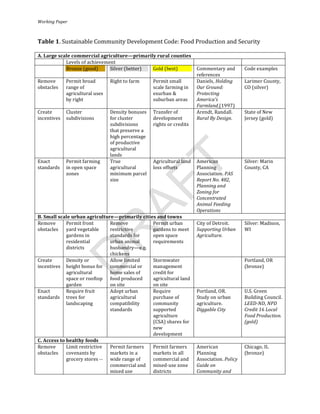
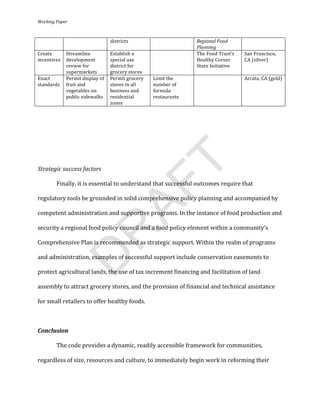
  Table	
  1	
  illustrates	
  the	
  matrix	
  in	
  a	
  condensed	
  form.	
  The	
  full	
  chapter	
  and	
  

matrix	
  may	
  be	
  viewed	
  at	
  the	
  Rocky	
  Mountain	
  Land	
  Use’s	
  web	
  site.xxix	
  It	
  contains	
  hyperlinks	
  

to	
  the	
  majority	
  of	
  references	
  and	
  local	
  development	
  code	
  examples	


Working	
  Paper	


Table	
  1.	
  Sustainable	
  Community	
  Development	
  Code:	
  Food	
  Production	
  and	
  Security	


A.	
  Large	
  scale	
  commercial	
  agriculture—primarily	
  rural	
  counties	
  
	
                    Levels	
  of	
  achievement	


                    Bronze	
  ( good)	
             Silver	
  ( better)	
         Gold	
  ( best)	
           Commentary	
  and	
               Code	
  examples	
  
                                                                                                                references	
  
Remove	
              Permit	
  broad	
               Right	
  to	
  farm	
         Permit	
  small	
           Daniels,	
  Holding	
             Larimer	
  County,	
  
obstacles	
   range	
  of	
                                          	
             scale	
  farming	
  in	
   Our	
  Ground:	
  	
               CO	
  (silver)	
  
                      agricultural	
  uses	
                                        exurban	
  &	
              Protecting	
  
                      by	
  right	
                                                 suburban	
  areas	
         America’s	
  
                      	
                                                                                        Farmland	
  (1997)	
  
Create	
              Cluster	
                       Density	
  bonuses	
   Transfer	
  of	
                   Arendt,	
  Randall.	
             State	
  of	
  New	
  
incentives	
   subdivisions	
                         for	
  cluster	
              development	
               Rural	
  By	
  Design.	
          Jersey	
  (gold)	
  
                                                      subdivisions	
                rights	
  or	
  credits	
   	
  
                                                      that	
  preserve	
  a	


                                                      high	
  percentage	
  
                                                      of	
  productive	
  
                                                      agricultural	
  
                                                      lands	
  
Enact	
               Permit	
  farming	
             True	
                        Agricultural	
  land	
   American	
                           Silver:	
  Marin	


                                                                                      T
standards	
   in	
  open	
  space	
                   agricultural	
                loss	
  offsets	
           Planning	
                        County,	
  CA	
  
                      zones	
                         minimum	
  parcel	
   	
                                  Association.	
  P AS	
  
                      	
                              size	
                                                    Report	
  No.	
  482,	
  
                                                     AF                                                         Planning	
  and	
  
                                                                                                                Zoning	
  for	
  
                                                                                                                Concentrated	
  
                                                                                                                Animal	
  Feeding	
  
                                                                                                                Operations	
  
B.	
  Small	
  scale	
  urban	
  agriculture—primarily	
  cities	
  and	
  towns	
  
Remove	
              Permit	
  front	
               Remove	
                      Permit	
  urban	
           City	
  o f	
  Detroit.	
  	
     Silver:	
  Madison,	
  
obstacles	
   yard	
  vegetable	
                     restrictive	
                 gardens	
  to	
  meet	
   Supporting	
  Urban	
               WI	
  
                 R
                      gardens	
  in	
                 standards	
  for	
            open	
  space	
             Agriculture.	
  
                      residential	
                   urban	
  animal	
             requirements	
  
                      districts	
                     husbandry—e.g.	


                              chickens	
  
                D

Create	
              Density	
  or	
                 Allow	
  limited	
            Stormwater	
                	
                                Portland,	
  OR	
  
incentives	
   height	
  bonus	
  for	
   commercial	
  or	
                        management	
                                                  (bronze)	
  
                      agricultural	
                  home	
  sales	
  o f	
        credit	
  for	
  
                      space	
  o r	
  rooftop	
   food	
  produced	
                agricultural	
  land	
  
                      garden	
                        on	
  site	
                  on	
  site	
  
Enact	
               Require	
  fruit	
              Adopt	
  urban	
              Require	
                   Portland,	
  O R.	
               U.S.	
  Green	
  
standards	
   trees	
  for	
                          agricultural	
                purchase	
  of	
            Study	
  on	
  urban	
            Building	
  Council.	
  
                      landscaping	
                   compatibility	
               community	
                 agriculture.	
                    LEED-­ND,	
  NPD	
  
                      	
                              standards	
                   supported	
                 Diggable	
  City	
                Credit	
  16	
  Local	
  
                                                                                    agriculture	
                                                 Food	
  Production.	
  
                                                                                    (CSA)	
  shares	
  for	
                                      (gold)	
  
                                                                                    new	
  
                                                                                    development	
  
C.	
  Access	
  to	
  healthy	
  foods	
  
Remove	
              Limit	
  restrictive	
   Permit	
  farmers	
                  Permit	
  farmers	
         American	
                        Chicago,	
  IL	
  
obstacles	
   covenants	
  by	
                       markets	
  in	
  a	
          markets	
  in	
  all	
      Planning	
                        (bronze)	
  
                      grocery	
  stores	
  -­‐-­‐	
   wide	
  range	
  o f	
        commercial	
  and	
   Association.	
  Policy	
  
                                                      commercial	
  and	
   mixed-­‐use	
  zone	
   Guide	
  on	
  
                                                      mixed	
  use	
                districts	
                 Community	
  and	


Working	
  Paper	


                                             districts	
                                   Regional	
  Food	
  
                                                                                           Planning	
  
Create	
       Streamline	
                  Establish	
  a	
           	
                 The	
  Food	
  Trust’s	
     San	
  Francisco,	
  
incentives	
   development	
                 special	
  use	
                              Healthy	
  Corner	
          CA	
  (silver)	
  
               review	
  for	
               district	
  for	
                             Store	
  Initiative	
  
               supermarkets	
                grocery	
  stores	
  
Enact	
        Permit	
  display	
  of	
     Permit	
  grocery	
        Limit	
  the	
     	
                           Arcata,	
  CA	
  (gold)	
  
standards	
   fruit	
  and	
                 stores	
  in	
  all	
      number	
  of	
  
               vegetables	
  o n	
           business	
  and	
          formula	
  
               public	
  s idewalks	
        residential	
              restaurants	
  
                                             zones	


                                                                               T
Strategic	
  success	
  factors	
  

            Finally,	
  it	
  is	
  essential	
  to	
  understand	
  that	
  successful	
  outcomes	
  require	
  that	
  
                                               AF
regulatory	
  tools	
  be	
  grounded	
  in	
  solid	
  comprehensive	
  policy	
  planning	
  and	
  accompanied	
  by	
  

competent	
  administration	
  and	
  supportive	
  programs.	
  In	
  the	
  instance	
  of	
  food	
  production	
  and	
  

security	
  a	
  regional	
  food	
  policy	
  council	
  and	
  a	
  food	
  policy	
  element	
  within	
  a	
  community’s	
  
                R

Comprehensive	
  Plan	
  is	
  recommended	
  as	
  strategic	
  support.	
  Within	
  the	
  realm	
  of	
  programs	
  

and	
  administration,	
  examples	
  of	
  successful	
  support	
  include	
  conservation	
  easements	
  to	
  
               D


protect	
  agricultural	
  lands,	
  the	
  use	
  of	
  tax	
  increment	
  financing	
  and	
  facilitation	
  of	
  land	
  

assembly	
  to	
  attract	
  grocery	
  stores,	
  and	
  the	
  provision	
  of	
  financial	
  and	
  technical	
  assistance	
  

for	
  small	
  retailers	
  to	
  offer	
  healthy	
  foods.	


Conclusion	
  

            The	
  code	
  provides	
  a	
  dynamic,	
  readily	
  accessible	
  framework	
  for	
  communities,	
  

regardless	
  of	
  size,	
  resources	
  and	
  culture,	
  to	
  immediately	
  begin	
  work	
  in	
  reforming	
  their	


Working	
  Paper	


development	
  codes	
  along	
  a	
  more	
  sustainable	
  path.	
  Dissemination,	
  training	
  and	
  

demonstration	
  pilot	
  projects	
  represent	
  the	
  next	
  important	
  challenge	
  to	
  reforming	
  the	
  

nation’s	
  development	
  codes.


                                                              T
                                      AF
                R
               D


Working	
  Paper	


End	
  Notes	
  
i	
  Muro,	
   Mark	
  et	
   al	
  (2008).	
  Shaping	
  a	
  New	
  Partnership	
  for	
  a 	
  Metropolitan	
  Nation.	
  	
   Retrieved	
  A pril	
  20,	
  2009,	
  

from	
  Brookings	
  Institution	
  Web	
  s ite:	
  
http://www.brookings.edu/~/media/Files/rc/reports/2008/06_metropolicy/06_metropolicy_fullreport.pdf
ii	
  See	
  Z iegler,	
  Edward	
   H.,	
  (2009).	
   The	
   Case	
   for	
   Megapolitan	
  Growth	
   Management	
  in	
  the	
  2 1st	
  Century:	
   Regional	
  

Urban	
  Planning	
  and	
  Sustainable	
  Development	
  in	
  the	
  United	
  States.	
  The	
  Urban	
  Lawyer	
  4(1).
iii	
  Ecological	
   footprint	
  is	
   a	
   measure	
  o f	
  human	
  d emand	
  o n	
  the	
  Earth's	
  e cosystems	
  that	
  represents	
   the	
  a mount	
  

of	
  biologically	
  productive	
  land	
  and	
  sea	
  area	
  needed	
  to	
  regenerate	
  the	
  resources	
  a	
  human	
  population	
  
consumes.	
  	
  See	
  Wackernagel,	
  Mathis	
  &	
  Rees,	
  W illiam	
  (1996).	
  Our	
  Ecological	
  Footprint.	
  Gabriola	
  Island,	
  BC:	
  
New	
  Society	
  Press.
iv	
  Halls,	
   Chris	
  (Ed.)	
  (2008).	
  G lobal	
  Footprint	
  Network.	
   Retrieved	
  April	
  20,	
  2009,	
   from	
  G lobal	
   Footprint	
  

Network.	
  Web	
  site:	
  http://www.footprintnetwork.org/en/index.php/GFN/page/data_sources/.	
  
v	
  Energy	
   Use	
  by	
  Sector	
  (2007).	
   Retrieved	
  April	
  20,	
  2009,	
  from	
  Energy	
   Information	
  Administration	
   Web	
  site:	
  

http://www.eia.doe.gov/emeu/aer/pdf/pages/sec2.pdf
vi	
  Ziegler,	
  Edward	
  H .	
  (2008).	
  A merican	
  C ities,	
  U rban	
   Collapse,	
  a nd	
  Environmental	
   Doom.	
  Planning	
  &	
  

Environmental	
  Law,	
  60,	
  7 ,	
  9 .
vii	
  The	
  U nited	
   States	
  h as	
  a	
  $ 2	
  trillion	
   infrastructure	
  m aintenance	
   deficit	
  that	
   increases	
   by	
   an	
  estimated	
  $100	


                                                                                                                                                                                                                                   T
billion	
  each	
  y ear.	
  See	
  Report	
  Card	
  for	
  America’s	
  Infrastructure	
  2003	
  Progress	
  Progress	
  Report:	
  An	
  update	
  to	
  the	
  
2001	
  Report	
  Card	
  (2003).	
  Retrieved	
  April	
  20,	
  2009,	
  from	
  American	
  Society	
  o f	
  Civil	
  Engineers	
  Web	
  s ite:	
  	
  
http://www.asce.org/reportcard/pdf/fullreport03.pdf.
viii	
  Peak	
  oil	
  is	
  the	
  point	
   in	
  t ime	
  when	
  the	
  m aximum	
  rate	
  o f	
   global	
  petroleum	
  e xtraction	
  is	
   reached,	
  a fter	
  which	
  
                                                                                                                                                                                                                           AF
the	
  rate	
  of	
  production	
  enters	
  terminal	
  d ecline.
ix.	
  The	
  Association	
   for	
  the	
   Study	
  o f	
   Peak	
  O il	
  and	
   Gas	
  (ASPO)	
  predicted	
  in	
  their	
  January	
  2008	
   newsletter	
  that	
  

the	
  production	
  peak	
  for	
  all	
  o il,	
  including	
  non-­‐conventional	
  sources,	
  would	
  occur	
  in	
  2010.	
  Note	
  that	
  estimates	
  
for	
  the	
  date	
  of	
  global	
  peak	
  oil	
  production	
  vary	
  considerably	
  due	
  to	
  the	
  volatility	
  of	
  variables	
  and	
  that	
  only	
  in	
  
hindsight	
  will	
  the	
  peak	
  be	
  clear.	
  Retrieved	
  April	
  20,	
  2009	
  from	
  ASPO	
  Web	
  s ite:	
  	
  http://www.aspo-­‐
ireland.org/contentFiles/newsletterPDFs/newsletter85_200801.pdf.	
  Note	
  that	
  estimates	
  for	
  the	
  date	
  of	
  
global	
  peak	
  oil	
  production	
  vary	
  considerably	
  due	
  to	
  the	
  v olatility	
  of	
  v ariables	
  and	
  that	
  only	
  in	
  hindsight	
  w ill	
  
                                                                    R
the	
  peak	
  be	
  clear.
x	
  Kunstler,	
  James	
   Howard	
  (2005).	
  The	
   Long	
   Emergency.	
   New	
  York:	
  Atlantic	
   Monthly	
  Press.
xi	
  Climate	
  Change	
  2007	
  Synthesis	
   Report:	
  Summary	
  f or	
  Policy	
  Makers	
  (2007).	
   Retrieved	
  April	
  20,	
  2009,	
   from	
  

Intergovernmental	
  Panel	
  on	
  Climate	
  Change	
  Web	
  s ite:	
  http://www.ipcc.ch/pdf/assessment-­‐
                                                                   D

report/ar4/syr/ar4_syr_spm.pdf
xii	
  Nearly	
  70%	
  o f	
   biologists	
  v iew	
  the	
  p resent	
  era	
  as	
  p art	
  o f	
  a 	
  mass	
  e xtinction	
  event,	
  possibly	
  one	
  of	
  the	
   fastest	
  

ever,	
  according	
  to	
  a	
  1998	
  survey	
  by	
  the	
  A merican	
  Museum	
  of	
  Natural	
  History.	
  Retrieved	
  April	
  20,	
  2009	
  from	
  
American	
  Museum	
  o f	
  Natural	
  History	
  Web	
  s ite:	
  	
  http://www.well.com/~davidu/amnh.html	
  .	
  See	
  also	
  E .	
  O.	
  
Wilson	
  (2006).	
  The	
  Creation:	
  An	
  Appeal	
  to	
  Save	
  Life	
  on	
  Earth.	
  New	
  York:	
  W.	
  W.	
  Norton	
  &	
  Company.
xiii	
  Ziegler,	
  Edward	
  H .	
  (2003).	
  Urban	
  Sprawl,	
   Growth	
   Management	
  and	
  Sustainable	
   Development	
  in	
  the	
  U nited	
  

States:	
  Thoughts	
  on	
  the	
  Sentimental	
  Quest	
  for	
  a	
  New	
  Middle	
  landscape.	
  Virginia	
  Journal	
  of	
  Social	
  Policy	
  &	
  Law,	
  
11,	
  26.	
  
xivAny	
  significant	
  growth	
   in	
  the	
  use	
  o f	
  plug-­‐in-­‐hybrid	
   cars	
   w ill	
   necessarily	
  r equire	
  the	
  use	
  of	
  fossil	
   fuels	
   as	
  the	
  

proportion	
  o f	
  renewable	
  energy	
  within	
  the	
  entire	
  energy	
  portfolio	
  is	
  expected	
  to	
  increase	
  only	
  slightly	
  faster	
  
than	
  the	
  overall	
  increase	
  in	
  energy	
  demand.	
  See	
  Annual	
  Energy	
  Outlook	
  2009,	
  Energy	
  Demand	
  Projections	
  
(2009).	
  Retrieved	
  April	
  20,	
  2 009	
  from	
  Energy	
  Information	
  Administration	
  Web	
  site:	
  
http://www.eia.doe.gov/oiaf/aeo/pdf/trend_2.pdf.	
  	
  
xv	
  	
  McNeely,	
  Jeffrey	
  A.	
  (2006).	
   Biofuels:	
  Green	
  energy	
  or	
  grim	
  reaper?	
  Retrieved	
  A pril	
  20,	
  2009	
   from	
  B BC	
  News	
  

Web	
  site.	
  http://news.bbc.co.uk/2/hi/science/nature/5369284.stm
xvi	
  The	
  Illusion	
  of	
   Clean	
   Coal	
  ( March	
  5 ,	
  2009).	
   Retrieved	
  April	
  20,	
  2009,	
   from	
   The	
  E conomist	
  Web	
  s ite:	
  

http://www.economist.com/opinion/displaystory.cfm?story_id=13235041
xvii	
  Bossel,	
  Ulf	
  (2006).	
  Does	
  a	
   Hydrogen	
  Economy	
   Make	
   Sense?	
  Proceedings	
  of	
   the	
  I EE,	
  94	
  (10).


Working	
  Paper	


xviii	
  	
  Dawe,	
  Pat	
  and	
  Hootman,	
  Tom	
  (2009).	
  G oing	
   beyond	
   LEED:	
  Carbon	
  Accountability	
  a t	
  the	
  Development	
  Scale.	
  

Presentation	
  made	
  at	
  the	
  18th	
  Annual	
  Land	
  Use	
  Conference	
  o f	
  the	
  Rocky	
  Mountain	
  Land	
  Use	
  Institute.	
  
Retrieved	
  April	
  2 0,	
  2009	
  from	
  RMLUI	
  Web	
  s ite:	
  http://www.law.du.edu/index.php/rmlui	
  
xix	
  Ziegler,	
  Edward	
  H .,	
  (2009).	
   The	
  Case	
  for	
   Megapolitan	
   Growth	
  Management	
  in	
  the	
  2 1st	
  Century:	
   Regional	
  

Urban	
  Planning	
  and	
  Sustainable	
  Development	
  in	
  the	
  United	
  States.	
  The	
  Urban	
  Lawyer	
  4(1).	
  
xx	
  272	
  U.S.	
   365	
  (1926).
xxi	
  Kendig,	
  L ane	
  (1980).	
  Performance	
   Zoning.	
  W ashington,	
   D .C.;	
  Chicago,	
  IL:	
  Planners	
   Press.	
  
xxii	
  The	
   SmartCode	
   is	
  a 	
  unified	
  d evelopment	
  ordinance	
  developed	
   by	
  Duany	
  Andres	
  a nd	
  Elizabeth	
  Plater-­‐

Zyberk.	
  Retrieved	
  April	
  20,	
  2009	
  from	
  SmartCode	
  Central	
  Web	
  site:	
  at	
  http://www.smartcodecentral.org/
xxiii	
  Peter	
  S.	
  Brandon	
  and	
   Patrizia	
  L ombardi	
  ( 2005).	
  Evaluating	
  Sustainable	
  Development	
  in	
   the	
   Built	
  

Environment.	
  Oxford,	
  U K;	
  Malden,	
  MA:	
  Blackwell	
  Publishing.	
  See	
  Chapter	
  4	
  in	
  particular.

xxiv	
  The	
  theory	
  o n	
  m odalities	
   is	
  articulated	
  in	
  The	
  Philosophy	
  of	
  the	
  Cosmonomic	
   Idea	
  (1935-­‐1936)	
  [De	
  

Wijsbegeerte	
  d er	
  Wetsidee	
  (Amsterdam:	
  1935-­‐36)].	
  Herman	
  Dooyeweerd	
  w as	
  a	
  professor	
  o f	
  law	
  at	
  the	
  Free	
  
University	
  o f	
  A msterdam.	
  This	
  writing	
  is	
  available	
  in	
  English	
  in	
  the	
  Encyclopedia	
  o f	
  the	
  Science	
  o f	
  Law	
  
Volume	
  1	
  Mellen,	
  Series	
  A ,	
  vol.	
  8 ,	
  General	
  Editor:	
  D.F.M.	
  Strauss,	
  Translated	
  by	
  Robert	
  D.	
  Knudsen,	
  Edited	
  by	
  
Alan	
  M.	
  Cameron	
  	
  ( New	
  York:	
  The	
  Edwin	
  Mellen	
  Press,	
  2 002).	
  	
  A	
  d etailed	
  discussion	
  o n	
  linking	
  Dooyeweerd’s	
  
modalities	
  w ith	
  topical	
  elements	
  o f	
  the	
  Sustainable	
  Community	
  Development	
  Code	
  may	
  be	
  found	
  in	
  van	
  
Hemert,	
  James	
  (2007).	
  Sustainable	
  Zoning:	
  A	
  New	
  Imperative.	
  The	
  Rocky	
  Mountain	
  Land	
  Use	
  Institute.	


                                                                                                                                                                                                                                                                                                                                                               T
Available	
  online	
  at	
  http://law.du.edu/images/uploads/rmlui/rmlui-­‐sustainable-­‐
SustainableZoningFramework%206.pdf.	
  

xxv	
  American	
   Planning	
  Association	
  (2007).	
  Policy	
  Guide	
  on	
   C ommunity	
  and	
   Regional	
  Food	
  Planning.	
   Retrieved	
  
                                                                                                                                                                                                                         AF
April	
  2 0,	
  2009,	
  from	
  A merican	
  Planning	
  Association	
  Web	
  site:	
  
http://www.planning.org/divisions/initiatives/foodsystem.htm
                                                                                  xxvi	
  Ibid.

xxvii	
  Martin	
  C .	
   Heller	
   and	
   Gregory	
  A .	
  Keoleian	
  (2000).	
   Life	
  Cycle-­Based	
  Sustainability	
   Indicators	
   for	
  Assessment	
  

of	
  the	
  U.S.	
  Food	
  Systems.	
  Ann	
  A rbor:	
  University	
  o f	
  Michigan,	
  Center	
  for	
  Sustainable	
  Systems.	
  Retrieved	
  April	
  
20,	
  2009:	
  http://css.snre.umich.edu/css_doc/CSS00-­‐04.pdf	
  
xxviii	
  U.S.	
  E PA	
  (2007).	
  Inventory	
  of	
  U .S.	
   Greenhouse	
  Gas	
   Emissions	
  and	
  Sinks:	
  1990	
  -­	
  2005.	
  W ashington,	
   DC	
  
                                                                   R
xxix	
  Rocky	
   Mountain	
   Land	
  Use	
  Institute	
  (2009).	
  Sustainable	
  C ommunity	
  Development	
  Code.	
   Retrieved	
  April	
  2 0,	
  

2009	
  from	
  RMLUI	
  Web	
  site:	
  http://www.law.du.edu/rmlui
                                                                  D


The Sustainable Development Code

  • 1.
    Working  Paper     The  Sustainable  Community  Development  Code:     Regulating  a  Sustainable  Urban  Land-­use  Patterns  for  a  Post-­Carbon  World   James  van  Hemert     Introduction   Local  government  land-­‐use  codes  must  be  reformed  if  they  are  to  play  an  important   societal  role  in  achieving  a  sustainable  and  livable  post  carbon  future.  The  United  States  of   America’s  100  largest  metropolitan  regions  include  9,000  cities,  towns,  and  counties.i  They   are  failing  to  sufficiently  change  their  codes  to  advance  the  emerging  paradigm  of   sustainability.ii  Worse,  their  codes  represent  a  significant  barrier  to  achieving  sustainability   T goals.  This  chapter  describes  a  comprehensive  framework  for  land-­‐use  code  reform,  an   initiative  of  the  Rocky  Mountain  Land  Use  Institute  of  the  University  of  Denver.  The   AF Sustainable  Commuity  Development  Code  is  discussed,  featuring  the  code’s  rationale,   approach,  and  structure,  as  well  as  an  explanation  of  one  of  the  code’s  chapters.   Our  land-­‐use  patterns  and  transportation  networks  have  substantially  contributed   R to  the  bloated  size  of  our  ecological  footprint,iii  which  weighs  in  at  over  four  times  the   global  average,  which  is  itself  already  1.3  times  the  planet’s  carrying  capacity.iv  The  low   D density  and  limited-­‐use  character  of  our  settlements  is  coupled  with  an  almost  exclusively   automobile-­‐focused  transportation  system,  and,  together,  they  conspire  to  trap  us  in  a   wasteful  mobility  patterns  in  which  each  household  depends  almost  exclusively  on  a   privately  owned  vehicle.  Our  built  environment  represents  68  percent  of  our  total  energy   use,  of  which  buildings  represent  39  percent  and  transportation  represents  29  percent.v   We  use  fossil  fuels  to  generate  85  percent  of  our  energy.     In  the  United  States,  the  rate  of  urban  land  consumption  over  the  past  several   generations  has  exceeded  the  rate  of  population  growth  by  several  times.vi  This  increases    
  • 2.
    Working  Paper     the  rapidly  growing  financial  burden  of  maintaining  an  automobile-­‐centered   infrastructurevii  and  increases  our  dependency  on  fossil  fuels  with  all  the  attendant   environmental  costs,  including  carbon  greenhouse  gas  emissions.  The  Association  for  the   Study  of  Peak  Oil  and  Gas  (ASPO)  projects  global  “peak  oil”viii  to  occur  in  2010.ix  If  true,  our   entire  human  settlement  infrastructure  and  its  economic  basis  are  in  grave  danger  of   imminent  collapse.x       Global  warming  induced  climate  change  is  already  threatening  the  viability  of   coastline  settlements,  increasing  drought  in  the  Rocky  Mountain  West,  increasing  the   potential  for  disease,  increasing  flooding,  and  threatening  the  viability  of  agricultural   T production.xi  Biologists  predict  that  the  current  alarming  rate  of  species  extinction  will   AF accelerate  further  under  the  combined  effects  of  climate  change,  declining  habitat  due  to   deforestation,  agriculture,  and  urbanization.xii     Our  current  and  future  land-­‐use  patterns  are  substantially  locked  in  place  by  local   R growth-­‐management  policies  and  development  codes  which,  despite  using  “smart  growth”   labels,  severely  limit  land-­‐use  choices  and  density,  creating  in  effect,  legally  mandated  low-­‐ D density  sprawl.  xiii     Breaking  free  from  this  balkanized  local  land-­‐use  code  regulatory  trap  will  be   excruciatingly  difficult  for  psychological,  social,  political,  and  financial  reasons.   Exacerbating  the  challenge  is  the  fact  that  our  attention  is  distracted  by  narrowly  conceived   technical  fixes  for  addressing  climate  change  and  “peak  oil.”  These  fixes  include,  for   example,  plug-­‐in-­‐hybrid  cars,  that  will  still  require  fossil-­‐fuel  based  electricity.xiv  Most   biofuels  have  yet  to  achieve  a  net  positive  return  on  energy  inputs  and  represent  direct   competition  with  global  food  supplies.xv  Deceptively  named  “clean  coal,”  requiring  carbon    
  • 3.
    Working  Paper     sequestration,  remains  uneconomical  and  faces  enormous  technological  challenges.xvi  A   hydrogen  economy  may  be  a  very  long  ways  off.xvii  “Green”  buildings  are  not  necessarily   energy  and  carbon  efficient.xviii  These  fixes  fail  to  address  the  fundamental  problem  of   unsustainable  land-­‐use  patterns,  inflexible  land-­‐use  regulatory  regimes  and  an  exceedingly   burdensome  and  dysfunctional  automobile-­‐focused  roadway  network.  Additionally,  local   politics,  often  excessively  influenced  by  NIMBYs—“not  in  my  back  yard”  activists),  whose   ranks  include  “no  growth”  environmentalists—exacerbates  the  difficulties  already  inherent   in  meeting  the  challenge  of  a  more  sustainable  future.xix       The  critical  and  necessary  starting  point  to  break  free  of  this  regulatory  leg-­‐hold  is   T comprehensive  reform  of  land-­‐use  codes  focused  on  the  environmental,  the  economic  and   AF the  social  equity  elements  of  sustainability  as  the  central  paradigm.       Land-­use  code  family  tree   R Understanding  the  nature  of  our  current  land-­‐use  code  types,  their  history,  and  their   strengths  and  shortcomings  is  a  necessary  first  step.  We  will  be  building  upon  and   D reforming  these  edifices:  they  are  not  about  to  be  disassembled.  There  are  basically  four   typological  strains  of  land-­‐use  codes  in  operation:  Euclidian,  Planned  Development,   Performance,  and  Form  Based  (as  well  hybrid  codes  that  combine  some  aspects  of  each);   each  of  the  four  primary  types  are  explained  below  in  more  detail.  Most  communities  have   evolved  over  the  years  a  hybridized  form  of  zoning  that  incorporates  elements  to  varying   degrees  of  these  four  types.  An  emerging  fifth  type  of  code  is  the  sustainable  code.       1.  Euclidian    
  • 4.
    Working  Paper     In  1926  the  U.S.  Supreme  Court  in  “Village  of  Euclid  vs.  Ambler  Realty  Companyxx”  upheld   the  validity  of  an  ordinance  to  separate  land  uses  into  zone  districts,  specifying  permitted   and  excluded  uses,  prescribing  minimum  lot,  area,  and  bulk  requirement  for  all  permitted   uses.  Land  uses  are  separated  and  sorted  into  groups  based  upon  their  perceived   compatibility  in  order  to  promote  public  “health,  safety,  and  welfare.”  Euclidian  zoning,  also   referred  to  as  “conventional  zoning,”  remains  the  default  base  code  in  most  cities,  towns,   and  counties.    Euclidian  codes  have  not  been  shown  to  be  particularly  effective,  however,  in   dealing  with  myriad  environmental  issues  such  as  floodplain  management  and  habitat   protection.  Their  focus  on  density  maximums  and  the  separation  of  uses  have  the   T particularly  pernicious  effect  of  enabling  NIMBY  groups  to  prevent  sustainable  compact   AF and  mixed-­‐use  urban  development.     2.  Planned  Unit  Development  (PUD)     R Planned  Unit  Development  is  a  means  of  land  regulation  typically  associated  with  large-­‐-­‐ scale,  unified  land  development.  Generally  it  promotes  a  mixture  of  land  uses  and  dwelling   D types,  increased  administrative  discretion  of  local  professional  planning  staff,  and  the   enhancement  of  the  bargaining  process  between  the  developer  and  government   municipalities.  This  strengthens  the  municipality’s  site  plan  review  and  control  over   development.  PUDs  exhibit  a  much  greater  degree  of  flexibility  granted  relative  to  the  more   rigid  Euclidian  zoning  scheme.  Although  PUDs  can  address  sustainability  issues,  their   highly  negotiated  and  custom-­‐designed  character  means  that  critical  sustainability  matters   are  often  inadequate  or  left  unaddressed.        
  • 5.
    Working  Paper     3.  Performance  Systems     Developed  in  the  1970s  in  response  to  the  overly  rigid  and  often  environmentally   damaging  Euclidian  zoning  system,  performance-­‐based  zoning  takes  as  its  starting  point  an   environmental  carrying  capacity  model  whereby  the  type  and  level  of  development  must  fit   the  unique  characteristics  of  the  individual  property.  Lane  Kendig’s  extensive  work  on  this   system  has  made  his  name  virtually  synonymous  with  it.xxi  Essentially,  the  code  allows   almost  anything  to  be  built  anywhere,  provided  appropriate  mitigation  measures  are  taken   into  consideration.  The  approach  placed  an  emphasis  on  environmental  protection  hitherto   not  present  in  any  Euclidian  scheme.     T   AF 4.  Form-­Based   Form-­‐based  development  codes,  popularly  represented  by  the  SmartCode,xxii  focus  heavily   on  the  public  realm  and  the  type  of  urban  form  necessary  to  create  welcoming  public   R spaces  and  walkable  neighborhoods.  It  is  based  on  an  urban-­‐to-­‐rural  transect  urban   planning  which  defines  a  series  of  zones  that  transition  from  sparse  rural  lands  to  the   D dense  urban  core.  The  transect  is  an  important  part  of  the  New  Urbanist  and  Smart  Growth   movements.  The  code  is  highly  prescriptive  regarding  urban  form  and  has  limited  explicit   focus  on  environmental  and  natural  resources.  To  the  extent  that  many  New  Urbanist   developments  rely  heavily  on  automobile  transport  and  serve  the  detached  single-­‐family   housing  market,  they  often  fall  short  of  being  truly  sustainable.  Furthermore,  form-­‐based   codes  and  the  SmartCode  in  particular  are  incomplete  and  no  community  can  adopt  them   as  a  stand-­‐alone  regulatory  ordinance.      
  • 6.
    Working  Paper     The  Sustainable  Community  Development  Code   The  Sustainable  Community  Development  Code  is  a  holistic  framework  for  local   government  regulation  of  land  use  and  the  environment.  Its  core  distinguishing  feature  is   the  promotion,  enhancement,  and  enforcement  of  environmental,  social,  and  economic   sustainability.  The  meta-­‐goal  of  the  code  is  to  reform  land-­‐use  codes  in  such  a  way  that   human  settlements  move  toward  smaller  ecological  footprints.  This  can  be  measured,  for   example,  in  movement  toward  zero  carbon  emissions,  zero  waste,  zero  fossil  fuel   consumption,  improved  prosperity,  and  greater  social  cohesion.       When  we  began  shaping  the  sustainable  community  development  code,  we  were   T influenced  by  the  work  of  Peter  Brandon  (University  of  Salford,  UK)  and  Patrizia  Lombardi   AF (University  of  Turin,  Italy)  as  expressed  in  “Evaluating  Sustainable  Development  in  the   Built  Environment.”xxiii  Their  work  is  heavily  influenced  by  the  Dutch  philosopher  Herman   Dooyeweerd,  whose  once  obscure  writings  have  gained  currency  recently  in  legal  and   R planning  literature.    Dooyeweerd  developed  the  concept  of  modalities,  an  integrated  and   holistic  philosophy  that  can  be  used  to  explain  the  interdependence  between  aspects  of  the   D urban  environment.  This  concept  can  also  be  linked  to  the  wider  sustainable  development   agenda.  The  holism  of  modalities  allows  an  integrated  view  of  the  issue  and  assists  in   explaining  what  is  meant  by,  and  what  contributes  to,  sustainable  development.xxiv       This  overview  covers  the  code’s  distinct  characteristics,  describes  the  intellectual   genesis  of  its  topical  substance,  lists  the  topics  organized  by  major  themes  and  explains  one   of  the  code  chapters  to  describe  the  code’s  operational  features.       The  code’s  distinct  characteristics  include  the  following:   1. A  high  degree  of  comprehensiveness;    
  • 7.
    Working  Paper     2. The  integration  of  natural  and  man-­‐made  systems;   3. A  progressive  nature,  drawing  upon  useful  features  of  other  code  frameworks   already  proven  and  in  use:   4. It  is  based  on  sustainable  comprehensive  policy  plans  and  long-­‐term  civic   engagement;  and     5. It  is  tailored  to  local  and  regional  climate,  ecology,  and  culture.   Innovative  operational  features  include  a  user-­‐friendly  web-­‐based  framework,  the  use  of   hyperlinks  to  references  and  government  web  sites,  commentary,  and  sustainability   measurements.  A  key  organizational  feature  is  the  division  of  topics  into  three  categories:   T overcoming  obstacles,  applying  incentives  and  enacting  regulations.     AF   Major  topics  of  the  code  are  organized  according  to  the  following:   1. ENVIRONMENTAL  HEALTH  AND  NATURAL  RESOURCES   R 1.1. Climate  change   1.2. Low  impact  development  and  green  infrastructure     D 1.3. Natural   resource   conservation—including   wildlife   habitat   and   sensitive   lands   protection     1.4. Water  conservation   1.5. Solid  waste  and  recycling   2. NATURAL  HAZARDS     2.1. Floodplain  management     2.2. Wildfires  in  the  wildland-­‐urban  interface     2.3. Coastal  hazards    
  • 8.
    Working  Paper     2.4. Steep  slopes   3. LAND  USE  AND  COMMUNITY  CHARACTER   3.1. Character  and  aesthetics   3.1.1. Visual  elements   3.2. Urban  form  and  density   3.3. Historic  preservation   4. MOBILITY  &  TRANSPORTATION   4.1. Mobility  systems     4.1.1.      Complete  streets   T 4.1.2.      Pedestrian  systems   AF 4.1.3.      Bicycle  systems   4.1.4.      Public  transit   4.2. Parking     R 4.3. Transit  oriented  development     5. COMMUNITY   D 5.1. Community  development   5.2. Public  participation  and  community  benefits   6. HEALTHY  NEIGHBORHOODS,  HOUSING,  FOOD  SECURITY   6.1. Community  health  and  safety   6.2. Affordable  housing     6.3. Housing  diversity  and  accessibility     6.4. Food  production  and  security    
  • 9.
    Working  Paper     7. ENERGY     7.1. Renewable  energy:    wind,  small  and  large  scale   7.2. Renewable  energy:    solar,  including  solar  access   7.3. Energy  efficiency  and  conservation     8. LIVABILITY   8.1. Noise   8.2. Lighting     Illustration  of  a  code  chapter:  Food  production  and  security   T The  topic  of  food  production  and  security  is  a  salient  illustration  of  the  code  because   AF of  the  significant  impact  it  has  on  our  carbon  emissions.  Food  production  and  security   touch  upon  other  elements  of  sustainability  such  as  human  health,  social  equity,  and  a   healthy  local  economy.  With  the  average  morsel  of  food  on  our  dinner  plates  coming  from   R 1500  miles  away,  the  food  system  is  as  sprawling  and  dependent  on  fossil  fuel  as  our   cities.xxv   D    
  • 10.
    Working  Paper     Commentary,  Key  statistics,  Goals,   The  chapter,  “Food  production  and  security,”  succinctly  lays  out  the  key  issues  and   rationale  for  inclusion  of  the  topic  in  local  community  development  codes.    The  American   food  system,  which,  broadly  defined,  is  the  sequence  of  activities  linking  food  production,   processing,  distribution  and  access,  consumption,  and  waste  management,  as  well  as  all  the   associated  supporting  and  regulatory  institutions  and  activities.xxvi    In  2000,  approximately   10%  of  all  energy  used  in  the  U.S.  was  consumed  by  the  food  industry.xxvii  Agricultural   activities  were  responsible  for  7%  of  total  U.S.  greenhouse  gas  emissions  in  2005,  of  which   livestock  is  a  major  contributor.xxviii    Goals,  which  can  be  included  in  a  code’s  purpose   T statement,  are  suggested  and  include:     AF 1)  The  elimination  of  barriers  such  as  restrictions  on  farmers  markets,  animal   husbandry  and  overly  simplistic  rural  agricultural  zoning  provisions;   2)  Incentives  to  encourage  urban  agriculture  and  increase  access  to  healthy  food;   R and    3)  The  enactment  of  standards  for  sustainable  large  scale  food  production,  access  to   D healthy  foods,  and  limits  on  unhealthy  food  choices  such  as  fast  food  restaurants,   the  expansion  of  permissive  animal  unit  regulations,  and  the  broadening  of     permitted  uses  by  right  in  agricultural  zones.     Within  this  framework  of  goals  local  development  codes  can  play  a  significant  role  in   enhancing  more  energy  efficient  food  production,  increasing  access  to  healthy  foods,  and   supporting  a  local  agricultural  economy.      
  • 11.
    Working  Paper     Measurement  index   Suggested  specific  sustainable  measurement  metrics  include:   1. Energy  consumption  to  food  production  ratio;     2. Average  distance  a  food  item  travels  (the  lower,  the  better);   3. Percentage  of  community  demand  met  from  agriculture  within  the  community;   4. Average  distance  to  healthy  food  (absence  of  food  deserts);  and   5. Energy  consumption  to  food  production  ratio.     The  matrix   T The  heart  of  the  code  is  the  matrix  of  regulations,  levels  of  achievement,  references   AF and  commentary,  and  existing  code  examples  from  communities  around  the  USA  and  the   world.  Along  the  x-­‐axis  are  categories  of  achievement  ranging  from  good  (bronze),  better   (silver)  to  best  (gold).    The  remaining  columns  on  this  axis  include  commentary  with   R references  and  exemplary  codes  with  hyperlinks.  The  y-­‐axis  rows  are  organized  according   to  overcoming  barriers,  creating  incentives,  and  enacting  standards.   D For  this  particular  chapter,  the  matrix  is  further  organized  in  accordance  with  three  broad   categories:  large  scale  commercial  agriculture,  small  scale  urban  agriculture,  and  access  to   healthy  foods.  Table  1  illustrates  the  matrix  in  a  condensed  form.  The  full  chapter  and   matrix  may  be  viewed  at  the  Rocky  Mountain  Land  Use’s  web  site.xxix  It  contains  hyperlinks   to  the  majority  of  references  and  local  development  code  examples          
  • 12.
    Working  Paper     Table  1.  Sustainable  Community  Development  Code:  Food  Production  and  Security     A.  Large  scale  commercial  agriculture—primarily  rural  counties     Levels  of  achievement         Bronze  ( good)   Silver  ( better)   Gold  ( best)   Commentary  and   Code  examples   references   Remove   Permit  broad   Right  to  farm   Permit  small   Daniels,  Holding   Larimer  County,   obstacles   range  of     scale  farming  in   Our  Ground:     CO  (silver)   agricultural  uses   exurban  &   Protecting   by  right   suburban  areas   America’s     Farmland  (1997)   Create   Cluster   Density  bonuses   Transfer  of   Arendt,  Randall.   State  of  New   incentives   subdivisions   for  cluster   development   Rural  By  Design.   Jersey  (gold)   subdivisions   rights  or  credits     that  preserve  a       high  percentage   of  productive   agricultural   lands   Enact   Permit  farming   True   Agricultural  land   American   Silver:  Marin   T standards   in  open  space   agricultural   loss  offsets   Planning   County,  CA   zones   minimum  parcel     Association.  P AS     size   Report  No.  482,   AF Planning  and   Zoning  for   Concentrated   Animal  Feeding   Operations   B.  Small  scale  urban  agriculture—primarily  cities  and  towns   Remove   Permit  front   Remove   Permit  urban   City  o f  Detroit.     Silver:  Madison,   obstacles   yard  vegetable   restrictive   gardens  to  meet   Supporting  Urban   WI   R gardens  in   standards  for   open  space   Agriculture.   residential   urban  animal   requirements   districts   husbandry—e.g.       chickens   D Create   Density  or   Allow  limited   Stormwater     Portland,  OR   incentives   height  bonus  for   commercial  or   management   (bronze)   agricultural   home  sales  o f   credit  for   space  o r  rooftop   food  produced   agricultural  land   garden   on  site   on  site   Enact   Require  fruit   Adopt  urban   Require   Portland,  O R.   U.S.  Green   standards   trees  for   agricultural   purchase  of   Study  on  urban   Building  Council.   landscaping   compatibility   community   agriculture.   LEED-­ND,  NPD     standards   supported   Diggable  City   Credit  16  Local   agriculture   Food  Production.   (CSA)  shares  for   (gold)   new   development   C.  Access  to  healthy  foods   Remove   Limit  restrictive   Permit  farmers   Permit  farmers   American   Chicago,  IL   obstacles   covenants  by   markets  in  a   markets  in  all   Planning   (bronze)   grocery  stores  -­‐-­‐   wide  range  o f   commercial  and   Association.  Policy   commercial  and   mixed-­‐use  zone   Guide  on   mixed  use   districts   Community  and    
  • 13.
    Working  Paper     districts   Regional  Food   Planning   Create   Streamline   Establish  a     The  Food  Trust’s   San  Francisco,   incentives   development   special  use   Healthy  Corner   CA  (silver)   review  for   district  for   Store  Initiative   supermarkets   grocery  stores   Enact   Permit  display  of   Permit  grocery   Limit  the     Arcata,  CA  (gold)   standards   fruit  and   stores  in  all   number  of   vegetables  o n   business  and   formula   public  s idewalks   residential   restaurants   zones           T Strategic  success  factors   Finally,  it  is  essential  to  understand  that  successful  outcomes  require  that   AF regulatory  tools  be  grounded  in  solid  comprehensive  policy  planning  and  accompanied  by   competent  administration  and  supportive  programs.  In  the  instance  of  food  production  and   security  a  regional  food  policy  council  and  a  food  policy  element  within  a  community’s   R Comprehensive  Plan  is  recommended  as  strategic  support.  Within  the  realm  of  programs   and  administration,  examples  of  successful  support  include  conservation  easements  to   D protect  agricultural  lands,  the  use  of  tax  increment  financing  and  facilitation  of  land   assembly  to  attract  grocery  stores,  and  the  provision  of  financial  and  technical  assistance   for  small  retailers  to  offer  healthy  foods.       Conclusion   The  code  provides  a  dynamic,  readily  accessible  framework  for  communities,   regardless  of  size,  resources  and  culture,  to  immediately  begin  work  in  reforming  their    
  • 14.
    Working  Paper     development  codes  along  a  more  sustainable  path.  Dissemination,  training  and   demonstration  pilot  projects  represent  the  next  important  challenge  to  reforming  the   nation’s  development  codes. T AF R D  
  • 15.
    Working  Paper                                                                                                                         End  Notes   i  Muro,   Mark  et   al  (2008).  Shaping  a  New  Partnership  for  a  Metropolitan  Nation.     Retrieved  A pril  20,  2009,   from  Brookings  Institution  Web  s ite:   http://www.brookings.edu/~/media/Files/rc/reports/2008/06_metropolicy/06_metropolicy_fullreport.pdf ii  See  Z iegler,  Edward   H.,  (2009).   The   Case   for   Megapolitan  Growth   Management  in  the  2 1st  Century:   Regional   Urban  Planning  and  Sustainable  Development  in  the  United  States.  The  Urban  Lawyer  4(1). iii  Ecological   footprint  is   a   measure  o f  human  d emand  o n  the  Earth's  e cosystems  that  represents   the  a mount   of  biologically  productive  land  and  sea  area  needed  to  regenerate  the  resources  a  human  population   consumes.    See  Wackernagel,  Mathis  &  Rees,  W illiam  (1996).  Our  Ecological  Footprint.  Gabriola  Island,  BC:   New  Society  Press. iv  Halls,   Chris  (Ed.)  (2008).  G lobal  Footprint  Network.   Retrieved  April  20,  2009,   from  G lobal   Footprint   Network.  Web  site:  http://www.footprintnetwork.org/en/index.php/GFN/page/data_sources/.   v  Energy   Use  by  Sector  (2007).   Retrieved  April  20,  2009,  from  Energy   Information  Administration   Web  site:   http://www.eia.doe.gov/emeu/aer/pdf/pages/sec2.pdf vi  Ziegler,  Edward  H .  (2008).  A merican  C ities,  U rban   Collapse,  a nd  Environmental   Doom.  Planning  &   Environmental  Law,  60,  7 ,  9 . vii  The  U nited   States  h as  a  $ 2  trillion   infrastructure  m aintenance   deficit  that   increases   by   an  estimated  $100   T billion  each  y ear.  See  Report  Card  for  America’s  Infrastructure  2003  Progress  Progress  Report:  An  update  to  the   2001  Report  Card  (2003).  Retrieved  April  20,  2009,  from  American  Society  o f  Civil  Engineers  Web  s ite:     http://www.asce.org/reportcard/pdf/fullreport03.pdf. viii  Peak  oil  is  the  point   in  t ime  when  the  m aximum  rate  o f   global  petroleum  e xtraction  is   reached,  a fter  which   AF the  rate  of  production  enters  terminal  d ecline. ix.  The  Association   for  the   Study  o f   Peak  O il  and   Gas  (ASPO)  predicted  in  their  January  2008   newsletter  that   the  production  peak  for  all  o il,  including  non-­‐conventional  sources,  would  occur  in  2010.  Note  that  estimates   for  the  date  of  global  peak  oil  production  vary  considerably  due  to  the  volatility  of  variables  and  that  only  in   hindsight  will  the  peak  be  clear.  Retrieved  April  20,  2009  from  ASPO  Web  s ite:    http://www.aspo-­‐ ireland.org/contentFiles/newsletterPDFs/newsletter85_200801.pdf.  Note  that  estimates  for  the  date  of   global  peak  oil  production  vary  considerably  due  to  the  v olatility  of  v ariables  and  that  only  in  hindsight  w ill   R the  peak  be  clear. x  Kunstler,  James   Howard  (2005).  The   Long   Emergency.   New  York:  Atlantic   Monthly  Press. xi  Climate  Change  2007  Synthesis   Report:  Summary  f or  Policy  Makers  (2007).   Retrieved  April  20,  2009,   from   Intergovernmental  Panel  on  Climate  Change  Web  s ite:  http://www.ipcc.ch/pdf/assessment-­‐ D report/ar4/syr/ar4_syr_spm.pdf xii  Nearly  70%  o f   biologists  v iew  the  p resent  era  as  p art  o f  a  mass  e xtinction  event,  possibly  one  of  the   fastest   ever,  according  to  a  1998  survey  by  the  A merican  Museum  of  Natural  History.  Retrieved  April  20,  2009  from   American  Museum  o f  Natural  History  Web  s ite:    http://www.well.com/~davidu/amnh.html  .  See  also  E .  O.   Wilson  (2006).  The  Creation:  An  Appeal  to  Save  Life  on  Earth.  New  York:  W.  W.  Norton  &  Company. xiii  Ziegler,  Edward  H .  (2003).  Urban  Sprawl,   Growth   Management  and  Sustainable   Development  in  the  U nited   States:  Thoughts  on  the  Sentimental  Quest  for  a  New  Middle  landscape.  Virginia  Journal  of  Social  Policy  &  Law,   11,  26.   xivAny  significant  growth   in  the  use  o f  plug-­‐in-­‐hybrid   cars   w ill   necessarily  r equire  the  use  of  fossil   fuels   as  the   proportion  o f  renewable  energy  within  the  entire  energy  portfolio  is  expected  to  increase  only  slightly  faster   than  the  overall  increase  in  energy  demand.  See  Annual  Energy  Outlook  2009,  Energy  Demand  Projections   (2009).  Retrieved  April  20,  2 009  from  Energy  Information  Administration  Web  site:   http://www.eia.doe.gov/oiaf/aeo/pdf/trend_2.pdf.     xv    McNeely,  Jeffrey  A.  (2006).   Biofuels:  Green  energy  or  grim  reaper?  Retrieved  A pril  20,  2009   from  B BC  News   Web  site.  http://news.bbc.co.uk/2/hi/science/nature/5369284.stm xvi  The  Illusion  of   Clean   Coal  ( March  5 ,  2009).   Retrieved  April  20,  2009,   from   The  E conomist  Web  s ite:   http://www.economist.com/opinion/displaystory.cfm?story_id=13235041 xvii  Bossel,  Ulf  (2006).  Does  a   Hydrogen  Economy   Make   Sense?  Proceedings  of   the  I EE,  94  (10).  
  • 16.
    Working  Paper                                                                                                                                                                                                                                                                                                                                                                         xviii    Dawe,  Pat  and  Hootman,  Tom  (2009).  G oing   beyond   LEED:  Carbon  Accountability  a t  the  Development  Scale.   Presentation  made  at  the  18th  Annual  Land  Use  Conference  o f  the  Rocky  Mountain  Land  Use  Institute.   Retrieved  April  2 0,  2009  from  RMLUI  Web  s ite:  http://www.law.du.edu/index.php/rmlui   xix  Ziegler,  Edward  H .,  (2009).   The  Case  for   Megapolitan   Growth  Management  in  the  2 1st  Century:   Regional   Urban  Planning  and  Sustainable  Development  in  the  United  States.  The  Urban  Lawyer  4(1).   xx  272  U.S.   365  (1926). xxi  Kendig,  L ane  (1980).  Performance   Zoning.  W ashington,   D .C.;  Chicago,  IL:  Planners   Press.   xxii  The   SmartCode   is  a  unified  d evelopment  ordinance  developed   by  Duany  Andres  a nd  Elizabeth  Plater-­‐ Zyberk.  Retrieved  April  20,  2009  from  SmartCode  Central  Web  site:  at  http://www.smartcodecentral.org/ xxiii  Peter  S.  Brandon  and   Patrizia  L ombardi  ( 2005).  Evaluating  Sustainable  Development  in   the   Built   Environment.  Oxford,  U K;  Malden,  MA:  Blackwell  Publishing.  See  Chapter  4  in  particular. xxiv  The  theory  o n  m odalities   is  articulated  in  The  Philosophy  of  the  Cosmonomic   Idea  (1935-­‐1936)  [De   Wijsbegeerte  d er  Wetsidee  (Amsterdam:  1935-­‐36)].  Herman  Dooyeweerd  w as  a  professor  o f  law  at  the  Free   University  o f  A msterdam.  This  writing  is  available  in  English  in  the  Encyclopedia  o f  the  Science  o f  Law   Volume  1  Mellen,  Series  A ,  vol.  8 ,  General  Editor:  D.F.M.  Strauss,  Translated  by  Robert  D.  Knudsen,  Edited  by   Alan  M.  Cameron    ( New  York:  The  Edwin  Mellen  Press,  2 002).    A  d etailed  discussion  o n  linking  Dooyeweerd’s   modalities  w ith  topical  elements  o f  the  Sustainable  Community  Development  Code  may  be  found  in  van   Hemert,  James  (2007).  Sustainable  Zoning:  A  New  Imperative.  The  Rocky  Mountain  Land  Use  Institute.   T Available  online  at  http://law.du.edu/images/uploads/rmlui/rmlui-­‐sustainable-­‐ SustainableZoningFramework%206.pdf.   xxv  American   Planning  Association  (2007).  Policy  Guide  on   C ommunity  and   Regional  Food  Planning.   Retrieved   AF April  2 0,  2009,  from  A merican  Planning  Association  Web  site:   http://www.planning.org/divisions/initiatives/foodsystem.htm xxvi  Ibid. xxvii  Martin  C .   Heller   and   Gregory  A .  Keoleian  (2000).   Life  Cycle-­Based  Sustainability   Indicators   for  Assessment   of  the  U.S.  Food  Systems.  Ann  A rbor:  University  o f  Michigan,  Center  for  Sustainable  Systems.  Retrieved  April   20,  2009:  http://css.snre.umich.edu/css_doc/CSS00-­‐04.pdf   xxviii  U.S.  E PA  (2007).  Inventory  of  U .S.   Greenhouse  Gas   Emissions  and  Sinks:  1990  -­  2005.  W ashington,   DC   R xxix  Rocky   Mountain   Land  Use  Institute  (2009).  Sustainable  C ommunity  Development  Code.   Retrieved  April  2 0,   2009  from  RMLUI  Web  site:  http://www.law.du.edu/rmlui D