Making Sense of Your Company's Reputation
     What We Can Learn from FMCG Marcoms


                  June 19, 2010
Changing the game

“.. business is different in a fundamental way:
the game doesn’t stand still … nothing is fixed
… People are free to change the game to their
benefit. And they do.”
                   Nalebuff and Brandenburger, 1996
Why change the game?


If you continue on the course you’re headed,
that’s where you’ll end up.
                              Chinese proverb
How to change the game?
• To change the game you have to change one or more
  of the five elements: you change the PARTS:
   – Players
   – Added values
   – Rules
   – Tactics
   – Scope


                      Nalebuff and Brandenburger, 1996
Our assumptions
“If you don’t have a strategy of your own, you
become a part of someone else’s strategy.”
                                      Alvin Toffler
Our proposition


• Bringing an FMCG Marcoms perspective to Corporate
  Reputation (CR) strategy development
   – Differentiated, stakeholder segmentation approach to
     message strategy.
Our definitions
• CR - A set of values, based on an evaluation of a
  company, that predisposes a stakeholder
  segment to think, feel and to behave more
  positively or negatively towards the organization
   – An evaluation based on real facts - not just perceptions
• Stakeholder – A person or group capable of
  affecting your business outputs and profitability
   – For ASB – Customers, employees, media,
     communications professionals, investment and finance
     specialists, CEOs
   – Reputation drivers are different for each segment.
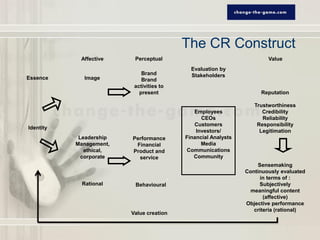
The CR Construct
            Affective     Perceptual                                   Value
                                            Evaluation by
                             Brand          Stakeholders
Essence      Image           Brand
                          activities to
                            present                                 Reputation

                                                                  Trustworthiness
                                             Employees               Credibility
                                                CEOs                 Reliability
                                             Customers             Responsibility
Identity
                                              Investors/            Legitimation
            Leadership   Performance      Financial Analysts
           Management,    Financial             Media
              ethical,   Product and      Communications
             corporate     service           Community
                                                                   Sensemaking
                                                               Continuously evaluated
                                                                    in terms of :
             Rational     Behavioural                               Subjectively
                                                                 meaningful content
                                                                      (affective)
                                                               Objective performance
                                                                  criteria (rational)
                         Value creation
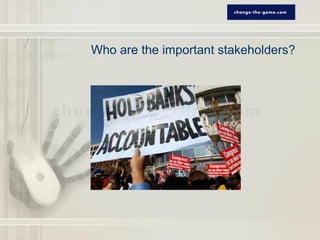
Who are the important stakeholders?
Why are stakeholders important?


• Your reputation reflects your standing relative to
  internal and external stakeholders groups
   – They form a collective assessment that reflects:
       • Your past behaviour and outcomes
       • Your ability to deliver valued results to multiple stakeholders.
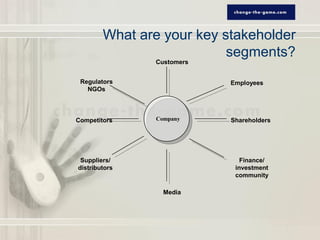
What are your key stakeholder
                           segments?
               Customers


 Regulators                Employees
   NGOs


Competitors    Company     Shareholders


 Suppliers/                   Finance/
distributors                investment
                            community

                 Media
Growing recognition
• Significant proportion of market value lies in
  intangible, off balance sheet assets
• Corporate reputation (CR) recognized as an important
  intangible asset
• CR management strengthens strategically a
  company’s competitive position
   – Value of organization’s reputation
   – Value of market offering as perceived by a market/stakeholder
     segment.
Threats and benefits of events

• US credit rating agency Moody's Investor Services fell
  almost 16 per cent during mid-2008
    – The Financial Times report that the agency had mislead investors
    – Prosecutor asks if banks duped rating agencies (New York Times. May
      12, 2010)
        • Goldman Sachs, Morgan Stanley, UBS, Citigroup among targets

• British Airways attempt to graft new branding on to a dissonant
  identity
• Shell Oil, like other oil companies slow to respond to environmental
  pressure from stakeholders
    – Reputation of top oil companies (Fortune) considerably lower than the
      top chemical companies.
Threats and benefits of events

• Johnson & Johnson moved up one spot to take the lead as the
  most reputable U.S. Company on Reputation Institute's 2009
  U.S. Reputation Pulse
                                         PRNewswire (April 29, 2009)
• General Mills and Johnson & Johnson among the companies US
  consumers believe are leading the way when it comes to
  corporate social responsibility (CSR)
                                                         WARC 2010
• Brands should build "social capital" with consumers.
                       Fernando Rodés Vilà, CEO Havas (WARC 2010)
Who can benefit from reputational value


• Companies in foreign markets (Heinz in NZ)
• Start-ups (R&D, new technologies)
• High visibility companies (Fonterra, Telecom, Air NZ)
• High visibility industries (financial services, oil companies)
• Established companies (Heinz-Watties, GlaxoSmithKline)
• Merger and acquisition partners
• Organizations (political parties, NGOs, CRIs, local government).
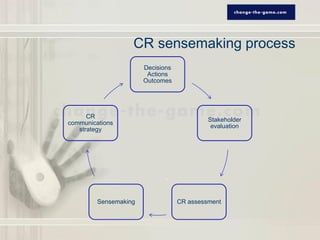
CR sensemaking process
                       Decisions
                        Actions
                       Outcomes


      CR
                                            Stakeholder
communications
                                             evaluation
   strategy


         Sensemaking               CR assessment
Creating reputational value

• Reputation assessment
   – Reputation audit
   – Strategic evaluation - Identifying needs and opportunities
   – Reputation measurement and tracking
• Analysis and planning
   – Developing your advantage
• Stakeholder communications strategy.
Road map

• Strategic evaluation – based on an Executive briefing
• Conducting an audit of existing research data, working with your
  research provider or providing custom research independently
• Analysis and planning
    – Developing your advantage
• Providing a stakeholder communications strategy
• Briefing to your communications partner.
About Stephen Lloyd
• Former JWT and McCann-
  Erickson Asia-Pacific VP
• Assignments include UK, New
  Zealand, Japan, US
• Director-in-charge of Nestle,
  Gillette, Coca-Cola, Kellogg’s,
  Kraft, Johnson & Johnson, Bristol-
  Myers Squibb, Air New Zealand
  and Cathay Pacific
• PhD on corporate reputation
• Brings an FMCG Marcoms
  approach to CR strategy
  development.

C:\fakepath\rep pres290410

  • 1.
    Making Sense ofYour Company's Reputation What We Can Learn from FMCG Marcoms June 19, 2010
  • 2.
    Changing the game “..business is different in a fundamental way: the game doesn’t stand still … nothing is fixed … People are free to change the game to their benefit. And they do.” Nalebuff and Brandenburger, 1996
  • 3.
    Why change thegame? If you continue on the course you’re headed, that’s where you’ll end up. Chinese proverb
  • 4.
    How to changethe game? • To change the game you have to change one or more of the five elements: you change the PARTS: – Players – Added values – Rules – Tactics – Scope Nalebuff and Brandenburger, 1996
  • 5.
    Our assumptions “If youdon’t have a strategy of your own, you become a part of someone else’s strategy.” Alvin Toffler
  • 6.
    Our proposition • Bringingan FMCG Marcoms perspective to Corporate Reputation (CR) strategy development – Differentiated, stakeholder segmentation approach to message strategy.
  • 7.
    Our definitions • CR- A set of values, based on an evaluation of a company, that predisposes a stakeholder segment to think, feel and to behave more positively or negatively towards the organization – An evaluation based on real facts - not just perceptions • Stakeholder – A person or group capable of affecting your business outputs and profitability – For ASB – Customers, employees, media, communications professionals, investment and finance specialists, CEOs – Reputation drivers are different for each segment.
  • 8.
    The CR Construct Affective Perceptual Value Evaluation by Brand Stakeholders Essence Image Brand activities to present Reputation Trustworthiness Employees Credibility CEOs Reliability Customers Responsibility Identity Investors/ Legitimation Leadership Performance Financial Analysts Management, Financial Media ethical, Product and Communications corporate service Community Sensemaking Continuously evaluated in terms of : Rational Behavioural Subjectively meaningful content (affective) Objective performance criteria (rational) Value creation
  • 9.
    Who are theimportant stakeholders?
  • 10.
    Why are stakeholdersimportant? • Your reputation reflects your standing relative to internal and external stakeholders groups – They form a collective assessment that reflects: • Your past behaviour and outcomes • Your ability to deliver valued results to multiple stakeholders.
  • 11.
    What are yourkey stakeholder segments? Customers Regulators Employees NGOs Competitors Company Shareholders Suppliers/ Finance/ distributors investment community Media
  • 12.
    Growing recognition • Significantproportion of market value lies in intangible, off balance sheet assets • Corporate reputation (CR) recognized as an important intangible asset • CR management strengthens strategically a company’s competitive position – Value of organization’s reputation – Value of market offering as perceived by a market/stakeholder segment.
  • 13.
    Threats and benefitsof events • US credit rating agency Moody's Investor Services fell almost 16 per cent during mid-2008 – The Financial Times report that the agency had mislead investors – Prosecutor asks if banks duped rating agencies (New York Times. May 12, 2010) • Goldman Sachs, Morgan Stanley, UBS, Citigroup among targets • British Airways attempt to graft new branding on to a dissonant identity • Shell Oil, like other oil companies slow to respond to environmental pressure from stakeholders – Reputation of top oil companies (Fortune) considerably lower than the top chemical companies.
  • 14.
    Threats and benefitsof events • Johnson & Johnson moved up one spot to take the lead as the most reputable U.S. Company on Reputation Institute's 2009 U.S. Reputation Pulse PRNewswire (April 29, 2009) • General Mills and Johnson & Johnson among the companies US consumers believe are leading the way when it comes to corporate social responsibility (CSR) WARC 2010 • Brands should build "social capital" with consumers. Fernando Rodés Vilà, CEO Havas (WARC 2010)
  • 15.
    Who can benefitfrom reputational value • Companies in foreign markets (Heinz in NZ) • Start-ups (R&D, new technologies) • High visibility companies (Fonterra, Telecom, Air NZ) • High visibility industries (financial services, oil companies) • Established companies (Heinz-Watties, GlaxoSmithKline) • Merger and acquisition partners • Organizations (political parties, NGOs, CRIs, local government).
  • 16.
    CR sensemaking process Decisions Actions Outcomes CR Stakeholder communications evaluation strategy Sensemaking CR assessment
  • 17.
    Creating reputational value •Reputation assessment – Reputation audit – Strategic evaluation - Identifying needs and opportunities – Reputation measurement and tracking • Analysis and planning – Developing your advantage • Stakeholder communications strategy.
  • 18.
    Road map • Strategicevaluation – based on an Executive briefing • Conducting an audit of existing research data, working with your research provider or providing custom research independently • Analysis and planning – Developing your advantage • Providing a stakeholder communications strategy • Briefing to your communications partner.
  • 19.
    About Stephen Lloyd •Former JWT and McCann- Erickson Asia-Pacific VP • Assignments include UK, New Zealand, Japan, US • Director-in-charge of Nestle, Gillette, Coca-Cola, Kellogg’s, Kraft, Johnson & Johnson, Bristol- Myers Squibb, Air New Zealand and Cathay Pacific • PhD on corporate reputation • Brings an FMCG Marcoms approach to CR strategy development.