Ethics in business decision-making	 Christine Elgood ba (hons) mba
www.chris-elgood.co.uk Copyright Elgood Effective Learning August 2014 1
Ethics in business
decision-making
Introduction
The way organisations behave reflects how individuals behave and make decisions
within them. This is a matter for serious consideration in a climate where many
organisations have been revealed as making poor decisions and failing to reach
the standards expected of them. One of the key words associated with the debate
is ‘ethics’. The question posed is:
“Are organisations conducting their business ethically?”
At Elgood Effective Learning, our specialist interest and expertise are around
understanding organisations and recognising the factors that contribute to long-
term sustainability. We believe that conducting business to generally acceptable
ethical values is critical for survival.
This paper is the start of our journey and is designed to stimulate debate around
the subject of ethics in business decision-making.
How do we define ethics?
In the dictionary, ethics are defined as covering “the rules and standards governing
the conduct of an individual or group”. At Elgood, we consider it is applied ethics
which are of particular interest in a business context, i.e. how these rules and
standards guide decision-making. Specifically, we are interested in examining
how ethics are applied to decision-making within organisations, where the main
objective is to provide goods or services for a profit thus increasing shareholder
value.
In exploring rules and standards, we are looking beyond the explicit legal
regulatory framework, and considering both the implicit rules - ’the way we do
things around here’ – and the possible links between how these rules are applied
and the subsequent impact on an organisation’s performance.
Our particular focus is on those decisions where the outcome is likely to have a
significant impact on the long-term success of the organisation. So, this would
not include the employees’ personal moral decisions that they might face at
work. For example, do I claim expenses for a taxi fare when I actually walked
to the meeting? Instead, we are focussing on decisions that determine how
an organisation is perceived by key stakeholder groups, e.g. its customers and
employees, and how these perceptions impact on the organisation’s ability to
achieve sustainable growth. For instance, if we increase our prices by 5% above
inflation to enable us to retain our profit levels, how will this be perceived by our
stakeholders?
Ethics in business decision-making	 Christine Elgood ba (hons) mba
www.chris-elgood.co.uk Copyright Elgood Effective Learning August 2014 2
While focussing on decisions made within the business context, we acknowledge
that an individual’s ethical perspective cannot be ignored. It seems unlikely that
individuals leave their ethics at home on Monday morning when they go to work,
although there is evidence to show that an individual’s attitude to ethics applied at
home and at work may vary.
Since our focus is on decision-making within a business context, we define ethics
as:
“the rules and standards applied by individuals when
making decisions in their business environment.”
Applied ethics is then “the application of these rules and standards to decisions
that determine how the organisation is perceived by its stakeholders and its ability
to maintain stable growth.”
Why is the application of ethics important
for an organisation?
The primary objective for most organisations is growth. We use the term growth
rather than sustainability because in a constantly changing environment, any
organisation that does not grow will not survive. Organisations need a constant
stream of new products and customers to replace ageing and lost ones. To be able
to do this, they need to make a profit.
Legal duties
The conduct of all Directors is covered by The Companies Act 2006 which sets
out seven general duties, including two to promote the success of the company
for the benefit of its members and to exercise reasonable care, skill and
diligence.
Organisations do not exist in a vacuum. They exist within the wider community
and, as such, need to balance their desire to make a profit against the needs
and desires of the society within which they operate, a society that has become
ever more transparent and demanding. A decision considered poor by a staff
member can be transmitted to a wider audience almost instantly through social
media.
30% of managers bend the rules
for their own self-interest1
35% of managers tell white lies
in the workplace every day
Ethics in business decision-making	 Christine Elgood ba (hons) mba
www.chris-elgood.co.uk Copyright Elgood Effective Learning August 2014 3
The best business case but not the right decision
in the eyes of the wider stakeholders – Brent Spa
In 1995, the oil company Shell shelved a £4.5m plan to dispose of the Brent Spa
oil platform in deep water off the coast of Scotland. The original decision was
reached after three years of discussion with the UK Government. It had been
identified as the best practicable environmental option, was legal and was
supported by the UK Government.
However, following occupation of the platform by Greenpeace, and extensive
media coverage resulting in a boycott of Shell petrol stations, the decision was
reversed (in Germany, the company suffered a 20% drop in sales).
The platform was taken to Mekjarvik in Norway to form the base of a new ferry
quay and was decommissioned at a cost of £43m.
In 2010 Dr Doug Parr, Chief Scientist and Policy Director for Greenpeace UK said,
“Legal is not necessarily legitimate in the eyes of the population at large –
there has to be justification as well as regulatory compliance.”
Is regulation not enough?
We believe that the answer is no.
We live in a global economy where multi-national organisations can transcend
national laws. So, if regulations are unacceptable in one area, the company will
simply move.
Currently, a number of high-profile organisations (such as Amazon, Starbucks and
Google) are being accused of diverting hundreds of millions of pounds in UK profits
to secretive tax havens. While the specifics are beyond our remit, it is relevant
that Matt Britten, Head of Google’s Northern Operation, is on record as stating
that the company operates in Ireland and Bermuda because these countries offer
‘attractive tax rates’.
“Like any company you play by the rules (and) manage costs
efficiently to offer fair value to shareholders.” 2
Another factor indicating that regulation is not sufficient is the increasing
complexity of modern business. Gone are the days when a company would
have direct personal contact with all of its suppliers. Now business is often done
through various associated networks and media channels, with contacts made
through vague recommendations across cultural divides.
Ethics in business decision-making	 Christine Elgood ba (hons) mba
www.chris-elgood.co.uk Copyright Elgood Effective Learning August 2014 4
In 2012, Apple, Microsoft and Hewlett Packard were all tainted when one of
their main suppliers in China, Foxconn, was exposed for having hired underage
interns in its factory in the city of Yantai. The employees, who were under China’s
minimum legal working age of 16, had been employed without Foxconn checking
their IDs3
. Stricter regulation with better processes and more efficient systems may
create compliance but they will not create an ethical culture. They cannot deal
with creative individuals and organisations who wish to circumvent the system,
or cover every eventuality without stifling all creativity and speed within the
business.
Dr Rushworth Kidder, President and Founder of the Institute for Global Ethics, said
at a talk Elgood attended in September 2010, at the UK’s Institute of Business
Ethics, that while a government’s standard response to unethical behaviour is
to send in the regulator, regulation is not the answer. Apart from anything else,
business people who are inclined to do so will always find ways round it. So he
defined ethics as “obedience to the unenforceable”, that is, to what cannot be
regulated for.
What we need is to help those in decision-making roles to develop a wider
perspective, a clear and useable decision-making process, embracing the ethical
issues they face in their business, and the moral courage to do the right thing. Or
at least, make clear, rational decisions using all the information available to them.
Does ethical decision-making in business pay?
There is a general perception that good ethics mean good business and that in the
long run, businesses that incorporate ethics in their decision-making will enhance
their reputation and produce better financial results. This perception is borne out
by statements such as:
“Organisations which drive ethics to the heart of their operations can obtain the
additional bonus of a trust dividend. It is a dividend that feeds into employee
engagement and workforce commitment, and thus improves organisational
performance.”4
However, these claims are difficult to measure factually because the ‘long run’ is
an indefinite period of time and there are no generally accepted criteria by which
success can be measured.
One piece of research that did take a serious look at this issue, albeit from a pure
ethics rather than ethics in business decision-making perspective, is the research
done by the Institute of Business Ethics (“IBE”) in their report ‘Does Business ethics
pay? Revisited’. The report describes research into the relationship between the
provision of business ethics training and corporate financial performance over a
five year period, from 2001 to 2005. One of the core questions in the research was,
Ethics in business decision-making	 Christine Elgood ba (hons) mba
www.chris-elgood.co.uk Copyright Elgood Effective Learning August 2014 5
“Do you offer training to members of staff on the meaning and use of your (ethics)
code?” The research then looked at the performance of companies who had:
1.	 Corporate revealed ethics (a published code included in documents such as
the corporate statement mission/vision statements)
2.	 Corporate applied ethics (a code which was supported by actions such as
training initiatives)
The report concluded that “using four measures of financial performance,
companies with corporate applied ethics perform better financially than those
with only corporate revealed ethics. This difference was found not to be due to
difference in company size nor risk effects.” 5
So, a standalone ethics policy is not the answer: it is the application of a core set
of organisational values to decision-making within the business that results in
better organisational performance.
Further evidence, again more from a pure ethics perspective, is available from The
Ethisphere Institute. In 2011, they reported that ‘The World’s Most Ethical Firms’
had outperformed the S&P 500 index every year since its inception in 2007.
Is a lack of ethics in decision-making damaging?
If the evidence to support the claim that “Incorporating ethics in business decision-
making will lead to better organisational performance” is sparse and incomplete,
then maybe a better question to ask is, “Does a lack of ethics in decision-making
damage an organisation’s performance?” There are countless examples of
companies who have tripped up and have suffered significant damage, which can
be measured in financial terms.
SIEMENS – Phoney consultant’s contracts false bills
and shell firms
In November 2006 regulatory investigations revealed that hundreds of
employees had been siphoning off millions of Euros.
The ensuring scandal cost the company Euro 2.5bn, including 2bn of fines
as well as costs for detailed analysis of its financial transactions and fees.
Employees endured two years of shame and hostile public scrutiny. The scandal
shamed Siemens, not only in the eyes of shareholders and investors, but also
the German public and it brought humiliation to thousands of employees.
Ethics in business decision-making	 Christine Elgood ba (hons) mba
www.chris-elgood.co.uk Copyright Elgood Effective Learning August 2014 6
BBC – Editorial misjudgements misled or
deliberately deceived the audience
In 2007 the publicly funded BBC was found guilty of two breaches of
the Broadcasting Code and fined £50.000. The fines related to phone-in
competitions which gave the appearance, but did not actually allow, viewer
participation in the programmes. The fine was significant being the first ever
fine in over 80 years. However, more significant was the damage to the BBC’s
public reputation for honesty and excellence. A survey following the revelations
showed that 56% of the public felt their trust had been damaged.6
So a question to ponder for all those making critical business decisions is, “Do you
want to be the one that contributes to your organisation’s demise?”
How can we foster ethics in business decision-making?
In some situations where an organisation or industry is accused of poor practices
or of being unethical, the majority view may be that the situation was brought on
by collective malpractice. Recent examples of this might include the banking crisis.
However, in many other situations, it is less the case of individuals or collections of
individuals purposefully doing the wrong thing and more the result of ‘mistakes’.
These mistakes are often the result of:
•	 Focussing on a limited number of options and considering only one or two
ideas.
•	 Failing to think widely enough: what if there was a significant change in
the industry, regulatory environment or economy?
•	 Assuming that the best decision for the business is the best decision for all
interested parties.
•	 Favouring short-term gains over long-term losses.
•	 Justifying the potential ‘harm’ to other stakeholder groups as necessary to
achieve the organisation’s goals.
We feel these issues can be addressed by:
•	 Examining some key performance indicators and how they link to or might
indicate ethical or non-ethical decision-making.
•	 Creating a culture where individuals are encouraged to think wider than
their immediate job role and are given a process to help them consider the
potential consequences of their actions.
Ethics in business decision-making	 Christine Elgood ba (hons) mba
www.chris-elgood.co.uk Copyright Elgood Effective Learning August 2014 7
Key performance indicators and ethical business
decision-making
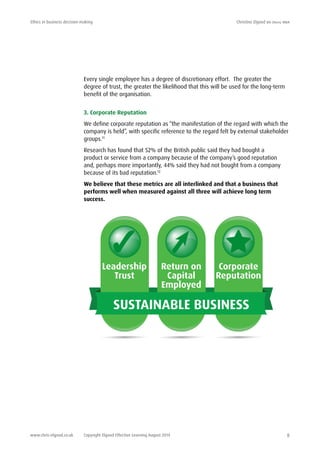
The long-term sustainability of a business is driven by many factors. Elgood
Effective Learning has identified three critical drivers with relation to ethical
decision-making in a business context, bearing in mind that the objective of an
organisation is long-term growth and sustainability.
1. Return on Capital Employed
This is a traditional financial ratio used for company valuations and finance and
accounting purposes. It tells the business managers and shareholders what
returns (profits) the business has made on the resources available to it. It is a
key measure for many businesses since it allows investors to compare the return
on their investment between different businesses. It is also a key measure of
whether the business is generating enough profit to enable it to reinvest in the
future. Without continual re-investment, a business will become uncompetitive
and obsolete.
2. Leadership Trust
The degree to which leaders are trusted is dependent on four key characteristics:7
•	 Ability – the ability of the individual to do their job
•	 Benevolence – concern for others beyond their own needs and having
benign motives
•	 Integrity – adherence to a set of principles acceptable to others,
encompassing fairness and honesty
•	 Predictability – a regularity of behaviour over time
For the purposes of our discussion, we define ‘Leadership Trust’ as when the
leaders in an organisation, at all levels, demonstrate their ability in the eyes of
their employees, to make decisions honestly and ethically, and to keep their
promises. For example, when the Board of Directors takes actions in line with
their corporate statement and values.
Lack of employee trust is regularly cited as a factor that limits an organisation’s
performance. In a Manpower survey, 50% of respondents would not work for a low
trust organisation. So, good employees often go to the competitor.8
Conversely,
high levels of trust deliver positive results:
•	 42% shared positive company opinion and experiences online.9
•	 High levels of employee engagement can lead to share price increases of
around 10% above the industry average.10
Ethics in business decision-making	 Christine Elgood ba (hons) mba
www.chris-elgood.co.uk Copyright Elgood Effective Learning August 2014 8
Every single employee has a degree of discretionary effort. The greater the
degree of trust, the greater the likelihood that this will be used for the long-term
benefit of the organisation.
3. Corporate Reputation
We define corporate reputation as “the manifestation of the regard with which the
company is held”, with specific reference to the regard felt by external stakeholder
groups.11
Research has found that 52% of the British public said they had bought a
product or service from a company because of the company’s good reputation
and, perhaps more importantly, 44% said they had not bought from a company
because of its bad reputation.12
We believe that these metrics are all interlinked and that a business that
performs well when measured against all three will achieve long term
success.
Leadership
Trust
Corporate
Reputation
SUSTAINABLE BUSINESS
Return on
Capital
Employed
Ethics in business decision-making	 Christine Elgood ba (hons) mba
www.chris-elgood.co.uk Copyright Elgood Effective Learning August 2014 9
A robust decision-making process
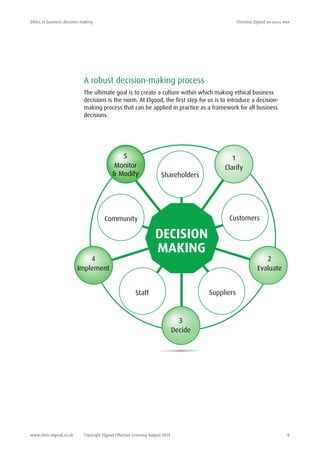
The ultimate goal is to create a culture within which making ethical business
decisions is the norm. At Elgood, the first step for us is to introduce a decision-
making process that can be applied in practice as a framework for all business
decisions.
Shareholders
Customers
SuppliersStaff
Community
5
Monitor
& Modify
1
Clarify
2
Evaluate
3
Decide
4
Implement
DECISION
MAKING
Ethics in business decision-making	 Christine Elgood ba (hons) mba
www.chris-elgood.co.uk Copyright Elgood Effective Learning August 2014 10
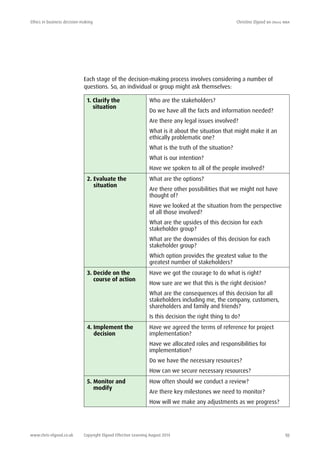
Each stage of the decision-making process involves considering a number of
questions. So, an individual or group might ask themselves:
1. Clarify the
situation
Who are the stakeholders?
Do we have all the facts and information needed?
Are there any legal issues involved?
What is it about the situation that might make it an
ethically problematic one?
What is the truth of the situation?
What is our intention?
Have we spoken to all of the people involved?
2. Evaluate the
situation
What are the options?
Are there other possibilities that we might not have
thought of?
Have we looked at the situation from the perspective
of all those involved?
What are the upsides of this decision for each
stakeholder group?
What are the downsides of this decision for each
stakeholder group?
Which option provides the greatest value to the
greatest number of stakeholders?
3. Decide on the
course of action
Have we got the courage to do what is right?
How sure are we that this is the right decision?
What are the consequences of this decision for all
stakeholders including me, the company, customers,
shareholders and family and friends?
Is this decision the right thing to do?
4. Implement the
decision
Have we agreed the terms of reference for project
implementation?
Have we allocated roles and responsibilities for
implementation?
Do we have the necessary resources?
How can we secure necessary resources?
5. Monitor and
modify
How often should we conduct a review?
Are there key milestones we need to monitor?
How will we make any adjustments as we progress?
Ethics in business decision-making	 Christine Elgood ba (hons) mba
www.chris-elgood.co.uk Copyright Elgood Effective Learning August 2014 11
How can a business simulation help?
Our interest is in the application of ethics rather than the theoretical study of it.
To develop skill at application, individuals need to practice; application cannot
be taught because it is not pure theory but the adaptation of theory along with
individual skill and knowledge to a particular set of circumstances. Business
simulations are an effective and efficient means to develop this skill. Business
simulations achieve the following results:
1. Enable individuals and groups of individuals to go on a journey
They discover for themselves through interactive participation rather than from
passively consuming information from a teacher. The participants have to make
a range of real-life decisions and these decisions result in financial and other
outcomes. The participants are actively considering options and using their
knowledge and judgement to determine the best course of action for their
company.
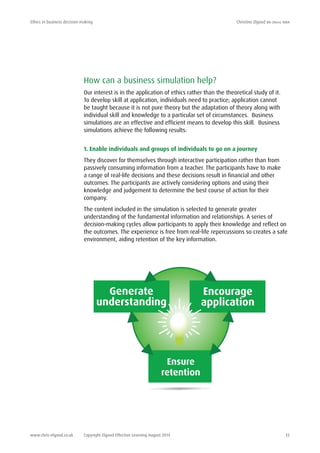
The content included in the simulation is selected to generate greater
understanding of the fundamental information and relationships. A series of
decision-making cycles allow participants to apply their knowledge and reflect on
the outcomes. The experience is free from real-life repercussions so creates a safe
environment, aiding retention of the key information.
Generate
understanding
Encourage
application
Ensure
retention
Ethics in business decision-making	 Christine Elgood ba (hons) mba
www.chris-elgood.co.uk Copyright Elgood Effective Learning August 2014 12
2. Speed up the decision-making cycle and provide participants
with tangible outcomes
Instead of making a decision and waiting for 4-6 months to see what the
reaction and outcome is, participants can make a decision and see the effect
almost instantly. This allows them to experience several time periods of business
decisions within a day. While some would argue that the reason why organisations
should be ethical is because it is the right thing to do,13
there are still many who
need to see clear and logical benefits. A business simulation can help to create
these tangible links.
3. Allow participants to experience situations before they encounter
them in real life
This addresses two of the key challenges respondents to the 2010 survey 9
mentioned, when asked, “When you have dealt with an ethical issue, what were
the challenges you encountered?” The key responses were that they did not
recognise it as an ethical issue at first and secondly, they were not sure how to
handle it.
4. Provide the foundations for all participants to develop their courage
and confidence
One of the key themes that everyone needs to confront is wrongdoing. The first
time one is faced with an ethical dilemma, it is easy to be overwhelmed and
shy away from having a difficult conversation. While few people would seek out
a difficult conversation, many can improve their ability to handle one through
practice.
Ethics in business decision-making	 Christine Elgood ba (hons) mba
www.chris-elgood.co.uk Copyright Elgood Effective Learning August 2014 13
What will participants and organisations gain?
Organisations will find that a business simulation is an effective way to raise
awareness amongst their employees of the need for ethical decision-making
within the business environment. The simulation will not just raise awareness,
it will also equip participants with some of the skills they need to help their
organisation become more successful (success being measured in the broader
economic and longer term context).
Participants will be able to:
•	 Identify decisions where ethical decision-making is critical.
•	 Implement and follow a decision-making framework.
•	 Recognise the link between management decisions and employees’ trust
in their company’s leadership.
•	 Recognise the impact of an organisation’s corporate reputation on its
ability to meet its goals.
•	 Understand how leadership trust and corporate reputation impact on an
organisation’s profitability and long-term sustainability.
At Elgood, we have created a business simulation in which the three metrics,
Return on Capital Employed, Leadership Trust and Corporate Reputation are
matched with the decision-making framework. A short outline document can be
downloaded from our web site
For more information about Elgood Effective Learning, visit our website at www.
chris-elgood.co.uk, or email us on info@chris-elgood.co.uk If you are interested
in exploring ethics further, more information is available from The Institute of
Business Ethics (www.ibe.org.uk).
Ethics in business decision-making	 Christine Elgood ba (hons) mba
www.chris-elgood.co.uk Copyright Elgood Effective Learning August 2014 14
More about Elgood
Christine Elgood has been Managing Director of Elgood Effective Learning since
1996, having first completed an MBA with experience gained in the financial areas
of manufacturing and retailing. Her business qualifications are complemented by
training (CTP) and coaching (ILM) qualifications. She has nurtured Elgood Effective
Learning into today’s dynamic training provider which specialises in the design
and facilitation of business simulation games for the business and education
communities. She regularly facilitates courses in the UK and at client sites around
Europe.
Together with Chris Elgood, who is a renowned facilitator and an authority
in the field of learning and development, and the author of The Handbook
of Management Games, she is backed up by a skilled group of mentors and
facilitators who can draw on many years of experience across diverse industries
and organisations to ensure that every training event delivers the experience and
results required.
www.chris-elgood.co.uk
t: 0118 982 1115
e: christine@chris-elgood.co.uk
1 	 CMI – Managers and the moral maze
2 	 http://www.guardian.co.uk/business/2012/nov/12/amazon-google-starbucks-diverting-uk-profits
3 	 http://www.bbc.co.uk/news/technology-19965641
4 	 ILM – Index of Trust and Leadership 2011
5 	 IBE – Does Business Ethics Pay? Revisited
6 	 IBE – The Recovery of Trust: Case studies of organisational failure and trust repair
7	 CIPD – March 2012 – Where has all the trust gone?
8	 Manpower report – Leadership and Trust Consortium White Paper 2005-2006
9	 IBE – Doing business ethically… makes for better sense – Edelman 2009
10	 Manpower report – Leadership and Trust Consortium White Paper 2005-2006
11	 IBE – Setting the Tone – Ethical Business Leadership
12	 IBE – Setting the Tone – Ethical Business Leadership
13	 Sally Bibb – The Right Thing – Ethics in the workplace survey 2010

Ethics in business decision-making August 2014

  • 1.
    Ethics in businessdecision-making Christine Elgood ba (hons) mba www.chris-elgood.co.uk Copyright Elgood Effective Learning August 2014 1 Ethics in business decision-making Introduction The way organisations behave reflects how individuals behave and make decisions within them. This is a matter for serious consideration in a climate where many organisations have been revealed as making poor decisions and failing to reach the standards expected of them. One of the key words associated with the debate is ‘ethics’. The question posed is: “Are organisations conducting their business ethically?” At Elgood Effective Learning, our specialist interest and expertise are around understanding organisations and recognising the factors that contribute to long- term sustainability. We believe that conducting business to generally acceptable ethical values is critical for survival. This paper is the start of our journey and is designed to stimulate debate around the subject of ethics in business decision-making. How do we define ethics? In the dictionary, ethics are defined as covering “the rules and standards governing the conduct of an individual or group”. At Elgood, we consider it is applied ethics which are of particular interest in a business context, i.e. how these rules and standards guide decision-making. Specifically, we are interested in examining how ethics are applied to decision-making within organisations, where the main objective is to provide goods or services for a profit thus increasing shareholder value. In exploring rules and standards, we are looking beyond the explicit legal regulatory framework, and considering both the implicit rules - ’the way we do things around here’ – and the possible links between how these rules are applied and the subsequent impact on an organisation’s performance. Our particular focus is on those decisions where the outcome is likely to have a significant impact on the long-term success of the organisation. So, this would not include the employees’ personal moral decisions that they might face at work. For example, do I claim expenses for a taxi fare when I actually walked to the meeting? Instead, we are focussing on decisions that determine how an organisation is perceived by key stakeholder groups, e.g. its customers and employees, and how these perceptions impact on the organisation’s ability to achieve sustainable growth. For instance, if we increase our prices by 5% above inflation to enable us to retain our profit levels, how will this be perceived by our stakeholders?
  • 2.
    Ethics in businessdecision-making Christine Elgood ba (hons) mba www.chris-elgood.co.uk Copyright Elgood Effective Learning August 2014 2 While focussing on decisions made within the business context, we acknowledge that an individual’s ethical perspective cannot be ignored. It seems unlikely that individuals leave their ethics at home on Monday morning when they go to work, although there is evidence to show that an individual’s attitude to ethics applied at home and at work may vary. Since our focus is on decision-making within a business context, we define ethics as: “the rules and standards applied by individuals when making decisions in their business environment.” Applied ethics is then “the application of these rules and standards to decisions that determine how the organisation is perceived by its stakeholders and its ability to maintain stable growth.” Why is the application of ethics important for an organisation? The primary objective for most organisations is growth. We use the term growth rather than sustainability because in a constantly changing environment, any organisation that does not grow will not survive. Organisations need a constant stream of new products and customers to replace ageing and lost ones. To be able to do this, they need to make a profit. Legal duties The conduct of all Directors is covered by The Companies Act 2006 which sets out seven general duties, including two to promote the success of the company for the benefit of its members and to exercise reasonable care, skill and diligence. Organisations do not exist in a vacuum. They exist within the wider community and, as such, need to balance their desire to make a profit against the needs and desires of the society within which they operate, a society that has become ever more transparent and demanding. A decision considered poor by a staff member can be transmitted to a wider audience almost instantly through social media. 30% of managers bend the rules for their own self-interest1 35% of managers tell white lies in the workplace every day
  • 3.
    Ethics in businessdecision-making Christine Elgood ba (hons) mba www.chris-elgood.co.uk Copyright Elgood Effective Learning August 2014 3 The best business case but not the right decision in the eyes of the wider stakeholders – Brent Spa In 1995, the oil company Shell shelved a £4.5m plan to dispose of the Brent Spa oil platform in deep water off the coast of Scotland. The original decision was reached after three years of discussion with the UK Government. It had been identified as the best practicable environmental option, was legal and was supported by the UK Government. However, following occupation of the platform by Greenpeace, and extensive media coverage resulting in a boycott of Shell petrol stations, the decision was reversed (in Germany, the company suffered a 20% drop in sales). The platform was taken to Mekjarvik in Norway to form the base of a new ferry quay and was decommissioned at a cost of £43m. In 2010 Dr Doug Parr, Chief Scientist and Policy Director for Greenpeace UK said, “Legal is not necessarily legitimate in the eyes of the population at large – there has to be justification as well as regulatory compliance.” Is regulation not enough? We believe that the answer is no. We live in a global economy where multi-national organisations can transcend national laws. So, if regulations are unacceptable in one area, the company will simply move. Currently, a number of high-profile organisations (such as Amazon, Starbucks and Google) are being accused of diverting hundreds of millions of pounds in UK profits to secretive tax havens. While the specifics are beyond our remit, it is relevant that Matt Britten, Head of Google’s Northern Operation, is on record as stating that the company operates in Ireland and Bermuda because these countries offer ‘attractive tax rates’. “Like any company you play by the rules (and) manage costs efficiently to offer fair value to shareholders.” 2 Another factor indicating that regulation is not sufficient is the increasing complexity of modern business. Gone are the days when a company would have direct personal contact with all of its suppliers. Now business is often done through various associated networks and media channels, with contacts made through vague recommendations across cultural divides.
  • 4.
    Ethics in businessdecision-making Christine Elgood ba (hons) mba www.chris-elgood.co.uk Copyright Elgood Effective Learning August 2014 4 In 2012, Apple, Microsoft and Hewlett Packard were all tainted when one of their main suppliers in China, Foxconn, was exposed for having hired underage interns in its factory in the city of Yantai. The employees, who were under China’s minimum legal working age of 16, had been employed without Foxconn checking their IDs3 . Stricter regulation with better processes and more efficient systems may create compliance but they will not create an ethical culture. They cannot deal with creative individuals and organisations who wish to circumvent the system, or cover every eventuality without stifling all creativity and speed within the business. Dr Rushworth Kidder, President and Founder of the Institute for Global Ethics, said at a talk Elgood attended in September 2010, at the UK’s Institute of Business Ethics, that while a government’s standard response to unethical behaviour is to send in the regulator, regulation is not the answer. Apart from anything else, business people who are inclined to do so will always find ways round it. So he defined ethics as “obedience to the unenforceable”, that is, to what cannot be regulated for. What we need is to help those in decision-making roles to develop a wider perspective, a clear and useable decision-making process, embracing the ethical issues they face in their business, and the moral courage to do the right thing. Or at least, make clear, rational decisions using all the information available to them. Does ethical decision-making in business pay? There is a general perception that good ethics mean good business and that in the long run, businesses that incorporate ethics in their decision-making will enhance their reputation and produce better financial results. This perception is borne out by statements such as: “Organisations which drive ethics to the heart of their operations can obtain the additional bonus of a trust dividend. It is a dividend that feeds into employee engagement and workforce commitment, and thus improves organisational performance.”4 However, these claims are difficult to measure factually because the ‘long run’ is an indefinite period of time and there are no generally accepted criteria by which success can be measured. One piece of research that did take a serious look at this issue, albeit from a pure ethics rather than ethics in business decision-making perspective, is the research done by the Institute of Business Ethics (“IBE”) in their report ‘Does Business ethics pay? Revisited’. The report describes research into the relationship between the provision of business ethics training and corporate financial performance over a five year period, from 2001 to 2005. One of the core questions in the research was,
  • 5.
    Ethics in businessdecision-making Christine Elgood ba (hons) mba www.chris-elgood.co.uk Copyright Elgood Effective Learning August 2014 5 “Do you offer training to members of staff on the meaning and use of your (ethics) code?” The research then looked at the performance of companies who had: 1. Corporate revealed ethics (a published code included in documents such as the corporate statement mission/vision statements) 2. Corporate applied ethics (a code which was supported by actions such as training initiatives) The report concluded that “using four measures of financial performance, companies with corporate applied ethics perform better financially than those with only corporate revealed ethics. This difference was found not to be due to difference in company size nor risk effects.” 5 So, a standalone ethics policy is not the answer: it is the application of a core set of organisational values to decision-making within the business that results in better organisational performance. Further evidence, again more from a pure ethics perspective, is available from The Ethisphere Institute. In 2011, they reported that ‘The World’s Most Ethical Firms’ had outperformed the S&P 500 index every year since its inception in 2007. Is a lack of ethics in decision-making damaging? If the evidence to support the claim that “Incorporating ethics in business decision- making will lead to better organisational performance” is sparse and incomplete, then maybe a better question to ask is, “Does a lack of ethics in decision-making damage an organisation’s performance?” There are countless examples of companies who have tripped up and have suffered significant damage, which can be measured in financial terms. SIEMENS – Phoney consultant’s contracts false bills and shell firms In November 2006 regulatory investigations revealed that hundreds of employees had been siphoning off millions of Euros. The ensuring scandal cost the company Euro 2.5bn, including 2bn of fines as well as costs for detailed analysis of its financial transactions and fees. Employees endured two years of shame and hostile public scrutiny. The scandal shamed Siemens, not only in the eyes of shareholders and investors, but also the German public and it brought humiliation to thousands of employees.
  • 6.
    Ethics in businessdecision-making Christine Elgood ba (hons) mba www.chris-elgood.co.uk Copyright Elgood Effective Learning August 2014 6 BBC – Editorial misjudgements misled or deliberately deceived the audience In 2007 the publicly funded BBC was found guilty of two breaches of the Broadcasting Code and fined £50.000. The fines related to phone-in competitions which gave the appearance, but did not actually allow, viewer participation in the programmes. The fine was significant being the first ever fine in over 80 years. However, more significant was the damage to the BBC’s public reputation for honesty and excellence. A survey following the revelations showed that 56% of the public felt their trust had been damaged.6 So a question to ponder for all those making critical business decisions is, “Do you want to be the one that contributes to your organisation’s demise?” How can we foster ethics in business decision-making? In some situations where an organisation or industry is accused of poor practices or of being unethical, the majority view may be that the situation was brought on by collective malpractice. Recent examples of this might include the banking crisis. However, in many other situations, it is less the case of individuals or collections of individuals purposefully doing the wrong thing and more the result of ‘mistakes’. These mistakes are often the result of: • Focussing on a limited number of options and considering only one or two ideas. • Failing to think widely enough: what if there was a significant change in the industry, regulatory environment or economy? • Assuming that the best decision for the business is the best decision for all interested parties. • Favouring short-term gains over long-term losses. • Justifying the potential ‘harm’ to other stakeholder groups as necessary to achieve the organisation’s goals. We feel these issues can be addressed by: • Examining some key performance indicators and how they link to or might indicate ethical or non-ethical decision-making. • Creating a culture where individuals are encouraged to think wider than their immediate job role and are given a process to help them consider the potential consequences of their actions.
  • 7.
    Ethics in businessdecision-making Christine Elgood ba (hons) mba www.chris-elgood.co.uk Copyright Elgood Effective Learning August 2014 7 Key performance indicators and ethical business decision-making The long-term sustainability of a business is driven by many factors. Elgood Effective Learning has identified three critical drivers with relation to ethical decision-making in a business context, bearing in mind that the objective of an organisation is long-term growth and sustainability. 1. Return on Capital Employed This is a traditional financial ratio used for company valuations and finance and accounting purposes. It tells the business managers and shareholders what returns (profits) the business has made on the resources available to it. It is a key measure for many businesses since it allows investors to compare the return on their investment between different businesses. It is also a key measure of whether the business is generating enough profit to enable it to reinvest in the future. Without continual re-investment, a business will become uncompetitive and obsolete. 2. Leadership Trust The degree to which leaders are trusted is dependent on four key characteristics:7 • Ability – the ability of the individual to do their job • Benevolence – concern for others beyond their own needs and having benign motives • Integrity – adherence to a set of principles acceptable to others, encompassing fairness and honesty • Predictability – a regularity of behaviour over time For the purposes of our discussion, we define ‘Leadership Trust’ as when the leaders in an organisation, at all levels, demonstrate their ability in the eyes of their employees, to make decisions honestly and ethically, and to keep their promises. For example, when the Board of Directors takes actions in line with their corporate statement and values. Lack of employee trust is regularly cited as a factor that limits an organisation’s performance. In a Manpower survey, 50% of respondents would not work for a low trust organisation. So, good employees often go to the competitor.8 Conversely, high levels of trust deliver positive results: • 42% shared positive company opinion and experiences online.9 • High levels of employee engagement can lead to share price increases of around 10% above the industry average.10
  • 8.
    Ethics in businessdecision-making Christine Elgood ba (hons) mba www.chris-elgood.co.uk Copyright Elgood Effective Learning August 2014 8 Every single employee has a degree of discretionary effort. The greater the degree of trust, the greater the likelihood that this will be used for the long-term benefit of the organisation. 3. Corporate Reputation We define corporate reputation as “the manifestation of the regard with which the company is held”, with specific reference to the regard felt by external stakeholder groups.11 Research has found that 52% of the British public said they had bought a product or service from a company because of the company’s good reputation and, perhaps more importantly, 44% said they had not bought from a company because of its bad reputation.12 We believe that these metrics are all interlinked and that a business that performs well when measured against all three will achieve long term success. Leadership Trust Corporate Reputation SUSTAINABLE BUSINESS Return on Capital Employed
  • 9.
    Ethics in businessdecision-making Christine Elgood ba (hons) mba www.chris-elgood.co.uk Copyright Elgood Effective Learning August 2014 9 A robust decision-making process The ultimate goal is to create a culture within which making ethical business decisions is the norm. At Elgood, the first step for us is to introduce a decision- making process that can be applied in practice as a framework for all business decisions. Shareholders Customers SuppliersStaff Community 5 Monitor & Modify 1 Clarify 2 Evaluate 3 Decide 4 Implement DECISION MAKING
  • 10.
    Ethics in businessdecision-making Christine Elgood ba (hons) mba www.chris-elgood.co.uk Copyright Elgood Effective Learning August 2014 10 Each stage of the decision-making process involves considering a number of questions. So, an individual or group might ask themselves: 1. Clarify the situation Who are the stakeholders? Do we have all the facts and information needed? Are there any legal issues involved? What is it about the situation that might make it an ethically problematic one? What is the truth of the situation? What is our intention? Have we spoken to all of the people involved? 2. Evaluate the situation What are the options? Are there other possibilities that we might not have thought of? Have we looked at the situation from the perspective of all those involved? What are the upsides of this decision for each stakeholder group? What are the downsides of this decision for each stakeholder group? Which option provides the greatest value to the greatest number of stakeholders? 3. Decide on the course of action Have we got the courage to do what is right? How sure are we that this is the right decision? What are the consequences of this decision for all stakeholders including me, the company, customers, shareholders and family and friends? Is this decision the right thing to do? 4. Implement the decision Have we agreed the terms of reference for project implementation? Have we allocated roles and responsibilities for implementation? Do we have the necessary resources? How can we secure necessary resources? 5. Monitor and modify How often should we conduct a review? Are there key milestones we need to monitor? How will we make any adjustments as we progress?
  • 11.
    Ethics in businessdecision-making Christine Elgood ba (hons) mba www.chris-elgood.co.uk Copyright Elgood Effective Learning August 2014 11 How can a business simulation help? Our interest is in the application of ethics rather than the theoretical study of it. To develop skill at application, individuals need to practice; application cannot be taught because it is not pure theory but the adaptation of theory along with individual skill and knowledge to a particular set of circumstances. Business simulations are an effective and efficient means to develop this skill. Business simulations achieve the following results: 1. Enable individuals and groups of individuals to go on a journey They discover for themselves through interactive participation rather than from passively consuming information from a teacher. The participants have to make a range of real-life decisions and these decisions result in financial and other outcomes. The participants are actively considering options and using their knowledge and judgement to determine the best course of action for their company. The content included in the simulation is selected to generate greater understanding of the fundamental information and relationships. A series of decision-making cycles allow participants to apply their knowledge and reflect on the outcomes. The experience is free from real-life repercussions so creates a safe environment, aiding retention of the key information. Generate understanding Encourage application Ensure retention
  • 12.
    Ethics in businessdecision-making Christine Elgood ba (hons) mba www.chris-elgood.co.uk Copyright Elgood Effective Learning August 2014 12 2. Speed up the decision-making cycle and provide participants with tangible outcomes Instead of making a decision and waiting for 4-6 months to see what the reaction and outcome is, participants can make a decision and see the effect almost instantly. This allows them to experience several time periods of business decisions within a day. While some would argue that the reason why organisations should be ethical is because it is the right thing to do,13 there are still many who need to see clear and logical benefits. A business simulation can help to create these tangible links. 3. Allow participants to experience situations before they encounter them in real life This addresses two of the key challenges respondents to the 2010 survey 9 mentioned, when asked, “When you have dealt with an ethical issue, what were the challenges you encountered?” The key responses were that they did not recognise it as an ethical issue at first and secondly, they were not sure how to handle it. 4. Provide the foundations for all participants to develop their courage and confidence One of the key themes that everyone needs to confront is wrongdoing. The first time one is faced with an ethical dilemma, it is easy to be overwhelmed and shy away from having a difficult conversation. While few people would seek out a difficult conversation, many can improve their ability to handle one through practice.
  • 13.
    Ethics in businessdecision-making Christine Elgood ba (hons) mba www.chris-elgood.co.uk Copyright Elgood Effective Learning August 2014 13 What will participants and organisations gain? Organisations will find that a business simulation is an effective way to raise awareness amongst their employees of the need for ethical decision-making within the business environment. The simulation will not just raise awareness, it will also equip participants with some of the skills they need to help their organisation become more successful (success being measured in the broader economic and longer term context). Participants will be able to: • Identify decisions where ethical decision-making is critical. • Implement and follow a decision-making framework. • Recognise the link between management decisions and employees’ trust in their company’s leadership. • Recognise the impact of an organisation’s corporate reputation on its ability to meet its goals. • Understand how leadership trust and corporate reputation impact on an organisation’s profitability and long-term sustainability. At Elgood, we have created a business simulation in which the three metrics, Return on Capital Employed, Leadership Trust and Corporate Reputation are matched with the decision-making framework. A short outline document can be downloaded from our web site For more information about Elgood Effective Learning, visit our website at www. chris-elgood.co.uk, or email us on info@chris-elgood.co.uk If you are interested in exploring ethics further, more information is available from The Institute of Business Ethics (www.ibe.org.uk).
  • 14.
    Ethics in businessdecision-making Christine Elgood ba (hons) mba www.chris-elgood.co.uk Copyright Elgood Effective Learning August 2014 14 More about Elgood Christine Elgood has been Managing Director of Elgood Effective Learning since 1996, having first completed an MBA with experience gained in the financial areas of manufacturing and retailing. Her business qualifications are complemented by training (CTP) and coaching (ILM) qualifications. She has nurtured Elgood Effective Learning into today’s dynamic training provider which specialises in the design and facilitation of business simulation games for the business and education communities. She regularly facilitates courses in the UK and at client sites around Europe. Together with Chris Elgood, who is a renowned facilitator and an authority in the field of learning and development, and the author of The Handbook of Management Games, she is backed up by a skilled group of mentors and facilitators who can draw on many years of experience across diverse industries and organisations to ensure that every training event delivers the experience and results required. www.chris-elgood.co.uk t: 0118 982 1115 e: christine@chris-elgood.co.uk 1 CMI – Managers and the moral maze 2 http://www.guardian.co.uk/business/2012/nov/12/amazon-google-starbucks-diverting-uk-profits 3 http://www.bbc.co.uk/news/technology-19965641 4 ILM – Index of Trust and Leadership 2011 5 IBE – Does Business Ethics Pay? Revisited 6 IBE – The Recovery of Trust: Case studies of organisational failure and trust repair 7 CIPD – March 2012 – Where has all the trust gone? 8 Manpower report – Leadership and Trust Consortium White Paper 2005-2006 9 IBE – Doing business ethically… makes for better sense – Edelman 2009 10 Manpower report – Leadership and Trust Consortium White Paper 2005-2006 11 IBE – Setting the Tone – Ethical Business Leadership 12 IBE – Setting the Tone – Ethical Business Leadership 13 Sally Bibb – The Right Thing – Ethics in the workplace survey 2010