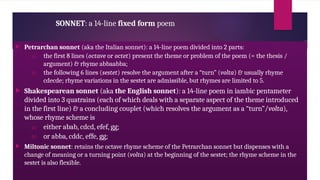
SONNET: a 14-linefixed form poem
Petrarchan sonnet (aka the Italian sonnet): a 14-line poem divided into 2 parts:
a) the first 8 lines (octave or octet) present the theme or problem of the poem (= the thesis /
argument) & rhyme abbaabba;
b) the following 6 lines (sestet) resolve the argument after a “turn” (volta) & usually rhyme
cdecde; rhyme variations in the sestet are admissible, but rhymes are limited to 5.
Shakespearean sonnet (aka the English sonnet): a 14-line poem in iambic pentameter
divided into 3 quatrains (each of which deals with a separate aspect of the theme introduced
in the first line) & a concluding couplet (which resolves the argument as a “turn”/volta),
whose rhyme scheme is
a) either abab, cdcd, efef, gg;
b) or abba, cddc, effe, gg;
Miltonic sonnet: retains the octave rhyme scheme of the Petrarchan sonnet but dispenses with a
change of meaning or a turning point (volta) at the beginning of the sestet; the rhyme scheme in the
sestet is also flexible.
3.
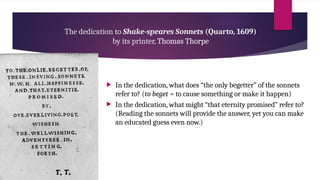
The dedication toShake-speares Sonnets (Quarto, 1609)
by its printer, Thomas Thorpe
In the dedication, what does “the only begetter” of the sonnets
refer to? (to beget = to cause something or make it happen)
In the dedication, what might “that eternity promised” refer to?
(Reading the sonnets will provide the answer, yet you can make
an educated guess even now.)
4.
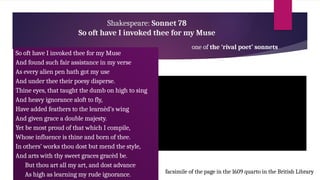
Shakespeare: Sonnet 78
Sooft have I invoked thee for my Muse
one of the ‘rival poet’ sonnets
So oft have I invoked thee for my Muse
And found such fair assistance in my verse
As every alien pen hath got my use
And under thee their poesy disperse.
Thine eyes, that taught the dumb on high to sing
And heavy ignorance aloft to fly,
Have added feathers to the learnèd’s wing
And given grace a double majesty.
Yet be most proud of that which I compile,
Whose influence is thine and born of thee.
In others’ works thou dost but mend the style,
And arts with thy sweet graces gracèd be.
But thou art all my art, and dost advance
As high as learning my rude ignorance. facsimile of the page in the 1609 quarto in the British Library
5.
Shakespeare: Sonnet 60
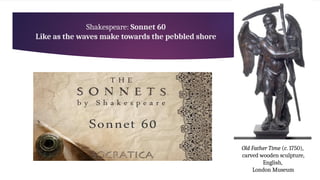
Likeas the waves make towards the pebbled shore
Old Father Time (c. 1750),
carved wooden sculpture,
English,
London Museum
6.
Shakespeare: Sonnet 60
Likeas the waves make towards the pebbled shore
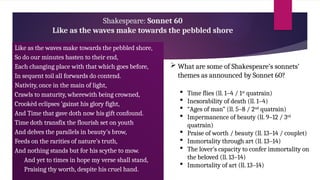
What are some of Shakespeare’s sonnets’
themes as announced by Sonnet 60?
Time flies (ll. 1–4 / 1st
quatrain)
Inexorability of death (ll. 1–4)
“Ages of man” (ll. 5–8 / 2nd
quatrain)
Impermanence of beauty (ll. 9–12 / 3rd
quatrain)
Praise of worth / beauty (ll. 13–14 / couplet)
Immortality through art (ll. 13–14)
The lover’s capacity to confer immortality on
the beloved (ll. 13–14)
Immortality of art (ll. 13–14)
Like as the waves make towards the pebbled shore,
So do our minutes hasten to their end,
Each changing place with that which goes before,
In sequent toil all forwards do contend.
Nativity, once in the main of light,
Crawls to maturity, wherewith being crowned,
Crookèd eclipses ’gainst his glory fight,
And Time that gave doth now his gift confound.
Time doth transfix the flourish set on youth
And delves the parallels in beauty’s brow,
Feeds on the rarities of nature’s truth,
And nothing stands but for his scythe to mow.
And yet to times in hope my verse shall stand,
Praising thy worth, despite his cruel hand.
7.
Shakespeare: Sonnet 60
Likeas the waves make towards the pebbled shore,
So do our minutes hasten to their end,
Each changing place with that which goes before,
In sequent toil all forwards do contend.
Nativity, once in the main of light,
Crawls to maturity, wherewith being crowned,
Crookèd eclipses ’gainst his glory fight,
And Time that gave doth now his gift confound.
Time doth transfix the flourish set on youth
And delves the parallels in beauty’s brow,
Feeds on the rarities of nature’s truth,
And nothing stands but for his scythe to mow.
And yet to times in hope my verse shall stand,
Praising thy worth, despite his cruel hand.
Devouring Time, blunt thou the lion’s paws,
And make the earth devour her own sweet brood,
Pluck the keen teeth from the fierce tiger’s jaws,
And burn the long-lived phoenix in her blood,
Make glad and sorry seasons as thou fleet’st,
And do whate’er thou wilt, swift-footed Time,
To the wide world and all her fading sweets:
But I forbid thee one most heinous crime,
O carve not with thy hours my love’s fair brow,
Nor draw no lines there with thine antique pen.
Him in thy course untainted do allow
For beauty’s pattern to succeeding men.
Yet do thy worst, old Time: despite thy wrong,
My love shall in my verse ever live young.
Shakespeare: Sonnet 19
8.
Shakespeare: Sonnet 17
Whowill believe my verse in time to come
Who will believe my verse in time to come,
If [even if] it were filled with your most high deserts?
Though yet heaven knows it is but as a tomb
Which hides your life, and shows not half your parts.
If I could write the beauty of your eyes,
And in fresh numbers number all your graces,
The age to come would say “This poet lies;
Such heavenly touches ne’er touched earthly faces.”
So should my papers, yellowed with their age,
Be scorned, like old men of less truth than tongue,
And your true rights be termed a poet’s rage
And stretched metre of an antique song:
But were some child of yours alive that time,
You should live twice, in it, and in my rhyme.
last in the ‘marriage’ / ‘procreation’ sequence;
the exegi monumentum theme;
Horace, Carmina III, Ode 30: “Exegi monumentum aere
perennius, regalique situ pyramidum altius” (line 1) =
“I have crafted a monument more lasting than bronze and
loftier than the pyramids”
9.
Shakespeare: Sonnet 18
ShallI compare thee to a summer’s day?
Shall I compare thee to a summer’s day?
Thou art more lovely and more temperate:
Rough winds do shake the darling buds of May,
And summer’s lease hath all too short a date;
Sometime too hot the eye of heaven shines,
And often is his gold complexion dimmed;
And every fair from fair sometime declines,
By chance or nature’s changing course untrimmed:
But thy eternal summer shall not fade,
Nor lose possession of that fair thou ow’st;
Nor shall death brag thou wand’rest in his shade,
When in eternal lines to time thou grow’st:
So long as men can breathe or eyes can see,
So long lives this, and this gives life to thee.
the exegi monumentum theme;
10.
Shakespeare: Sonnet 18
ShallI compare thee to a summer’s day?
Shall I compare thee to a summer’s day?
Thou art more lovely and more temperate:
Rough winds do shake the darling buds of May,
And summer’s lease hath all too short a date;
Sometime too hot the eye of heaven shines,
And often is his gold complexion dimmed;
And every fair from fair sometime declines,
By chance or nature’s changing course untrimmed:
But thy eternal summer shall not fade,
Nor lose possession of that fair thou ow’st;
Nor shall death brag thou wand’rest in his shade,
When in eternal lines to time thou grow’st:
So long as men can breathe or eyes can see,
So long lives this, and this gives life to thee.
untrimmed = “deprived of trimness or elegance;
stripped of ornament” (OED 1);
wand’rest . . . shade: allusion to Psalm 23:4: “Yea,
though I should walk through the valley of the
shadow of death, I will fear no evil: for thou art with
me: thy rod and thy staff, they comfort me”;
eternal lines = both “enduring lines of verse” &
“perpetual genealogical descent”;
to time thou grow’st = you become a living part of
time; to grow to = “to be an organic or integral part
of” (OED 3b): “The addressee of the poem is like a
shoot grafted into time’s substance, and continues to
live through either the poet’s lines or his own
bloodline” (Burrow 416).
Where does the volta/turn/twist start?
11.
Shakespeare: Sonnet 127
Inthe old age, black was not counted fair
“Sonnet 127 begins a group of sonnets [127–152]
which are chiefly about a mistress with dark hair
and dark eyes whom Shakespeare never calls a
‘lady’, let alone the ‘dark lady’ favoured by his
biographical critics.” (Burrow 634)
12.
Shakespeare: Sonnet 127
Inthe old age black was not counted fair,
Or if it were it bore not beauty’s name;
But now is black beauty’s successive heir,
And beauty slandered with a bastard shame:
For since each hand hath put on Nature’s power,
Fairing the foul with Art’s false borrowed face,
Sweet beauty hath no name, no holy bower,
But is profaned, if not lives in disgrace.
Therefore my mistress’ eyes are raven black,
Her eyes so suited [similarly attired], and [as if]
they mourners seem
At such who, not born fair, no beauty lack,
Sland’ring creation with a false esteem.
Yet so they mourn, becoming of their woe,
That every tongue says beauty should look so.
“Shakespeare is humorously conscious of the clichés of
the sonnet tradition, that mistresses have cherry lips
and hairs of golden wire, and artfully seeks to
differentiate his mistress from the tired blondes of
Petrarchan convention.” (Burrow 111)
successive heir = the true inheritor by blood;
And beauty ... shame = (a) beauty is declared
illegitimate; (a) beauty is publicly shamed with having
borne a bastard. “The desire for paradox here creates a
genealogical problem: beauty is both the source of due
succession and its own illegitimate offspring.” (Burrow
634)
no name ... bower = no legitimate hereditary title (or
reputation) & no sacred inner sanctum.
What does “Fairing the foul with Art’s false
borrowed face” mean?
Editor's Notes
#2 The Petrarchan sonnet (aka Italian sonnet) originated in 13th-century Italy & was perfected by Petrarch (1304–74). It was imported to England in the 16th century.
octave (aka octet) = a group of 8 lines – either in stanza form (ottava rima) or as the first 8 lines of a sonnet; the octave in a sonnet usually rhymes abbaabba.
Cuddon, J. A. A Dictionary of Literary Terms and Literary Theory. 5th ed. Revised by M. A. R. Habib. Wiley-Blackwell, 2013.
#3 Burrow, Colin, ed. William Shakespeare, The Complete Sonnets and Poems. OUP, 2002.
#4 Burrow, Colin, ed. William Shakespeare, The Complete Sonnets and Poems. OUP, 2002.
Audio, with facsimile of 1609 quarto page: https://www.youtube.com/watch?v=o3ALqbkXCvs
#5 Burrow, Colin, ed. William Shakespeare, The Complete Sonnets and Poems. OUP, 2002.
Audio, with subs (read by Jamie Muffett): https://www.youtube.com/watch?v=Ay0AqPN7vas
Old Father Time carved wooden sculpture (c. 1750; London Museum): used to adorn a bracket clock inside St Giles’ Church at Cripplegate in the City of London; the whereabouts of the original clock and the identity of the maker are unknown (https://www.londonmuseum.org.uk/collections/v/object-909745/old-father-time/ ).
See also the Father Time sculpture (c. 1790, unknown artist) located in the centre room of the fourth floor in the YCBA, Yale Univ.: https://campuspress.yale.edu/ycbateachers/a-3-2-1-look-father-time/
#6 Burrow, Colin, ed. William Shakespeare, The Complete Sonnets and Poems. OUP, 2002.
#7 Burrow, Colin, ed. William Shakespeare, The Complete Sonnets and Poems. OUP, 2002.
Sonnets 1–60: composed c. 1595–6, possibly revised thereafter, due to the presence of both early & late rare words (Burrow 104–105).
Sonnet 19: “at this stage of the sequence literary reproduction is beginning to oust the biological” (Burrow 418).
Devouring Time < Ovid’s tempus edax rerum (‘time the devourer of things’), Met. 15.234 (proverbial) (Burrow 418).
#8 Burrow, Colin, ed. William Shakespeare, The Complete Sonnets and Poems. OUP, 2002.
Audio, with subs (read by Jamie Muffett): https://www.youtube.com/watch?v=5pt0V7EOCoQ
Gloss: https://shakespeares-sonnets.com/sonnet/17
3. Though yet heaven knows it is but as a tomb
but as a tomb = like a tomb. A hint of the exegi monumentum theme which has already been sounded in the previous two sonnets [15 & 16] and reaches fruition in 63, 65 and especially 81:
Your monument shall be my gentle verse,
Which eyes not yet created shall o’er-read;
And tongues to be your being shall rehearse,
When all the breathers of this world are dead;
Here it is the negative side of tombs which is emphasised. They hide life, and do not disclose it.
8. Such heavenly touches ne’er touched earthly faces.
touches = descriptions, strokes of a painter’s brush (figuratively);
ne’er touched = never belonged to, never were placed on, were never relevant to.
9. So should my papers, yellowed with their age,
my papers - the papers on which my sonnets are written; the sonnets themselves.
yellowed with their age - white paper discolours as it ages. There is probably a hint also of the yellowing of skin with age, as in old men, who figure in the next line.
10. Be scorned, like old men of less truth than tongue, Old men were proverbially thought to gabble endless nonsense (tongue = speech). Justice Shallow depicts the type in Henry IV, Part 2 (3.2).
11. And your true rights be termed a poet’s rage
true rights = the rights of praise which are your due because of your beauty;
a poet’s rage = the frenzied inspiration which drives a poet to create. In the ancient world there was not a great distinction made between a poet and a seer, the latter especially being thought to be inspired with divine fervour.
12. And stretched metre of an antique song: This was one of Keat’s favourite lines.
stretched metre suggests that the metre of the line in old poems was irregular, or perhaps too long; antique as well as meaning old, could have a secondary meaning of bizarre, odd, slightly insane.
#9 Burrow, Colin, ed. William Shakespeare, The Complete Sonnets and Poems. OUP, 2002.
Audio, with subs (read by Jamie Muffett): https://www.youtube.com/watch?v=FnMDj1K0gks
wand’rest . . . shade alluding to Psalm 23: 4: “Yea, though I should walk through the valley of the shadow of death, I will fear no evil: for thou art with me: thy rod and thy staff, they comfort me”.
#10 Burrow, Colin, ed. William Shakespeare, The Complete Sonnets and Poems. OUP, 2002.
Audio, with subs (read by Jamie Muffett): https://www.youtube.com/watch?v=FnMDj1K0gks
wand’rest . . . shade alluding to Psalm 23: 4: “Yea, though I should walk through the valley of the shadow of death, I will fear no evil: for thou art with me: thy rod and thy staff, they comfort me”.
#11 Burrow, Colin, ed. William Shakespeare, The Complete Sonnets and Poems. OUP, 2002.
Audio, with subs (read by Jamie Muffett): https://www.youtube.com/watch?v=DPQWgH81NdA
#12 Burrow, Colin, ed. William Shakespeare, The Complete Sonnets and Poems. OUP, 2002.

![Shakespeare: Sonnet 17
Who will believe my verse in time to come
Who will believe my verse in time to come,
If [even if] it were filled with your most high deserts?
Though yet heaven knows it is but as a tomb
Which hides your life, and shows not half your parts.
If I could write the beauty of your eyes,
And in fresh numbers number all your graces,
The age to come would say “This poet lies;
Such heavenly touches ne’er touched earthly faces.”
So should my papers, yellowed with their age,
Be scorned, like old men of less truth than tongue,
And your true rights be termed a poet’s rage
And stretched metre of an antique song:
But were some child of yours alive that time,
You should live twice, in it, and in my rhyme.
last in the ‘marriage’ / ‘procreation’ sequence;
the exegi monumentum theme;
Horace, Carmina III, Ode 30: “Exegi monumentum aere
perennius, regalique situ pyramidum altius” (line 1) =
“I have crafted a monument more lasting than bronze and
loftier than the pyramids”](https://image.slidesharecdn.com/shakespearessonnets1609-250525113254-c21546ed/85/Shakespeare-s-Sonnets-1609-pptxpptxpptx-8-320.jpg)

![Shakespeare: Sonnet 127
In the old age, black was not counted fair
“Sonnet 127 begins a group of sonnets [127–152]
which are chiefly about a mistress with dark hair
and dark eyes whom Shakespeare never calls a
‘lady’, let alone the ‘dark lady’ favoured by his
biographical critics.” (Burrow 634)](https://image.slidesharecdn.com/shakespearessonnets1609-250525113254-c21546ed/85/Shakespeare-s-Sonnets-1609-pptxpptxpptx-11-320.jpg)
![Shakespeare: Sonnet 127
In the old age black was not counted fair,
Or if it were it bore not beauty’s name;
But now is black beauty’s successive heir,
And beauty slandered with a bastard shame:
For since each hand hath put on Nature’s power,
Fairing the foul with Art’s false borrowed face,
Sweet beauty hath no name, no holy bower,
But is profaned, if not lives in disgrace.
Therefore my mistress’ eyes are raven black,
Her eyes so suited [similarly attired], and [as if]
they mourners seem
At such who, not born fair, no beauty lack,
Sland’ring creation with a false esteem.
Yet so they mourn, becoming of their woe,
That every tongue says beauty should look so.
“Shakespeare is humorously conscious of the clichés of
the sonnet tradition, that mistresses have cherry lips
and hairs of golden wire, and artfully seeks to
differentiate his mistress from the tired blondes of
Petrarchan convention.” (Burrow 111)
successive heir = the true inheritor by blood;
And beauty ... shame = (a) beauty is declared
illegitimate; (a) beauty is publicly shamed with having
borne a bastard. “The desire for paradox here creates a
genealogical problem: beauty is both the source of due
succession and its own illegitimate offspring.” (Burrow
634)
no name ... bower = no legitimate hereditary title (or
reputation) & no sacred inner sanctum.
What does “Fairing the foul with Art’s false
borrowed face” mean?](https://image.slidesharecdn.com/shakespearessonnets1609-250525113254-c21546ed/85/Shakespeare-s-Sonnets-1609-pptxpptxpptx-12-320.jpg)


