Our Solar System
    What Is It?
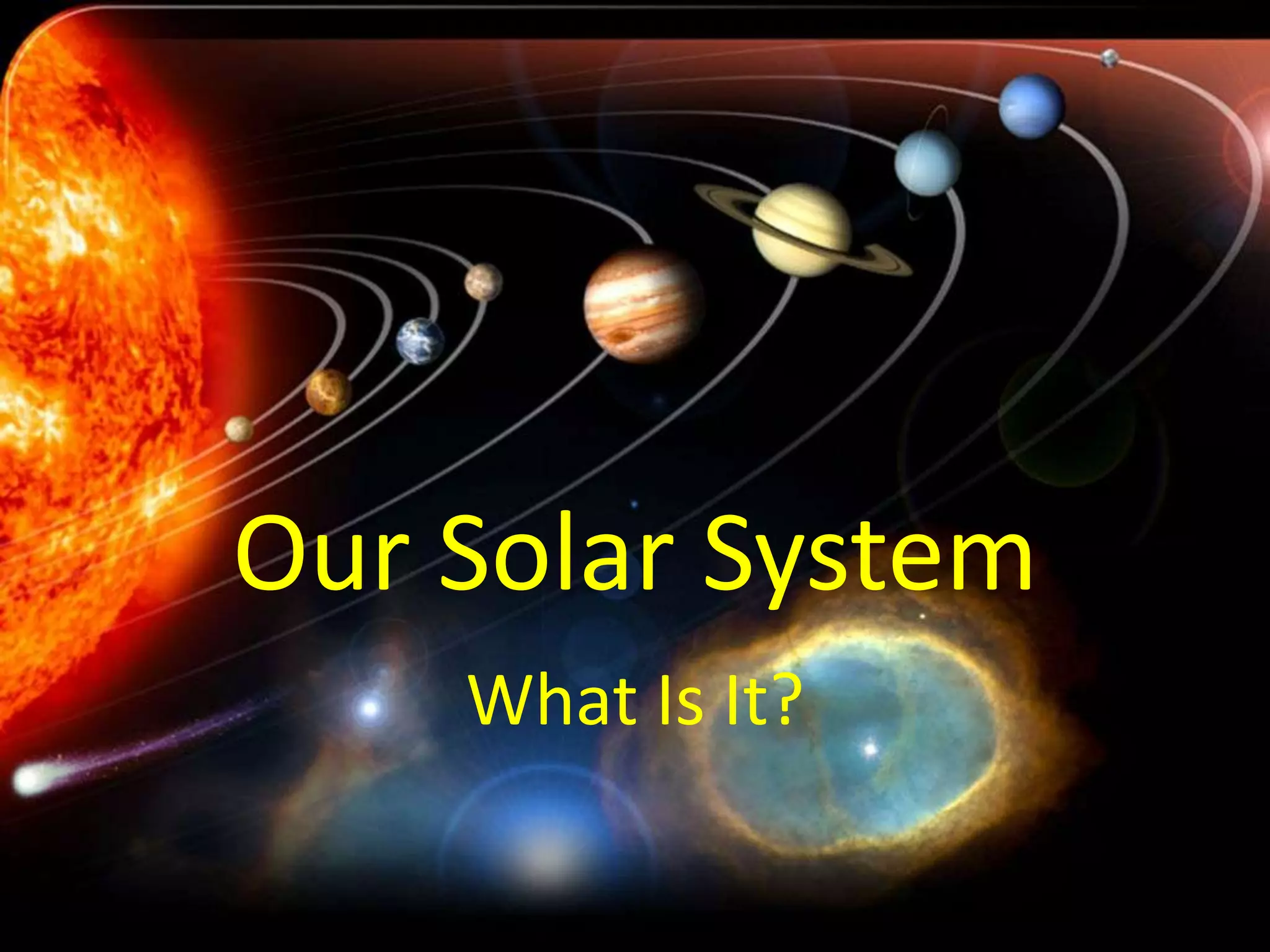
The Solar System
 The Solar System is a region of space that
contains 1 star and 8 planets. The star is called
the Sun and the 8 planets in order are
Mercury, Venus, Earth, Mars, Jupiter, Saturn,
Uranus and Neptune. In our solar system
there are 4 small rocky planets and 4 gas
giants. The 4 rocky planets are Mercury, Mars,
Earth and Venus. The four gas giants are
Jupiter, Saturn, Uranus and Neptune.
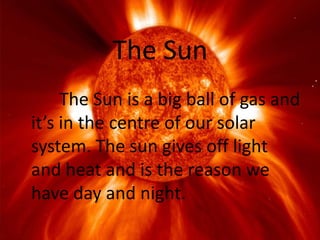
The Sun
     The Sun is a big ball of gas and
it’s in the centre of our solar
system. The sun gives off light
and heat and is the reason we
have day and night.
Mercury
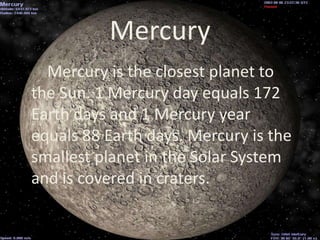
  Mercury is the closest planet to
the Sun. 1 Mercury day equals 172
Earth days and 1 Mercury year
equals 88 Earth days. Mercury is the
smallest planet in the Solar System
and is covered in craters.
Venus
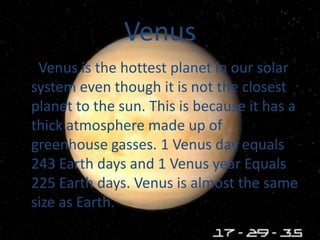
 Venus is the hottest planet in our solar
system even though it is not the closest
planet to the sun. This is because it has a
thick atmosphere made up of
greenhouse gasses. 1 Venus day equals
243 Earth days and 1 Venus year Equals
225 Earth days. Venus is almost the same
size as Earth.
Earth
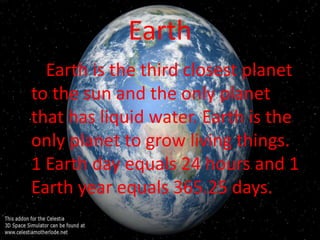
  Earth is the third closest planet
to the sun and the only planet
that has liquid water. Earth is the
only planet to grow living things.
1 Earth day equals 24 hours and 1
Earth year equals 365.25 days.
Mars
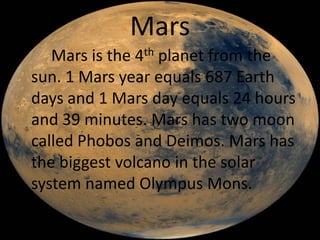
   Mars is the 4th planet from the
sun. 1 Mars year equals 687 Earth
days and 1 Mars day equals 24 hours
and 39 minutes. Mars has two moon
called Phobos and Deimos. Mars has
the biggest volcano in the solar
system named Olympus Mons.
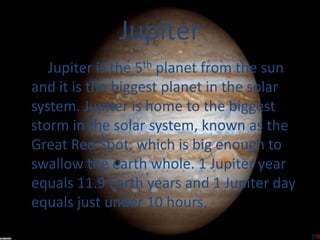
Jupiter
   Jupiter is the 5th planet from the sun
and it is the biggest planet in the solar
system. Jupiter is home to the biggest
storm in the solar system, known as the
Great Red Spot, which is big enough to
swallow the earth whole. 1 Jupiter year
equals 11.9 Earth years and 1 Jupiter day
equals just under 10 hours.
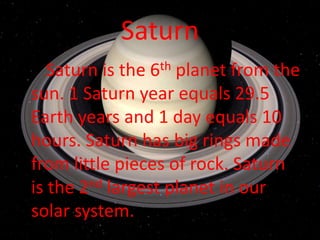
Saturn
   Saturn is the 6th planet from the
sun. 1 Saturn year equals 29.5
Earth years and 1 day equals 10
hours. Saturn has big rings made
from little pieces of rock. Saturn
is the 2nd largest planet in our
solar system.
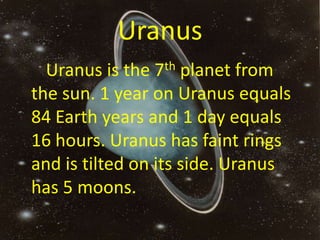
Uranus
  Uranus is the 7th planet from
the sun. 1 year on Uranus equals
84 Earth years and 1 day equals
16 hours. Uranus has faint rings
and is tilted on its side. Uranus
has 5 moons.
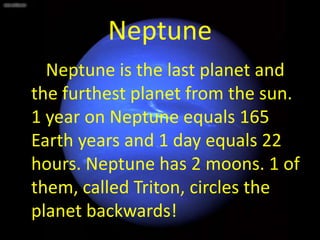
Neptune
  Neptune is the last planet and
the furthest planet from the sun.
1 year on Neptune equals 165
Earth years and 1 day equals 22
hours. Neptune has 2 moons. 1 of
them, called Triton, circles the
planet backwards!

The Solar System by Justice

  • 1.
    Our Solar System What Is It?
  • 2.
    The Solar System The Solar System is a region of space that contains 1 star and 8 planets. The star is called the Sun and the 8 planets in order are Mercury, Venus, Earth, Mars, Jupiter, Saturn, Uranus and Neptune. In our solar system there are 4 small rocky planets and 4 gas giants. The 4 rocky planets are Mercury, Mars, Earth and Venus. The four gas giants are Jupiter, Saturn, Uranus and Neptune.
  • 3.
    The Sun The Sun is a big ball of gas and it’s in the centre of our solar system. The sun gives off light and heat and is the reason we have day and night.
  • 4.
    Mercury Mercuryis the closest planet to the Sun. 1 Mercury day equals 172 Earth days and 1 Mercury year equals 88 Earth days. Mercury is the smallest planet in the Solar System and is covered in craters.
  • 5.
    Venus Venus isthe hottest planet in our solar system even though it is not the closest planet to the sun. This is because it has a thick atmosphere made up of greenhouse gasses. 1 Venus day equals 243 Earth days and 1 Venus year Equals 225 Earth days. Venus is almost the same size as Earth.
  • 6.
    Earth Earthis the third closest planet to the sun and the only planet that has liquid water. Earth is the only planet to grow living things. 1 Earth day equals 24 hours and 1 Earth year equals 365.25 days.
  • 7.
    Mars Mars is the 4th planet from the sun. 1 Mars year equals 687 Earth days and 1 Mars day equals 24 hours and 39 minutes. Mars has two moon called Phobos and Deimos. Mars has the biggest volcano in the solar system named Olympus Mons.
  • 8.
    Jupiter Jupiter is the 5th planet from the sun and it is the biggest planet in the solar system. Jupiter is home to the biggest storm in the solar system, known as the Great Red Spot, which is big enough to swallow the earth whole. 1 Jupiter year equals 11.9 Earth years and 1 Jupiter day equals just under 10 hours.
  • 9.
    Saturn Saturn is the 6th planet from the sun. 1 Saturn year equals 29.5 Earth years and 1 day equals 10 hours. Saturn has big rings made from little pieces of rock. Saturn is the 2nd largest planet in our solar system.
  • 10.
    Uranus Uranusis the 7th planet from the sun. 1 year on Uranus equals 84 Earth years and 1 day equals 16 hours. Uranus has faint rings and is tilted on its side. Uranus has 5 moons.
  • 11.
    Neptune Neptuneis the last planet and the furthest planet from the sun. 1 year on Neptune equals 165 Earth years and 1 day equals 22 hours. Neptune has 2 moons. 1 of them, called Triton, circles the planet backwards!