By:Divij Arora
Solar System
The
Mercury
Venus
Earth
Mars
Jupiter
Saturn
Neptune
SUN
Uranus
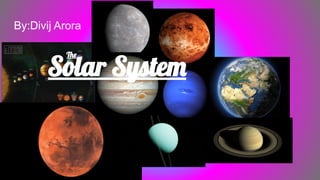
The Solar System
The Solar System is the gravitationally bound system of the Sun and the
objects that orbit it. Of the objects that orbit the Sun directly, the largest are
the eight planets, with the remainder being smaller objects, the dwarf planets.
Solar System
SUN
MERCURY
Venus
E
a
r
t
h
Jupiter
Mars
Saturn
Uranus
Neptune
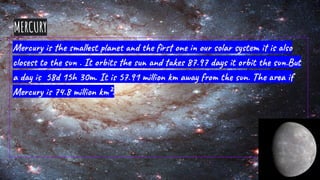
MERCURY
Mercury is the smallest planet and the first one in our solar system it is also
closest to the sun . It orbits the sun and takes 87.97 days it orbit the sun.But
a day is 58d 15h 30m. It is 57.91 million km away from the sun. The area if
Mercury is 74.8 million km².
Venus
Venus is the hottest planet in the world but it is the second planet from the
sun. One day in Venus is more than a earth year! How much is year in Venus?
The surface area is 460.2 million km².Venus is the second brightest natural
object in the night sky after the Moon.
EARTH
Earth is the planet we live in it is the only planet with enough oxygen for
humans to survive.75% of earth is covered with water and from the 75% only
8% is Fresh water that we can drink.We have more trees in the world the the
human and animals population together! We have 7 main landmarks called
contenente.we have 195 countries in earth! The earth is over 4.543 billion
years old.
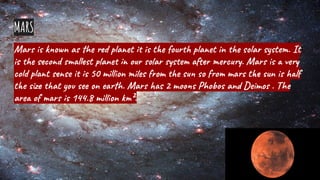
MARS
Mars is known as the red planet it is the fourth planet in the solar system. It
is the second smallest planet in our solar system after mercury. Mars is a very
cold plant sense it is 50 million miles from the sun so from mars the sun is half
the size that you see on earth. Mars has 2 moons Phobos and Deimos . The
area of mars is 144.8 million km².
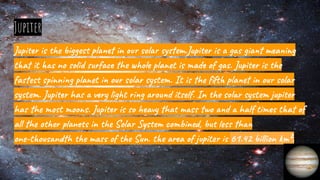
Jupiter
Jupiter is the biggest planet in our solar system.Jupiter is a gas giant meaning
that it has no solid surface the whole planet is made of gas. Jupiter is the
fastest spinning planet in our solar system. It is the fifth planet in our solar
system. Jupiter has a very light ring around itself. In the solar system jupiter
has the most moons. Jupiter is so heavy that mass two and a half times that of
all the other planets in the Solar System combined, but less than
one-thousandth the mass of the Sun. the area of jupiter is 61.42 billion km².
Saturn
Saturn is the sixth planet from the sun and the second biggest after jupiter it
is also known as the ringed planet.Saturn is the flattest planet in our solar
system it's so big that we could fit 95 earths inside of saturn. The ring of
saturn is made if ice rock and diamonds. It also has diamonds raining every
year. The area of saturn is 1.434 billion km.
Uranus
Uranus is the seventh planet in our solar system Uranus is known as the
“sideways planet” because it rotates on its side. It also has a ring. Uranus is
four times bigger than earth it is the fourth largest planet in the solar system.
The area of uranus is 8.083 billion km².
Neptune
Last but not least Neptune, Neptune is also a gas planet but it is the smallest. A year on neptune is about
165 earth years Neptune a 6 faded rings around it. Neptune has the most strongest and coldest winds in
all the planets. Neptune has a very similar gravitational pull as earth. Neptune is not discover fully yet but
it will later.
Constellation
Constellation is a group of stars that form a image in the night sky.There
are 88 constellation patterns that you can see.
Here is a activity.
1.Take a plastic cup
2. Make whole in the plastic cup of a constellation sign with a pin
3.Use a flashlight to pass the light on the wall of a dark room
Leo the crab
constellation
RESULT
Solar System

Solar System

  • 1.
  • 2.
  • 3.
    The Solar System TheSolar System is the gravitationally bound system of the Sun and the objects that orbit it. Of the objects that orbit the Sun directly, the largest are the eight planets, with the remainder being smaller objects, the dwarf planets. Solar System SUN MERCURY Venus E a r t h Jupiter Mars Saturn Uranus Neptune
  • 4.
    MERCURY Mercury is thesmallest planet and the first one in our solar system it is also closest to the sun . It orbits the sun and takes 87.97 days it orbit the sun.But a day is 58d 15h 30m. It is 57.91 million km away from the sun. The area if Mercury is 74.8 million km².
  • 5.
    Venus Venus is thehottest planet in the world but it is the second planet from the sun. One day in Venus is more than a earth year! How much is year in Venus? The surface area is 460.2 million km².Venus is the second brightest natural object in the night sky after the Moon.
  • 6.
    EARTH Earth is theplanet we live in it is the only planet with enough oxygen for humans to survive.75% of earth is covered with water and from the 75% only 8% is Fresh water that we can drink.We have more trees in the world the the human and animals population together! We have 7 main landmarks called contenente.we have 195 countries in earth! The earth is over 4.543 billion years old.
  • 7.
    MARS Mars is knownas the red planet it is the fourth planet in the solar system. It is the second smallest planet in our solar system after mercury. Mars is a very cold plant sense it is 50 million miles from the sun so from mars the sun is half the size that you see on earth. Mars has 2 moons Phobos and Deimos . The area of mars is 144.8 million km².
  • 8.
    Jupiter Jupiter is thebiggest planet in our solar system.Jupiter is a gas giant meaning that it has no solid surface the whole planet is made of gas. Jupiter is the fastest spinning planet in our solar system. It is the fifth planet in our solar system. Jupiter has a very light ring around itself. In the solar system jupiter has the most moons. Jupiter is so heavy that mass two and a half times that of all the other planets in the Solar System combined, but less than one-thousandth the mass of the Sun. the area of jupiter is 61.42 billion km².
  • 9.
    Saturn Saturn is thesixth planet from the sun and the second biggest after jupiter it is also known as the ringed planet.Saturn is the flattest planet in our solar system it's so big that we could fit 95 earths inside of saturn. The ring of saturn is made if ice rock and diamonds. It also has diamonds raining every year. The area of saturn is 1.434 billion km.
  • 10.
    Uranus Uranus is theseventh planet in our solar system Uranus is known as the “sideways planet” because it rotates on its side. It also has a ring. Uranus is four times bigger than earth it is the fourth largest planet in the solar system. The area of uranus is 8.083 billion km².
  • 11.
    Neptune Last but notleast Neptune, Neptune is also a gas planet but it is the smallest. A year on neptune is about 165 earth years Neptune a 6 faded rings around it. Neptune has the most strongest and coldest winds in all the planets. Neptune has a very similar gravitational pull as earth. Neptune is not discover fully yet but it will later.
  • 12.
    Constellation Constellation is agroup of stars that form a image in the night sky.There are 88 constellation patterns that you can see. Here is a activity. 1.Take a plastic cup 2. Make whole in the plastic cup of a constellation sign with a pin 3.Use a flashlight to pass the light on the wall of a dark room Leo the crab constellation RESULT