The Solar System by Paige Mertens
Formation of the Solar System The solar system is composed of: Stars (including the sun) 8 planets Moons Other small bodies such has comets and asteroids All revolve around the sun Is almost 5 billon years old, and took 10 million years to develop
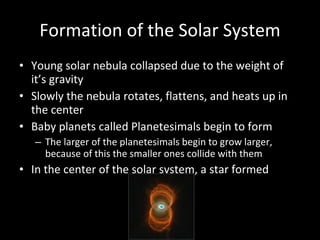
Formation of the Solar System Young solar nebula collapsed due to the weight of it’s gravity Slowly the nebula rotates, flattens, and heats up in the center Baby planets called Planetesimals begin to form The larger of the planetesimals begin to grow larger, because of this the smaller ones collide with them In the center of the solar system, a star formed
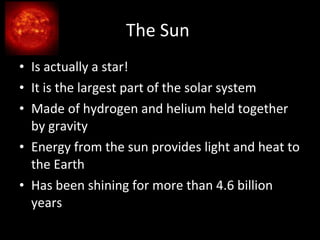
The Sun  Is actually a star! It is the largest part of the solar system Made of hydrogen and helium held together by gravity Energy from the sun provides light and heat to the Earth Has been shining for more than 4.6 billion years
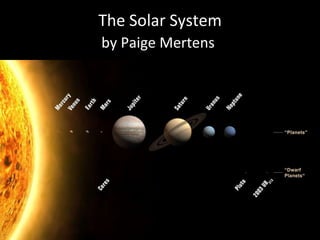
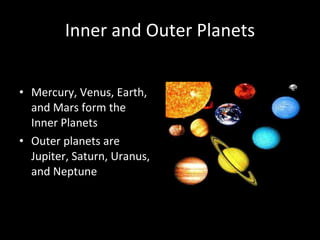
Inner and Outer Planets Mercury, Venus, Earth, and Mars form the Inner Planets Outer planets are Jupiter, Saturn, Uranus, and Neptune
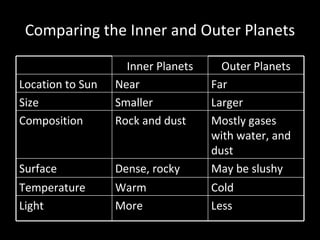
Comparing the Inner and Outer Planets Inner Planets Outer Planets Location to Sun  Near Far Size Smaller Larger Composition Rock and dust Mostly gases with water, and dust Surface Dense, rocky May be slushy Temperature Warm Cold Light More Less
The Future Technology continues to allow us to learn more about the solar system Currently satellites and probes provide information to astronomers furthering our knowledge The International Space Station uses visual and radio telescopes to explore our universe We continue to use the Hubble space telescope to improve our understanding of the solar system Future exploration may focus on the Kuiper Belt; which was discovered about 20 years
The Future Exploration of the solar system is very expensive to the United States, as well as other countries.  Some people feel we  are spending too much money on this, so it has become  controversial. In my opinion we need to continue this work.  I believe it is  important for us to learn about the solar system.  Technology is  helping us track the path of asteroids.  In the future, we may be  able to see an asteroid heading for Earth.  We might be able to  change its path and prevent damage to Earth.  We may even find  there really is life on another planet.
Resources Dunbar, Brian. &quot;mission_pages.&quot; 10 February 2011.  nasa.gov.  10 February 2011 <http://www.nasa.gov/mission_pages/station/research/index.html> kidsknowitnetwork. &quot;solar_system.&quot;  kidsastronomy.  10 February 2011  http://www.kidsastronomy.com/solar_system.htm Hemenway, Mary.  Astronomy.  Austin: Holts, science, and technology, 2007.

The Solar System

  • 1.
    The Solar Systemby Paige Mertens
  • 2.
    Formation of theSolar System The solar system is composed of: Stars (including the sun) 8 planets Moons Other small bodies such has comets and asteroids All revolve around the sun Is almost 5 billon years old, and took 10 million years to develop
  • 3.
    Formation of theSolar System Young solar nebula collapsed due to the weight of it’s gravity Slowly the nebula rotates, flattens, and heats up in the center Baby planets called Planetesimals begin to form The larger of the planetesimals begin to grow larger, because of this the smaller ones collide with them In the center of the solar system, a star formed
  • 4.
    The Sun Is actually a star! It is the largest part of the solar system Made of hydrogen and helium held together by gravity Energy from the sun provides light and heat to the Earth Has been shining for more than 4.6 billion years
  • 5.
    Inner and OuterPlanets Mercury, Venus, Earth, and Mars form the Inner Planets Outer planets are Jupiter, Saturn, Uranus, and Neptune
  • 6.
    Comparing the Innerand Outer Planets Inner Planets Outer Planets Location to Sun Near Far Size Smaller Larger Composition Rock and dust Mostly gases with water, and dust Surface Dense, rocky May be slushy Temperature Warm Cold Light More Less
  • 7.
    The Future Technologycontinues to allow us to learn more about the solar system Currently satellites and probes provide information to astronomers furthering our knowledge The International Space Station uses visual and radio telescopes to explore our universe We continue to use the Hubble space telescope to improve our understanding of the solar system Future exploration may focus on the Kuiper Belt; which was discovered about 20 years
  • 8.
    The Future Explorationof the solar system is very expensive to the United States, as well as other countries. Some people feel we are spending too much money on this, so it has become controversial. In my opinion we need to continue this work. I believe it is important for us to learn about the solar system. Technology is helping us track the path of asteroids. In the future, we may be able to see an asteroid heading for Earth. We might be able to change its path and prevent damage to Earth. We may even find there really is life on another planet.
  • 9.
    Resources Dunbar, Brian.&quot;mission_pages.&quot; 10 February 2011. nasa.gov. 10 February 2011 <http://www.nasa.gov/mission_pages/station/research/index.html> kidsknowitnetwork. &quot;solar_system.&quot; kidsastronomy. 10 February 2011 http://www.kidsastronomy.com/solar_system.htm Hemenway, Mary. Astronomy. Austin: Holts, science, and technology, 2007.