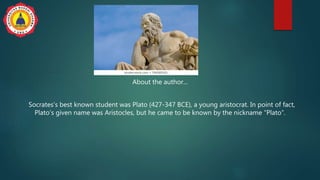
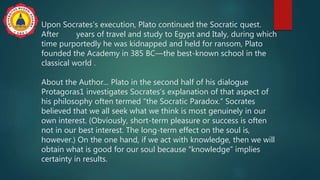
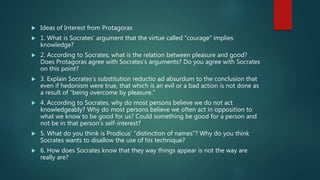
Plato's dialogue "The Protagoras" investigates Socrates' explanation of the "Socratic Paradox" - that people always act in their own self-interest and seek what they believe is good. The summary explores Socrates' arguments that virtue implies knowledge, his view that pleasure and good are related, and his belief that people act knowledgably rather than against their own interests. It also briefly outlines topics from the dialogue worth further investigation.
![Reading from The Protagoras
[Do All Virtues Imply Knowledge?]
So I said: Do not imagine, Protagoras, that I have any
other interest in asking questions of you but that of
clearing up my own difficulties. For I think that Homer
was very right in saying that "When two go together,
one sees before the other (Il.)," for all men who have a
companion are readier in deed, word, or thought; but if
a man "Sees a thing when he is alone," he goes about
straightway seeking until he finds some one to whom
he may show his discoveries, and who may confirm him
in them](https://image.slidesharecdn.com/basicethics1-191208142739/85/The-Socratic-Paradox-by-Plato-5-320.jpg)
![[Pleasure and Good]
I said: You would admit, Protagoras, that some men live
well and others ill?
He assented.
And do you think that a man lives well who lives in pain
and grief?
He does not. But if he lives pleasantly to the end of his life,
will he not in that case have lived well?
He will.
Then to live pleasantly is a good, and to live unpleasantly an
evil?](https://image.slidesharecdn.com/basicethics1-191208142739/85/The-Socratic-Paradox-by-Plato-6-320.jpg)
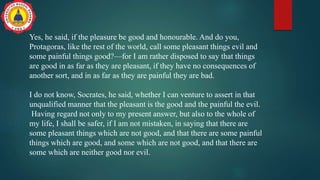
![[Knowledge and Pleasure]]
May I employ an illustration? I said. Suppose some one who is
enquiring into the health or some other bodily quality of
another:—he looks at his face and at the tips of his fingers, and
then he says, Uncover your chest and back to me that I may have a
better view:—that is the sort of thing which I desire in this
speculation. Having seen what your opinion is about good and
pleasure, I am minded to say to you: Uncover your mind to me,
Protagoras, and reveal your opinion about knowledge, that I may
know whether you agree with the rest of the world.](https://image.slidesharecdn.com/basicethics1-191208142739/85/The-Socratic-Paradox-by-Plato-8-320.jpg)
![[Can Virtue Be Taught?]
Then, my friends, what do you say to this? Are not all
actions honourable and useful, of which the tendency is
to make life painless and pleasant? The honourable work
is also useful and good? This was admitted.
Then, I said, if the pleasant is the good, nobody does
anything under the idea or conviction that some other
thing would be better and is also attainable, when he
might do the better. And this inferiority of a man to
himself is merely ignorance, as the superiority of a man
to himself is wisdom.](https://image.slidesharecdn.com/basicethics1-191208142739/85/The-Socratic-Paradox-by-Plato-9-320.jpg)