Vision of Next Generation of Library Technical Services (LTS)  Alignment to the Changing Needs of Library Users and Public Services StaffGeorge Mason University LibrariesDec. 7, 2010Fairfax, VirginiaUpdated March 8, 2011By Amanda XuJames E. Walker LibraryMiddle Tennessee State Univ.amanda_xu@yahoo.com
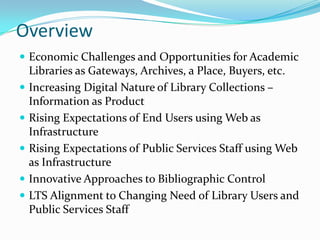
OverviewEconomic Challenges and Opportunities for Academic Libraries as Gateways, Archives, a Place, Buyers, etc.Increasing Digital Nature of Library Collections – Information as ProductRising Expectations of End Users using Web as InfrastructureRising Expectations of Public Services Staff using Web as InfrastructureInnovative Approaches to Bibliographic ControlLTS Alignment to Changing Need of Library Users and Public Services Staff
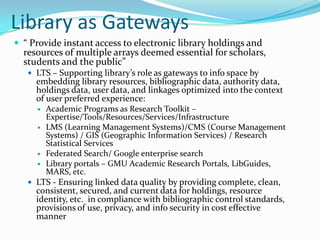
Library as Gateways“ Provide instant access to electronic library holdings and resources of multiple arrays deemed essential for scholars, students and the public” LTS – Supporting library’s role as gateways to info space by embedding library resources, bibliographic data, authority data, holdings data, user data, and linkages optimized into the context of user preferred experience: Academic Programs as Research Toolkit – Expertise/Tools/Resources/Services/Infrastructure LMS (Learning Management Systems)/CMS (Course Management Systems) / GIS (Geographic Information Services) / Research Statistical Services   Federated Search/ Google enterprise search Library portals – GMU Academic Research Portals, LibGuides, MARS, etc.LTS - Ensuring linked data quality by providing complete, clean, consistent, secured, and current data for holdings, resource  identity, etc.  in compliance with bibliographic control standards, provisions of use, privacy, and info security in cost effective manner
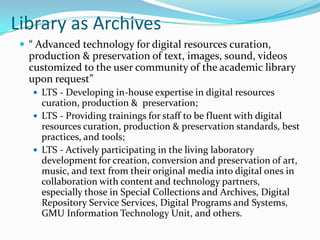
Library as Archives“ Advanced technology for digital resources curation, production & preservation of text, images, sound, videos customized to the user community of the academic library upon request” LTS - Developing in-house expertise in digital resources curation, production &  preservation; LTS - Providing trainings for staff to be fluent with digital resources curation, production & preservation standards, best practices, and tools; LTS - Actively participating in the living laboratory development for creation, conversion and preservation of art, music, and text from their original media into digital ones in collaboration with content and technology partners, especially those in Special Collections and Archives, Digital Repository Service Services, Digital Programs and Systems,  GMU Information Technology Unit, and others.
Library as a Place“ With greater capacity for traditional print collections” LTS – Honoring tradition by continuously selecting, acquiring, organizing, maintaining, tracking and reporting, evaluating active holdings for print collections via integrated library systems, and any other external systems in the network, e.g. OCLC, WRLC Aquabrowser, GMU instance of Voyager, MetaFinder, Voyager Analyzer, etc. “ Social learning and social networking” LTS – Embracing changes to the library landscape by incorporating the appropriate tools into the library that supports social learning and networking, including using Web as infrastructure with optimized processes and control objectives, e.g. strategic alignment, change management, performance measures, process maturity measures, etc. “ Scholarly community and intellectual engagement” LTS – Participating in the infrastructure development for effective dissemination of ideas in the form of talks, exhibits, and forums.
Library as Buyers (1)Selectively acquiring or subscribing critical mass of information resources by discipline distributed to the library in whatever delivery channels by vendors, e.g. MARC 21, Z39.50, EDI, OpenURL, OAI, Web Services API, XML/XSL, and ILS; LTS – Providing solutions to the next generation of library technologies in collection development, acquisitions, cataloging, serials control, ERMS (Electronic Resources Management Systems), and linked data in highly integrated, automated and maintainable computing environment;LTS – Improving IT infrastructure of the library for auto-processing information resources in various formats in collaboration with external and internal partners & in compliance with control objectives and process maturity measures for info systems and enterprise architecture defined by COBIT 5.0, TOGAF 9.0, and leveraged by library-specific IT industry;
Library as Buyers (2)ILSERMSFull-text A-ZFederated searchGoogle Search ApplianceLink ResolverILLeReserveeReferencesIntegrated support for specialized services with CMS, LMS, social media sites, location-based services, etc.Auto citation integrationRecord management for institution and archival contentsLibrary portals as library content and service distribution toolkitResearch PortalsMARSOAI & community-based portalsMeasures, evaluation, and refinement
Library as Universal Digital Library Infrastructure (1) - DefinitionLTS - Providing ubiquitous and pervasive information infrastructure and computing environment, which integrate people, organizations, processes, data, information, and technologies in such a coherent manner that the objectives of a digital library can be performed, measured and controlled at the lowest meaningful and atomic level; LTS - Providing relevant, engaged, and customized information contents and services, which cover all resources, all vocabularies, and all languages to any given user at any time in compliance with control objectives and process maturity measures for info systems and enterprise architecture defined by COBIT 5.0, TOGAF 9.0, and leveraged by library-specific IT industry; LTS - Empowering the whole brain team using leadership, communication skills, project management, analytical skills, collaboration, and teamwork.
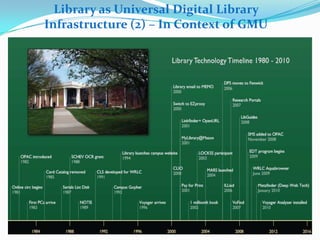
Library as Universal Digital Library Infrastructure (2) – In Context of GMU
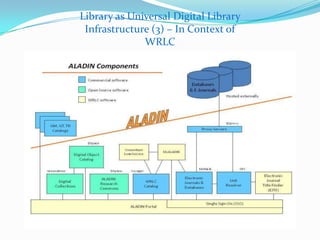
Library as Universal Digital Library Infrastructure (3) – In Context of WRLC
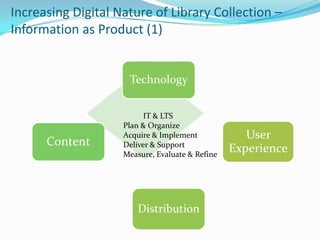
Increasing Digital Nature of Library Collection – Information as Product (1)          IT & LTSPlan & OrganizeAcquire & ImplementDeliver & SupportMeasure, Evaluate & Refine
Increasing Digital Nature of Library Collection – Information as Product (2)Project management, enterprise architecture (EA), EA modeling and business process modeling Content capturing Content modeling and content management systems Search engine services Enterprise service bus (ESB) and service-oriented architecture (SOA) Relational, multidimensional and ontological database management systems and administration Portal solutions Customer relationship management Service resolution management Business intelligence and reporting Specialized content and services, e.g. location as service, IaaS, Intentional Discovery, etc.Information security
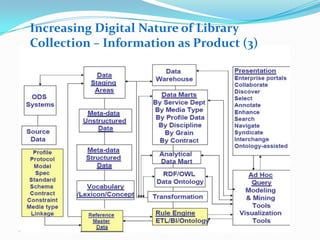
Increasing Digital Nature of Library Collection – Information as Product (3)
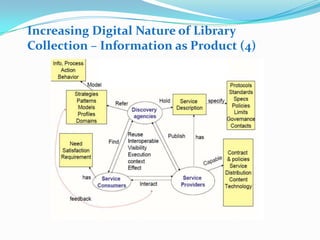
Increasing Digital Nature of Library Collection – Information as Product (4)
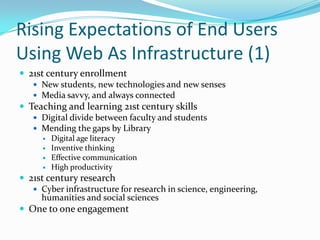
Rising Expectations of End Users Using Web As Infrastructure (1)21st century enrollment New students, new technologies and new senses Media savvy, and always connected Teaching and learning 21st century skills Digital divide between faculty and students Mending the gaps by Library Digital age literacy Inventive thinking Effective communication High productivity 21st century research Cyber infrastructure for research in science, engineering, humanities and social sciences One to one engagement
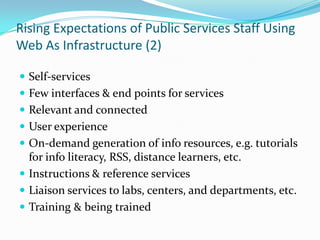
Rising Expectations of Public Services Staff Using Web As Infrastructure (2)Self-servicesFew interfaces & end points for servicesRelevant and connectedUser experienceOn-demand generation of info resources, e.g. tutorials for info literacy, RSS, distance learners, etc.Instructions & reference servicesLiaison services to labs, centers, and departments, etc.Training & being trained
Innovative Approaches to Bibliographic Control (1)A library resource is increasingly becoming an info product, e.g. parts of a book or collection of books aggregated, distributed, and disaggregated in heterogeneous computing environment with end service point on the Web platform geared toward a specific user group community, who are the supporters of the library services (M.V.C. & M.G.C.); Unified/federated approach to bibliographic control of library resources purchased, licensed, in-house developed, or freely available in the public domain through common infrastructures compostable, comparable and maintainable at presentation layer, application layer, service layer, business logic layer, database layer, network layer, content model layer, etc. during design-time, development-time and run-time computing environment;
Innovative Approaches to Bibliographic Control (2)Any collection of electronic data, from library catalogs to collections of full-text packages whether structured or unstructured in any media type on the Internet can be: Interwoven with enterprise-wide resources, processes, services, systems and devices Mined through automated means, e.g. named entity and noun phrases extraction, analysis, association, and interpretation Sliced and diced for better forecasting and decision making using data warehousing and business intelligence packages on things such as library collection development, assessment, and re-organization Bibliographic control is increasingly a matter of managing relationships – among works, names, concepts, and object descriptions across communities with emphasis on reuse, scalability, maintainability, traceability, efficiency, and productivity using Web as Infrastructure
Innovative Approaches to Bibliographic Control (3)Traditional information context Markup Types – Descriptive, Technical, Administrative, Structural, Preservation; Typical library metadata schemes – MARC, TEI, EAD, Dublin Core, VRA, MODS, MIX, METS, PREMIS, CDWA, OAI-PHM A metadata scheme specifies – structure, syntax, contentCrosswalks among metadata schemas Maintenance – validation, CRUD (Create, Read, Update, Delete) & archive Digital information context Linked Data & Internet of Things CIA – Confidential, Integrity, Available Process maturity measures Adaptable, maintainable & lifecycle Separation of concerns: rules; patterns; structures, behavior & user experience
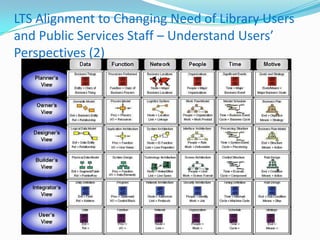
LTS Alignment to Changing Need of Library Users and Public Services Staff – Understand Users’ Perspectives (1)What data are involved with the systems?How and what are expected systems behavior?Where are the logistics of the network for the systems?Who are the users, and what are their access rights andprivileges for the systems? When and what system procedures will be generated for what business activities? Contextual-level req.?Why or what are purposes for the system functions to be built?
LTS Alignment to Changing Need of Library Users and Public Services Staff – Understand Users’ Perspectives (2)
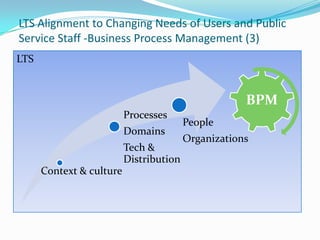
LTS Alignment to Changing Needs of Users and Public Service Staff -Business Process Management (3)LTS
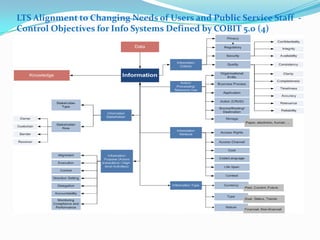
LTS Alignment to Changing Needs of Users and Public Service Staff  - Control Objectives for Info Systems Defined by COBIT 5.0 (4)
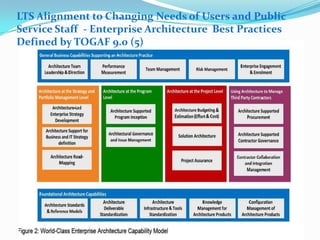
LTS Alignment to Changing Needs of Users and Public Service Staff  - Enterprise Architecture  Best Practices Defined by TOGAF 9.0 (5)
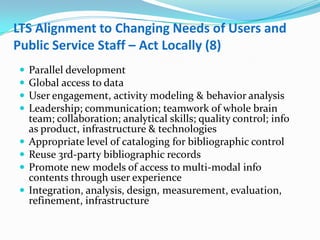
LTS Alignment to Changing Needs of Users and Public Service Staff – Three Dimensions of Process Maturity Measures (6)Source: IT Governance Institute.  2007.  “Figure 13 – Generic Maturity Model.”   COBIT Framework, p. 19.
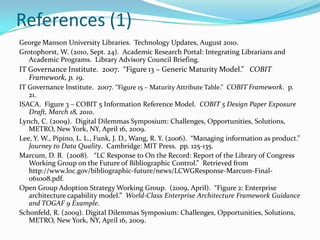
LTS Alignment to Changing Needs of Users and Public Service Staff – Three Dimensions of Process Maturity Measures (7)Awareness and communicationPolicies, plans and proceduresTools and automationSkills and expertiseResponsibility and accountabilityGoal setting and measurementSource: IT Governance Institute.  2007.  “Figure 15 – Maturity Attribute Table.” COBIT Framework, p. 21
LTS Alignment to Changing Needs of Users and Public Service Staff – Act Locally (8)Parallel developmentGlobal access to dataUser engagement, activity modeling & behavior analysisLeadership; communication; teamwork of whole brain team; collaboration; analytical skills; quality control; info as product, infrastructure & technologies  Appropriate level of cataloging for bibliographic controlReuse 3rd-party bibliographic recordsPromote new models of access to multi-modal info contents through user experienceIntegration, analysis, design, measurement, evaluation, refinement, infrastructure
References (1)George Manson University Libraries.  Technology Updates, August 2010.Grotophorst, W. (2010, Sept. 24).  Academic Research Portal: Integrating Librarians and Academic Programs.  Library Advisory Council Briefing.IT Governance Institute.  2007.  “Figure 13 – Generic Maturity Model.”   COBIT Framework, p. 19.IT Governance Institute.  2007. “Figure 15 – Maturity Attribute Table.” COBIT Framework.  p. 21.ISACA.  Figure 3 – COBIT 5 Information Reference Model.  COBIT 5 Design Paper Exposure Draft, March 18, 2010.  Lynch, C. (2009).  Digital Dilemmas Symposium: Challenges, Opportunities, Solutions, METRO, New York, NY, April 16, 2009.Lee, Y. W., Pipino, L. L., Funk, J. D., Wang, R. Y. (2006).  “Managing information as product.”  Journey to Data Quality.  Cambridge: MIT Press.  pp. 125-135.Marcum, D. B.  (2008).   “LC Response to On the Record: Report of the Library of Congress Working Group on the Future of Bibliographic Control.”  Retrieved from  http://www.loc.gov/bibliographic-future/news/LCWGResponse-Marcum-Final-061008.pdf.   Open Group Adoption Strategy Working Group.  (2009, April).  “Figure 2: Enterprise architecture capability model.”  World-Class Enterprise Architecture Framework Guidance and TOGAF 9 Example.Schonfeld, R. (2009). Digital Dilemmas Symposium: Challenges, Opportunities, Solutions, METRO, New York, NY, April 16, 2009.
References (2)Sowa, J.F., and Zachman, J.A.  (1992).  “Extending and formalizing the framework for information systems architecture.” IBM Systems Journals, 31 (3), 590-616.U.S. Department of Veterans Affairs. A Tutorial on the ZachmanFramework for Enterprise Architecture. Available: http://www.va.gov/oirm/architecture/EA/theory/tutorial.pptXu, A. (2009).  “FocusOn Search and CategoryMap: An Integrated Approach for Discovery of University Resources and Libraries on the Web” – poster presentation at the Faculty Research Forum of St. John’s University, Queens, NY, April 2, 2009.--.  “Vision of Library Technical Services: FocusOn Search and CategoryMap” – presented to University Libraries, University of California Santa Cruz, June 8, 2009, Santa Cruz, CA.--.  “Online Surveys for Collecting, Analyzing, Tracking and Evaluating User Responses on FocusOn Search and CategoryMap” – a position paper presented at ACM/IEEE Joint Conference on Digital Libraries, Austin, Texas, June 19, 2009.  Available: http://www.dlib.org/dlib/july09/khoo/Xu.pdf--.  “Mending the Gap Between the Library’s Electronic and Print Collections on Library’s Web Site Using Semantic Web: Progress Report” – presented for ExLibrisEndUser Meeting 2007, Schaumburg, IL, April 26 & 27, 2007.WRLC.  ALADIN Technology.  Retrieved 12/6/2010 from www.wrlc.org/dlib/cns/

Alignment of Lib Technical Services to Changing Needs of Users

  • 1.
    Vision of NextGeneration of Library Technical Services (LTS) Alignment to the Changing Needs of Library Users and Public Services StaffGeorge Mason University LibrariesDec. 7, 2010Fairfax, VirginiaUpdated March 8, 2011By Amanda XuJames E. Walker LibraryMiddle Tennessee State Univ.amanda_xu@yahoo.com
  • 2.
    OverviewEconomic Challenges andOpportunities for Academic Libraries as Gateways, Archives, a Place, Buyers, etc.Increasing Digital Nature of Library Collections – Information as ProductRising Expectations of End Users using Web as InfrastructureRising Expectations of Public Services Staff using Web as InfrastructureInnovative Approaches to Bibliographic ControlLTS Alignment to Changing Need of Library Users and Public Services Staff
  • 3.
    Library as Gateways“Provide instant access to electronic library holdings and resources of multiple arrays deemed essential for scholars, students and the public” LTS – Supporting library’s role as gateways to info space by embedding library resources, bibliographic data, authority data, holdings data, user data, and linkages optimized into the context of user preferred experience: Academic Programs as Research Toolkit – Expertise/Tools/Resources/Services/Infrastructure LMS (Learning Management Systems)/CMS (Course Management Systems) / GIS (Geographic Information Services) / Research Statistical Services Federated Search/ Google enterprise search Library portals – GMU Academic Research Portals, LibGuides, MARS, etc.LTS - Ensuring linked data quality by providing complete, clean, consistent, secured, and current data for holdings, resource identity, etc. in compliance with bibliographic control standards, provisions of use, privacy, and info security in cost effective manner
  • 4.
    Library as Archives“Advanced technology for digital resources curation, production & preservation of text, images, sound, videos customized to the user community of the academic library upon request” LTS - Developing in-house expertise in digital resources curation, production & preservation; LTS - Providing trainings for staff to be fluent with digital resources curation, production & preservation standards, best practices, and tools; LTS - Actively participating in the living laboratory development for creation, conversion and preservation of art, music, and text from their original media into digital ones in collaboration with content and technology partners, especially those in Special Collections and Archives, Digital Repository Service Services, Digital Programs and Systems, GMU Information Technology Unit, and others.
  • 5.
    Library as aPlace“ With greater capacity for traditional print collections” LTS – Honoring tradition by continuously selecting, acquiring, organizing, maintaining, tracking and reporting, evaluating active holdings for print collections via integrated library systems, and any other external systems in the network, e.g. OCLC, WRLC Aquabrowser, GMU instance of Voyager, MetaFinder, Voyager Analyzer, etc. “ Social learning and social networking” LTS – Embracing changes to the library landscape by incorporating the appropriate tools into the library that supports social learning and networking, including using Web as infrastructure with optimized processes and control objectives, e.g. strategic alignment, change management, performance measures, process maturity measures, etc. “ Scholarly community and intellectual engagement” LTS – Participating in the infrastructure development for effective dissemination of ideas in the form of talks, exhibits, and forums.
  • 6.
    Library as Buyers(1)Selectively acquiring or subscribing critical mass of information resources by discipline distributed to the library in whatever delivery channels by vendors, e.g. MARC 21, Z39.50, EDI, OpenURL, OAI, Web Services API, XML/XSL, and ILS; LTS – Providing solutions to the next generation of library technologies in collection development, acquisitions, cataloging, serials control, ERMS (Electronic Resources Management Systems), and linked data in highly integrated, automated and maintainable computing environment;LTS – Improving IT infrastructure of the library for auto-processing information resources in various formats in collaboration with external and internal partners & in compliance with control objectives and process maturity measures for info systems and enterprise architecture defined by COBIT 5.0, TOGAF 9.0, and leveraged by library-specific IT industry;
  • 7.
    Library as Buyers(2)ILSERMSFull-text A-ZFederated searchGoogle Search ApplianceLink ResolverILLeReserveeReferencesIntegrated support for specialized services with CMS, LMS, social media sites, location-based services, etc.Auto citation integrationRecord management for institution and archival contentsLibrary portals as library content and service distribution toolkitResearch PortalsMARSOAI & community-based portalsMeasures, evaluation, and refinement
  • 8.
    Library as UniversalDigital Library Infrastructure (1) - DefinitionLTS - Providing ubiquitous and pervasive information infrastructure and computing environment, which integrate people, organizations, processes, data, information, and technologies in such a coherent manner that the objectives of a digital library can be performed, measured and controlled at the lowest meaningful and atomic level; LTS - Providing relevant, engaged, and customized information contents and services, which cover all resources, all vocabularies, and all languages to any given user at any time in compliance with control objectives and process maturity measures for info systems and enterprise architecture defined by COBIT 5.0, TOGAF 9.0, and leveraged by library-specific IT industry; LTS - Empowering the whole brain team using leadership, communication skills, project management, analytical skills, collaboration, and teamwork.
  • 9.
    Library as UniversalDigital Library Infrastructure (2) – In Context of GMU
  • 10.
    Library as UniversalDigital Library Infrastructure (3) – In Context of WRLC
  • 11.
    Increasing Digital Natureof Library Collection – Information as Product (1) IT & LTSPlan & OrganizeAcquire & ImplementDeliver & SupportMeasure, Evaluate & Refine
  • 12.
    Increasing Digital Natureof Library Collection – Information as Product (2)Project management, enterprise architecture (EA), EA modeling and business process modeling Content capturing Content modeling and content management systems Search engine services Enterprise service bus (ESB) and service-oriented architecture (SOA) Relational, multidimensional and ontological database management systems and administration Portal solutions Customer relationship management Service resolution management Business intelligence and reporting Specialized content and services, e.g. location as service, IaaS, Intentional Discovery, etc.Information security
  • 13.
    Increasing Digital Natureof Library Collection – Information as Product (3)
  • 14.
    Increasing Digital Natureof Library Collection – Information as Product (4)
  • 15.
    Rising Expectations ofEnd Users Using Web As Infrastructure (1)21st century enrollment New students, new technologies and new senses Media savvy, and always connected Teaching and learning 21st century skills Digital divide between faculty and students Mending the gaps by Library Digital age literacy Inventive thinking Effective communication High productivity 21st century research Cyber infrastructure for research in science, engineering, humanities and social sciences One to one engagement
  • 16.
    Rising Expectations ofPublic Services Staff Using Web As Infrastructure (2)Self-servicesFew interfaces & end points for servicesRelevant and connectedUser experienceOn-demand generation of info resources, e.g. tutorials for info literacy, RSS, distance learners, etc.Instructions & reference servicesLiaison services to labs, centers, and departments, etc.Training & being trained
  • 17.
    Innovative Approaches toBibliographic Control (1)A library resource is increasingly becoming an info product, e.g. parts of a book or collection of books aggregated, distributed, and disaggregated in heterogeneous computing environment with end service point on the Web platform geared toward a specific user group community, who are the supporters of the library services (M.V.C. & M.G.C.); Unified/federated approach to bibliographic control of library resources purchased, licensed, in-house developed, or freely available in the public domain through common infrastructures compostable, comparable and maintainable at presentation layer, application layer, service layer, business logic layer, database layer, network layer, content model layer, etc. during design-time, development-time and run-time computing environment;
  • 18.
    Innovative Approaches toBibliographic Control (2)Any collection of electronic data, from library catalogs to collections of full-text packages whether structured or unstructured in any media type on the Internet can be: Interwoven with enterprise-wide resources, processes, services, systems and devices Mined through automated means, e.g. named entity and noun phrases extraction, analysis, association, and interpretation Sliced and diced for better forecasting and decision making using data warehousing and business intelligence packages on things such as library collection development, assessment, and re-organization Bibliographic control is increasingly a matter of managing relationships – among works, names, concepts, and object descriptions across communities with emphasis on reuse, scalability, maintainability, traceability, efficiency, and productivity using Web as Infrastructure
  • 19.
    Innovative Approaches toBibliographic Control (3)Traditional information context Markup Types – Descriptive, Technical, Administrative, Structural, Preservation; Typical library metadata schemes – MARC, TEI, EAD, Dublin Core, VRA, MODS, MIX, METS, PREMIS, CDWA, OAI-PHM A metadata scheme specifies – structure, syntax, contentCrosswalks among metadata schemas Maintenance – validation, CRUD (Create, Read, Update, Delete) & archive Digital information context Linked Data & Internet of Things CIA – Confidential, Integrity, Available Process maturity measures Adaptable, maintainable & lifecycle Separation of concerns: rules; patterns; structures, behavior & user experience
  • 20.
    LTS Alignment toChanging Need of Library Users and Public Services Staff – Understand Users’ Perspectives (1)What data are involved with the systems?How and what are expected systems behavior?Where are the logistics of the network for the systems?Who are the users, and what are their access rights andprivileges for the systems? When and what system procedures will be generated for what business activities? Contextual-level req.?Why or what are purposes for the system functions to be built?
  • 21.
    LTS Alignment toChanging Need of Library Users and Public Services Staff – Understand Users’ Perspectives (2)
  • 22.
    LTS Alignment toChanging Needs of Users and Public Service Staff -Business Process Management (3)LTS
  • 23.
    LTS Alignment toChanging Needs of Users and Public Service Staff - Control Objectives for Info Systems Defined by COBIT 5.0 (4)
  • 24.
    LTS Alignment toChanging Needs of Users and Public Service Staff - Enterprise Architecture Best Practices Defined by TOGAF 9.0 (5)
  • 25.
    LTS Alignment toChanging Needs of Users and Public Service Staff – Three Dimensions of Process Maturity Measures (6)Source: IT Governance Institute. 2007. “Figure 13 – Generic Maturity Model.” COBIT Framework, p. 19.
  • 26.
    LTS Alignment toChanging Needs of Users and Public Service Staff – Three Dimensions of Process Maturity Measures (7)Awareness and communicationPolicies, plans and proceduresTools and automationSkills and expertiseResponsibility and accountabilityGoal setting and measurementSource: IT Governance Institute. 2007. “Figure 15 – Maturity Attribute Table.” COBIT Framework, p. 21
  • 27.
    LTS Alignment toChanging Needs of Users and Public Service Staff – Act Locally (8)Parallel developmentGlobal access to dataUser engagement, activity modeling & behavior analysisLeadership; communication; teamwork of whole brain team; collaboration; analytical skills; quality control; info as product, infrastructure & technologies Appropriate level of cataloging for bibliographic controlReuse 3rd-party bibliographic recordsPromote new models of access to multi-modal info contents through user experienceIntegration, analysis, design, measurement, evaluation, refinement, infrastructure
  • 28.
    References (1)George MansonUniversity Libraries. Technology Updates, August 2010.Grotophorst, W. (2010, Sept. 24). Academic Research Portal: Integrating Librarians and Academic Programs. Library Advisory Council Briefing.IT Governance Institute. 2007. “Figure 13 – Generic Maturity Model.” COBIT Framework, p. 19.IT Governance Institute. 2007. “Figure 15 – Maturity Attribute Table.” COBIT Framework. p. 21.ISACA. Figure 3 – COBIT 5 Information Reference Model. COBIT 5 Design Paper Exposure Draft, March 18, 2010. Lynch, C. (2009). Digital Dilemmas Symposium: Challenges, Opportunities, Solutions, METRO, New York, NY, April 16, 2009.Lee, Y. W., Pipino, L. L., Funk, J. D., Wang, R. Y. (2006). “Managing information as product.” Journey to Data Quality. Cambridge: MIT Press. pp. 125-135.Marcum, D. B. (2008). “LC Response to On the Record: Report of the Library of Congress Working Group on the Future of Bibliographic Control.” Retrieved from http://www.loc.gov/bibliographic-future/news/LCWGResponse-Marcum-Final-061008.pdf. Open Group Adoption Strategy Working Group. (2009, April). “Figure 2: Enterprise architecture capability model.” World-Class Enterprise Architecture Framework Guidance and TOGAF 9 Example.Schonfeld, R. (2009). Digital Dilemmas Symposium: Challenges, Opportunities, Solutions, METRO, New York, NY, April 16, 2009.
  • 29.
    References (2)Sowa, J.F.,and Zachman, J.A. (1992). “Extending and formalizing the framework for information systems architecture.” IBM Systems Journals, 31 (3), 590-616.U.S. Department of Veterans Affairs. A Tutorial on the ZachmanFramework for Enterprise Architecture. Available: http://www.va.gov/oirm/architecture/EA/theory/tutorial.pptXu, A. (2009). “FocusOn Search and CategoryMap: An Integrated Approach for Discovery of University Resources and Libraries on the Web” – poster presentation at the Faculty Research Forum of St. John’s University, Queens, NY, April 2, 2009.--. “Vision of Library Technical Services: FocusOn Search and CategoryMap” – presented to University Libraries, University of California Santa Cruz, June 8, 2009, Santa Cruz, CA.--. “Online Surveys for Collecting, Analyzing, Tracking and Evaluating User Responses on FocusOn Search and CategoryMap” – a position paper presented at ACM/IEEE Joint Conference on Digital Libraries, Austin, Texas, June 19, 2009. Available: http://www.dlib.org/dlib/july09/khoo/Xu.pdf--. “Mending the Gap Between the Library’s Electronic and Print Collections on Library’s Web Site Using Semantic Web: Progress Report” – presented for ExLibrisEndUser Meeting 2007, Schaumburg, IL, April 26 & 27, 2007.WRLC. ALADIN Technology. Retrieved 12/6/2010 from www.wrlc.org/dlib/cns/