Metadata and Scotland’s Information Environment: potential benefits of Web 2.0  Metadata issues and Web 2.0 services. CIGS Seminar January 30 th  2009 Kathleen Menzies with Dennis Nicholson Centre for Digital Library Research
Overview SLIC and CDLR (often with external funding): working to pioneer the development of a ‘ Scottish   Information Landscape ’ (SIL) encompassing services like: CAIRNS, SCONE, RCO, SDDL One focus of CDLR work for SLIC has been investigating the potential/implications of using  Web 2.0  to enhance  SIL  services I will mainly look at two examples relating to  metadata   Work-sharing and discussion/collaboration, in cataloguing BUBL using the proposed new  BUBL Community  forum Getting closer to user needs, looking at the possible use of ‘folksonomies’ in the  HILT  project
Web 2.0 and Scotland's Information Landscape An overview of definitions and trends
What is SIL? “ Scotland's Information Landscape is a distributed information infrastructure for Scotland, designed to be sufficiently generic to support the specific activities of archives, libraries, museums, and other cultural information organizations through the sharing of common data and services” -  http://scone.strath.ac.uk/scie/index.cfm Co-operative catalogues Directories Contact details, locations and opening hours Links to online resources News and updates Subject strengths
Web 2 Primarily about the internet as a ‘platform’ Technologies and web design that aim to “enhance creativity, communications, secure information sharing, collaboration and functionality of the web” -  http://en.wikipedia.org/wiki/Web_2.0 Web 2 depends on ‘mass collaboration’ This means chiefly, peer production, Open Source, collaboration, syndication of site content Web 2 services include tagging, reviews, user comments, image sharing, social book-marking
Becomes Web 3... Transformation from a network of separately siloed applications and content repositories to a more seamless and interoperable whole The Semantic Web, the ‘Intelligent Web’; linking to the ‘real world’ Open technologies, open APIs and protocols, open data formats, open-source software platforms and open data (e.g. Creative Commons, Open Data License) Open identity, OpenID, open reputation, roaming portable identity and personal data The ‘intelligent’ web; Semantic Web technologies such as RDF, OWL  –  definitions from Nova Spivack at readwriteweb.com  (http://www.readwriteweb.com/archives/on_web_30.php)
Information Environment To quote JISC: “ An Information Environment can be characterised as the set of network or online services that support publishing and use of information and learning resources… The Information Environment as it is proposed here aims to offer the user a more seamless and less complex journey to relevant information and learning resources.  It is important that this activity is aligned where possible with other developments, nationally and internationally, and that it makes a leading contribution to the enhanced information use and a true democracy of learning opportunity…” -  Information Environment Development Strategy  (2001-2005)
A Scottish approach “ The common information environment must encompass resources and services from all domains and for physical and digital formats if it is to appeal to the widest range of users. It is likely to be developed faster for digital formats…”  –   Dunsire, 2005,  The Centre for Digital Library Research and the Common Information Environment
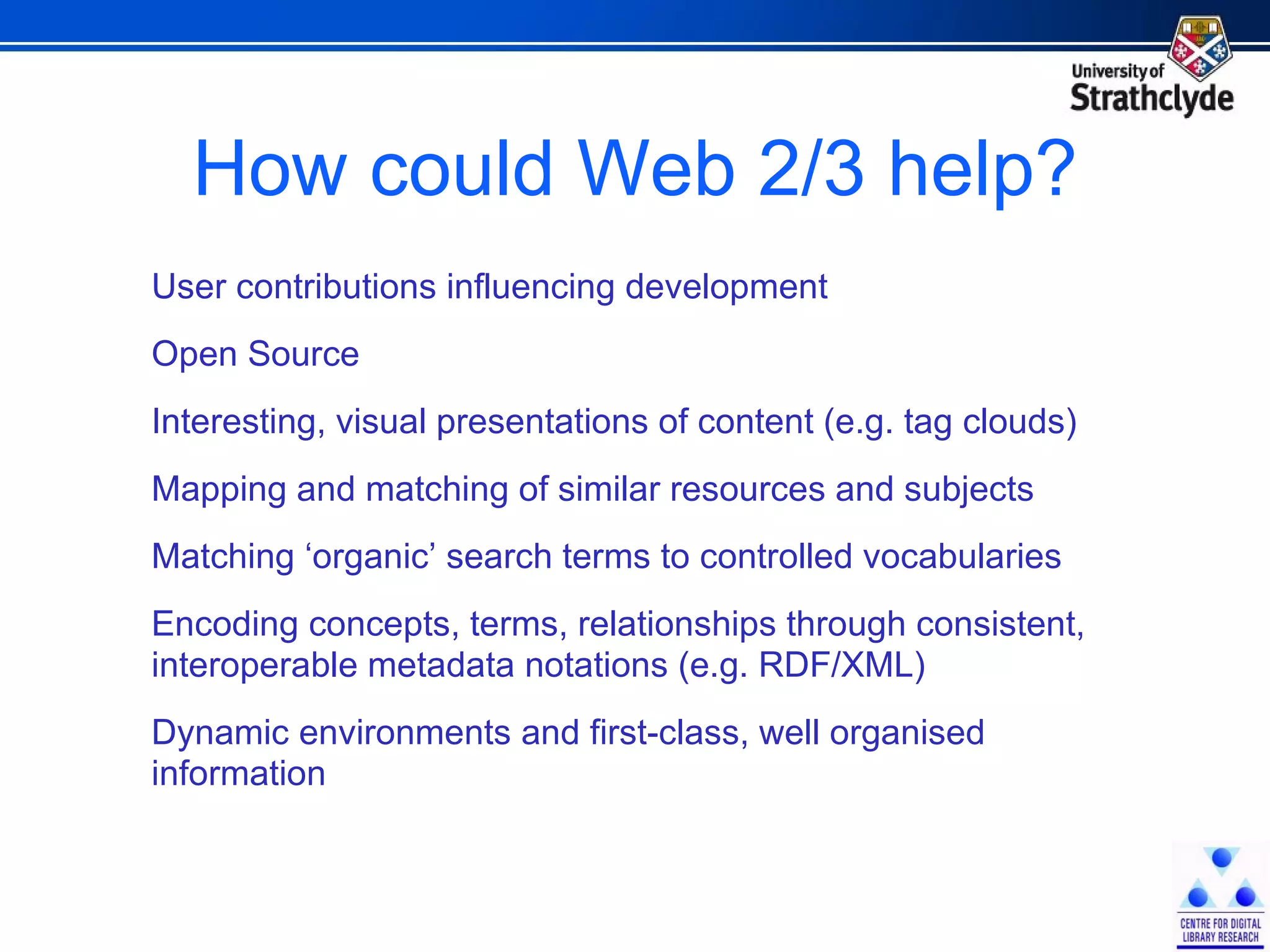
How could Web 2/3 help? User contributions influencing development Open Source Interesting, visual presentations of content (e.g. tag clouds) Mapping and matching of similar resources and subjects Matching ‘organic’ search terms to controlled vocabularies Encoding concepts, terms, relationships through consistent, interoperable metadata notations (e.g. RDF/XML) Dynamic environments and first-class, well organised  information
A focussed approach Distributing the work-load Sharing knowledge and experience Interacting directly with the user community Improving and updating services
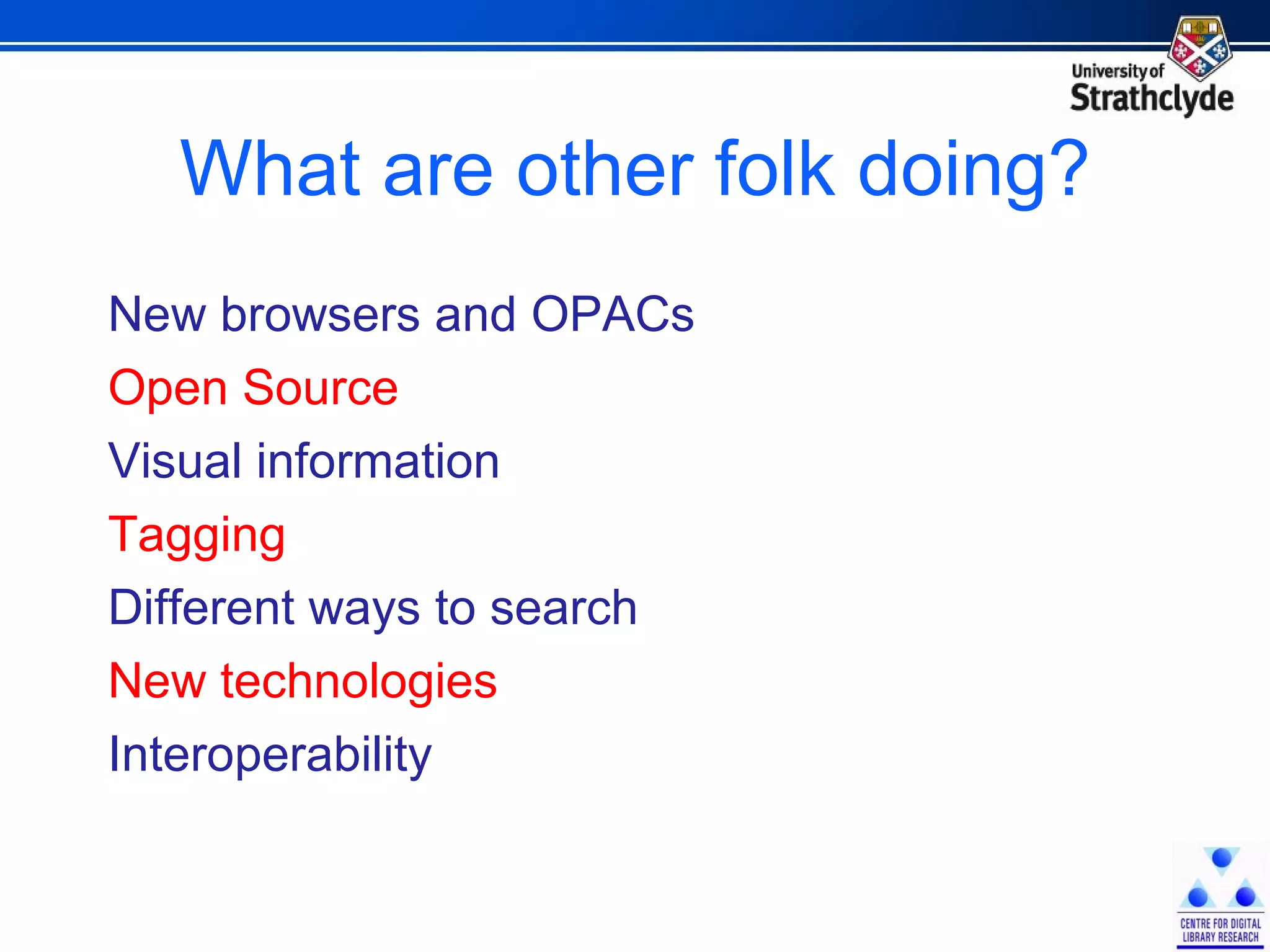
What are other folk doing? New browsers and OPACs  Open Source Visual information Tagging Different ways to search New technologies Interoperability
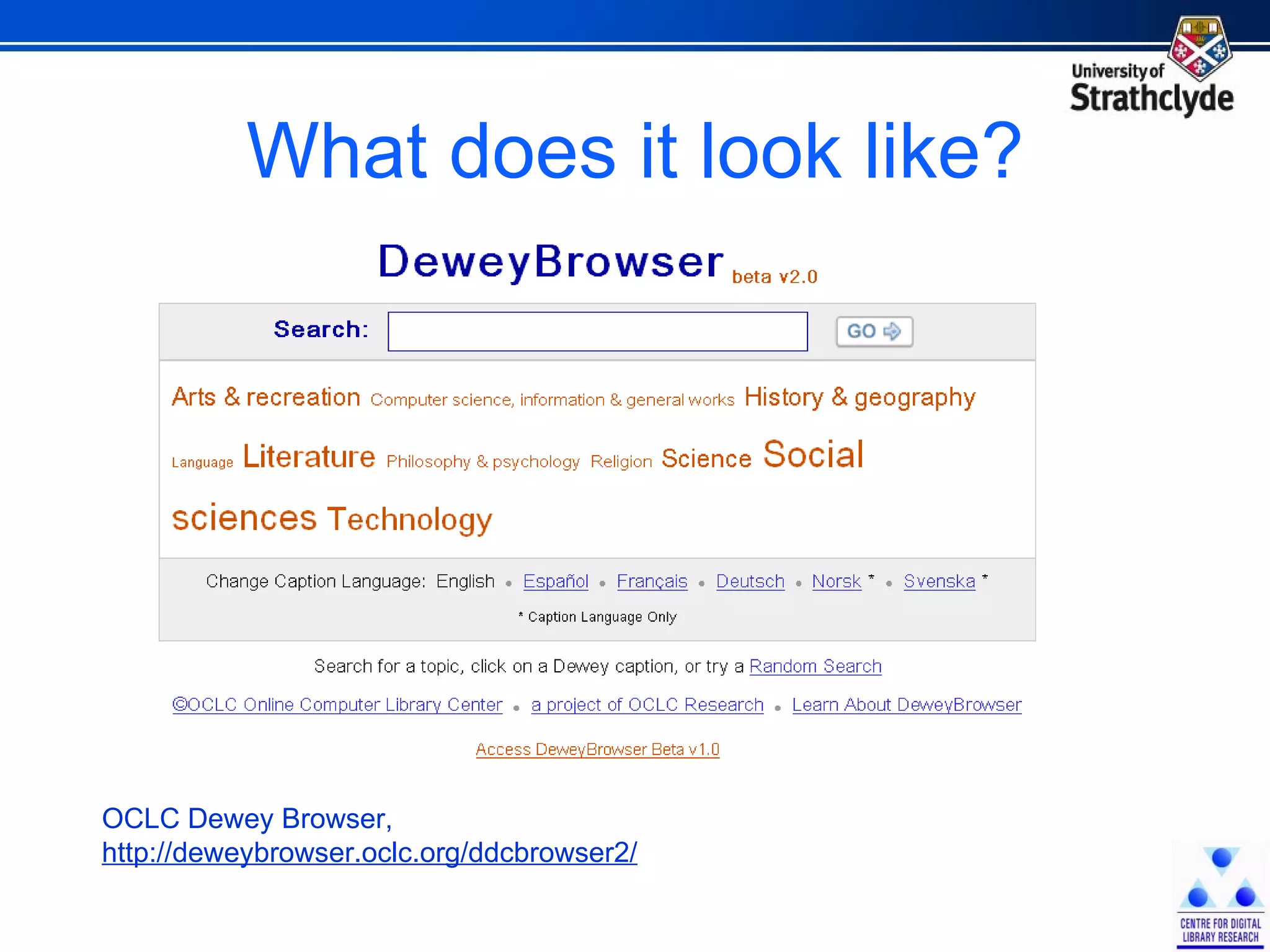
What does it look like? OCLC Dewey Browser,  http://deweybrowser.oclc.org/ddcbrowser2/
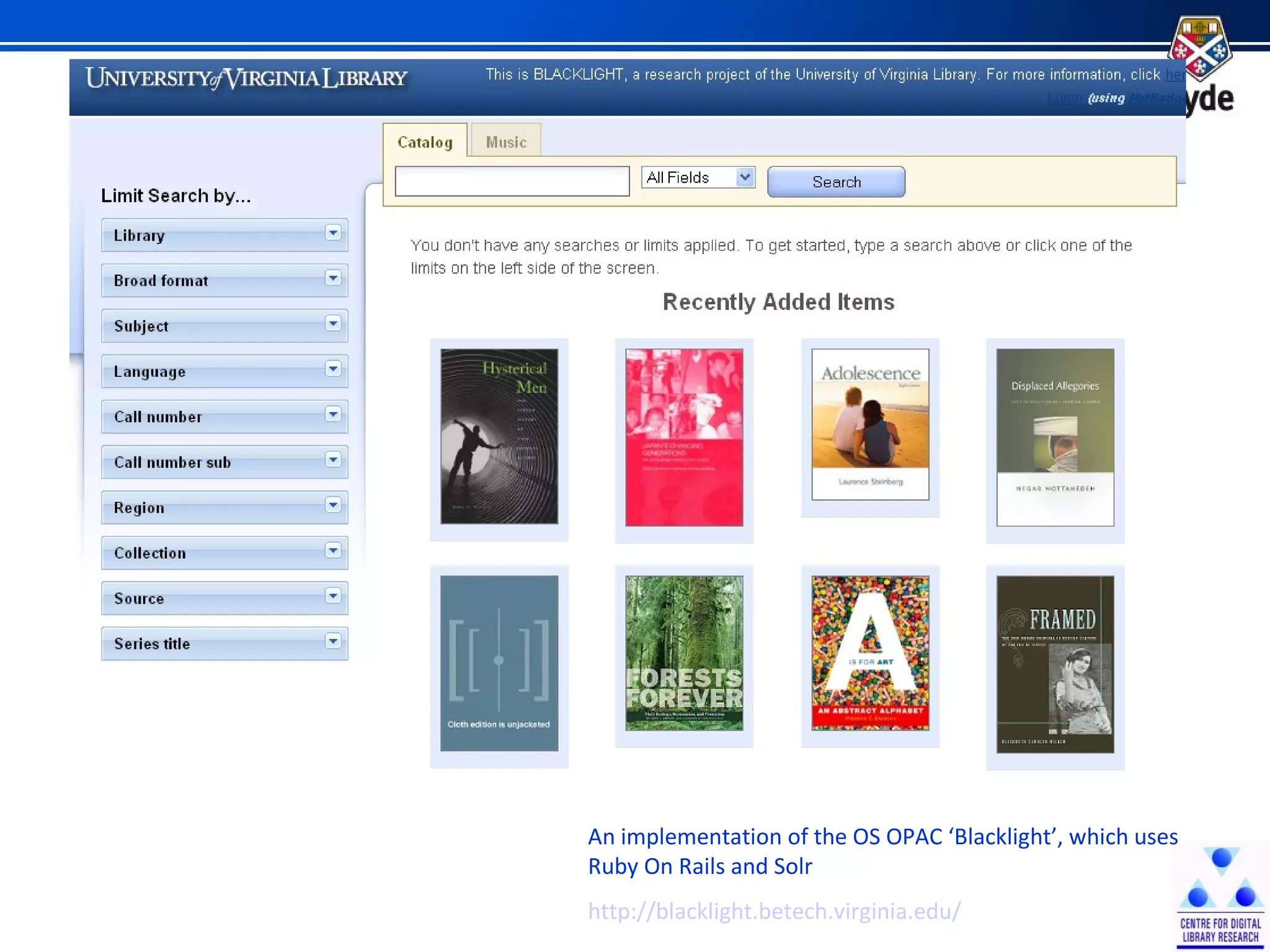
An implementation of the OS OPAC ‘Blacklight’, which uses Ruby On Rails and Solr http://blacklight.betech.virginia.edu/
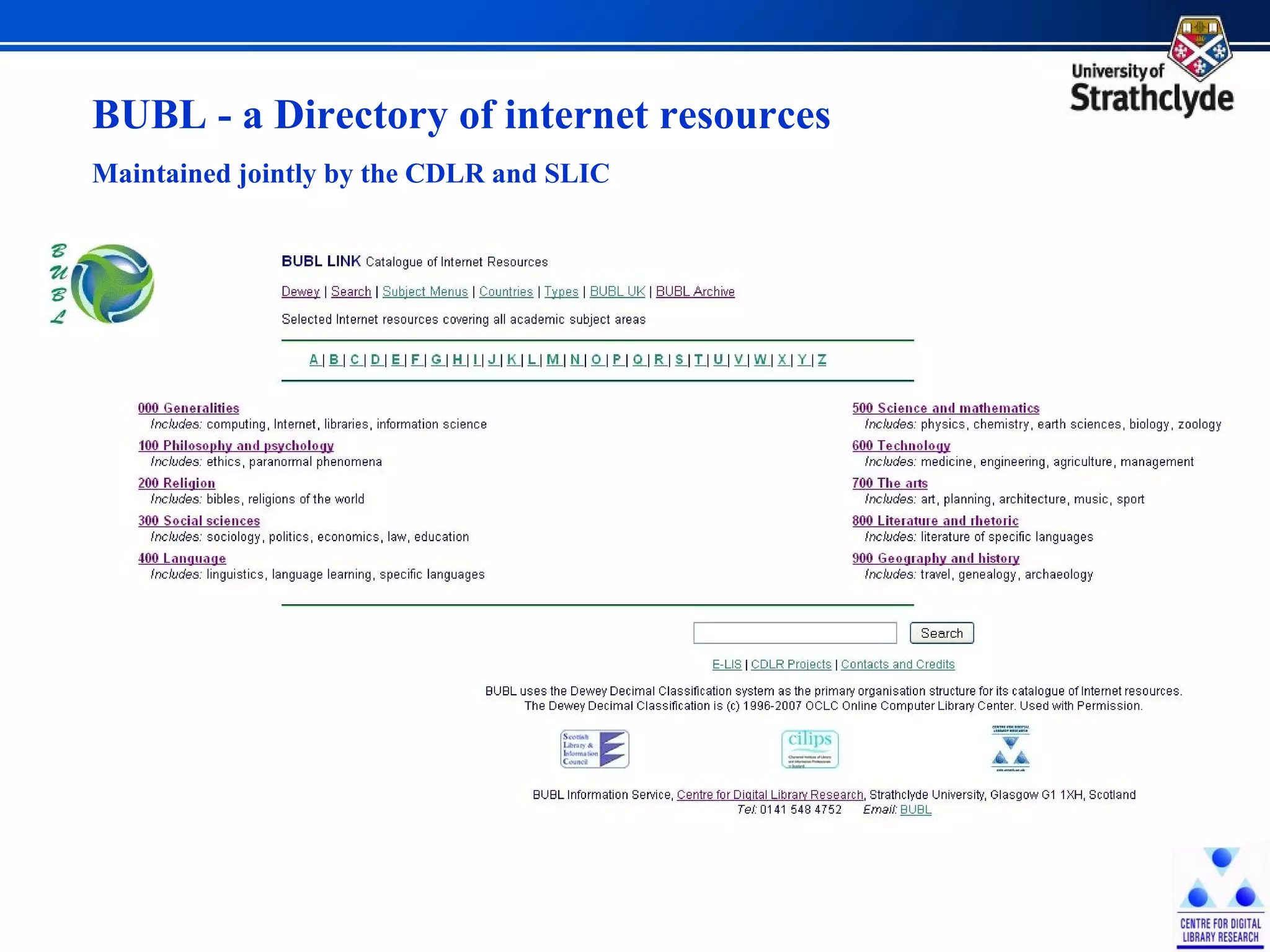
BUBL - a Directory of internet resources Maintained jointly by the CDLR and SLIC
BUBL and BUBL Community Web 2
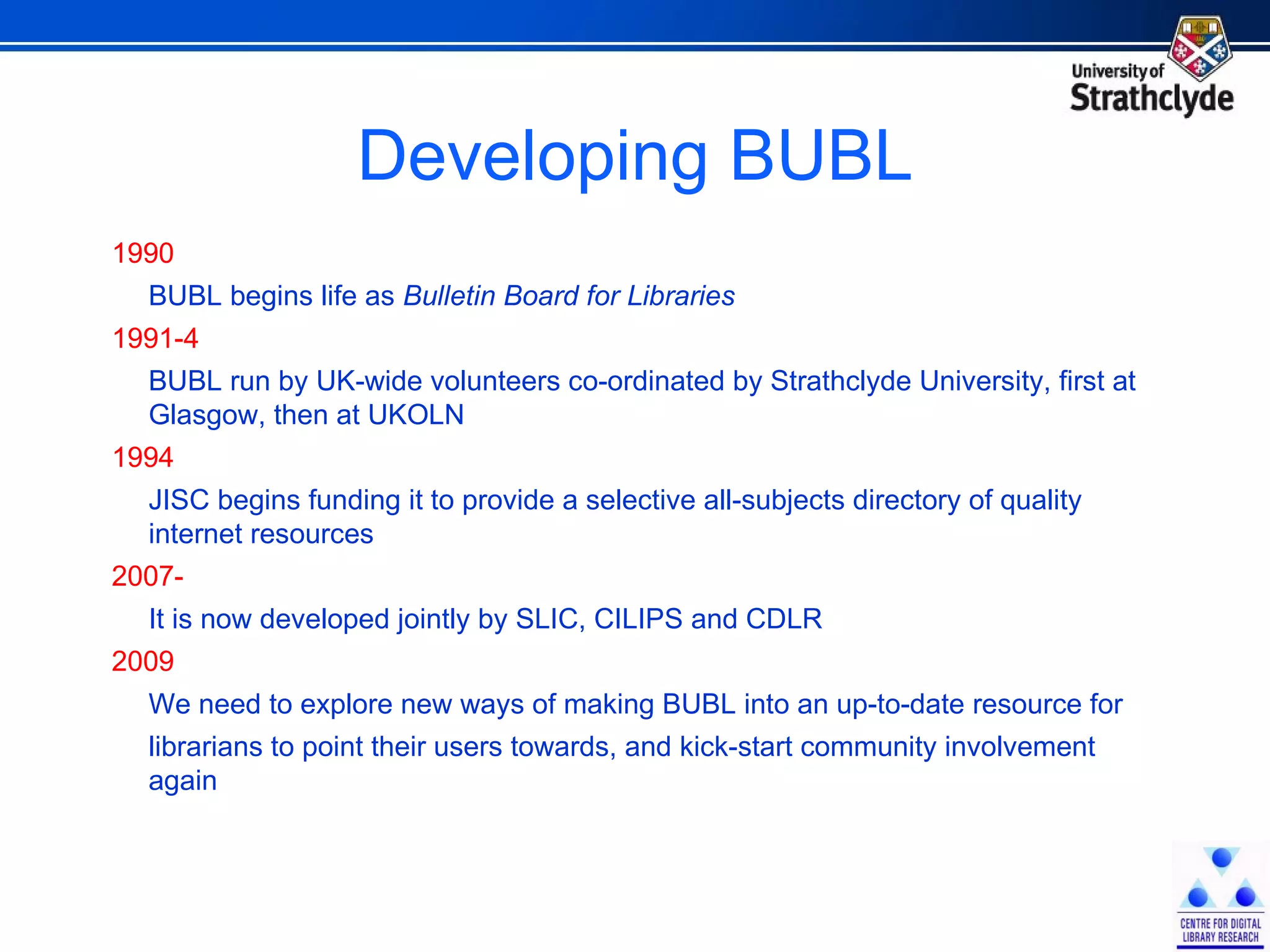
Developing BUBL 1990 BUBL begins life as  Bulletin Board for Libraries  1991-4 BUBL run by UK-wide volunteers co-ordinated by Strathclyde University, first at Glasgow, then at UKOLN 1994 JISC begins funding it to provide a selective all-subjects directory of quality internet resources  2007- It is now developed jointly by SLIC, CILIPS and CDLR  2009 We need to explore new ways of making BUBL into an up-to-date resource for librarians to point their users towards, and kick-start community involvement again
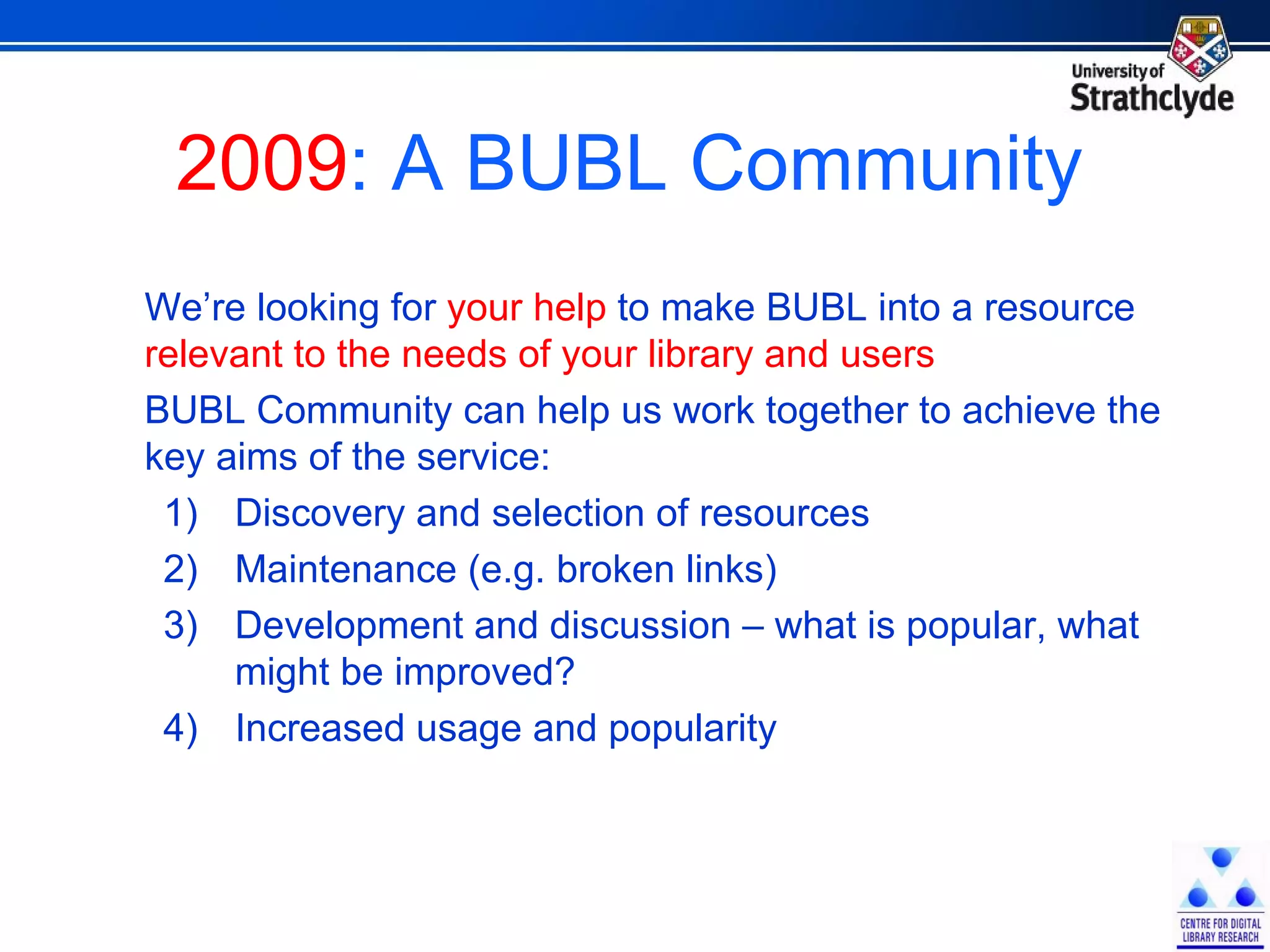
2009 : A BUBL Community We’re looking for  your help  to make BUBL into a resource  relevant to the needs of your library and users BUBL Community can help us work together to achieve the key aims of the service: Discovery and selection of resources Maintenance (e.g. broken links) Development and discussion – what is popular, what might be improved? Increased usage and popularity
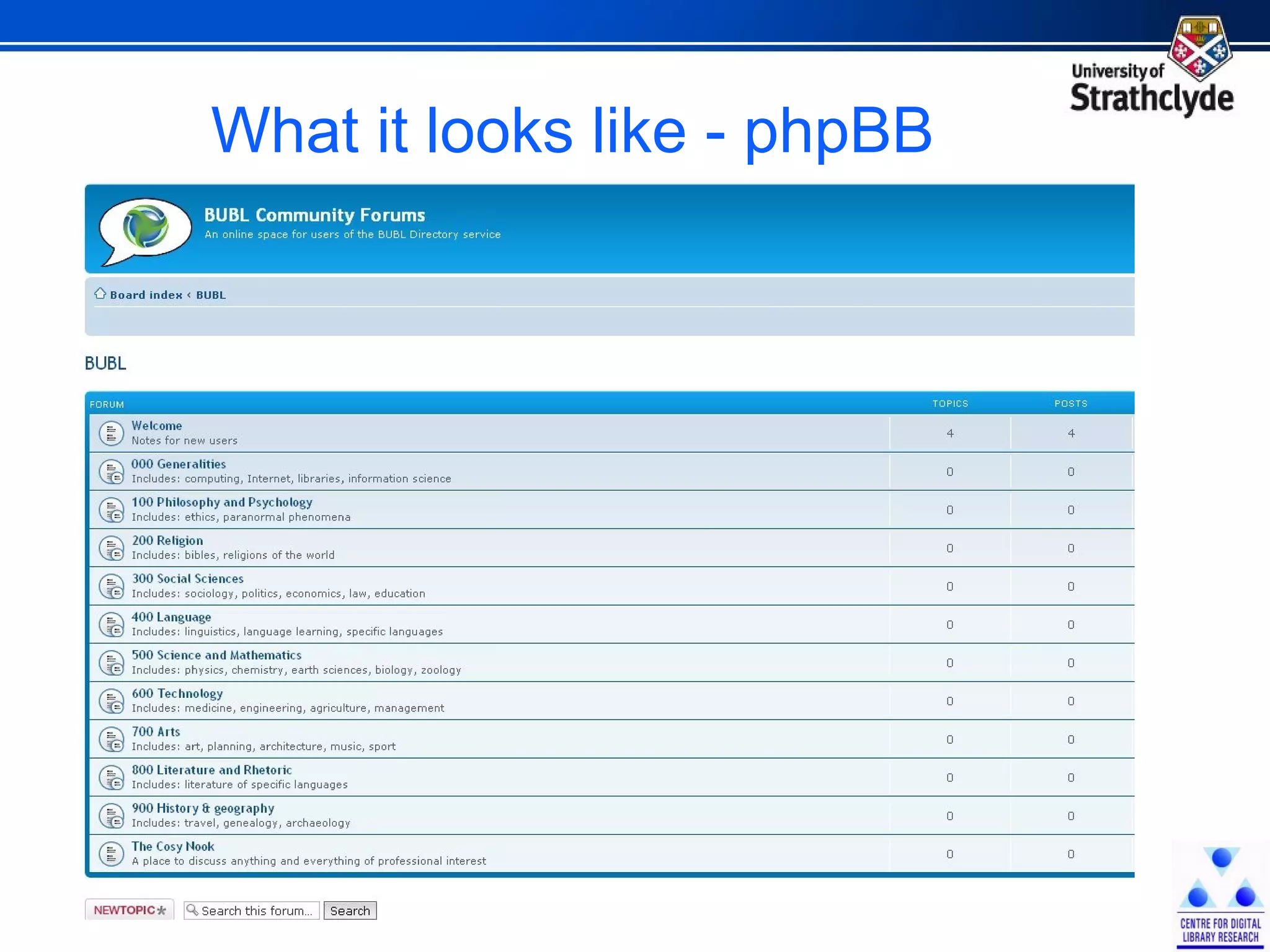
What it looks like - phpBB
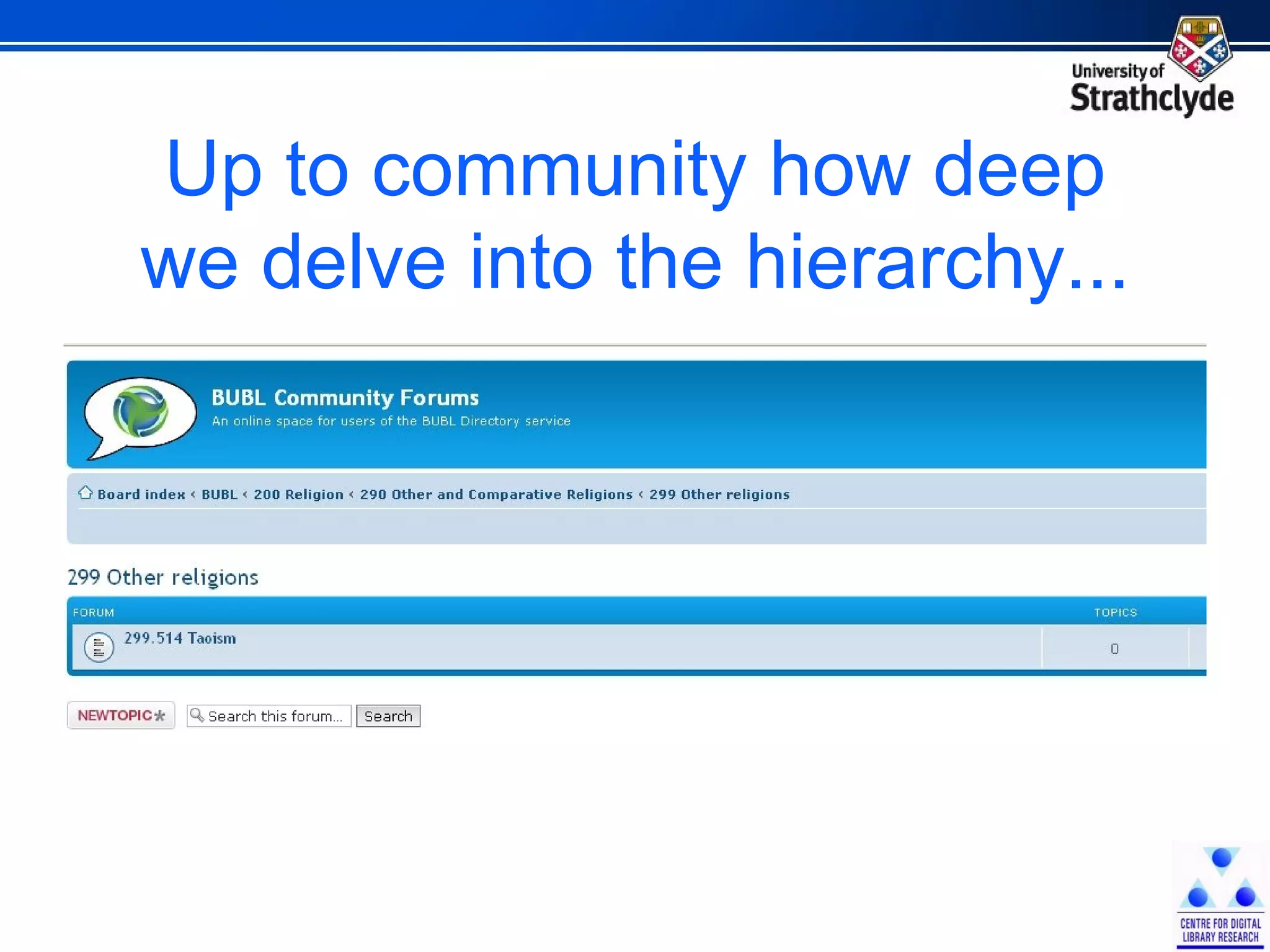
Up to community how deep we delve into the hierarchy...
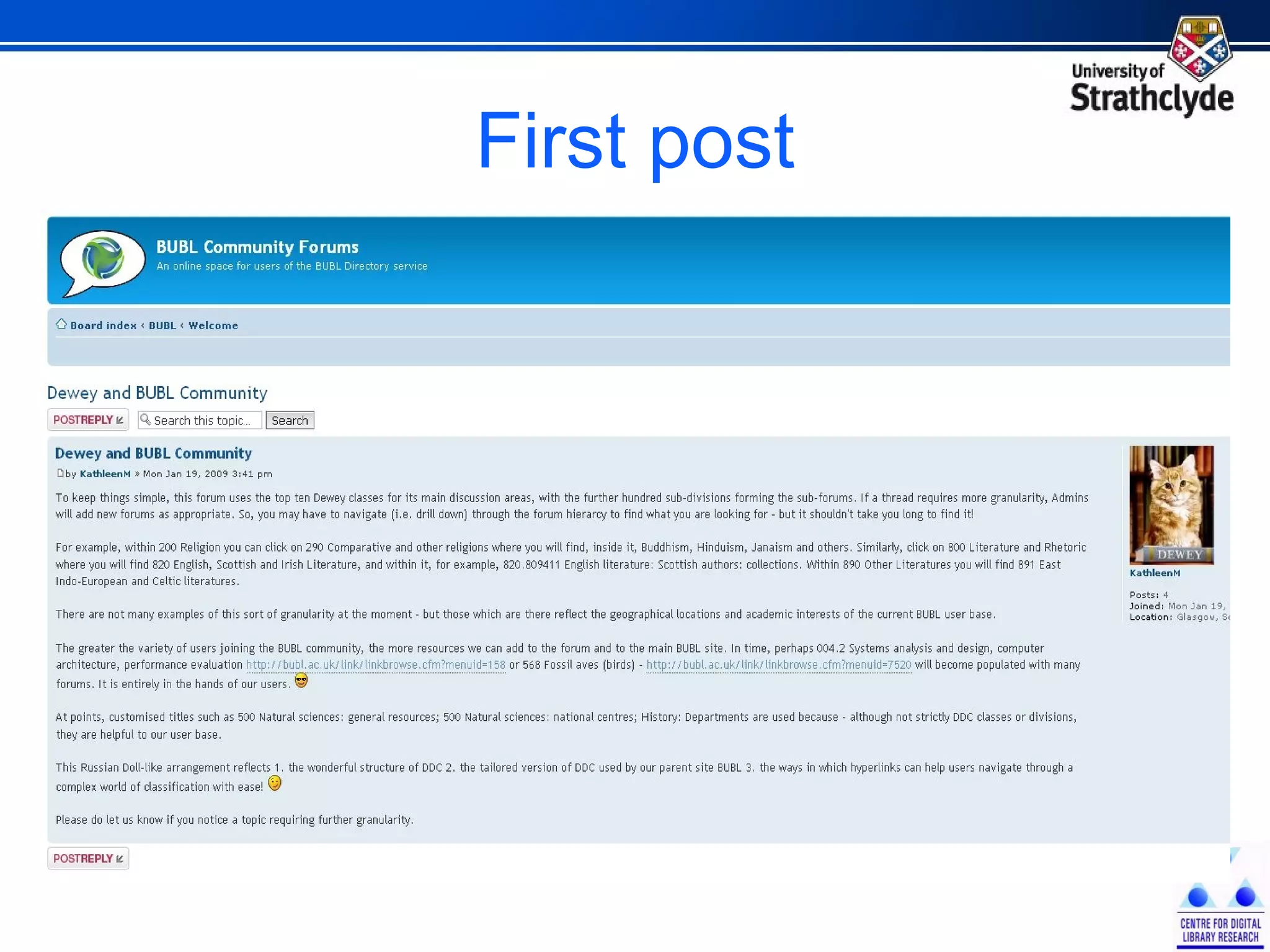
First post
Some other SIL possibilities Research Collections Online   Could adapt the CONSPECTUS collection level/depth indicator system to map high/low points of an 'information landscape' linked to a researcher's profile, which the system could remember when they visit the site. Scotland's Culture website/OPAC   This could be improved on by adding some Web 2 OPAC functionalities to move from a static list to comments, tags, Amazon front-cover image retrieval etc. A variety of ‘next generation’ OPACS/Webpacs are out there already (e.g. Keystone, Arena, WebPAC Pro, Koha, NewGenLib, Blacklight). Scottish Distributed Digital Library Open onto listed sites within SDDL navigation pane, so that users are not forced to leave site. Enable comments, ratings/reviews and tagging of resources.
HILT and Folksonomies
About HILT Based at CDLR; also involves Edina Funded by JISC as I.E. Shared Infrastructure Service Support from OCLC (DDC22 and LCSH to DDC mappings) Offers a range of terminology services, including delivery of data on individual subjects (preferred terms, non-preferred terms, related terms) ... ....from a range of subject schemes:  DDC, IPSV, AAT, CAB, GCMD, HASSET, LCSH, MeSH, NMR, SCAS, UNESCO High level mappings between some schemes and a DDC spine and some deeper mappings to assist in cross-searching services using different schemes For example: a spade, a shovel, a digging implement?
HILT and Web 2/3 At demonstrator/pilot stage Allows information services to enhance subject search and browse Offers ‘web services’ Machine to Machine (M2M) access to database of terminologies and mappings Is already a recognised part of the IE landscape, with a lot of potential to become a part of the Web 2/3 environment Could be used to help control users’ social tagging efforts Services could use it to create drop down lists of terms from a standard scheme to force taggers to use standard terms to tag resources
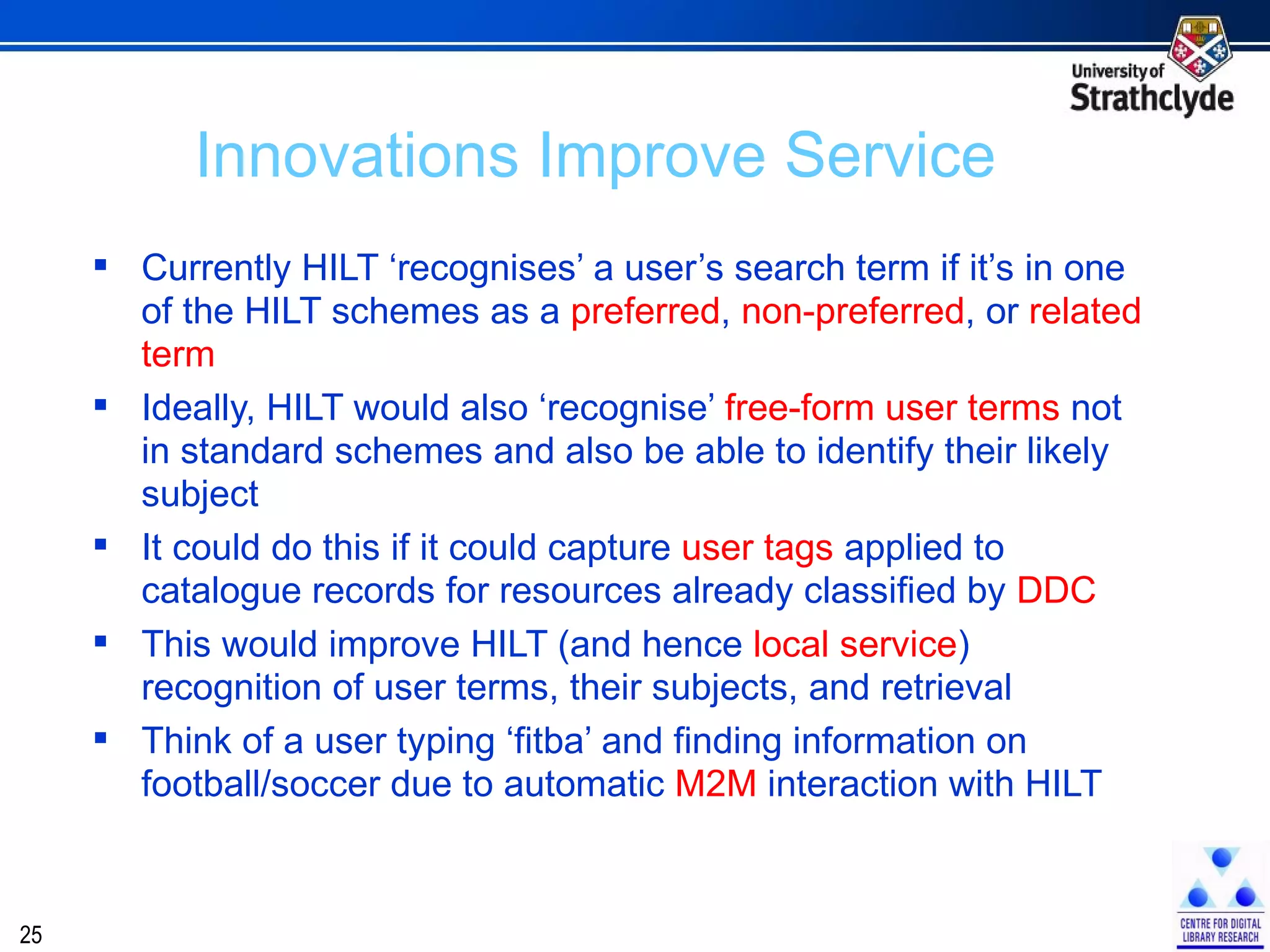
Currently HILT ‘recognises’ a user’s search term if it’s in one of the HILT schemes as a  preferred ,  non-preferred , or  related term Ideally, HILT would also ‘recognise’  free-form   user terms  not in standard schemes and also be able to identify their likely subject It could do this if it could capture  user tags  applied to catalogue records for resources already classified by  DDC This would improve HILT (and hence  local service ) recognition of user terms, their subjects, and retrieval Think of a user typing ‘fitba’ and finding information on football/soccer due to automatic  M2M  interaction with HILT Innovations Improve Service
Further Information CDLR:  http://cdlr.strath.ac.uk/  HILT phases:  http://hilt.cdlr.strath.ac.uk/  BUBL community: http://forums.bubl.cdlr.strath.ac.uk/ E-mails:  klmenzies@cis.strath.ac.uk  d.m.nicholson@strath.ac.uk

Metadata and Scotland’s information environment: potential benefits of Web 2.0

  • 1.
    Metadata and Scotland’sInformation Environment: potential benefits of Web 2.0 Metadata issues and Web 2.0 services. CIGS Seminar January 30 th 2009 Kathleen Menzies with Dennis Nicholson Centre for Digital Library Research
  • 2.
    Overview SLIC andCDLR (often with external funding): working to pioneer the development of a ‘ Scottish Information Landscape ’ (SIL) encompassing services like: CAIRNS, SCONE, RCO, SDDL One focus of CDLR work for SLIC has been investigating the potential/implications of using Web 2.0 to enhance SIL services I will mainly look at two examples relating to metadata Work-sharing and discussion/collaboration, in cataloguing BUBL using the proposed new BUBL Community forum Getting closer to user needs, looking at the possible use of ‘folksonomies’ in the HILT project
  • 3.
    Web 2.0 andScotland's Information Landscape An overview of definitions and trends
  • 4.
    What is SIL?“ Scotland's Information Landscape is a distributed information infrastructure for Scotland, designed to be sufficiently generic to support the specific activities of archives, libraries, museums, and other cultural information organizations through the sharing of common data and services” - http://scone.strath.ac.uk/scie/index.cfm Co-operative catalogues Directories Contact details, locations and opening hours Links to online resources News and updates Subject strengths
  • 5.
    Web 2 Primarilyabout the internet as a ‘platform’ Technologies and web design that aim to “enhance creativity, communications, secure information sharing, collaboration and functionality of the web” - http://en.wikipedia.org/wiki/Web_2.0 Web 2 depends on ‘mass collaboration’ This means chiefly, peer production, Open Source, collaboration, syndication of site content Web 2 services include tagging, reviews, user comments, image sharing, social book-marking
  • 6.
    Becomes Web 3...Transformation from a network of separately siloed applications and content repositories to a more seamless and interoperable whole The Semantic Web, the ‘Intelligent Web’; linking to the ‘real world’ Open technologies, open APIs and protocols, open data formats, open-source software platforms and open data (e.g. Creative Commons, Open Data License) Open identity, OpenID, open reputation, roaming portable identity and personal data The ‘intelligent’ web; Semantic Web technologies such as RDF, OWL – definitions from Nova Spivack at readwriteweb.com (http://www.readwriteweb.com/archives/on_web_30.php)
  • 7.
    Information Environment Toquote JISC: “ An Information Environment can be characterised as the set of network or online services that support publishing and use of information and learning resources… The Information Environment as it is proposed here aims to offer the user a more seamless and less complex journey to relevant information and learning resources. It is important that this activity is aligned where possible with other developments, nationally and internationally, and that it makes a leading contribution to the enhanced information use and a true democracy of learning opportunity…” - Information Environment Development Strategy (2001-2005)
  • 8.
    A Scottish approach“ The common information environment must encompass resources and services from all domains and for physical and digital formats if it is to appeal to the widest range of users. It is likely to be developed faster for digital formats…” – Dunsire, 2005, The Centre for Digital Library Research and the Common Information Environment
  • 9.
    How could Web2/3 help? User contributions influencing development Open Source Interesting, visual presentations of content (e.g. tag clouds) Mapping and matching of similar resources and subjects Matching ‘organic’ search terms to controlled vocabularies Encoding concepts, terms, relationships through consistent, interoperable metadata notations (e.g. RDF/XML) Dynamic environments and first-class, well organised information
  • 10.
    A focussed approachDistributing the work-load Sharing knowledge and experience Interacting directly with the user community Improving and updating services
  • 11.
    What are otherfolk doing? New browsers and OPACs Open Source Visual information Tagging Different ways to search New technologies Interoperability
  • 12.
    What does itlook like? OCLC Dewey Browser, http://deweybrowser.oclc.org/ddcbrowser2/
  • 13.
    An implementation ofthe OS OPAC ‘Blacklight’, which uses Ruby On Rails and Solr http://blacklight.betech.virginia.edu/
  • 14.
    BUBL - aDirectory of internet resources Maintained jointly by the CDLR and SLIC
  • 15.
    BUBL and BUBLCommunity Web 2
  • 16.
    Developing BUBL 1990BUBL begins life as Bulletin Board for Libraries 1991-4 BUBL run by UK-wide volunteers co-ordinated by Strathclyde University, first at Glasgow, then at UKOLN 1994 JISC begins funding it to provide a selective all-subjects directory of quality internet resources 2007- It is now developed jointly by SLIC, CILIPS and CDLR 2009 We need to explore new ways of making BUBL into an up-to-date resource for librarians to point their users towards, and kick-start community involvement again
  • 17.
    2009 : ABUBL Community We’re looking for your help to make BUBL into a resource relevant to the needs of your library and users BUBL Community can help us work together to achieve the key aims of the service: Discovery and selection of resources Maintenance (e.g. broken links) Development and discussion – what is popular, what might be improved? Increased usage and popularity
  • 18.
    What it lookslike - phpBB
  • 19.
    Up to communityhow deep we delve into the hierarchy...
  • 20.
  • 21.
    Some other SILpossibilities Research Collections Online Could adapt the CONSPECTUS collection level/depth indicator system to map high/low points of an 'information landscape' linked to a researcher's profile, which the system could remember when they visit the site. Scotland's Culture website/OPAC This could be improved on by adding some Web 2 OPAC functionalities to move from a static list to comments, tags, Amazon front-cover image retrieval etc. A variety of ‘next generation’ OPACS/Webpacs are out there already (e.g. Keystone, Arena, WebPAC Pro, Koha, NewGenLib, Blacklight). Scottish Distributed Digital Library Open onto listed sites within SDDL navigation pane, so that users are not forced to leave site. Enable comments, ratings/reviews and tagging of resources.
  • 22.
  • 23.
    About HILT Basedat CDLR; also involves Edina Funded by JISC as I.E. Shared Infrastructure Service Support from OCLC (DDC22 and LCSH to DDC mappings) Offers a range of terminology services, including delivery of data on individual subjects (preferred terms, non-preferred terms, related terms) ... ....from a range of subject schemes: DDC, IPSV, AAT, CAB, GCMD, HASSET, LCSH, MeSH, NMR, SCAS, UNESCO High level mappings between some schemes and a DDC spine and some deeper mappings to assist in cross-searching services using different schemes For example: a spade, a shovel, a digging implement?
  • 24.
    HILT and Web2/3 At demonstrator/pilot stage Allows information services to enhance subject search and browse Offers ‘web services’ Machine to Machine (M2M) access to database of terminologies and mappings Is already a recognised part of the IE landscape, with a lot of potential to become a part of the Web 2/3 environment Could be used to help control users’ social tagging efforts Services could use it to create drop down lists of terms from a standard scheme to force taggers to use standard terms to tag resources
  • 25.
    Currently HILT ‘recognises’a user’s search term if it’s in one of the HILT schemes as a preferred , non-preferred , or related term Ideally, HILT would also ‘recognise’ free-form user terms not in standard schemes and also be able to identify their likely subject It could do this if it could capture user tags applied to catalogue records for resources already classified by DDC This would improve HILT (and hence local service ) recognition of user terms, their subjects, and retrieval Think of a user typing ‘fitba’ and finding information on football/soccer due to automatic M2M interaction with HILT Innovations Improve Service
  • 26.
    Further Information CDLR: http://cdlr.strath.ac.uk/ HILT phases: http://hilt.cdlr.strath.ac.uk/ BUBL community: http://forums.bubl.cdlr.strath.ac.uk/ E-mails: klmenzies@cis.strath.ac.uk d.m.nicholson@strath.ac.uk

Editor's Notes

  • #2 12.20-13.00: Metadata and Scotland’s information environment: potential benefits of Web 2.0 / Kathleen Menzies and Dennis Nicholson (Centre for Digital Library Research, Strathclyde University). This presentation will report on a project funded by the Scottish Library and Information Council, and discuss ways of benefitting cataloguing and end-user activities through the use of Web 2.0.