The Sales Funnel
Introduction
A predictable sales funnel is something that every company looks for to
help them make effective business decisions. Unfortunately, predicting
revenue is one thing that proves to be extremely difficult to pin down and
hard to achieve if you are not using a standardize set of best practices and
staying on top of what is feeding into and flowing through the sales funnel.
As a sales representative, having an accurate picture of your sales funnel
helps you run your business more effectively and smoothly.
Some sales people are very good at managing their sales funnel while
others are not accurate at all. This is why a good sales funnel management
process is important. Without a process that works well, sales projections
become subjective and unpredictable. And unfortunately, that subjectivity is
usually amplified as it passes through each layer of our organization
What is a Sales Funnel?
A sales funnel is a visual representation of a sales pipeline. Many sales
organizations use the image of a funnel to represent the sales process. It’s
a useful model because it’s very visual.
Your sales funnel allows you to look at the overall health of all the leads
feeding into your funnel, the deals moving through your pipeline, and the
new accounts that flow out. A single glance will tell you exactly where you
stand and where you need to focus your sales activities.
The visualization categorizes the stages of a sales pipeline. The sales
funnel shows at the top the leads (suspects) entering the funnel, becoming
prospects and closing as customers. The funnel is a useful tool for
organizing specific sales opportunities by their probability of resulting in a
sale.
Sales funnel management helps you estimate the probability that enough
opportunities are moving towards closure to keep revenue flowing for a
period of time. A robust sales funnel is a good leading indicator of medium
to long-term health of your team’s sales efforts and helps you predict your
sales forecast.
The sales funnel describes the actual conversion of prospects into new
customers. It is called as such because it includes the conversion ratio at
each stage of the sales cycle, which has a funneling effect. By using the
sales funnel, and by quantifying the number of prospects at each stage of
the process, you can predict the number of prospects who will, in time,
become customers.
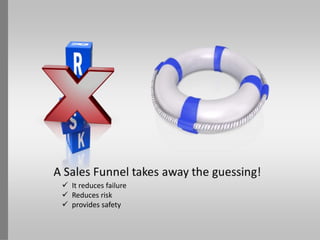
Should Sales be a guessing game?
 It reduces failure
 Reduces risk
 provides safety
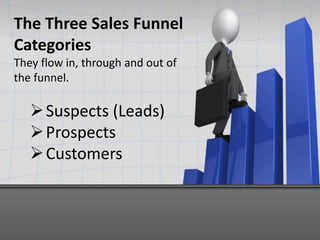
The Three Sales Funnel
Categories
They flow in, through and out of
the funnel.
Suspects (Leads)
Prospects
Customers
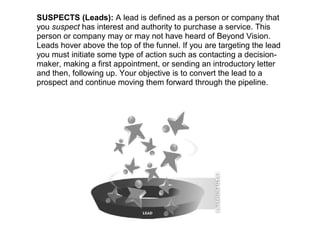
SUSPECTS (Leads): A lead is defined as a person or company that
you suspect has interest and authority to purchase a service. This
person or company may or may not have heard of Beyond Vision.
Leads hover above the top of the funnel. If you are targeting the lead
you must initiate some type of action such as contacting a decision-
maker, making a first appointment, or sending an introductory letter
and then, following up. Your objective is to convert the lead to a
prospect and continue moving them forward through the pipeline.
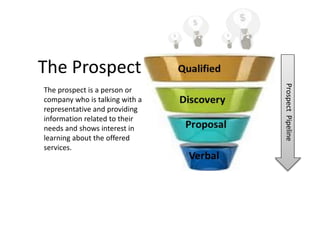
The Prospect
ProspectPipeline
The prospect is a person or
company who is talking with a
representative and providing
information related to their
needs and shows interest in
learning about the offered
services.
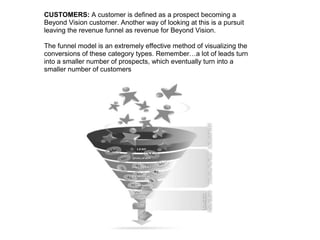
CUSTOMERS: A customer is defined as a prospect becoming a
Beyond Vision customer. Another way of looking at this is a pursuit
leaving the revenue funnel as revenue for Beyond Vision.
The funnel model is an extremely effective method of visualizing the
conversions of these category types. Remember…a lot of leads turn
into a smaller number of prospects, which eventually turn into a
smaller number of customers
Sales Stages Overview
Each sales stage within the sales funnel has
distinct criteria to help you know where you are at
within the sales cycle.
LEAD: The Lead sales stage is the identification of a person or company
that you suspect has interest and authority to purchase a service. This step
is the entry point of the pipeline. Outside sales channels prospect leads
with the objective of reaching the decision-maker and setting up a first
appointment. Inside sales channels prospect leads with the objective of
reaching the decision-maker and closing the opportunity in a short time
frame. Leads can be assigned to a sales representative or the sales
representative may discover the lead while in the field, through networking,
or other lead sources. Before converting a Lead, a sales representative
must determine if the customer is interested in learning about our services.
In the Lead sales stage, ask yourself, “Can I sell this account now?”
As you begin to pursue a lead, qualify it by obtaining the following
information:
 Decision-maker
 Current supplier(s)
 Current provider for services or products
 Contractual obligations
QUALIFIED: In this sales stage, a person or company has expressed
interest in our service and provided us information related to their specific
need(s). The “lead” is now a “prospect.” Either the customer contacted
Beyond Vision or they agreed to meet with you to discuss the possibility of
using us as their supplier. During this sales stage, the sales representative
asks the customer a series of questions to understand their service
requirements and needs, decision-making process, and any current
contractual obligations. In return, the customer is providing the sales
representative with the information.
If a sales representative is able gather all the information required in the
Qualified and Discovery sales stages in a single visit or telephone call, they
are ready to move forward to the Proposal stage. Before doing so, they
must also gain the customer’s commitment to review a proposal.
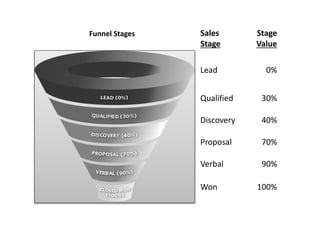
The probability of closing the deal is estimated at 30%.
DISCOVERY: During this stage, the sales representative is continuing to
gather information related to the customer’s needs. They would use this
sales stage if they were unable to uncover the customer’s needs in a single
visit (or telephone call) and have scheduled additional follow-up visits (i.e.
site surveys, meetings with additional decision-makers). In addition, given
the complexity of the customer’s needs, the sales representative may be
collaborating with the customer to develop a value proposition.
Finally, as the sales representative develops the value proposition, they
may be confirming the feasibility of possible solutions internally before they
create the written proposal. Before moving on to the Proposal stage, the
sales representative must have a complete understanding of the
customer’s needs and a scheduled meeting to review the proposal.
The probability of closing the deal is estimated at 40%.
PROPOSAL: During the Proposal stage, the sales representative has a full
understanding of the customer’s need(s) and their specific requirements; they
are developing the proposal, which includes an optimal service solution and
pricing. The decision-maker has committed to reviewing a formal proposal with
pricing. The sales representative may be negotiating the final terms and
conditions of the agreement in order to finalize the details in preparation of the
signed Service agreement (customer’s contract).
The probability of closing the deal is estimated at 70%.
VERBAL: During the Verbal stage, the customer has provided a verbal
commitment but the sales representative has not obtained a signed
Service Agreement (customer’s contract). They have a scheduled next
step (i.e. a follow-up meeting or sent a Service Agreement for signature) to
obtain that signed Service Agreement (customer’s contract).
The probability of closing the deal is estimated at 90%.
CLOSED WON: The sales representative has won the business and if
required, has obtained a signed Service Agreement. The customer has
agreed to all terms and conditions and they are attending to all set-up and
delivery activities to ensure a seamless transition.
CLOSED LOST: The customer has decided not to award the business.
Before the sales representative updates the sales stage, they should follow
up with the customer to solicit feedback regarding their final decision and
request to stay-in-touch. If the business was awarded to a competitor, they
should gather information about the competitor, the contract expiration date,
and the competitor’s value proposition. While the sales representative lost
the business, they will want to pursue them again in the future. To ensure
this is done, they should create a follow up activity in Salesforce.com as a
reminder to initiate the sales process. When they begin to pursue the
customer again, the opportunity begins at the start of the pipeline.
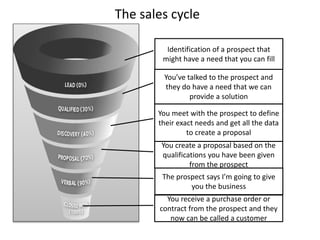
Identification of a prospect that
might have a need that you can fill
You’ve talked to the prospect and
they do have a need that we can
provide a solution
You meet with the prospect to define
their exact needs and get all the data
to create a proposal
You create a proposal based on the
qualifications you have been given
from the prospect
The prospect says I’m going to give
you the business
You receive a purchase order or
contract from the prospect and they
now can be called a customer
The sales cycle
Sales
Stage
Stage
Value
Lead 0%
Qualified 30%
Discovery 40%
Proposal 70%
Verbal 90%
Won 100%
Funnel Stages
Sales
Stage
Stage
Value
Lead 0%
Qualified 30%
Discovery 40%
Proposal 70%
Verbal 90%
Won 100%
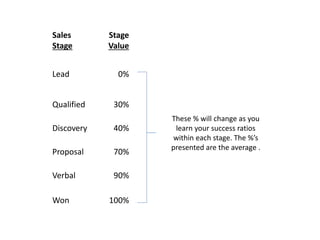
These % will change as you
learn your success ratios
within each stage. The %’s
presented are the average .
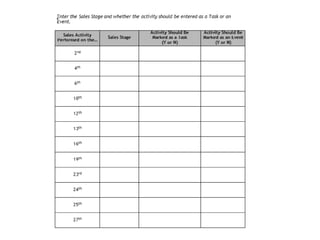
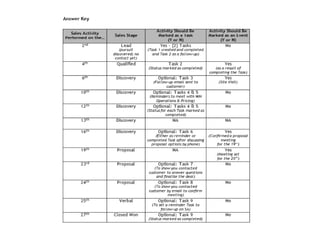
Activity: Day in the Life of a
Sales Representative
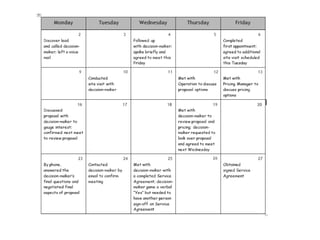
On the next slide is a quiz representing a 30-
day calendar containing a set of prospecting
activities performed by a sales
representative as they target a new business
pursuit. Given the calendar activities,
identify the appropriate sales stage. Decide
if a sales representative should enter the
activity as a Task or an Event in
Salesforce.com.
The sales funnel
The sales funnel
The sales funnel
The sales funnel

The sales funnel

  • 2.
    The Sales Funnel Introduction Apredictable sales funnel is something that every company looks for to help them make effective business decisions. Unfortunately, predicting revenue is one thing that proves to be extremely difficult to pin down and hard to achieve if you are not using a standardize set of best practices and staying on top of what is feeding into and flowing through the sales funnel. As a sales representative, having an accurate picture of your sales funnel helps you run your business more effectively and smoothly. Some sales people are very good at managing their sales funnel while others are not accurate at all. This is why a good sales funnel management process is important. Without a process that works well, sales projections become subjective and unpredictable. And unfortunately, that subjectivity is usually amplified as it passes through each layer of our organization
  • 3.
    What is aSales Funnel? A sales funnel is a visual representation of a sales pipeline. Many sales organizations use the image of a funnel to represent the sales process. It’s a useful model because it’s very visual. Your sales funnel allows you to look at the overall health of all the leads feeding into your funnel, the deals moving through your pipeline, and the new accounts that flow out. A single glance will tell you exactly where you stand and where you need to focus your sales activities. The visualization categorizes the stages of a sales pipeline. The sales funnel shows at the top the leads (suspects) entering the funnel, becoming prospects and closing as customers. The funnel is a useful tool for organizing specific sales opportunities by their probability of resulting in a sale. Sales funnel management helps you estimate the probability that enough opportunities are moving towards closure to keep revenue flowing for a period of time. A robust sales funnel is a good leading indicator of medium to long-term health of your team’s sales efforts and helps you predict your sales forecast. The sales funnel describes the actual conversion of prospects into new customers. It is called as such because it includes the conversion ratio at each stage of the sales cycle, which has a funneling effect. By using the sales funnel, and by quantifying the number of prospects at each stage of the process, you can predict the number of prospects who will, in time, become customers.
  • 4.
    Should Sales bea guessing game?
  • 5.
     It reducesfailure  Reduces risk  provides safety
  • 6.
    The Three SalesFunnel Categories They flow in, through and out of the funnel. Suspects (Leads) Prospects Customers
  • 7.
    SUSPECTS (Leads): Alead is defined as a person or company that you suspect has interest and authority to purchase a service. This person or company may or may not have heard of Beyond Vision. Leads hover above the top of the funnel. If you are targeting the lead you must initiate some type of action such as contacting a decision- maker, making a first appointment, or sending an introductory letter and then, following up. Your objective is to convert the lead to a prospect and continue moving them forward through the pipeline.
  • 8.
    The Prospect ProspectPipeline The prospectis a person or company who is talking with a representative and providing information related to their needs and shows interest in learning about the offered services.
  • 9.
    CUSTOMERS: A customeris defined as a prospect becoming a Beyond Vision customer. Another way of looking at this is a pursuit leaving the revenue funnel as revenue for Beyond Vision. The funnel model is an extremely effective method of visualizing the conversions of these category types. Remember…a lot of leads turn into a smaller number of prospects, which eventually turn into a smaller number of customers
  • 10.
    Sales Stages Overview Eachsales stage within the sales funnel has distinct criteria to help you know where you are at within the sales cycle.
  • 11.
    LEAD: The Leadsales stage is the identification of a person or company that you suspect has interest and authority to purchase a service. This step is the entry point of the pipeline. Outside sales channels prospect leads with the objective of reaching the decision-maker and setting up a first appointment. Inside sales channels prospect leads with the objective of reaching the decision-maker and closing the opportunity in a short time frame. Leads can be assigned to a sales representative or the sales representative may discover the lead while in the field, through networking, or other lead sources. Before converting a Lead, a sales representative must determine if the customer is interested in learning about our services. In the Lead sales stage, ask yourself, “Can I sell this account now?” As you begin to pursue a lead, qualify it by obtaining the following information:  Decision-maker  Current supplier(s)  Current provider for services or products  Contractual obligations
  • 12.
    QUALIFIED: In thissales stage, a person or company has expressed interest in our service and provided us information related to their specific need(s). The “lead” is now a “prospect.” Either the customer contacted Beyond Vision or they agreed to meet with you to discuss the possibility of using us as their supplier. During this sales stage, the sales representative asks the customer a series of questions to understand their service requirements and needs, decision-making process, and any current contractual obligations. In return, the customer is providing the sales representative with the information. If a sales representative is able gather all the information required in the Qualified and Discovery sales stages in a single visit or telephone call, they are ready to move forward to the Proposal stage. Before doing so, they must also gain the customer’s commitment to review a proposal. The probability of closing the deal is estimated at 30%.
  • 13.
    DISCOVERY: During thisstage, the sales representative is continuing to gather information related to the customer’s needs. They would use this sales stage if they were unable to uncover the customer’s needs in a single visit (or telephone call) and have scheduled additional follow-up visits (i.e. site surveys, meetings with additional decision-makers). In addition, given the complexity of the customer’s needs, the sales representative may be collaborating with the customer to develop a value proposition. Finally, as the sales representative develops the value proposition, they may be confirming the feasibility of possible solutions internally before they create the written proposal. Before moving on to the Proposal stage, the sales representative must have a complete understanding of the customer’s needs and a scheduled meeting to review the proposal. The probability of closing the deal is estimated at 40%.
  • 14.
    PROPOSAL: During theProposal stage, the sales representative has a full understanding of the customer’s need(s) and their specific requirements; they are developing the proposal, which includes an optimal service solution and pricing. The decision-maker has committed to reviewing a formal proposal with pricing. The sales representative may be negotiating the final terms and conditions of the agreement in order to finalize the details in preparation of the signed Service agreement (customer’s contract). The probability of closing the deal is estimated at 70%.
  • 15.
    VERBAL: During theVerbal stage, the customer has provided a verbal commitment but the sales representative has not obtained a signed Service Agreement (customer’s contract). They have a scheduled next step (i.e. a follow-up meeting or sent a Service Agreement for signature) to obtain that signed Service Agreement (customer’s contract). The probability of closing the deal is estimated at 90%.
  • 16.
    CLOSED WON: Thesales representative has won the business and if required, has obtained a signed Service Agreement. The customer has agreed to all terms and conditions and they are attending to all set-up and delivery activities to ensure a seamless transition. CLOSED LOST: The customer has decided not to award the business. Before the sales representative updates the sales stage, they should follow up with the customer to solicit feedback regarding their final decision and request to stay-in-touch. If the business was awarded to a competitor, they should gather information about the competitor, the contract expiration date, and the competitor’s value proposition. While the sales representative lost the business, they will want to pursue them again in the future. To ensure this is done, they should create a follow up activity in Salesforce.com as a reminder to initiate the sales process. When they begin to pursue the customer again, the opportunity begins at the start of the pipeline.
  • 17.
    Identification of aprospect that might have a need that you can fill You’ve talked to the prospect and they do have a need that we can provide a solution You meet with the prospect to define their exact needs and get all the data to create a proposal You create a proposal based on the qualifications you have been given from the prospect The prospect says I’m going to give you the business You receive a purchase order or contract from the prospect and they now can be called a customer The sales cycle
  • 18.
    Sales Stage Stage Value Lead 0% Qualified 30% Discovery40% Proposal 70% Verbal 90% Won 100% Funnel Stages
  • 19.
    Sales Stage Stage Value Lead 0% Qualified 30% Discovery40% Proposal 70% Verbal 90% Won 100% These % will change as you learn your success ratios within each stage. The %’s presented are the average .
  • 20.
    Activity: Day inthe Life of a Sales Representative On the next slide is a quiz representing a 30- day calendar containing a set of prospecting activities performed by a sales representative as they target a new business pursuit. Given the calendar activities, identify the appropriate sales stage. Decide if a sales representative should enter the activity as a Task or an Event in Salesforce.com.