Victorian SchoolsVictorian Schools
ByBy
Amena AmirAmena Amir
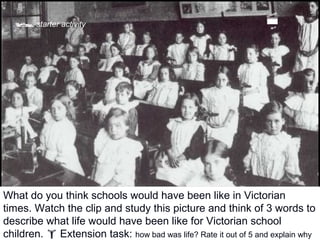
What do you think schools would have been like in Victorian
times. Watch the clip and study this picture and think of 3 words to
describe what life would have been like for Victorian school
children.  Extension task: how bad was life? Rate it out of 5 and explain why
starter activity 
Victorian schoolsVictorian schools
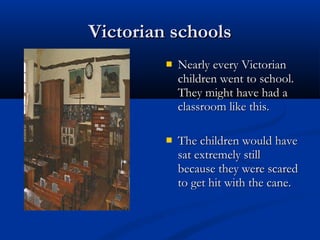
 Nearly every VictorianNearly every Victorian
children went to school.children went to school.
They might have had aThey might have had a
classroom like this.classroom like this.
 The children would haveThe children would have
sat extremely stillsat extremely still
because they were scaredbecause they were scared
to get hit with the cane.to get hit with the cane.
The TeachersThe Teachers
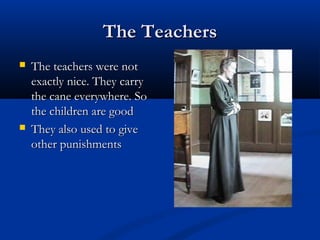
 The teachers were notThe teachers were not
exactly nice. They carryexactly nice. They carry
the cane everywhere. Sothe cane everywhere. So
the children are goodthe children are good
 They also used to giveThey also used to give
other punishmentsother punishments
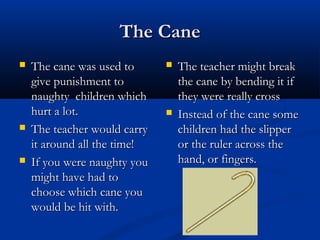
The CaneThe Cane
 The cane was used toThe cane was used to
give punishment togive punishment to
naughty children whichnaughty children which
hurt a lot.hurt a lot.
 The teacher would carryThe teacher would carry
it around all the time!it around all the time!
 If you were naughty youIf you were naughty you
might have had tomight have had to
choose which cane youchoose which cane you
would be hit with.would be hit with.
 The teacher might breakThe teacher might break
the cane by bending it ifthe cane by bending it if
they were really crossthey were really cross
 Instead of the cane someInstead of the cane some
children had the slipperchildren had the slipper
or the ruler across theor the ruler across the
hand, or fingers.hand, or fingers.
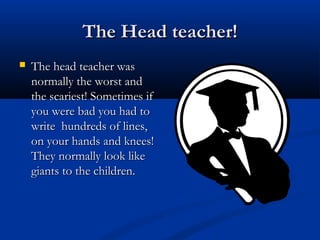
The Head teacher!The Head teacher!
 The head teacher wasThe head teacher was
normally the worst andnormally the worst and
the scariest! Sometimes ifthe scariest! Sometimes if
you were bad you had toyou were bad you had to
write hundreds of lines,write hundreds of lines,
on your hands and knees!on your hands and knees!
They normally look likeThey normally look like
giants to the children.giants to the children.
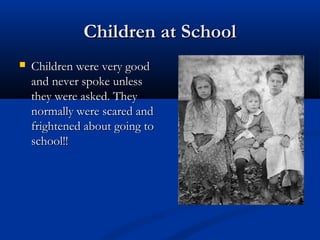
Children at SchoolChildren at School
 Children were very goodChildren were very good
and never spoke unlessand never spoke unless
they were asked. Theythey were asked. They
normally were scared andnormally were scared and
frightened about going tofrightened about going to
school!!school!!
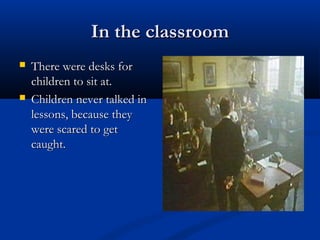
In the classroomIn the classroom
 There were desks forThere were desks for
children to sit at.children to sit at.
 Children never talked inChildren never talked in
lessons, because theylessons, because they
were scared to getwere scared to get
caught.caught.
Playtime!Playtime!
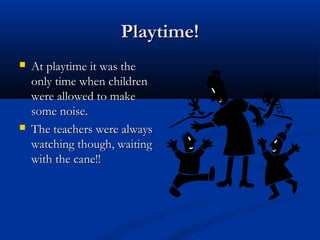
 At playtime it was theAt playtime it was the
only time when childrenonly time when children
were allowed to makewere allowed to make
some noise.some noise.
 The teachers were alwaysThe teachers were always
watching though, waitingwatching though, waiting
with the cane!!with the cane!!
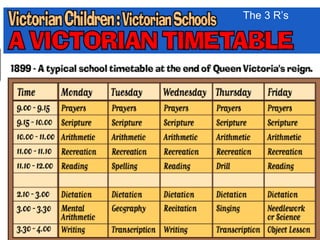
LessonsLessons
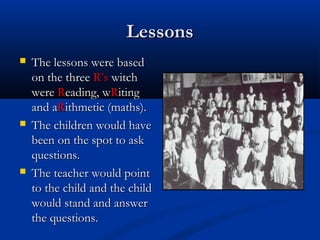
 The lessons were basedThe lessons were based
on the threeon the three R’sR’s witchwitch
werewere RReading, weading, wRRitingiting
and aand aRRithmetic (maths).ithmetic (maths).
 The children would haveThe children would have
been on the spot to askbeen on the spot to ask
questions.questions.
 The teacher would pointThe teacher would point
to the child and the childto the child and the child
would stand and answerwould stand and answer
the questions.the questions.
ContinueContinue
 If you got the answerIf you got the answer
wrong you would eitherwrong you would either
be called stupid or givenbe called stupid or given
the dunce cap. If youthe dunce cap. If you
kept getting the answerkept getting the answer
wrong you could get thewrong you could get the
cane, slipper or ruler!cane, slipper or ruler!
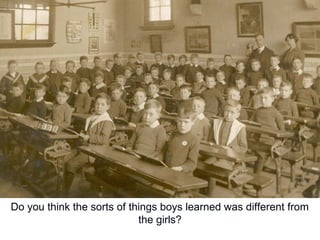
Do you think the sorts of things boys learned was different from
the girls?
AnswerAnswer
 Girls and boys learned together in primaryGirls and boys learned together in primary
schools, but were separated in secondaryschools, but were separated in secondary
schools. Both boys and girls learned reading,schools. Both boys and girls learned reading,
writing, arithmetic, spelling and drill (PE).writing, arithmetic, spelling and drill (PE).
Children were often taught by copying andChildren were often taught by copying and
repeating what the teacher told them. Lessonsrepeating what the teacher told them. Lessons
included teaching in right and wrong, and theincluded teaching in right and wrong, and the
Christian religion.Christian religion.
ContinueContinue
 Boys learned technology: woodwork, maths andBoys learned technology: woodwork, maths and
technical drawing, to help with work in factories,technical drawing, to help with work in factories,
workshops or the army when they grew up.workshops or the army when they grew up.
 Girls had lessons in cooking and sewing, toGirls had lessons in cooking and sewing, to
prepare them for housework and motherhood.prepare them for housework and motherhood.
Leaving School!Leaving School!
 When the children wereWhen the children were
about 10-12 years oldabout 10-12 years old
they would have leftthey would have left
school. They then go toschool. They then go to
work.work.
 They would haveThey would have
probably been happy toprobably been happy to
leave school then, butleave school then, but
they were going to gothey were going to go
into a far moreinto a far more
dangerous life!dangerous life!
Improvements in educationImprovements in education
 Dame schoolsDame schools – run by local women– run by local women
 1844, children working in factories given 6 ½ days schooling a1844, children working in factories given 6 ½ days schooling a
week.week. Ragged schoolsRagged schools set up to provide free education forset up to provide free education for
orphans & poor childrenorphans & poor children
 1870, Forster Education Act, schools built to pro country1870, Forster Education Act, schools built to pro country
 1876, school became compulsory for children up the age of 81876, school became compulsory for children up the age of 8
 1880, leaving age increased to 101880, leaving age increased to 10
 1889, increased to 121889, increased to 12
 1891, ‘schools pence’ abolished, free education for everyone1891, ‘schools pence’ abolished, free education for everyone
introducedintroduced
The 3 R’s
Think about it?Think about it?
 Which of the following was a punishmentWhich of the following was a punishment
recorded in Victorian schools?recorded in Victorian schools?
 The caneThe cane
 Tying a pupil to a deskTying a pupil to a desk
 Hanging logs around a pupil’s neckHanging logs around a pupil’s neck
 Putting a naughty pupil in a basket hanging fromPutting a naughty pupil in a basket hanging from
the roofthe roof
 Wearing a dunce’s hatWearing a dunce’s hat
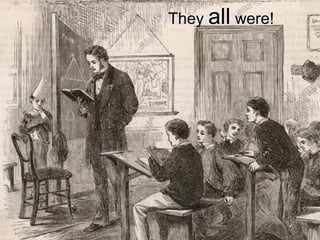
They all were!
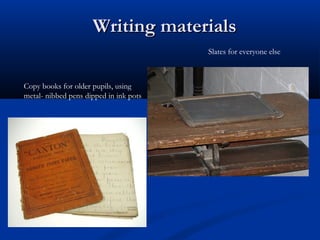
Writing materialsWriting materials
Copy books for older pupils, using
metal- nibbed pens dipped in ink pots
Slates for everyone else
 Your taskYour task
 You are a teacher at a Victorian school in Folkestone.You are a teacher at a Victorian school in Folkestone.
Write a set of class rules & guidelines for your newWrite a set of class rules & guidelines for your new
pupils. Include the following:pupils. Include the following:
 Methods of teachingMethods of teaching
 Information about the sorts of lessons girls & boys willInformation about the sorts of lessons girls & boys will
receivereceive
 What to expect to find in a typical classroomWhat to expect to find in a typical classroom
 Rules of behaviour, e.g. how to address your teacher,Rules of behaviour, e.g. how to address your teacher,
how to enter the classhow to enter the class
 PunishmentsPunishments
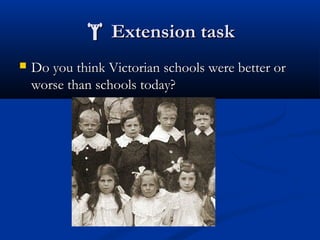
 Extension taskExtension task
 Do you think Victorian schools were better orDo you think Victorian schools were better or
worse than schools today?worse than schools today?
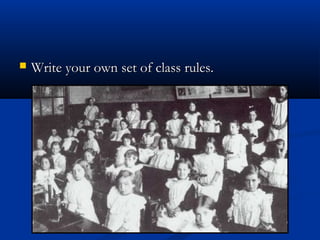
 Write your own set of class rules.Write your own set of class rules.
Victorian schools
Victorian schools

Victorian schools

  • 1.
  • 2.
    What do youthink schools would have been like in Victorian times. Watch the clip and study this picture and think of 3 words to describe what life would have been like for Victorian school children.  Extension task: how bad was life? Rate it out of 5 and explain why starter activity 
  • 3.
    Victorian schoolsVictorian schools Nearly every VictorianNearly every Victorian children went to school.children went to school. They might have had aThey might have had a classroom like this.classroom like this.  The children would haveThe children would have sat extremely stillsat extremely still because they were scaredbecause they were scared to get hit with the cane.to get hit with the cane.
  • 4.
    The TeachersThe Teachers The teachers were notThe teachers were not exactly nice. They carryexactly nice. They carry the cane everywhere. Sothe cane everywhere. So the children are goodthe children are good  They also used to giveThey also used to give other punishmentsother punishments
  • 5.
    The CaneThe Cane The cane was used toThe cane was used to give punishment togive punishment to naughty children whichnaughty children which hurt a lot.hurt a lot.  The teacher would carryThe teacher would carry it around all the time!it around all the time!  If you were naughty youIf you were naughty you might have had tomight have had to choose which cane youchoose which cane you would be hit with.would be hit with.  The teacher might breakThe teacher might break the cane by bending it ifthe cane by bending it if they were really crossthey were really cross  Instead of the cane someInstead of the cane some children had the slipperchildren had the slipper or the ruler across theor the ruler across the hand, or fingers.hand, or fingers.
  • 6.
    The Head teacher!TheHead teacher!  The head teacher wasThe head teacher was normally the worst andnormally the worst and the scariest! Sometimes ifthe scariest! Sometimes if you were bad you had toyou were bad you had to write hundreds of lines,write hundreds of lines, on your hands and knees!on your hands and knees! They normally look likeThey normally look like giants to the children.giants to the children.
  • 7.
    Children at SchoolChildrenat School  Children were very goodChildren were very good and never spoke unlessand never spoke unless they were asked. Theythey were asked. They normally were scared andnormally were scared and frightened about going tofrightened about going to school!!school!!
  • 8.
    In the classroomInthe classroom  There were desks forThere were desks for children to sit at.children to sit at.  Children never talked inChildren never talked in lessons, because theylessons, because they were scared to getwere scared to get caught.caught.
  • 9.
    Playtime!Playtime!  At playtimeit was theAt playtime it was the only time when childrenonly time when children were allowed to makewere allowed to make some noise.some noise.  The teachers were alwaysThe teachers were always watching though, waitingwatching though, waiting with the cane!!with the cane!!
  • 10.
    LessonsLessons  The lessonswere basedThe lessons were based on the threeon the three R’sR’s witchwitch werewere RReading, weading, wRRitingiting and aand aRRithmetic (maths).ithmetic (maths).  The children would haveThe children would have been on the spot to askbeen on the spot to ask questions.questions.  The teacher would pointThe teacher would point to the child and the childto the child and the child would stand and answerwould stand and answer the questions.the questions.
  • 11.
    ContinueContinue  If yougot the answerIf you got the answer wrong you would eitherwrong you would either be called stupid or givenbe called stupid or given the dunce cap. If youthe dunce cap. If you kept getting the answerkept getting the answer wrong you could get thewrong you could get the cane, slipper or ruler!cane, slipper or ruler!
  • 12.
    Do you thinkthe sorts of things boys learned was different from the girls?
  • 13.
    AnswerAnswer  Girls andboys learned together in primaryGirls and boys learned together in primary schools, but were separated in secondaryschools, but were separated in secondary schools. Both boys and girls learned reading,schools. Both boys and girls learned reading, writing, arithmetic, spelling and drill (PE).writing, arithmetic, spelling and drill (PE). Children were often taught by copying andChildren were often taught by copying and repeating what the teacher told them. Lessonsrepeating what the teacher told them. Lessons included teaching in right and wrong, and theincluded teaching in right and wrong, and the Christian religion.Christian religion.
  • 14.
    ContinueContinue  Boys learnedtechnology: woodwork, maths andBoys learned technology: woodwork, maths and technical drawing, to help with work in factories,technical drawing, to help with work in factories, workshops or the army when they grew up.workshops or the army when they grew up.  Girls had lessons in cooking and sewing, toGirls had lessons in cooking and sewing, to prepare them for housework and motherhood.prepare them for housework and motherhood.
  • 15.
    Leaving School!Leaving School! When the children wereWhen the children were about 10-12 years oldabout 10-12 years old they would have leftthey would have left school. They then go toschool. They then go to work.work.  They would haveThey would have probably been happy toprobably been happy to leave school then, butleave school then, but they were going to gothey were going to go into a far moreinto a far more dangerous life!dangerous life!
  • 16.
    Improvements in educationImprovementsin education  Dame schoolsDame schools – run by local women– run by local women  1844, children working in factories given 6 ½ days schooling a1844, children working in factories given 6 ½ days schooling a week.week. Ragged schoolsRagged schools set up to provide free education forset up to provide free education for orphans & poor childrenorphans & poor children  1870, Forster Education Act, schools built to pro country1870, Forster Education Act, schools built to pro country  1876, school became compulsory for children up the age of 81876, school became compulsory for children up the age of 8  1880, leaving age increased to 101880, leaving age increased to 10  1889, increased to 121889, increased to 12  1891, ‘schools pence’ abolished, free education for everyone1891, ‘schools pence’ abolished, free education for everyone introducedintroduced
  • 17.
  • 18.
    Think about it?Thinkabout it?  Which of the following was a punishmentWhich of the following was a punishment recorded in Victorian schools?recorded in Victorian schools?  The caneThe cane  Tying a pupil to a deskTying a pupil to a desk  Hanging logs around a pupil’s neckHanging logs around a pupil’s neck  Putting a naughty pupil in a basket hanging fromPutting a naughty pupil in a basket hanging from the roofthe roof  Wearing a dunce’s hatWearing a dunce’s hat
  • 19.
  • 20.
    Writing materialsWriting materials Copybooks for older pupils, using metal- nibbed pens dipped in ink pots Slates for everyone else
  • 21.
     Your taskYourtask  You are a teacher at a Victorian school in Folkestone.You are a teacher at a Victorian school in Folkestone. Write a set of class rules & guidelines for your newWrite a set of class rules & guidelines for your new pupils. Include the following:pupils. Include the following:  Methods of teachingMethods of teaching  Information about the sorts of lessons girls & boys willInformation about the sorts of lessons girls & boys will receivereceive  What to expect to find in a typical classroomWhat to expect to find in a typical classroom  Rules of behaviour, e.g. how to address your teacher,Rules of behaviour, e.g. how to address your teacher, how to enter the classhow to enter the class  PunishmentsPunishments
  • 22.
     Extension taskExtensiontask  Do you think Victorian schools were better orDo you think Victorian schools were better or worse than schools today?worse than schools today?
  • 23.
     Write yourown set of class rules.Write your own set of class rules.