Eramus+ ‘Different but together’, 2019-1-RO01-KA229-063163_1
‘Gheorghe Șincai’ Technological High School
Târgu Mureș, Romania
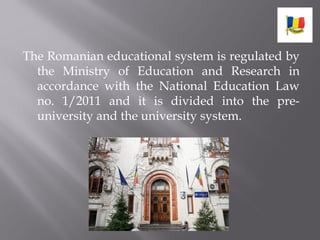
The Romanian educational system is regulated by
the Ministry of Education and Research in
accordance with the National Education Law
no. 1/2011 and it is divided into the pre-
university and the university system.
The pre-university system has 6 forms of organisation.
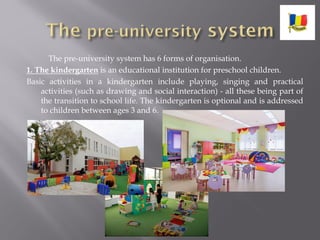
1. The kindergarten is an educational institution for preschool children.
Basic activities in a kindergarten include playing, singing and practical
activities (such as drawing and social interaction) - all these being part of
the transition to school life. The kindergarten is optional and is addressed
to children between ages 3 and 6.
2. Primary education consists of the preparatory class (0) and grades I-IV;
thus primary education lasts for five years. The preparatory class -
which became compulsory in 2012 - children generally begin it at the
age of 6. (Schooling is compulsory until the tenth grade - usually
corresponding to the ages of 16 -17).
Most primary schools are state schools; MEC statistics show that less than
2 percent of students are enrolled in private education.
3. Secondary education
The gymnasium lasts for 4 years and is compulsory for all children.
The evaluation of students' performance in primary schools is different
from the evaluation in secondary schools. In the primary cycle pupils
are given so - called qualifications (very good, good, sufficient,
insufficient) and starting with the 5th grade students are assessed
with grades from 1 to 10.
4. High school education
High school studies lasts for four years: two are compulsory (grades 9 and 10)
and two optional (grades 11 and 12).
There are 3 types of high schools - theoretical, vocational (arts, pedagogical,
military) and technological - all three allow access to university
education, depending on the type of education offered and students'
school performance. All these lead to obtain high school diploma,
participate to the Baccalaureate exam and therefore access to university
studies.
Most theoretical high schools have special classes (such as intensive English
or Computer Science classes) thus they offer more classes of these subjects
than any other type of high school.
Technological high schools give students the opportunity to obtain a
certificate attesting the qualification they have after finishing their studies
at these type of schools.
5. Vocational education
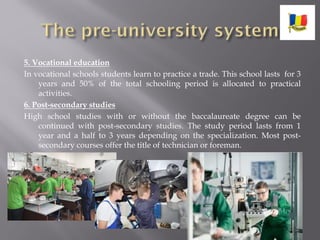
In vocational schools students learn to practice a trade. This school lasts for 3
years and 50% of the total schooling period is allocated to practical
activities.
6. Post-secondary studies
High school studies with or without the baccalaureate degree can be
continued with post-secondary studies. The study period lasts from 1
year and a half to 3 years depending on the specialization. Most post-
secondary courses offer the title of technician or foreman.
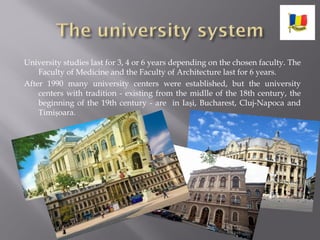
University studies last for 3, 4 or 6 years depending on the chosen faculty. The
Faculty of Medicine and the Faculty of Architecture last for 6 years.
After 1990 many university centers were established, but the university
centers with tradition - existing from the midlle of the 18th century, the
beginning of the 19th century - are in Iași, Bucharest, Cluj-Napoca and
Timișoara.

The romanian education system

  • 1.
    Eramus+ ‘Different buttogether’, 2019-1-RO01-KA229-063163_1 ‘Gheorghe Șincai’ Technological High School Târgu Mureș, Romania
  • 2.
    The Romanian educationalsystem is regulated by the Ministry of Education and Research in accordance with the National Education Law no. 1/2011 and it is divided into the pre- university and the university system.
  • 3.
    The pre-university systemhas 6 forms of organisation. 1. The kindergarten is an educational institution for preschool children. Basic activities in a kindergarten include playing, singing and practical activities (such as drawing and social interaction) - all these being part of the transition to school life. The kindergarten is optional and is addressed to children between ages 3 and 6.
  • 4.
    2. Primary educationconsists of the preparatory class (0) and grades I-IV; thus primary education lasts for five years. The preparatory class - which became compulsory in 2012 - children generally begin it at the age of 6. (Schooling is compulsory until the tenth grade - usually corresponding to the ages of 16 -17). Most primary schools are state schools; MEC statistics show that less than 2 percent of students are enrolled in private education.
  • 5.
    3. Secondary education Thegymnasium lasts for 4 years and is compulsory for all children. The evaluation of students' performance in primary schools is different from the evaluation in secondary schools. In the primary cycle pupils are given so - called qualifications (very good, good, sufficient, insufficient) and starting with the 5th grade students are assessed with grades from 1 to 10.
  • 6.
    4. High schooleducation High school studies lasts for four years: two are compulsory (grades 9 and 10) and two optional (grades 11 and 12). There are 3 types of high schools - theoretical, vocational (arts, pedagogical, military) and technological - all three allow access to university education, depending on the type of education offered and students' school performance. All these lead to obtain high school diploma, participate to the Baccalaureate exam and therefore access to university studies. Most theoretical high schools have special classes (such as intensive English or Computer Science classes) thus they offer more classes of these subjects than any other type of high school. Technological high schools give students the opportunity to obtain a certificate attesting the qualification they have after finishing their studies at these type of schools.
  • 7.
    5. Vocational education Invocational schools students learn to practice a trade. This school lasts for 3 years and 50% of the total schooling period is allocated to practical activities. 6. Post-secondary studies High school studies with or without the baccalaureate degree can be continued with post-secondary studies. The study period lasts from 1 year and a half to 3 years depending on the specialization. Most post- secondary courses offer the title of technician or foreman.
  • 8.
    University studies lastfor 3, 4 or 6 years depending on the chosen faculty. The Faculty of Medicine and the Faculty of Architecture last for 6 years. After 1990 many university centers were established, but the university centers with tradition - existing from the midlle of the 18th century, the beginning of the 19th century - are in Iași, Bucharest, Cluj-Napoca and Timișoara.