THE ROLE OF TECHNOLOGY
IN DELIVERING THE
CURRICULUM
Desired Learning Outcomes
•Discuss the roles of technology in curriculum
delivery
•Identify the factors in technology selection
including the use of visual aids
Is an umbrella terms that
describe Communication,
Information and Technological
Tools to enhance teaching and
learning experience.
Types of Instructional Media/Technology
Non-projected media Projected media
Real objects Models Overhead transparencies
Field trips Opaque projection
Kits Slides
Printed materials (books, worksheets)
Visuals (drawings, photographs, graphs,
charts, posters)
Filmstrips
Visual boards (chalkboard, whiteboard,
flannel board. etc.)
Video, VCD, DVD
Audio materials Computer/multimedia presentations
Factors in Technology Selection
In deciding on which technology to use from a wide
range of media available, the factors on which to base
selection are:
1. Practicality. Is the equipment (hardware) or already
prepared lesson material (software) available? If not,
what would be the cost in acquiring the equipment or
producing the lesson in audial or visual form?
2. Appropriateness in relation to the learners. Is the
medium suitable to the learners' ability to
comprehend? Will the medium be a source of plain
amusement or entertainment, but not learning?
3. Activity/suitability. Will the chosen media fit the
set instructional event, resulting in either
information, motivation, or psychomotor display?
4. Objective-matching. Overall, does the medium
help in achieving the learning objective(s)?
The Role of Technology in
Curriculum Delivery
We can identify three current trends
that could carry on to the nature of
education in the future.
•1. the paradigm shift from teacher-centered to
student-centered approach to learning.
•2. the broadening realization that education is
not simply a delivery of facts and information,
but an educative process of cultivating the
cognitive, affective, psychomotor, and much
more the contemplative intelligence of the
learners of a new age.
•3. the more explosive trend is the increase in
the use of new information and communication
technology or ICT.
For now, the primary roles of educational
technology in delivering the school
curriculum's instructional program have
been identified:
⚫ upgrading the quality of teaching-and-
learning in schools;
⚫increasing the capability of the teacher
to effectively inculcate learning, and for
students to gain mastery of lessons and
courses;
⚫ broadening the delivery of education
outside schools through non-traditional
approaches to formal and informal learning,
such as Open Universities and lifelong
learning to adult learners and
⚫ revolutionizing the use of technology to
boost educational paradigm shifts that give
importance to student-centered and holistic
learning.
These primary roles are based on the
framework of Driven Teaching and Learning
called TPACK ((1) Technological Knowledge,
(2) Pedagogical Knowledge and (3) Content
Knowledge).
Thus in teaching-learning process, a teacher
should always ask and find the correct answer
to the following questions for every lesson.
1. What shall I teach? (Content knowledge)
2. How shall I teach the content?
(Pedagogical knowledge)
3. What technology will I use in how the
teach the (Technological knowledge)
content?
TPACK Framework (Koehler,
2006)
Criteria for the Use of Visual
Aids
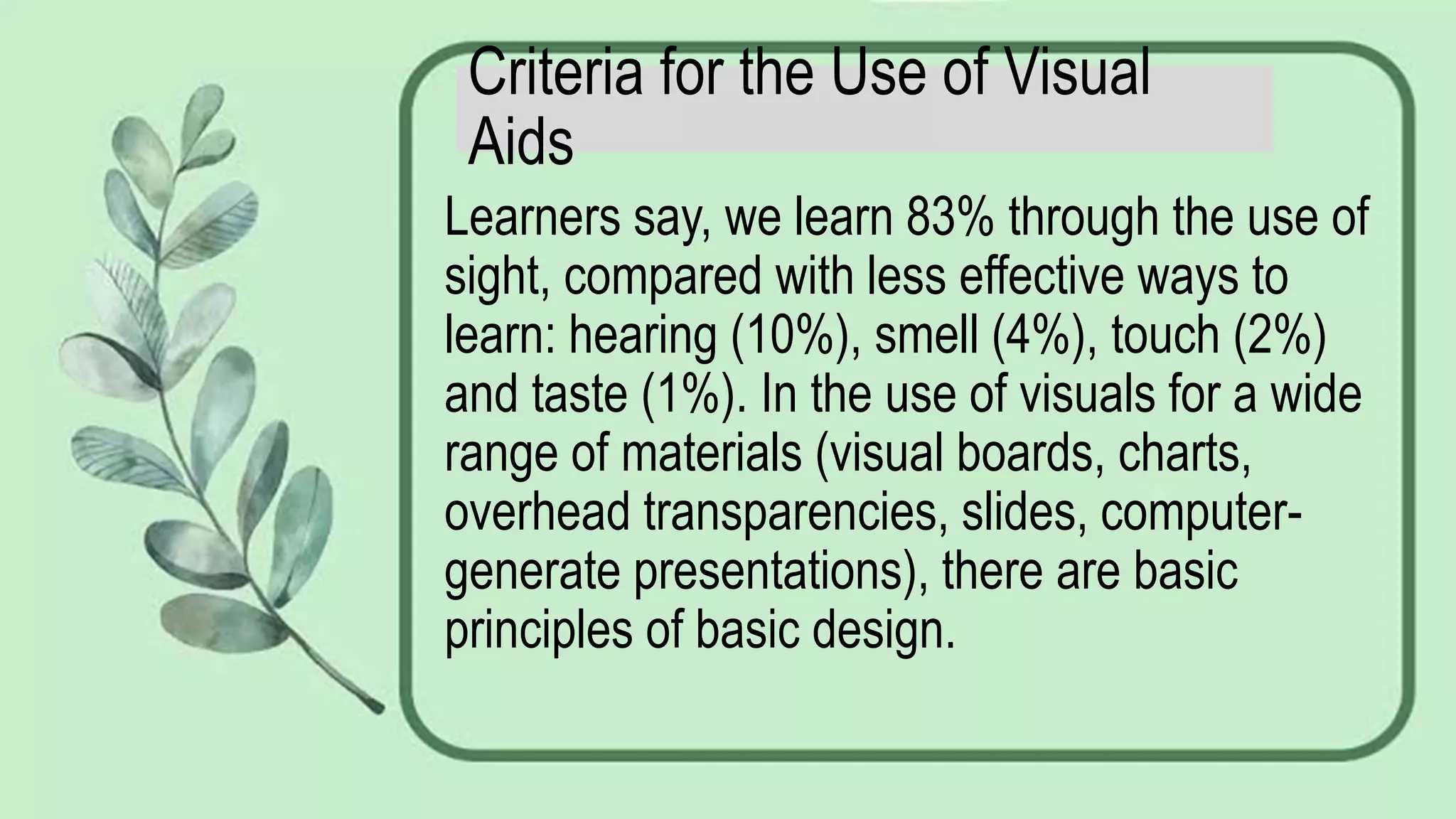
Learners say, we learn 83% through the use of
sight, compared with less effective ways to
learn: hearing (10%), smell (4%), touch (2%)
and taste (1%). In the use of visuals for a wide
range of materials (visual boards, charts,
overhead transparencies, slides, computer-
generate presentations), there are basic
principles of basic design.
Assess a visual material or presentation
(a transparency or slide) using the
following criteria:
Visual elements (pictures, illustrations,
graphics)
1. Lettering style or font-consistency and
harmony
2. Number of lettering style-no more than 2 in a
static display (chart, bulletin board)
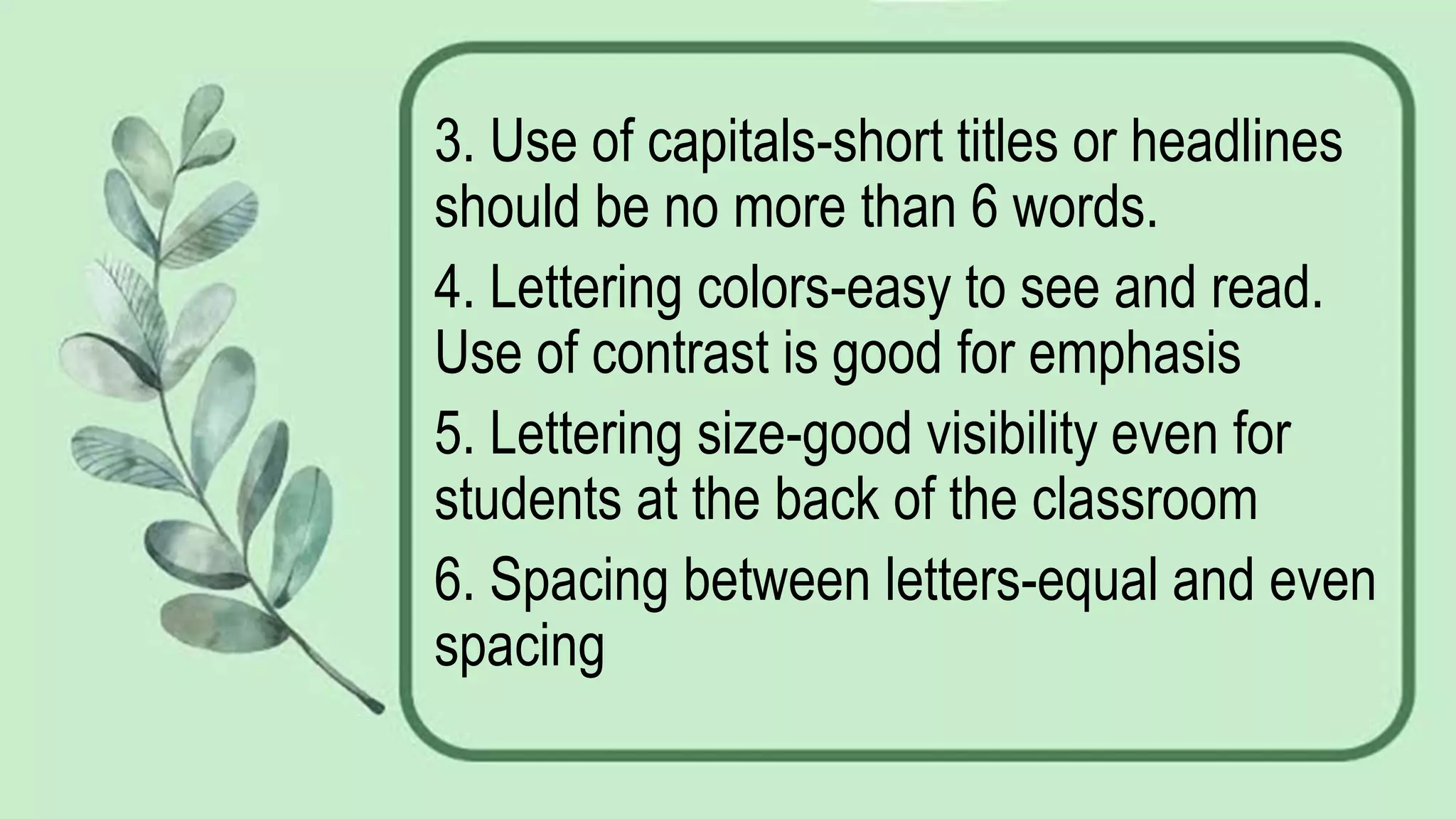
3. Use of capitals-short titles or headlines
should be no more than 6 words.
4. Lettering colors-easy to see and read.
Use of contrast is good for emphasis
5. Lettering size-good visibility even for
students at the back of the classroom
6. Spacing between letters-equal and even
spacing
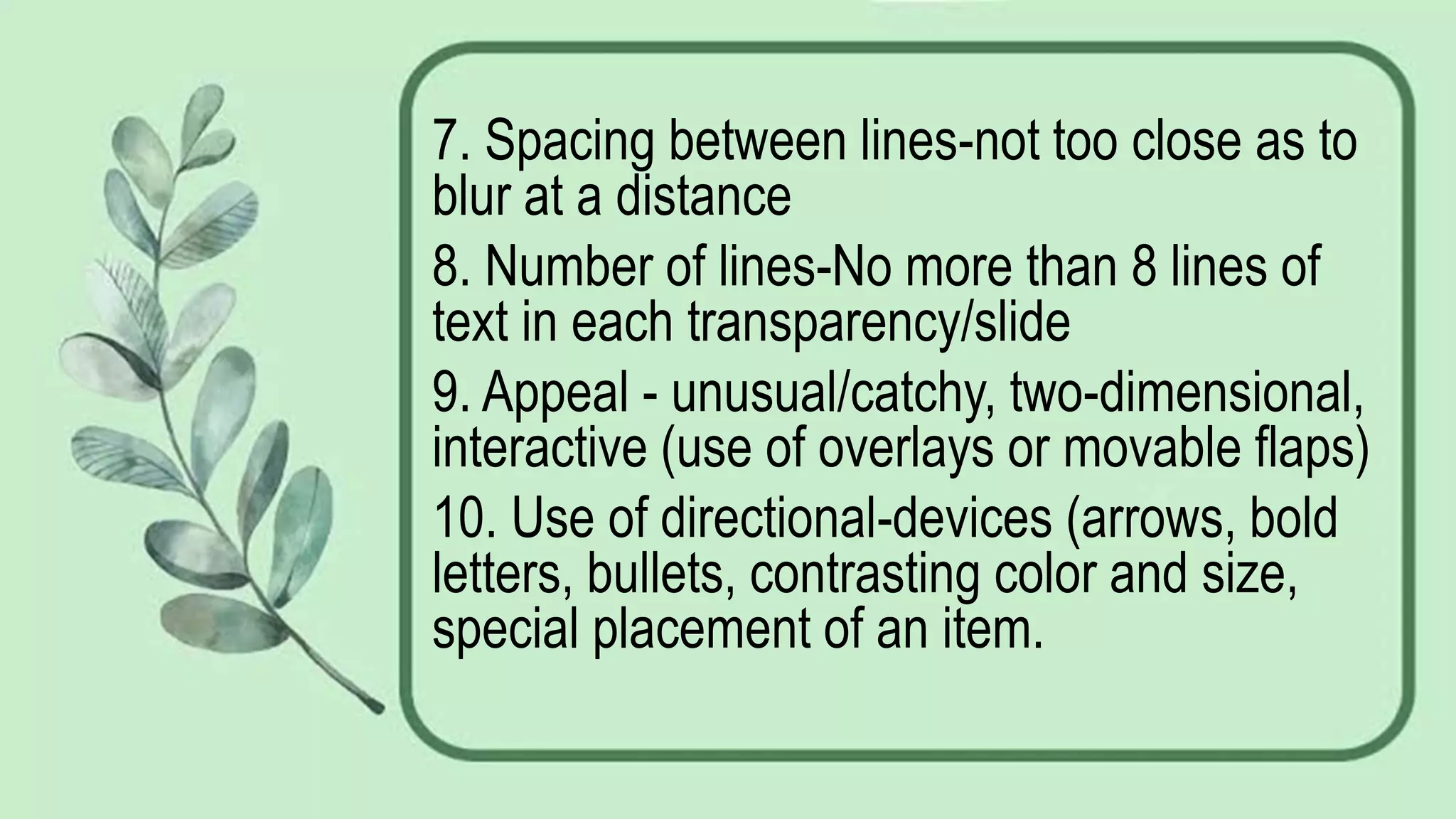
7. Spacing between lines-not too close as to
blur at a distance
8. Number of lines-No more than 8 lines of
text in each transparency/slide
9. Appeal - unusual/catchy, two-dimensional,
interactive (use of overlays or movable flaps)
10. Use of directional-devices (arrows, bold
letters, bullets, contrasting color and size,
special placement of an item.

the role of technology.pptx

  • 1.
    THE ROLE OFTECHNOLOGY IN DELIVERING THE CURRICULUM
  • 2.
    Desired Learning Outcomes •Discussthe roles of technology in curriculum delivery •Identify the factors in technology selection including the use of visual aids
  • 3.
    Is an umbrellaterms that describe Communication, Information and Technological Tools to enhance teaching and learning experience.
  • 4.
    Types of InstructionalMedia/Technology Non-projected media Projected media Real objects Models Overhead transparencies Field trips Opaque projection Kits Slides Printed materials (books, worksheets) Visuals (drawings, photographs, graphs, charts, posters) Filmstrips Visual boards (chalkboard, whiteboard, flannel board. etc.) Video, VCD, DVD Audio materials Computer/multimedia presentations
  • 5.
    Factors in TechnologySelection In deciding on which technology to use from a wide range of media available, the factors on which to base selection are: 1. Practicality. Is the equipment (hardware) or already prepared lesson material (software) available? If not, what would be the cost in acquiring the equipment or producing the lesson in audial or visual form?
  • 6.
    2. Appropriateness inrelation to the learners. Is the medium suitable to the learners' ability to comprehend? Will the medium be a source of plain amusement or entertainment, but not learning? 3. Activity/suitability. Will the chosen media fit the set instructional event, resulting in either information, motivation, or psychomotor display? 4. Objective-matching. Overall, does the medium help in achieving the learning objective(s)?
  • 7.
    The Role ofTechnology in Curriculum Delivery We can identify three current trends that could carry on to the nature of education in the future.
  • 8.
    •1. the paradigmshift from teacher-centered to student-centered approach to learning. •2. the broadening realization that education is not simply a delivery of facts and information, but an educative process of cultivating the cognitive, affective, psychomotor, and much more the contemplative intelligence of the learners of a new age. •3. the more explosive trend is the increase in the use of new information and communication technology or ICT.
  • 9.
    For now, theprimary roles of educational technology in delivering the school curriculum's instructional program have been identified: ⚫ upgrading the quality of teaching-and- learning in schools; ⚫increasing the capability of the teacher to effectively inculcate learning, and for students to gain mastery of lessons and courses;
  • 10.
    ⚫ broadening thedelivery of education outside schools through non-traditional approaches to formal and informal learning, such as Open Universities and lifelong learning to adult learners and ⚫ revolutionizing the use of technology to boost educational paradigm shifts that give importance to student-centered and holistic learning.
  • 11.
    These primary rolesare based on the framework of Driven Teaching and Learning called TPACK ((1) Technological Knowledge, (2) Pedagogical Knowledge and (3) Content Knowledge). Thus in teaching-learning process, a teacher should always ask and find the correct answer to the following questions for every lesson. 1. What shall I teach? (Content knowledge)
  • 12.
    2. How shallI teach the content? (Pedagogical knowledge) 3. What technology will I use in how the teach the (Technological knowledge) content?
  • 13.
  • 14.
    Criteria for theUse of Visual Aids Learners say, we learn 83% through the use of sight, compared with less effective ways to learn: hearing (10%), smell (4%), touch (2%) and taste (1%). In the use of visuals for a wide range of materials (visual boards, charts, overhead transparencies, slides, computer- generate presentations), there are basic principles of basic design.
  • 15.
    Assess a visualmaterial or presentation (a transparency or slide) using the following criteria: Visual elements (pictures, illustrations, graphics) 1. Lettering style or font-consistency and harmony 2. Number of lettering style-no more than 2 in a static display (chart, bulletin board)
  • 16.
    3. Use ofcapitals-short titles or headlines should be no more than 6 words. 4. Lettering colors-easy to see and read. Use of contrast is good for emphasis 5. Lettering size-good visibility even for students at the back of the classroom 6. Spacing between letters-equal and even spacing
  • 17.
    7. Spacing betweenlines-not too close as to blur at a distance 8. Number of lines-No more than 8 lines of text in each transparency/slide 9. Appeal - unusual/catchy, two-dimensional, interactive (use of overlays or movable flaps) 10. Use of directional-devices (arrows, bold letters, bullets, contrasting color and size, special placement of an item.