






The Robots are coming for the Accountancy
Profession
Top 10 Robotic Process Automation (RPA) cases
Dayana Mastura Baharudin
• Robotic process automation (RPA) is a software
technology that makes it easy to build, deploy,
and manage software robots that emulate
human actions interacting with digital systems
and software.
• Just like people, software robots can do things
like understand what’s on a screen, complete
the right keystrokes, navigate systems, identify
and extract data, and perform a wide range of
defined actions.
• But software robots can do it faster and more
consistently than people, without the need to
get up and stretch or take a coffee break.
Robotic Process Automation
(RPA) - Definition
• Finance, with its accounting and procurement
departments, meets both criteria.
• As a business function, it’s famous for
repetitive, time-consuming tasks like data
entry, reporting, cross-checking, and record
keeping, which are the perfect food for RPA
bots.
• On the other hand, most processes are more
or less structured and rule-based, as there are
almost no exceptions or human decision-
making involved.
• It’s the automation of tedious, high-volume,
and repetitive tasks in a digital environment.
Using RPA in Finance and
Accounting
5 Main Benefits of Implementing Robotics Process
Automation (RPA) in Accounting and Finance
• You can leverage on metrics such as
Days Payable Outstanding, Days Sales
Outstanding, Days Inventory etc
(1) Improved operational
metrics and Service Level
Agreement (SLA)
• Software robots can run such common
processes as invoice processing end-to-
end, 24/7, and with no mistakes.
(2) Fewer mistakes
and better compliance
(3) Higher productivity
• Your team will spend less time on routine operations, saving hours for
strategizing and the tasks that drive value.
(4) Cost reduction
• And it’s not about staff
redundancy: you’ll have less
turnover due to burnout and,
consequently, lower hiring costs.
(5) More transparency, fewer risks
RPA will streamline core financial processes, mitigating data safety and regulation risks.
10 most popular
RPA
implementation
in Finance and
Accounting
• Accounts Receivable is a good point to kick off
automation in finance, as it’s less reliant on external
documents, as opposed to Accounts Payable.
• The main metric RPA can help leverage here is Days Sales
Outstanding (DSO).
• DSO heavily depends on the human element on both the
payee’s and the recipient’s side.
• For example, an accountant can forget to send an
invoice. The result is not only a cash gap: if it’s done too
frequently, it jeopardizes the order to cash process and
impacts liquidity.
• If you adopt RPA bots as your digital workforce, they will
issue and email invoices automatically. By automating
this task, you will get a consistent cash flow without
deficiencies.
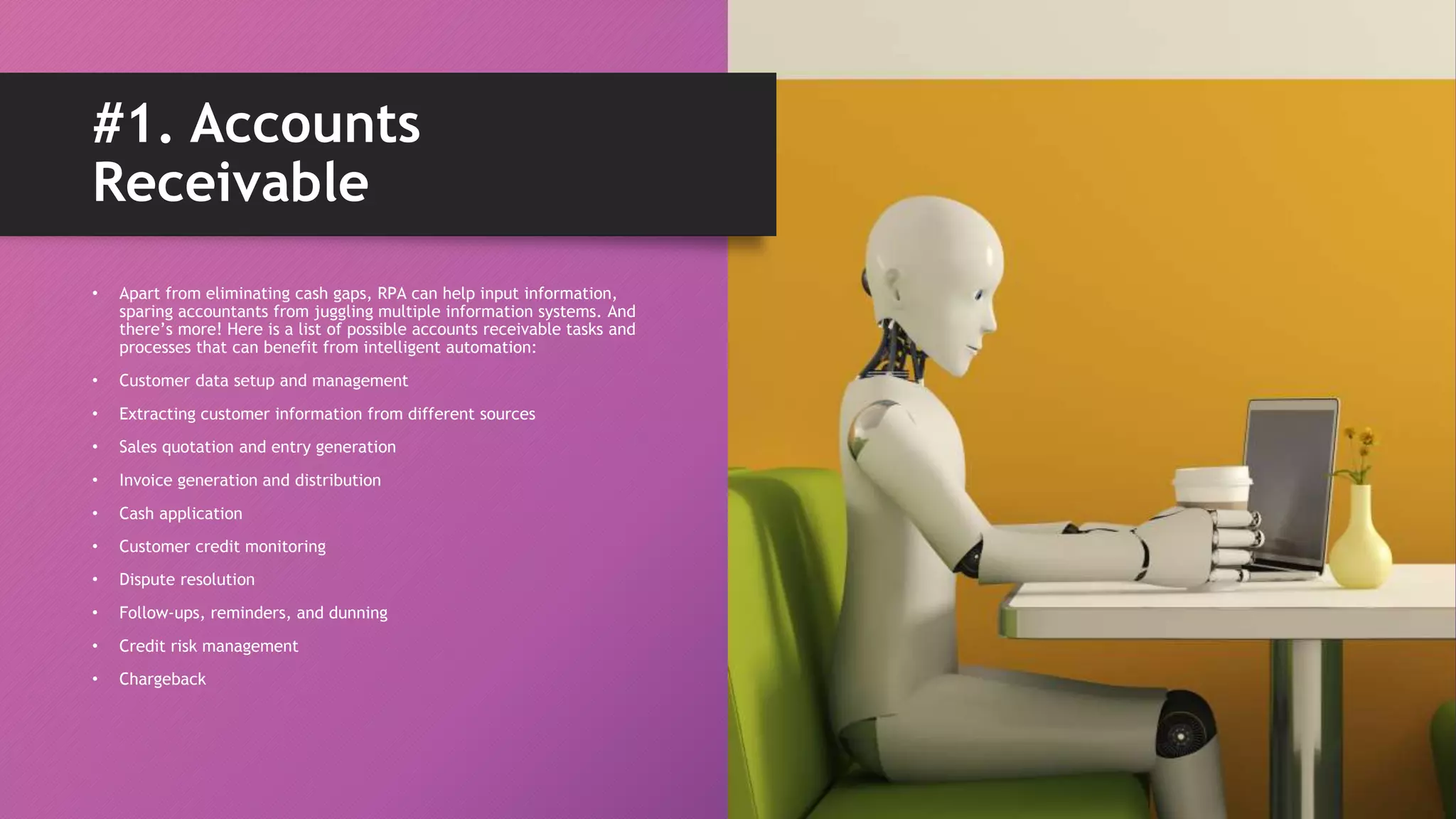
#1. Accounts Receivable
• Apart from eliminating cash gaps, RPA can help input information,
sparing accountants from juggling multiple information systems. And
there’s more! Here is a list of possible accounts receivable tasks and
processes that can benefit from intelligent automation:
• Customer data setup and management
• Extracting customer information from different sources
• Sales quotation and entry generation
• Invoice generation and distribution
• Cash application
• Customer credit monitoring
• Dispute resolution
• Follow-ups, reminders, and dunning
• Credit risk management
• Chargeback
#1. Accounts
Receivable
• The metric robotic process automation can help you
boost here is Days Payable Outstanding (DPO). Though a
high DPO has its advantages, as there is more cash on
hand for short-term operations, it may be tricky in terms
of reputation.
• A high DPO is good when it’s triggered by friendly credit
terms, and not so good if the reason is that you are not
able to pay your bills on time due to inefficiency.
• Operational lags in accounts payable usually occur while
processing invoices.
• Vendor invoices are non-standardized,and need to be
cross-checked with purchasing orders and approved.
Intelligent automation can streamline this process end-
to-end even if the incoming docs are paper-based, thanks
to optical character recognition technology (OCR).
#2. Accounts Payable and procure
to pay
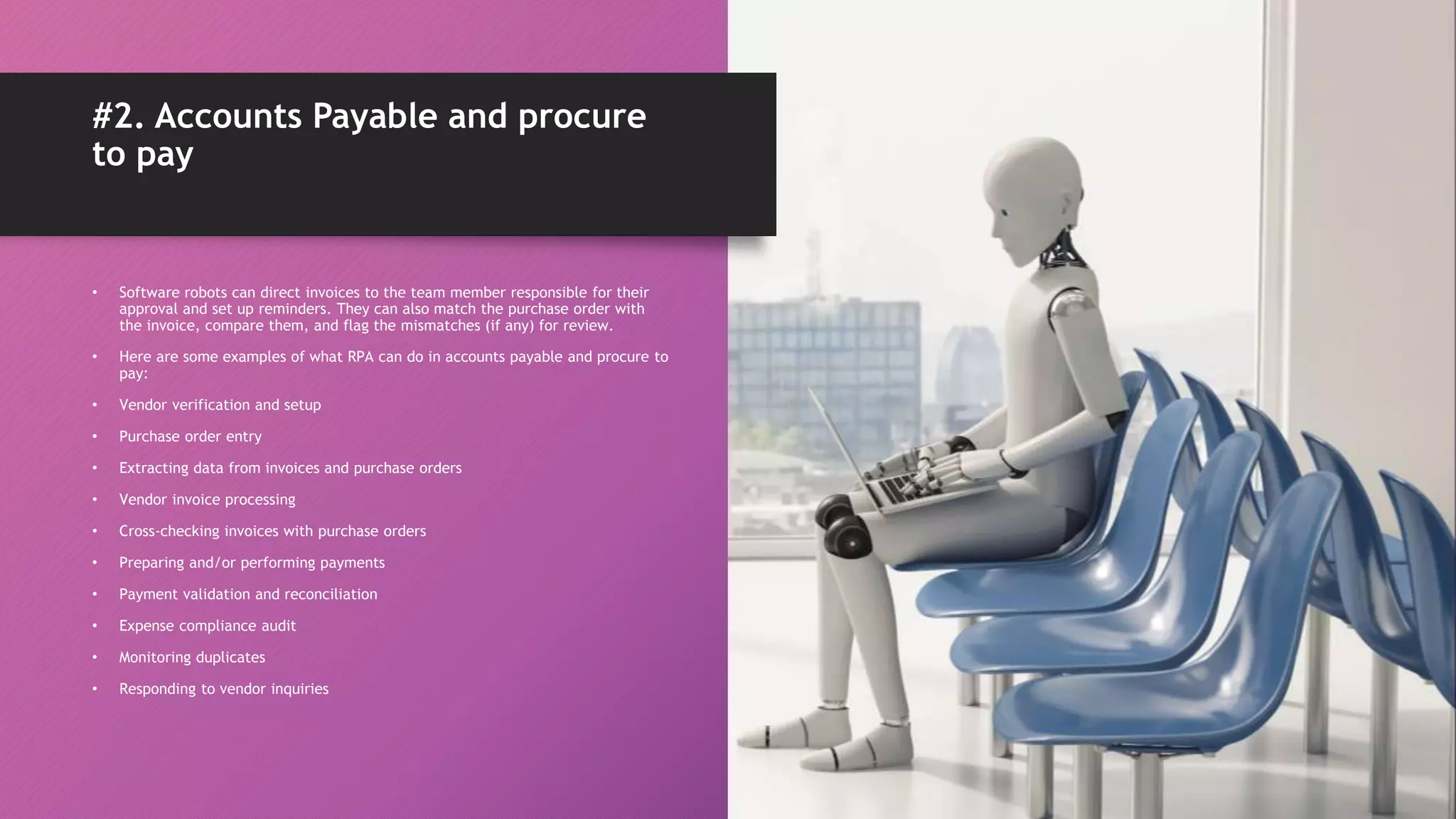
• Software robots can direct invoices to the team member responsible for their
approval and set up reminders. They can also match the purchase order with
the invoice, compare them, and flag the mismatches (if any) for review.
• Here are some examples of what RPA can do in accounts payable and procure to
pay:
• Vendor verification and setup
• Purchase order entry
• Extracting data from invoices and purchase orders
• Vendor invoice processing
• Cross-checking invoices with purchase orders
• Preparing and/or performing payments
• Payment validation and reconciliation
• Expense compliance audit
• Monitoring duplicates
• Responding to vendor inquiries
#2. Accounts Payable and procure
to pay
#3. Intercompany reconciliations (ICR)
• Another promising application point for RPA in finance
and accounting is intercompany reconciliations.
Balancing accounts to provide an accurate financial
statement is a source of constant stress due to manual
data entry, extraction, and cross-checking. In the
worst cases, identifying unrecorded transactions or
balances and rooting out invoicing mistakes can
paralyze the entire department.
• A bot can streamline this process by easily acquiring
and checking transactional data from any source,
automatically approving all matching records, and
notifying about discrepancies.
• By adopting RPA, you can automate and
streamline the following tasks and operations:
• Extracting or retrieving data from files
• Searching for related statements in ERP
systems
• Comparing balances
• Looking for missing invoices and sending emails
to customers
• Reporting discrepancies
• Directing reports to the business controller
• Creating journal entries
#3. Intercompany reconciliations
(ICR)
• This business process is all about
control: you need to be in the know
about inventory levels to maintain a
constant product supply.
• RPA bots can do all the heavy lifting and
help leverage the dead stock and stock-
outs, improve lead times, and optimize
storage costs.
#4. Inventory management
• These are the tasks software bots can handle
without batting an eyelash:
• Monitoring inventory
• Notifying about low inventory levels
• Ordering products when the stock levels hit a
threshold
• Placing and approving stock orders
• Forecasting optimal inventory levels
• Updating ERP and WMS systems
• Reporting and follow-ups
• Tracking shipments
#4. Inventory
management
• When it comes to business trips, RPA bots can facilitate lots of
manual work for both travelers and accountants, creating a
better employee experience. They can extract and read data
from all types of receipts, check whether they qualify as a
business expense, and wrap them into accurate expense
reports—and all this with zero time spent on the part of the
employees involved.
• Entering expense records and checking according to company
policies and legislation
• Aggregating data into expense reports
• Creating paychecks and managing benefits and
reimbursements
• Alerting in case of policy violations or data discrepancies
#5. Travel & expenses
• Speaking of payroll, bots help to avoid payment
delays and inaccuracies, taking on data entry,
timesheet validation, and deduction calculations.
They can even extract data from paper sick lists
that are still in use in some countries.
• These are the use cases RPA can help you with:
• Employee data extraction
• Data verification across information systems (sick
days, business trips, timesheets)
• Generating and approving timesheets
#6. Payroll
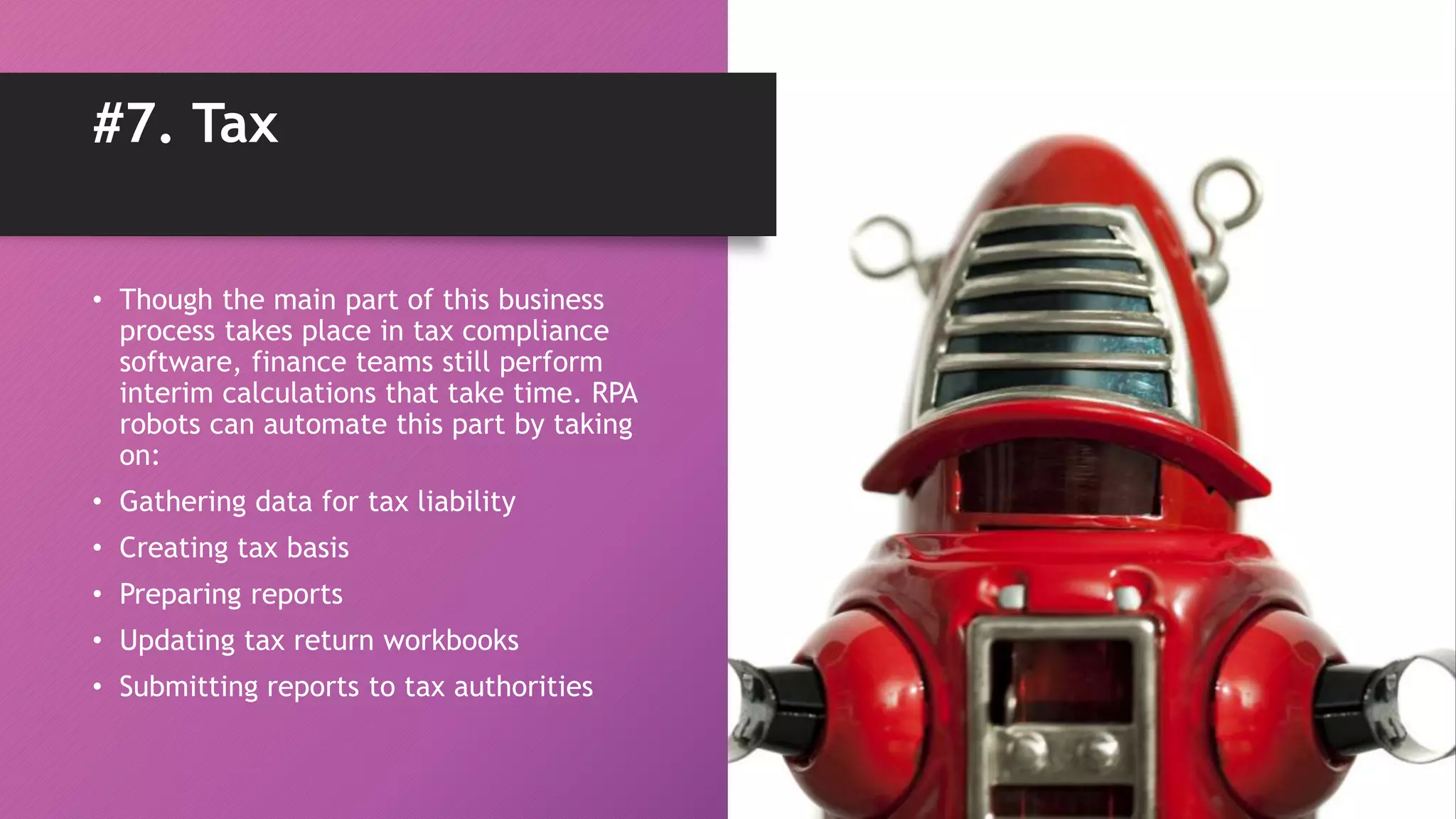
• Though the main part of this business
process takes place in tax compliance
software, finance teams still perform
interim calculations that take time. RPA
robots can automate this part by taking
on:
• Gathering data for tax liability
• Creating tax basis
• Preparing reports
• Updating tax return workbooks
• Submitting reports to tax authorities
#7. Tax
• Same for treasury management: though
there are quite sophisticated information
systems in place, initial data input is
often performed manually. Bots can
extract and transform data into a format
a treasury system can process, and even
more:
• Extracting and formatting data
• Updating treasury systems
• Sending out reports
• General ledger updates
#8. Treasury
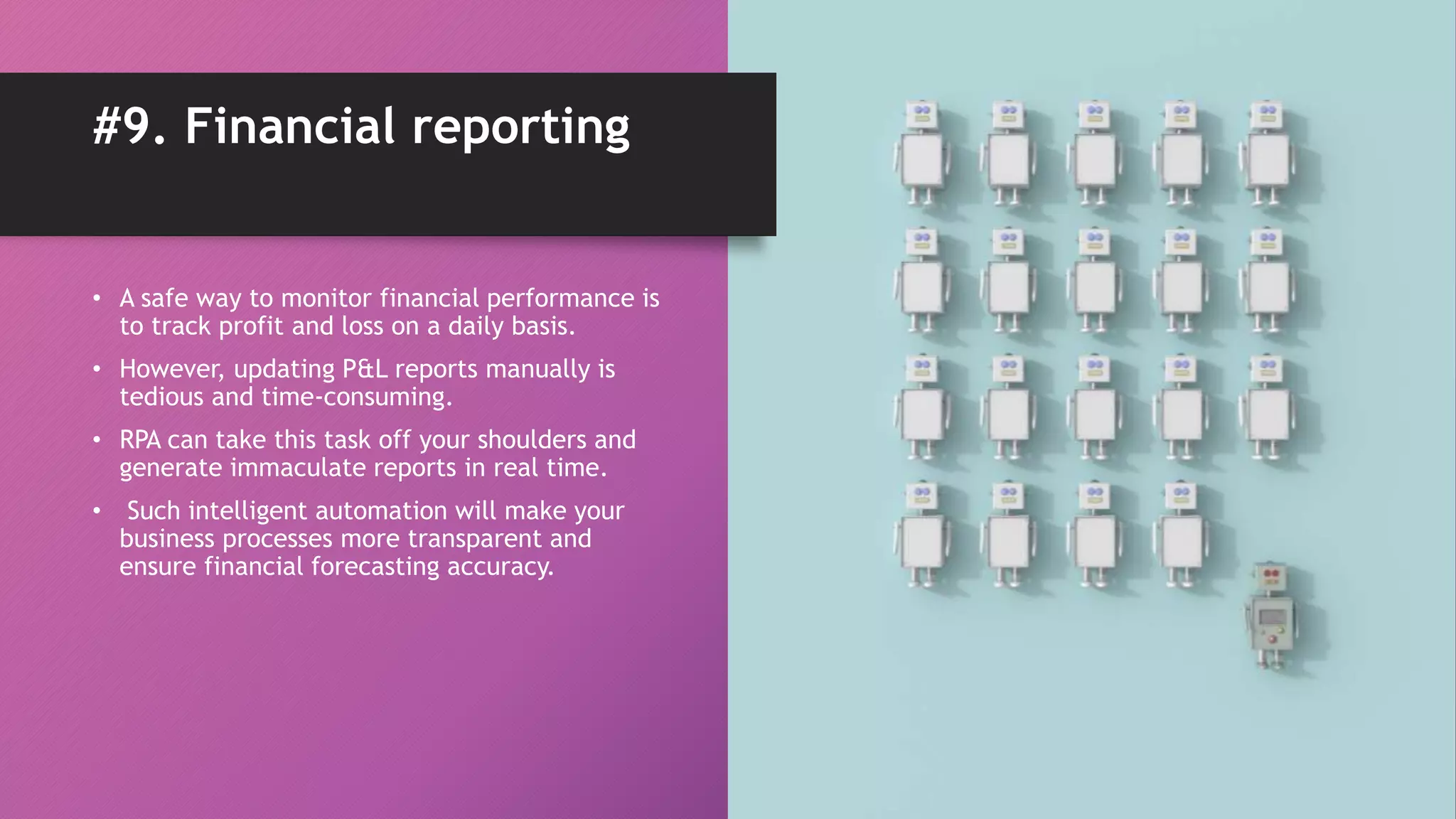
• A safe way to monitor financial performance is
to track profit and loss on a daily basis.
• However, updating P&L reports manually is
tedious and time-consuming.
• RPA can take this task off your shoulders and
generate immaculate reports in real time.
• Such intelligent automation will make your
business processes more transparent and
ensure financial forecasting accuracy.
#9. Financial reporting
• There are quite a lot of reporting
processes where RPA can come
handy:
• Trial balance and balance sheets
• Income statements
• P&L
• Variance analysis
• Financial close processes
• Regulatory/management reports
#10. Financial planning
and forecasting
• As for planning and forecasting, bots can help
with such tasks as loading balances to
planning systems and creating variance
reports.
• Based on this information and historic data,
modern RPA platforms can also provide
forecasts and help improve financial planning.
• The Tax function is filled with routine
processes that are still being performed
manually in order to prepare reports and file
information required by the law.
• Disparate systems and finance processes for
many organizations often create a challenge
in gathering and reconciling tax-related data.
The Robots are
here to stay……
• The use cases we mentioned here
cover most business processes that are
related to finance and accounting.
• That means that any finance
department with high volumes of
manually performed processes can
benefit from digital transformation
even without drastic infrastructure
changes.
• And that’s the gist of intelligent
automation with RPA: you can take a
shortcut towards better productivity,
enabling people to perform more
complex and strategic tasks that drive
value.
The Robots are coming for the Accountancy Profession - Top 10 Robotic Process Automation (RPA) cases

The Robots are coming for the Accountancy Profession - Top 10 Robotic Process Automation (RPA) cases

  • 1.
    The Robots arecoming for the Accountancy Profession Top 10 Robotic Process Automation (RPA) cases Dayana Mastura Baharudin
  • 2.
    • Robotic processautomation (RPA) is a software technology that makes it easy to build, deploy, and manage software robots that emulate human actions interacting with digital systems and software. • Just like people, software robots can do things like understand what’s on a screen, complete the right keystrokes, navigate systems, identify and extract data, and perform a wide range of defined actions. • But software robots can do it faster and more consistently than people, without the need to get up and stretch or take a coffee break. Robotic Process Automation (RPA) - Definition
  • 3.
    • Finance, withits accounting and procurement departments, meets both criteria. • As a business function, it’s famous for repetitive, time-consuming tasks like data entry, reporting, cross-checking, and record keeping, which are the perfect food for RPA bots. • On the other hand, most processes are more or less structured and rule-based, as there are almost no exceptions or human decision- making involved. • It’s the automation of tedious, high-volume, and repetitive tasks in a digital environment. Using RPA in Finance and Accounting
  • 4.
    5 Main Benefitsof Implementing Robotics Process Automation (RPA) in Accounting and Finance
  • 5.
    • You canleverage on metrics such as Days Payable Outstanding, Days Sales Outstanding, Days Inventory etc (1) Improved operational metrics and Service Level Agreement (SLA)
  • 6.
    • Software robotscan run such common processes as invoice processing end-to- end, 24/7, and with no mistakes. (2) Fewer mistakes and better compliance
  • 7.
    (3) Higher productivity •Your team will spend less time on routine operations, saving hours for strategizing and the tasks that drive value.
  • 8.
    (4) Cost reduction •And it’s not about staff redundancy: you’ll have less turnover due to burnout and, consequently, lower hiring costs.
  • 9.
    (5) More transparency,fewer risks RPA will streamline core financial processes, mitigating data safety and regulation risks.
  • 10.
  • 11.
    • Accounts Receivableis a good point to kick off automation in finance, as it’s less reliant on external documents, as opposed to Accounts Payable. • The main metric RPA can help leverage here is Days Sales Outstanding (DSO). • DSO heavily depends on the human element on both the payee’s and the recipient’s side. • For example, an accountant can forget to send an invoice. The result is not only a cash gap: if it’s done too frequently, it jeopardizes the order to cash process and impacts liquidity. • If you adopt RPA bots as your digital workforce, they will issue and email invoices automatically. By automating this task, you will get a consistent cash flow without deficiencies. #1. Accounts Receivable
  • 12.
    • Apart fromeliminating cash gaps, RPA can help input information, sparing accountants from juggling multiple information systems. And there’s more! Here is a list of possible accounts receivable tasks and processes that can benefit from intelligent automation: • Customer data setup and management • Extracting customer information from different sources • Sales quotation and entry generation • Invoice generation and distribution • Cash application • Customer credit monitoring • Dispute resolution • Follow-ups, reminders, and dunning • Credit risk management • Chargeback #1. Accounts Receivable
  • 13.
    • The metricrobotic process automation can help you boost here is Days Payable Outstanding (DPO). Though a high DPO has its advantages, as there is more cash on hand for short-term operations, it may be tricky in terms of reputation. • A high DPO is good when it’s triggered by friendly credit terms, and not so good if the reason is that you are not able to pay your bills on time due to inefficiency. • Operational lags in accounts payable usually occur while processing invoices. • Vendor invoices are non-standardized,and need to be cross-checked with purchasing orders and approved. Intelligent automation can streamline this process end- to-end even if the incoming docs are paper-based, thanks to optical character recognition technology (OCR). #2. Accounts Payable and procure to pay
  • 14.
    • Software robotscan direct invoices to the team member responsible for their approval and set up reminders. They can also match the purchase order with the invoice, compare them, and flag the mismatches (if any) for review. • Here are some examples of what RPA can do in accounts payable and procure to pay: • Vendor verification and setup • Purchase order entry • Extracting data from invoices and purchase orders • Vendor invoice processing • Cross-checking invoices with purchase orders • Preparing and/or performing payments • Payment validation and reconciliation • Expense compliance audit • Monitoring duplicates • Responding to vendor inquiries #2. Accounts Payable and procure to pay
  • 15.
    #3. Intercompany reconciliations(ICR) • Another promising application point for RPA in finance and accounting is intercompany reconciliations. Balancing accounts to provide an accurate financial statement is a source of constant stress due to manual data entry, extraction, and cross-checking. In the worst cases, identifying unrecorded transactions or balances and rooting out invoicing mistakes can paralyze the entire department. • A bot can streamline this process by easily acquiring and checking transactional data from any source, automatically approving all matching records, and notifying about discrepancies.
  • 16.
    • By adoptingRPA, you can automate and streamline the following tasks and operations: • Extracting or retrieving data from files • Searching for related statements in ERP systems • Comparing balances • Looking for missing invoices and sending emails to customers • Reporting discrepancies • Directing reports to the business controller • Creating journal entries #3. Intercompany reconciliations (ICR)
  • 17.
    • This businessprocess is all about control: you need to be in the know about inventory levels to maintain a constant product supply. • RPA bots can do all the heavy lifting and help leverage the dead stock and stock- outs, improve lead times, and optimize storage costs. #4. Inventory management
  • 18.
    • These arethe tasks software bots can handle without batting an eyelash: • Monitoring inventory • Notifying about low inventory levels • Ordering products when the stock levels hit a threshold • Placing and approving stock orders • Forecasting optimal inventory levels • Updating ERP and WMS systems • Reporting and follow-ups • Tracking shipments #4. Inventory management
  • 19.
    • When itcomes to business trips, RPA bots can facilitate lots of manual work for both travelers and accountants, creating a better employee experience. They can extract and read data from all types of receipts, check whether they qualify as a business expense, and wrap them into accurate expense reports—and all this with zero time spent on the part of the employees involved. • Entering expense records and checking according to company policies and legislation • Aggregating data into expense reports • Creating paychecks and managing benefits and reimbursements • Alerting in case of policy violations or data discrepancies #5. Travel & expenses
  • 20.
    • Speaking ofpayroll, bots help to avoid payment delays and inaccuracies, taking on data entry, timesheet validation, and deduction calculations. They can even extract data from paper sick lists that are still in use in some countries. • These are the use cases RPA can help you with: • Employee data extraction • Data verification across information systems (sick days, business trips, timesheets) • Generating and approving timesheets #6. Payroll
  • 21.
    • Though themain part of this business process takes place in tax compliance software, finance teams still perform interim calculations that take time. RPA robots can automate this part by taking on: • Gathering data for tax liability • Creating tax basis • Preparing reports • Updating tax return workbooks • Submitting reports to tax authorities #7. Tax
  • 22.
    • Same fortreasury management: though there are quite sophisticated information systems in place, initial data input is often performed manually. Bots can extract and transform data into a format a treasury system can process, and even more: • Extracting and formatting data • Updating treasury systems • Sending out reports • General ledger updates #8. Treasury
  • 23.
    • A safeway to monitor financial performance is to track profit and loss on a daily basis. • However, updating P&L reports manually is tedious and time-consuming. • RPA can take this task off your shoulders and generate immaculate reports in real time. • Such intelligent automation will make your business processes more transparent and ensure financial forecasting accuracy. #9. Financial reporting
  • 24.
    #9. Financial reporting •There are quite a lot of reporting processes where RPA can come handy: • Trial balance and balance sheets • Income statements • P&L • Variance analysis • Financial close processes • Regulatory/management reports
  • 25.
    #10. Financial planning andforecasting • As for planning and forecasting, bots can help with such tasks as loading balances to planning systems and creating variance reports. • Based on this information and historic data, modern RPA platforms can also provide forecasts and help improve financial planning. • The Tax function is filled with routine processes that are still being performed manually in order to prepare reports and file information required by the law. • Disparate systems and finance processes for many organizations often create a challenge in gathering and reconciling tax-related data.
  • 26.
    The Robots are hereto stay…… • The use cases we mentioned here cover most business processes that are related to finance and accounting. • That means that any finance department with high volumes of manually performed processes can benefit from digital transformation even without drastic infrastructure changes. • And that’s the gist of intelligent automation with RPA: you can take a shortcut towards better productivity, enabling people to perform more complex and strategic tasks that drive value.