Performed students of 32 IT group:
Timonova Anastasia
Poliakova Maria
Tkacheva Julia
Teacher: Kochkina V. U.
Project-work category: general human
interest topic.
Type of the project: semi-structured
(defined and planned by the teacher with
students.
Time limit: in and out class project work,
covering 8 academic hours.
Final outcome: multimedia and oral
presentation.
Equipment and materials: the Internet,
pictures, the Wikipedia
 to improve students’ language (reading, writing,
speaking, listening, grammar knowledge) and
content knowledge;
 to recycle the vocabulary on the topic: “The
Environment Nature.
 to encourage students to work together and to write
their messages to future;
 to develop students’ abilities to find and present
information;
 to develop students’ autonomy and independence;
 to increase students’ motivation and ensure
meaningful students’ engagement.
1. Preface
2. History of the Red Book
3. The Belgorod region’s Red Book
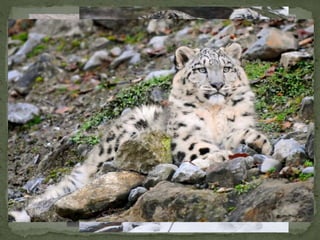
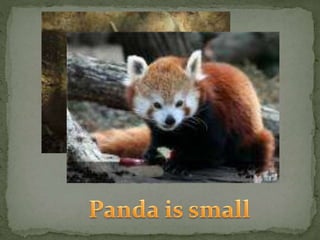
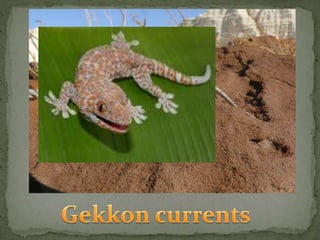
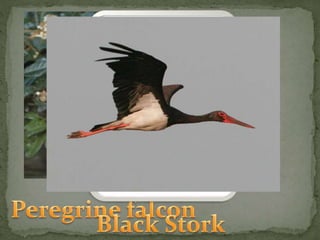
4. Some animals species
5. Video materials
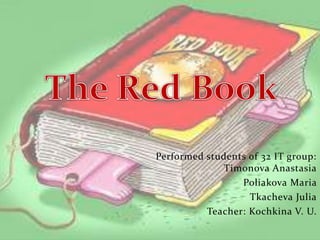
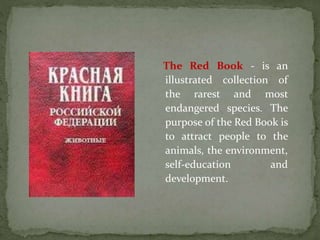
The Red Book - is an
illustrated collection of
the rarest and most
endangered species. The
purpose of the Red Book is
to attract people to the
animals, the environment,
self-education and
development.
History of the World Red Book was launched in
Paris in 1902, when a number of countries have
signed the first of its kind Red Book - The
International Convention for the Protection of
Birds, which can be considered the first
international agreement to protect biodiversity.
In 1948 was established the International Union for
Conservation of Nature and (IUCN, IUCN) - an
international non-governmental organization in
consultative status with UNESCO, which has 502
organizations from 130 countries.
The range of activities extends from the IUCN
conservation of endangered species, protected areas and
ecosystem management to environmental legislation and
social policy.
IUCN seeks to ensure that decision-making in
environmental management was based strictly on a
scientific basis, using the latest scientific developments.
In 1966 was published the second edition,
which was already much more voluminous,
and include information not only on
mammals and birds, and amphibians and
reptiles.
The third edition, volumes of which began
to emerge in 1972, included information on
528 species already and subspecies of
mammals, 619 species of birds and 153
species and subspecies of reptiles and
amphibians.
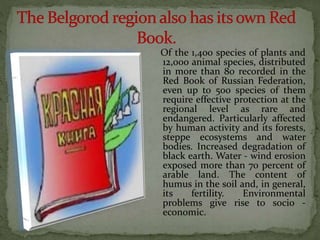
Of the 1,400 species of plants and
12,000 animal species, distributed
in more than 80 recorded in the
Red Book of Russian Federation,
even up to 500 species of them
require effective protection at the
regional level as rare and
endangered. Particularly affected
by human activity and its forests,
steppe ecosystems and water
bodies. Increased degradation of
black earth. Water - wind erosion
exposed more than 70 percent of
arable land. The content of
humus in the soil and, in general,
its fertility. Environmental
problems give rise to socio -
economic.
The red book
The red book
The red book
The red book
The red book
The red book
The red book
The red book

The red book

  • 1.
    Performed students of32 IT group: Timonova Anastasia Poliakova Maria Tkacheva Julia Teacher: Kochkina V. U.
  • 2.
    Project-work category: generalhuman interest topic. Type of the project: semi-structured (defined and planned by the teacher with students. Time limit: in and out class project work, covering 8 academic hours. Final outcome: multimedia and oral presentation. Equipment and materials: the Internet, pictures, the Wikipedia
  • 3.
     to improvestudents’ language (reading, writing, speaking, listening, grammar knowledge) and content knowledge;  to recycle the vocabulary on the topic: “The Environment Nature.  to encourage students to work together and to write their messages to future;  to develop students’ abilities to find and present information;  to develop students’ autonomy and independence;  to increase students’ motivation and ensure meaningful students’ engagement.
  • 4.
    1. Preface 2. Historyof the Red Book 3. The Belgorod region’s Red Book 4. Some animals species 5. Video materials
  • 5.
    The Red Book- is an illustrated collection of the rarest and most endangered species. The purpose of the Red Book is to attract people to the animals, the environment, self-education and development.
  • 6.
    History of theWorld Red Book was launched in Paris in 1902, when a number of countries have signed the first of its kind Red Book - The International Convention for the Protection of Birds, which can be considered the first international agreement to protect biodiversity.
  • 7.
    In 1948 wasestablished the International Union for Conservation of Nature and (IUCN, IUCN) - an international non-governmental organization in consultative status with UNESCO, which has 502 organizations from 130 countries. The range of activities extends from the IUCN conservation of endangered species, protected areas and ecosystem management to environmental legislation and social policy. IUCN seeks to ensure that decision-making in environmental management was based strictly on a scientific basis, using the latest scientific developments.
  • 8.
    In 1966 waspublished the second edition, which was already much more voluminous, and include information not only on mammals and birds, and amphibians and reptiles. The third edition, volumes of which began to emerge in 1972, included information on 528 species already and subspecies of mammals, 619 species of birds and 153 species and subspecies of reptiles and amphibians.
  • 9.
    Of the 1,400species of plants and 12,000 animal species, distributed in more than 80 recorded in the Red Book of Russian Federation, even up to 500 species of them require effective protection at the regional level as rare and endangered. Particularly affected by human activity and its forests, steppe ecosystems and water bodies. Increased degradation of black earth. Water - wind erosion exposed more than 70 percent of arable land. The content of humus in the soil and, in general, its fertility. Environmental problems give rise to socio - economic.