1
SCIENCE, first ESO
II. MATTER
1. Solids, liquids and gases
You might be able to easily tell which things
are solids, which are liquids and which are
gases.
Look at these photographs of substances you
might find at home.
• Which are solids?
• Which are liquids?
• Which are gases?
A1: In your group, write down some differences
between the way solids, liquids and gases
behave.
Try to make a table to show the properties of
solids liquids and gases.
SOLIDS
LIQUIDS
GASES
Some substances are difficult to classify and their state depends on temperature. Custard
would be a good example of this kind of substance.
A2: Looking at solids, liquids and gases:
1. Fill a plastic bottle with air and screw the lid on tightly.
a. Has it been difficult to fill the bottle with air?
b. Squeeze the bottle with your hands. Can you squash the bottle?
2. Fill the plastic bottle with water:
a. Try to squeeze the bottle.
3. Take a piece of rock.
a. Squeeze it with your hands.
Try to explain your results.
2
A3: Watching a crystal in water:
a. Drop a crystal in a beaker of cold water.
b. Drop another crystal in a beaker of hot water.
Leave them for a while. Watch.
Try to explain the results. What do they tell you about solids and liquids?
A4: Smelling
a. Someone has eaten orange. How do you notice?
b. What can you tell about the gases?
Discuss your explanations with other members of your group.
A5: Look at your table about how solids, liquids and gases behave.
Can you add some more ideas to the table now?
Try making a key you could use to decide if a material is solid, liquid or gas.
A6: Fill in the blanks with either “liquids” or “solids”.
• Spread . . . . . . . . on a surface.
• . . . . . . . are hard.
• . . . . . . . can be poured.
• . . . . . . . take the shape of the container.
• . . . . . . . have a fixed shape.
• . . . . . . . and . . . . . . cannot be easily squashed.
A7: Some substances are difficult to classify as liquids or solids. Custard is one
example. Write down another 3 examples.
Homework: Use the dictionary or check on line to find out the meaning of the words
that you don’t know.
• Write a paragraph about liquids. Include the following words:
• Write a paragraph about gases. Include the following words:
Wet, pour, thick, thin, drip, flow, container, freeze.
Squash, air, smell, light, fizzy, balloon
3
2. Particles
You have already seen that solids, liquids and gases behave in different ways. We
can explain the difference using a theory. Scientists believe that everything is made
of tiny particles.
In solids, liquids and gases the particles are arranged in different ways.
A8: In your group, discuss which drawing represents: a solid, a liquid and gas.
Your table of solids, liquids and gases properties should help you decide.
A9: Do you think the particles are moving?
. . . . . . . in solids
. . . . . . . in liquids
. . . . . . . in gases
Give reasons for your ideas.
A10: WARMING
a. A SOLID: Predict what will happen when
you warm the metallic ball.
Has the ball changed its shape?
Has the ball increased its volume?
Use the idea of particles to explain what you see.
4
b. A LIQUID:
Fill a test tube with water.
Put a rubber stopper and glass tube in it, as shown in the
diagram opposite.
Mark the water level above the stopper.
Predict what will happen when the tube is put in a beaker
of hot water.
Now try it out.
Use the idea of particles to explain what you see.
c. A GAS:
Predict what will happen in this next experiment:
Take a flask fitted with a stopper and glass tube.
Run cold water on the outside for 3 minutes. Put the glass
tube into a beaker of water.
Warm the outside of the flask with your hands. As is
shown in the diagram opposite.
Use the idea of particles to explain what you see.
Gases, liquids and solids expand when heated. But it is the amount of particles that
expands. Remember the particles themselves do not expand or contract as
temperature changes.
A11: Which state of matter expands the most, a gas, a liquid or a solid?
A12: Which of the following is the best substance to use for bicycles tyres? Why?
• When things get bigger, we say they
EXPAND.
• When the things get smaller, we say they
CONTRACT
Water; compressed air; wood
5
1. It is possible to squash gases and it isn’t possible to squash liquids and solids. Use
the idea of particles to explain this fact. Watch the video, it will help you to answer
the question.
− http://www.youtube.com/watch?v=bMbmQzV-Ezs
2. Are particles of solids stopped in their regular arrangement? . . . . . . . . . . . . . .
What do particles do when a solid is getting cold? Chose the correct answer:
a. Vibrate more and move further away
b. Vibrate less and stay in the same place.
c. Vibrate less and move closer together.
What do particles do when the solid is getting hot? . . . . . . . . . . . . . . . . . . . .
Can particles change their position in a solid when it’s getting hot? . . . . . . . .
What happens to particles when a solid is heated up? Chose the correct answer:
a. They get smaller
b. They stay the same size.
c. They get bigger
What are its particles doing when a liquid is heated? . . . . . . . . . . . . . . . . . . . . . . .
What are its particles doing when a gas is warmed? What happens to its particles
when a gas is cooled down? . . . . . . . . . . . . . . . . . . . . . . . . . . . . . . . . . . . . . . . . .
Which of these are able to flow?
a. Liquids, solids and gases.
b. Liquids and gases.
c. Solids and gases.
− http://www.youtube.com/watch?v=s-KvoVzukHo
− http://www.bbc.co.uk/bitesize/ks3/science/chemical_material_behaviour/
behaviour_of_matter/activity/
3. All substances can change their state. Use the video in order to name the next
change of state:
a. Solid à Liquid:
b. Liquid à Gas:
c. Gas à Liquid
d. Liquid à Solid
e. Solid à Gas
f. Gas à Solid
What are these boys doing when they represent a solid state?
− http://www.youtube.com/watch?v=I9xB4hhWvXY
4. What state of matter is a glass?
When placed into a furnace, the initial white solid becomes gooey and stretchy.
What other materials get gooey and stretchy?
− http://www.youtube.com/watch?v=HAPc6JH85pM
6
3. Density
A13: Check the following statements. First explain your answer in each case and
afterwards discuss your answer with the others in your group. Give reasons for your
answer.
a. Do all bodies have the same weight when they have the same size?
b. Is a bigger body always heavier than a smaller one?
c. Is water heavier when it turns to solid ice?
d. Is a piece of rock always heavier than a piece of plastic?
Scientists explain this idea through the concept of density.
Homework:
1. Copy and complete using some of the words in the box:
a. The three states of matter are . . . . . . . . , . . . . . . . and . . . . . . . .
b. . . . . . . and . . . . . . . . are harder to compress (squeeze together) than . . . . .
c. Everything is made of . . . . . . . . . . . .
d. The particles are very . . . . . . . . . . . .
e. Oven shelves fit more tightly in . . . . . . . . . ovens.
f. Gases, liquids and solids . . . . . . . . . . . when warmed.
2. The label on a lemonade bottle shows the contents:
a. Name one substance in the list that is a liquid, another that is a gas.
b. There is normally a lot of sugar in fizzy drinks. Which substance in the
list replaces sugar?
c. Why do you think sugar is not used here?
d. Is sugar solid, liquid or gas?
Melting, lumps, small, solids, gases, liquids, particles, same,
contract, hot expand
Water; citric acid; flavourings; carbon dioxide; artificial sweetener
Density is how much mass a substance has in a given volume. Mathematically,
density is defined as the mass of a body divided by its volume.
𝒅 =
𝒎𝒂𝒔𝒔  𝒐𝒇  𝒕𝒉𝒆  𝒃𝒐𝒅𝒚
𝒗𝒐𝒍𝒖𝒎𝒆  𝒐𝒇  𝒕𝒉𝒆  𝒃𝒐𝒅𝒚
=
𝒎
𝑽
So there are two things contributing to density:
• The mass of the particles that makes up the material.
• How close together the particles of a substance or material are.
7
Normally, each object, each substance has a different value for its density. So, when we
have an unknown object, we can identify which substance it is made of by finding its
density. Density is what we call a CHARACTERISTIC PROPERTY of substance,
because this property allows us to identify the substance.
A14. How can you find density in the laboratory? Look for this information on line or
using books.
a. Liquids.
b. Solid things.
A15. Use the information on densities in the table below to identify the three samples
your teacher will give you. Fill the table below.
Substance Density
(g/cm3
)
Aluminium (Al) 2,7
Iron (Fe) 7,8
Lead (Pb) 11,3
Copper (Cu) 8,9
Alcohol 0,8
Water 1,0
Wood 0,8
Olive oil 0,9
One of the most important properties of density is that the bodies less dense floats on
the denser if the last are a liquid or gas.
Substance Mass
grams (g)
Volume (cm3
) Experimental
density (d/cm3
)
Identify
Number-
Number-
Number-
Density Units: because density is mass divided by volume, the density units are
always units of mass divided by units of volume, but usually we use grams, g,
divided by cubic centimetres, cm3
. We express density using this unit: g/cm3
.
8
Changes of state
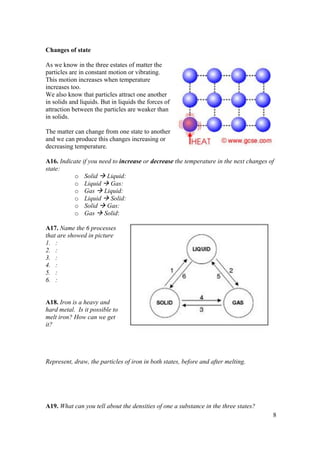
As we know in the three estates of matter the
particles are in constant motion or vibrating.
This motion increases when temperature
increases too.
We also know that particles attract one another
in solids and liquids. But in liquids the forces of
attraction between the particles are weaker than
in solids.
The matter can change from one state to another
and we can produce this changes increasing or
decreasing temperature.
A16. Indicate if you need to increase or decrease the temperature in the next changes of
state:
o Solid à Liquid:
o Liquid à Gas:
o Gas à Liquid:
o Liquid à Solid:
o Solid à Gas:
o Gas à Solid:
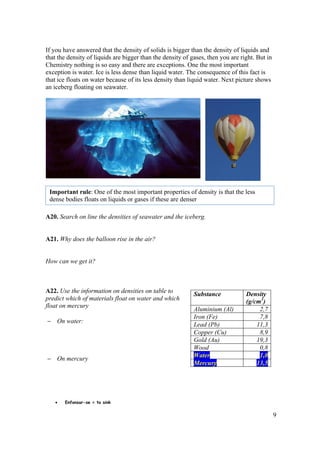
A17. Name the 6 processes
that are showed in picture
1. :
2. :
3. :
4. :
5. :
6. :
A18. Iron is a heavy and
hard metal. Is it possible to
melt iron? How can we get
it?
Represent, draw, the particles of iron in both states, before and after melting.
A19. What can you tell about the densities of one a substance in the three states?
9
If you have answered that the density of solids is bigger than the density of liquids and
that the density of liquids are bigger than the density of gases, then you are right. But in
Chemistry nothing is so easy and there are exceptions. One the most important
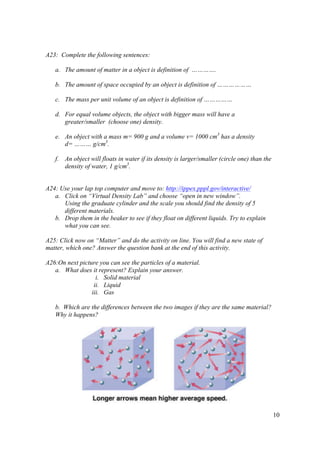
exception is water. Ice is less dense than liquid water. The consequence of this fact is
that ice floats on water because of its less density than liquid water. Next picture shows
an iceberg floating on seawater.
A20. Search on line the densities of seawater and the iceberg.
A21. Why does the balloon rise in the air?
How can we get it?
A22. Use the information on densities on table to
predict which of materials float on water and which
float on mercury
− On water:
− On mercury
• Enfonsar-se = to sink
Substance Density
(g/cm3
)
Aluminium (Al) 2,7
Iron (Fe) 7,8
Lead (Pb) 11,3
Copper (Cu) 8,9
Gold (Au) 19,3
Wood 0,8
Water 1,0
Mercury 13,5
Important rule: One of the most important properties of density is that the less
dense bodies floats on liquids or gases if these are denser
10
A23: Complete the following sentences:
a. The amount of matter in a object is definition of ………….
b. The amount of space occupied by an object is definition of ………………
c. The mass per unit volume of an object is definition of ……………
d. For equal volume objects, the object with bigger mass will have a
greater/smaller (choose one) density.
e. An object with a mass m= 900 g and a volume v= 1000 cm3
has a density
d= ……… g/cm3
.
f. An object will floats in water if its density is larger/smaller (circle one) than the
density of water, 1 g/cm3
.
A24: Use your lap top computer and move to: http://ippex.pppl.gov/interactive/
a. Click on “Virtual Density Lab” and choose “open in new window”.
Using the graduate cylinder and the scale you should find the density of 5
different materials.
b. Drop them in the beaker to see if they float on different liquids. Try to explain
what you can see.
A25: Click now on “Matter” and do the activity on line. You will find a new state of
matter, which one? Answer the question bank at the end of this activity.
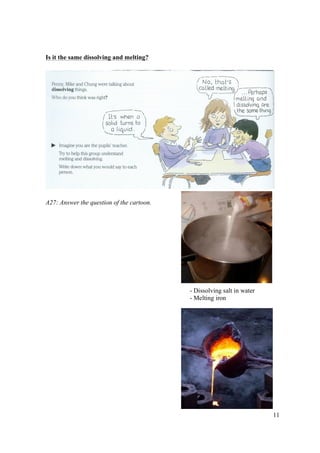
A26:On next picture you can see the particles of a material.
a. What does it represent? Explain your answer.
i. Solid material
ii. Liquid
iii. Gas
b. Which are the differences between the two images if they are the same material?
Why it happens?
11
Is it the same dissolving and melting?
A27: Answer the question of the cartoon.
- Dissolving salt in water
- Melting iron
12
The atoms
As you know, everything is made of particles. From now on, we will change this name
and we will call them MOLECULES (particles).
Well, what are these molecules made of?
All molecules are made of other smaller particles that we name ATOMS. In our world,
there are about 100 different atoms. Every single one has its own name. Below, you can
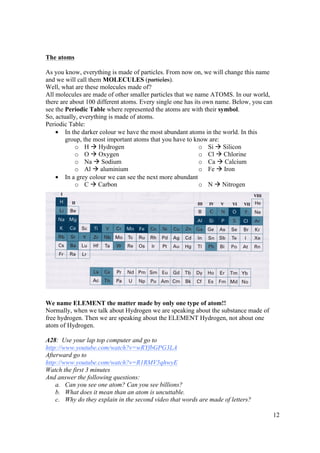
see the Periodic Table where represented the atoms are with their symbol.
So, actually, everything is made of atoms.
Periodic Table:
• In the darker colour we have the most abundant atoms in the world. In this
group, the most important atoms that you have to know are:
o H à Hydrogen
o O à Oxygen
o Na à Sodium
o Al à aluminium
o Si à Silicon
o Cl à Chlorine
o Ca à Calcium
o Fe à Iron
• In a grey colour we can see the next more abundant
o C à Carbon o N à Nitrogen
We name ELEMENT the matter made by only one type of atom!!
Normally, when we talk about Hydrogen we are speaking about the substance made of
free hydrogen. Then we are speaking about the ELEMENT Hydrogen, not about one
atom of Hydrogen.
A28: Use your lap top computer and go to
http://www.youtube.com/watch?v=wRYfbGPG3LA
Afterward go to
http://www.youtube.com/watch?v=R1RMV5qhwyE
Watch the first 3 minutes
And answer the following questions:
a. Can you see one atom? Can you see billions?
b. What does it mean than an atom is uncuttable.
c. Why do they explain in the second video that words are made of letters?
13
Our Body, the Earth crust
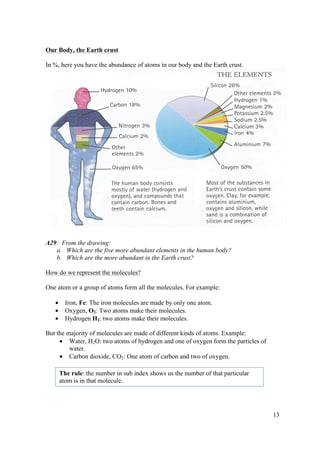
In %, here you have the abundance of atoms in our body and the Earth crust.
A29: From the drawing:
a. Which are the five more abundant elements in the human body?
b. Which are the more abundant in the Earth crust?
How do we represent the molecules?
One atom or a group of atoms form all the molecules. For example:
• Iron, Fe: The iron molecules are made by only one atom.
• Oxygen, O2: Two atoms make their molecules.
• Hydrogen H2: two atoms make their molecules.
But the majority of molecules are made of different kinds of atoms. Example:
• Water, H2O: two atoms of hydrogen and one of oxygen form the particles of
water.
• Carbon dioxide, CO2: One atom of carbon and two of oxygen.
The rule: the number in sub index shows us the number of that particular
atom is in that molecule.
14
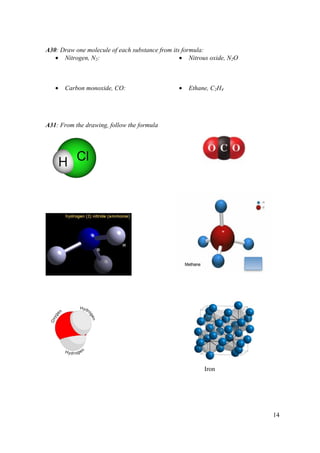
A30: Draw one molecule of each substance from its formula:
• Nitrogen, N2:
• Carbon monoxide, CO:
• Nitrous oxide, N2O
• Ethane, C2H4
A31: From the drawing, follow the formula
Iron
15
Molecules and substances
The arrangement of molecules depends on the estate of the substances.
• Solid state: the molecules are close one another and in a regular
arrangement.
• Liquid state: the molecules are close one another but in complete
disordered.
• Gaseous state: molecules are widely separated and completely
disordered.
A1: From the drawing identify the state of the substances and their
formula.
A2: Classify the systems represented below. For each one:
• Is there only one substance?
• Which are their states?
• Is there any solution?
A3: From its formula and its state, draw the substance using its molecules.
Iron
Oxygen Water Sodium hydroxideNa
O
H
Mercury,
Hg (liquid) Chlorine, Cl2
(gas)
CS2 ; liquid. FeO ; Solid
16
Where were the atoms made?
From pure energy our Universe was born 13700 million years ago with a huge
explosion and from then on the universe is expanding and cooling. We name this event
“Big Bang”. While the universe was getting cooler the first atoms that formed in the
new and early universe were Hydrogen atoms. These hydrogen atoms formed the stars,
as our Sun. The stars made up the other elements from Hydrogen atoms and in this
process light and energy are produced. Therefore, all the atoms in our Solar System
were made in our Sun. So, we are stars’ dust.
Our Sun is like all the other stars you can see
in the night sky.
The star patterns you can see at night are
called Constellations. For example, you can
see Orion on the right and the Great Bear
below.
The Sun is part of a huge collection of
stars called Galaxy. Our galaxy is called
the Milky Way. Our galaxy has more
than 100.000 stars.
Our galaxy has a spiral shape, as you can
see on the below picture.
The Milky Way is our galaxy, but it is not the
only galaxy. It is one of 20 galaxies called Local
Group. The Andromeda galaxy is one of these.
The Andromeda contains 300 billions stars.
The Andromeda
17
A4: What is bigger, a star or a galaxy? Why?
Have the iron atoms existed from the beginning of the universe?
Why are hydrogen atoms the most abundant in the universe?
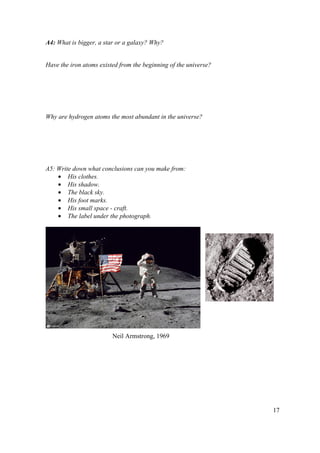
A5: Write down what conclusions can you make from:
• His clothes.
• His shadow.
• The black sky.
• His foot marks.
• His small space - craft.
• The label under the photograph.
Neil Armstrong, 1969
18
Worksheet 6
A1: Explain how hot air balloon works.
Comparing densities of gases.
Which gasses are denser than the air?
We are going to produce two gases in the lab:
• Hydrogen, H2. Write the names of the substances that we use to produce
Hydrogen.
How can we identify this gas?
• Carbon dioxide, CO2. Write the names of the substances that we use to produce
Carbon dioxide.
How can we identify this gas?
We are going to fill 3 balloons with:
• Air
• Hydrogen
• Carbon dioxide
Which is denser? Remember that the empty balloon has its own mass.
19
CHEMICAL REACTIONS, CR
You have seen that our world has about 100 different elements. These elements bond
together to form all that we can see.
How is it possible that all things, inanimate objects and living organisms are formed
from only 100 different atoms?
Our alphabet has only 28 letters and we make all the words joining some of this letters.
This is the answer to our question; there exist a lot of possibilities of joining atoms and
form different materials, different molecules. Materials are made of molecules.
Every thing around us is made of materials. Some are found naturally. Some need to be
made from raw materials.
What would your life be without glass, plastic, metals … ? How would we cook without
burning some fuel?
To make materials, to burn fuel is what we call CHEMICAL REACTIONS, CR.
Some materials are natural. Others are made. The wool from sheep is a natural material
and glass is to be made. We name that kind of material SYNTHETIC. It can be made
from sand, limestone and sodium carbonate. It is the result of a CHEMICAL
REACTION. Making new substances always involve a CR.
A6. Which of following substances are natural and which are synthetic?
• Wood.
• Glass used for making windows.
• Cotton wool.
• Coca Cola
• Fruits
• Your sport clothes.
The wool is a material Wood is a material Plastic is a material
20
How do we know when a chemical reaction has taken place? A chemical reaction
takes place when a new substance is produced. Then the final substance has different
properties than initial substance.
• A change of colour is produced or change any other property, density, melting
point, …
• Bubbles appear and a new gas is produced.
• Energy and light is released.
Then, we have a chemical reaction.
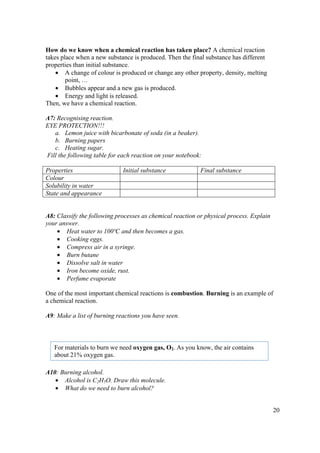
A7: Recognising reaction.
EYE PROTECTION!!!
a. Lemon juice with bicarbonate of soda (in a beaker).
b. Burning papers
c. Heating sugar.
Fill the following table for each reaction on your notebook:
Properties Initial substance Final substance
Colour
Solubility in water
State and appearance
A8: Classify the following processes as chemical reaction or physical process. Explain
your answer.
• Heat water to 100ºC and then becomes a gas.
• Cooking eggs.
• Compress air in a syringe.
• Burn butane
• Dissolve salt in water
• Iron become oxide, rust.
• Perfume evaporate
One of the most important chemical reactions is combustion. Burning is an example of
a chemical reaction.
A9: Make a list of burning reactions you have seen.
A10: Burning alcohol.
• Alcohol is C2H5O. Draw this molecule.
• What do we need to burn alcohol?
For materials to burn we need oxygen gas, O2. As you know, the air contains
about 21% oxygen gas.
21
A11: Wet a little bit of cotton wool with alcohol and put it on clock glass. Burn it and
cover with a beaker as it is shown in the image with the candles.
Predict what will happen when the beaker is put over burning cotton. Give reasons that
give support your ideas.
A12: Burning candles:
a. A more difficult prediction …
Predict what will happen when a beaker is
put over candles of three different heights.
Which candle do you think go out first?
Explain your ideas.
Write the word equation.
b. Plan an investigation to find out how the volume of air in a beaker affects the
time a candle burn.
i. How will you measure the volume of air in the beaker?
ii. How will you make measures on time?
iii. How will you record yours measures?
iv. What type of graph will you use to show any pattern?
When the alcohol is burned, alcohol disappears and the CR forms news
substances. We can show what happens in a reaction in a word equation:
For example:
Alcohol + oxygen à carbon dioxide + water + ENERGY
Also it is possible rewrite the equation as it is shown bellow:
C2H5O + O2 à CO2 + H2O + Energy
A word equation shows that initial substances disappear and news substances are
formed. We name the initial substances REACTANTS and the final substances
PRODUCTS.
It is very important to realise that the combustion reactions also produce
ENERGY.
22
Carbon dioxide
We have seen that carbon dioxide, CO2, is a gas and its density is bigger than air’s. So,
carbon dioxide sinks in the air.
We know that we can identify carbon dioxide because the flame is extinguished.
Where is the carbon dioxide produced?
You know that we take oxygen, O2, from the air and expel carbon dioxide, CO2, when
we breathe.
Use the computer to find out the following questions:
A13: Do animals breathe like humans?
A14: Do plants breathe?
Air has a
20% of
Oxygen
We breathe
out air with
less oxygen
and more
carbon
dioxide
23
A15: You know that when alcohol is burned this chemical reaction produce carbon
dioxide and water
Alcohol + oxygen à carbon dioxide + water + ENERGY
Do the same thing happens when we burn other fuels? Write the word equation for each
one.
Fuel Needs Oxygen? Produce carbon dioxide
Methane, CH4:
Butane, C4H10:
Petrol:
Coal:
Wood:
When we want to get energy we need to burn fuel and then, this chemical reaction,
produces energy and huge amounts of carbon dioxide, which goes to atmosphere.
Despite plants and oceans absorb greats quantities of carbon dioxide from the
atmosphere; the amount of carbon dioxide in the atmosphere is increasing, which
produces the Greenhouse Effect.
A16: Find out the meaning of Greenhouse
Effect.
Where can we find carbon dioxide?
The Carbon dioxide is easily dissolves in water and you can find it in all
fizzy drinks. Coca Cola, beers, soda, …
A17: Is the carbon dioxide a toxic gas? Why?
A18: Is the carbon dioxide the gas that we take from the air to breathe?
A19: Why is carbon dioxide so important?

Ii matter

  • 1.
    1 SCIENCE, first ESO II.MATTER 1. Solids, liquids and gases You might be able to easily tell which things are solids, which are liquids and which are gases. Look at these photographs of substances you might find at home. • Which are solids? • Which are liquids? • Which are gases? A1: In your group, write down some differences between the way solids, liquids and gases behave. Try to make a table to show the properties of solids liquids and gases. SOLIDS LIQUIDS GASES Some substances are difficult to classify and their state depends on temperature. Custard would be a good example of this kind of substance. A2: Looking at solids, liquids and gases: 1. Fill a plastic bottle with air and screw the lid on tightly. a. Has it been difficult to fill the bottle with air? b. Squeeze the bottle with your hands. Can you squash the bottle? 2. Fill the plastic bottle with water: a. Try to squeeze the bottle. 3. Take a piece of rock. a. Squeeze it with your hands. Try to explain your results.
  • 2.
    2 A3: Watching acrystal in water: a. Drop a crystal in a beaker of cold water. b. Drop another crystal in a beaker of hot water. Leave them for a while. Watch. Try to explain the results. What do they tell you about solids and liquids? A4: Smelling a. Someone has eaten orange. How do you notice? b. What can you tell about the gases? Discuss your explanations with other members of your group. A5: Look at your table about how solids, liquids and gases behave. Can you add some more ideas to the table now? Try making a key you could use to decide if a material is solid, liquid or gas. A6: Fill in the blanks with either “liquids” or “solids”. • Spread . . . . . . . . on a surface. • . . . . . . . are hard. • . . . . . . . can be poured. • . . . . . . . take the shape of the container. • . . . . . . . have a fixed shape. • . . . . . . . and . . . . . . cannot be easily squashed. A7: Some substances are difficult to classify as liquids or solids. Custard is one example. Write down another 3 examples. Homework: Use the dictionary or check on line to find out the meaning of the words that you don’t know. • Write a paragraph about liquids. Include the following words: • Write a paragraph about gases. Include the following words: Wet, pour, thick, thin, drip, flow, container, freeze. Squash, air, smell, light, fizzy, balloon
  • 3.
    3 2. Particles You havealready seen that solids, liquids and gases behave in different ways. We can explain the difference using a theory. Scientists believe that everything is made of tiny particles. In solids, liquids and gases the particles are arranged in different ways. A8: In your group, discuss which drawing represents: a solid, a liquid and gas. Your table of solids, liquids and gases properties should help you decide. A9: Do you think the particles are moving? . . . . . . . in solids . . . . . . . in liquids . . . . . . . in gases Give reasons for your ideas. A10: WARMING a. A SOLID: Predict what will happen when you warm the metallic ball. Has the ball changed its shape? Has the ball increased its volume? Use the idea of particles to explain what you see.
  • 4.
    4 b. A LIQUID: Filla test tube with water. Put a rubber stopper and glass tube in it, as shown in the diagram opposite. Mark the water level above the stopper. Predict what will happen when the tube is put in a beaker of hot water. Now try it out. Use the idea of particles to explain what you see. c. A GAS: Predict what will happen in this next experiment: Take a flask fitted with a stopper and glass tube. Run cold water on the outside for 3 minutes. Put the glass tube into a beaker of water. Warm the outside of the flask with your hands. As is shown in the diagram opposite. Use the idea of particles to explain what you see. Gases, liquids and solids expand when heated. But it is the amount of particles that expands. Remember the particles themselves do not expand or contract as temperature changes. A11: Which state of matter expands the most, a gas, a liquid or a solid? A12: Which of the following is the best substance to use for bicycles tyres? Why? • When things get bigger, we say they EXPAND. • When the things get smaller, we say they CONTRACT Water; compressed air; wood
  • 5.
    5 1. It ispossible to squash gases and it isn’t possible to squash liquids and solids. Use the idea of particles to explain this fact. Watch the video, it will help you to answer the question. − http://www.youtube.com/watch?v=bMbmQzV-Ezs 2. Are particles of solids stopped in their regular arrangement? . . . . . . . . . . . . . . What do particles do when a solid is getting cold? Chose the correct answer: a. Vibrate more and move further away b. Vibrate less and stay in the same place. c. Vibrate less and move closer together. What do particles do when the solid is getting hot? . . . . . . . . . . . . . . . . . . . . Can particles change their position in a solid when it’s getting hot? . . . . . . . . What happens to particles when a solid is heated up? Chose the correct answer: a. They get smaller b. They stay the same size. c. They get bigger What are its particles doing when a liquid is heated? . . . . . . . . . . . . . . . . . . . . . . . What are its particles doing when a gas is warmed? What happens to its particles when a gas is cooled down? . . . . . . . . . . . . . . . . . . . . . . . . . . . . . . . . . . . . . . . . . Which of these are able to flow? a. Liquids, solids and gases. b. Liquids and gases. c. Solids and gases. − http://www.youtube.com/watch?v=s-KvoVzukHo − http://www.bbc.co.uk/bitesize/ks3/science/chemical_material_behaviour/ behaviour_of_matter/activity/ 3. All substances can change their state. Use the video in order to name the next change of state: a. Solid à Liquid: b. Liquid à Gas: c. Gas à Liquid d. Liquid à Solid e. Solid à Gas f. Gas à Solid What are these boys doing when they represent a solid state? − http://www.youtube.com/watch?v=I9xB4hhWvXY 4. What state of matter is a glass? When placed into a furnace, the initial white solid becomes gooey and stretchy. What other materials get gooey and stretchy? − http://www.youtube.com/watch?v=HAPc6JH85pM
  • 6.
    6 3. Density A13: Checkthe following statements. First explain your answer in each case and afterwards discuss your answer with the others in your group. Give reasons for your answer. a. Do all bodies have the same weight when they have the same size? b. Is a bigger body always heavier than a smaller one? c. Is water heavier when it turns to solid ice? d. Is a piece of rock always heavier than a piece of plastic? Scientists explain this idea through the concept of density. Homework: 1. Copy and complete using some of the words in the box: a. The three states of matter are . . . . . . . . , . . . . . . . and . . . . . . . . b. . . . . . . and . . . . . . . . are harder to compress (squeeze together) than . . . . . c. Everything is made of . . . . . . . . . . . . d. The particles are very . . . . . . . . . . . . e. Oven shelves fit more tightly in . . . . . . . . . ovens. f. Gases, liquids and solids . . . . . . . . . . . when warmed. 2. The label on a lemonade bottle shows the contents: a. Name one substance in the list that is a liquid, another that is a gas. b. There is normally a lot of sugar in fizzy drinks. Which substance in the list replaces sugar? c. Why do you think sugar is not used here? d. Is sugar solid, liquid or gas? Melting, lumps, small, solids, gases, liquids, particles, same, contract, hot expand Water; citric acid; flavourings; carbon dioxide; artificial sweetener Density is how much mass a substance has in a given volume. Mathematically, density is defined as the mass of a body divided by its volume. 𝒅 = 𝒎𝒂𝒔𝒔  𝒐𝒇  𝒕𝒉𝒆  𝒃𝒐𝒅𝒚 𝒗𝒐𝒍𝒖𝒎𝒆  𝒐𝒇  𝒕𝒉𝒆  𝒃𝒐𝒅𝒚 = 𝒎 𝑽 So there are two things contributing to density: • The mass of the particles that makes up the material. • How close together the particles of a substance or material are.
  • 7.
    7 Normally, each object,each substance has a different value for its density. So, when we have an unknown object, we can identify which substance it is made of by finding its density. Density is what we call a CHARACTERISTIC PROPERTY of substance, because this property allows us to identify the substance. A14. How can you find density in the laboratory? Look for this information on line or using books. a. Liquids. b. Solid things. A15. Use the information on densities in the table below to identify the three samples your teacher will give you. Fill the table below. Substance Density (g/cm3 ) Aluminium (Al) 2,7 Iron (Fe) 7,8 Lead (Pb) 11,3 Copper (Cu) 8,9 Alcohol 0,8 Water 1,0 Wood 0,8 Olive oil 0,9 One of the most important properties of density is that the bodies less dense floats on the denser if the last are a liquid or gas. Substance Mass grams (g) Volume (cm3 ) Experimental density (d/cm3 ) Identify Number- Number- Number- Density Units: because density is mass divided by volume, the density units are always units of mass divided by units of volume, but usually we use grams, g, divided by cubic centimetres, cm3 . We express density using this unit: g/cm3 .
  • 8.
    8 Changes of state Aswe know in the three estates of matter the particles are in constant motion or vibrating. This motion increases when temperature increases too. We also know that particles attract one another in solids and liquids. But in liquids the forces of attraction between the particles are weaker than in solids. The matter can change from one state to another and we can produce this changes increasing or decreasing temperature. A16. Indicate if you need to increase or decrease the temperature in the next changes of state: o Solid à Liquid: o Liquid à Gas: o Gas à Liquid: o Liquid à Solid: o Solid à Gas: o Gas à Solid: A17. Name the 6 processes that are showed in picture 1. : 2. : 3. : 4. : 5. : 6. : A18. Iron is a heavy and hard metal. Is it possible to melt iron? How can we get it? Represent, draw, the particles of iron in both states, before and after melting. A19. What can you tell about the densities of one a substance in the three states?
  • 9.
    9 If you haveanswered that the density of solids is bigger than the density of liquids and that the density of liquids are bigger than the density of gases, then you are right. But in Chemistry nothing is so easy and there are exceptions. One the most important exception is water. Ice is less dense than liquid water. The consequence of this fact is that ice floats on water because of its less density than liquid water. Next picture shows an iceberg floating on seawater. A20. Search on line the densities of seawater and the iceberg. A21. Why does the balloon rise in the air? How can we get it? A22. Use the information on densities on table to predict which of materials float on water and which float on mercury − On water: − On mercury • Enfonsar-se = to sink Substance Density (g/cm3 ) Aluminium (Al) 2,7 Iron (Fe) 7,8 Lead (Pb) 11,3 Copper (Cu) 8,9 Gold (Au) 19,3 Wood 0,8 Water 1,0 Mercury 13,5 Important rule: One of the most important properties of density is that the less dense bodies floats on liquids or gases if these are denser
  • 10.
    10 A23: Complete thefollowing sentences: a. The amount of matter in a object is definition of …………. b. The amount of space occupied by an object is definition of ……………… c. The mass per unit volume of an object is definition of …………… d. For equal volume objects, the object with bigger mass will have a greater/smaller (choose one) density. e. An object with a mass m= 900 g and a volume v= 1000 cm3 has a density d= ……… g/cm3 . f. An object will floats in water if its density is larger/smaller (circle one) than the density of water, 1 g/cm3 . A24: Use your lap top computer and move to: http://ippex.pppl.gov/interactive/ a. Click on “Virtual Density Lab” and choose “open in new window”. Using the graduate cylinder and the scale you should find the density of 5 different materials. b. Drop them in the beaker to see if they float on different liquids. Try to explain what you can see. A25: Click now on “Matter” and do the activity on line. You will find a new state of matter, which one? Answer the question bank at the end of this activity. A26:On next picture you can see the particles of a material. a. What does it represent? Explain your answer. i. Solid material ii. Liquid iii. Gas b. Which are the differences between the two images if they are the same material? Why it happens?
  • 11.
    11 Is it thesame dissolving and melting? A27: Answer the question of the cartoon. - Dissolving salt in water - Melting iron
  • 12.
    12 The atoms As youknow, everything is made of particles. From now on, we will change this name and we will call them MOLECULES (particles). Well, what are these molecules made of? All molecules are made of other smaller particles that we name ATOMS. In our world, there are about 100 different atoms. Every single one has its own name. Below, you can see the Periodic Table where represented the atoms are with their symbol. So, actually, everything is made of atoms. Periodic Table: • In the darker colour we have the most abundant atoms in the world. In this group, the most important atoms that you have to know are: o H à Hydrogen o O à Oxygen o Na à Sodium o Al à aluminium o Si à Silicon o Cl à Chlorine o Ca à Calcium o Fe à Iron • In a grey colour we can see the next more abundant o C à Carbon o N à Nitrogen We name ELEMENT the matter made by only one type of atom!! Normally, when we talk about Hydrogen we are speaking about the substance made of free hydrogen. Then we are speaking about the ELEMENT Hydrogen, not about one atom of Hydrogen. A28: Use your lap top computer and go to http://www.youtube.com/watch?v=wRYfbGPG3LA Afterward go to http://www.youtube.com/watch?v=R1RMV5qhwyE Watch the first 3 minutes And answer the following questions: a. Can you see one atom? Can you see billions? b. What does it mean than an atom is uncuttable. c. Why do they explain in the second video that words are made of letters?
  • 13.
    13 Our Body, theEarth crust In %, here you have the abundance of atoms in our body and the Earth crust. A29: From the drawing: a. Which are the five more abundant elements in the human body? b. Which are the more abundant in the Earth crust? How do we represent the molecules? One atom or a group of atoms form all the molecules. For example: • Iron, Fe: The iron molecules are made by only one atom. • Oxygen, O2: Two atoms make their molecules. • Hydrogen H2: two atoms make their molecules. But the majority of molecules are made of different kinds of atoms. Example: • Water, H2O: two atoms of hydrogen and one of oxygen form the particles of water. • Carbon dioxide, CO2: One atom of carbon and two of oxygen. The rule: the number in sub index shows us the number of that particular atom is in that molecule.
  • 14.
    14 A30: Draw onemolecule of each substance from its formula: • Nitrogen, N2: • Carbon monoxide, CO: • Nitrous oxide, N2O • Ethane, C2H4 A31: From the drawing, follow the formula Iron
  • 15.
    15 Molecules and substances Thearrangement of molecules depends on the estate of the substances. • Solid state: the molecules are close one another and in a regular arrangement. • Liquid state: the molecules are close one another but in complete disordered. • Gaseous state: molecules are widely separated and completely disordered. A1: From the drawing identify the state of the substances and their formula. A2: Classify the systems represented below. For each one: • Is there only one substance? • Which are their states? • Is there any solution? A3: From its formula and its state, draw the substance using its molecules. Iron Oxygen Water Sodium hydroxideNa O H Mercury, Hg (liquid) Chlorine, Cl2 (gas) CS2 ; liquid. FeO ; Solid
  • 16.
    16 Where were theatoms made? From pure energy our Universe was born 13700 million years ago with a huge explosion and from then on the universe is expanding and cooling. We name this event “Big Bang”. While the universe was getting cooler the first atoms that formed in the new and early universe were Hydrogen atoms. These hydrogen atoms formed the stars, as our Sun. The stars made up the other elements from Hydrogen atoms and in this process light and energy are produced. Therefore, all the atoms in our Solar System were made in our Sun. So, we are stars’ dust. Our Sun is like all the other stars you can see in the night sky. The star patterns you can see at night are called Constellations. For example, you can see Orion on the right and the Great Bear below. The Sun is part of a huge collection of stars called Galaxy. Our galaxy is called the Milky Way. Our galaxy has more than 100.000 stars. Our galaxy has a spiral shape, as you can see on the below picture. The Milky Way is our galaxy, but it is not the only galaxy. It is one of 20 galaxies called Local Group. The Andromeda galaxy is one of these. The Andromeda contains 300 billions stars. The Andromeda
  • 17.
    17 A4: What isbigger, a star or a galaxy? Why? Have the iron atoms existed from the beginning of the universe? Why are hydrogen atoms the most abundant in the universe? A5: Write down what conclusions can you make from: • His clothes. • His shadow. • The black sky. • His foot marks. • His small space - craft. • The label under the photograph. Neil Armstrong, 1969
  • 18.
    18 Worksheet 6 A1: Explainhow hot air balloon works. Comparing densities of gases. Which gasses are denser than the air? We are going to produce two gases in the lab: • Hydrogen, H2. Write the names of the substances that we use to produce Hydrogen. How can we identify this gas? • Carbon dioxide, CO2. Write the names of the substances that we use to produce Carbon dioxide. How can we identify this gas? We are going to fill 3 balloons with: • Air • Hydrogen • Carbon dioxide Which is denser? Remember that the empty balloon has its own mass.
  • 19.
    19 CHEMICAL REACTIONS, CR Youhave seen that our world has about 100 different elements. These elements bond together to form all that we can see. How is it possible that all things, inanimate objects and living organisms are formed from only 100 different atoms? Our alphabet has only 28 letters and we make all the words joining some of this letters. This is the answer to our question; there exist a lot of possibilities of joining atoms and form different materials, different molecules. Materials are made of molecules. Every thing around us is made of materials. Some are found naturally. Some need to be made from raw materials. What would your life be without glass, plastic, metals … ? How would we cook without burning some fuel? To make materials, to burn fuel is what we call CHEMICAL REACTIONS, CR. Some materials are natural. Others are made. The wool from sheep is a natural material and glass is to be made. We name that kind of material SYNTHETIC. It can be made from sand, limestone and sodium carbonate. It is the result of a CHEMICAL REACTION. Making new substances always involve a CR. A6. Which of following substances are natural and which are synthetic? • Wood. • Glass used for making windows. • Cotton wool. • Coca Cola • Fruits • Your sport clothes. The wool is a material Wood is a material Plastic is a material
  • 20.
    20 How do weknow when a chemical reaction has taken place? A chemical reaction takes place when a new substance is produced. Then the final substance has different properties than initial substance. • A change of colour is produced or change any other property, density, melting point, … • Bubbles appear and a new gas is produced. • Energy and light is released. Then, we have a chemical reaction. A7: Recognising reaction. EYE PROTECTION!!! a. Lemon juice with bicarbonate of soda (in a beaker). b. Burning papers c. Heating sugar. Fill the following table for each reaction on your notebook: Properties Initial substance Final substance Colour Solubility in water State and appearance A8: Classify the following processes as chemical reaction or physical process. Explain your answer. • Heat water to 100ºC and then becomes a gas. • Cooking eggs. • Compress air in a syringe. • Burn butane • Dissolve salt in water • Iron become oxide, rust. • Perfume evaporate One of the most important chemical reactions is combustion. Burning is an example of a chemical reaction. A9: Make a list of burning reactions you have seen. A10: Burning alcohol. • Alcohol is C2H5O. Draw this molecule. • What do we need to burn alcohol? For materials to burn we need oxygen gas, O2. As you know, the air contains about 21% oxygen gas.
  • 21.
    21 A11: Wet alittle bit of cotton wool with alcohol and put it on clock glass. Burn it and cover with a beaker as it is shown in the image with the candles. Predict what will happen when the beaker is put over burning cotton. Give reasons that give support your ideas. A12: Burning candles: a. A more difficult prediction … Predict what will happen when a beaker is put over candles of three different heights. Which candle do you think go out first? Explain your ideas. Write the word equation. b. Plan an investigation to find out how the volume of air in a beaker affects the time a candle burn. i. How will you measure the volume of air in the beaker? ii. How will you make measures on time? iii. How will you record yours measures? iv. What type of graph will you use to show any pattern? When the alcohol is burned, alcohol disappears and the CR forms news substances. We can show what happens in a reaction in a word equation: For example: Alcohol + oxygen à carbon dioxide + water + ENERGY Also it is possible rewrite the equation as it is shown bellow: C2H5O + O2 à CO2 + H2O + Energy A word equation shows that initial substances disappear and news substances are formed. We name the initial substances REACTANTS and the final substances PRODUCTS. It is very important to realise that the combustion reactions also produce ENERGY.
  • 22.
    22 Carbon dioxide We haveseen that carbon dioxide, CO2, is a gas and its density is bigger than air’s. So, carbon dioxide sinks in the air. We know that we can identify carbon dioxide because the flame is extinguished. Where is the carbon dioxide produced? You know that we take oxygen, O2, from the air and expel carbon dioxide, CO2, when we breathe. Use the computer to find out the following questions: A13: Do animals breathe like humans? A14: Do plants breathe? Air has a 20% of Oxygen We breathe out air with less oxygen and more carbon dioxide
  • 23.
    23 A15: You knowthat when alcohol is burned this chemical reaction produce carbon dioxide and water Alcohol + oxygen à carbon dioxide + water + ENERGY Do the same thing happens when we burn other fuels? Write the word equation for each one. Fuel Needs Oxygen? Produce carbon dioxide Methane, CH4: Butane, C4H10: Petrol: Coal: Wood: When we want to get energy we need to burn fuel and then, this chemical reaction, produces energy and huge amounts of carbon dioxide, which goes to atmosphere. Despite plants and oceans absorb greats quantities of carbon dioxide from the atmosphere; the amount of carbon dioxide in the atmosphere is increasing, which produces the Greenhouse Effect. A16: Find out the meaning of Greenhouse Effect. Where can we find carbon dioxide? The Carbon dioxide is easily dissolves in water and you can find it in all fizzy drinks. Coca Cola, beers, soda, … A17: Is the carbon dioxide a toxic gas? Why? A18: Is the carbon dioxide the gas that we take from the air to breathe? A19: Why is carbon dioxide so important?