THE PROCESS OF QUALITATIVE
RESEARCH METHODS
Research & Project Design
Assoc. Prof. Chiwoza R Bandawe
What is the purpose of my research?
 What is my research for?
 How will this contribute to the socio-political
and cultural context of Malawi?
 Who will benefit? How emancipatory or
participatory is it?
What topic or broad area is the
research concerned with?
 Health?
 Policy?
 Sociological?
 Historical?
 Multi disciplinary approach?
What puzzle am I trying to unwind?
 Development puzzle? How and why did x or y
develop?
 Mechanical puzzles? How does x or y work?
Why does it work in this way?
 Comparative puzzles?What can we learn
from comparing x and y? How can we explain
the differences between them?
What are my research questions?
 What is the social reality I wish to investigate?
 What explanations or arguments can I build from
my data?
 Can I generalise my findings?
 Are my RQs consistent & linked with each other?
Do they add to a sensible whole?
 Are they worth asking and grounded in an
understanding of the relevant background?
How is the social world organised?
 What is my theory/ cosmology or world view?
 What are my life values?
 How might my cosmology influence my
research?
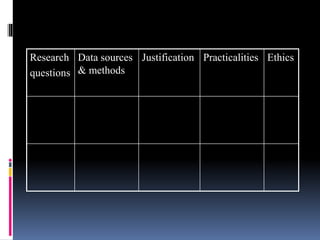
Research
questions
Data sources
& methods
Justification Practicalities Ethics
Qualitative data analysis
 Principles of data analysis (Patton,1990)
 1. No exact replication. Each study unique
 2. Dependent on skills of researcher at each
stage of study
 3. No absolute rules, but guidelines for
analysis
 4. Report and monitor and report analytical
procedures in detail
Principles of qualitative data
analysis
 Important for researchers to recognise and
account for own perspective
 Respondent validation
 Seek alternative explanations
 Work closely with same-language key informant
familiar with the languages and perspectives of
both researchers and participants
Principles of qualitative data
analysis
 Context is critical
i.e. physical, historical, social, political,
organisational, individual context
Dependence/interdependence
 Identify convergence / divergence of views and
how contextual factors may influence the
differences
Principles of qualitative data
analysis
 Role of theory guides approach to analysis
 Established conceptual framework –
predetermined categories according to research
questions
 Grounded theory – interrogate the data for
emergent themes
Principles of qualitative
data analysis
 Pay attention to deviant cases / exceptions
 Gives a voice to minorities
 Yield new insights
 Lead to further inquiry
Principles of qualitative data
analysis
 Data analysis is a non-linear / iterative
process
 Numerous rounds of questioning, reflecting,
rephrasing, analysing, theorising, verifying after
each observation, interview, or Focus Group
Discussion
Steps to Analysis
 Step 1: Familiarisation and immersion
 Step 2: Inducing themes/ Hypothesis
Formulation:
 Identifying
 Coding
 Categorisation
 Step 3: Discursive Elaboration (context)
 Step 4: Interpretation (telling the story)
Discourse (language)
 Realised in texts
 Is about objects
 Contains subjects
 Reflects its own way of speaking/
presentation
 Is historically located
Ideology
 A set of ideas that explains reality, provides
guidelines for behaviour and expresses the
interest of a group
 Elaborate: Christianity, capitalism, Marxism.
 Consistent framework guiding action
 Narrowly aimed at one side of issue
Step 1: Familiarisation and
immersion
 Read the whole, read parts and see how they
fit into the whole picture.
 What are the contradictions?
 What are the taken for granted statements?
 What vivid expressions, figures of speech and
metaphors emerge?
 What repetitions, gaps are noticed?
Step 1 …continued
 Why is this pattern like this?
 How are the sentences constructed?Active or
passive?
 How is the language being used? E.g. police:
“they did it, I keep law and order” for
protection.
 Comb the data and immerse yourself
Step 2: Inducing Themes
 Order the text into segment and solicit
themes
 -Way in which people categorise
 -Who is doing the categories?
 -Look for consistent patterns
 Coding
 Categorisation
Processes in qualitative data
analysis
2. Coding – Identifying emerging themes
 Code the themes that you have identified
 No standard rules of how to code
 Researchers differ on how to derive codes, when
to start and stop, and on the level of detail
required
 Record coding decisions
 Usually - insert codes / labels into the margins
 Use words or parts of words to flag ideas you find
in the transcript
 Identify sub-themes and explore them in greater
depth
Coding – Identifying emerging
themes
 Codes / labels
 Emergent codes
 Closely match the language and ideas in the textual
data
 Insert notes during the coding process
 Explanatory notes, questions
 Give consideration to the words that you will use as
codes / labels – must capture meaning and lead to
explanations
 Flexible coding scheme – record codes, definitions,
and revisions
Code continuously as data
 Imposes a systematic approach
 Helps to identify gaps or questions
while it is possible to return for more
data
 Reveals early biases
 Helps to re-define concepts
Step 3: Discursive
Elaboration
 Texts work to reproduce status quo of power
relations OR disrupt, challenge, deconstruct,
show marginal voices.
 Explore function of texts in relation to:
 Power
 Ideology
 Institutions & domination
Developing hypotheses,
questioning and verification
 Extract meaning from the data
 Do the categories developed make sense?
 What pieces of information contradict my
emerging ideas?
 What pieces of information are missing or
underdeveloped?
 What other opinions should be taken into
account?
 How do my own biases influence the data
collection and analysis process?
Step 3 Tools for Analysis
 How are persons, situations named, referred
to linguistically?
 What traits, qualities, characteristics
attributed?
 What arguments are used to justify,
legitimise the status quo?
Step 4: Telling the Story
 Bringing the whole analysis together into a
coherent whole. For a competent and useful
guideline, refer to the article:
 Malterud, K. (2001). Qualitative research:
standards, challenges, guidelines. The Lancet,
358, 483-488.
Interpretation
 Dependability
 Can findings be replicated?
 Confirmability
 Audit trail
 Permits external review of analysis decisions
 Transferability
 Apply lessons learned in one context to another
 Support, refine, limit the generalisability of, or
propose an alternative model or theory

The Process of Qualitative Research Methods

  • 1.
    THE PROCESS OFQUALITATIVE RESEARCH METHODS Research & Project Design Assoc. Prof. Chiwoza R Bandawe
  • 2.
    What is thepurpose of my research?  What is my research for?  How will this contribute to the socio-political and cultural context of Malawi?  Who will benefit? How emancipatory or participatory is it?
  • 3.
    What topic orbroad area is the research concerned with?  Health?  Policy?  Sociological?  Historical?  Multi disciplinary approach?
  • 4.
    What puzzle amI trying to unwind?  Development puzzle? How and why did x or y develop?  Mechanical puzzles? How does x or y work? Why does it work in this way?  Comparative puzzles?What can we learn from comparing x and y? How can we explain the differences between them?
  • 5.
    What are myresearch questions?  What is the social reality I wish to investigate?  What explanations or arguments can I build from my data?  Can I generalise my findings?  Are my RQs consistent & linked with each other? Do they add to a sensible whole?  Are they worth asking and grounded in an understanding of the relevant background?
  • 6.
    How is thesocial world organised?  What is my theory/ cosmology or world view?  What are my life values?  How might my cosmology influence my research?
  • 7.
  • 8.
    Qualitative data analysis Principles of data analysis (Patton,1990)  1. No exact replication. Each study unique  2. Dependent on skills of researcher at each stage of study  3. No absolute rules, but guidelines for analysis  4. Report and monitor and report analytical procedures in detail
  • 9.
    Principles of qualitativedata analysis  Important for researchers to recognise and account for own perspective  Respondent validation  Seek alternative explanations  Work closely with same-language key informant familiar with the languages and perspectives of both researchers and participants
  • 10.
    Principles of qualitativedata analysis  Context is critical i.e. physical, historical, social, political, organisational, individual context Dependence/interdependence  Identify convergence / divergence of views and how contextual factors may influence the differences
  • 11.
    Principles of qualitativedata analysis  Role of theory guides approach to analysis  Established conceptual framework – predetermined categories according to research questions  Grounded theory – interrogate the data for emergent themes
  • 12.
    Principles of qualitative dataanalysis  Pay attention to deviant cases / exceptions  Gives a voice to minorities  Yield new insights  Lead to further inquiry
  • 13.
    Principles of qualitativedata analysis  Data analysis is a non-linear / iterative process  Numerous rounds of questioning, reflecting, rephrasing, analysing, theorising, verifying after each observation, interview, or Focus Group Discussion
  • 14.
    Steps to Analysis Step 1: Familiarisation and immersion  Step 2: Inducing themes/ Hypothesis Formulation:  Identifying  Coding  Categorisation  Step 3: Discursive Elaboration (context)  Step 4: Interpretation (telling the story)
  • 15.
    Discourse (language)  Realisedin texts  Is about objects  Contains subjects  Reflects its own way of speaking/ presentation  Is historically located
  • 16.
    Ideology  A setof ideas that explains reality, provides guidelines for behaviour and expresses the interest of a group  Elaborate: Christianity, capitalism, Marxism.  Consistent framework guiding action  Narrowly aimed at one side of issue
  • 17.
    Step 1: Familiarisationand immersion  Read the whole, read parts and see how they fit into the whole picture.  What are the contradictions?  What are the taken for granted statements?  What vivid expressions, figures of speech and metaphors emerge?  What repetitions, gaps are noticed?
  • 18.
    Step 1 …continued Why is this pattern like this?  How are the sentences constructed?Active or passive?  How is the language being used? E.g. police: “they did it, I keep law and order” for protection.  Comb the data and immerse yourself
  • 19.
    Step 2: InducingThemes  Order the text into segment and solicit themes  -Way in which people categorise  -Who is doing the categories?  -Look for consistent patterns  Coding  Categorisation
  • 20.
    Processes in qualitativedata analysis 2. Coding – Identifying emerging themes  Code the themes that you have identified  No standard rules of how to code  Researchers differ on how to derive codes, when to start and stop, and on the level of detail required  Record coding decisions  Usually - insert codes / labels into the margins  Use words or parts of words to flag ideas you find in the transcript  Identify sub-themes and explore them in greater depth
  • 21.
    Coding – Identifyingemerging themes  Codes / labels  Emergent codes  Closely match the language and ideas in the textual data  Insert notes during the coding process  Explanatory notes, questions  Give consideration to the words that you will use as codes / labels – must capture meaning and lead to explanations  Flexible coding scheme – record codes, definitions, and revisions
  • 22.
    Code continuously asdata  Imposes a systematic approach  Helps to identify gaps or questions while it is possible to return for more data  Reveals early biases  Helps to re-define concepts
  • 23.
    Step 3: Discursive Elaboration Texts work to reproduce status quo of power relations OR disrupt, challenge, deconstruct, show marginal voices.  Explore function of texts in relation to:  Power  Ideology  Institutions & domination
  • 24.
    Developing hypotheses, questioning andverification  Extract meaning from the data  Do the categories developed make sense?  What pieces of information contradict my emerging ideas?  What pieces of information are missing or underdeveloped?  What other opinions should be taken into account?  How do my own biases influence the data collection and analysis process?
  • 25.
    Step 3 Toolsfor Analysis  How are persons, situations named, referred to linguistically?  What traits, qualities, characteristics attributed?  What arguments are used to justify, legitimise the status quo?
  • 26.
    Step 4: Tellingthe Story  Bringing the whole analysis together into a coherent whole. For a competent and useful guideline, refer to the article:  Malterud, K. (2001). Qualitative research: standards, challenges, guidelines. The Lancet, 358, 483-488.
  • 27.
    Interpretation  Dependability  Canfindings be replicated?  Confirmability  Audit trail  Permits external review of analysis decisions  Transferability  Apply lessons learned in one context to another  Support, refine, limit the generalisability of, or propose an alternative model or theory

Editor's Notes

  • #18 Read for content Are you obtaining the types of information you intended to collect Identify emergent themes and develop tentative explanations Note (new / surprising) topics that need to be explored in further fieldwork Read noting the quality of the data Have you obtained superficial or rich and deep responses How vivid and detailed are the descriptions of observations Is there sufficient contextual detail Problems in the quality of the data require a review of: How you are asking questions (neutral or leading) The venue The composition of the groups The style and characteristics of the interviewer How soon after the field activity are notes recorded Develop a system to identify problems in the data (audit trail)
  • #19 Read noting the quality of the data Have you obtained superficial or rich and deep responses How vivid and detailed are the descriptions of observations Is there sufficient contextual detail Problems in the quality of the data require a review of: How you are asking questions (neutral or leading) The venue The composition of the groups The style and characteristics of the interviewer How soon after the field activity are notes recorded Develop a system to identify problems in the data (audit trail) After identifying themes, examine how these are patterned Do the themes occur in all or some of the data Are their relationships between themes Are there contradictory responses Are there gaps in understanding – these require further exploration
  • #23 Building theme related files Conduct a coding sort Cut and paste together into one file similarly coded blocks of text NB identifiers that help you to identify the original source
  • #24 Capture the variation or richness of each theme Note differences between individuals and sub-groups Organise into sub-themes Return to the data and examine evidence that supports each sub-theme Note intensity/emphasis; first- or second-hand experiences; identify different contexts within which the phenomenon occurs