FACULTY OF EDUCATION
HPGD2203
EDUCATION MANAGEMENT
MATRICULATION NUMBER :
SEMESTER / MONTH (YEAR) : SEMESTER 2/MAY 2025
PROGRAMME : POST GRADUATE DIPLOMA
IN TEACHING (PGDT)
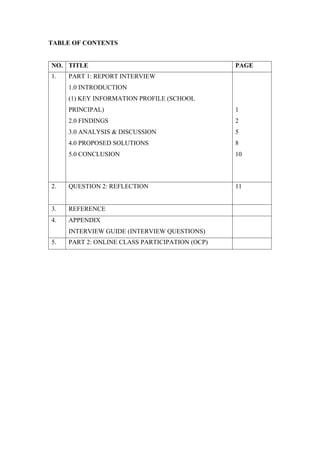
TABLE OF CONTENTS
NO. TITLE PAGE
1. PART 1: REPORT INTERVIEW
1.0 INTRODUCTION
(1) KEY INFORMATION PROFILE (SCHOOL
PRINCIPAL)
2.0 FINDINGS
3.0 ANALYSIS & DISCUSSION
4.0 PROPOSED SOLUTIONS
5.0 CONCLUSION
1
2
5
8
10
2. QUESTION 2: REFLECTION 11
3. REFERENCE
4. APPENDIX
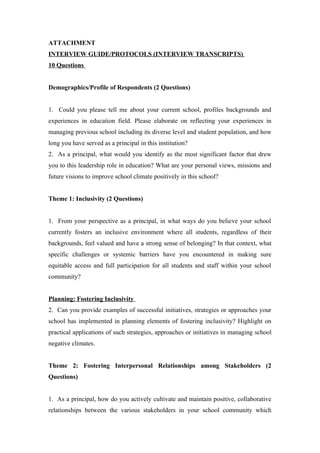
INTERVIEW GUIDE (INTERVIEW QUESTIONS)
5. PART 2: ONLINE CLASS PARTICIPATION (OCP)
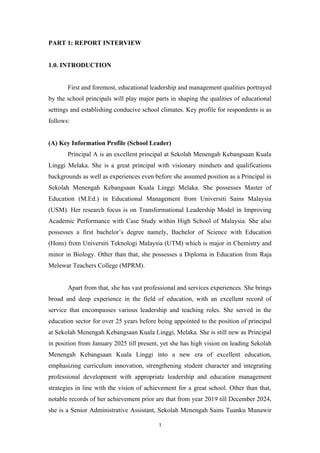
PART 1: REPORT INTERVIEW
1.0. INTRODUCTION
First and foremost, educational leadership and management qualities portrayed
by the school principals will play major parts in shaping the qualities of educational
settings and establishing conducive school climates. Key profile for respondents is as
follows:
(A) Key Information Profile (School Leader)
Principal A is an excellent principal at Sekolah Menengah Kebangsaan Kuala
Linggi Melaka. She is a great principal with visionary mindsets and qualifications
backgrounds as well as experiences even before she assumed position as a Principal in
Sekolah Menengah Kebangsaan Kuala Linggi Melaka. She possesses Master of
Education (M.Ed.) in Educational Management from Universiti Sains Malaysia
(USM). Her research focus is on Transformational Leadership Model in Improving
Academic Performance with Case Study within High School of Malaysia. She also
possesses a first bachelor’s degree namely, Bachelor of Science with Education
(Hons) from Universiti Teknologi Malaysia (UTM) which is major in Chemistry and
minor in Biology. Other than that, she possesses a Diploma in Education from Raja
Melewar Teachers College (MPRM).
Apart from that, she has vast professional and services experiences. She brings
broad and deep experience in the field of education, with an excellent record of
service that encompasses various leadership and teaching roles. She served in the
education sector for over 25 years before being appointed to the position of principal
at Sekolah Menengah Kebangsaan Kuala Linggi, Melaka. She is still new as Principal
in position from January 2025 till present, yet she has high vision on leading Sekolah
Menengah Kebangsaan Kuala Linggi into a new era of excellent education,
emphasizing curriculum innovation, strengthening student character and integrating
professional development with appropriate leadership and education management
strategies in line with the vision of achievement for a great school. Other than that,
notable records of her achievement prior are that from year 2019 till December 2024,
she is a Senior Administrative Assistant, Sekolah Menengah Sains Tuanku Munawir
1
(SAKTI) in Seremban. Her responsibility consists of upholding responsibility for
academic strategic planning, national and international curriculum coordination, as
well as data management and school performance evaluation. She believes that an
excellent educational institution not only produces high-performing students in
academics, but also forms individuals who are integrity-based, creative and critical as
well as have high soft skills. As a principal, she is committed to creating a conducive,
inclusive and always relevant learning environment with the demands of 21st century
education.
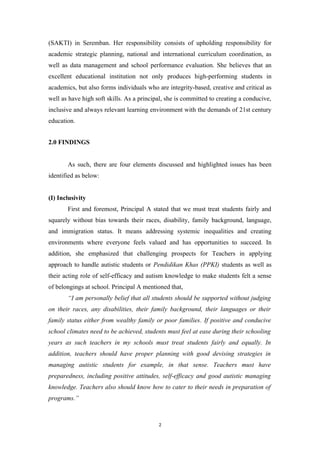
2.0 FINDINGS
As such, there are four elements discussed and highlighted issues has been
identified as below:
(I) Inclusivity
First and foremost, Principal A stated that we must treat students fairly and
squarely without bias towards their races, disability, family background, language,
and immigration status. It means addressing systemic inequalities and creating
environments where everyone feels valued and has opportunities to succeed. In
addition, she emphasized that challenging prospects for Teachers in applying
approach to handle autistic students or Pendidikan Khas (PPKI) students as well as
their acting role of self-efficacy and autism knowledge to make students felt a sense
of belongings at school. Principal A mentioned that,
“I am personally belief that all students should be supported without judging
on their races, any disabilities, their family background, their languages or their
family status either from wealthy family or poor families. If positive and conducive
school climates need to be achieved, students must feel at ease during their schooling
years as such teachers in my schools must treat students fairly and equally. In
addition, teachers should have proper planning with good devising strategies in
managing autistic students for example, in that sense. Teachers must have
preparedness, including positive attitudes, self-efficacy and good autistic managing
knowledge. Teachers also should know how to cater to their needs in preparation of
programs.”
2
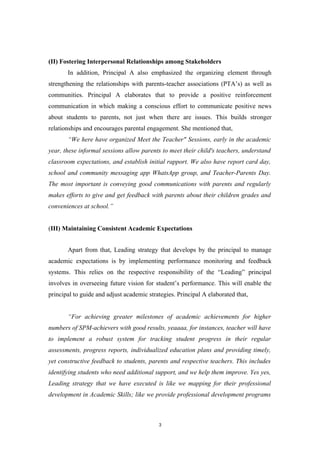
(II) Fostering Interpersonal Relationships among Stakeholders
In addition, Principal A also emphasized the organizing element through
strengthening the relationships with parents-teacher associations (PTA’s) as well as
communities. Principal A elaborates that to provide a positive reinforcement
communication in which making a conscious effort to communicate positive news
about students to parents, not just when there are issues. This builds stronger
relationships and encourages parental engagement. She mentioned that,
“We here have organized Meet the Teacher" Sessions, early in the academic
year, these informal sessions allow parents to meet their child's teachers, understand
classroom expectations, and establish initial rapport. We also have report card day,
school and community messaging app WhatsApp group, and Teacher-Parents Day.
The most important is conveying good communications with parents and regularly
makes efforts to give and get feedback with parents about their children grades and
conveniences at school.”
(III) Maintaining Consistent Academic Expectations
Apart from that, Leading strategy that develops by the principal to manage
academic expectations is by implementing performance monitoring and feedback
systems. This relies on the respective responsibility of the “Leading” principal
involves in overseeing future vision for student’s performance. This will enable the
principal to guide and adjust academic strategies. Principal A elaborated that,
“For achieving greater milestones of academic achievements for higher
numbers of SPM-achievers with good results, yeaaaa, for instances, teacher will have
to implement a robust system for tracking student progress in their regular
assessments, progress reports, individualized education plans and providing timely,
yet constructive feedback to students, parents and respective teachers. This includes
identifying students who need additional support, and we help them improve. Yes yes,
Leading strategy that we have executed is like we mapping for their professional
development in Academic Skills; like we provide professional development programs
3
for teachers; in example, how we promote effective teaching strategies likely
differentiated instruction and formative assessment.”
(IV) Implementing Strategies for Discipline and Safety Management
Subsequently, the Controlling strategy that developed by the principal is
represented in this upholding safety environment in the school. In managing bullying,
fundamentally schools need to implement resilient systems and foster a strong culture
that minimizes opportunities for bullying and empowers students to act positively.
Principal A reaffirmed that,
“This school is not compromised on any bully that happened within school
compounds, as such we have develop a zero-tolerance policy against bullying. we
clearly communicated to all students, staff, and parents upon admission and
throughout the year. We have defined various forms of bullying either physical,
verbal, social, cyber and their consequences, as well as reporting procedures to our
teachers and severe consequences, if caught. We are not tolerating Bully cases
reported. Other else, we form partnerships with external authorities and conduct
Program namely #BeliaBenciBuli Campaign as advised by Ministry of Education
awareness program to promote awareness for avoiding cyber-bullying in social
media.”
3.0 ANALYSIS AND DISCUSSIONS
1) Promoting Inclusivity (Planning Strategy)
First and foremost, the principal mentioned about challenges to implement
strategies to change negative climates of school to be more conducive, inclusive and
collaborative school environment. First, Planning strategy is teacher readiness and
extra teacher training gaps courses to equip teachers with professional skills. Teachers
did have training to cater inclusive students, yet consistent and comprehensive
training for all mainstream teachers on inclusive practices remains a challenge.
Principal A mentioned that,
“In Planning initiative for cater Inclusivity education policy, okay, we know
we need our manpower which is teacher to have extra skills, professional
4
development that manage to cater all our inclusive students. Right? As such, effective
planning for an inclusive school culture hinges on making sure that human factor
primarily teachers are adequately prepared and equipped to implement inclusive
practices. As such, our panel head (guru panitia) that handles inclusive practices has
3-days CRT short course to Dungun, Terengganu to learn about aligned process with
the school's overall inclusivity vision and policy, which are themselves products of the
planning phase.”
As such, Inclusivity practices for catering students will be managed with
differentiated instruction among the diverse group of learners that adjusted well to
their diverse learning style and equipped them with fundamentally pedagogy strategy
that represents universal design for learning (UDL).
2) Fostering Interpersonal Relationships with stakeholders (Organizing
Strategy)
Other than that, second strategy is Organizing which emphasized towards
fostering interpersonal relationships among stakeholders. this strategy intentionally
designs and implements for the systems, enhancing social structures and organizing
activities that cultivate trust, promoting open communication, inducing empathy and a
bring a sense of shared community. Principal A emphasized that,
“We have revitalized PIBG (Parent-Teacher Association) into a more
collaborative Body in which we re-organize our PIBG meetings to include activities
like workshops, brainstorming sessions and shared project planning for our students’
academic programmes and promoting personality development among our students.
We also have provided programme of Bacaan Yasin and Bermunajat for our SPM
students and involving staffs, teachers as well as parents.”
Henceforth, it comprehends this strategy is promoting open communications
and creating structured opportunities for positive interaction and collaborative efforts
from all stakeholders in working together towards common goals, breaking down
silos and building empathy for the betterment of students.
5
3) Maintaining consistent academic expectations (Leading Strategy)
Consistent academic results and expectations is among the important factor for
promoting positive climates. This can be realized with aims to inspire, provides guide
and make sure that high, clear and equitable academic standards are consistently
applied and continuous efforts for learning students. Hence, with continuous and
rigorous efforts, principals may create a sense of purpose, managing challenge and
motivating students and teachers towards achieving collective success. Principal A
elaborated that,
"In this school, as leading strategy to cater academic achievement, we use
data-driven decision-making for monitoring student’s academic achievement. We
need to track progress of students in several critical subjects such as Additional
Mathematics, Chemistry, Biology and Physics as well as Mathematics for their
improvements. As such, Senior Academic Head (for instances, Penolong Kanan
Akademik) will leads regular data review meetings with department heads (Ketua
Panitia) for each subject as well as teachers. They analyse SAPS data, internal test
results and attendance records to identify struggling students, identify trends of
marking grades in specific subjects during their mid-terms results or SPM trials, or
areas where teaching strategies might need improvements.”
Hence, based on the interview session, Principal A identified that leading
strategy that being used is school is using data to identify students who are falling
behind. Furthermore, based on the academic data, responsible academic leaders will
work with departments and individual teachers to set specific, measurable, achievable
plus relevant information’s within specified timeframe (SMART) for achieving
academic goals. For instances, to increase the percentage of students achieving Band
4 or higher in Bahasa Melayu by margin of more than 10%". Indeed, it is
responsibilities of school counterparts to fully improve the school negative climates.
4) Implementing strategies for discipline and safety management (Controlling
Strategy)
In term of controlling strategy in school management, it is basically
emphasized by means putting systems in place to make sure that rules are followed
along with it being fulfilled and met standards requirements as well as potential risks
6
are controlled. It is highlighted that such mechanism will keep sustaining the school
community to conduct process of discipline and behaviour management in a safer
environment. Principal A reiterated that,
“In this school, we emphasize students to behave in righteous manner,
discipline, smart and appropriate conduct as school students should be. We want
student to monitor their discipline, and we are not tolerating Bully issues. We have
provided a swift and fair response system, if any bully occurred, and when a
disciplinary issue arises or a safety concern is reported by their disciplinary
homeroom teacher, disciplinary teacher or guidance and counselling teacher, we will
respond promptly and fairly. Investigations also should be thorough, and decisions
should be made based on evidence along with established enacting policy within our
school authority.”
Principal A emphasized that, restorative practices as a form of control are very
fundamental. They also guide student’s behaviour and make sure students will need to
understand the impact of their actions, which ultimately results towards better self-
control. For recurring problems or students struggling with negative behaviour, a
controlling strategy involves providing individualized support plans, guidance and
counselling or mentorship will be implemented to address root causes and guide them
toward positive choices that will takes place.
4.0 PROPOSED SOLUTIONS
According to the interview session conducted, it is fundamentally important
for the principal perspectives to address elements of improving inclusivity policy and
approach, fostering interpersonal relationships with stakeholders, improving academic
expectations and maintaining discipline and safety management for handling negative
school climates. Hence, proposed solutions for the themes mentioned is as follows:
(a) First Theme: Promoting Inclusivity
First and foremost, Planning strategy has been discussed in which teacher
professional development with minimizing teacher training gaps in inclusivity
7
pedagogy construction of curriculum planning and implementation. According to
Abdulah & Mahmud (2025c), for teachers to teach mathematics in primary inclusive
school, it has been identified five required competencies namely content mastery
skills, flexible strategies and techniques skills, technology utilisation skills, effective
classroom management skills along with skills in assessment and monitoring. These
findings have implications for enhancing teacher training and professional
development programs to equip them with the necessary competencies for effective
inclusive teaching of mathematics subject. Hence, like Principal A mentioned, teacher
preparedness and professional development fundamentally to cater inclusivity in
tackling school negative climates.
(b) Second Theme: Fostering Interpersonal Relationships of Stakeholders
Principal A also provide justifications on the organizing strategy to cater
fostering relationships among stakeholders on requirements to provide a positive and
rigorous reinforcement communication in which making a conscious effort to
communicate positive news about students to parents and not just when there are
issues arises. This comes with concerned that through building stronger relationships
will encourages parental engagement. According to Wondim (2024), teacher and
school must play initiatives in engaging parents which is pivotal. If schools do not
actively design and implement effective strategies to involve parents, a negative or
indifferent climate around parental involvement is likely to persist. It also emphasized
that school must avoid weak communication. Beforehand, the low engagement in
communication between parents and schools also involving teachers can contribute to
a disconnected and potentially negative school climate. In that sense, parents are not
well-informed or feel their input is not valued, it can lead to misunderstandings,
distrust in relationships and a lack of unified support for the student. Improving
communication is crucial for building trust and a sense of shared community alike.
(c) Third Theme: Maintaining consistent academic expectations
Principal A highlighted importance on implementation of several leading
strategies towards process of maintaining academic expectations and improving
student’s achievement results. There are two (2) main strategies for the training of
teacher development towards differentiated instruction and formative assessment.
8
Both targeted differentiated instruction and formative assessment interconnected in
improving academic achievement and obtain what expected from student’s results.
According to Ndlovu (2025), formative assessment will provide prompt and
continuous feedback on academic achievements which pivotally causes significant
advantage of this engagement in term of provision that continuous and bring prompt
feedback to learners. This immediate feedback loop is beneficial for administering
students' understanding and advancement. As a results, maintaining the academic
expectations can be met and school will address negative climate to improve school
settings efficiently.
(d) Fourth Theme: Implementing strategies for discipline and safety
management
For this theme, after discussion with the Principal A, she reiterated about
empowering students to act positively which can elevates safety management from a
top-down mandate to an application of collective responsibility. This includes
empowering students through social-emotional learning, bystander intervention
training and opportunities for leadership in school safety initiatives whilst fostering a
sense of ownership toward learning institution. According to Mahoney, Durlak, &
Weisberg (2021), process of fostering social-emotional competence should serves as a
proactive and preventative discipline strategy. Further, it should just solely aim in
reacting to misbehaviour of students but more towards interventions that could
augmented skills such as self-awareness, self-management, social awareness, making
friends and relationships plus responsible decision-making will qualify students with
the internal tools requirement in regulating behaviours towards making them come
out with positive conduct. As such, this proactive approach to discipline integrates
seamlessly into daily school life which can shifting the focus from mere rule
enforcement to more skill development that is a benchmark for a practical discipline
management.
5.0 CONCLUSION
In summary, the success of an educational institution in fostering a truly
conducive school environment depends towards perceptions of school principals’ that
significantly shaped their strategies accompanied by actions in administering
9
complicated challenges to inculcate a positive school climate. The important
applications of appropriates strategy in catering four themes (4) which specifically
consists of; Inclusivity, fostering interpersonal relationships among stakeholders,
maintaining academic expectations and upholding discipline and safety management
will be shifting school settings to be more proactive and be in a positive context.
Then, when these four themes are integrated and being championed respectively by
principal practices, they will collectively modify an educational institution experience
into a more conducive environment where students will feel safe to learn and motivate
them for academic success. In addition, this will holistically bring development in all
of their facets of life.
(2816 Words)
10
REFERENCES
Adams, D., Moosa, V., Shareefa, M., Mohamed, A., & Tan, K. L. (2024). Assessing
Inclusive School Leadership Practices in Malaysia: instrument adaptation and
validation. International Journal of Disability Development and Education, 1–
19. https://doi.org/10.1080/1034912x.2024.2354895
Anyanwu, I. K. (2025). The Influence of Counselling Strategies on Deviant
Behaviour Modification Among Secondary School Students. Igboscholars
International Journal, 18(2).
Ezeaku, S. N., & Okoye, A. C. (2025). Best Strategies for Ensuring a Good
Organizational Climate in Secondary Schools in Anambra State. Unizik
Journal of Educational Laws and Leadership Studies, 1(1).
https://unilaws.org/unilaws/article/view/24
Fülöp, M., Varga, B. A., & Sebestyén, N. (2024). Competitive and non-competitive
school climate and students' well-being. Learning and Instruction,
Volume(Issue),Page numbers.
https://doi.org/10.1016/j.learninstruc.2024.102036
Mahoney, J. L., Durlak, J. A., & Weisberg, R. P. (2021). Promoting social-emotional
competence and preventing bullying in schools: A systematic review of
universal school-based interventions. Journal of Applied Developmental
Psychology, 72, 101267.
Musty, J.,& Obedient, S. M.(2018). The influence of the readiness of the teacher to
the management room of the degrees of the 21st century. Malaysian Journal
of Social Science and Humanities, 3(4), 6-22.
Ndlovu, B. B. (2025). Exploring teachers’ practices when using formative assessment
in improving quality education. Cogent Education, 12(1).
https://doi.org/10.1080/2331186X.2025.2451489
Wondim, M. G. (2024). Parental Engagement in Early Childhood Education: The
Case of Debre Tabor Schools, Ethiopia. European Journal of Education, 60(1).
https://doi.org/10.1111/ejed.12817
QUESTION 2: REFLECTION
First and foremost, there are leadership styles that practices by principal in fostering a
conducive school environment. As such, this study highlighted how these leadership
criteria will impact decision-making and contributes to the process of encouraging a
positive and conducive school environment.
Firstly, the theme Inclusivity within educational constitution is clearly emphasized
through a vision provided to make sure students with diverse needs are given equal
treatment, rights and their requirements being fulfilled without any discriminations by
the school stakeholder’s conduct. Additionally, school counterparts must embody and
having inspired vision towards recognizing every student to feels valued, being seen
for their abilities or disadvantages and provided with supports regardless of their
background or distinctiveness from the other (Ketikidou & Saiti, 2022). There are two
types of apparent leadership practices style using by the principal’s which was found
throughout the interview session which are transformational leadership and
transactional leadership. For the Transformational leadership, the principal applies
influence approach in which principal represents empathetic behaviour with purpose
of actively championing student’s diversity and providing inspirational motivation
which brings diversified students along with their articulate vision that compelling in
designing for a truly equitable school community (Yakob et. al, 2025). For instance, a
transformational principal might initiate school-wide campaigns celebrating cultural
diversity as well as empowering stakeholders to challenge their own biases rather than
simply enforcing anti-discrimination rules should practices by teachers towards cater
distinctive students. Hence, Principal A has applied Transformational Leadership
Styles through providing teacher training inclusively to cater the specialized needs
students, curriculum execution through Universal Design Learning (UDL) which
transforming and shifting the school environment totally towards inclusion. This will
enhance the positive school climates in a longstanding effort which can be
realistically attained. According to Shields & Hesbol (2019), school leaders should
exercise equitable emphasizing socially just leadership to create welcoming and
inclusive schools in which students who are minoritized or specialized along with
economically disadvantaged would feel affirmed, being respected by others and
academically improved not left disadvantageous. As such, school leaders need to
11
align their goals and practices which becoming their major challenge. School leaders
are prompt to disrupt inequitable school cultures and work transformative in that
sense to achieved desired school environment.
Apart from that, the principal also applied Instructional Leadership Style
Practices in progressive efforts to make sure that inclusivity is not just a philosophy
but a pedagogical reality in practices. An instructional Principal as a leader will focus
on curriculum adaptation and improving professional development for equipping
differentiated instruction towards specific needs for students (Ralebese et. al, 2025).
Other else, Instructional leadership also shows by monitoring teaching practices to
make sure equitable access were given towards students for their learning process.
Take for instances, principal allocate resources for specialist training in supporting
students with diverse learning needs and lead discussions on how assessment
practices can be made more in term of equitable manner.
Second theme discusses fostering interpersonal relationships among
stakeholders in the school context. Throughout the discussions with principal, it has
been identified that principal apply initiative such as building strong interpersonal
relationships among stakeholder students, teachers, parents and wider community.
This highlights Principal Transformational Leadership styles or at lesser extent,
Transactional Leadership styles in practice towards school setting. In addition,
Transformational leaders are those who succeed in changing the attitude and values of
those whom they lead because they have succeeded in giving them a new sense of
awareness (Gupta, 2025). This will be motivating stakeholders to uphold moral values
such as social justice and inculcate harmony towards managing relationships for safe
environment at school. Through interview, it can be identified that Principal employ
Transformational Leadership Styles through open and honest communication skills in
practices, good communication skills, trustworthiness, empathy and good problem-
solving skills instils in the various stakeholders (Abdul Ghani & Ling, 2021).
Principal is employing excellent communication skills practices to strengthening good
rapport with communities towards betterment of the positive school climate.
On the other hand, Principal also practices transactional leadership in through
the formal parameters of communication such as meeting schedules with parents and
teacher associations with regular meetings along with providing official reporting
lines. Furthermore, it is the transformational leader's ability to inspire trust and mutual
12
respect that creates authentic and necessary relationship experiences within the
school. For instances, Principal has instructional leadership practices in application by
working PIBG (Parent-Teacher Association’s) into a more collaborative body and re-
organize PIBG meetings with conducive activities like workshops, brainstorming
sessions and shared project planning for shifted implementations.
Third theme is maintaining academic expectations which refer to ascends
academic excellency acquired by students. This important theme highlighted through
three (3) Principal Leadership Styles which are Instructional Leadership,
Transactional Leadership and Transformational Leadership. Instructional practices
demonstrated by principal which has significantly positive relationships towards
student’s academic achievement. As such, instructional leadership practices (ILP) and
the monitoring tools which applied by school principals has positive effect on student
achievement. The impact is delivered in mechanisms such as a model for ILP that
should be applied by principals and incorporated such strategies into their daily habits
that provide opportunities for instructional changes and improved student
achievement can be attained (Sanchez & Watson, 2021). Principal has applied
instructional leadership through emphasizes on curriculum alignment is aligned to meet
requirements and enhance student’s professional development. As such, strategies like
monitoring student progress through data analysis and providing targeted professional
development to enhance pedagogical skills is valid and important. In term of
Instructional leadership approach, Principal has applied a robust system tracking
system to monitor student academic progress and achievements in their regular
assessments, progress reports and setting up individualized education plans which and
constantly provide feedback and informing parents. Furthermore, Principal also help
to decide on school-wide literacy initiatives which based on student performance data
and provide coaching to students struggling specifically which refer to student’s
Bahasa Melayu literacy rates.
Furthermore, Transactional Leadership plays a vital role in establishing clear
performance metrics for teachers like short courses, implementing assessment
schedules along with compliances in curriculum requirements and guidelines.
Principal has provided teacher training to fill in the gap of new pedagogical approach
for strategy to be effectively. As for Transformational approach, principal would
articulate a compelling vision of high academic achievement whilst empowering
13
teachers to innovate and take ownership of their student learning which foster culture
of continuous improvement. For instances, teachers will adhere in preparation of
academic programmes to cater academic progress and efforts such as arranging
academic activities for examinations like SPM.
The fourth theme is handling students’ discipline and safety management.
Instructional Leadership being implemented by the principal like handling bullying
and cyberbullying issues that occurred at school. Instructional practices being
conducted in which action beyond rule enforcement and applied effective strategies to
foster an environment where students will feel secure and respected as well enhanced
their motivation to attend school and be present in the learning process. For the
Transformational Leadership is through inspiring students to take responsibility for
their actions by promoting restorative justice practices and inculcate a strong sense of
community where students take care for the well-beings of one another. Their
decisions might include implementing peer mediation programs, investing in social-
emotional learning curricula or empowering student leadership to promote a positive
school climate. As for Transactional Leadership it is essential for establishing clear
rules through implementing consistent disciplinary procedures and make sure robust
safety protocols being followed (Abdul Ghani & Ling, 2021). Furthermore, teachers
and school staffs are fully aware and well-informed to notices rules and guidelines
about school's bullying policy. This clearly shows their focus on clear roles, abiding
responsibilities and contingent rewards or punishments strategies to establish order
can be implemented effectively.
In summary, the most effective school leaders are not confined to a single
style in their approach to improve school negative climates. Instead, they are adept at
strategically blending and adapting elements of each and others to gain understanding
when to apply clear goals and objectives as well as gaining accountability towards
empowering students in the school context. Moreover, this can regain pedagogical
improvement intensely and beneficial to the making school as conducive and efficient
educational environment. Hence, this adaptive and multifaceted leadership approach
is essential for navigating the inherent complexities of school management and make
sure an educational institution being readily in which every member will play their
parts well and thrive excellently developing the positive school climates as a result.
14
(1400 WORDS)
15
REFERENCES
Abdul Ghani, A. W., & Ling, T. L. (2021). HPGD2203 Educational Management
Module. Petaling Jaya: Open University Malaysia Publisher.
Gupta, P. (2025). Transformational leadership: inspiring change and innovation.
International Journal of Science and Research (IJSR), 14(2), 504-509.
Ketikidou, G., & Saiti, A. (2022). The promotion of inclusive education through
sustainable and systemic leadership. International Journal of Leadership in
Education, 28(3), 639–654. https://doi.org/10.1080/13603124.2022.2032368
Ralebese, M. D., Jita, L., & Badmus, O. T. (2025). Examining Primary School
Principals’ Instructional Leadership Practices: A Case Study on Curriculum
Reform and Implementation. Education Sciences, 15(1), 70.
Sanchez, J., & Watson, J. (2021). Effective instructional leadership practices in high
performing elementary schools. Journal of School Administration Research
and Development, 6(2), 60-70.
Shields, C. M., & Hesbol, K. A. (2019). Transformative Leadership Approaches to
Inclusion, Equity, and Social Justice. Journal of School Leadership, 30(1), 3-
22. https://doi.org/10.1177/1052684619873343 (Original work published
2020)
Yakob, M., Sahudra, T. M., & Sukirno, S. (2025). Transformational Leadership of
Principals: Driving Excellence in Education Quality. Al-Ishlah: Jurnal
Pendidikan, 17(1), 1658-1667.
ATTACHMENT
INTERVIEW GUIDE/PROTOCOLS (INTERVIEW TRANSCRIPTS)
10 Questions
Demographics/Profile of Respondents (2 Questions)
1. Could you please tell me about your current school, profiles backgrounds and
experiences in education field. Please elaborate on reflecting your experiences in
managing previous school including its diverse level and student population, and how
long you have served as a principal in this institution?
2. As a principal, what would you identify as the most significant factor that drew
you to this leadership role in education? What are your personal views, missions and
future visions to improve school climate positively in this school?
Theme 1: Inclusivity (2 Questions)
1. From your perspective as a principal, in what ways do you believe your school
currently fosters an inclusive environment where all students, regardless of their
backgrounds, feel valued and have a strong sense of belonging? In that context, what
specific challenges or systemic barriers have you encountered in making sure
equitable access and full participation for all students and staff within your school
community?
Planning: Fostering Inclusivity
2. Can you provide examples of successful initiatives, strategies or approaches your
school has implemented in planning elements of fostering inclusivity? Highlight on
practical applications of such strategies, approaches or initiatives in managing school
negative climates.
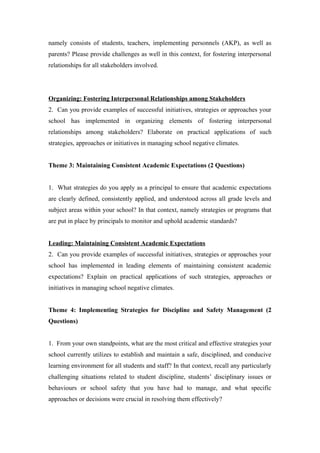
Theme 2: Fostering Interpersonal Relationships among Stakeholders (2
Questions)
1. As a principal, how do you actively cultivate and maintain positive, collaborative
relationships between the various stakeholders in your school community which
namely consists of students, teachers, implementing personnels (AKP), as well as
parents? Please provide challenges as well in this context, for fostering interpersonal
relationships for all stakeholders involved.
Organizing: Fostering Interpersonal Relationships among Stakeholders
2. Can you provide examples of successful initiatives, strategies or approaches your
school has implemented in organizing elements of fostering interpersonal
relationships among stakeholders? Elaborate on practical applications of such
strategies, approaches or initiatives in managing school negative climates.
Theme 3: Maintaining Consistent Academic Expectations (2 Questions)
1. What strategies do you apply as a principal to ensure that academic expectations
are clearly defined, consistently applied, and understood across all grade levels and
subject areas within your school? In that context, namely strategies or programs that
are put in place by principals to monitor and uphold academic standards?
Leading: Maintaining Consistent Academic Expectations
2. Can you provide examples of successful initiatives, strategies or approaches your
school has implemented in leading elements of maintaining consistent academic
expectations? Explain on practical applications of such strategies, approaches or
initiatives in managing school negative climates.
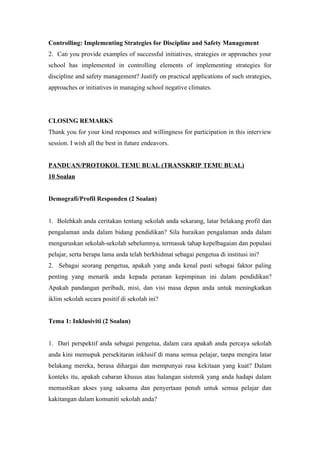
Theme 4: Implementing Strategies for Discipline and Safety Management (2
Questions)
1. From your own standpoints, what are the most critical and effective strategies your
school currently utilizes to establish and maintain a safe, disciplined, and conducive
learning environment for all students and staff? In that context, recall any particularly
challenging situations related to student discipline, students’ disciplinary issues or
behaviours or school safety that you have had to manage, and what specific
approaches or decisions were crucial in resolving them effectively?
Controlling: Implementing Strategies for Discipline and Safety Management
2. Can you provide examples of successful initiatives, strategies or approaches your
school has implemented in controlling elements of implementing strategies for
discipline and safety management? Justify on practical applications of such strategies,
approaches or initiatives in managing school negative climates.
CLOSING REMARKS
Thank you for your kind responses and willingness for participation in this interview
session. I wish all the best in future endeavors.
PANDUAN/PROTOKOL TEMU BUAL (TRANSKRIP TEMU BUAL)
10 Soalan
Demografi/Profil Responden (2 Soalan)
1. Bolehkah anda ceritakan tentang sekolah anda sekarang, latar belakang profil dan
pengalaman anda dalam bidang pendidikan? Sila huraikan pengalaman anda dalam
menguruskan sekolah-sekolah sebelumnya, termasuk tahap kepelbagaian dan populasi
pelajar, serta berapa lama anda telah berkhidmat sebagai pengetua di institusi ini?
2. Sebagai seorang pengetua, apakah yang anda kenal pasti sebagai faktor paling
penting yang menarik anda kepada peranan kepimpinan ini dalam pendidikan?
Apakah pandangan peribadi, misi, dan visi masa depan anda untuk meningkatkan
iklim sekolah secara positif di sekolah ini?
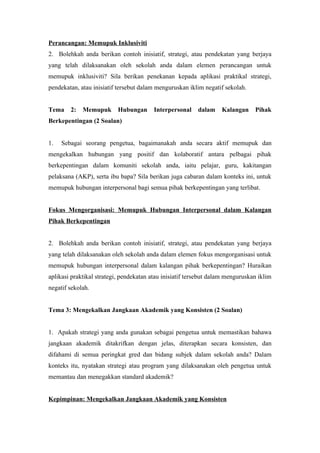
Tema 1: Inklusiviti (2 Soalan)
1. Dari perspektif anda sebagai pengetua, dalam cara apakah anda percaya sekolah
anda kini memupuk persekitaran inklusif di mana semua pelajar, tanpa mengira latar
belakang mereka, berasa dihargai dan mempunyai rasa kekitaan yang kuat? Dalam
konteks itu, apakah cabaran khusus atau halangan sistemik yang anda hadapi dalam
memastikan akses yang saksama dan penyertaan penuh untuk semua pelajar dan
kakitangan dalam komuniti sekolah anda?
Perancangan: Memupuk Inklusiviti
2. Bolehkah anda berikan contoh inisiatif, strategi, atau pendekatan yang berjaya
yang telah dilaksanakan oleh sekolah anda dalam elemen perancangan untuk
memupuk inklusiviti? Sila berikan penekanan kepada aplikasi praktikal strategi,
pendekatan, atau inisiatif tersebut dalam menguruskan iklim negatif sekolah.
Tema 2: Memupuk Hubungan Interpersonal dalam Kalangan Pihak
Berkepentingan (2 Soalan)
1. Sebagai seorang pengetua, bagaimanakah anda secara aktif memupuk dan
mengekalkan hubungan yang positif dan kolaboratif antara pelbagai pihak
berkepentingan dalam komuniti sekolah anda, iaitu pelajar, guru, kakitangan
pelaksana (AKP), serta ibu bapa? Sila berikan juga cabaran dalam konteks ini, untuk
memupuk hubungan interpersonal bagi semua pihak berkepentingan yang terlibat.
Fokus Mengorganisasi: Memupuk Hubungan Interpersonal dalam Kalangan
Pihak Berkepentingan
2. Bolehkah anda berikan contoh inisiatif, strategi, atau pendekatan yang berjaya
yang telah dilaksanakan oleh sekolah anda dalam elemen fokus mengorganisasi untuk
memupuk hubungan interpersonal dalam kalangan pihak berkepentingan? Huraikan
aplikasi praktikal strategi, pendekatan atau inisiatif tersebut dalam menguruskan iklim
negatif sekolah.
Tema 3: Mengekalkan Jangkaan Akademik yang Konsisten (2 Soalan)
1. Apakah strategi yang anda gunakan sebagai pengetua untuk memastikan bahawa
jangkaan akademik ditakrifkan dengan jelas, diterapkan secara konsisten, dan
difahami di semua peringkat gred dan bidang subjek dalam sekolah anda? Dalam
konteks itu, nyatakan strategi atau program yang dilaksanakan oleh pengetua untuk
memantau dan menegakkan standard akademik?
Kepimpinan: Mengekalkan Jangkaan Akademik yang Konsisten
2. Bolehkah anda berikan contoh inisiatif, strategi atau pendekatan yang berjaya yang
telah dilaksanakan oleh sekolah anda dalam elemen kepimpinan untuk mengekalkan
jangkaan akademik yang konsisten? Terangkan aplikasi praktikal strategi, pendekatan,
atau inisiatif tersebut dalam menguruskan iklim negatif sekolah.
Tema 4: Melaksanakan Strategi Pengurusan Disiplin dan Keselamatan (2
Soalan)
1. Dari pandangan anda sendiri, apakah strategi paling kritikal dan berkesan yang
kini digunakan oleh sekolah anda untuk mewujudkan dan mengekalkan persekitaran
pembelajaran yang selamat, berdisiplin dan kondusif untuk semua pelajar dan
kakitangan? Dalam konteks itu, sila ingat semula sebarang situasi yang sangat
mencabar berkaitan disiplin pelajar, isu atau tingkah laku disiplin pelajar atau
keselamatan sekolah yang perlu anda uruskan, dan apakah pendekatan atau keputusan
khusus yang penting dalam menyelesaikannya secara berkesan?
Pengawalan: Melaksanakan Strategi Pengurusan Disiplin dan Keselamatan
2. Bolehkah anda berikan contoh inisiatif, strategi atau pendekatan yang berjaya
yang telah dilaksanakan oleh sekolah anda dalam elemen pengawalan untuk
melaksanakan strategi pengurusan disiplin dan keselamatan? Justifikasikan aplikasi
praktikal strategi, pendekatan atau inisiatif tersebut dalam menguruskan iklim negatif
sekolah.
KATA-KATA PENUTUP
Terima kasih atas respons baik dan kesudian tuan/puan untuk mengambil bahagian
dalam sesi temu bual ini. Saya mengucapkan selamat maju jaya dalam semua usaha
masa depan.
PART 2: ONLINE CLASS PARTICIPATION (OCP)

EDUCATIONAL MANAGEMENT ASSIGNMENT SEMESTER MAY 2025.docx

  • 1.
    FACULTY OF EDUCATION HPGD2203 EDUCATIONMANAGEMENT MATRICULATION NUMBER : SEMESTER / MONTH (YEAR) : SEMESTER 2/MAY 2025 PROGRAMME : POST GRADUATE DIPLOMA IN TEACHING (PGDT)
  • 2.
    TABLE OF CONTENTS NO.TITLE PAGE 1. PART 1: REPORT INTERVIEW 1.0 INTRODUCTION (1) KEY INFORMATION PROFILE (SCHOOL PRINCIPAL) 2.0 FINDINGS 3.0 ANALYSIS & DISCUSSION 4.0 PROPOSED SOLUTIONS 5.0 CONCLUSION 1 2 5 8 10 2. QUESTION 2: REFLECTION 11 3. REFERENCE 4. APPENDIX INTERVIEW GUIDE (INTERVIEW QUESTIONS) 5. PART 2: ONLINE CLASS PARTICIPATION (OCP)
  • 3.
    PART 1: REPORTINTERVIEW 1.0. INTRODUCTION First and foremost, educational leadership and management qualities portrayed by the school principals will play major parts in shaping the qualities of educational settings and establishing conducive school climates. Key profile for respondents is as follows: (A) Key Information Profile (School Leader) Principal A is an excellent principal at Sekolah Menengah Kebangsaan Kuala Linggi Melaka. She is a great principal with visionary mindsets and qualifications backgrounds as well as experiences even before she assumed position as a Principal in Sekolah Menengah Kebangsaan Kuala Linggi Melaka. She possesses Master of Education (M.Ed.) in Educational Management from Universiti Sains Malaysia (USM). Her research focus is on Transformational Leadership Model in Improving Academic Performance with Case Study within High School of Malaysia. She also possesses a first bachelor’s degree namely, Bachelor of Science with Education (Hons) from Universiti Teknologi Malaysia (UTM) which is major in Chemistry and minor in Biology. Other than that, she possesses a Diploma in Education from Raja Melewar Teachers College (MPRM). Apart from that, she has vast professional and services experiences. She brings broad and deep experience in the field of education, with an excellent record of service that encompasses various leadership and teaching roles. She served in the education sector for over 25 years before being appointed to the position of principal at Sekolah Menengah Kebangsaan Kuala Linggi, Melaka. She is still new as Principal in position from January 2025 till present, yet she has high vision on leading Sekolah Menengah Kebangsaan Kuala Linggi into a new era of excellent education, emphasizing curriculum innovation, strengthening student character and integrating professional development with appropriate leadership and education management strategies in line with the vision of achievement for a great school. Other than that, notable records of her achievement prior are that from year 2019 till December 2024, she is a Senior Administrative Assistant, Sekolah Menengah Sains Tuanku Munawir 1
  • 4.
    (SAKTI) in Seremban.Her responsibility consists of upholding responsibility for academic strategic planning, national and international curriculum coordination, as well as data management and school performance evaluation. She believes that an excellent educational institution not only produces high-performing students in academics, but also forms individuals who are integrity-based, creative and critical as well as have high soft skills. As a principal, she is committed to creating a conducive, inclusive and always relevant learning environment with the demands of 21st century education. 2.0 FINDINGS As such, there are four elements discussed and highlighted issues has been identified as below: (I) Inclusivity First and foremost, Principal A stated that we must treat students fairly and squarely without bias towards their races, disability, family background, language, and immigration status. It means addressing systemic inequalities and creating environments where everyone feels valued and has opportunities to succeed. In addition, she emphasized that challenging prospects for Teachers in applying approach to handle autistic students or Pendidikan Khas (PPKI) students as well as their acting role of self-efficacy and autism knowledge to make students felt a sense of belongings at school. Principal A mentioned that, “I am personally belief that all students should be supported without judging on their races, any disabilities, their family background, their languages or their family status either from wealthy family or poor families. If positive and conducive school climates need to be achieved, students must feel at ease during their schooling years as such teachers in my schools must treat students fairly and equally. In addition, teachers should have proper planning with good devising strategies in managing autistic students for example, in that sense. Teachers must have preparedness, including positive attitudes, self-efficacy and good autistic managing knowledge. Teachers also should know how to cater to their needs in preparation of programs.” 2
  • 5.
    (II) Fostering InterpersonalRelationships among Stakeholders In addition, Principal A also emphasized the organizing element through strengthening the relationships with parents-teacher associations (PTA’s) as well as communities. Principal A elaborates that to provide a positive reinforcement communication in which making a conscious effort to communicate positive news about students to parents, not just when there are issues. This builds stronger relationships and encourages parental engagement. She mentioned that, “We here have organized Meet the Teacher" Sessions, early in the academic year, these informal sessions allow parents to meet their child's teachers, understand classroom expectations, and establish initial rapport. We also have report card day, school and community messaging app WhatsApp group, and Teacher-Parents Day. The most important is conveying good communications with parents and regularly makes efforts to give and get feedback with parents about their children grades and conveniences at school.” (III) Maintaining Consistent Academic Expectations Apart from that, Leading strategy that develops by the principal to manage academic expectations is by implementing performance monitoring and feedback systems. This relies on the respective responsibility of the “Leading” principal involves in overseeing future vision for student’s performance. This will enable the principal to guide and adjust academic strategies. Principal A elaborated that, “For achieving greater milestones of academic achievements for higher numbers of SPM-achievers with good results, yeaaaa, for instances, teacher will have to implement a robust system for tracking student progress in their regular assessments, progress reports, individualized education plans and providing timely, yet constructive feedback to students, parents and respective teachers. This includes identifying students who need additional support, and we help them improve. Yes yes, Leading strategy that we have executed is like we mapping for their professional development in Academic Skills; like we provide professional development programs 3
  • 6.
    for teachers; inexample, how we promote effective teaching strategies likely differentiated instruction and formative assessment.” (IV) Implementing Strategies for Discipline and Safety Management Subsequently, the Controlling strategy that developed by the principal is represented in this upholding safety environment in the school. In managing bullying, fundamentally schools need to implement resilient systems and foster a strong culture that minimizes opportunities for bullying and empowers students to act positively. Principal A reaffirmed that, “This school is not compromised on any bully that happened within school compounds, as such we have develop a zero-tolerance policy against bullying. we clearly communicated to all students, staff, and parents upon admission and throughout the year. We have defined various forms of bullying either physical, verbal, social, cyber and their consequences, as well as reporting procedures to our teachers and severe consequences, if caught. We are not tolerating Bully cases reported. Other else, we form partnerships with external authorities and conduct Program namely #BeliaBenciBuli Campaign as advised by Ministry of Education awareness program to promote awareness for avoiding cyber-bullying in social media.” 3.0 ANALYSIS AND DISCUSSIONS 1) Promoting Inclusivity (Planning Strategy) First and foremost, the principal mentioned about challenges to implement strategies to change negative climates of school to be more conducive, inclusive and collaborative school environment. First, Planning strategy is teacher readiness and extra teacher training gaps courses to equip teachers with professional skills. Teachers did have training to cater inclusive students, yet consistent and comprehensive training for all mainstream teachers on inclusive practices remains a challenge. Principal A mentioned that, “In Planning initiative for cater Inclusivity education policy, okay, we know we need our manpower which is teacher to have extra skills, professional 4
  • 7.
    development that manageto cater all our inclusive students. Right? As such, effective planning for an inclusive school culture hinges on making sure that human factor primarily teachers are adequately prepared and equipped to implement inclusive practices. As such, our panel head (guru panitia) that handles inclusive practices has 3-days CRT short course to Dungun, Terengganu to learn about aligned process with the school's overall inclusivity vision and policy, which are themselves products of the planning phase.” As such, Inclusivity practices for catering students will be managed with differentiated instruction among the diverse group of learners that adjusted well to their diverse learning style and equipped them with fundamentally pedagogy strategy that represents universal design for learning (UDL). 2) Fostering Interpersonal Relationships with stakeholders (Organizing Strategy) Other than that, second strategy is Organizing which emphasized towards fostering interpersonal relationships among stakeholders. this strategy intentionally designs and implements for the systems, enhancing social structures and organizing activities that cultivate trust, promoting open communication, inducing empathy and a bring a sense of shared community. Principal A emphasized that, “We have revitalized PIBG (Parent-Teacher Association) into a more collaborative Body in which we re-organize our PIBG meetings to include activities like workshops, brainstorming sessions and shared project planning for our students’ academic programmes and promoting personality development among our students. We also have provided programme of Bacaan Yasin and Bermunajat for our SPM students and involving staffs, teachers as well as parents.” Henceforth, it comprehends this strategy is promoting open communications and creating structured opportunities for positive interaction and collaborative efforts from all stakeholders in working together towards common goals, breaking down silos and building empathy for the betterment of students. 5
  • 8.
    3) Maintaining consistentacademic expectations (Leading Strategy) Consistent academic results and expectations is among the important factor for promoting positive climates. This can be realized with aims to inspire, provides guide and make sure that high, clear and equitable academic standards are consistently applied and continuous efforts for learning students. Hence, with continuous and rigorous efforts, principals may create a sense of purpose, managing challenge and motivating students and teachers towards achieving collective success. Principal A elaborated that, "In this school, as leading strategy to cater academic achievement, we use data-driven decision-making for monitoring student’s academic achievement. We need to track progress of students in several critical subjects such as Additional Mathematics, Chemistry, Biology and Physics as well as Mathematics for their improvements. As such, Senior Academic Head (for instances, Penolong Kanan Akademik) will leads regular data review meetings with department heads (Ketua Panitia) for each subject as well as teachers. They analyse SAPS data, internal test results and attendance records to identify struggling students, identify trends of marking grades in specific subjects during their mid-terms results or SPM trials, or areas where teaching strategies might need improvements.” Hence, based on the interview session, Principal A identified that leading strategy that being used is school is using data to identify students who are falling behind. Furthermore, based on the academic data, responsible academic leaders will work with departments and individual teachers to set specific, measurable, achievable plus relevant information’s within specified timeframe (SMART) for achieving academic goals. For instances, to increase the percentage of students achieving Band 4 or higher in Bahasa Melayu by margin of more than 10%". Indeed, it is responsibilities of school counterparts to fully improve the school negative climates. 4) Implementing strategies for discipline and safety management (Controlling Strategy) In term of controlling strategy in school management, it is basically emphasized by means putting systems in place to make sure that rules are followed along with it being fulfilled and met standards requirements as well as potential risks 6
  • 9.
    are controlled. Itis highlighted that such mechanism will keep sustaining the school community to conduct process of discipline and behaviour management in a safer environment. Principal A reiterated that, “In this school, we emphasize students to behave in righteous manner, discipline, smart and appropriate conduct as school students should be. We want student to monitor their discipline, and we are not tolerating Bully issues. We have provided a swift and fair response system, if any bully occurred, and when a disciplinary issue arises or a safety concern is reported by their disciplinary homeroom teacher, disciplinary teacher or guidance and counselling teacher, we will respond promptly and fairly. Investigations also should be thorough, and decisions should be made based on evidence along with established enacting policy within our school authority.” Principal A emphasized that, restorative practices as a form of control are very fundamental. They also guide student’s behaviour and make sure students will need to understand the impact of their actions, which ultimately results towards better self- control. For recurring problems or students struggling with negative behaviour, a controlling strategy involves providing individualized support plans, guidance and counselling or mentorship will be implemented to address root causes and guide them toward positive choices that will takes place. 4.0 PROPOSED SOLUTIONS According to the interview session conducted, it is fundamentally important for the principal perspectives to address elements of improving inclusivity policy and approach, fostering interpersonal relationships with stakeholders, improving academic expectations and maintaining discipline and safety management for handling negative school climates. Hence, proposed solutions for the themes mentioned is as follows: (a) First Theme: Promoting Inclusivity First and foremost, Planning strategy has been discussed in which teacher professional development with minimizing teacher training gaps in inclusivity 7
  • 10.
    pedagogy construction ofcurriculum planning and implementation. According to Abdulah & Mahmud (2025c), for teachers to teach mathematics in primary inclusive school, it has been identified five required competencies namely content mastery skills, flexible strategies and techniques skills, technology utilisation skills, effective classroom management skills along with skills in assessment and monitoring. These findings have implications for enhancing teacher training and professional development programs to equip them with the necessary competencies for effective inclusive teaching of mathematics subject. Hence, like Principal A mentioned, teacher preparedness and professional development fundamentally to cater inclusivity in tackling school negative climates. (b) Second Theme: Fostering Interpersonal Relationships of Stakeholders Principal A also provide justifications on the organizing strategy to cater fostering relationships among stakeholders on requirements to provide a positive and rigorous reinforcement communication in which making a conscious effort to communicate positive news about students to parents and not just when there are issues arises. This comes with concerned that through building stronger relationships will encourages parental engagement. According to Wondim (2024), teacher and school must play initiatives in engaging parents which is pivotal. If schools do not actively design and implement effective strategies to involve parents, a negative or indifferent climate around parental involvement is likely to persist. It also emphasized that school must avoid weak communication. Beforehand, the low engagement in communication between parents and schools also involving teachers can contribute to a disconnected and potentially negative school climate. In that sense, parents are not well-informed or feel their input is not valued, it can lead to misunderstandings, distrust in relationships and a lack of unified support for the student. Improving communication is crucial for building trust and a sense of shared community alike. (c) Third Theme: Maintaining consistent academic expectations Principal A highlighted importance on implementation of several leading strategies towards process of maintaining academic expectations and improving student’s achievement results. There are two (2) main strategies for the training of teacher development towards differentiated instruction and formative assessment. 8
  • 11.
    Both targeted differentiatedinstruction and formative assessment interconnected in improving academic achievement and obtain what expected from student’s results. According to Ndlovu (2025), formative assessment will provide prompt and continuous feedback on academic achievements which pivotally causes significant advantage of this engagement in term of provision that continuous and bring prompt feedback to learners. This immediate feedback loop is beneficial for administering students' understanding and advancement. As a results, maintaining the academic expectations can be met and school will address negative climate to improve school settings efficiently. (d) Fourth Theme: Implementing strategies for discipline and safety management For this theme, after discussion with the Principal A, she reiterated about empowering students to act positively which can elevates safety management from a top-down mandate to an application of collective responsibility. This includes empowering students through social-emotional learning, bystander intervention training and opportunities for leadership in school safety initiatives whilst fostering a sense of ownership toward learning institution. According to Mahoney, Durlak, & Weisberg (2021), process of fostering social-emotional competence should serves as a proactive and preventative discipline strategy. Further, it should just solely aim in reacting to misbehaviour of students but more towards interventions that could augmented skills such as self-awareness, self-management, social awareness, making friends and relationships plus responsible decision-making will qualify students with the internal tools requirement in regulating behaviours towards making them come out with positive conduct. As such, this proactive approach to discipline integrates seamlessly into daily school life which can shifting the focus from mere rule enforcement to more skill development that is a benchmark for a practical discipline management. 5.0 CONCLUSION In summary, the success of an educational institution in fostering a truly conducive school environment depends towards perceptions of school principals’ that significantly shaped their strategies accompanied by actions in administering 9
  • 12.
    complicated challenges toinculcate a positive school climate. The important applications of appropriates strategy in catering four themes (4) which specifically consists of; Inclusivity, fostering interpersonal relationships among stakeholders, maintaining academic expectations and upholding discipline and safety management will be shifting school settings to be more proactive and be in a positive context. Then, when these four themes are integrated and being championed respectively by principal practices, they will collectively modify an educational institution experience into a more conducive environment where students will feel safe to learn and motivate them for academic success. In addition, this will holistically bring development in all of their facets of life. (2816 Words) 10
  • 13.
    REFERENCES Adams, D., Moosa,V., Shareefa, M., Mohamed, A., & Tan, K. L. (2024). Assessing Inclusive School Leadership Practices in Malaysia: instrument adaptation and validation. International Journal of Disability Development and Education, 1– 19. https://doi.org/10.1080/1034912x.2024.2354895 Anyanwu, I. K. (2025). The Influence of Counselling Strategies on Deviant Behaviour Modification Among Secondary School Students. Igboscholars International Journal, 18(2). Ezeaku, S. N., & Okoye, A. C. (2025). Best Strategies for Ensuring a Good Organizational Climate in Secondary Schools in Anambra State. Unizik Journal of Educational Laws and Leadership Studies, 1(1). https://unilaws.org/unilaws/article/view/24 Fülöp, M., Varga, B. A., & Sebestyén, N. (2024). Competitive and non-competitive school climate and students' well-being. Learning and Instruction, Volume(Issue),Page numbers. https://doi.org/10.1016/j.learninstruc.2024.102036 Mahoney, J. L., Durlak, J. A., & Weisberg, R. P. (2021). Promoting social-emotional competence and preventing bullying in schools: A systematic review of universal school-based interventions. Journal of Applied Developmental Psychology, 72, 101267. Musty, J.,& Obedient, S. M.(2018). The influence of the readiness of the teacher to the management room of the degrees of the 21st century. Malaysian Journal of Social Science and Humanities, 3(4), 6-22. Ndlovu, B. B. (2025). Exploring teachers’ practices when using formative assessment in improving quality education. Cogent Education, 12(1). https://doi.org/10.1080/2331186X.2025.2451489
  • 14.
    Wondim, M. G.(2024). Parental Engagement in Early Childhood Education: The Case of Debre Tabor Schools, Ethiopia. European Journal of Education, 60(1). https://doi.org/10.1111/ejed.12817
  • 15.
    QUESTION 2: REFLECTION Firstand foremost, there are leadership styles that practices by principal in fostering a conducive school environment. As such, this study highlighted how these leadership criteria will impact decision-making and contributes to the process of encouraging a positive and conducive school environment. Firstly, the theme Inclusivity within educational constitution is clearly emphasized through a vision provided to make sure students with diverse needs are given equal treatment, rights and their requirements being fulfilled without any discriminations by the school stakeholder’s conduct. Additionally, school counterparts must embody and having inspired vision towards recognizing every student to feels valued, being seen for their abilities or disadvantages and provided with supports regardless of their background or distinctiveness from the other (Ketikidou & Saiti, 2022). There are two types of apparent leadership practices style using by the principal’s which was found throughout the interview session which are transformational leadership and transactional leadership. For the Transformational leadership, the principal applies influence approach in which principal represents empathetic behaviour with purpose of actively championing student’s diversity and providing inspirational motivation which brings diversified students along with their articulate vision that compelling in designing for a truly equitable school community (Yakob et. al, 2025). For instance, a transformational principal might initiate school-wide campaigns celebrating cultural diversity as well as empowering stakeholders to challenge their own biases rather than simply enforcing anti-discrimination rules should practices by teachers towards cater distinctive students. Hence, Principal A has applied Transformational Leadership Styles through providing teacher training inclusively to cater the specialized needs students, curriculum execution through Universal Design Learning (UDL) which transforming and shifting the school environment totally towards inclusion. This will enhance the positive school climates in a longstanding effort which can be realistically attained. According to Shields & Hesbol (2019), school leaders should exercise equitable emphasizing socially just leadership to create welcoming and inclusive schools in which students who are minoritized or specialized along with economically disadvantaged would feel affirmed, being respected by others and academically improved not left disadvantageous. As such, school leaders need to 11
  • 16.
    align their goalsand practices which becoming their major challenge. School leaders are prompt to disrupt inequitable school cultures and work transformative in that sense to achieved desired school environment. Apart from that, the principal also applied Instructional Leadership Style Practices in progressive efforts to make sure that inclusivity is not just a philosophy but a pedagogical reality in practices. An instructional Principal as a leader will focus on curriculum adaptation and improving professional development for equipping differentiated instruction towards specific needs for students (Ralebese et. al, 2025). Other else, Instructional leadership also shows by monitoring teaching practices to make sure equitable access were given towards students for their learning process. Take for instances, principal allocate resources for specialist training in supporting students with diverse learning needs and lead discussions on how assessment practices can be made more in term of equitable manner. Second theme discusses fostering interpersonal relationships among stakeholders in the school context. Throughout the discussions with principal, it has been identified that principal apply initiative such as building strong interpersonal relationships among stakeholder students, teachers, parents and wider community. This highlights Principal Transformational Leadership styles or at lesser extent, Transactional Leadership styles in practice towards school setting. In addition, Transformational leaders are those who succeed in changing the attitude and values of those whom they lead because they have succeeded in giving them a new sense of awareness (Gupta, 2025). This will be motivating stakeholders to uphold moral values such as social justice and inculcate harmony towards managing relationships for safe environment at school. Through interview, it can be identified that Principal employ Transformational Leadership Styles through open and honest communication skills in practices, good communication skills, trustworthiness, empathy and good problem- solving skills instils in the various stakeholders (Abdul Ghani & Ling, 2021). Principal is employing excellent communication skills practices to strengthening good rapport with communities towards betterment of the positive school climate. On the other hand, Principal also practices transactional leadership in through the formal parameters of communication such as meeting schedules with parents and teacher associations with regular meetings along with providing official reporting lines. Furthermore, it is the transformational leader's ability to inspire trust and mutual 12
  • 17.
    respect that createsauthentic and necessary relationship experiences within the school. For instances, Principal has instructional leadership practices in application by working PIBG (Parent-Teacher Association’s) into a more collaborative body and re- organize PIBG meetings with conducive activities like workshops, brainstorming sessions and shared project planning for shifted implementations. Third theme is maintaining academic expectations which refer to ascends academic excellency acquired by students. This important theme highlighted through three (3) Principal Leadership Styles which are Instructional Leadership, Transactional Leadership and Transformational Leadership. Instructional practices demonstrated by principal which has significantly positive relationships towards student’s academic achievement. As such, instructional leadership practices (ILP) and the monitoring tools which applied by school principals has positive effect on student achievement. The impact is delivered in mechanisms such as a model for ILP that should be applied by principals and incorporated such strategies into their daily habits that provide opportunities for instructional changes and improved student achievement can be attained (Sanchez & Watson, 2021). Principal has applied instructional leadership through emphasizes on curriculum alignment is aligned to meet requirements and enhance student’s professional development. As such, strategies like monitoring student progress through data analysis and providing targeted professional development to enhance pedagogical skills is valid and important. In term of Instructional leadership approach, Principal has applied a robust system tracking system to monitor student academic progress and achievements in their regular assessments, progress reports and setting up individualized education plans which and constantly provide feedback and informing parents. Furthermore, Principal also help to decide on school-wide literacy initiatives which based on student performance data and provide coaching to students struggling specifically which refer to student’s Bahasa Melayu literacy rates. Furthermore, Transactional Leadership plays a vital role in establishing clear performance metrics for teachers like short courses, implementing assessment schedules along with compliances in curriculum requirements and guidelines. Principal has provided teacher training to fill in the gap of new pedagogical approach for strategy to be effectively. As for Transformational approach, principal would articulate a compelling vision of high academic achievement whilst empowering 13
  • 18.
    teachers to innovateand take ownership of their student learning which foster culture of continuous improvement. For instances, teachers will adhere in preparation of academic programmes to cater academic progress and efforts such as arranging academic activities for examinations like SPM. The fourth theme is handling students’ discipline and safety management. Instructional Leadership being implemented by the principal like handling bullying and cyberbullying issues that occurred at school. Instructional practices being conducted in which action beyond rule enforcement and applied effective strategies to foster an environment where students will feel secure and respected as well enhanced their motivation to attend school and be present in the learning process. For the Transformational Leadership is through inspiring students to take responsibility for their actions by promoting restorative justice practices and inculcate a strong sense of community where students take care for the well-beings of one another. Their decisions might include implementing peer mediation programs, investing in social- emotional learning curricula or empowering student leadership to promote a positive school climate. As for Transactional Leadership it is essential for establishing clear rules through implementing consistent disciplinary procedures and make sure robust safety protocols being followed (Abdul Ghani & Ling, 2021). Furthermore, teachers and school staffs are fully aware and well-informed to notices rules and guidelines about school's bullying policy. This clearly shows their focus on clear roles, abiding responsibilities and contingent rewards or punishments strategies to establish order can be implemented effectively. In summary, the most effective school leaders are not confined to a single style in their approach to improve school negative climates. Instead, they are adept at strategically blending and adapting elements of each and others to gain understanding when to apply clear goals and objectives as well as gaining accountability towards empowering students in the school context. Moreover, this can regain pedagogical improvement intensely and beneficial to the making school as conducive and efficient educational environment. Hence, this adaptive and multifaceted leadership approach is essential for navigating the inherent complexities of school management and make sure an educational institution being readily in which every member will play their parts well and thrive excellently developing the positive school climates as a result. 14
  • 19.
  • 20.
    REFERENCES Abdul Ghani, A.W., & Ling, T. L. (2021). HPGD2203 Educational Management Module. Petaling Jaya: Open University Malaysia Publisher. Gupta, P. (2025). Transformational leadership: inspiring change and innovation. International Journal of Science and Research (IJSR), 14(2), 504-509. Ketikidou, G., & Saiti, A. (2022). The promotion of inclusive education through sustainable and systemic leadership. International Journal of Leadership in Education, 28(3), 639–654. https://doi.org/10.1080/13603124.2022.2032368 Ralebese, M. D., Jita, L., & Badmus, O. T. (2025). Examining Primary School Principals’ Instructional Leadership Practices: A Case Study on Curriculum Reform and Implementation. Education Sciences, 15(1), 70. Sanchez, J., & Watson, J. (2021). Effective instructional leadership practices in high performing elementary schools. Journal of School Administration Research and Development, 6(2), 60-70. Shields, C. M., & Hesbol, K. A. (2019). Transformative Leadership Approaches to Inclusion, Equity, and Social Justice. Journal of School Leadership, 30(1), 3- 22. https://doi.org/10.1177/1052684619873343 (Original work published 2020) Yakob, M., Sahudra, T. M., & Sukirno, S. (2025). Transformational Leadership of Principals: Driving Excellence in Education Quality. Al-Ishlah: Jurnal Pendidikan, 17(1), 1658-1667.
  • 21.
    ATTACHMENT INTERVIEW GUIDE/PROTOCOLS (INTERVIEWTRANSCRIPTS) 10 Questions Demographics/Profile of Respondents (2 Questions) 1. Could you please tell me about your current school, profiles backgrounds and experiences in education field. Please elaborate on reflecting your experiences in managing previous school including its diverse level and student population, and how long you have served as a principal in this institution? 2. As a principal, what would you identify as the most significant factor that drew you to this leadership role in education? What are your personal views, missions and future visions to improve school climate positively in this school? Theme 1: Inclusivity (2 Questions) 1. From your perspective as a principal, in what ways do you believe your school currently fosters an inclusive environment where all students, regardless of their backgrounds, feel valued and have a strong sense of belonging? In that context, what specific challenges or systemic barriers have you encountered in making sure equitable access and full participation for all students and staff within your school community? Planning: Fostering Inclusivity 2. Can you provide examples of successful initiatives, strategies or approaches your school has implemented in planning elements of fostering inclusivity? Highlight on practical applications of such strategies, approaches or initiatives in managing school negative climates. Theme 2: Fostering Interpersonal Relationships among Stakeholders (2 Questions) 1. As a principal, how do you actively cultivate and maintain positive, collaborative relationships between the various stakeholders in your school community which
  • 22.
    namely consists ofstudents, teachers, implementing personnels (AKP), as well as parents? Please provide challenges as well in this context, for fostering interpersonal relationships for all stakeholders involved. Organizing: Fostering Interpersonal Relationships among Stakeholders 2. Can you provide examples of successful initiatives, strategies or approaches your school has implemented in organizing elements of fostering interpersonal relationships among stakeholders? Elaborate on practical applications of such strategies, approaches or initiatives in managing school negative climates. Theme 3: Maintaining Consistent Academic Expectations (2 Questions) 1. What strategies do you apply as a principal to ensure that academic expectations are clearly defined, consistently applied, and understood across all grade levels and subject areas within your school? In that context, namely strategies or programs that are put in place by principals to monitor and uphold academic standards? Leading: Maintaining Consistent Academic Expectations 2. Can you provide examples of successful initiatives, strategies or approaches your school has implemented in leading elements of maintaining consistent academic expectations? Explain on practical applications of such strategies, approaches or initiatives in managing school negative climates. Theme 4: Implementing Strategies for Discipline and Safety Management (2 Questions) 1. From your own standpoints, what are the most critical and effective strategies your school currently utilizes to establish and maintain a safe, disciplined, and conducive learning environment for all students and staff? In that context, recall any particularly challenging situations related to student discipline, students’ disciplinary issues or behaviours or school safety that you have had to manage, and what specific approaches or decisions were crucial in resolving them effectively?
  • 23.
    Controlling: Implementing Strategiesfor Discipline and Safety Management 2. Can you provide examples of successful initiatives, strategies or approaches your school has implemented in controlling elements of implementing strategies for discipline and safety management? Justify on practical applications of such strategies, approaches or initiatives in managing school negative climates. CLOSING REMARKS Thank you for your kind responses and willingness for participation in this interview session. I wish all the best in future endeavors. PANDUAN/PROTOKOL TEMU BUAL (TRANSKRIP TEMU BUAL) 10 Soalan Demografi/Profil Responden (2 Soalan) 1. Bolehkah anda ceritakan tentang sekolah anda sekarang, latar belakang profil dan pengalaman anda dalam bidang pendidikan? Sila huraikan pengalaman anda dalam menguruskan sekolah-sekolah sebelumnya, termasuk tahap kepelbagaian dan populasi pelajar, serta berapa lama anda telah berkhidmat sebagai pengetua di institusi ini? 2. Sebagai seorang pengetua, apakah yang anda kenal pasti sebagai faktor paling penting yang menarik anda kepada peranan kepimpinan ini dalam pendidikan? Apakah pandangan peribadi, misi, dan visi masa depan anda untuk meningkatkan iklim sekolah secara positif di sekolah ini? Tema 1: Inklusiviti (2 Soalan) 1. Dari perspektif anda sebagai pengetua, dalam cara apakah anda percaya sekolah anda kini memupuk persekitaran inklusif di mana semua pelajar, tanpa mengira latar belakang mereka, berasa dihargai dan mempunyai rasa kekitaan yang kuat? Dalam konteks itu, apakah cabaran khusus atau halangan sistemik yang anda hadapi dalam memastikan akses yang saksama dan penyertaan penuh untuk semua pelajar dan kakitangan dalam komuniti sekolah anda?
  • 24.
    Perancangan: Memupuk Inklusiviti 2.Bolehkah anda berikan contoh inisiatif, strategi, atau pendekatan yang berjaya yang telah dilaksanakan oleh sekolah anda dalam elemen perancangan untuk memupuk inklusiviti? Sila berikan penekanan kepada aplikasi praktikal strategi, pendekatan, atau inisiatif tersebut dalam menguruskan iklim negatif sekolah. Tema 2: Memupuk Hubungan Interpersonal dalam Kalangan Pihak Berkepentingan (2 Soalan) 1. Sebagai seorang pengetua, bagaimanakah anda secara aktif memupuk dan mengekalkan hubungan yang positif dan kolaboratif antara pelbagai pihak berkepentingan dalam komuniti sekolah anda, iaitu pelajar, guru, kakitangan pelaksana (AKP), serta ibu bapa? Sila berikan juga cabaran dalam konteks ini, untuk memupuk hubungan interpersonal bagi semua pihak berkepentingan yang terlibat. Fokus Mengorganisasi: Memupuk Hubungan Interpersonal dalam Kalangan Pihak Berkepentingan 2. Bolehkah anda berikan contoh inisiatif, strategi, atau pendekatan yang berjaya yang telah dilaksanakan oleh sekolah anda dalam elemen fokus mengorganisasi untuk memupuk hubungan interpersonal dalam kalangan pihak berkepentingan? Huraikan aplikasi praktikal strategi, pendekatan atau inisiatif tersebut dalam menguruskan iklim negatif sekolah. Tema 3: Mengekalkan Jangkaan Akademik yang Konsisten (2 Soalan) 1. Apakah strategi yang anda gunakan sebagai pengetua untuk memastikan bahawa jangkaan akademik ditakrifkan dengan jelas, diterapkan secara konsisten, dan difahami di semua peringkat gred dan bidang subjek dalam sekolah anda? Dalam konteks itu, nyatakan strategi atau program yang dilaksanakan oleh pengetua untuk memantau dan menegakkan standard akademik? Kepimpinan: Mengekalkan Jangkaan Akademik yang Konsisten
  • 25.
    2. Bolehkah andaberikan contoh inisiatif, strategi atau pendekatan yang berjaya yang telah dilaksanakan oleh sekolah anda dalam elemen kepimpinan untuk mengekalkan jangkaan akademik yang konsisten? Terangkan aplikasi praktikal strategi, pendekatan, atau inisiatif tersebut dalam menguruskan iklim negatif sekolah. Tema 4: Melaksanakan Strategi Pengurusan Disiplin dan Keselamatan (2 Soalan) 1. Dari pandangan anda sendiri, apakah strategi paling kritikal dan berkesan yang kini digunakan oleh sekolah anda untuk mewujudkan dan mengekalkan persekitaran pembelajaran yang selamat, berdisiplin dan kondusif untuk semua pelajar dan kakitangan? Dalam konteks itu, sila ingat semula sebarang situasi yang sangat mencabar berkaitan disiplin pelajar, isu atau tingkah laku disiplin pelajar atau keselamatan sekolah yang perlu anda uruskan, dan apakah pendekatan atau keputusan khusus yang penting dalam menyelesaikannya secara berkesan? Pengawalan: Melaksanakan Strategi Pengurusan Disiplin dan Keselamatan 2. Bolehkah anda berikan contoh inisiatif, strategi atau pendekatan yang berjaya yang telah dilaksanakan oleh sekolah anda dalam elemen pengawalan untuk melaksanakan strategi pengurusan disiplin dan keselamatan? Justifikasikan aplikasi praktikal strategi, pendekatan atau inisiatif tersebut dalam menguruskan iklim negatif sekolah. KATA-KATA PENUTUP Terima kasih atas respons baik dan kesudian tuan/puan untuk mengambil bahagian dalam sesi temu bual ini. Saya mengucapkan selamat maju jaya dalam semua usaha masa depan.
  • 26.
    PART 2: ONLINECLASS PARTICIPATION (OCP)