 A Global leader in household and Personal care Products
with sales of $6.06 billion and gross profit of $2.76 billion
in 1991
 In 1991, CP held 43% of the world toothpaste market
and 16% of the world toothbrush market.
 $243 million was spent to upgrade 25 of CP’s
91 manufacturing plants; 275 new products introduced
worldwide; several strategic acquisitions made and
manufacturing began in China and Eastern Europe.
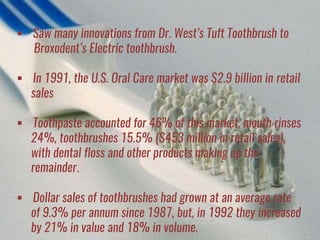
 Saw many innovations from Dr. West’s Tuft Toothbrush to
Broxodent’s Electric toothbrush.
 In 1991, the U.S. Oral Care market was $2.9 billion in retail
sales
 Toothpaste accounted for 46% of this market, mouth rinses
24%, toothbrushes 15.5% ($453 million in retail sales),
with dental floss and other products making up the
remainder.
 Dollar sales of toothbrushes had grown at an average rate
of 9.3% per annum since 1987, but, in 1992 they increased
by 21% in value and 18% in volume.
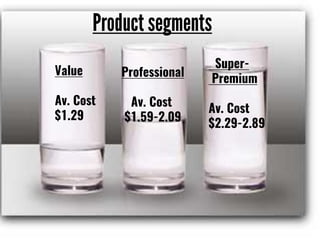
Value
Av. Cost
$1.29
Professional
Av. Cost
$1.59-2.09
Super-
Premium
Av. Cost
$2.29-2.89
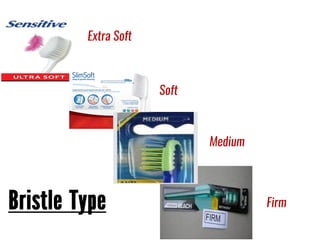
Extra Soft
Soft
Medium
Firm
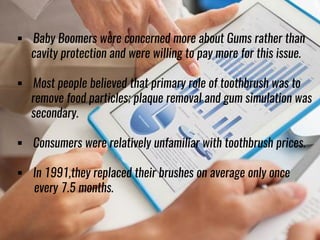
 Baby Boomers were concerned more about Gums rather than
cavity protection and were willing to pay more for this issue.
 Most people believed that primary role of toothbrush was to
remove food particles; plaque removal and gum simulation was
secondary.
 Consumers were relatively unfamiliar with toothbrush prices.
 In 1991,they replaced their brushes on average only once
every 7.5 months.
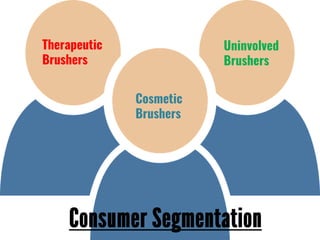
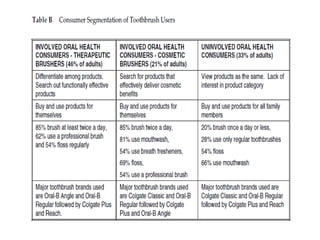
Therapeutic
Brushers
Cosmetic
Brushers
Uninvolved
Brushers
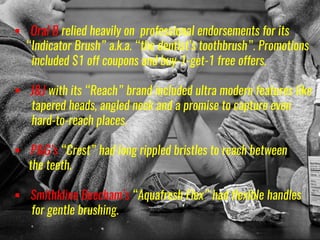
 Oral B relied heavily on professional endorsements for its
“Indicator Brush” a.k.a. “the dentist’s toothbrush”. Promotions
included $1 off coupons and buy-1-get-1 free offers.
 J&J with its “Reach” brand included ultra modern features like
tapered heads, angled neck and a promise to capture even
hard-to-reach places.
 P&G’s “Crest” had long rippled bristles to reach between
the teeth.
 Smithkline Beecham’s “Aquafresh Flex” had flexible handles
for gentle brushing.
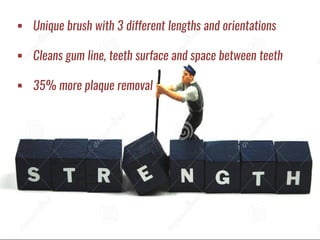
 Unique brush with 3 different lengths and orientations
 Cleans gum line, teeth surface and space between teeth
 35% more plaque removal
Mainstream
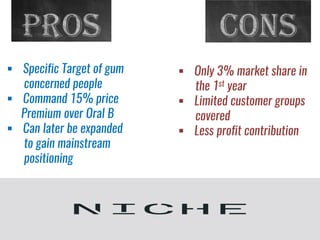
Niche
 Specific Target of gum
concerned people
 Command 15% price
Premium over Oral B
 Can later be expanded
to gain mainstream
positioning
 Only 3% market share in
the 1st year
 Limited customer groups
covered
 Less profit contribution
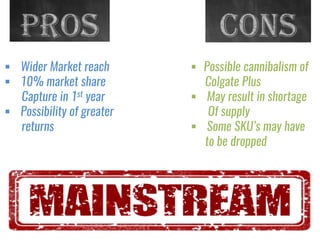
 Wider Market reach
 10% market share
Capture in 1st year
 Possibility of greater
returns
 Possible cannibalism of
Colgate Plus
 May result in shortage
Of supply
 Some SKU’s may have
to be dropped
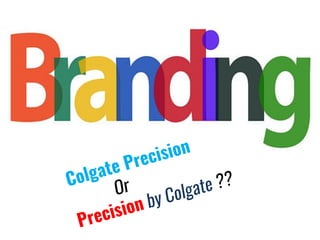
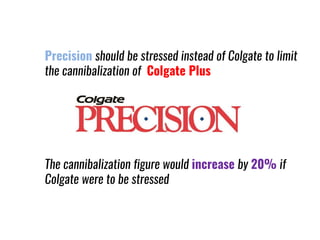
Precision should be stressed instead of Colgate to limit
the cannibalization of Colgate Plus
The cannibalization figure would increase by 20% if
Colgate were to be stressed
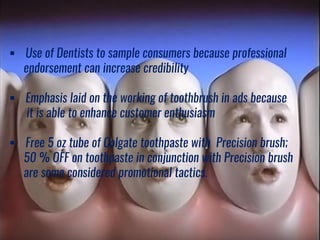
 Use of Dentists to sample consumers because professional
endorsement can increase credibility
 Emphasis laid on the working of toothbrush in ads because
it is able to enhance customer enthusiasm
 Free 5 oz tube of Colgate toothpaste with Precision brush;
50 % OFF on toothpaste in conjunction with Precision brush
are some considered promotional tactics.
 Should spend more on Media Advertising as currently it is
very less as compared to Oral B and Reach
 Initially it should target niche positioning for Precision so as
to avoid cannibalization of Colgate Plus.
 After some time it should be expanded to mainstream
market to gain more customers.
 Should focus more on sampling as it is a key to successful
introduction of any product.
 May include more professional testimonials and
demonstrations in advertising.
Created During a Marketing internship under the
Supervision of
Prof. Sameer Mathur, IIM Lucknow
By
Vivek Kumar, GBPEC, Pauri

Harvard Colgate Palmolive case study

  • 4.
     A Globalleader in household and Personal care Products with sales of $6.06 billion and gross profit of $2.76 billion in 1991  In 1991, CP held 43% of the world toothpaste market and 16% of the world toothbrush market.  $243 million was spent to upgrade 25 of CP’s 91 manufacturing plants; 275 new products introduced worldwide; several strategic acquisitions made and manufacturing began in China and Eastern Europe.
  • 7.
     Saw manyinnovations from Dr. West’s Tuft Toothbrush to Broxodent’s Electric toothbrush.  In 1991, the U.S. Oral Care market was $2.9 billion in retail sales  Toothpaste accounted for 46% of this market, mouth rinses 24%, toothbrushes 15.5% ($453 million in retail sales), with dental floss and other products making up the remainder.  Dollar sales of toothbrushes had grown at an average rate of 9.3% per annum since 1987, but, in 1992 they increased by 21% in value and 18% in volume.
  • 8.
  • 9.
  • 11.
     Baby Boomerswere concerned more about Gums rather than cavity protection and were willing to pay more for this issue.  Most people believed that primary role of toothbrush was to remove food particles; plaque removal and gum simulation was secondary.  Consumers were relatively unfamiliar with toothbrush prices.  In 1991,they replaced their brushes on average only once every 7.5 months.
  • 12.
  • 16.
     Oral Brelied heavily on professional endorsements for its “Indicator Brush” a.k.a. “the dentist’s toothbrush”. Promotions included $1 off coupons and buy-1-get-1 free offers.  J&J with its “Reach” brand included ultra modern features like tapered heads, angled neck and a promise to capture even hard-to-reach places.  P&G’s “Crest” had long rippled bristles to reach between the teeth.  Smithkline Beecham’s “Aquafresh Flex” had flexible handles for gentle brushing.
  • 18.
     Unique brushwith 3 different lengths and orientations  Cleans gum line, teeth surface and space between teeth  35% more plaque removal
  • 19.
  • 20.
     Specific Targetof gum concerned people  Command 15% price Premium over Oral B  Can later be expanded to gain mainstream positioning  Only 3% market share in the 1st year  Limited customer groups covered  Less profit contribution
  • 21.
     Wider Marketreach  10% market share Capture in 1st year  Possibility of greater returns  Possible cannibalism of Colgate Plus  May result in shortage Of supply  Some SKU’s may have to be dropped
  • 23.
    Precision should bestressed instead of Colgate to limit the cannibalization of Colgate Plus The cannibalization figure would increase by 20% if Colgate were to be stressed
  • 25.
     Use ofDentists to sample consumers because professional endorsement can increase credibility  Emphasis laid on the working of toothbrush in ads because it is able to enhance customer enthusiasm  Free 5 oz tube of Colgate toothpaste with Precision brush; 50 % OFF on toothpaste in conjunction with Precision brush are some considered promotional tactics.
  • 27.
     Should spendmore on Media Advertising as currently it is very less as compared to Oral B and Reach  Initially it should target niche positioning for Precision so as to avoid cannibalization of Colgate Plus.  After some time it should be expanded to mainstream market to gain more customers.  Should focus more on sampling as it is a key to successful introduction of any product.  May include more professional testimonials and demonstrations in advertising.
  • 28.
    Created During aMarketing internship under the Supervision of Prof. Sameer Mathur, IIM Lucknow By Vivek Kumar, GBPEC, Pauri