The Pre-Production Process
REQUIREMENTS FOR A MOVING IMAGE PRODUCTION
BLOG REPORT
LOUIS WESTERN
Types of distribution
We have done a 90 second short film for a competition called depict. We will distribute it
through YouTube.
There are other forms of distribution as well.
Including cinema, DVD and Blu-ray and
streaming services such as Netflix.
Sources of finance
There are many types of funds available for up and coming or already established film makers.
Including development and government funds, the British Film Institute (BFI) and funds from the
national lottery. There are also various online sources to get funds. Including GoFundMe and
KickStarter.
Requirements
There are many requirements for a film to be successful or just to run smoothly. These include
equipment e.g. cameras, lighting etc. music right, food and drink and also the final payment for
cast and crew.
For our depict project we HAD to have acting permission forms and consent forms before we
were aloud to film.
Requirements continued
There are various different levels of teams for loads off different types of production, for
example a low budget short will have cheap unknown normally locally sourced talent. A
television show would hire people who specialise in television acting and people who are used
to high work rates especially for shows like EastEnders and Coronation Street.
For our small group we had to split out the roles heavily because for a part of our production
part of our group were missing. In the end I played God and was partly a cameraman, Jack
played the main character, he was also a camera man part time and our editor for our first part
of our post production period and Taylor was our head editor during the second part of our post
production period.
Time
For our depict project we had around 6 weeks from start to finish and had two weeks for each
part of the process each; pre-production, filming and post-production. Our group met all of
those deadlines throughout the project. In the professional industry if you don’t meet your
deadlines you will be fired and your repetition will go down as a content creator.
Equipment and Facilities
For our project we obtained equipment from our skills centre at the college where all of the
audio and visual equipment we took out for our short film. We took out a canon camera and
various pieces of sound equipment to use throughout production.
https://www.arrirental.co.uk/cata
log/product.php?product_id=158
3
Locations
Location recces are forms you need to fill out to film at a certain location during any part of your
production. We picked the locations we filmed in because as a team we thought they were the
most suitable to film in. We didn’t face any major issues or risks during any part of our
production but we were prepared to overcome any issues of such because of our risk
assessment form.
Gathering materials (sources, costs, clearances)
We had various materials used in our film including props and costumes. Our costumes were
bought online budgeting sheet we filled out during pre production. Because our film was a low
budget short (very low!) we had to be very wary of costs we may come by. Research materials is
the research you go into the topic of a film. For example a war film you will need to do research
from that time point from stuff like archives, TV, radio and broadcasts.
Legal Issues
Copyright wasn’t a problem during our depict project because we didn’t
use music or anything anyone could sue us on. For 99% of productions find
copyright to be a MAJOR issues and it has been many directors, producers
etc. downfall in the industry due to major court cases bought against
them. ‘https://www.gov.uk/copyright’
Legal continued
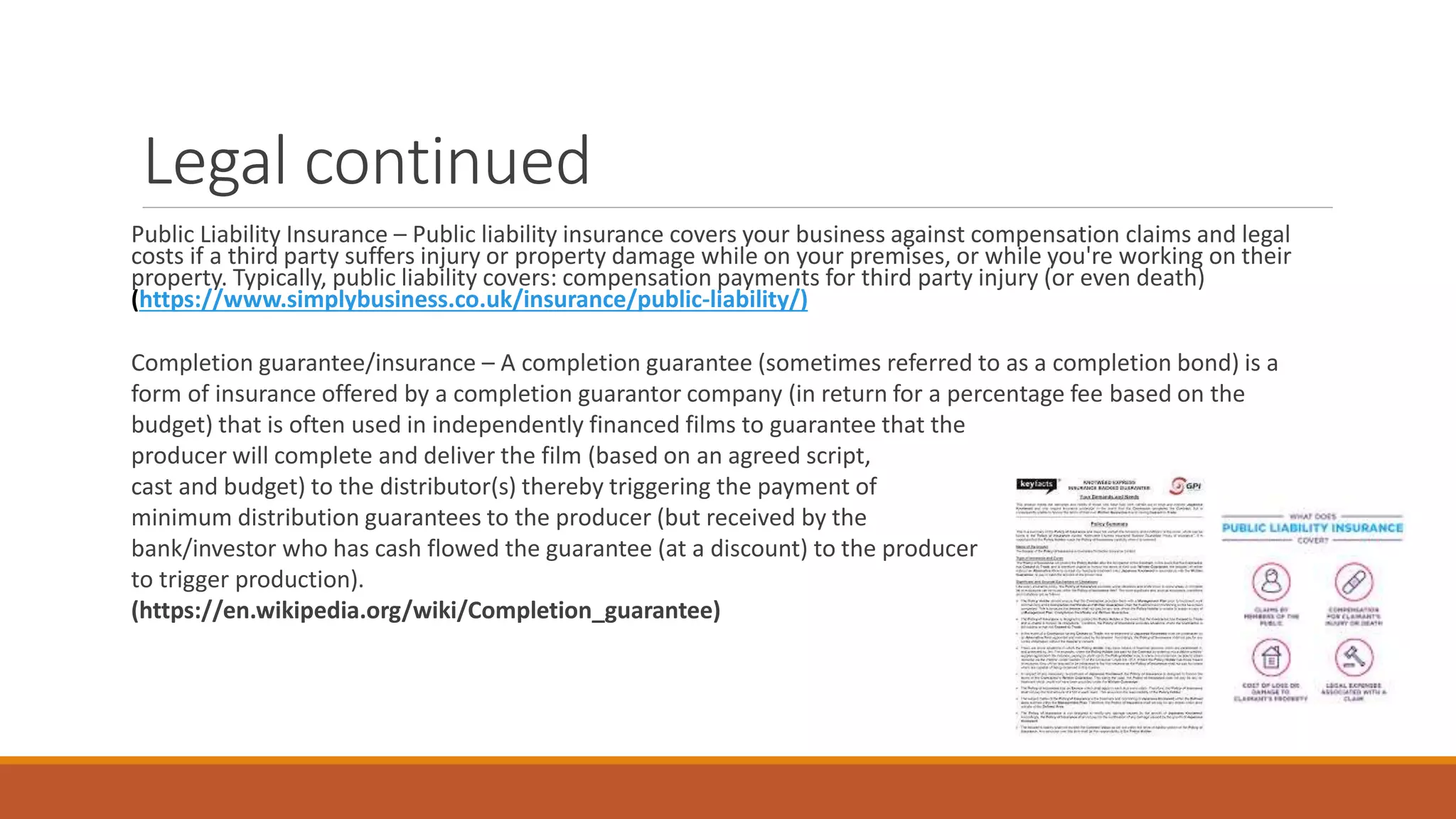
Public Liability Insurance – Public liability insurance covers your business against compensation claims and legal
costs if a third party suffers injury or property damage while on your premises, or while you're working on their
property. Typically, public liability covers: compensation payments for third party injury (or even death)
(https://www.simplybusiness.co.uk/insurance/public-liability/)
Completion guarantee/insurance – A completion guarantee (sometimes referred to as a completion bond) is a
form of insurance offered by a completion guarantor company (in return for a percentage fee based on the
budget) that is often used in independently financed films to guarantee that the
producer will complete and deliver the film (based on an agreed script,
cast and budget) to the distributor(s) thereby triggering the payment of
minimum distribution guarantees to the producer (but received by the
bank/investor who has cash flowed the guarantee (at a discount) to the producer
to trigger production).
(https://en.wikipedia.org/wiki/Completion_guarantee)
Codes of practice and regulation
( Clearances, legal, insurance, regulatory bodies)
Ofcom is the regulator and competition authority
for the UK communications industries. It regulates
the TV and radio sectors, fixed line telecoms,
mobiles, postal services, plus the airwaves over
which wireless devices operate. Ofcom became
the first independent, external regulator of the
BBC today. Under the new BBC Charter
and Agreement, our role is to hold the BBC’s
performance and editorial standards to
account, and also to regulate the competitive
effects of its services.
Codes of practice and regulation
(Clearances, legal, insurance, regulatory bodies)
The British Board of Film Classification (BBFC), previously the British Board of Film Censors, is a
non-governmental organization, founded by the film industry in 1912 and responsible for the
national classification and censorship of films exhibited at cinemas and video works (such as
television programmes, trailers, adverts, public Information/campaigning films, menus, bonus
content etc.) released on physical media within the United Kingdom. It has a statutory
requirement to classify all video works released on VHS, DVD, Blu-ray and to a lesser extent,
some video games under the Video Recordings Act 1984
(https://en.wikipedia.org/wiki/British_Board_of_Film_Classification)
Trade unions and trade associations
A trade association is an organization or group that is funded by businesses in a particular industry. The
purpose of a trade association is to set laws and provide extensive knowledge to companies within the
industry. (https://study.com/academy/lesson/trade-association-definition-importance.html) In film this
would be all of the producers coming together to fund the film they are making.
The BECTU Sector of Prospect represents a community of workers, in a wide variety of roles (excluding
actors and musicians) across the media, entertainment, IT and telecoms industries. BECTU membership
currently stands at approximately 40,000.
Pact is the trade association
representing the commercial
interests of UK independent
television, film, digital,
children’s and animation
media companies.

The pre production process

  • 1.
    The Pre-Production Process REQUIREMENTSFOR A MOVING IMAGE PRODUCTION BLOG REPORT LOUIS WESTERN
  • 2.
    Types of distribution Wehave done a 90 second short film for a competition called depict. We will distribute it through YouTube. There are other forms of distribution as well. Including cinema, DVD and Blu-ray and streaming services such as Netflix.
  • 3.
    Sources of finance Thereare many types of funds available for up and coming or already established film makers. Including development and government funds, the British Film Institute (BFI) and funds from the national lottery. There are also various online sources to get funds. Including GoFundMe and KickStarter.
  • 4.
    Requirements There are manyrequirements for a film to be successful or just to run smoothly. These include equipment e.g. cameras, lighting etc. music right, food and drink and also the final payment for cast and crew. For our depict project we HAD to have acting permission forms and consent forms before we were aloud to film.
  • 5.
    Requirements continued There arevarious different levels of teams for loads off different types of production, for example a low budget short will have cheap unknown normally locally sourced talent. A television show would hire people who specialise in television acting and people who are used to high work rates especially for shows like EastEnders and Coronation Street. For our small group we had to split out the roles heavily because for a part of our production part of our group were missing. In the end I played God and was partly a cameraman, Jack played the main character, he was also a camera man part time and our editor for our first part of our post production period and Taylor was our head editor during the second part of our post production period.
  • 6.
    Time For our depictproject we had around 6 weeks from start to finish and had two weeks for each part of the process each; pre-production, filming and post-production. Our group met all of those deadlines throughout the project. In the professional industry if you don’t meet your deadlines you will be fired and your repetition will go down as a content creator.
  • 7.
    Equipment and Facilities Forour project we obtained equipment from our skills centre at the college where all of the audio and visual equipment we took out for our short film. We took out a canon camera and various pieces of sound equipment to use throughout production. https://www.arrirental.co.uk/cata log/product.php?product_id=158 3
  • 8.
    Locations Location recces areforms you need to fill out to film at a certain location during any part of your production. We picked the locations we filmed in because as a team we thought they were the most suitable to film in. We didn’t face any major issues or risks during any part of our production but we were prepared to overcome any issues of such because of our risk assessment form.
  • 9.
    Gathering materials (sources,costs, clearances) We had various materials used in our film including props and costumes. Our costumes were bought online budgeting sheet we filled out during pre production. Because our film was a low budget short (very low!) we had to be very wary of costs we may come by. Research materials is the research you go into the topic of a film. For example a war film you will need to do research from that time point from stuff like archives, TV, radio and broadcasts.
  • 10.
    Legal Issues Copyright wasn’ta problem during our depict project because we didn’t use music or anything anyone could sue us on. For 99% of productions find copyright to be a MAJOR issues and it has been many directors, producers etc. downfall in the industry due to major court cases bought against them. ‘https://www.gov.uk/copyright’
  • 11.
    Legal continued Public LiabilityInsurance – Public liability insurance covers your business against compensation claims and legal costs if a third party suffers injury or property damage while on your premises, or while you're working on their property. Typically, public liability covers: compensation payments for third party injury (or even death) (https://www.simplybusiness.co.uk/insurance/public-liability/) Completion guarantee/insurance – A completion guarantee (sometimes referred to as a completion bond) is a form of insurance offered by a completion guarantor company (in return for a percentage fee based on the budget) that is often used in independently financed films to guarantee that the producer will complete and deliver the film (based on an agreed script, cast and budget) to the distributor(s) thereby triggering the payment of minimum distribution guarantees to the producer (but received by the bank/investor who has cash flowed the guarantee (at a discount) to the producer to trigger production). (https://en.wikipedia.org/wiki/Completion_guarantee)
  • 12.
    Codes of practiceand regulation ( Clearances, legal, insurance, regulatory bodies) Ofcom is the regulator and competition authority for the UK communications industries. It regulates the TV and radio sectors, fixed line telecoms, mobiles, postal services, plus the airwaves over which wireless devices operate. Ofcom became the first independent, external regulator of the BBC today. Under the new BBC Charter and Agreement, our role is to hold the BBC’s performance and editorial standards to account, and also to regulate the competitive effects of its services.
  • 13.
    Codes of practiceand regulation (Clearances, legal, insurance, regulatory bodies) The British Board of Film Classification (BBFC), previously the British Board of Film Censors, is a non-governmental organization, founded by the film industry in 1912 and responsible for the national classification and censorship of films exhibited at cinemas and video works (such as television programmes, trailers, adverts, public Information/campaigning films, menus, bonus content etc.) released on physical media within the United Kingdom. It has a statutory requirement to classify all video works released on VHS, DVD, Blu-ray and to a lesser extent, some video games under the Video Recordings Act 1984 (https://en.wikipedia.org/wiki/British_Board_of_Film_Classification)
  • 14.
    Trade unions andtrade associations A trade association is an organization or group that is funded by businesses in a particular industry. The purpose of a trade association is to set laws and provide extensive knowledge to companies within the industry. (https://study.com/academy/lesson/trade-association-definition-importance.html) In film this would be all of the producers coming together to fund the film they are making. The BECTU Sector of Prospect represents a community of workers, in a wide variety of roles (excluding actors and musicians) across the media, entertainment, IT and telecoms industries. BECTU membership currently stands at approximately 40,000. Pact is the trade association representing the commercial interests of UK independent television, film, digital, children’s and animation media companies.