The Power & Pitfalls of Social Media Alisha Slaughter Marketing Consultant Slaughter Consulting
Questions & Introductions About Me About You How many of you know what the term Social Media means? How many of you have a personal Facebook, Twitter or LinkedIn Profile? How many of your organizations are already incorporating Social Media into your current marketing plan? Worksheet & Reference Sheet What are you hoping to get out of today?
Agenda What is Social Media? Popular Networks Why should you care?  Examples A Good Foundation Develop a Plan & Set Goals Who is your target audience? Examples of Goals & How to Measure Success What & How to Post What does it take to be successful? Potential Pitfalls or Problems Worksheet and Reference Sheet Questions?
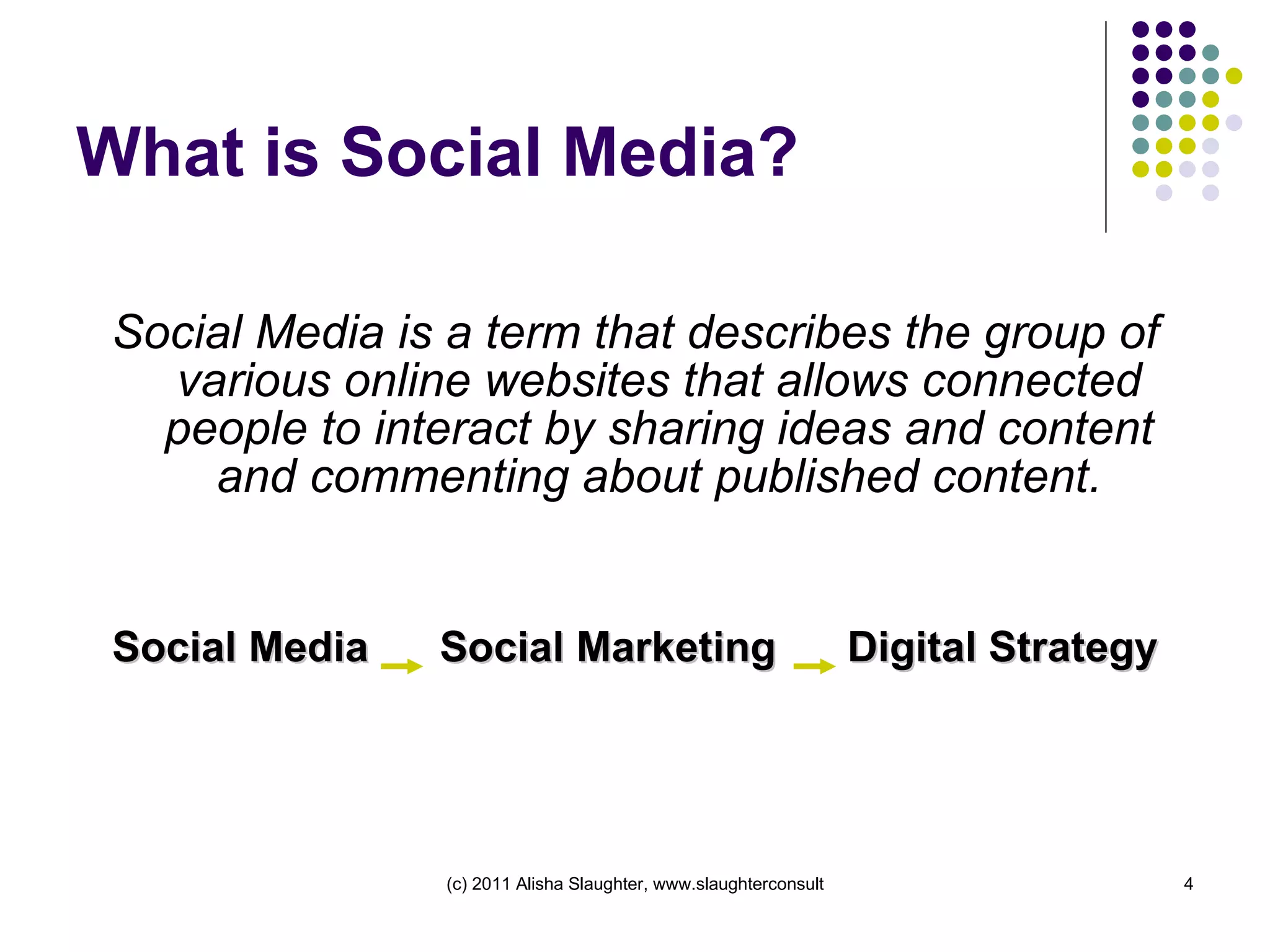
What is Social Media? Social Media is a term that describes the group of various online websites that allows connected people to interact by sharing ideas and content and commenting about published content. Social Media  Social Marketing  Digital Strategy
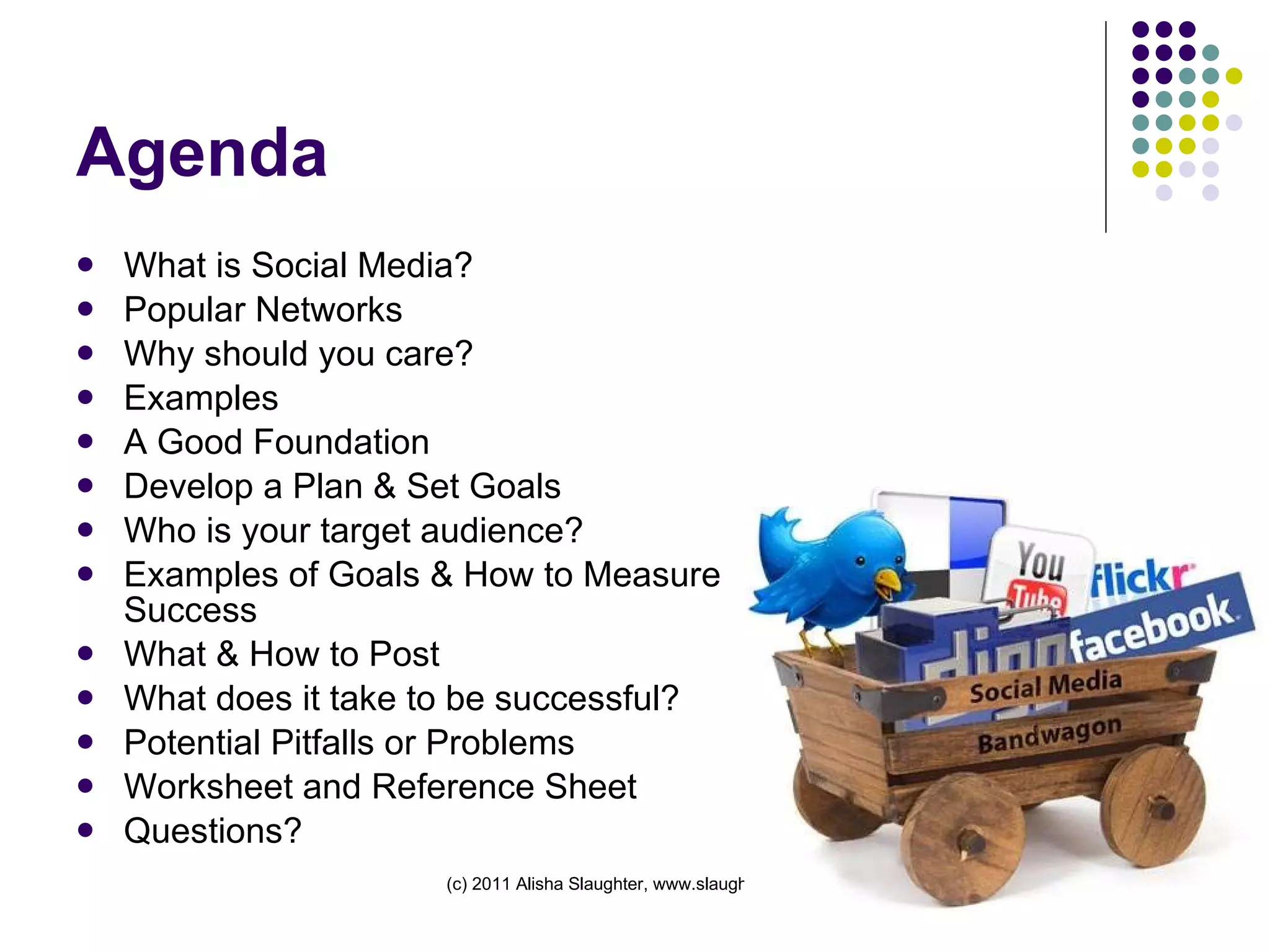
Popular Networks & Platforms Social Networking Facebook (facebook.com) Twitter (twitter.com) LinkedIn (linkedin.com) Social Photo and Video Sharing: YouTube (youtube.com) Flickr (flickr.com)
Why should you care? Americans spend almost a quarter of their time online on social networks and Blogs (a 43% increase from last year).* Social Media now surpasses Email in global reach.* 73% of US companies are using social media tools for marketing purposes.** *  Nielsen Online, 2010 **  Social Media in the Marketing Mix: Budgeting for 2011,  http://www.emarketer.com/Report.aspx?code=emarketer_2000742
Facebook More than 500 million active users* The average Facebook user spends more than 55 minutes per day on Facebook** 20 million Facebook users become fans of Pages per day** 50% of active users log on to Facebook in any given day* Average user has 130 friends* People spend over 700 billion minutes per month on Facebook* *  People on Facebook (From Facebook Statistics) ** Facebook Factbook, Mashable.com
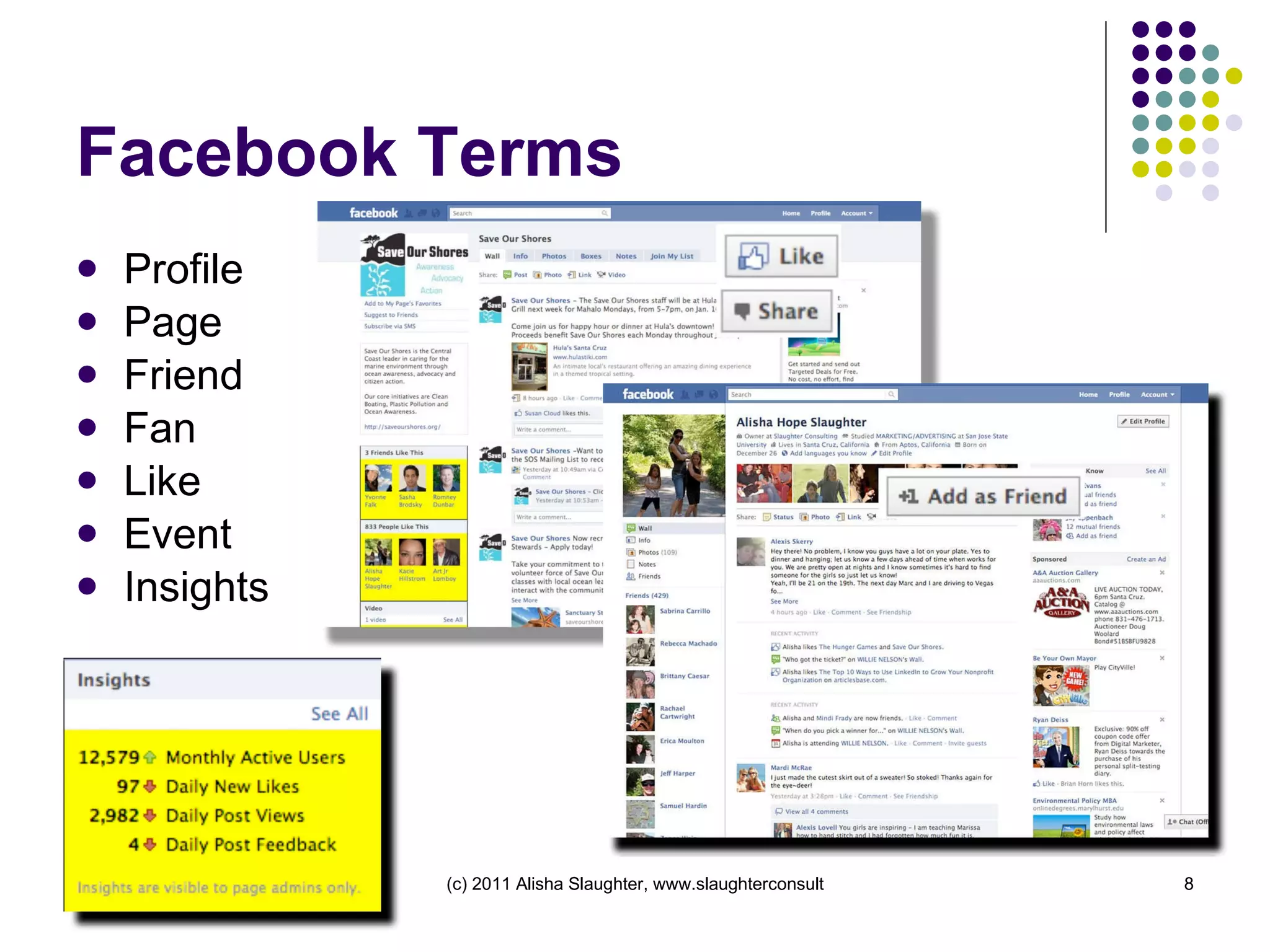
Facebook Terms Profile Page Friend Fan Like Event Insights
Twitter Between 2009 and 2012, the number of adults who user Twitter is expected to double (from 18 million in 2009, to 36 million in 2012) * Twitter is particularly popular with young adults, minorities, and those who live in cities.** *Twitter Stays Strong as Growth Slows,  http://www.emarketer.com/Article.aspx?R=1007644 ** Overview: The people who use Twitter, http://www.pewinternet.org/Reports/2010/Twitter-Update-2010/Findings.aspx?view=all
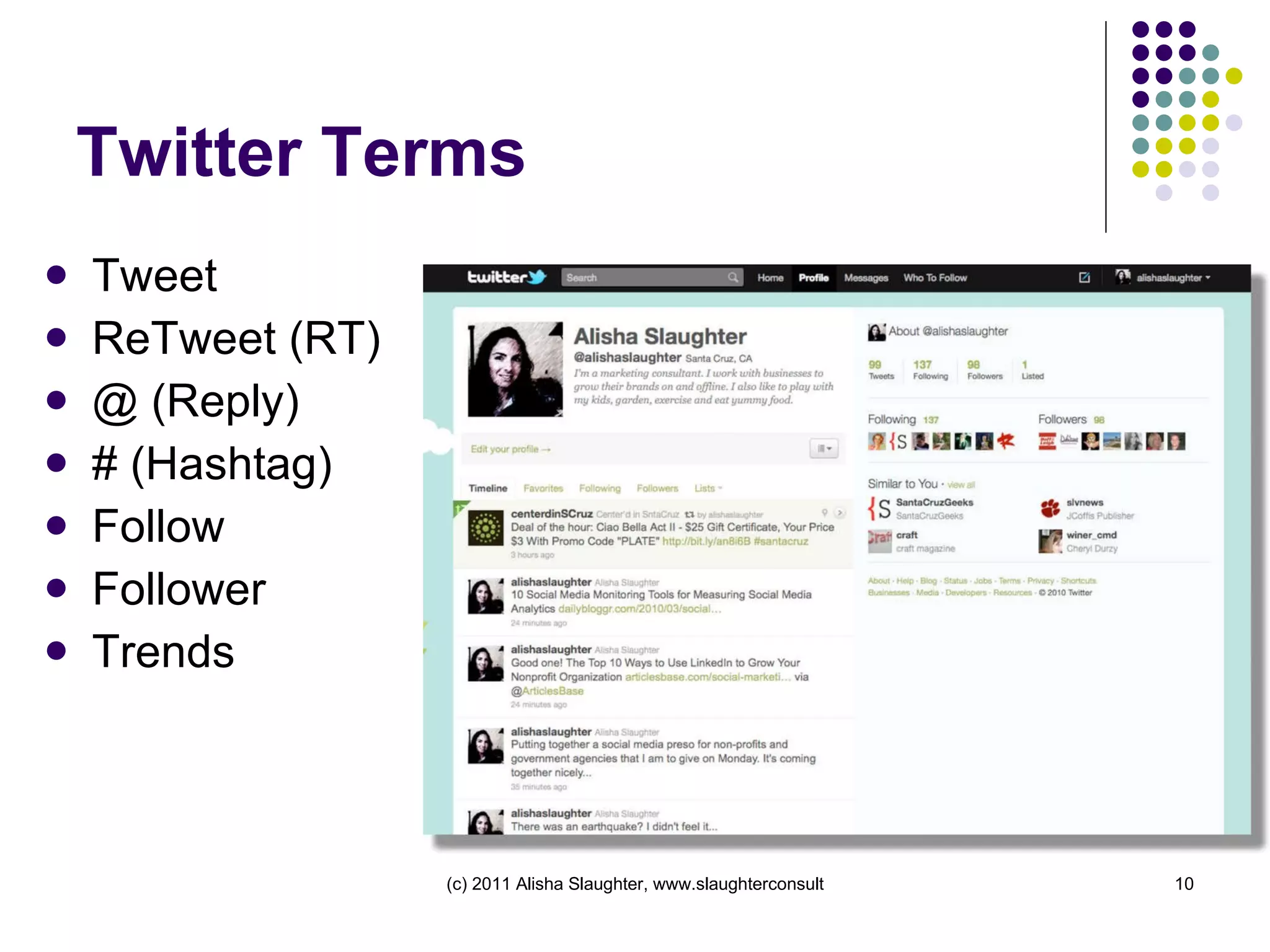
Twitter Terms Tweet ReTweet (RT) @ (Reply) # (Hashtag) Follow Follower Trends
Linked In The World's Largest Audience of Affluent, Influential Professionals 40 Million US Members A great way to connect with other like minded professionals Nielsen Online @Plan, Rel 2 2010
Linked In Terms Connections Summary Groups Activity Recommendations Company Pages
Who’s Already On and How They Use Various Platforms Environmental Protection Agency (www.epa.gov) American Red Cross  (www.redcross.org) The Humane Society  (www.humanesociety.org) Save the Children  (www.savethechildren.org) Second Harvest Food Bank  (www.shfb.org) Grind Out Hunger  (www.grindouthunger.org) Surfrider  (www.surfrider.org)
Your Foundation Website or Blog Social Media Policy Goals and Objectives
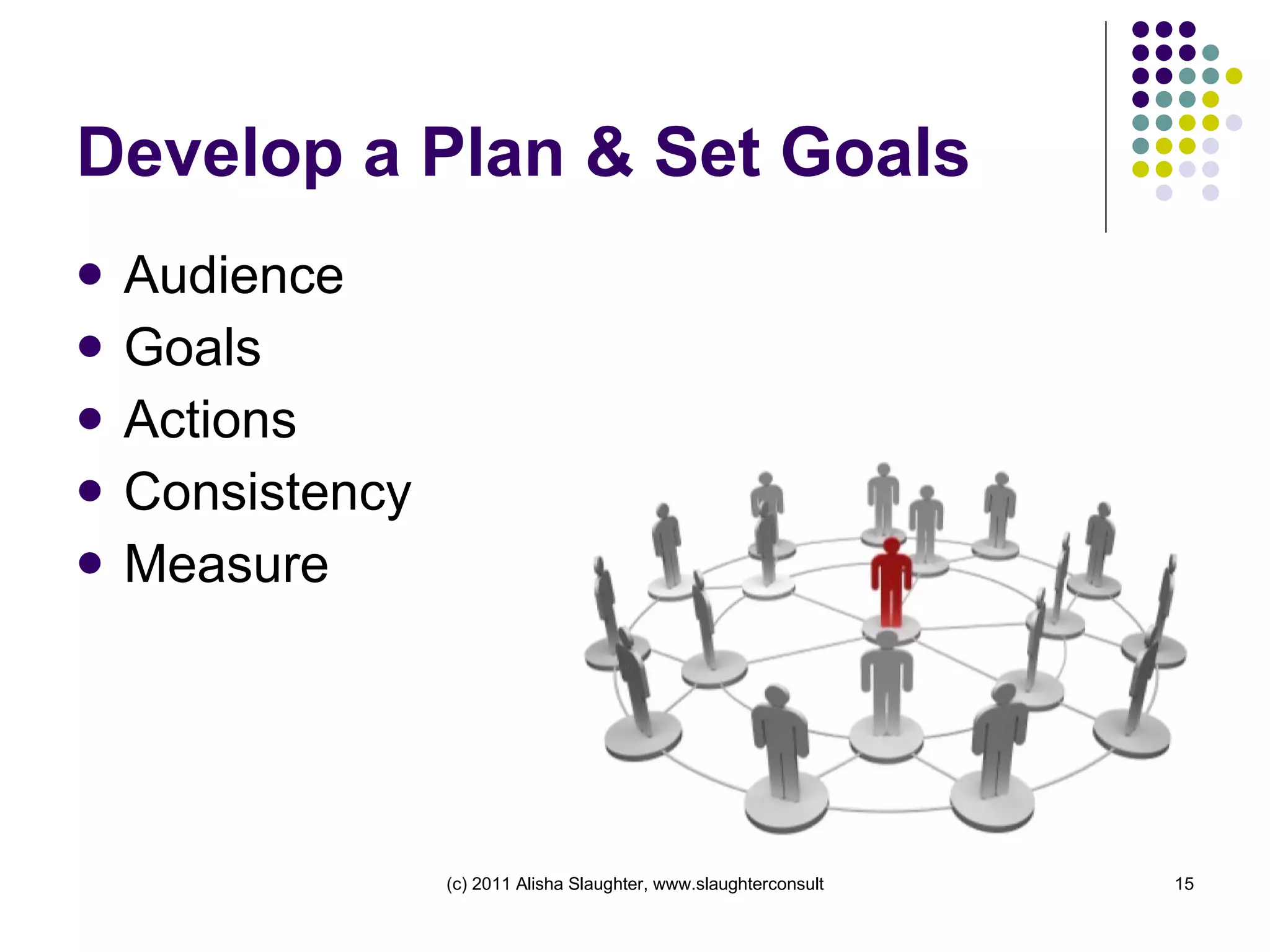
Develop a Plan & Set Goals Audience Goals Actions Consistency Measure
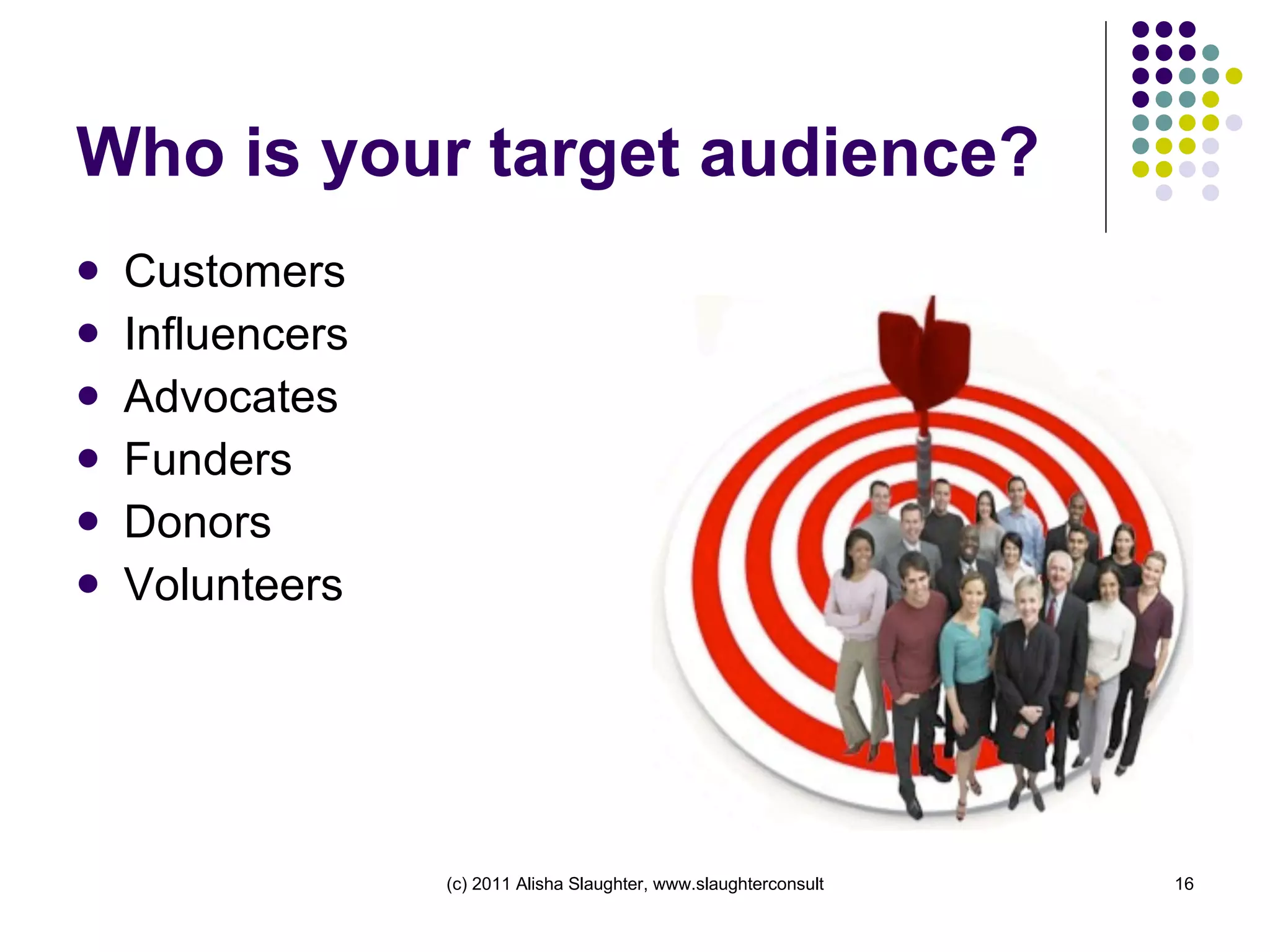
Who is your target audience? Customers Influencers Advocates Funders Donors Volunteers
Examples of Goals Build better relationships Increase service coverage Raise awareness about your cause, event or recent successes Increase website traffic Attract volunteers Inspire people to action Increase donations SET BENCHMARKS!!!!
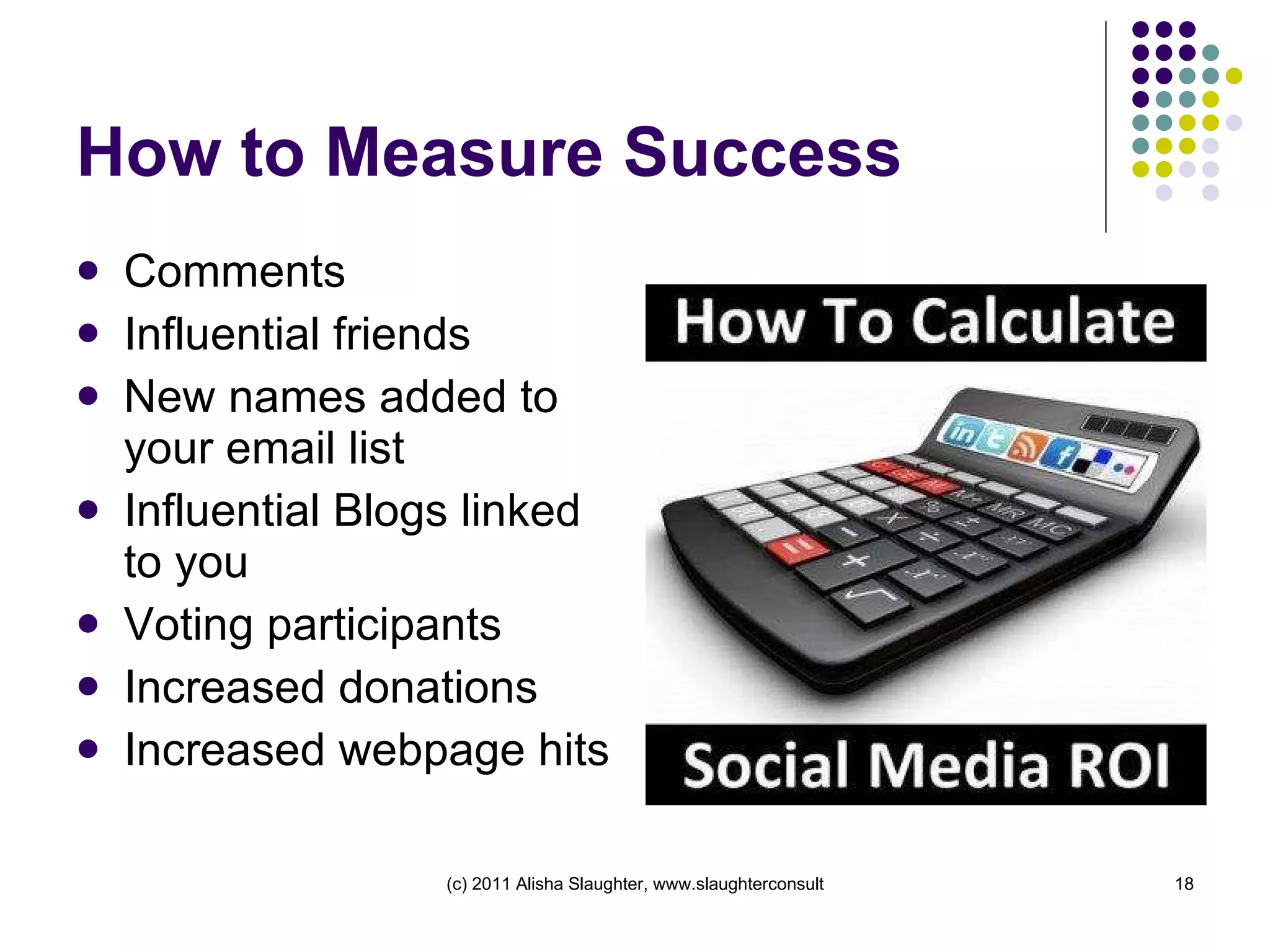
How to Measure Success Comments Influential friends New names added to your email list Influential Blogs linked to you Voting participants Increased donations Increased webpage hits
What and How to Post Type: Articles, Blog posts, video, photos or audio Original vs. Shared Sources Frequency Producing, posting, sharing, responding
What does it take to be successful? Have a dedicated person managing your posts and voice, but have everyone involved in helping you grow your networks and listening to what is being said online Every piece of marketing should mention your networks Create the audience  Have a Plan, Test and Measure Listen  Engage  Be Real
Potential Pitfalls or Problems Social Marketing is not for everyone Not having a dedicated person/project owner How to use volunteers or interns Lack of organizational / leadership buy in Rush to action without a plan Lack of objectives and measurement Lack of a social media policy and content guidelines Failing to engage audiences Limited reach
Worksheet / Reference Sheet Any Questions?
Thank You!

The Power & Pitfalls of Social Media

  • 1.
    The Power &Pitfalls of Social Media Alisha Slaughter Marketing Consultant Slaughter Consulting
  • 2.
    Questions & IntroductionsAbout Me About You How many of you know what the term Social Media means? How many of you have a personal Facebook, Twitter or LinkedIn Profile? How many of your organizations are already incorporating Social Media into your current marketing plan? Worksheet & Reference Sheet What are you hoping to get out of today?
  • 3.
    Agenda What isSocial Media? Popular Networks Why should you care? Examples A Good Foundation Develop a Plan & Set Goals Who is your target audience? Examples of Goals & How to Measure Success What & How to Post What does it take to be successful? Potential Pitfalls or Problems Worksheet and Reference Sheet Questions?
  • 4.
    What is SocialMedia? Social Media is a term that describes the group of various online websites that allows connected people to interact by sharing ideas and content and commenting about published content. Social Media Social Marketing Digital Strategy
  • 5.
    Popular Networks &Platforms Social Networking Facebook (facebook.com) Twitter (twitter.com) LinkedIn (linkedin.com) Social Photo and Video Sharing: YouTube (youtube.com) Flickr (flickr.com)
  • 6.
    Why should youcare? Americans spend almost a quarter of their time online on social networks and Blogs (a 43% increase from last year).* Social Media now surpasses Email in global reach.* 73% of US companies are using social media tools for marketing purposes.** * Nielsen Online, 2010 ** Social Media in the Marketing Mix: Budgeting for 2011, http://www.emarketer.com/Report.aspx?code=emarketer_2000742
  • 7.
    Facebook More than500 million active users* The average Facebook user spends more than 55 minutes per day on Facebook** 20 million Facebook users become fans of Pages per day** 50% of active users log on to Facebook in any given day* Average user has 130 friends* People spend over 700 billion minutes per month on Facebook* * People on Facebook (From Facebook Statistics) ** Facebook Factbook, Mashable.com
  • 8.
    Facebook Terms ProfilePage Friend Fan Like Event Insights
  • 9.
    Twitter Between 2009and 2012, the number of adults who user Twitter is expected to double (from 18 million in 2009, to 36 million in 2012) * Twitter is particularly popular with young adults, minorities, and those who live in cities.** *Twitter Stays Strong as Growth Slows, http://www.emarketer.com/Article.aspx?R=1007644 ** Overview: The people who use Twitter, http://www.pewinternet.org/Reports/2010/Twitter-Update-2010/Findings.aspx?view=all
  • 10.
    Twitter Terms TweetReTweet (RT) @ (Reply) # (Hashtag) Follow Follower Trends
  • 11.
    Linked In TheWorld's Largest Audience of Affluent, Influential Professionals 40 Million US Members A great way to connect with other like minded professionals Nielsen Online @Plan, Rel 2 2010
  • 12.
    Linked In TermsConnections Summary Groups Activity Recommendations Company Pages
  • 13.
    Who’s Already Onand How They Use Various Platforms Environmental Protection Agency (www.epa.gov) American Red Cross (www.redcross.org) The Humane Society (www.humanesociety.org) Save the Children (www.savethechildren.org) Second Harvest Food Bank (www.shfb.org) Grind Out Hunger (www.grindouthunger.org) Surfrider (www.surfrider.org)
  • 14.
    Your Foundation Websiteor Blog Social Media Policy Goals and Objectives
  • 15.
    Develop a Plan& Set Goals Audience Goals Actions Consistency Measure
  • 16.
    Who is yourtarget audience? Customers Influencers Advocates Funders Donors Volunteers
  • 17.
    Examples of GoalsBuild better relationships Increase service coverage Raise awareness about your cause, event or recent successes Increase website traffic Attract volunteers Inspire people to action Increase donations SET BENCHMARKS!!!!
  • 18.
    How to MeasureSuccess Comments Influential friends New names added to your email list Influential Blogs linked to you Voting participants Increased donations Increased webpage hits
  • 19.
    What and Howto Post Type: Articles, Blog posts, video, photos or audio Original vs. Shared Sources Frequency Producing, posting, sharing, responding
  • 20.
    What does ittake to be successful? Have a dedicated person managing your posts and voice, but have everyone involved in helping you grow your networks and listening to what is being said online Every piece of marketing should mention your networks Create the audience Have a Plan, Test and Measure Listen Engage Be Real
  • 21.
    Potential Pitfalls orProblems Social Marketing is not for everyone Not having a dedicated person/project owner How to use volunteers or interns Lack of organizational / leadership buy in Rush to action without a plan Lack of objectives and measurement Lack of a social media policy and content guidelines Failing to engage audiences Limited reach
  • 22.
    Worksheet / ReferenceSheet Any Questions?
  • 23.

Editor's Notes

  • #5 What is Social Media? Social Media is a term that describes the group of various online platforms that allow people to post content and react, share and comment on that content. It is people and businesses using online tools and platforms to share content and engage with audiences in a more personal way online. Social Marketing would be the use of these platforms to help a brand, company or agency reach their marketing/business goals. Digital Strategy is the the overall integrated effort of how to market a company/brand online.
  • #6 Twitter: Twitter is an online social networking site where members can post short updates and keep up with other members through online profiles or cell phone text messages. YouTube: YouTube is an online social networking site where members can post videos, comment on videos, provide video responses, mark videos as favorites and subscribe to video channels. Facebook: Facebook is an online social networking site where members can create videos, update their status, create photo albums, post photos, post videos, write on their wall, instant message with other members, send internal e-mail to other members, find friends, add friends, become fans of groups and organizations. Facebook integrates the best features from other sites like Twitter, YouTube, Flickr and MySpace. Social media is about increasing cost efficiency and marketing effectiveness, using each medium to do what it does best. The Big Four of social media are Twitter, Facebook, YouTube, and LinkedIn. Each has its own character, its own strengths and weaknesses....
  • #7 According to Nielsen, Americans spend almost a quarter of their time online on social networks and blogs. That's up from 15.8% a just a year ago (a 43% increase). Social media surpasses Email in global reach (Nielsen Online) 73% of US companies use social media tools for marketing purposes (Social Media in the Marketing Mix: Budgeting for 2011, http://www.emarketer.com/Report.aspx?code=emarketer_2000742 )
  • #9 Friend: This is any person with which you connect on Facebook. When you add someone as a friend, you are requesting to connect with them, have access to their profile, etc. When you accept a friend request, you are allowing someone to connect with you. You can add or accept anyone you wish, you don’t have to consider them a friend outside of Facebook. Fan: A person who has joined a page because they like what that page represents. Like: This is a simple feature that allow you to let your friends know you like something they’ve posted. Whether it’s a photo, note, or status post, you simply click the “like” button to say you agree, you found it amusing, etc. Read more: http://www.articlesbase.com/internet-articles/common-facebook-terms-you-should-know-1854178.html#ixzz1AP95LYcr Under Creative Commons License: Attribution Group: A group is not a page or profile. It is a Facebook site created by bands, companies and other organizations to promote their activities. Insights: Facebook's answer to web page analysis. For each Facebook page, Insights tracks the number of page views, unique views, total interactions, wall posts, discussion topics, fans, new fans, removed fans, reviews, photo views, audio plays, and video plays.
  • #13 Examples of Groups: Social Entrepreneur Planning for Good ChariTweeps Social Media for Non Profits
  • #14 These agencies are using Social Media to offer their audiences - Real Time Updates where they broadcast (and re-broadcast) special alerts and emergency announcements - As an Education tool to help inspire and educate - To increase awareness and public favor by sharing share success stories about the good things that they are doing - Assisting with customer service by providing customer service updates like office hours, government services, and deadlines - Offering a Call to Action: Organiations call on citizens to participate in social matters to attract new recruits ------ http://mashable.com/2009/03/19/twitter-nonprofits/ ------ National Security Federal Emergency Management Agency (FEMA) on Twitter Center for Disease Control on Twitter Department of Homeland Security on Twitter Public Relations Agencies and departments can proactive share success stories about the good things that government is doing, e.g., Environmental Protection Agency on Twitter US Geological Survey on Twitter AIDS.gov on Twitter, Facebook, MySpace Education Tech-savvy agencies are reaching out to enthusiasts and children to help inspire and educate, e.g., NASA on Twitter National Science Foundation (NSF) on Twitter Customer Service Agencies are using sites like Twitter and Facebook to provide customer service updates like office hours, government services, deadlines, etc., e.g., Social Security Administration Veterans Administration State Department Public Service Government leaders can call on citizens to participate in social matters and civilization Peace Corps Help America Vote National and Community Service Recruiting Youth-savvy recruiters are leveraging Facebook, MySpace and Twitter to attract new recruits, e.g., US Army on MySpace, Facebook, Twitter, YouTube US Coast Guard on MySpace, Facebook, Twitter, YouTube US Air Force on MySpace, Facebook, Twitter, YouTube US Marines on MySpace, Facebook, Twitter, YouTube As the impact of the oil spill in the Gulf of Mexico that began on April 20 has grown, traditional technologies have been applied to mitigating the damage, like dispersants or floating booms to protect fragile wetlands. NOAA is tracking the oil spill and NASA satellites are tracking the slick. The Environmental Protection Agency, however, has also used its existing social media muscle to communicate how it is monitoring and responding to potential public health and environmental concerns. EPA Administrator Lisa Jackson shared news and her observations on Twitter as @LisaPJackson and on her Facebook (Facebook) page. The agency set up a website, deepwaterhorizonresponse.com, with a dedicated Twitter account at @Oil_Spill_2010 and on Facebook at Deepwater Horizon Response. Following the principles set out by the Obama administration’s Open Government Directive, the EPA is releasing oil spill data it collects from monitoring in open formats. The EPA is also coordinating with volunteer efforts to help, like the Crisis Commons oil response project. Just as Crisis Camps helped in Haiti, where crisis mappers helped first responders like the United States Coast Guard to find earthquake victims, now thje Ushahidi open source platform is being by the Louisiana Bucket Brigade to track the reporting of oil spill-related incidents. Volunteers are sending texts, tweets and email to OilSpill.LABucketBrigade.org where they’re added to a database of oil spill-related incidents.
  • #15 - blogs, articles, images, videos
  • #17 Define who your audience is and how to reach them - Mini Campaigns
  • #18 We want x positive comments per week on Twitter. We want $x from our charity mall. We want x page rank by a certain date. We want x people to sign our petition. - attract donors - attract volunteers - generate visits to your website - offer a place to talk about your cause and hear feedback from your audience
  • #20 Facebook: Effective applications for government use of Facebook would agency sponsored public outreach programs that target segmented audiences, public service announcements, agency information, emergency broadcasts and other public affairs activities. Agencies would use Facebook primarily because it has a loyal audience with frequent logins that are often multiple times per day. Members often spend hours on Facebook every day. Facebook is a captive audience with targeted demographics and advertising opportunities. Twitter:Effective applications for government use of Twitter would be to re-broadcast the agency’s blog headlines, news releases, testimonies, statements, public service announcements, accomplishments, job announcements and fact sheets. The emergency management community uses Twitter for local real-time updates and short nationwide announcements. Other uses of Twitter may be to alert citizens of emergency broadcasts, epidemics, recalls, hazardous materials incidents, national incidents, terrorists’ threats and natural disasters. YouTube: Effective applications for government use of YouTube would agency sponsored public service announcements, recruiting videos, licensed broadcasts, animated instructions, guides or user’s manuals and agency produced B-roll (supplemental or alternate footage available to be intercut with the main shot in an interview or documentary, footage provided free of charge to broadcast news organizations as a means of gaining free publicity). YouTube has a distinct following of segmented demographic audiences that regularly spend multiple hours per day on the site and login frequently. YouTube has a captive audience and provides advertising opportunities.
  • #21 Success Requires: Defined and measurable objectives Metrics that tie to those objectives Tools (and knowledge) for tracking metrics Ability to translate online activity to business results Methodology to Calculate ROI Levels of Social Media Engagement: Listen to and monitor social chatter Brand your organization across social media platforms Broadcast your message across social media Promote your social media profile and social bookmarking Engage your audience through social media AIDS.gov Twitter.com/AIDSgov YouTube.com/AIDSgov MySpace.com/AIDSgov facebook.com/AIDS.gov Follow me on Twitter or Visit our Facebook Page Bookmark me on Delicious, Review my site on StumbleUpon, Submit to Digg Subscribe to our YouTube Channel or Become a Facebook Fan Share a link to this site on your Facebook profile or Tweet (Retweet) about us Online, email, offline, PR, word-of-mouth Choose your strategy—a static site or one with frequent postings. A simple word-based website. Leave the fancy graphics to General Motors Use a dot-gov address whenever possible Build your social media presences within the framework of an older, existing site Have a content approval process that works quickly. Ad material frequently Post what your audience wants Make it very easy to find (create categories—post categories at the top of your site) Post material in a variety of formats (audio, video, fact sheets, and story-based articles) Place your content on Facebook, Stumble Upon and Twitter (or the sites that work best for your audience). Don’t worry about the endless options. Create fact sheets on key topics to respond so you won’t feel overwhelmed by user requests. Find conversations to join Track responses to your social media strategy Discover what works and what doesn’t What does it take to be successful (3-6 months to see/measure results) Listening: Knowing what is being said online about your organization and the field you work in. You can listen with google alerts, technorati, twitter, and RSS readers. Key skill is pattern analysis. Link listening and analysis to decisions or actions. About 5 hours a week once you learn how to use the tools and make listening a daily habit.  (5 hours per week) Participate: Is joining the conversation with your audience. By making a human connection with people online, you can influence their perception of your brand and help them find meaningful, relevant ways to support your mission. Tools to help you participate are Twitter and Co-Comment.  You can also participate vicariously through bloggers by encouraging them to write about your organization.  (10 hours per week - also includes listening tasks as they go hand-in-hand) Generate Buzz: Your raising your organizations profile and spreading awareness of your organization's programs or campaigns. What happens is that you share your message with enthusiastic supporters and they in turn may choose to pass it to others with a similar a interest in your organization or campaign. But first, you have to build trust, credibility and -- most importantly -- a relationship with those who might interact with your posted content.  Buzz tools include FriendFeed, Twitter, StumbleUpon, and Digg - and of course you add many others to this category that are found in other categories.  I'd also include your individual social networking profile which can be a great way to spread buzz (or spread yourself too thin.)  (10-15 hours per week - also includes some listening tasks) Share Your Story: You share the impact of your organization's programs through blogging, podcasting, sharing photos on Flickr, or YouTube or other video sharing site.  Once you have content created through these methods, it can be easily shared using the buzz tools above through social networks.   But even better is getting your constituents to share their stories about your organization with others (which takes more time because it is more in the community building area) (15-20 per week depending on the type of content, number of different ways you're creating it, and skill) Community Building and Social Networking:  You build relationships online, nurture a community, engage people and inspire them to take an action, or raise money using social networks and apps. If you want to build an online community for knowledge or skill sharing, using social network tools like Ning or LinkedIN will help you get there. If you're looking to engage and inspire new supporters, setting up an organizational presence on one of the larger social networks like Facebook or MySpace is the best step. Finally, consider how you can mix in fundraising.  Note, this step goes beyond just setting up your individual profile or creating a fan page or profile -- to get results in this category - it requires heavy lifting.  I wouldn't advise an organization to start here ...  (20 plus hours a week)
  • #22 Doing the right thing requires careful planning, strategy, execution and measurement. Doing the right thing doesn’t need to be grand or expensive, it simply needs thinking before doing, and counting while doing. In one way or another, you always end up ahead when you do the right thing. Only designated people should be in charge of engaging your audience on behalf of the organization. This should probably belong to one of these departmental offices: Executive Office Public Affairs or Public Relations Office Marketing Department Customer Relationship Management or Customer Service External Communications Office Legal implications associated with gov 2.0 and social networking Agency, organization and department heads should be aware of the legal implications of participating in social media. Moreover, organizations should take proactive steps to mitigate the risks of social media participation. Legal implications include, but are not limited to: Privacy Laws Accessibility Laws (Section 508 compliance) Records Management Laws Terms of Use Policies Copyrights