MAHARISHI UNIVERSITY OF INFORMATION TECHNOLOGY
SITAPUR ROAD, LUCKNOW, U.P., INDIA
DEPARTMENT OF GEOLOGY
1.
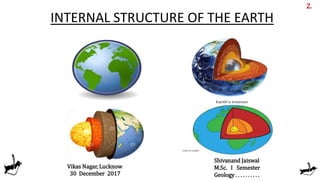
INTERNAL STRUCTURE OF THE EARTH
Shivanand Jaiswal
M.Sc. I Semester
Geology . . . . . . . . . .
Vikas Nagar, Lucknow
30 December 2017
2.
ACKNOWLEDGEMENTS
''The Earth Internal Structure file is made with the help of '‘Maharishi University of
Information Technology'‘ Lucknow Teachers, Professor and Head of Department of
Geology. Geology teacher provide me notes and books. Google provide me Soil Pollution
currently information, photographs and maps etc. Classmates provide some important
notes for Soil Pollution. My friends (Geology Department) instructed me to make the file
in a proper manner. My family also help me. So thanks for all. If any mistakes, so sorry''.
Vikas Nagar, Lucknow
30 December 2017
Shivanand Jaiswal
M.Sc. I Semester
Geology . . . . . . . . . .
3.
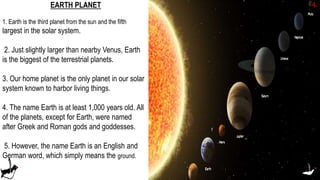
EARTH PLANET
1. Earth is the third planet from the sun and the fifth
largest in the solar system.
2. Just slightly larger than nearby Venus, Earth
is the biggest of the terrestrial planets.
3. Our home planet is the only planet in our solar
system known to harbor living things.
4. The name Earth is at least 1,000 years old. All
of the planets, except for Earth, were named
after Greek and Roman gods and goddesses.
5. However, the name Earth is an English and
German word, which simply means the ground.
4.
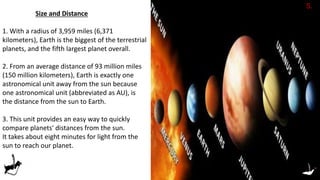
Size and Distance
1. With a radius of 3,959 miles (6,371
kilometers), Earth is the biggest of the terrestrial
planets, and the fifth largest planet overall.
2. From an average distance of 93 million miles
(150 million kilometers), Earth is exactly one
astronomical unit away from the sun because
one astronomical unit (abbreviated as AU), is
the distance from the sun to Earth.
3. This unit provides an easy way to quickly
compare planets' distances from the sun.
It takes about eight minutes for light from the
sun to reach our planet.
5.
Orbit and Rotation
As Earth orbits the sun, it completes one rotation every
23.9 hours. It takes 365.25 days to complete one trip
around the sun. That extra quarter of a day presents a
challenge to our calendar system, which counts one year as
365 days. To keep our yearly calendars consistent with our
orbit around the sun, every four years we add one day. That
day is called a leap day, and the year it's added to is called a
leap year.
Earth's axis of rotation is tilted 23.4 degrees with respect to
the plane of Earth's orbit around the sun. This tilt causes
our yearly cycle of seasons. During part of the year, the
northern hemisphere is tilted toward the sun and the
southern hemisphere is tilted away. With the sun higher in
the sky, solar heating is greater in the north producing
summer there. Less direct solar heating produces winter in
the south. Six months later, the situation is reversed. When
spring and fall begin, both hemispheres receive roughly
equal amounts of heat from the sun.
6.
Formation
When the solar system settled into
its current layout about 4.5 billion
years ago, Earth formed when
gravity pulled swirling gas and dust
in to become the third planet from
the sun. Like its fellow terrestrial
planets, Earth has a central core,
a rocky mantle and a solid crust.
Structure
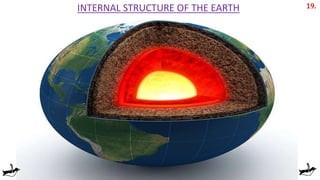
Earth is composed of four main
layers, starting with an inner
core at the planet's center,
enveloped by the outer core,
mantle and crust.
7.
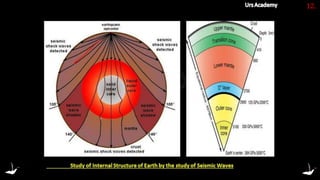
Structure of the Earth
The inner core is a solid sphere made of iron and
nickel metals about 759 miles (1,221 kilometers) in
radius. There the temperature is as high as 9,800
degrees Fahrenheit (5,400 degrees Celsius).
Surrounding the inner core is the outer core. This
layer is about 1,400 miles (2,300 kilometers) thick,
made of iron and nickel fluids.
In between the outer core and crust is the mantle,
the thickest layer. This hot, viscous mixture of
molten rock is about 1,800 miles (2,900 kilometers)
thick and has the consistency of caramel. The
outermost layer, Earth's crust, goes about 19 miles
(30 kilometers) deep on average on land. At the
bottom of the ocean, the crust is thinner and
extends about 3 miles (5 kilometers) from the sea
floor to the top of the mantle.
8.
Surface
Like Mars and Venus, Earth has volcanoes, mountains and
valleys. Earth's lithosphere, which includes the crust (both
continental and oceanic) and the upper mantle, is divided
into huge plates that are constantly moving. For example,
the North American plate moves west over the Pacific
Ocean basin, roughly at a rate equal to the growth of our
fingernails. Earthquakes result when plates grind past one
another, ride up over one another, collide to make
mountains, or split and separate.
Earth's global ocean, which covers nearly 70 percent of the
planet's surface, has an average depth of about 2.5 miles
(4 kilometers) and contains 97 percent of Earth's water.
Almost all of Earth's volcanoes are hidden under these
oceans. Hawaii's Mauna Kea volcano is taller from base to
summit than Mount Everest, but most of it is underwater.
Earth's longest mountain range is also underwater, at the
bottom of the Arctic and Atlantic oceans. It is four times
longer than the Andes, Rockies and Himalayas combined.
9.
Atmosphere
Near the surface, Earth has an
atmosphere that consists of 78 percent
nitrogen, 21 percent oxygen, and 1
percent other gases such as argon,
carbon dioxide and neon. The
atmosphere affects Earth's long-term
climate and short-term local weather
and shields us from much of the harmful
radiation coming from the sun. It also
protects us from meteoroids, most of
which burn up in the atmosphere, seen
as meteors in the night sky, before they
can strike the surface as meteorites.
10.
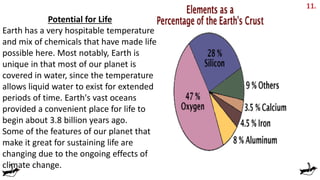
Potential for Life
Earth has a very hospitable temperature
and mix of chemicals that have made life
possible here. Most notably, Earth is
unique in that most of our planet is
covered in water, since the temperature
allows liquid water to exist for extended
periods of time. Earth's vast oceans
provided a convenient place for life to
begin about 3.8 billion years ago.
Some of the features of our planet that
make it great for sustaining life are
changing due to the ongoing effects of
climate change.
11.
12.
13.
14.
15.
16.
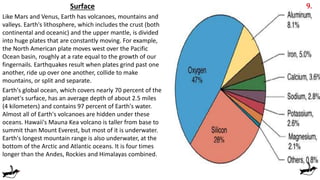
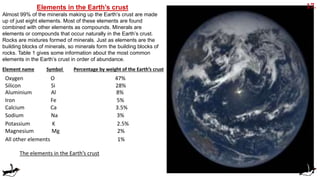
Elements in the Earth’s crust
Almost 99% of the minerals making up the Earth’s crust are made
up of just eight elements. Most of these elements are found
combined with other elements as compounds. Minerals are
elements or compounds that occur naturally in the Earth’s crust.
Rocks are mixtures formed of minerals. Just as elements are the
building blocks of minerals, so minerals form the building blocks of
rocks. Table 1 gives some information about the most common
elements in the Earth’s crust in order of abundance.
Element name Symbol Percentage by weight of the Earth’s crust
Oxygen O 47%
Silicon Si 28%
Aluminium Al 8%
Iron Fe 5%
Calcium Ca 3.5%
Sodium Na 3%
Potassium K 2.5%
Magnesium Mg 2%
All other elements 1%
The elements in the Earth’s crust
17.
n
18.
INTERNAL STRUCTURE OF THE EARTH 19.
SAVE EARTH SAFE LIFE
The End......
''SAVE GREEN TREES''...
20.

Earth structure

  • 1.
    MAHARISHI UNIVERSITY OFINFORMATION TECHNOLOGY SITAPUR ROAD, LUCKNOW, U.P., INDIA DEPARTMENT OF GEOLOGY 1.
  • 2.
    INTERNAL STRUCTURE OFTHE EARTH Shivanand Jaiswal M.Sc. I Semester Geology . . . . . . . . . . Vikas Nagar, Lucknow 30 December 2017 2.
  • 3.
    ACKNOWLEDGEMENTS ''The Earth InternalStructure file is made with the help of '‘Maharishi University of Information Technology'‘ Lucknow Teachers, Professor and Head of Department of Geology. Geology teacher provide me notes and books. Google provide me Soil Pollution currently information, photographs and maps etc. Classmates provide some important notes for Soil Pollution. My friends (Geology Department) instructed me to make the file in a proper manner. My family also help me. So thanks for all. If any mistakes, so sorry''. Vikas Nagar, Lucknow 30 December 2017 Shivanand Jaiswal M.Sc. I Semester Geology . . . . . . . . . . 3.
  • 4.
    EARTH PLANET 1. Earthis the third planet from the sun and the fifth largest in the solar system. 2. Just slightly larger than nearby Venus, Earth is the biggest of the terrestrial planets. 3. Our home planet is the only planet in our solar system known to harbor living things. 4. The name Earth is at least 1,000 years old. All of the planets, except for Earth, were named after Greek and Roman gods and goddesses. 5. However, the name Earth is an English and German word, which simply means the ground. 4.
  • 5.
    Size and Distance 1.With a radius of 3,959 miles (6,371 kilometers), Earth is the biggest of the terrestrial planets, and the fifth largest planet overall. 2. From an average distance of 93 million miles (150 million kilometers), Earth is exactly one astronomical unit away from the sun because one astronomical unit (abbreviated as AU), is the distance from the sun to Earth. 3. This unit provides an easy way to quickly compare planets' distances from the sun. It takes about eight minutes for light from the sun to reach our planet. 5.
  • 6.
    Orbit and Rotation AsEarth orbits the sun, it completes one rotation every 23.9 hours. It takes 365.25 days to complete one trip around the sun. That extra quarter of a day presents a challenge to our calendar system, which counts one year as 365 days. To keep our yearly calendars consistent with our orbit around the sun, every four years we add one day. That day is called a leap day, and the year it's added to is called a leap year. Earth's axis of rotation is tilted 23.4 degrees with respect to the plane of Earth's orbit around the sun. This tilt causes our yearly cycle of seasons. During part of the year, the northern hemisphere is tilted toward the sun and the southern hemisphere is tilted away. With the sun higher in the sky, solar heating is greater in the north producing summer there. Less direct solar heating produces winter in the south. Six months later, the situation is reversed. When spring and fall begin, both hemispheres receive roughly equal amounts of heat from the sun. 6.
  • 7.
    Formation When the solarsystem settled into its current layout about 4.5 billion years ago, Earth formed when gravity pulled swirling gas and dust in to become the third planet from the sun. Like its fellow terrestrial planets, Earth has a central core, a rocky mantle and a solid crust. Structure Earth is composed of four main layers, starting with an inner core at the planet's center, enveloped by the outer core, mantle and crust. 7.
  • 8.
    Structure of theEarth The inner core is a solid sphere made of iron and nickel metals about 759 miles (1,221 kilometers) in radius. There the temperature is as high as 9,800 degrees Fahrenheit (5,400 degrees Celsius). Surrounding the inner core is the outer core. This layer is about 1,400 miles (2,300 kilometers) thick, made of iron and nickel fluids. In between the outer core and crust is the mantle, the thickest layer. This hot, viscous mixture of molten rock is about 1,800 miles (2,900 kilometers) thick and has the consistency of caramel. The outermost layer, Earth's crust, goes about 19 miles (30 kilometers) deep on average on land. At the bottom of the ocean, the crust is thinner and extends about 3 miles (5 kilometers) from the sea floor to the top of the mantle. 8.
  • 9.
    Surface Like Mars andVenus, Earth has volcanoes, mountains and valleys. Earth's lithosphere, which includes the crust (both continental and oceanic) and the upper mantle, is divided into huge plates that are constantly moving. For example, the North American plate moves west over the Pacific Ocean basin, roughly at a rate equal to the growth of our fingernails. Earthquakes result when plates grind past one another, ride up over one another, collide to make mountains, or split and separate. Earth's global ocean, which covers nearly 70 percent of the planet's surface, has an average depth of about 2.5 miles (4 kilometers) and contains 97 percent of Earth's water. Almost all of Earth's volcanoes are hidden under these oceans. Hawaii's Mauna Kea volcano is taller from base to summit than Mount Everest, but most of it is underwater. Earth's longest mountain range is also underwater, at the bottom of the Arctic and Atlantic oceans. It is four times longer than the Andes, Rockies and Himalayas combined. 9.
  • 10.
    Atmosphere Near the surface,Earth has an atmosphere that consists of 78 percent nitrogen, 21 percent oxygen, and 1 percent other gases such as argon, carbon dioxide and neon. The atmosphere affects Earth's long-term climate and short-term local weather and shields us from much of the harmful radiation coming from the sun. It also protects us from meteoroids, most of which burn up in the atmosphere, seen as meteors in the night sky, before they can strike the surface as meteorites. 10.
  • 11.
    Potential for Life Earthhas a very hospitable temperature and mix of chemicals that have made life possible here. Most notably, Earth is unique in that most of our planet is covered in water, since the temperature allows liquid water to exist for extended periods of time. Earth's vast oceans provided a convenient place for life to begin about 3.8 billion years ago. Some of the features of our planet that make it great for sustaining life are changing due to the ongoing effects of climate change. 11.
  • 12.
  • 13.
  • 14.
  • 15.
  • 16.
  • 17.
    Elements in theEarth’s crust Almost 99% of the minerals making up the Earth’s crust are made up of just eight elements. Most of these elements are found combined with other elements as compounds. Minerals are elements or compounds that occur naturally in the Earth’s crust. Rocks are mixtures formed of minerals. Just as elements are the building blocks of minerals, so minerals form the building blocks of rocks. Table 1 gives some information about the most common elements in the Earth’s crust in order of abundance. Element name Symbol Percentage by weight of the Earth’s crust Oxygen O 47% Silicon Si 28% Aluminium Al 8% Iron Fe 5% Calcium Ca 3.5% Sodium Na 3% Potassium K 2.5% Magnesium Mg 2% All other elements 1% The elements in the Earth’s crust 17.
  • 18.
  • 19.
    INTERNAL STRUCTURE OFTHE EARTH 19.
  • 20.
    SAVE EARTH SAFELIFE The End...... ''SAVE GREEN TREES''... 20.